
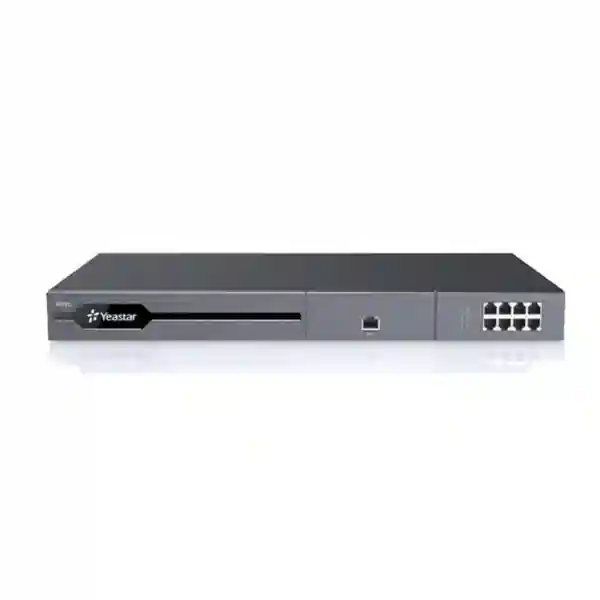
Yeastar P570 IP PBX Tanzania
The Yeastar P570 IP PBX is the largest appliance model in Yeastar’s P-Series PBX System Appliance Edition, built for organizations that want an on-premise business communications platform with room to scale. It brings voice, video, unified communications, remote-working tools and customer-service functions into one manageable system. For Tanzanian companies planning a new PBX, replacing an older analog or hybrid platform, consolidating multiple departments, or preparing for branch growth, the P570 provides a practical path from traditional telephony to a modern IP-based communications environment without forcing every connection to be identical.
Official Yeastar specifications position the P570 at 300 base users with expansion up to 500 users and 60 base concurrent calls with expansion up to 120. It supports up to 16 FXS ports, 16 FXO/BRI ports, six cellular ports and two E1/T1/J1 ports through its modular hardware design. These figures make capacity planning easier for medium-sized and larger organizations that need a PBX capable of supporting office users, reception teams, service desks, mobile staff, remote users and multiple telephony interfaces.
Start from the P570’s standard user and call capacity and expand when the organization grows, avoiding a premature replacement cycle.
Combine SIP services with analog, BRI, cellular or E1/T1/J1 connections where project requirements and provider interfaces demand flexibility.
Support staff using desk phones, desktop clients, web access and mobile devices while centralizing business communication workflows.
Use browser-based administration, call-center tools and operator functions to give IT and communications teams clearer day-to-day control.
What the Yeastar P570 Solves for Business Communications
Many organizations reach a point where a basic office PBX no longer matches the way people work. Staff may be split across departments, floors, branches and remote locations. Customer-facing teams need queueing and call visibility. Management wants more consistent internal communications. IT teams need to control extensions, trunks, routing and security without depending on a patchwork of disconnected systems. The Yeastar P570 addresses this transition by combining IP PBX functions with unified communications capabilities in a dedicated appliance.
The system can be particularly relevant when a company wants to preserve some existing telephony connections while moving progressively toward SIP and IP phones. Its modular design means project planners can consider analog endpoints, PSTN lines, ISDN BRI, cellular connectivity and E1/T1/J1 interfaces alongside VoIP. That flexibility can reduce migration friction where legacy equipment, provider contracts or local infrastructure still matter.
For procurement teams, the most important benefit is not merely a long feature list. It is the ability to size a communications platform around real user counts, simultaneous-call demand, trunk strategy, branch topology, recording requirements, remote-working needs and growth expectations. FourTeck can help buyers turn those operational requirements into a structured quotation request rather than selecting a PBX only by headline user capacity.
Yeastar P570 Verified Technical Highlights
| Base users / maximum users | 300 / 500 |
| Base / maximum concurrent calls | 60 / 120 |
| Maximum FXS ports | 16 |
| Maximum FXO/BRI ports | 16 |
| Maximum cellular ports | 6 |
| Maximum E1/T1/J1 ports | 2 |
| Expansion boards | Up to 2, using supported EX08 or EX30 configurations as applicable |
| Capacity expansion | P570 supports up to two DSP modules; Yeastar states each DSP module adds 100 VoIP users and 30 concurrent calls. |
Final port mix, licensing plan, storage, trunk type and expansion components should be confirmed during solution design because the maximum values describe platform capability rather than a default fully populated chassis.
Unified Communications, Remote Work and Customer-Service Features
The P-Series platform is designed as more than an extension-and-trunk appliance. Yeastar positions it as a unified communications system combining voice, video and collaboration functions. Linkus UC Clients give users access from web, desktop and mobile environments, which can support organizations with mixed desk-based and mobile work patterns. This matters for sales staff, supervisors, field teams, executives and remote workers who need business calling without being tied to a single physical handset.
For reception and service operations, the platform includes tools such as operator-panel and call-center functions. These can help teams manage inbound call distribution, monitor queue activity and improve handling consistency. Video conferencing and messaging capabilities can also reduce dependence on separate communication tools when the business prefers a more unified workflow. Exact feature entitlement can vary by plan, so buyers should map required functions against the applicable P-Series subscription before purchase.
Remote access should be planned with security and network architecture in mind. Yeastar documentation supports scenarios using its FQDN-based methods as well as public-IP approaches for PBX interconnection. The correct design depends on branch topology, firewall policy, SIP-provider requirements, NAT, security controls and the organization’s risk posture. FourTeck’s role in a quotation discussion is to help identify these dependencies early so implementation effort is understood before deployment.
Planning the Right P570 Configuration
A good P570 project starts with a capacity worksheet, not a generic shopping list. Count current employees who need extensions, then separate that number from concurrent-call demand. A 300-user organization does not necessarily place 300 calls at once; conversely, a contact center may have a much higher simultaneous-call ratio than an office with the same headcount. Estimate internal and external call patterns, busy-hour traffic, reception and queue requirements, and expected growth over the next three to five years.
Next, document every external telephony interface. Identify SIP trunks, PSTN lines, BRI services, cellular trunks and any E1/T1/J1 connections that must remain in service. List analog fax machines, door phones or legacy endpoints that may require FXS connectivity. Clarify whether existing IP phones will be retained and whether they are compatible with the planned provisioning and SIP environment. This step determines which expansion boards and telephony modules may be required.
Finally, define operational features: call recording, queueing, IVR, mobile applications, remote workers, branch interconnection, video meetings, business-hours routing, failover strategy, reporting and integrations. These requirements influence licensing, storage, security design and implementation scope. A structured requirements list also makes supplier quotations easier to compare because every bidder is pricing against the same operational need.
Yeastar P570 IP PBX Tanzania
For organizations in Tanzania, the Yeastar P570 fits projects where communications need to support more than a small office. Typical buyers may include multi-department companies, hospitality groups, educational institutions, healthcare operators, professional-service firms, logistics companies, retailers with central support teams, manufacturing organizations and businesses operating multiple sites. The P570’s headline capacity of 300 base users with expansion to 500 users makes it especially relevant when the buyer wants a platform that can serve a substantial extension base while retaining future growth options.
A Tanzania deployment should begin with the available telecom services at each site. Some organizations may be ready for SIP trunks throughout; others may need to maintain PSTN, BRI, cellular or E1/T1/J1 services during migration. The P570’s modular architecture is useful because it allows the solution design to reflect the actual line environment instead of assuming a pure-IP cutover. This can be important when a business is consolidating legacy PBX equipment, adding IP phones gradually, or coordinating different provider services between a headquarters and branch sites.
Network readiness is equally important. Voice quality depends on LAN design, switching, bandwidth, quality-of-service policy, firewall configuration and stable connectivity between sites and service providers. A PBX purchase therefore often needs related network planning. Buyers considering a broader communications refresh can also review FourTeck Tanzania resources and solution categories at FourTeck Tanzania, where the PBX can be considered alongside IP phones, networking, security and supporting infrastructure.
For procurement, request a bill of materials that separates the base P570 appliance from expansion boards, telephony modules, DSP capacity additions, supported storage, licenses or subscription plans, IP phones, gateways, installation services and optional support. This makes budget approval clearer and reduces the risk that an apparently low appliance price omits necessary components. The same process should document whether call recording, remote access, queueing, branch connectivity or integration work is required at launch or planned as a later phase.
Yeastar P570 IP PBX Dar es Salaam
Dar es Salaam organizations frequently manage concentrated headquarters operations, customer-service desks, sales teams, logistics coordination and branch communications. In these environments, the Yeastar P570 can function as a central communications platform connecting extensions, SIP trunks and selected legacy interfaces while giving users access to desktop, mobile and web-based UC tools. The key design question is whether the PBX will serve one large site, several interconnected offices, remote users, or a hybrid of all three.
For a head-office project, start by mapping departments and extension groups. Reception, finance, sales, support, management and operations often need different call-routing rules. Determine which numbers route through IVR, which teams require queues, which users need direct inward dialing, and whether call recording policies differ by department. If a service desk handles customer calls, concurrent-call sizing should be based on busy-hour activity rather than employee count alone. The P570’s expansion path to 120 concurrent calls can provide useful headroom for higher-volume deployments, but actual requirements should be calculated before equipment is specified.
A Dar es Salaam implementation should also evaluate resilience. If communications are business critical, ask how SIP trunks, internet circuits, cellular options and traditional lines can complement one another. The P570 supports multiple telephony technologies, but redundancy only works when trunks, routing rules, power protection and network paths are deliberately designed. UPS capacity, switch resilience, firewall rules and provider failover should therefore be part of the solution discussion rather than afterthoughts.
When comparing proposals, request clear separation between hardware, configuration, licenses, endpoint deployment and training. Also confirm whether existing IP phones, analog devices or gateways are intended to remain. This creates a migration plan that can be executed department by department if necessary, reducing disruption while the organization moves toward a more unified IP communications environment.
Yeastar P570 IP PBX Mwanza
Businesses in Mwanza evaluating the Yeastar P570 may be looking to centralize communications for a main office, warehouses, distribution operations, service counters or regional branches. A scalable PBX is useful where the extension count is expected to grow or where teams need to connect from more than one physical location. The P570’s user capacity and modular interfaces allow planners to build around current telephony services while creating a roadmap for wider SIP and IP-phone adoption.
For regional operations, branch connectivity deserves careful attention. It may be more efficient to centralize core call control and give branch staff remote or network-based access, or to interconnect PBX systems depending on site size and business-continuity needs. Yeastar documentation includes P570 interconnection examples using FQDN and public-IP methods, but the final topology should be based on available connectivity, firewall policy, latency, provider design and security controls. A well-designed branch plan also defines what happens if WAN connectivity fails and whether local calling must continue independently.
Another consideration is endpoint diversity. Management may prefer feature-rich IP phones, while warehouses or common areas may require simpler handsets. Some locations may still have analog fax devices or specialty equipment. Because the P570 can incorporate FXS connectivity through supported modules, migration does not necessarily require immediate replacement of every analog endpoint. However, each legacy device should be evaluated for actual business need rather than preserved automatically.
For quotation preparation in Mwanza, provide expected extension count, peak simultaneous calls, trunk types, number of analog devices, branch count, preferred IP phone classes, recording requirements, remote-user count and planned growth. This information lets the supplier size the PBX, telephony modules, DSP expansion, storage and network dependencies more accurately and prevents later changes caused by incomplete requirements.
Yeastar P570 IP PBX Arusha
Arusha businesses in hospitality, travel, professional services, NGOs, education and other multi-team environments often require a communications platform that can manage front-desk calls, office extensions, mobile personnel and customer-facing workflows. The Yeastar P570 can be designed to support these mixed demands by combining core PBX functions with unified communications and call-center tools. Its modular interfaces are also useful when the site has a combination of modern SIP services and existing analog or digital telephony connections.
Hospitality and service-oriented organizations should pay particular attention to routing logic and operational workflow. Reception teams may need ring groups, queues, transfer visibility and after-hours routing. Sales or reservations teams may need reporting and recording policies. Managers and mobile staff may benefit from Linkus UC access so that business calls are not limited to a desk extension. The aim should be to design a consistent caller experience across these workflows rather than simply activate every feature available.
If the PBX is replacing an older system, create an extension inventory before migration. Record each user, department, direct number, hunt group, analog device and trunk. Identify which numbering patterns should remain and where new call flows are required. This inventory becomes the basis for configuration, user communication and testing. It also helps determine whether the P570’s base capacity is sufficient or whether DSP expansion should be included from the beginning.
Network quality should be validated at every site that will carry VoIP traffic. Separate voice VLANs, quality-of-service policies, capable switching, firewall configuration and adequate WAN capacity can contribute as much to user experience as the PBX itself. Where a project also requires network or security modernization, buyers can review broader regional technology capabilities through FourTeck Africa as part of a multi-site planning discussion.
Yeastar P570 IP PBX Dodoma
Organizations in Dodoma may evaluate the Yeastar P570 when they need centralized communications for administrative teams, institutions, professional offices, project environments or growing multi-department operations. The P570 provides the scale to support a substantial extension population and offers flexibility where different trunk technologies must coexist. This can be useful in projects where telephony is being modernized gradually rather than through a complete one-stage replacement.
For administrative environments, governance of the PBX is important. Decide who can create users, modify routing, access recordings, review reports and change system settings. Establish an extension naming convention, numbering policy, backup process and change-control procedure. These operational controls make the system easier to maintain as staff and departments change. They are especially valuable once a PBX grows beyond a small office and becomes a shared business platform.
Security planning should include strong administrator credentials, controlled remote access, appropriate firewall rules, timely software maintenance and careful SIP-trunk configuration. Remote users and branch connections should be introduced through a documented network design rather than ad hoc port exposure. Yeastar’s supported remote-access and FQDN-related options can simplify some scenarios, but the exact deployment should reflect organizational security policy and any applicable subscription requirements.
A Dodoma buyer comparing PBX proposals should ask each supplier to explain capacity assumptions. How many users are included? How many simultaneous external and internal calls are expected? Which modules and boards are fitted? What subscription level is required for desired UC or remote-access functions? Are IP phones and installation included? What is the migration approach? Clear answers make it easier to compare complete solutions rather than appliance prices alone.
Yeastar P570 IP PBX UAE
For UAE-based companies, the Yeastar P570 can support regional headquarters, branch networks, service organizations and multi-national teams that require an appliance-based IP PBX with unified communications capabilities. Companies often need to integrate office extensions with SIP services, mobile users, reception teams and structured call routing while keeping administration centralized. The P570’s 300-user base capacity and expansion path to 500 users can suit substantial offices where growth is expected.
A UAE project should confirm telecom-provider requirements, approved trunk interfaces and any regulatory or service constraints before final configuration. The P570 supports SIP and multiple traditional telephony interfaces at the platform level, but availability and service design depend on the selected operator and location. Procurement teams should therefore separate the PBX hardware decision from provider-side assumptions and verify the exact service handoff that will be delivered to each site.
For organizations that have offices in both the Gulf and East Africa, standardized extension plans, common call-routing logic and unified administration can simplify support. The PBX architecture can be assessed alongside specialist regional resources at FourTeck IP PBX Dubai and wider UAE technology services from FourTeck UAE. These links are relevant for customers planning communications across multiple country operations rather than a Tanzania-only deployment.
When requesting a UAE quotation, include office headcount, extension plan, simultaneous-call estimate, SIP-provider details, call-center requirements, remote users, phone models, recording retention and integration needs. If the deployment is part of a regional standardization project, document which settings should remain consistent across countries and which must be adapted to each provider or regulatory environment.
Yeastar P570 IP PBX Uganda
Ugandan organizations can consider the Yeastar P570 when their communications requirements extend across a sizeable headquarters, multiple departments, branch offices or customer-service teams. The appliance provides a combination of SIP-based communications, modular legacy interfaces and UC functions that can help businesses transition from older phone systems without losing flexibility. This is particularly useful where some sites are already IP-ready while others still depend on analog or carrier-specific connections.
A national deployment should begin with a site-by-site telecom inventory. Record each branch’s internet connectivity, available trunk services, local numbering, current PBX or gateway equipment and critical calling functions. The project team can then determine whether the P570 will serve as a central system, whether branch PBXs or gateways are required, and how calls should route during WAN interruptions. This architecture decision affects both user experience and business continuity.
Organizations serving customers by phone should also define queue strategy. Identify which teams answer sales, support, reception or service calls; set expectations for overflow; decide whether calls are recorded; and determine who needs supervisory visibility. P-Series call-center functions can support these workflows, but deployment should be based on documented business processes rather than enabling features without operational ownership.
Regional buyers can review FourTeck Uganda when planning related technology requirements in Uganda. For a P570 quotation, include user counts, peak calls, trunk types, desired UC functions, branch topology, phone quantities and any analog devices. This gives the solution team enough information to build a realistic bill of materials and implementation scope.
Yeastar P570 IP PBX Kampala
Kampala organizations often combine head-office operations, sales teams, service desks and remote or field staff. The Yeastar P570 can provide centralized extension management and routing while offering UC clients for users who need to communicate away from a desk phone. This helps companies design one business-number experience across office and mobile work patterns instead of relying on personal numbers for customer interactions.
For a busy office, call concurrency must be measured carefully. Reception and customer-service operations can generate more simultaneous traffic than employee count might suggest. Review historical bills, existing PBX statistics where available, queue activity and expected growth. The P570 starts at 60 concurrent calls and can expand to 120, but sizing should include internal calling, external trunks, conference use and any branch traffic that will traverse the system.
A Kampala migration can also be phased. Existing analog devices may remain through FXS modules, while staff phones move to SIP endpoints. PSTN or other legacy trunks can coexist with SIP where required by the project. Phasing can reduce disruption, but it should include a defined retirement plan for equipment that no longer adds value. Maintaining old technology indefinitely can increase support complexity and make troubleshooting harder.
Before go-live, conduct structured testing: inbound and outbound calls, transfer and hold, IVR selections, queue overflow, emergency or important service numbers, trunk failover, remote users, call recording, voicemail, branch calls and after-hours routing. User training should focus on the workflows each team actually uses. A successful PBX deployment is measured by reliable daily communication, not merely by whether the appliance powers on.
Yeastar P570 IP PBX Arua
For organizations operating in Arua, a PBX project may need to balance central management with practical branch connectivity. The Yeastar P570 is relevant when the overall organization has a larger user base but needs to connect teams across locations with different network conditions. The appliance’s combination of SIP support and modular telephony interfaces gives designers options when not every site has the same carrier service or legacy equipment.
Connectivity planning should include latency, bandwidth and resilience between Arua and any central office or data location. Voice traffic is sensitive to packet loss and jitter, so WAN design matters. Where branch users depend on a central PBX, define what happens during internet outages. Some businesses may accept temporary loss of central calling; others require local fallback or alternative trunks. This requirement should be agreed before the hardware bill is finalized.
The P570 can also support organizations that need to connect analog devices during modernization. Rather than replacing every endpoint at once, the project can prioritize users who benefit most from IP-phone and UC features while retaining specific legacy devices through supported interfaces. However, every retained endpoint should be documented so the correct module count is specified.
Procurement teams should avoid ordering based only on the largest possible port numbers. Maximum FXS, FXO/BRI, cellular and E1/T1/J1 capacities depend on expansion architecture. Ask for a configuration diagram showing exactly which boards and modules are proposed, what spare capacity remains, and what would be required to expand later. This makes the quotation easier to audit and helps future IT teams understand the installed design.
Yeastar P570 IP PBX Mbarara
Mbarara businesses looking to modernize communications can use the Yeastar P570 as the foundation for a larger extension environment with room for future expansion. It can serve organizations where departments have outgrown independent phone systems or where management wants common dialing, centralized administration and more consistent customer handling. The P-Series approach also introduces mobile and desktop UC tools for staff who work between offices or away from their desks.
A practical first step is to group users by communication profile. Receptionists, contact-center agents, office staff, executives, warehouse teams and mobile sales users may need different phone models and permissions. Designing these user profiles before procurement helps avoid overspending on endpoints while ensuring that customer-facing staff receive the features they need. It also makes extension templates and training easier to standardize.
If call recording is required, determine which calls are recorded, who can access recordings and how long data should be retained. The P570 provides storage-related options, but capacity planning must consider recording volume and organizational policy. Storage should not be sized by guesswork. Estimate daily recording hours, codec use, retention period and backup requirements, then select suitable supported media and processes.
For branch and remote users, define security controls before activation. Remote communication should use supported access methods and appropriate firewall policy. Administrator access should be restricted and reviewed. Combine PBX configuration with switch, router and firewall planning so that voice services are treated as part of the business network rather than a standalone appliance isolated from IT governance.
Yeastar P570 IP PBX Gulu
In Gulu, the Yeastar P570 can be evaluated by institutions and businesses that need a scalable system for internal extensions, external calling and communications across multiple work areas. The PBX is especially useful when the organization expects growth beyond a basic office system and wants a platform that can add users and concurrent-call capacity through supported expansion rather than requiring an immediate platform replacement.
During design, map call flows in plain business language. Who answers the main number? What happens when reception is busy? Which department handles sales enquiries? How are calls treated outside office hours? Which managers need calls to reach mobile or remote clients? Which numbers require recording? This workflow mapping can then be translated into IVRs, ring groups, queues, time conditions and extension policies.
The telecom environment should be documented with equal care. Note every line type and provider handoff. The P570 can support multiple interface technologies, but modules must be selected to match the actual service. If a line technology will be retired soon, determine whether it is worth investing in an interface module or whether a migration to SIP should be brought forward. This prevents spending on short-lived hardware.
Implementation planning should include configuration backup, administrator handover and basic user guides. Staff need to know how to transfer, conference, use voicemail and work with mobile or desktop UC clients where deployed. IT administrators should receive documentation of extension ranges, trunk settings, routing rules and installed modules so future changes do not depend entirely on the original installer.
Yeastar P570 IP PBX Kenya
Kenyan organizations considering the Yeastar P570 may need a larger-capacity PBX for headquarters, contact centers, distributed branches or regional operations. The appliance’s combination of 300 base users, expansion up to 500 users and modular line interfaces offers a flexible starting point for businesses that want to consolidate multiple communication functions. UC clients can extend business communications to laptops, browsers and mobile devices, while operator and call-center tools support teams handling a higher volume of incoming calls.
For Kenya deployments, SIP trunk availability and provider requirements should be validated before the system is finalized. If existing analog, cellular, BRI or E1/T1/J1 connections need to remain, specify them in the bill of materials. The goal is to build a migration plan that reflects the company’s actual carrier environment and avoids ordering unnecessary interface modules.
Organizations operating between Kenya, Tanzania and Uganda can benefit from standardized extension naming, user policies and call-routing principles even when local trunk services differ. A regional design should define which functions are centralized and which remain local. Review FourTeck Kenya when coordinating related requirements for Kenyan sites and FourTeck Tanzania for the Tanzania side of a regional project.
When requesting pricing, provide a complete specification that includes P570 capacity, expansion boards, modules, licenses, IP phones, gateways, storage, installation, configuration, training and support expectations. A complete quotation enables meaningful supplier comparison and reduces later scope additions that can make the final project cost difficult to control.
Yeastar P570 IP PBX Kuwait
Businesses in Kuwait can deploy the Yeastar P570 where a substantial office or multi-site operation needs a dedicated IP PBX with unified communications capabilities. The appliance can support organizations transitioning from traditional PBX systems, expanding a SIP environment or adding mobile and desktop communication for employees. Its modular design is useful when carrier services or existing equipment require a mixture of line interfaces during migration.
Telecom provider compatibility should be confirmed early. SIP trunk parameters, numbering, emergency calling, caller ID presentation and any gateway requirements should be documented for the selected service. If PRI or other legacy interfaces remain, the P570’s E1/T1/J1 expansion options can be considered, but the configuration must match the provider handoff. Procurement should not assume that a port type alone guarantees service compatibility.
For larger offices, a network assessment is essential. Review switch capacity, PoE requirements for IP phones, VLAN design, QoS, DHCP and DNS dependencies, firewall policy and WAN performance. If the organization uses redundant internet or multiple providers, define how voice traffic should fail over and whether SIP registration behavior changes. These decisions influence both PBX reliability and troubleshooting procedures.
Customers coordinating Kuwait and East African projects can use FourTeck Kuwait for regional technology context while maintaining a common P570 requirements document across sites. Standardizing the PBX platform can simplify training and administration, but local carrier, numbering and network requirements should remain explicitly documented for each country.
Yeastar P570 IP PBX Ghana
Ghanaian businesses may select the Yeastar P570 when they need higher user capacity, more structured customer-call handling or a clear upgrade path from legacy telephony. The system’s modular hardware can support several line technologies, helping organizations preserve necessary interfaces while adopting SIP and IP phones at a pace that suits the project. Unified communications clients also provide a route to support remote and mobile users with business calling tools.
A Ghana deployment should distinguish between user capacity and call capacity. Count every extension that needs registration, then estimate the maximum number of simultaneous conversations during busy periods. Add headroom for growth, conferences, branch traffic and call queues. This protects against a common sizing error: choosing a platform by employee count without considering how heavily different teams use external calls.
For customer-facing operations, document the desired experience from the caller’s perspective. Decide which greeting is heard, which menu options are offered, how long callers can wait, where overflow routes, and what happens after hours. Call-center features are most effective when they implement a clear service process. Reporting can then be used to improve staffing and routing rather than simply to collect data.
Organizations with projects in Ghana can refer to FourTeck Ghana for complementary regional technology requirements. A P570 quotation request should include trunk details, branch count, IP-phone quantities, analog devices, UC requirements, queueing, recording, storage and support expectations so that the proposed design is complete rather than appliance-only.
Yeastar P570 IP PBX Nigeria
Nigeria-based organizations with larger offices, service teams or branch networks can use the Yeastar P570 as a central communications appliance capable of supporting up to 500 users with the appropriate expansion. The system combines core PBX call control with UC, remote-working and customer-service functions, allowing businesses to standardize internal and external communications while retaining flexibility for multiple trunk types.
Power and network continuity should be part of design discussions for any business-critical PBX. The appliance, switches, routers, firewalls and carrier equipment should be considered together when planning UPS or backup power. For multi-site deployments, WAN resilience and alternative call paths may also be necessary. The P570 can participate in a resilient architecture, but availability depends on the full communications stack rather than on the PBX alone.
Large organizations should also plan extension governance. Use structured ranges for departments and locations, define naming standards, and maintain a controlled process for onboarding and offboarding users. This makes the PBX easier to support at scale. Where UC clients are deployed, include them in employee joiner and leaver procedures so credentials and business calling access are managed consistently.
For projects connected with Nigeria, FourTeck Nigeria provides regional context for related infrastructure. Buyers should ask for a solution diagram and bill of materials showing the P570 appliance, DSP expansion if required, telephony boards and modules, endpoints, storage, licensing, implementation, network dependencies and support. This makes future expansion and troubleshooting more straightforward.
Yeastar P570 IP PBX Seychelles
Organizations in Seychelles may consider the Yeastar P570 for hotel groups, service businesses, administration offices, multi-site companies or institutions that need scalable voice and unified communications. In island environments where sites can be geographically separated and telecom options vary, a flexible PBX platform can help standardize the user experience while still accommodating different trunks and connectivity at each location.
Hospitality and customer-service deployments should pay close attention to reception workflows and after-hours routing. Multiple departments may answer different call types, and overflow rules need to be simple enough for staff to understand. If mobile workers use UC clients, policies should define when business calls ring mobile devices and how presence or availability is managed. The objective is to make communications predictable for customers and staff.
A multi-island or multi-site design should assess WAN dependence. If all extensions register to one central P570, connectivity between sites becomes a critical service. If local survivability is required, the architecture may need additional components or alternative routing. These requirements should be clarified before procurement because they affect network, gateway and system design decisions.
For a Seychelles quotation, provide a site list, user count at each site, estimated simultaneous calls, telecom-provider interfaces, IP-phone requirements, analog endpoints, recording needs, remote users and any integration goals. Suppliers can then propose a configuration based on the actual operating model instead of treating the P570 as a one-size-fits-all appliance.
Compatibility and Integration Considerations
The P570 is designed to operate with SIP-based devices and trunks while also supporting selected traditional telephony interfaces through Yeastar modules and expansion boards. Compatibility planning should cover far more than whether two products both use SIP. Confirm provisioning method, codec requirements, DTMF method, TLS or SRTP needs, NAT behavior, VLAN configuration and any vendor-specific functionality required from IP phones or gateways.
If a third-party CRM, helpdesk or business application must integrate with communications, define the use case before purchase. Common goals include click-to-call, screen pop, call logging or customer identification, but implementation depends on supported APIs, connectors, subscription level and the business application itself. Treat integration as a separate workstream with clear acceptance criteria instead of assuming every desired workflow is automatic.
For branch integration, document addressing, NAT, firewall rules and DNS dependencies. Yeastar publishes P570 examples for linking PBX systems through FQDN and public IP, illustrating that multiple network designs are possible. Select the approach that aligns with security policy, provider limitations and network ownership. Any ports exposed to the internet should be minimized and protected according to vendor guidance and the organization’s security standards.
Deployment and Installation Checklist
Confirm users, simultaneous calls, expected growth and whether DSP expansion is required.
List SIP, PSTN, BRI, cellular and E1/T1/J1 services with provider handoff details.
Count IP phones, analog phones, fax devices, door phones and any special endpoints.
Validate switching, PoE, VLANs, QoS, DHCP, DNS, firewall and WAN performance.
Design IVR, ring groups, queues, business hours, failover and emergency routing.
Define administration, backup, recording policy, user training and ongoing support.
Buying Guidance: P570 vs Smaller P-Series Appliances
The P570 should not be chosen simply because it is the largest P-Series appliance. Yeastar’s P550 and P560 serve smaller capacity ranges, so an accurate requirements assessment can prevent oversizing. The P570 makes sense when user count, concurrent-call demand, interface requirements, expansion expectations or branch strategy justify its larger capacity and two-board architecture.
Consider the P570 when the organization is approaching or beyond the practical capacity of smaller appliances, when two E1/T1/J1 interfaces may be required, when a high number of analog or BRI interfaces is part of the migration, or when long-term growth makes additional DSP expansion valuable. Conversely, a smaller organization with modest call concurrency and simple SIP trunking may achieve the same business outcome with a smaller model.
The correct comparison is therefore total solution fit: base appliance, required modules, licenses, endpoints, network readiness, implementation complexity and growth. FourTeck can use these factors to help build a quotation request that identifies the most appropriate P-Series model rather than defaulting to maximum capacity.
Quotation Checklist for Yeastar P570
To receive a meaningful Yeastar P570 quotation, prepare the following information: total users, expected growth, peak simultaneous calls, office and branch locations, SIP or carrier trunk details, analog line count, BRI count, cellular requirements, E1/T1/J1 requirements, IP phone quantities, analog endpoint count, recording retention, IVR and queue needs, remote-user count, required integrations, network readiness and preferred support scope.
Also state whether the request is hardware supply only or a complete project including configuration, migration, endpoint provisioning, testing, training and ongoing support. Clear scope enables an apples-to-apples comparison between proposals and reduces the risk of missing modules or services after purchase approval.
Frequently Asked Questions
How many users does the Yeastar P570 support?
Yeastar lists the P570 with 300 base users and expansion up to 500 users. Expansion is achieved through supported DSP modules, and project sizing should also consider simultaneous-call demand.
How many concurrent calls can the P570 handle?
The official P-Series specifications list 60 base concurrent calls with expansion up to 120. A supplier should size this against busy-hour traffic, call queues, conferencing and branch requirements.
Can the P570 connect analog phones or PSTN lines?
Yes. With the appropriate Yeastar expansion boards and modules, the P570 can support FXS for analog endpoints and FXO for analog PSTN lines. The final module combination should be specified for the actual project.
Does the Yeastar P570 support E1/T1/J1?
Yes. Yeastar specifies a maximum of two E1/T1/J1 ports for the P570 using supported expansion hardware. Confirm the required interface and provider configuration before ordering.
Is the P570 suitable for remote workers?
The P-Series includes Linkus UC clients and remote-working capabilities. Exact feature entitlement and remote-access method should be checked against the selected subscription plan and security design.
Can the P570 be used for call-center operations?
Yeastar promotes P-Series call-center functions including queue-related tools, operator functionality and supervisory visibility. The required workflows and licensing should be confirmed during solution design.
What information is needed for a P570 price quotation?
Provide user count, concurrent-call estimate, trunk types, number of analog or digital interfaces, required modules, IP phone quantities, licensing needs, storage, branches, integrations and implementation scope. This produces a more reliable project quotation than asking only for the base appliance price.
Decision Recap
Choose the Yeastar P570 when your organization needs a substantial on-premise IP PBX with a 300-user starting point, expansion to 500 users, up to 120 concurrent calls and flexible telephony interfaces. It is particularly well suited to projects that require staged migration from legacy lines, multiple departments, customer-service functionality, remote users or multi-site communications.
Before ordering, confirm the complete design: user and call capacity, interface modules, DSP expansion, subscription level, storage, IP phones, trunk services, network readiness, security, installation and support. A correctly scoped P570 deployment can become a long-term communications platform rather than a short-term hardware purchase.
Talk to FourTeck About Yeastar P570
If you are planning a Yeastar P570 deployment in Tanzania or across a regional operation, share your extension count, concurrent-call estimate, trunk environment, branch topology and required UC features. FourTeck can use these details to structure a bill of materials and quotation discussion around your real communications requirements.



Reviews
There are no reviews yet.