
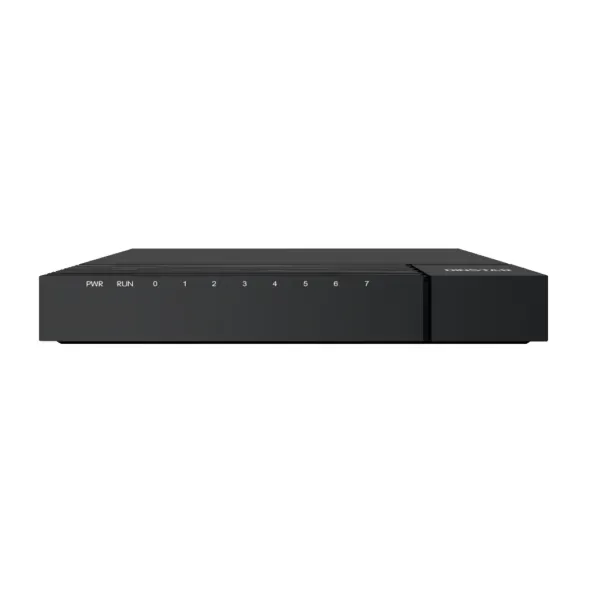
Dinstar DAG1000-8S GE FXS VoIP Gateway
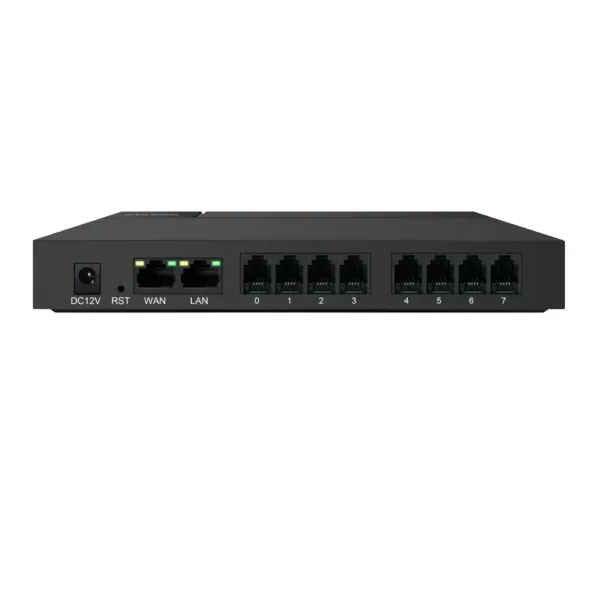
The Dinstar DAG1000-8S(GE) is an eight-port FXS analog VoIP gateway built for organizations that need to connect traditional analog telephones, fax machines, legacy PBX interfaces or similar analog endpoints to modern SIP-based telephony. It provides eight RJ11 FXS ports together with one Gigabit WAN and one Gigabit LAN interface, helping businesses preserve useful analog equipment while moving the core voice environment toward IP. For Tanzania buyers, the product is particularly relevant where a full handset replacement is unnecessary, where branch offices still use analog devices, or where an existing PBX needs an orderly path into a SIP or hosted telephony architecture.
Connect up to eight analog endpoints such as telephones or fax devices, subject to the actual deployment design.
The GE model provides one 10/100/1000 Mbps WAN and one 10/100/1000 Mbps LAN port.
SIP v2.0, T.38 fax and pass-through support make the gateway suitable for mixed voice and fax migration projects.
TLS/SRTP, SNMP, TR-069/TR-181, auto-provisioning, backup/restore, syslog and web administration support structured operations.
What the DAG1000-8S(GE) solves
A common challenge in voice modernization is that the telephone network does not become fully digital overnight. An organization may have a modern IP PBX but still depend on analog handsets in workshops, reception areas, security desks, lifts, guard posts or older office sections. Another business may operate a traditional PBX that still has useful life but wants to reach SIP trunks or a centralized IP telephony platform. The DAG1000-8S(GE) addresses this transitional layer. Its FXS interfaces provide analog station connectivity while the IP side speaks standard SIP, allowing established analog endpoints to participate in an IP telephony design.
This is different from an FXO gateway. FXS ports supply the analog subscriber interface used by telephones and similar endpoints, while FXO ports are used for analog trunk-line interfaces. That distinction matters during procurement because choosing the wrong port type changes the role the gateway can perform. The DAG1000-8S(GE) is therefore best understood as an eight-station analog-to-SIP bridge. It is not a replacement for an IP PBX by itself, and it is not an eight-line FXO gateway.
The official Dinstar specification lists SIP v2.0 over UDP/TCP, TLS/SRTP support, primary and backup SIP server capability, outbound proxy, IPv4/IPv6 dual stack, routing rules based on prefixes, caller/called-number manipulation, VLAN support, Layer 3 QoS/DiffServ and multiple maintenance tools. For buyers, the value is not in having a long feature list; it is in being able to fit the gateway into a controlled voice architecture with the dial plan, addressing, security policy and management approach already in place.
Verified technical highlights
| Area | DAG1000-8S(GE) | Deployment meaning |
|---|---|---|
| FXS capacity | 8 x RJ11 FXS | Designed for up to eight analog station interfaces. |
| Ethernet | 1 x Gigabit WAN, 1 x Gigabit LAN | Suitable for modern LAN attachment without a 100 Mbps gateway bottleneck at the physical port level. |
| Signalling | SIP v2.0, UDP/TCP; TLS/SRTP | Integrates with SIP-oriented PBXs, softswitches and telephony platforms where interoperability is confirmed. |
| Fax | T.38 and pass-through | Supports fax-over-IP designs, subject to the PBX, carrier and network path. |
| Networking | IPv4/IPv6 dual stack, VLAN 802.1P/802.1Q, QoS/DiffServ | Allows separation and prioritization within a managed network design. |
| Management | Web/Telnet, SNMP, TR-069/TR-181, provisioning, syslog, capture, backup/restore | Supports centralized maintenance and troubleshooting processes. |
Buying and compatibility guidance
Before ordering, confirm what each analog port will connect to and what SIP platform will register the gateway. A deployment team should record the IP PBX or softswitch make and software version, SIP authentication method, extension plan, codec policy, DTMF method, VLAN requirements, firewall/NAT topology, fax expectations and whether primary/backup SIP registration is required. This information is more useful than simply stating that a gateway is “SIP compatible,” because real-world SIP interoperability can depend on feature usage and configuration.
For organizations building a wider communications project, review FourTeck Tanzania’s integrated IT and telecom solutions overview, browse business telephony and networking products, and use the services and deployment capability page to plan the gateway together with switching, IP PBX, firewall, cabling and support requirements.
Deployment planning for analog-to-SIP migration
A successful gateway project begins by mapping the existing analog estate. Count the endpoints, identify which devices are ordinary telephones and which are fax, POS, modem or PBX interfaces, and document where each cable terminates. The official Dinstar datasheet lists a maximum FXS cable length of 3 km for the DAG1000-8S(GE), but field cabling quality, joints, interference, endpoint characteristics and local installation conditions still need to be assessed. In many business environments the practical cable runs are much shorter, but documenting them makes future fault isolation easier.
Next, define the logical voice design. Decide whether every FXS port will register as an individual SIP extension or whether the PBX will treat the gateway in another supported manner. Build a clear number plan, normalize called and calling numbers, and define how emergency, local, mobile, national and international calls should be routed. Dinstar supports digit maps and prefix-based routing, but the gateway should not be configured in isolation from the PBX call rules. A clear boundary between gateway routing and PBX routing prevents accidental loops and inconsistent behavior.
Finally, prepare the LAN. Voice works best when addressing, DNS, NTP, VLANs, QoS and firewall policy are deliberate rather than improvised. Where voice and data share switching infrastructure, a dedicated voice VLAN can simplify policy and troubleshooting. If SIP traverses NAT or a firewall, the configuration should be tested for registration stability, inbound and outbound audio, DTMF and fax. Security features such as TLS and SRTP are useful when supported end to end, but they should be enabled as part of a compatible design rather than as isolated settings.
Dinstar DAG1000-8S GE FXS VoIP Gateway Tanzania
For organizations in Tanzania, the Dinstar DAG1000-8S GE FXS VoIP Gateway is relevant when analog voice endpoints remain useful but the wider communications environment is moving toward SIP. A hotel may still have analog room phones, a small industrial site may use durable analog sets at operational positions, a branch office may inherit a legacy PBX, and a professional office may need to retain fax capability while deploying an IP PBX. In each case, the gateway can create a controlled transition point rather than forcing every analog endpoint to be replaced at once. The most important procurement question is therefore not “Is this an eight-port gateway?” but “Are eight FXS station ports the correct interface for the devices we are retaining?”
Tanzania projects also benefit from network and power planning. Voice systems may share infrastructure with user data, Wi-Fi, cameras and cloud applications. If the LAN is congested or poorly segmented, call quality problems can appear even when the gateway itself is functioning correctly. The DAG1000-8S(GE) supports VLAN tagging and Layer 3 QoS/DiffServ, which gives network administrators tools to place voice traffic into an intentional design. The Gigabit WAN and LAN ports are useful where the gateway sits within a modern switched network, but capacity planning still depends on the complete environment, not simply the speed printed on the interface.
For procurement, prepare the endpoint count, extension numbering, IP PBX or hosted SIP platform, expected codec policy, fax requirements, and whether secure signalling/media are mandatory. If the gateway is being added to an existing PBX, include the current PBX model and available analog interfaces. If it will serve independent analog phones, state how the SIP extensions should be assigned. The same information helps FourTeck discuss suitable supporting infrastructure such as managed switching, firewall policy and UPS protection. Buyers can compare the gateway requirement with the broader Tanzania business technology shop so that the voice component is purchased as part of a workable system rather than as a disconnected appliance.
A sound Tanzania deployment should end with documented port assignments, IP settings, SIP server details, firmware version, configuration backup and a simple test sheet. Test inbound and outbound calls, caller ID behavior, DTMF, transfers, hold, failover where configured, and fax if required. This creates a reliable acceptance baseline and gives future support staff a clear reference.
Dinstar DAG1000-8S GE FXS VoIP Gateway Dar es Salaam
Dar es Salaam businesses often operate mixed technology estates: modern fiber or business broadband can coexist with older analog telephony, legacy PBX equipment, reception phones and fax devices. The DAG1000-8S(GE) is suitable for this kind of phased modernization because it provides eight FXS station interfaces on one device while connecting upstream through Gigabit Ethernet to a SIP telephony environment. Offices, clinics, hospitality properties, logistics companies and distributed service teams can use the gateway where the operational goal is to keep selected analog endpoints while standardizing call control on an IP PBX or SIP service.
In a dense urban network, call quality is usually influenced less by geographic location than by the quality of the LAN, internet path, carrier interconnection and configuration. A Dar es Salaam deployment should therefore start with a voice-network checklist: identify the SIP server location, confirm whether NAT is involved, define voice VLANs, review firewall session handling and measure the actual internet path if the PBX is hosted remotely. The gateway supports primary and backup SIP server configuration, but failover should be tested with the specific platform rather than assumed from a menu setting.
For multi-floor offices, the eight FXS ports can be centralized near the network rack if existing analog cabling returns to a common distribution point. Where analog cabling is dispersed or difficult to trace, it may be better to position the gateway closer to the endpoints, provided network, power, security and environmental conditions are suitable. Documenting the analog cable pairs is especially important in older buildings because a gateway migration often exposes unlabeled extensions that have accumulated over many years.
When requesting a quotation in Dar es Salaam, include the number and type of analog devices, whether fax is mandatory, the SIP or IP PBX platform, expected call concurrency, preferred codec policy and whether the gateway needs to operate behind an existing firewall. A precise requirement makes it easier to validate the role of the DAG1000-8S(GE) and to avoid confusing FXS station connectivity with FXO trunk-line connectivity. FourTeck can then discuss the gateway alongside the network, PBX and security architecture rather than treating it as an isolated converter.
Dinstar DAG1000-8S GE FXS VoIP Gateway Mwanza
In Mwanza, organizations with branch offices, hospitality sites, education facilities, clinics, warehouses and commercial operations may need a practical bridge between analog telephony and IP voice. The Dinstar DAG1000-8S(GE) fits projects where eight or fewer analog station ports are needed at a location and the central call-control platform uses SIP. This allows a business to preserve selected analog handsets or fax devices while gaining access to centralized extension plans, SIP routing and IP-based management.
The planning emphasis for a Mwanza branch should be resilience and maintainability. If the SIP PBX is in another city or hosted in a data center, the WAN path becomes part of the voice system. Administrators should determine what happens when the WAN is unavailable, whether local calling must continue, and whether secondary SIP registration can meet the business continuity requirement. The DAG1000-8S(GE) supports primary and backup SIP servers, but the end-to-end behavior depends on how the PBX and service provider are configured. Testing should include registration recovery after link interruptions and verification that calls resume without manual intervention.
Power quality is another practical consideration. The gateway uses a 12 V DC supply from a 100–240 VAC source and the official datasheet lists typical consumption of 18 W. For business use, the gateway, router, switch and any local PBX equipment should be considered together when sizing UPS protection. Backing up only the gateway while the switch or internet router loses power does not preserve service. A small coordinated UPS design can provide a more useful result than protecting devices independently.
Procurement teams should also decide whether eight ports provide enough headroom. If the site currently needs seven or eight analog endpoints and additional extensions are planned, selecting a higher-capacity FXS gateway may be more economical than adding a second unit later. If the requirement is four or five endpoints with little growth expected, the eight-port model offers practical spare capacity. Record the growth expectation in the quotation request so model selection reflects the next phase as well as the immediate need.
Dinstar DAG1000-8S GE FXS VoIP Gateway Arusha
Arusha has a broad mix of hospitality, tourism, education, professional services and regional offices, and many of these environments contain legacy analog endpoints that remain perfectly serviceable. The Dinstar DAG1000-8S(GE) can be used where organizations want to centralize call control on SIP without discarding every analog device. Hotels may have selected analog extensions, offices may retain simple phones in common areas, and administrative teams may still depend on fax. The gateway provides eight FXS interfaces specifically for that station-side role.
Hospitality deployments deserve careful attention to dial plans. Guest-room or service phones often use short internal numbers and may require controlled access to outside calling. The gateway supports digit maps, prefix-based routing and number manipulation, but the final policy should normally be coordinated with the IP PBX. Keeping business logic primarily in the PBX can make administration easier, while using the gateway for the analog interface and only the routing functions genuinely needed at the edge. This division should be documented before configuration begins.
Arusha organizations with distributed properties should also plan management. Dinstar lists web administration, SNMP, TR-069/TR-181, auto provisioning, syslog, ping/traceroute, network capture and cloud-based management among the maintenance capabilities. The right mix depends on the organization’s management platform and security policy. Remote access to the gateway should not be exposed casually to the public internet. Management interfaces should be restricted to trusted networks or secure remote-access paths, and default credentials should be changed during commissioning.
When evaluating the model, verify endpoint compatibility, ringing requirements, caller ID method and any fax or modem use. The official specification supports DTMF/FSK caller ID presentation, pulse dialing, reversed polarity and programmable call-progress tones, but legacy analog equipment can vary significantly. A pilot with representative devices is useful when the endpoint estate is unusual or business critical. That approach is more reliable than assuming every analog device behaves identically simply because it uses an RJ11 connector.
Dinstar DAG1000-8S GE FXS VoIP Gateway Dodoma
For offices and institutions in Dodoma, the Dinstar DAG1000-8S(GE) provides a compact way to connect analog extensions into a SIP-based communications environment. It is relevant for branch modernization, administrative buildings, meeting facilities, clinics, campuses and businesses that do not want to replace every analog endpoint during an IP PBX project. The eight FXS ports are intended for station-side analog devices, making the model appropriate where the requirement is to register or route those endpoints through a SIP telephony platform.
A public-sector or enterprise deployment should place strong emphasis on change control and documentation. Assign every FXS port a clear label, extension number, physical endpoint location and service owner. Store a configuration backup after acceptance, record the firmware version, and keep the SIP credentials under an appropriate access policy. Dinstar supports configuration backup/restore and system logging, which can help support teams reproduce settings and investigate faults, but these tools are most useful when they are part of a formal operational process.
Network separation is equally important. Voice gateways should not be placed on an unmanaged flat LAN simply because they have only a few ports. The DAG1000-8S(GE) supports 802.1P/802.1Q VLAN functions and Layer 3 QoS/DiffServ. In a managed network, these can be used to keep voice traffic organized and prioritized relative to general data flows. The exact VLAN and QoS policy should match the switching and routing architecture so markings are honored across the full path rather than only at the gateway.
For quotation preparation in Dodoma, provide a concise scope: current PBX, new PBX or SIP service, number of analog endpoints, analog cable topology, WAN design, security requirements and any need for fax. Also identify whether the project includes installation, testing, migration scheduling or remote support. That scope allows product selection to be evaluated against the actual operating environment and helps prevent a small gateway purchase from becoming a larger integration problem later.
Dinstar DAG1000-8S GE FXS VoIP Gateway UAE
UAE businesses frequently operate multi-site voice environments and may encounter analog endpoints during office relocations, hotel upgrades, warehouse deployments or migration from legacy PBX systems. The Dinstar DAG1000-8S(GE) is useful when eight FXS station ports are needed to present analog devices to a SIP platform. Its Gigabit WAN and LAN interfaces, SIP support, fax capability, VLAN functions and centralized management features make it suitable for integration into structured enterprise networks.
The main UAE buying question is often interoperability with an existing IP PBX or hosted voice platform. The official Dinstar information states compatibility with leading SIP-based systems and IMS/NGN platforms, but procurement teams should still validate the exact PBX model, software release and feature set. Basic registration may work while specialized functions such as fax, transfer methods, caller ID or secure media require additional configuration. For business-critical projects, a proof-of-concept with the intended platform is a sensible step before a large rollout.
Security is also a priority in managed corporate networks. The gateway supports SIP TLS and SRTP, web and Telnet ACLs, OpenVPN, SNMP and other management options. These capabilities should be aligned with the corporate policy. Disable unused management paths, restrict administrative access, use trusted management networks, and maintain firmware as part of the change cycle. If the SIP platform is cloud hosted, define firewall rules explicitly rather than relying on broad outbound access.
FourTeck customers coordinating voice projects between East Africa and the Gulf can use the same design principles across sites: consistent extension plans, VLAN numbering, SIP security, documentation and acceptance tests. A common standard reduces troubleshooting time when support teams manage more than one geography. The Dinstar gateway is only one element in that standard; switches, firewalls, IP PBX policy and WAN resilience remain equally important to the quality of the final service.
Dinstar DAG1000-8S GE FXS VoIP Gateway Uganda
Organizations in Uganda can use the Dinstar DAG1000-8S(GE) when analog telephones or fax endpoints need to participate in a SIP-based voice network. The eight-port design is a practical size for branch offices and smaller operational sites because it provides enough capacity for several analog devices without moving immediately to a high-density chassis. The key is to confirm that FXS is the correct interface: the model is intended to connect analog station equipment, not analog PSTN trunk lines.
Uganda deployments often benefit from careful WAN planning when the PBX is centralized. If a Kampala data center or cloud PBX serves regional branches, every remote gateway depends on the IP path for registration and media. Measure latency, packet loss and jitter during realistic traffic periods, not only during initial installation. QoS policy should be carried across the LAN and WAN wherever the infrastructure permits. The gateway’s jitter buffering and echo-cancellation functions can help voice quality, but they do not replace a stable network.
Where the same organization operates several branches, provisioning consistency becomes important. Dinstar supports auto provisioning, SNMP, TR-069/TR-181, configuration backup and remote diagnostics. A standard template can define SIP server addresses, VLAN information, codec order and security settings while site-specific fields contain extension identities. This reduces configuration drift and makes replacement easier if a device needs to be swapped.
For regional project context, buyers can review FourTeck Uganda’s IP PBX, VoIP and networking solutions. The practical quotation checklist remains the same: endpoint count, SIP platform, location of the PBX, WAN design, extension plan, fax requirement, expected growth and whether installation or configuration assistance is needed. That information is the best basis for confirming the DAG1000-8S(GE) as the right capacity and interface type.
Dinstar DAG1000-8S GE FXS VoIP Gateway Kampala
Kampala offices and service organizations often need to integrate older telephony with newer IP communications during a phased migration. The Dinstar DAG1000-8S(GE) supports that process by giving eight analog devices a route into a SIP system. Typical examples include retaining analog phones in security posts, store rooms, common areas or reception overflow positions while new staff use native IP phones. The result can be a mixed endpoint environment controlled by one PBX rather than parallel independent phone systems.
A Kampala deployment should establish a clear extension and numbering policy before connecting cables. Each port can be associated with a business role and physical location. The PBX should define how internal dialing, outside access, caller ID and call forwarding are handled. The gateway supports multiple supplementary services and routing tools, but administrators should avoid duplicating complex logic across both the PBX and gateway unless there is a specific reason. Centralizing policy makes changes easier and minimizes inconsistent behavior.
For fax, treat compatibility as an end-to-end requirement. The gateway supports T.38 and pass-through, yet successful faxing also depends on the SIP service, PBX configuration, codec handling and network stability. If fax is business critical, test representative documents in both directions and record the chosen mode. Do not assume that a voice call test proves fax readiness.
Businesses should also consider whether the eight-port form factor matches growth. If a site is likely to expand beyond eight analog devices, a higher-capacity Dinstar FXS gateway may simplify long-term management. If analog usage is expected to decline as IP phones replace older endpoints, the eight-port model can be a sensible transitional choice. Procurement should therefore include a two- or three-year endpoint forecast rather than only the current count.
Dinstar DAG1000-8S GE FXS VoIP Gateway Arua
Arua-based branches, NGOs, clinics, offices and service sites may need to connect a modest number of analog devices to a central SIP platform without deploying a large gateway. The DAG1000-8S(GE) provides eight FXS ports and can suit sites where analog telephones remain useful because they are simple, already installed or located in operational areas where a full IP handset is unnecessary. The gateway allows those endpoints to participate in an IP voice design through standard SIP.
For a regional branch, the network path to the PBX deserves special attention. If the PBX is hosted in Kampala, another country or a cloud platform, WAN outages can directly affect calling. The gateway supports primary/backup SIP server configuration, but continuity also depends on DNS, routing, firewall policy and the behavior of the SIP service. A branch acceptance test should include link interruption and recovery, not just normal calling, so the support team understands what users will experience during an outage.
Power resilience should be planned as a complete chain. Protecting the gateway alone is insufficient if the modem, router, switch or PBX loses power. List the devices needed to keep a call path active and size UPS runtime for that set. The official operating range for the gateway is 0–45°C, so rack placement should also avoid excessive heat and poorly ventilated enclosures. Environmental discipline contributes directly to long-term stability.
When ordering for Arua, provide the remote-site network details, analog endpoint inventory and the management method intended for support. If local technical access is limited, centralized monitoring, configuration backup and remote diagnostics become more valuable. Standard port labels and a simple site diagram can reduce the time needed to resolve faults later, especially when assistance is being provided from another city.
Dinstar DAG1000-8S GE FXS VoIP Gateway Mbarara
In Mbarara, the Dinstar DAG1000-8S(GE) can support branch modernization where analog devices still serve practical business functions. An organization may have a few legacy desk phones, a fax machine and analog endpoints in common areas while the central voice platform is SIP-based. Consolidating these connections into an eight-port gateway can create a cleaner migration path than maintaining an old standalone PBX solely for a handful of analog extensions.
The physical installation should be approached like any other network appliance. Mount or place the device in a secure, ventilated area, use properly terminated Ethernet cabling, label the FXS ports, and protect the power feed. The official dimensions are 194 x 110 x 28 mm and unit weight 0.3 kg, making the gateway physically compact, but compact size does not reduce the need for cable management and documentation. A tidy installation makes changes and troubleshooting safer.
The network team should decide whether the gateway receives a static address, DHCP reservation or another managed addressing method. DNS and NTP should be reachable, and the correct gateway, VLAN and firewall rules should be documented. The DAG1000-8S(GE) provides network diagnostic functions including ping, traceroute and packet capture, which are useful when separating a SIP problem from a general connectivity issue.
Mbarara buyers should also identify whether they are replacing an analog PBX extension card, connecting stand-alone phones or supporting fax. Each scenario can require different PBX configuration. If the goal is to connect public telephone lines rather than analog stations, an FXO model is the appropriate family to investigate instead. Making that interface distinction before purchase is one of the simplest ways to prevent an incorrect gateway order.
Dinstar DAG1000-8S GE FXS VoIP Gateway Gulu
Gulu organizations planning IP telephony can use the DAG1000-8S(GE) as a bridge for existing analog stations. The product supports eight FXS RJ11 ports, which can be allocated to analog telephones, fax or compatible legacy interfaces while the IP side connects to a SIP PBX or softswitch. This can reduce unnecessary endpoint replacement and allow a phased transition to native IP phones over time.
A phased approach should still have a clear end-state design. Document which analog devices are temporary and which are expected to remain. Temporary endpoints can be replaced gradually, freeing FXS ports for other uses. Long-term analog endpoints should be included in capacity and support planning. Keeping this distinction in the project document helps procurement avoid buying either too much gateway capacity or too little.
Call quality testing in Gulu should include the real network path and real traffic. During commissioning, make test calls while normal office data traffic is present, verify DTMF through IVR systems, and check voice in both directions. If secure SIP or SRTP will be used, test those settings with the actual PBX. The gateway supports SIP TLS and SRTP, but encryption requires compatibility on both sides and can interact with firewalls and NAT.
For support readiness, save the final configuration, note the firmware release and keep a port map with extension assignments. Dinstar’s syslog and packet-capture tools can help investigate future faults, but the fastest troubleshooting usually starts with knowing which port, extension and physical device are involved. A disciplined commissioning record therefore adds practical value long after the initial installation is complete.
Dinstar DAG1000-8S GE FXS VoIP Gateway Kenya
Kenya businesses with mixed analog and SIP telephony can use the Dinstar DAG1000-8S(GE) where eight FXS station interfaces are required. The gateway can be relevant to branch offices, hotels, clinics, warehouses and professional offices that are migrating to an IP PBX but still need selected analog endpoints. Its role is straightforward: present analog station interfaces on one side and SIP connectivity on the other, allowing an organization to modernize the call-control layer without forcing immediate replacement of every device.
Nairobi and regional branch projects often involve centralized PBX architecture. In that design, the gateway at each site registers to a PBX in a data center or cloud environment. WAN quality then becomes a voice dependency, so network monitoring should include latency, packet loss and jitter. VLAN and QoS policies can help within managed infrastructure, while firewall and NAT behavior must be validated for SIP and RTP. The gateway includes STUN and static/dynamic NAT features, but the simplest stable design should be preferred over unnecessary complexity.
If fax is part of the Kenya requirement, verify the carrier and PBX support for T.38, then test both transmission and reception. Where T.38 is not available end to end, pass-through may be used if the network and codec behavior support it. Fax reliability can vary more than ordinary voice, so a dedicated test plan is worthwhile for organizations that still depend on document exchange by fax.
Customers coordinating procurement can review FourTeck Kenya’s IP PBX and VoIP solutions when planning cross-border standards. A consistent design across Kenya and Tanzania can simplify extension numbering, gateway configuration, VLAN policy and support documentation, particularly for businesses with regional operations.
Dinstar DAG1000-8S GE FXS VoIP Gateway Kuwait
Kuwait organizations may encounter analog endpoints in established offices, hospitality properties, residential facilities and operational sites even when the main telephony platform is SIP. The Dinstar DAG1000-8S(GE) provides an eight-port FXS bridge for these cases. It is especially useful when replacing the endpoint itself would offer little business benefit but centralizing telephony on an IP PBX improves administration, call routing and reporting.
In a structured enterprise network, the gateway should be treated as a managed voice endpoint. Assign it to the appropriate management and voice policies, restrict administrative access, back up the configuration, and integrate logging with the organization’s monitoring approach where practical. The device supports SNMP v1/v2/v3, TR-069/TR-181, web administration, syslog and cloud-based management. Security teams can choose the methods that match corporate standards rather than enabling every available service.
Kuwait deployments in larger buildings should also verify the analog cable path. The Dinstar datasheet lists a maximum cable length of 3 km, but actual performance depends on cable quality and conditions. Where very old wiring is reused, inspect and test the pairs instead of assuming continuity. Intermittent analog faults can appear as gateway problems even when the underlying cause is a poor cable joint or damaged pair.
Procurement should include the SIP platform details, port count, endpoint type, secure signalling requirement, fax need and expected expansion. If more than eight analog stations are likely, compare higher-capacity Dinstar FXS models before purchase. Selecting capacity based on a realistic growth plan is usually easier to support than adding several small gateways without a deliberate architecture.
Dinstar DAG1000-8S GE FXS VoIP Gateway Ghana
Ghana businesses can use the Dinstar DAG1000-8S(GE) to connect up to eight analog station interfaces to SIP-based voice infrastructure. This can be valuable in offices and operational sites where the PBX is modernized but some analog phones, fax devices or legacy interfaces remain. The gateway keeps those endpoints useful while the organization standardizes call routing, numbering and administration on an IP platform.
For a multi-site Ghana deployment, build a repeatable configuration standard. Define the SIP server addresses, codec policy, DTMF method, VLAN ID, QoS markings, time settings and management rules centrally. Then vary only the site-specific extensions and addressing. This approach reduces differences between branches and makes remote support easier. The DAG1000-8S(GE) includes configuration backup/restore and auto-provisioning features that can support a standardized operational model.
If the SIP platform is hosted outside the branch, confirm internet redundancy and firewall policy. Primary/backup SIP server support can help at the application layer, but it does not create a second WAN path. A complete resilience plan should consider the internet circuit, router, firewall, switch, gateway and SIP service together. The voice system is only as resilient as the weakest required component in that chain.
For quotation accuracy, Ghana buyers should specify whether the gateway will serve ordinary handsets, fax or another analog device, and should provide the make/model where compatibility is important. Include the expected number of concurrent calls, although each analog station can only carry its own active call. This helps the PBX and SIP trunk sizing discussion as well as gateway selection. The objective is a complete voice path that works predictably, not simply an appliance that powers on.
Dinstar DAG1000-8S GE FXS VoIP Gateway Nigeria
Nigeria has many large and distributed business environments where legacy analog telephony and modern SIP platforms operate side by side. The Dinstar DAG1000-8S(GE) is appropriate where a site needs eight FXS station ports and wants those analog endpoints controlled through an IP PBX or SIP system. It can be deployed at branches, hotels, clinics, warehouses, campuses and offices as part of a staged migration strategy.
Power continuity is a particularly important design topic for any voice system. The gateway itself has modest power requirements, but voice service also depends on the upstream switch, router, firewall, modem and PBX path. UPS planning should therefore cover the complete set of devices needed to maintain a call. If the PBX is on premises, include it and any storage or network components it requires. If the PBX is cloud hosted, the local internet and security equipment become the critical chain.
Security teams should review SIP exposure carefully. Avoid forwarding broad SIP or management ports from the public internet unless the architecture specifically requires it and controls are in place. Where supported by the PBX, TLS/SRTP can protect signalling and media, while ACLs and firewall policy can restrict trusted peers. Management access should use secure administration paths and strong credentials, with unused services disabled where possible.
Nigeria procurement teams should also distinguish capacity from scale. Eight FXS ports are ideal for a modest analog endpoint count, but a large estate should be designed with higher-density gateways rather than many unrelated small units. Conversely, where analog usage is declining, the eight-port model can provide enough transition capacity without overbuilding. A clear endpoint inventory and growth forecast will identify which strategy is more appropriate.
Dinstar DAG1000-8S GE FXS VoIP Gateway Seychelles
Seychelles hospitality, professional-service and multi-site organizations may need to retain analog endpoints while using a modern SIP-based communications platform. The Dinstar DAG1000-8S(GE) offers eight FXS ports in a compact gateway, making it suitable for smaller sites or specific analog clusters. A hotel, for example, might keep selected analog phones or fax while moving central call control to an IP PBX. The gateway makes that coexistence possible without confusing the analog device layer with the IP call-control layer.
Island and multi-property environments often place a premium on remote manageability. The gateway supports SNMP, TR-069/TR-181, auto-provisioning, configuration backup, web management and diagnostics. A support team can use these functions to maintain consistent settings across sites, provided remote management is secured through trusted network paths. Keeping a standard template and a current backup for every site reduces recovery time after configuration changes or hardware replacement.
Network resilience should be assessed against the business impact of voice downtime. If the SIP PBX is hosted off-site, a loss of internet access can affect calling. Primary/backup SIP server options address server availability but do not substitute for a resilient WAN. Where continuous calling is important, review internet diversity, router/firewall redundancy and power backup as part of the same project.
For procurement, confirm the analog cable topology and endpoint count at each property rather than assuming one gateway per building. Some sites may need fewer ports, while others may justify a higher-density gateway. The most efficient design groups analog endpoints logically, keeps cable runs manageable and places the gateway where network, power and environmental conditions are controlled. The resulting system is easier to document and support.
Key features and how they matter in practice
SIP v2.0
Standard SIP support allows the gateway to register or interoperate with compatible IP PBXs, softswitches and SIP platforms. Always validate the actual platform and required features.
Fax over IP
T.38 and pass-through support give deployment teams options for integrating fax devices. End-to-end testing remains essential because fax depends on the carrier, PBX and network path.
TLS / SRTP
Encrypted SIP signalling and media can be used when supported by the PBX and security architecture. Certificate, firewall and NAT handling should be tested before production rollout.
Primary / backup SIP server
Registration resilience can be improved by defining primary and secondary servers. True continuity still depends on WAN and PBX design.
Voice VLAN and QoS
802.1Q/802.1P and DiffServ functions help place voice in a structured network policy where switches, routers and firewalls honor the same design.
Diagnostics
Syslog, CDR, ping, traceroute and network capture make troubleshooting more systematic by helping teams distinguish signalling, media and network faults.
Who should choose this gateway?
Choose the DAG1000-8S(GE) when the requirement is specifically for up to eight FXS analog station ports and the upstream telephony platform is SIP based. It is a strong fit for branch-office migration, small analog clusters, hospitality extensions, common-area phones, fax integration and projects where existing analog cabling still has operational value. It is also suitable when a business wants Gigabit Ethernet on the gateway instead of the older non-GE interface design.
Consider a different model when the number of analog endpoints is likely to exceed eight, when the need is for FXO trunk ports rather than FXS station ports, or when the organization is replacing the analog estate with native IP phones. Dinstar offers higher-density FXS gateways as well as FXO and hybrid families. Capacity should therefore be selected against the real endpoint inventory and the expected direction of the voice architecture.
Quotation checklist
- Number of analog telephones, fax machines or other analog endpoints.
- Confirmation that FXS, not FXO, is the required interface type.
- IP PBX, hosted PBX, softswitch or SIP service make and version.
- Extension numbering and whether each FXS port needs an individual SIP account.
- Fax requirement and preferred T.38 or pass-through approach.
- Voice VLAN, IP addressing, firewall/NAT and WAN topology.
- TLS/SRTP or other security requirements.
- Primary/backup SIP server requirement.
- Installation location, analog cabling condition and UPS requirement.
- Expected growth over the next two to three years.
Frequently asked questions
What is the difference between the DAG1000-8S(GE) and an FXO gateway?
The DAG1000-8S(GE) provides FXS station interfaces used for analog phones and similar endpoints. An FXO gateway connects analog trunk or PSTN line interfaces. Confirming this distinction is essential before purchase.
Does it support eight analog phones?
The official specification lists eight RJ11 FXS ports. Each port can serve a compatible analog station interface. Exact endpoint behavior should be validated during design and commissioning.
Can the gateway connect to an IP PBX?
Yes. Dinstar positions the product for SIP-based telephony and states compatibility with leading SIP systems and IMS/NGN platforms. The specific PBX and feature set should still be checked before rollout.
Does it support fax?
Yes. The official specification lists T.38 fax and pass-through. Fax should be tested end to end with the selected PBX and carrier because network and service compatibility affect reliability.
Does the GE model have Gigabit Ethernet?
Yes. The official datasheet lists one 10/100/1000 Mbps WAN port and one 10/100/1000 Mbps LAN port, both RJ45.
Can it be centrally managed?
The gateway supports SNMP, TR-069/TR-181, auto provisioning, web management, configuration backup/restore, syslog and cloud-based management functions. The selected method should align with the organization’s security and operations policy.
What should I provide when requesting a quote?
Provide the analog endpoint count and type, IP PBX or SIP platform, extension plan, fax requirement, network topology, security expectations, location and growth forecast. This allows the gateway capacity and interface type to be checked against the actual project.
Decision recap
The Dinstar DAG1000-8S(GE) is a focused migration product: eight analog FXS ports on one side, SIP telephony on the other. It adds Gigabit WAN/LAN connectivity, fax support, IPv4/IPv6, VLAN and QoS functions, TLS/SRTP, failover registration and a broad set of management tools. It is most valuable when analog endpoints still serve a purpose but the business wants centralized IP voice control.
The purchase decision should be driven by interface type, port count, SIP interoperability, fax requirements, growth, network readiness and support processes. If those factors match, the gateway can provide a clean bridge between legacy analog equipment and an IP PBX. If the requirement is for PSTN trunk ports or substantially more than eight analog stations, compare the relevant FXO or higher-density FXS alternatives before finalizing the bill of materials.
Consultation panel
For a useful recommendation, send FourTeck the number of analog endpoints, the current and planned PBX platform, the site locations, the WAN design and whether fax is required. For wider projects, FourTeck can discuss the gateway together with IP PBX, switching, firewall, cabling and UPS requirements so that the complete call path is considered. This is especially useful for organizations standardizing voice across Tanzania and regional branches.



Reviews
There are no reviews yet.