
Dinstar Analog VoIP Gateway • 16 FXO Ports • SIP / IMS
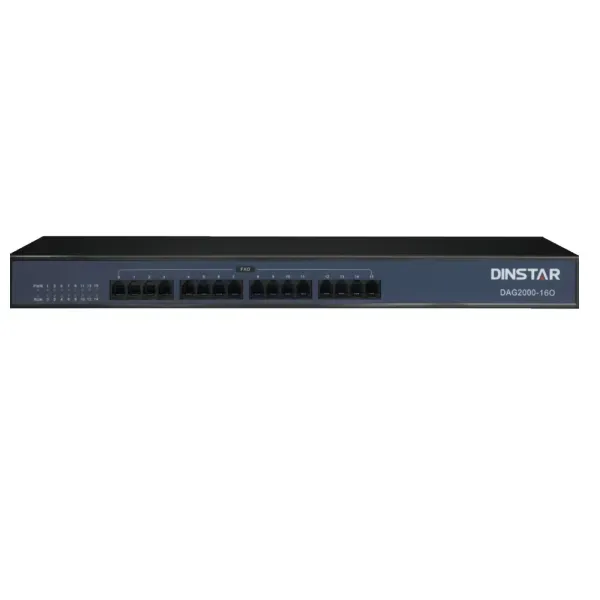
Dinstar DAG2000-16O FXO VoIP Gateway
The Dinstar DAG2000-16O is a 16-port FXO analog VoIP gateway for organisations that need to connect traditional PSTN lines or an analog PBX environment to SIP-based IP telephony. It is designed for controlled migration, branch connectivity, call-centre integration and mixed voice environments where existing analog carrier lines still need to participate in a modern VoIP architecture.
What the Dinstar DAG2000-16O is designed to solve
Many businesses still depend on analog lines supplied by a telecom operator, yet want the flexibility of SIP-based IP PBX platforms, centralized call routing, branch connectivity and modern voice-management tools. Replacing every analog line or redesigning a complete telephone environment at once is not always practical. The DAG2000-16O provides the interface layer between those two worlds. Its 16 FXO ports are intended for connection to PSTN lines or compatible analog PBX trunk interfaces, while the IP side communicates through standard SIP. This lets an organisation preserve useful analog connectivity while introducing VoIP services in a planned way.
The value of an FXO gateway is not simply the port count. Deployment depends on how incoming calls should be presented to the IP PBX, how outgoing calls should select lines, what caller-ID method is available, whether fax traffic is required, how failover should work, and how dialled numbers need to be manipulated. Dinstar provides flexible routing and dial-plan controls for these scenarios, along with port groups, SIP trunks, caller/called-number manipulation, digit maps and management tools. For a procurement team, these capabilities mean the gateway can be evaluated as part of a complete call-flow design rather than as an isolated box.
FourTeck Tanzania approaches voice projects from the system perspective. Before selecting a gateway, it is useful to document the number of active PSTN lines, the purpose of each line, the existing PBX or SIP platform, expected concurrent calls, fax requirements, network topology, rack space, power and the desired failover behaviour. You can review the broader FourTeck Tanzania technology portfolio, browse the FourTeck Tanzania shop for related business technology, or review implementation and support services when the gateway is part of a larger telephony or network project.
16 FXO interfaces
Sixteen RJ11 FXO ports allow the gateway to terminate multiple analog PSTN lines or suitable analog PBX trunk connections in one unit. This capacity is useful when an organisation has more than a few legacy lines and wants a consolidated SIP gateway rather than multiple small adapters.
SIP and security
The platform supports SIP v2.0 over UDP, TCP and TLS, with SRTP available for protected media transport when supported by the rest of the voice environment. IPv4 and IPv6 support gives network teams flexibility for current and evolving addressing plans.
Fax and voice handling
Fax can be carried with T.38 or pass-through methods. Voice processing includes G.711 A/μ-law, G.723.1 and G.729A/B codecs, echo cancellation, adaptive jitter buffering, silence suppression and comfort-noise features documented by Dinstar.
Management and provisioning
Web management, SNMP, TR-069, configuration backup/restore, firmware upgrade tools, logs, CDR and network capture capabilities support day-to-day administration and troubleshooting. Automated provisioning options can help standardise deployments where multiple gateways are used.
Verified technical highlights
| Area | Dinstar DAG2000-16O | Why it matters |
|---|---|---|
| Analog interfaces | 16 × FXO, RJ11 | Connects multiple PSTN lines or compatible analog PBX trunks to SIP infrastructure. |
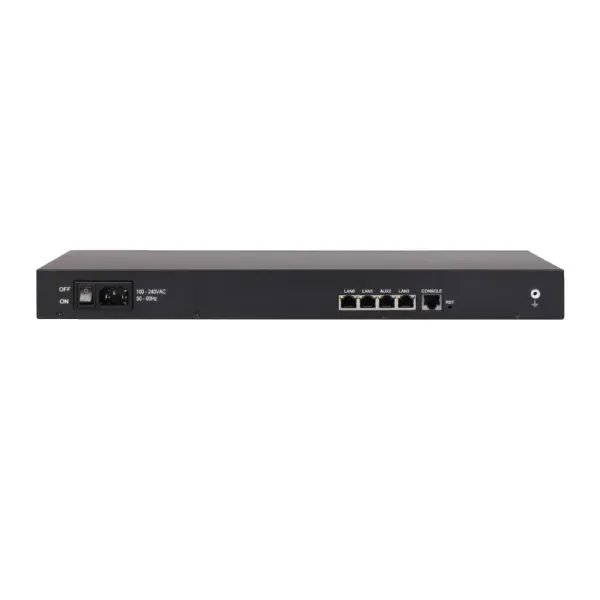
| Ethernet | 3 × 10/100 Mbps RJ45 LAN interfaces listed on the official datasheet | Supports network attachment and deployment flexibility within the voice environment. |
| SIP | SIP v2.0, UDP/TCP/TLS, SIP/IMS | Enables integration with standards-based IP PBX, SIP server and IMS/NGN platforms, subject to interoperability testing. |
| Fax | T.38 and pass-through | Supports organisations that still need analog fax workflows across a VoIP environment. |
| Network | IPv4/IPv6, VLAN 802.1P/802.1Q, Layer-3 QoS/DiffServ, DHCP, static/dynamic IP | Helps network teams segment and prioritise voice traffic. |
| Security | TLS/SRTP, web and Telnet ACL controls | Provides options for protecting signalling, media and management access when configured with compatible systems. |
| Management | Web, SNMP v1/v2/v3, TR-069/TR-181, logs, CDR, backup/restore | Supports administration, monitoring and recovery of configuration. |
| Power | 100–240 VAC, 50–60 Hz; 30 W typical | Useful for rack and UPS planning before installation. |
| Physical | 440 × 230 × 44 mm; 2.7 kg | Aids rack-space, shelf and installation planning. |
Before ordering: confirm the call-flow design
An FXO gateway sits at an important boundary between carrier lines and the IP voice system. A successful deployment starts by identifying exactly which PSTN lines will connect to the 16 ports, how inbound calls will be routed, which users or queues can seize outbound lines, what numbering translation is required and whether caller ID is delivered by FSK or DTMF in the local environment. Fax requirements, busy-tone detection and line supervision should also be checked against the actual carrier behaviour.
The LAN side should be treated as voice infrastructure. Confirm IP addressing, VLANs, QoS, DNS, NTP, firewall policies and reachability to the SIP server. Where TLS/SRTP is planned, certificates and platform compatibility need to be validated. It is also sensible to place the gateway and associated switching on suitable UPS protection, especially where analog lines are expected to remain part of a business-continuity strategy.
Dinstar DAG2000-16O FXO VoIP Gateway Tanzania
For organisations in Tanzania, the Dinstar DAG2000-16O is relevant when existing telephone services still arrive as analog PSTN circuits but the business wants to operate a SIP-based PBX or unified voice platform. Sixteen FXO ports provide a practical density for offices, hotels, call-handling teams, branches, service desks and multi-department environments that have more than a handful of analog lines. The key decision is not simply whether sixteen ports are available; it is whether those lines should terminate centrally on the gateway, how incoming numbers map to extensions or queues, and how outgoing calls should be distributed across the available trunks. A documented call-flow plan makes the gateway easier to configure, test and support.
Tanzania deployments can vary significantly in internet quality, LAN design, power conditions and existing PBX age. Because the DAG2000-16O is designed to bridge analog and IP voice, it is often used during a staged migration rather than a complete overnight replacement. A business can retain important PSTN connectivity while moving internal extensions, reception functions and branch communication toward SIP. Network preparation should include a stable Ethernet path to the IP PBX, voice VLAN planning where appropriate, Layer-3 QoS, firewall rules and reliable DNS/NTP. The official device supports IPv4 and IPv6, TLS/SRTP, T.38 fax, routing rules and management features that can support this transition, but the exact feature behaviour should be validated against the selected PBX and carrier lines before cutover.
Procurement teams should also confirm supporting infrastructure. The gateway uses AC power and is commonly placed with network and voice equipment, so rack position, ventilation and UPS capacity deserve attention. The analog side needs clean, labelled copper connections so each PSTN line can be traced to its corresponding FXO port. On the IP side, administrators should decide how configuration backups, access credentials, firmware control and logging will be handled. FourTeck Tanzania can place the gateway within a broader voice and network discussion, including IP PBX, IP phones, switching, cabling and security. The FourTeck Tanzania company overview explains the integrated technology approach, while the services page provides context for solution planning and implementation.
When requesting a Tanzania quotation, include the number of PSTN lines in service today, expected growth, PBX or SIP-server brand and version, whether fax is required, whether any lines must provide fallback during internet outages, and the site where the gateway will be installed. This information makes it easier to verify that a 16-port FXO model is the right size and that the project includes all supporting requirements. Price should be considered together with configuration scope, cabling, network readiness and the operational plan for incoming and outgoing calls. FourTeck does not need to assume local carrier behaviour: the safer approach is to test line signalling and call-routing expectations against the actual service before production migration.
Dinstar DAG2000-16O FXO VoIP Gateway Dar es Salaam
Businesses in Dar es Salaam frequently operate from multi-floor offices, commercial buildings, hotels, logistics facilities, customer-service centres and branch headquarters where telephony is tightly connected to daily operations. In these environments, the DAG2000-16O can be considered when the organisation has a set of analog carrier lines that must feed into a newer SIP PBX. Sixteen FXO interfaces allow those lines to be consolidated in one gateway, which is easier to document and manage than a collection of small two- or four-port adapters. The planning process should inventory every live line, identify which numbers are public-facing, record any fax or alarm dependencies and determine whether certain lines need a priority role for inbound or outbound calling.
A Dar es Salaam head office may also serve users at other Tanzanian branches. In that case, the FXO gateway can become one element of a centralised telephony architecture, with SIP extensions or branch PBXs reaching the central voice platform over secure IP links. The gateway itself supports SIP, flexible routing, main/secondary SIP server options and TLS/SRTP capabilities, but the wider design must consider WAN reliability, firewall policy, QoS and failover. A common mistake is to focus on the gateway while leaving the LAN untreated. Voice traffic benefits from stable switching, sensible VLAN separation, predictable DNS and NTP, and monitoring that can distinguish carrier-side line faults from IP-side registration or routing problems.
Physical installation deserves equal attention. The DAG2000-16O is a 1U-height device by dimension and should be placed where analog line termination, Ethernet connections and power can be maintained cleanly. Label each FXO circuit according to the carrier number and business purpose. If the gateway is being introduced during a migration from a traditional PBX, document the old routing before disconnecting anything so that reception, emergency contacts, hunt groups and after-hours behaviour can be recreated intentionally. Fax users should be identified early because T.38 and pass-through behaviour can depend on both the SIP environment and the remote endpoint.
For quotation preparation in Dar es Salaam, provide the current PBX model, the desired SIP platform, total analog line count, number of simultaneous calls, any requirement for call recording at the PBX level, and whether the project includes IP phones or network upgrades. FourTeck Tanzania’s business technology shop shows the broader procurement scope, while the services portfolio is useful when installation and configuration need to be coordinated with the gateway. The objective should be a documented end-to-end call path, not merely successful power-on of the hardware.
Dinstar DAG2000-16O FXO VoIP Gateway Mwanza
In Mwanza, businesses considering the Dinstar DAG2000-16O may include regional offices, distributors, hospitality operations, service companies, healthcare facilities, schools and organisations that retain traditional PSTN lines while modernising internal communications. A sixteen-port FXO gateway provides a useful consolidation point when several analog lines need to enter an IP PBX. The gateway can route calls according to prefixes and number-manipulation rules, which helps administrators map the carrier-facing side to internal extension plans. Before deployment, each line should be tested individually for dial tone, caller ID presentation, busy-tone behaviour and any special services so the configuration reflects real conditions rather than assumptions.
A Mwanza site may have a different support model or WAN path from a main office in Dar es Salaam. If the SIP PBX is hosted centrally or in another location, resilience becomes a design question. The DAG2000-16O supports primary and secondary SIP server concepts, but network architecture still needs to account for what happens if the WAN fails. Some businesses may want local PSTN lines to remain useful during an upstream outage; others may accept loss of central features until connectivity returns. That decision should be explicit. Network teams should also define voice VLANs and QoS policies where congestion is possible, particularly when the same uplink carries data backups, video, cloud applications and voice.
Power quality and physical access are practical considerations. Voice gateways, switches and routers should be connected to appropriately sized UPS equipment so short interruptions do not cause unnecessary call disruption or configuration concerns. The gateway’s web interface, configuration backup/restore, logs and CDR capabilities can help support teams troubleshoot without repeatedly visiting the rack. SNMP and TR-069 may also be relevant to organisations that use central monitoring or provisioning tools. Remote administration should be secured with appropriate access controls; it should not be exposed broadly to the internet simply for convenience.
For Mwanza procurement, a strong request for quotation should state whether all sixteen FXO ports are needed immediately or whether some are reserved for growth, identify the telephone numbers and departments involved, list the PBX/SIP server, specify the required support for fax, and describe the network connection between the gateway and PBX. If IP phones are also part of the project, include their quantity and PoE requirements so switching and UPS can be sized as one solution. This system approach reduces the chance that an otherwise suitable FXO gateway is limited by cabling, network policy or incomplete call-routing information.
Dinstar DAG2000-16O FXO VoIP Gateway Arusha
Arusha has a mix of hospitality, tourism, professional services, education, NGOs, retail and regional offices that may operate legacy analog lines alongside newer IP communications. The Dinstar DAG2000-16O is relevant where up to sixteen FXO circuits need to be connected to a SIP environment. Hotels and guest-oriented businesses, for example, may have long-established public numbers that should be retained while the internal PBX evolves. Offices may want to move extensions to IP phones yet keep analog carrier trunks for inbound business continuity. In both cases, the gateway provides the technical bridge, but the success of the project depends on mapping old call behaviour to the new SIP design in detail.
The gateway supports flexible routing and dial plans, which can be used to direct incoming PSTN calls to reception, departments, IVR destinations or other PBX targets. Outgoing routing can be organised by prefix or port group according to the wider design. However, routing logic should remain understandable. Complex rules that are not documented can make future troubleshooting difficult. A useful deployment record lists every FXO port, associated telephone number, carrier, intended inbound destination, outbound policy and any exceptional behaviour. If the organisation expects seasonal call peaks, confirm the number of concurrent lines required and how overflow is handled at the PBX level.
Arusha deployments also benefit from careful attention to network and environmental conditions. The gateway supports VLAN tagging and Layer-3 QoS, but the upstream switches and routers must be configured consistently for those features to provide value. If the SIP server is remote, latency and packet loss should be monitored. If the gateway is installed in a rack with other equipment, ensure proper ventilation and power protection. Configuration backups should be stored securely after commissioning, and access credentials should be managed as part of the organisation’s IT policy rather than left at factory defaults.
Before requesting a quotation in Arusha, document whether the requirement is a new VoIP migration, replacement of another FXO gateway, or expansion of an existing SIP PBX. Include the existing equipment brands, network diagram if available, number of analog lines, fax use, expected call volumes, and whether there are branch connections. This lets the deployment be scoped around integration rather than merely hardware quantity. Where the organisation is standardising technology across several regions, related FourTeck resources can also help procurement teams coordinate equipment and architecture consistently across East Africa.
Dinstar DAG2000-16O FXO VoIP Gateway Dodoma
For offices and institutions in Dodoma, the Dinstar DAG2000-16O can provide a migration path when important analog PSTN services need to coexist with a SIP-based voice platform. Government-related offices, professional services, educational organisations and growing enterprises may have public telephone numbers that should remain reachable even as internal telephony moves toward IP. The gateway’s sixteen FXO ports create a central handoff between those analog circuits and the SIP system. A well-planned deployment begins with a telephone-line audit: identify each number, department, billing owner, carrier, current call destination and whether the line supports fax or any non-voice service.
The next task is to define the future call flow. Incoming calls may need to route to a receptionist, auto attendant, hunt group or individual extension. Outgoing calls may use specific lines, groups or prefixes. The gateway provides routing and digit-manipulation tools to support these requirements, but they should be configured together with the PBX dial plan so that numbering is consistent. Administrators should avoid overlapping transformations that make it unclear whether a change occurs on the gateway or on the PBX. A clean design assigns responsibility to each platform and records it in the handover documentation.
Security is also part of voice infrastructure. The DAG2000-16O supports SIP over TLS and SRTP, along with access-control options, but secure deployment requires compatible PBX settings, proper credentials, firewall policy and certificate handling. Management access should be limited to trusted networks or secure remote-administration paths. Logs, CDR and network-capture tools can help troubleshoot registration, call setup and media problems. If the gateway is placed in a shared equipment room, label both network and PSTN cabling clearly and ensure UPS-backed power is available for the gateway and its upstream switch.
A Dodoma quotation request should include line quantity, existing and target PBX details, whether the deployment needs T.38 fax, the desired implementation schedule, and any requirement for configuration assistance or testing. If the site has more than sixteen analog trunks, state the total so gateway quantity or an alternative architecture can be assessed. If it has significantly fewer, confirm whether spare ports are justified by planned growth. Buying the correct port count is only one part of the decision; the integration plan, network readiness and operational documentation determine whether the gateway delivers reliable day-to-day value.
Dinstar DAG2000-16O FXO VoIP Gateway UAE
In the UAE, the Dinstar DAG2000-16O can be considered by organisations that still have analog PSTN interfaces or legacy PBX trunks but operate a SIP-based communications platform. Corporate offices, hospitality environments, service companies, warehouses and multi-site organisations may prefer a staged transition in which public telephone lines remain connected while internal users move to IP extensions. The gateway’s sixteen FXO ports provide a structured way to present those analog circuits to the SIP system. Because telecom configurations and provider services vary, the implementation team should verify signalling, caller ID, line supervision and dialling behaviour on the actual circuits rather than assuming every analog line behaves identically.
The UAE is also a common hub for regional businesses. A gateway at a UAE head office may feed calls into a central PBX that serves users across branches. In that architecture, security and WAN design become as important as FXO configuration. SIP over TLS and SRTP can be used where supported end-to-end, while firewall rules, voice VLANs and QoS should be aligned with the organisation’s network policy. Routing should specify whether branch users may place calls through the UAE PSTN lines, which number presentation rules apply and how emergency or local-call policies are handled. Those decisions belong in the voice design and should be reviewed with the relevant service providers.
Management features such as web administration, SNMP, TR-069, backup/restore, CDR and logging are useful where IT teams need repeatable support. Configuration should be backed up after commissioning and after major changes. Access should be protected with strong credentials and limited management paths. For businesses with several gateways, standard naming, IP addressing, port labels and template-based settings can reduce support time. The hardware’s 100–240 VAC input simplifies deployment in typical enterprise power environments, but UPS sizing and rack organisation should still be planned as part of the voice and network stack.
FourTeck’s UAE IT and telecom solutions site provides regional context for organisations managing projects there. When requesting a DAG2000-16O quotation, provide the number of PSTN lines, target PBX platform, required SIP security, fax needs and any multi-site routing requirements. Where the organisation is standardising across Tanzania and the UAE, align dial-plan conventions, gateway documentation, firmware policy and monitoring so support teams can work with a consistent operational model rather than two unrelated telephony designs.
Dinstar DAG2000-16O FXO VoIP Gateway Uganda
Ugandan organisations that retain analog carrier lines while upgrading to SIP can use a 16-port FXO gateway as the bridge between the two systems. The Dinstar DAG2000-16O is particularly relevant to multi-line businesses that need more density than a small gateway provides. Rather than treating each PSTN line as a separate technical problem, the gateway creates one manageable platform for inbound and outbound routing. The first planning step is to document the live lines and decide which ones must remain in service, which can be retired, which need fax capability, and which should be reserved for specific departments or failover purposes.
A Uganda deployment may connect the gateway to a local IP PBX or to a central system reached over a private WAN or VPN. If the PBX is remote, the voice design should account for latency, packet loss and WAN outages. The gateway can support main and secondary SIP-server arrangements, but business continuity still depends on the total architecture. Administrators should define what users can do when the central PBX is unreachable and whether local PSTN lines are expected to remain useful. Where multiple sites share one numbering plan, prefix conventions and caller-number manipulation should be standardised to avoid confusing routing rules.
The network side should be prepared with stable Ethernet, voice VLANs where required, QoS and firewall policy that allows only the necessary SIP and media traffic. Security options such as TLS and SRTP should be implemented only after confirming that the selected PBX or SIP server supports the same methods. On the analog side, technicians should test caller ID, answer delay and busy-tone behaviour because these can depend on the carrier. Configuration backups and CDR records can support troubleshooting after handover.
FourTeck’s Uganda IT and VoIP solutions site provides regional information for customers planning communication and network projects there. A good quotation request should list the current PSTN lines, desired PBX, number of branches, expected simultaneous calls, fax requirements, network topology and support scope. This avoids a narrow product-only quote and gives the project team enough information to validate that the DAG2000-16O is the right gateway size and integration method for the intended environment.
Dinstar DAG2000-16O FXO VoIP Gateway Kampala
Kampala businesses often combine head-office functions, customer service, sales teams and branch coordination in one location, making telephone continuity important. Where the organisation still has analog PSTN lines but wants a SIP IP PBX, the DAG2000-16O provides sixteen FXO interfaces in one managed gateway. This can suit companies that have several public numbers, departmental lines or legacy trunks that cannot be removed immediately. Before migration, technicians should capture how the old PBX handles incoming calls, hunting, after-hours routing and line selection so that the new SIP environment can reproduce or improve those behaviours deliberately.
Kampala deployments may also include remote branches or cloud-based collaboration tools sharing the same WAN. Voice should therefore be treated as one traffic class within the business network. VLAN tagging and QoS capabilities on the gateway are useful only when the upstream switch and router are configured consistently. If internet links are heavily used for backups or cloud applications, capacity and prioritisation should be reviewed. A SIP registration problem can look like a carrier-line problem to end users, so monitoring should separate analog line status, gateway health, SIP registration and WAN quality wherever possible.
The gateway’s flexible dial plans and routing rules can support different business requirements, but configuration simplicity should be a goal. Place number normalisation in one clearly defined part of the system and maintain a written port map. If caller ID needs to pass from the PSTN side into the PBX, confirm the local delivery method and PBX expectations. Fax use should be tested with the real endpoints because T.38 and pass-through reliability depends on the complete path. For secure administration, restrict the management interface to trusted networks and maintain configuration backups after approved changes.
A Kampala buyer should request a quotation with line count, port-use plan, SIP platform, installation location, network addressing requirements and any need for configuration, testing or user handover. If the project also includes phones, PoE switches or a firewall, include them in the same scope so interdependencies are visible. This avoids situations where the gateway is available but the supporting network cannot prioritise voice or provide enough protected power. FourTeck’s Uganda site can provide additional regional context for IP PBX, VoIP and networking requirements.
Dinstar DAG2000-16O FXO VoIP Gateway Arua
In Arua, a Dinstar DAG2000-16O deployment may be driven by a branch-office or institutional need to keep existing analog lines while connecting users to a newer IP-based telephone system. A regional site may not need all the features of a complex carrier platform, but it still benefits from a clear interface between PSTN trunks and SIP. The sixteen FXO ports make sense when several lines are active or when growth is expected. If only a few lines are required, the procurement team should compare the 16-port model against smaller gateway sizes instead of buying unused capacity without a business reason.
Connectivity between Arua and a central PBX elsewhere is a key design consideration. If the gateway registers over a WAN, call quality and availability depend on that link. Network teams should test round-trip delay, packet loss and congestion during busy periods, not only during installation. QoS can help when configured end-to-end, but it cannot fix an undersized or unstable WAN. It is also important to define whether the local PSTN lines are expected to serve as a resilience path during central-system or internet outages, and if so, how users will access them under those conditions.
Analog line behaviour should be verified locally. The gateway supports FSK and DTMF caller ID, pulse/DTMF dialling and busy-tone detection, but the actual service from the carrier determines which settings are appropriate. Technicians should test each line, label it and record its configuration. On the IP side, use protected management access, appropriate firewall rules and backup the gateway configuration after commissioning. Logging and CDR information can then be used to distinguish line failures, SIP errors and routing mistakes when users report a problem.
For Arua quotation planning, include the exact number of lines, how many are currently active, the intended call destinations, the PBX location and whether branch users need central extension dialling. Describe power and rack conditions if the site is remote from the main IT team. A small UPS and clean cabling plan may be as important as the gateway itself because a voice system that loses power or has poorly labelled analog circuits becomes difficult to support. Procurement should therefore consider the complete operational environment, not only the gateway purchase price.
Dinstar DAG2000-16O FXO VoIP Gateway Mbarara
Mbarara organisations with several analog business lines can use the Dinstar DAG2000-16O as a migration bridge into SIP telephony. The model’s sixteen FXO ports can consolidate line termination for a hotel, branch headquarters, healthcare facility, educational institution or multi-department office. The migration should begin with an inventory of every number and its role. Some lines may be tied to reception, others to finance, reservations or customer support, and some may be unused but still billed. Cleaning up that inventory before installation can simplify the call-routing design and may avoid carrying unnecessary circuits into the new environment.
The gateway supports routing rules based on prefixes and number manipulation, which is useful when the SIP PBX uses a structured dial plan. Administrators can group FXO ports and decide which outbound calls should use which line group. Incoming calls can be delivered to the PBX for IVR, ring groups or queues. These capabilities are flexible, but every rule should have a clear business purpose. A concise dial-plan document should explain the normal call flow, fallback behaviour, blocked patterns and any special routing so later changes do not accidentally disrupt service.
Network and security planning should accompany the telephony configuration. The DAG2000-16O supports VLANs, QoS, IPv4/IPv6 and secure SIP/media options, yet those features must match the rest of the environment. If the PBX is local, keep the voice path simple and segmented. If the PBX is remote, monitor WAN quality and consider how outages affect calling. For support, centralised logging, SNMP monitoring and configuration backups can reduce troubleshooting time. Management access should be limited to approved administrators and trusted source networks.
A Mbarara procurement request should identify the current PBX or analog distribution method, the target SIP platform, whether caller ID must be preserved, any fax lines, expected simultaneous traffic and whether installation includes network changes. If sixteen ports exceed current need, explain the growth plan; if sixteen is not enough, state the total line count so the architecture can be reviewed. This prevents a quote from being based on model preference alone and helps ensure the selected gateway fits the organisation’s operational and expansion requirements.
Dinstar DAG2000-16O FXO VoIP Gateway Gulu
For Gulu businesses and institutions, the DAG2000-16O can support a practical transition from multiple analog PSTN lines to a SIP-managed phone system. The gateway is most appropriate when the site has enough analog trunks to justify sixteen FXO interfaces or expects growth that makes a higher-density unit sensible. Before procurement, count active lines rather than relying on old PBX records. Disconnecting unused services and identifying the purpose of each number gives the project team a cleaner starting point. It also helps determine whether all lines should remain on the gateway or whether some can be replaced by SIP trunks.
Where Gulu is a branch of a larger organisation, the voice architecture should specify whether calls are processed locally or by a central PBX. A central design can simplify administration but increases dependence on the WAN. A local design may preserve more autonomy but require additional configuration at the branch. The DAG2000-16O supports standard SIP and main/secondary server arrangements, giving designers options, but the correct choice depends on the organisation’s resilience objectives. Test the intended failure scenarios rather than assuming that registration failover automatically delivers complete business continuity.
The analog side deserves careful commissioning. Busy-tone detection, caller ID method, answer delay and line conditions can vary, so each FXO port should be tested against its actual circuit. The IP side should use appropriate VLAN and QoS policy, and the firewall should permit only the required communication. Management interfaces should be protected and configuration files stored securely. If support will be provided remotely, logging and network-capture tools can help engineers diagnose issues without travelling to the site for every call-quality complaint.
When requesting a Gulu quotation, provide the PSTN line list, PBX or SIP-server details, any existing VPN or WAN topology, installation environment and desired support scope. Include whether fax traffic is still required and whether any special numbers or after-hours routes exist. This information allows the project to be sized around real call behaviour. It also highlights whether supporting switches, UPS capacity, rack organisation or cabling should be included so the finished system is stable and maintainable rather than a gateway connected into an undocumented environment.
Dinstar DAG2000-16O FXO VoIP Gateway Kenya
Kenyan businesses planning a staged VoIP migration may need to retain analog PSTN lines while moving internal users onto an IP PBX. The Dinstar DAG2000-16O provides sixteen FXO ports for that purpose. It can serve as the boundary between carrier-facing analog circuits and a SIP voice environment, allowing the business to retain established public numbers while introducing IP phones, centralised call routing and branch extensions. The gateway should be selected after confirming the real analog-line count, required call concurrency and expected growth. A smaller gateway may be more suitable for a site with only a few lines, while multiple or alternative gateways may be needed above sixteen.
Kenya-based organisations with operations in Tanzania or Uganda may also benefit from standardising voice architecture across countries. Standardisation does not mean that every site needs the same port count. It means the same principles are used for numbering, VLANs, QoS, security, monitoring and documentation. If the DAG2000-16O is deployed at several sites, consistent naming and backup procedures make remote support easier. Where SIP traffic crosses WAN or VPN links, measure performance under normal business load and define how calling should behave when a link is interrupted.
The official Dinstar feature set includes T.38 and fax pass-through, IPv4/IPv6, SIP over UDP/TCP/TLS, SRTP, routing rules, port groups, CDR, SNMP and TR-069. These are useful capabilities, but interoperability should be validated with the selected PBX, SIP server and carrier circuits. Carrier caller-ID signalling, tone cadence and line supervision can vary, so those settings should be tested during commissioning. Security options should be aligned with certificates and policies on the PBX rather than enabled in isolation.
FourTeck’s Kenya IT and VoIP solutions site is relevant for organisations sourcing related communication, network and security infrastructure. A quotation request should include line quantity, intended PBX, caller ID and fax requirements, branch topology and whether configuration services are needed. For cross-border organisations, it is useful to compare architecture across Tanzania and Kenya so procurement, support and change management follow common standards even when local carrier services differ.
Dinstar DAG2000-16O FXO VoIP Gateway Kuwait
In Kuwait, the Dinstar DAG2000-16O can support businesses that operate analog telephone trunks alongside a SIP PBX or IP telephony platform. Sixteen FXO interfaces provide a compact way to consolidate traditional lines, which may be useful for hotels, offices, customer-service operations and organisations that are modernising voice infrastructure in stages. The migration design should start with the existing public numbers and the business processes attached to them. Reception, reservations, finance, emergency contacts and after-hours routing can all depend on specific lines, so those functions should be documented before the analog PBX or previous gateway is replaced.
A Kuwait deployment should verify local line signalling and caller-ID behaviour during commissioning. The gateway supports FSK and DTMF caller-ID methods, pulse/DTMF dialling and configurable busy-tone handling, but the correct settings depend on the service presented by the telecom provider. SIP-side configuration should then map those lines to the PBX with clear routing rules. For large call-handling teams, administrators may use FXO port groups and structured outbound routes. The important point is to keep the routing readable so future changes can be made without introducing hidden dependencies.
Network teams should plan the gateway as part of the voice VLAN and security architecture. SIP over TLS and SRTP can be relevant where supported end-to-end, while QoS may help preserve voice quality when data traffic competes for links. The gateway’s management interfaces and monitoring features should be restricted to authorised administrators. Configuration backup, CDR and logging procedures should be included in the handover. In rack environments, power and cooling should be considered together with the IP PBX, switches and any session border or firewall devices.
For procurement, provide the number of analog lines, desired cutover method, target PBX, expected call concurrency and whether fax is still required. If the project spans several branches, state whether each location will have local FXO lines or whether PSTN access is centralised. That decision affects gateway quantity, WAN dependency and emergency-call policy. A complete quote can then cover not only the DAG2000-16O hardware but also the practical integration tasks required to make it part of a stable business telephone system.
Dinstar DAG2000-16O FXO VoIP Gateway Ghana
Ghanaian organisations that continue to use analog PSTN trunks can adopt the Dinstar DAG2000-16O when they want those lines to feed a SIP-based PBX. The sixteen FXO ports are suited to multi-line environments such as corporate offices, service centres, education, hospitality, healthcare or distributed businesses. A gateway deployment can preserve established telephone numbers and carrier services while internal endpoints move to IP phones or soft clients. The planning process should verify how many analog lines are genuinely active, which numbers receive customer traffic and whether any lines are linked to fax or legacy devices that need special treatment.
Routing flexibility is one of the gateway’s most important operational capabilities. Incoming PSTN calls can be delivered to the SIP system, while outbound calls can be directed through selected FXO ports or groups. Number manipulation and digit maps help align carrier dialling with the internal PBX plan. However, organisations should avoid building unnecessary complexity into both the gateway and PBX. Define where each transformation occurs, document it and test representative call cases including local, mobile, international, after-hours and failed-line scenarios where applicable.
For reliable operation, the IP network should provide stable connectivity to the SIP server, appropriate QoS and secure management. The gateway supports IPv4 and IPv6, VLAN tagging, Layer-3 QoS, TLS/SRTP and monitoring tools. Those features are most effective when the wider network is designed consistently. A UPS-backed rack can help keep the gateway, switches and PBX available through short power interruptions. Configuration backups should be stored outside the device, and firmware changes should follow an approved process rather than being performed casually during production hours.
FourTeck’s Ghana business IT solutions site provides related regional context for IP PBX, network and infrastructure requirements. For a DAG2000-16O quote, buyers should provide line count, PBX platform, intended call flow, fax needs, branch connectivity and support expectations. If the gateway will be part of a broader communications refresh, include phones, switching, firewall and cabling in the discussion so the project is engineered as one working system.
Dinstar DAG2000-16O FXO VoIP Gateway Nigeria
Nigeria has many organisations operating mixed telephony environments where traditional carrier lines still coexist with SIP trunks, IP PBXs and branch connectivity. The Dinstar DAG2000-16O fits this hybrid model by presenting sixteen FXO ports to a SIP-based system. It can be appropriate for customer-service operations, hotels, enterprises, education and distributed offices that want to preserve analog access while modernising internal communications. Before selecting the model, count actual PSTN trunks and peak simultaneous calls. Capacity should be based on real usage and resilience requirements rather than assuming that the highest port count always produces the best value.
Power and network resilience deserve specific attention. A gateway may connect analog lines that remain available when internet service is unstable, but users still need the SIP system and LAN to reach those lines. If the business expects PSTN to act as a fallback path, test the full failure scenario, including what happens to the PBX, switch and gateway during a power or WAN event. UPS protection, local PBX functions and secondary SIP-server options can all be part of the solution, but the desired behaviour should be designed intentionally and verified during acceptance testing.
Call quality and routing should be monitored separately. On the analog side, test caller ID, tone detection and line condition. On the SIP side, monitor registration, RTP quality and network latency. The DAG2000-16O offers logs, CDR and packet-capture tools that can assist troubleshooting. Security features such as TLS and SRTP can protect signalling and media where the PBX supports them, while management ACLs and network segmentation can reduce unnecessary exposure. Strong operational discipline is as important as the device’s feature list.
FourTeck’s Nigeria IT solutions site is relevant for businesses planning broader telephony, network and infrastructure projects. A quotation request should state line quantity, location, PBX type, branch topology, fax requirements, caller-ID expectations and installation scope. If a business operates in both Nigeria and Tanzania, aligning gateway configuration standards, numbering conventions and support documentation can reduce operational complexity even though the local carrier services and line characteristics may differ.
Dinstar DAG2000-16O FXO VoIP Gateway Seychelles
In Seychelles, businesses in hospitality, tourism, professional services and multi-site operations may still depend on analog telephone circuits while adopting modern SIP-based communications. The Dinstar DAG2000-16O can connect up to sixteen FXO lines to an IP PBX, allowing established PSTN numbers to remain part of the calling environment. This can be especially useful during a gradual migration where changing public numbers or replacing all voice services at once would create disruption. The project should begin by confirming which lines are active, what business function each line serves, and whether any are used for fax or other legacy services.
Island and multi-property deployments may place greater emphasis on remote management and WAN dependency. If a central PBX serves multiple properties, the gateway’s location should be chosen according to where the analog carrier lines terminate and how resilient the network path is to the PBX. Where practical, voice VLANs, QoS and monitoring should be implemented to help distinguish network congestion from analog line faults. If the organisation expects local calling to remain available during WAN disruption, that requirement should be tested with the complete architecture rather than assumed from the presence of PSTN lines.
The DAG2000-16O supports web management, SNMP, TR-069, logs, CDR, backup/restore and network capture, which can help remote administrators support the platform. Access should be restricted to trusted management networks or secure remote-access methods. Configuration backups are particularly useful where on-site technical resources are limited, because a documented recovery process can reduce downtime after hardware replacement or major configuration changes. Power protection and clean rack organisation should also be planned so the gateway, switch and PBX infrastructure remain accessible and easy to maintain.
For Seychelles procurement, include the number of analog lines per property, the PBX location, inter-site network design, required fax support and whether any lines are considered critical for guest services or business continuity. If fewer than sixteen lines are required, compare smaller Dinstar FXO models; if more are required, plan capacity beyond one gateway. This sizing exercise prevents both unnecessary overspend and avoidable port shortages. The quotation should then identify configuration, testing and documentation needs so the gateway becomes a maintainable part of the communications platform rather than an unmanaged conversion device.
Compatibility and integration guidance
Dinstar positions the DAG2000-16O for interoperability with leading softswitches, IP PBXs and SIP servers through standard SIP. In practical terms, standards support is the starting point, not the end of compatibility testing. Confirm the SIP transport, authentication method, codec set, DTMF mode, fax method and number format expected by the PBX. If TLS and SRTP are required, confirm certificate handling and crypto compatibility on both sides. If the platform uses NAT, define whether STUN, static NAT, firewall session policies or a session border controller is involved. Test incoming calls, outgoing calls, call release, caller ID and failover with the exact environment.
For analogue integration, the FXO ports connect to PSTN lines or compatible analog PBX trunk ports. Do not connect FXO and FXS interfaces incorrectly; they serve different roles. Confirm voltage, line presentation and local carrier signalling before go-live. When fax is required, test both T.38 and pass-through behaviour across representative destinations because a successful voice call does not guarantee fax reliability. For branch deployments, build a test plan that includes WAN loss, SIP-server loss, carrier-line loss, power restoration and configuration recovery.
Who should choose a 16-port FXO gateway?
Multi-line offices
Suitable where many existing PSTN lines need to be presented to one SIP PBX and where centralised routing is preferable to several small gateways.
Hotels and hospitality
Useful when established public telephone numbers or analogue trunks must remain available during migration to a newer PBX architecture.
Call-handling teams
Can support reception, service desks and call-centre environments that require several PSTN lines to feed queues, IVR or agents through an IP PBX.
Branch networks
Appropriate when a branch retains local PSTN access but needs to integrate those lines with central SIP extensions and corporate calling policies.
Quotation checklist
- Number of active analog PSTN lines and expected growth.
- Existing PBX and target SIP/IP PBX platform, including software version where relevant.
- Required inbound call destinations, IVR, queues, ring groups and after-hours behaviour.
- Outbound line-selection policy, number prefixes and branch calling requirements.
- Caller-ID method and any number-presentation requirements.
- Fax requirement and preferred T.38 or pass-through workflow.
- Voice VLAN, IP addressing, firewall, QoS and remote-management requirements.
- Rack, power, UPS and analog cabling readiness.
- Installation, configuration, testing, documentation and handover scope.
Frequently asked questions
What is the Dinstar DAG2000-16O used for?
It is a 16-port FXO analog VoIP gateway used to connect PSTN lines or compatible analog PBX trunks with SIP-based IP telephony. The gateway converts between the analogue line side and IP/SIP side so a business can retain traditional carrier circuits while using a modern IP PBX or SIP server.
Does the DAG2000-16O support fax?
Yes. Dinstar documents support for T.38 and fax pass-through. Actual fax reliability depends on the complete route, including the PBX, SIP provider or remote gateway and network quality, so representative fax testing is recommended before full deployment.
Can it work with an IP PBX?
The gateway uses standard SIP and is positioned by Dinstar for interoperability with SIP-based IP PBXs, softswitches and IMS/NGN platforms. Compatibility should still be validated for the exact PBX model, firmware, authentication, codec, DTMF, fax and security settings.
Does it support secure SIP?
Yes. Dinstar lists SIP over TLS and SRTP support. Secure deployment requires matching settings and certificate handling on the peer SIP platform, along with appropriate firewall rules and protected management access.
How many concurrent analog lines can be connected?
The model provides sixteen FXO interfaces. Each port connects to an analog line or compatible trunk interface, so the hardware is intended for up to sixteen such circuits. Actual call behaviour also depends on PBX routing and the carrier service on each line.
What network preparation is recommended?
Plan stable Ethernet connectivity, IP addressing, DNS/NTP, voice VLANs where used, QoS, firewall policy and secure management. If the SIP server is remote, also test WAN latency, packet loss and failover behaviour under normal business load.
Can the gateway be monitored remotely?
Dinstar documents web management, SNMP, TR-069, logs, CDR, configuration backup/restore and network capture capabilities. Remote administration should be restricted to authorised management paths rather than exposed directly to the public internet.
Should I choose this model if I have fewer than sixteen PSTN lines?
Possibly, if there is a clear growth plan or standardisation reason, but Dinstar also offers smaller FXO gateway models. The correct choice should reflect current line count, expected growth, required resilience and total project cost rather than simply choosing the highest capacity.
Decision recap
Choose the Dinstar DAG2000-16O when the requirement is specifically to integrate a substantial number of analog PSTN lines or analog PBX trunk interfaces with a standards-based SIP environment. Its sixteen FXO ports, SIP/IMS support, T.38 fax, IPv4/IPv6, TLS/SRTP, routing controls and management features make it a capable bridge for staged telephony migration. The strongest deployments start with a line inventory and call-flow design, then validate carrier signalling, PBX interoperability, network quality and failover before production cutover.
For Tanzania projects, FourTeck can discuss the gateway together with the surrounding IP PBX, IP phones, switching, cabling, firewall and support requirements. The goal is to make sure the analogue-to-SIP transition is technically coherent, documented and aligned with the way the business actually handles calls. Use the verified FourTeck Tanzania contact page to provide your line count, PBX details and project scope for quotation planning.
Consultation panel: information that speeds up technical review
When contacting FourTeck, share a simple diagram or written description showing the telecom provider lines, existing PBX, target SIP platform, user locations and network path. Include the current telephone numbers, how calls should route, any fax requirement and whether the gateway is expected to provide a resilience path. This allows the technical discussion to focus on configuration and compatibility instead of guessing about the environment.
If you are replacing an existing FXO gateway, also include its model and the reason for replacement. If you are migrating from a legacy PBX, record the old extension and trunk behaviour before cutover. These details reduce project risk and provide a better basis for selecting the correct hardware, accessories and implementation scope.



Reviews
There are no reviews yet.