
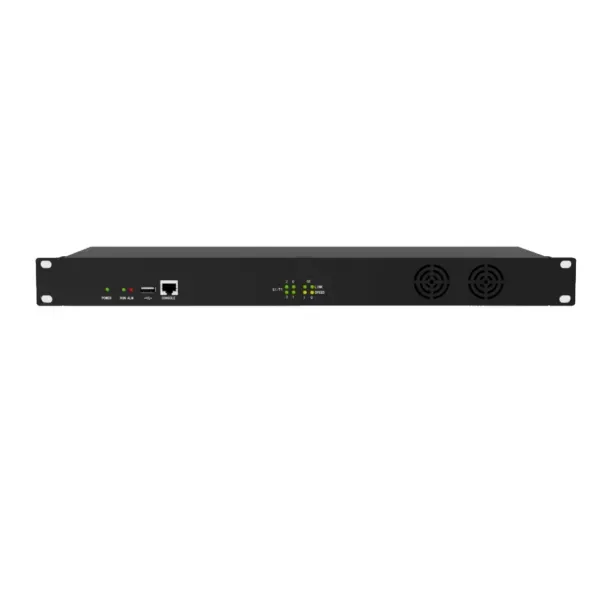
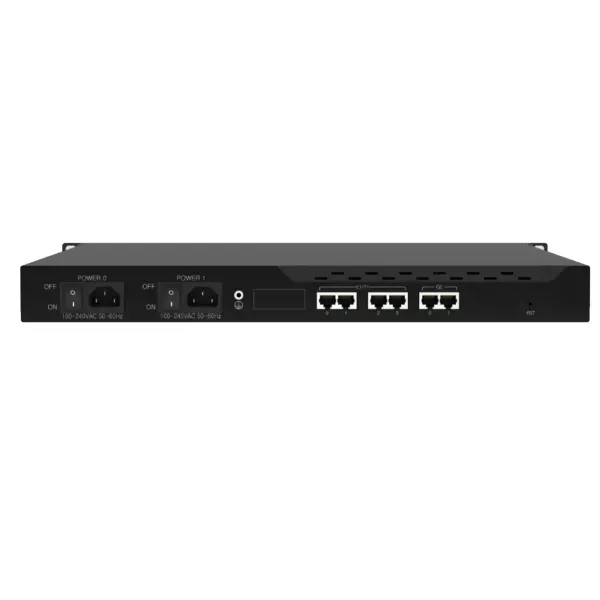
Dinstar MTG1000 Digital VoIP Gateway
The Dinstar MTG1000 is a low-density digital trunk gateway designed to bridge traditional E1/T1 telephony and SIP-based IP voice networks. It is available with one or two E1/T1 interfaces in a compact 1U chassis, supports up to 60 simultaneous calls, and provides the signaling, codec, routing and management functions needed for practical migration between legacy PBX, PSTN and modern VoIP environments. For Tanzanian businesses, call centres, service providers and multi-site organisations, its value is in protecting existing voice infrastructure while introducing SIP connectivity in a controlled, supportable way.
1 or 2 E1/T1 digital trunk interfaces
Up to 60 simultaneous calls
SIP, ISDN PRI, SS7 and R2 MFC interworking
T.38 and pass-through fax support
Dual power supplies and two Gigabit Ethernet ports
What the Dinstar MTG1000 is designed to solve
Many organisations do not move from traditional telephony to SIP in one step. A business may still have a PBX with an E1 or T1 interface, a carrier-delivered PRI service, established inbound numbers, or operational workflows built around digital trunks while also wanting the flexibility of SIP trunks, an IP PBX, a softswitch or a newer unified communications platform. The Dinstar MTG1000 provides the conversion and routing layer between these environments. Instead of replacing every element at once, the gateway can let the existing digital side continue to operate while calls are exchanged with the IP side through SIP.
Official Dinstar information positions MTG1000 as a compact, cost-effective trunk gateway for PSTN-to-IP interconnection. The family supports 1/2 E1/T1 ports and up to 60 concurrent calls, multiple SIP trunks, flexible routing and interoperability with mainstream VoIP platforms. On the traditional signaling side it supports ISDN PRI, SS7 and R2 MFC. Management functions include a web interface, SNMP, automated provisioning, configuration backup and restore, diagnostic tools and centralized management options. These capabilities are particularly useful when migration has to be staged, documented and tested rather than approached as a wholesale PBX replacement.
Digital trunk bridge
Connect E1/T1 digital telephony on one side with SIP-based IP voice systems on the other, supporting phased modernization without discarding a functional legacy PBX unnecessarily.
Flexible call routing
Routing can be planned between PSTN and IP directions using prefixes, time conditions, trunk groups, route priorities and number manipulation to match established dial plans.
Operational continuity
Dual power supplies, statistics, logs, network capture, backup/restore and SNMP help administrators build a more supportable voice edge and investigate signaling or media problems.
Fax and legacy traffic
T.38 and pass-through fax support, plus modem and POS use cases documented by Dinstar, can help mixed legacy environments when carrier, PBX, codec and network conditions are validated.
Dinstar MTG1000 technical specification guide
| Area | Verified MTG1000 information |
|---|---|
| Digital interfaces | 1 or 2 E1/T1, RJ48 |
| Call capacity | Up to 60 simultaneous calls |
| Ethernet | 2 Gigabit Ethernet interfaces |
| SIP | SIP v2.0, multiple SIP trunks, peer/access modes, SIP/IMS registration |
| PSTN signaling | ISDN PRI, Q.sig, SS7 variants and R2 MFC |
| Voice codecs | G.711 A/μ-law, G.723.1, G.729A/B, iLBC 13k/15k and AMR |
| Fax and legacy data | T.38, pass-through fax, modem and POS support |
| Voice processing | Echo cancellation to 128 ms, comfort noise, silence suppression, VAD, gain control and adaptive dynamic buffer |
| Routing | PSTN-PSTN, PSTN-IP and IP-PSTN routing, prefix and time-based rules, number manipulation and route priority |
| Management | Web GUI, SNMP v1/v2/v3, syslog, NTP, capture tools, firmware upgrade, statistics, backup and restore |
| Power design | Dual power supplies |
A specification list does not replace deployment validation. Before purchase, confirm the exact carrier signaling, E1/T1 framing and line coding, PBX trunk configuration, SIP peer behavior, codec policy, fax requirements, RTP range, firewall/NAT design and failover expectations. Those details determine whether a gateway is merely compatible on paper or ready for the actual call flow.
Compatibility, integration and migration planning
The MTG1000 can sit between a legacy PBX and a PSTN connection, between a digital carrier trunk and an IP PBX, or as part of a wider voice-routing design. Dinstar documents interoperability with mainstream VoIP platforms and supports SIP-to-SIP interworking in addition to traditional PSTN-to-IP conversion. For a buyer, the important question is not only whether the gateway supports SIP. The project team should map every call direction: inbound public numbers, outbound access codes, emergency calling policy, internal extensions, DID translation, caller ID presentation, overflow behavior, hunt groups, fax, modem or POS traffic, and what should happen when a preferred route is unavailable.
Network readiness deserves equal attention. Voice should be carried across stable switching and routing, with suitable QoS policies where congestion is possible. SIP and RTP ports should be documented, firewall rules should permit only the required flows, and NAT behavior should be tested rather than assumed. Management access should be restricted to trusted administration networks. The MTG1000 includes network capture, syslog and statistics that can assist troubleshooting, but the value of those tools is highest when the deployment has a clear addressing plan and baseline configuration.
Choosing the 1-E1/T1 or 2-E1/T1 MTG1000
Dinstar documentation identifies MTG1000-1E1/T1 and MTG1000-2E1/T1 variants. A one-port deployment can fit a site with a single digital trunk that needs SIP conversion or PBX migration. A two-port deployment may suit environments where two carrier trunks, two PBX-side connections or a more complex interconnect must be handled in one gateway. The choice should be based on physical trunk count and traffic engineering, not simply the maximum call figure. An E1 commonly carries more voice channels than a T1, and signaling timeslots or local carrier arrangements can affect usable capacity. Procurement should therefore record the exact line type and provider configuration before a model is ordered.
Related FourTeck Tanzania voice and infrastructure resources
A digital gateway works as part of a wider communications environment. FourTeck Tanzania provides several relevant pages that can help buyers frame that environment before requesting a quotation.
Useful for reviewing the wider Dinstar portfolio and preparing model, quantity, call-flow and site information.
Dinstar VoIP solutions Tanzania
Explains how gateways, IP PBX, endpoints and related voice components can be considered together.
Dinstar call-centre VoIP solutions
Relevant where the MTG1000 is being evaluated for inbound or outbound contact-centre trunk connectivity.
Dinstar DAG1000-1S FXS Gateway
Shows an analog-endpoint gateway option for projects that need to preserve a phone or fax device rather than a digital E1/T1 trunk.
Dinstar DAG2500-48S FXS Gateway
Relevant for higher-density analog extension migration where many legacy handsets must connect to a SIP environment.
Grandstream GXP1615 business IP phone
An endpoint reference for businesses planning a broader shift from legacy PBX trunks to SIP-based desk telephony.
Grandstream GRP2614 business IP phone
A higher-feature IP endpoint reference for projects where trunk migration is accompanied by desk-phone modernization.
FourTeck Tanzania technology approach
Provides context on integrated IP PBX, switching, Wi-Fi, firewall and business infrastructure planning.
Dinstar MTG1000 Digital VoIP Gateway Tanzania
For organisations in Tanzania, the Dinstar MTG1000 is most relevant where a digital E1/T1 trunk still plays an important operational role but the business also needs SIP connectivity. This can arise during PBX modernization, a move toward hosted or software-based telephony, call-centre expansion, consolidation of branch communications or a transition from carrier PRI services toward SIP trunks. The gateway gives the project team a controlled interconnection point rather than forcing an immediate replacement of every telephone-system component. Its 1/2 E1/T1 form factor is suited to lower-density trunk requirements, while support for up to 60 simultaneous calls provides room for many small and mid-sized business use cases when traffic assumptions are validated.
A Tanzanian procurement team should start with the current voice inventory. Record whether the existing carrier handoff is E1 or T1, which signaling is used, how many channels are active, how inbound numbers are delivered, how caller ID is presented, whether fax or modem traffic still matters, and what PBX or SIP platform will sit on the IP side. Those details matter because MTG1000 supports several signaling choices—ISDN PRI, SS7 and R2 MFC among them—but the configuration must match the real service. The same applies to codecs, dial rules, number manipulation and routing priorities.
For network planning, confirm rack space, protected power, LAN addressing, voice VLAN design, firewall rules, SIP and RTP ranges, QoS policy and remote-management restrictions. Dual power supplies can contribute to resilience, but continuity still depends on upstream power, switches, routers, carrier circuits and the PBX or softswitch. Businesses with critical calling should document failure scenarios rather than treating one redundant component as complete high availability.
When requesting a Tanzania quotation from FourTeck, provide the MTG1000 variant if known, E1/T1 count, signaling type, expected concurrent calls, PBX model, SIP provider or platform, site location and whether configuration or integration assistance is required. This produces a more useful quote than asking only for a unit price. Buyers can also review the Dinstar Tanzania solution page for broader product-selection context.
Dinstar MTG1000 Digital VoIP Gateway Dar es Salaam
Dar es Salaam organisations often operate the most complex voice environments in Tanzania because headquarters, customer-service teams, hotels, logistics companies, financial operations, healthcare facilities, trading businesses and service providers may have accumulated telephony systems over many years. A Dinstar MTG1000 project in Dar es Salaam can therefore be less about installing a new box and more about connecting two generations of infrastructure safely. A legacy PBX may still serve users reliably while a new SIP trunk, IP PBX or cloud-connected platform is introduced. The MTG1000 can provide the digital-to-IP bridge required for that staged migration.
Before selecting the gateway, map the real traffic. A head office may have busy-hour call peaks very different from its average daily usage. A contact desk may need many inbound channels in the morning, while a reservations or sales operation may place large numbers of outbound calls later in the day. Up to 60 simultaneous calls is a platform ceiling, not a planning assumption. The E1/T1 variant, signaling method and active timeslots should be matched to the carrier service and expected concurrency. If growth could exceed the low-density MTG1000 range, that should be identified during design rather than after deployment.
Dar es Salaam projects also benefit from careful network and rack planning. The gateway should be installed where power, cooling, switching and physical access are controlled. SIP traffic should traverse a documented network path, with firewall policies and NAT behavior verified. If administrators need remote access, use restricted management paths rather than exposing the web interface broadly. SNMP, syslog, call statistics and capture tools can then support troubleshooting without weakening the security posture.
For a procurement request, include the carrier circuit details, existing PBX model, target SIP platform, number of E1/T1 ports, fax or POS requirements, routing objectives and any cutover constraints. A planned migration can include a test window, inbound and outbound call validation, DTMF verification, caller-ID checks, fax testing, failure-path tests and backup of the final configuration. FourTeck’s Dinstar call-centre VoIP guidance is also relevant for Dar es Salaam deployments where the gateway supports customer-service operations.
Dinstar MTG1000 Digital VoIP Gateway Mwanza
Businesses in Mwanza evaluating the Dinstar MTG1000 may be dealing with a practical transition problem: an established digital telephone connection or PBX is still operational, yet new branches, SIP services or IP-based communications are becoming more attractive. The MTG1000 allows that transition to be approached incrementally. Rather than forcing an organisation to abandon its E1/T1 investment, the gateway can convert between digital trunk signaling and SIP so the existing system and the newer IP environment can coexist during migration.
The procurement discussion should begin with use case rather than brand name. A hotel may want to keep a proven PBX while adding a SIP carrier route. A healthcare facility may require reliable reception and departmental calling while modernizing the backbone. A trading or logistics company may need a digital trunk at one site to communicate with a newer IP PBX elsewhere. An education institution may be consolidating several voice systems. These scenarios all look different even when the same MTG1000 hardware is considered, because routing, number plans, failover and security requirements differ.
Mwanza deployments should document connectivity between the gateway and the network core. The two Gigabit Ethernet interfaces support IP connectivity, but good voice performance still depends on the surrounding network. Cabling, switch configuration, bandwidth, QoS and firewall rules should be checked. Codec choice can affect bandwidth and interoperability, while DTMF mode matters for IVR systems. Fax and modem traffic should be tested separately because successful voice calls do not automatically guarantee reliable legacy-data operation.
A useful quotation request should state whether one or two E1/T1 ports are needed, the current signaling, approximate busy-hour concurrency, desired SIP trunks, PBX or softswitch details, and whether installation or migration support is expected. If analog phones, fax machines or legacy extensions must also be retained, buyers may need an FXS gateway in addition to the MTG1000; the Dinstar DAG1000-1S reference illustrates that different gateway role. Selecting the correct gateway type prevents a common mistake: buying an E1/T1 trunk gateway for a requirement that is actually analog FXS or FXO.
Dinstar MTG1000 Digital VoIP Gateway Arusha
In Arusha, the Dinstar MTG1000 can be relevant to hospitality, tourism operators, NGOs, professional services, education, healthcare and multi-site businesses that have legacy digital telephony but want to introduce SIP. Hospitality is a particularly useful example because a property may have a stable hotel PBX integrated with room phones and operational workflows, yet still want newer SIP trunks or centralized call management. A trunk gateway can preserve the PBX-facing E1/T1 side while presenting calls to an IP voice platform, reducing the need for a disruptive all-at-once replacement.
The gateway should be selected only after the current PBX and carrier interfaces are understood. Determine whether the digital handoff uses PRI, SS7 or another supported signaling method; record channel count and number presentation; and confirm whether the desired IP side uses a SIP peer, registration or another supported trunk arrangement. Routing rules should then be designed around actual business behavior. For example, a hotel may need reception calls to remain stable while outbound routes move to SIP. An NGO may need predictable international routing policies. A service business may need direct inward dialing and accurate caller ID.
Power and network resilience are also important in Arusha deployments. The MTG1000 has dual power supplies, but administrators should still consider UPS coverage for the gateway, switching, router, firewall and PBX. Network quality should be tested under load. Voice VLANs and QoS may help keep RTP stable when data traffic is heavy, while firewall rules should be limited to known SIP peers and necessary management addresses. Backup and restore functions should be used after commissioning so a tested configuration can be recovered.
When preparing an Arusha quote, include site type, existing telephone platform, current digital-trunk details, desired SIP platform, concurrent-call estimate, fax or POS requirements and cutover expectations. Procurement teams should also identify future growth: if the organisation expects more than two E1/T1 circuits or materially higher capacity, a larger Dinstar MTG model may be more appropriate. The goal is not to force MTG1000 into every project, but to use it where its compact 1/2-port design fits the real deployment.
Dinstar MTG1000 Digital VoIP Gateway Dodoma
Dodoma organisations can use the Dinstar MTG1000 where digital telephony and IP voice need to coexist during modernization. Government-related offices, institutions, schools, healthcare organisations, professional-service firms and private enterprises may have established PBX investments and existing E1/T1 services that cannot be removed simply because a SIP platform is being introduced. The gateway provides a practical boundary between the two environments, converting signaling and media while allowing routing policy to be controlled centrally.
For public-sector or institutional procurement, documentation is especially important. The specification should identify the exact MTG1000 variant, required E1/T1 ports, signaling protocols, target call capacity, SIP trunk requirements, management access, rack and power needs, and compatibility dependencies. Avoid procurement wording that assumes every PRI or E1 service is configured identically. Carrier parameters, framing, line coding and number presentation should be confirmed with the telecommunications provider and reflected in the implementation plan.
Operational teams should plan how the gateway will be monitored after handover. Dinstar provides SNMP, syslog, PSTN and SIP trunk statistics, network capture, web administration and diagnostic tools. These functions are useful only when ownership is clear. Decide who receives alerts, who can make configuration changes, where backups are stored, how firmware changes are approved and how fault escalation will work. Voice infrastructure often remains in service for years, so maintainability is as important as first-day connectivity.
A Dodoma project should also test business-critical features, not only a simple inbound and outbound call. Validate DTMF through IVR menus, caller and called-number manipulation, transfer behavior, ringback, fax if used, call routing by prefix or time, and recovery after an upstream link interruption. For related endpoint modernization, businesses can review the Grandstream GRP2614 IP phone page as an example of how SIP desk endpoints fit into a broader voice environment. The MTG1000 itself remains the digital trunk bridge, not the PBX or endpoint platform.
Dinstar MTG1000 Digital VoIP Gateway UAE
UAE businesses frequently encounter mixed telephony environments in which PRI or E1 services, legacy PBX equipment and newer SIP platforms need to operate together. The Dinstar MTG1000 is well aligned with this type of transitional architecture because it supports one or two E1/T1 digital trunks, multiple SIP trunks and up to 60 simultaneous calls. For offices, hospitality groups, clinics, trading companies, call centres and systems integrators, the device can support a phased migration strategy: retain useful legacy equipment while introducing SIP routing and IP-based communications.
The key buying decision is whether the low-density MTG1000 matches the number of digital trunks and the busy-hour call load. A single E1/PRI environment may fit comfortably, while a larger enterprise or carrier interconnect may require a higher-density MTG platform. Signaling must also be verified. Support for PRI, SS7 and R2 MFC gives flexibility, but the configuration must be aligned with the specific PBX or carrier service. SIP-side requirements such as peer registration, codec preference, DTMF method, NAT behavior and number manipulation should be documented before cutover.
FourTeck’s UAE site has a dedicated Dinstar MTG1000 Dubai resource and a Dinstar PRI Gateway UAE category for customers comparing digital gateway options. These pages can help cross-regional organisations align product naming and procurement while the Tanzania page remains focused on local project requirements.
For UAE procurement, send the circuit type, number of E1/T1 links, PBX model, SIP platform, concurrent-call estimate, fax or POS requirements and site details. Ask for current availability and commercial terms rather than assuming stock, delivery or warranty. Deployment testing should include inbound and outbound routing, caller ID, DTMF, codec negotiation, failover behavior and any fax requirements. This structured approach is useful for organisations operating across Tanzania and the Gulf because the same gateway family can be evaluated under a common technical standard while carrier specifics remain site dependent.
Dinstar MTG1000 Digital VoIP Gateway Uganda
Ugandan organisations considering the Dinstar MTG1000 are typically trying to connect a traditional digital trunk environment with a newer SIP-based voice system. This could involve retaining a legacy PBX while adding an IP PBX, migrating carrier connectivity, connecting a call centre to a digital trunk, or creating a controlled transition path between PSTN and VoIP. The MTG1000 supports that role with one or two E1/T1 ports, up to 60 simultaneous calls, SIP v2.0 and traditional signaling choices including PRI, SS7 and R2 MFC.
A Uganda deployment should begin with a line audit. Identify the carrier circuit and signaling, active channels, inbound number ranges, outbound dial rules, PBX interface, and any fax, modem or POS traffic. This prevents a common procurement problem in which a gateway is selected on port count alone. The MTG1000 may be technically capable, but successful interoperability depends on exact configuration at both sides. Codec policy, DTMF, caller-ID handling and number manipulation should be agreed during the design stage.
The network carrying SIP and RTP must also be assessed. Stable switching, appropriate firewall rules, bandwidth and QoS matter more than headline Ethernet speed. Remote administration should be restricted, logs should be collected, and configuration backups should be stored after commissioning. The dual-power design can help equipment-level resilience, but the wider voice path still depends on UPS coverage, carrier availability, LAN infrastructure and the PBX platform.
FourTeck’s Uganda IT and VoIP solutions site provides regional context for organisations that need IP PBX, VoIP and supporting network infrastructure. For a cross-border Tanzania-Uganda deployment, procurement teams can standardize the gateway model where appropriate while keeping local carrier parameters separate. A good quote request should include site locations, E1/T1 count, signaling, traffic estimate, PBX details and whether remote or onsite implementation assistance is expected, without assuming a particular delivery or service scope until it is confirmed.
Dinstar MTG1000 Digital VoIP Gateway Kampala
Kampala is a natural location for MTG1000 use cases because larger offices, call centres, hotels, healthcare facilities, financial operations and service companies can have long-lived PBX infrastructure alongside newer SIP systems. The MTG1000 can help these organisations avoid an unnecessarily disruptive migration. By placing a digital trunk gateway between the E1/T1 side and SIP network, calls can be routed while the business transitions applications, extensions or carrier services at a manageable pace.
Traffic engineering should be treated seriously. A call centre may hit sharp concurrency peaks, while a hotel may experience different patterns around check-in, reservations and operator services. An office may have low average call usage but still require many channels during busy periods. The MTG1000 supports up to 60 simultaneous calls, but the usable design should be based on the selected E1/T1 variant and carrier configuration. If more circuits or higher density are required, a larger gateway should be compared before purchase.
For Kampala IT teams, management features can be as important as signaling. Web configuration, SNMP, syslog, network capture, statistics, firmware upgrade and backup/restore make the gateway easier to integrate into normal operational processes. Administrators should establish a secure management subnet, protect credentials, retain configuration backups and document routing rules. Monitoring should cover both SIP and PSTN sides so faults can be isolated quickly instead of being passed back and forth between carrier and PBX teams.
When requesting pricing, give a structured scope: one or two E1/T1 ports, PRI/SS7/R2 requirement, expected calls, existing PBX, target SIP platform, IP addressing approach, rack and power environment, fax needs and cutover window. The FourTeck Uganda platform can provide regional communication-system context, while Tanzania buyers can keep the FourTeck Tanzania contact page as the primary enquiry route for this listing. The same technical discipline applies across borders: verify the local carrier handoff and do not assume one country’s trunk configuration can simply be copied to another.
Dinstar MTG1000 Digital VoIP Gateway Arua
In Arua, a Dinstar MTG1000 deployment is most likely to make sense where an organisation has a defined digital-trunk requirement rather than a simple analog-line or small-office SIP need. Regional institutions, healthcare organisations, education facilities, NGOs, transport and logistics operations, hospitality sites or larger branch offices may retain digital PBX infrastructure that still performs useful work. When these organisations want SIP connectivity, a digital trunk gateway can preserve the existing environment and introduce IP voice without forcing a full replacement project.
Site readiness should be reviewed carefully because gateway performance depends on more than the appliance. Confirm stable rack power, UPS coverage, Ethernet switching, routing, internet or WAN quality, firewall policy and physical cabling. The MTG1000 uses RJ48 digital interfaces for E1/T1, which means the digital trunk cabling should not be treated as ordinary Ethernet simply because the connector looks familiar. Installation teams should use the correct wiring and carrier-approved handoff parameters. Dinstar support documentation specifically distinguishes E1 wiring from normal network cabling when troubleshooting signaling alarms.
The call-flow design should also be written before configuration. Decide which calls arrive from PSTN and route to SIP, which originate from SIP and use the digital trunk, whether PSTN-to-PSTN routing is required, how prefixes are manipulated, and whether time-based routes or priorities are needed. DTMF should be tested through automated services, and fax or POS traffic should have its own validation procedure. These steps prevent a deployment from being declared complete after only one successful voice call.
For Arua procurement, a buyer should provide the carrier service details, PBX brand and model, signaling type, number of channels, target SIP platform and site constraints. If the requirement is actually for analog handsets or fax extensions, compare an FXS gateway instead of MTG1000. This distinction saves cost and engineering time. FourTeck’s Uganda communications resources can support broader regional planning, while the Tanzania listing remains a useful technical reference for organisations standardizing Dinstar equipment across East African sites.
Dinstar MTG1000 Digital VoIP Gateway Mbarara
Mbarara businesses and institutions may evaluate the Dinstar MTG1000 when they need a reliable bridge between an existing E1/T1 telephone environment and SIP. The strongest use case is not a brand-new all-IP office with no legacy trunking; it is a site where digital telephony remains valuable and needs to be integrated with a modern IP PBX, hosted service, softswitch or new carrier route. The MTG1000 provides the necessary translation layer while offering routing and management controls that can support a staged migration.
Capacity planning begins with the current trunk. The family provides one or two E1/T1 ports and can handle up to 60 simultaneous calls. Procurement teams should still ask how many channels are provisioned and how busy-hour demand is distributed. If the organisation plans rapid expansion, a gateway with more ports may be more economical than replacing a low-density unit later. Conversely, buying a carrier-class high-density platform for a single PRI can add unnecessary cost and operational complexity. Matching the gateway to the actual trunk count is part of good engineering.
Mbarara deployments should include a security and management plan. Restrict the web interface to trusted networks, use SNMP and syslog within the organisation’s monitoring policy, back up the configuration after acceptance testing, and document all dial-plan changes. SIP trunks should be configured only to known peers where possible, and firewall rules should expose no more than required. Voice VLAN and QoS choices depend on the network design, but traffic should be observed under realistic data load rather than tested only on an idle LAN.
When requesting a quotation, state whether the project is migration, expansion, carrier conversion or PBX interconnection. Include signaling, E1/T1 count, approximate concurrent calls, PBX and SIP platform, fax needs and desired support scope. For organisations with several Uganda sites, standardizing configuration templates can help, but site-specific carrier parameters and number plans should remain distinct. The goal is repeatable architecture without copying settings that do not belong to the local circuit.
Dinstar MTG1000 Digital VoIP Gateway Gulu
Gulu organisations considering a Dinstar MTG1000 should first confirm that the requirement genuinely involves an E1/T1 digital trunk. If it does, the gateway can provide an effective route into SIP-based telephony while retaining a legacy PBX or carrier service. This can suit institutions, hospitals, education facilities, hotels, regional offices and service businesses that want to modernize communications gradually. The gateway’s support for PRI, SS7, R2 MFC and SIP allows several traditional-to-IP interconnection patterns, but each deployment should use only the signaling relevant to the real circuit.
Implementation planning should cover the physical and logical layers. On the physical side, check rack placement, E1/T1 cabling, power and UPS. On the logical side, document IP addressing, SIP peer details, RTP ranges, codec order, DTMF, firewall rules and routing. On the telephony side, record number formats, inbound DID handling, outbound prefixes, caller ID and any time-based policies. This three-layer approach helps troubleshoot systematically: a signaling alarm is investigated differently from a SIP registration issue or one-way audio problem.
Dinstar’s management features can support remote operations where local specialist resources are limited. Web configuration, SNMP, syslog, capture tools, call statistics and backup/restore can give a central team visibility into the gateway. Remote management must still be secured. Administrative interfaces should not be broadly exposed to the internet, credentials should be changed and access should follow the organisation’s network-security policy. The purpose of remote manageability is to improve support, not create another attack surface.
A Gulu procurement request should explain the business reason for the gateway and include technical details sufficient for model confirmation. If the organisation is replacing an old PBX entirely and the carrier already offers SIP, a direct SIP architecture might be simpler; if a digital trunk or legacy PBX must remain, the MTG1000 becomes more relevant. That decision should be made from the communications architecture rather than from product familiarity alone.
Dinstar MTG1000 Digital VoIP Gateway Kenya
Kenyan businesses that maintain PRI/E1 infrastructure while moving toward SIP can use the Dinstar MTG1000 as a compact interconnection layer. The product is appropriate for one or two E1/T1 links and supports up to 60 concurrent calls, making it a potential fit for offices, hotels, clinics, call-centre environments, system integrators and branch networks where low-density digital trunks remain part of the communications design. It can support migration without requiring the immediate retirement of a functioning PBX or fixed-line service.
The project should begin with a compatibility matrix. List the legacy PBX or carrier interface, signaling protocol, framing and line coding if applicable, number presentation, channel capacity, target SIP platform, preferred codecs and DTMF method. If the IP side is an IP PBX, document how SIP trunks are authenticated or peered and which number formats it expects. If the gateway is between a PBX and PSTN, decide which side owns routing and how failure scenarios are handled. Clear ownership prevents duplicate or conflicting dial-plan logic.
A Kenyan organisation with multiple branches should also decide whether each site needs a local gateway or whether trunks can be centralized. That choice depends on carrier topology, WAN reliability, emergency calling, survivability and operational policy. The MTG1000 can be managed remotely and provides SNMP, syslog and diagnostic tools, but centralized visibility does not remove the need for reliable local power and network infrastructure.
FourTeck’s Kenya IT and VoIP solutions site gives regional context for IP PBX, VoIP phones and unified communications. Cross-border organisations operating in Kenya and Tanzania can use a common procurement checklist: trunk count, signaling, busy-hour calls, PBX platform, SIP provider, fax requirements, rack/power environment and support scope. Pricing and availability should be requested for the exact project rather than inferred from another market, because logistics, warranty and commercial terms can differ by region.
Dinstar MTG1000 Digital VoIP Gateway Kuwait
Kuwait enterprises with PRI or E1 telephony can consider the Dinstar MTG1000 when they need to interconnect legacy digital trunks with SIP-based systems. The gateway’s compact 1/2-port design is aimed at lower-density deployments, so it can be useful for branch offices, hospitality sites, clinics, trading companies, service desks and organisations performing a staged PBX migration. Its up-to-60-call capacity should be compared against the real channel requirement and busy-hour traffic before purchase.
A Gulf-region deployment often includes established PBX systems and carrier services that cannot be changed casually. Engineering should therefore capture the existing signaling, number plan and call-routing behavior before introducing the gateway. If PRI is used, confirm the exact carrier configuration. If SS7 or R2 MFC is involved, implementation should be handled by personnel familiar with those signaling environments. SIP-side settings—including codecs, DTMF, RTP ports, NAT and peer authentication—must then be aligned with the new platform.
Resilience planning should extend beyond the gateway. Dual power supplies are useful, but the complete call path includes power feeds, UPS, switches, routers, firewalls, WAN links, carrier circuits and PBX systems. A critical operation may need redundant network paths or alternate trunks in addition to redundant device power. The routing capabilities of MTG1000 can support intelligent call paths, but failover logic should be tested with realistic outages so operators know what users will experience.
For procurement, include the intended deployment role, circuit count, signaling, expected concurrency, PBX/SIP platform, rack details, power requirement and desired implementation assistance. Where regional organisations also operate in Tanzania, a common Dinstar gateway standard can reduce training and spare-model variety, but configuration should remain tailored to each carrier and numbering environment. FourTeck’s wider regional network can support cross-market product discussion, while final commercial availability and service scope should always be confirmed for the Kuwait project itself.
Dinstar MTG1000 Digital VoIP Gateway Ghana
Ghanaian organisations modernizing from digital PBX or PRI connectivity to SIP can consider the Dinstar MTG1000 as a transition gateway. Its role is straightforward but important: receive traditional E1/T1 signaling and media on one side, exchange calls with SIP on the other, and apply routing rules that allow old and new systems to coexist. This approach can help a business preserve useful telephony assets while adopting IP-based services at a pace aligned with budget, carrier readiness and operational risk.
A Ghana deployment should be scoped around the actual trunk and business workflow. If the requirement is one digital circuit at a head office, the one-port variant may be sufficient. If two circuits must be interconnected, the two-port model may be considered. Concurrent-call planning should account for the available channels and the product’s up-to-60-call capacity. For call centres or service providers with higher density, a larger Dinstar digital gateway may be more appropriate. Selecting by future capacity can avoid a premature replacement cycle.
Voice quality depends on codec negotiation, network congestion, packet loss, jitter and echo management as well as gateway hardware. MTG1000 provides common codecs, echo cancellation, adaptive buffering and other voice-processing functions, but the LAN and WAN must still be engineered properly. QoS, bandwidth monitoring and stable switching are especially important where voice shares links with backups, cloud applications or video traffic. Security controls should restrict SIP and management access to the necessary peers and administrators.
FourTeck’s Ghana technology platform can be used by organisations seeking regional equipment and IT-solution context. A quotation request for MTG1000 should include the PBX, carrier service, E1/T1 count, signaling, SIP destination, number plan, expected calls and support requirement. If the project spans Ghana and Tanzania, maintain a shared design template but document separate carrier parameters, site IP addressing and cutover procedures. Standardization is valuable only when it does not erase local technical differences.
Dinstar MTG1000 Digital VoIP Gateway Nigeria
Nigeria has many enterprise, hospitality, financial, healthcare, education and service-provider environments where traditional PBX systems and digital trunks remain in use while SIP adoption continues. The Dinstar MTG1000 can be a practical low-density gateway for those mixed architectures. One or two E1/T1 ports and support for up to 60 simultaneous calls allow it to bridge smaller digital trunk requirements without deploying a high-density carrier chassis where it is unnecessary.
The first design question is whether the MTG1000 belongs at the carrier edge, between a PBX and PSTN, or between two voice platforms. Each position changes routing responsibility and troubleshooting. Carrier-edge deployments require exact understanding of the provider’s signaling and numbering. PBX migration designs must map extensions, DIDs, route prefixes and failure behavior. Inter-platform use may place more emphasis on SIP-to-SIP interworking and codec compatibility. Creating a simple call-flow diagram before configuration can prevent confusion during commissioning.
Power reliability and network resilience should be treated as system-level requirements. Dual power supplies help at the gateway, but UPS capacity, generator or site power policy, switch redundancy, WAN paths and carrier availability determine the real service uptime. Monitoring should capture PSTN and SIP status so faults can be isolated efficiently. Configuration backups should be taken after testing and whenever routing or signaling changes are approved.
FourTeck’s Nigeria IT services site gives regional context for wider infrastructure requirements. Nigerian buyers should send a detailed request including model variant, E1/T1 count, carrier signaling, PBX and SIP platform, target call volume and any fax or POS needs. Organisations operating across Nigeria, Ghana, Kenya, Uganda and Tanzania can benefit from a shared gateway standard and common documentation format, while still validating each country’s carrier interface independently. That balances procurement consistency with correct local engineering.
Dinstar MTG1000 Digital VoIP Gateway Seychelles
In Seychelles, the Dinstar MTG1000 can be relevant to hotels, resorts, government-related entities, healthcare, education, financial services and larger business sites where a digital PBX or E1/T1 service must be retained while SIP is introduced. Island deployments often place a premium on careful planning because replacement visits, spares and specialist intervention may be less convenient than in a large metropolitan market. A manageable gateway with configuration backup, remote administration, statistics and diagnostic tools can therefore be useful when the design is documented well.
Hospitality projects are a good example. A resort may have a legacy PBX integrated with room extensions, front desk operations and back-office workflows. Replacing the entire environment can be disruptive, yet the business may want SIP trunks or centralized voice connectivity. MTG1000 can interconnect the digital side with a modern SIP platform while preserving the operational PBX. The project should still verify hotel-specific features and call flows rather than assume a trunk gateway automatically preserves every application integration.
Remote support planning should include secure management access, configuration backups, SNMP or syslog integration and clear escalation information for the carrier and PBX. If an E1 alarm occurs, the team should be able to distinguish physical wiring, framing or signaling faults from IP-side issues. If calls connect but have one-way audio, the investigation shifts toward RTP routing, firewall or NAT. This diagnostic discipline reduces downtime and avoids unnecessary hardware replacement.
For Seychelles procurement, include the exact site, carrier service, E1/T1 count, signaling, PBX model, SIP platform, concurrent-call requirement, rack and power conditions, and desired remote or onsite support. Availability, shipping and warranty terms should be confirmed for the specific order rather than assumed from Tanzania or UAE listings. If the gateway is being standardized across a hotel group with properties in several countries, maintain a core template for routing and monitoring, then create site-specific overlays for carrier, number plan and network addressing.
FourTeck network resources for regional VoIP projects
Organisations operating across several countries can use FourTeck’s regional sites as contextual resources when comparing communications and infrastructure needs. The FourTeck UAE site includes Dinstar digital-gateway material, while FourTeck Kenya covers IP PBX and business VoIP, FourTeck Uganda covers IP PBX and VoIP solutions, FourTeck Africa provides wider multi-country technology context, FourTeck Ghana supports regional technology enquiries, and FourTeck Nigeria provides Nigeria-focused IT service context. These links are useful for regional project planning, but product availability, delivery, installation scope and warranty should be confirmed separately for each order and country.
Buying checklist for the Dinstar MTG1000
Confirm E1 or T1, carrier handoff, signaling and active channel count.
Decide whether the project requires one or two E1/T1 interfaces.
Estimate busy-hour concurrent calls, not only total extensions.
Document PRI, SS7, R2 MFC or other relevant signaling details.
Provide IP PBX, softswitch or SIP provider details and peer requirements.
List prefixes, DIDs, caller ID behavior, routing priorities and time rules.
Identify T.38, pass-through fax, modem or POS requirements before configuration.
Confirm addressing, VLAN, QoS, firewall, NAT, SIP and RTP requirements.
Plan protected power for the gateway and every upstream voice component.
State whether the request is supply-only, remote configuration, integration or a wider migration project.
Dinstar MTG1000 frequently asked questions
What is the Dinstar MTG1000 used for?
It is a digital VoIP trunk gateway used to interconnect E1/T1 PSTN or legacy PBX environments with SIP-based IP voice networks. Common uses include PRI-to-SIP migration, PBX interconnection, call-centre trunking and phased telephony modernization.
How many E1/T1 ports does MTG1000 support?
The MTG1000 family is documented with one-port and two-port E1/T1 variants using RJ48 interfaces.
How many simultaneous calls can it handle?
Dinstar specifies support for up to 60 simultaneous calls. Actual project capacity should be planned around the chosen E1/T1 variant, carrier provisioning and traffic requirements.
Does MTG1000 support PRI and SS7?
Yes. Dinstar lists ISDN PRI, Q.sig, SS7 variants and R2 MFC among the supported traditional signaling options. The implementation must match the actual carrier or PBX signaling.
Can MTG1000 be used for fax?
Dinstar supports T.38 and pass-through fax. Fax reliability also depends on the SIP provider, codec settings, network quality and the devices at each end, so fax should be tested during commissioning.
Is MTG1000 an IP PBX?
No. It is a gateway for interconnecting digital trunks and IP voice networks. An IP PBX or softswitch provides call-control functions such as extensions, queues, voicemail and user features.
Does it have redundant power?
Dinstar specifies dual power supplies for the MTG1000. Overall telephony availability still depends on upstream power, network devices, PBX systems and carrier circuits.
What should I provide for a FourTeck quotation?
Provide the required quantity, site, 1E1/T1 or 2E1/T1 preference if known, carrier signaling, current PBX, target SIP platform, approximate concurrent calls, fax/POS needs and whether integration or migration support is required.
Decision recap
Choose the Dinstar MTG1000 when the project needs a compact bridge between one or two E1/T1 digital trunks and a SIP environment, with support for up to 60 simultaneous calls and traditional signaling such as PRI, SS7 or R2 MFC. Do not select it only because the model is familiar. First verify the trunk type, signaling, call load, PBX or softswitch, SIP design, fax requirements and network conditions. If the project needs more than two E1/T1 links or materially higher capacity, compare larger MTG models. If the requirement is for analog handsets or PSTN analog lines, select an FXS or FXO gateway instead.
Consultation and quotation panel
For a productive Dinstar MTG1000 quotation, send FourTeck Tanzania the technical facts that influence model choice and deployment effort. Include the number of E1/T1 links, current signaling, PBX brand/model, SIP platform or carrier, expected busy-hour calls, inbound number ranges, outbound route needs, fax or POS requirements, network addressing constraints, rack/power environment and required support scope. FourTeck can then discuss model suitability and the surrounding voice-infrastructure requirements. Product availability, pricing, warranty, delivery and implementation timing remain subject to confirmation for the specific order.



Reviews
There are no reviews yet.