
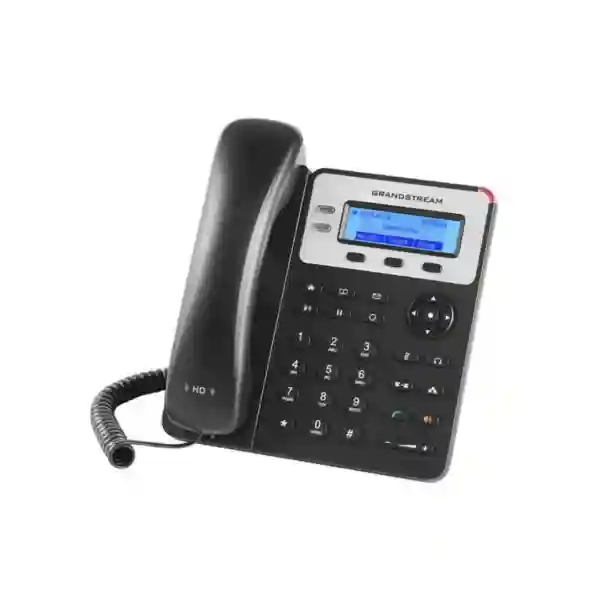
Grandstream basic business VoIP endpoint
Grandstream GXP1615 Tanzania
The Grandstream GXP1615 is a straightforward SIP desk phone designed for small businesses, branch offices, common areas and standard office users who need dependable voice calling without the complexity of a high-end executive endpoint. Grandstream positions the GXP1610/GXP1615 family as an easy-to-use small-business IP phone platform. The GXP1615 includes integrated IEEE 802.3af Power over Ethernet, dual switched 10/100 Mbps Ethernet ports, a 132×48 graphical LCD, three XML programmable context-sensitive soft keys, 3-way conferencing and support for an RJ9 headset connection with compatible electronic hook-switch accessories.
For organizations in Tanzania, the phone is most useful when considered as part of the complete voice environment rather than as an isolated handset. A successful deployment depends on the SIP PBX or hosted voice platform, Ethernet cabling, PoE capacity, VLAN design, Quality of Service, DNS, time settings, firmware control and a practical provisioning process. FourTeck Tanzania can help customers evaluate those dependencies before requesting a quotation for a single phone, a branch rollout or a wider IP telephony project.
Quick fit check
Best suited to standard office extensions, small businesses, shared work areas, light call-handling roles and users who value simple physical keys and PoE.
For heavy reception use, large BLF requirements, color displays, Gigabit switching or more advanced user features, compare a higher-tier endpoint before standardizing.
What the Grandstream GXP1615 offers
Grandstream’s current product information describes the GXP1615 as part of its basic IP phone range. The official datasheet and documentation identify dual switched auto-sensing 10/100 Mbps Ethernet interfaces, integrated PoE for the GXP1615, SIP-based operation, a compact 132×48 LCD, programmable soft keys, full-duplex speakerphone operation, 3-way conferencing, headset support, multilingual operation and enterprise-style provisioning and security controls. The model is therefore a sensible endpoint where the priority is ordinary business calling rather than an extensive display, integrated Wi-Fi or a large field of programmable line keys.
PoE convenience
Integrated IEEE 802.3af PoE can carry power and network connectivity over the Ethernet infrastructure when the connected switch or injector provides suitable PoE.
Practical call control
Dedicated function keys, soft keys, speakerphone, hold, transfer, forwarding and conference capabilities cover common office calling tasks.
SIP interoperability
The phone uses standard SIP signaling and supports a broad set of VoIP protocols and audio codecs, making PBX compatibility an important pre-purchase check rather than a proprietary lock-in assumption.
Provisioning and security
Grandstream documents HTTP/HTTPS and TFTP firmware methods, encrypted configuration support, TR-069, TLS, SRTP, HTTPS and 802.1X-related controls.
Verified technical highlights
| Network | Dual switched auto-sensing 10/100 Mbps Ethernet; integrated PoE on GXP1615 |
| Display | 132×48 graphical LCD |
| Call handling | Up to two call appearances, 3-way conferencing, hold, transfer, forwarding, call waiting, call history and related SIP telephony functions |
| Soft keys | 3 XML programmable context-sensitive soft keys |
| Audio | Full-duplex hands-free speakerphone; documented codec support includes G.711, G.722, G.723, G.726-32, G.729 A/B and iLBC |
| Headset | RJ9 headset interface with documented EHS support for compatible Plantronics headsets |
| QoS | Layer 2 802.1Q/802.1P and Layer 3 ToS/DiffServ/MPLS QoS mechanisms |
| Security | TLS, SRTP, HTTPS, 802.1X, administrator/user access controls and encrypted configuration support |
| Provisioning | TFTP, HTTP/HTTPS, FTP/FTPS and mass-provisioning methods documented by Grandstream |
Grandstream’s pages use slightly different wording across current product, datasheet and installation documents for line and account terminology. For procurement, the safest approach is to validate the exact firmware behavior and PBX account requirements against the intended deployment rather than assuming a higher account count from family-level documentation.
Where the GXP1615 fits in a business phone system
A phone such as the GXP1615 can be a strong fit for standard extension users because it focuses on the functions that ordinary employees use most frequently: answering, transferring, holding, redialing, conferencing, accessing contacts and working with a headset. It can also serve as a shared phone in a reception overflow position, storeroom, back office, workshop desk, guard station or other location where a simple Ethernet-connected SIP endpoint is preferable to a feature-heavy executive phone. The two-port Ethernet design can also simplify desk cabling in some layouts by allowing the phone to sit between a wall outlet and a computer, provided the network architecture and performance requirements are appropriate.
The GXP1615 should not be selected only because it is an entry-level model. Selection should start with user role. A receptionist handling many simultaneous monitored extensions may need a phone with more programmable keys, a larger display or expansion-module capability. An executive may want Bluetooth, Wi-Fi, Gigabit Ethernet or a color interface. A contact-center user may prioritize headset workflows and centralized call-control software. The GXP1615 is most attractive when the requirement is disciplined, uncomplicated SIP calling with PoE and a familiar physical keypad.
Compatibility, PBX and network planning
Before ordering the GXP1615, confirm the intended PBX, SIP service or hosted voice platform. Grandstream documents compatibility with Grandstream UCM features, but SIP environments vary in authentication, provisioning templates, dial plans, codecs, VLAN policies, certificates and feature support. A basic registration test may prove that a phone can place calls, while a complete deployment test should also cover transfer behavior, voicemail indication, caller ID, conferencing, hold, call pickup, emergency dialing policy, time synchronization and any organization-specific feature codes.
Network design matters because voice traffic is sensitive to delay, jitter and packet loss. A managed switch can help separate phones into a voice VLAN, provide the required 802.1Q tagging behavior, prioritize traffic and supply PoE. The GXP1615’s dual 10/100 Mbps ports are appropriate for many voice deployments, but organizations with desk computers that require Gigabit throughput should check whether placing the workstation behind a 10/100 phone is acceptable. Where it is not, use a separate data port or select an endpoint with Gigabit pass-through.
FourTeck Tanzania describes its IP phone and business telephony planning as part of a broader network approach that considers PoE, centralized provisioning and user roles. Buyers can also review the FourTeck Tanzania technology shop for procurement guidance covering IP phones, IP PBX, switches and supporting infrastructure, the FourTeck Tanzania services page when installation or configuration assistance is part of the requirement, the FourTeck Tanzania company overview for broader solution context, and the Tanzania contact page to request a quotation. The same Tanzania site also explains related planning for managed switching, Wi-Fi, firewalls and structured cabling on its main solution page, all of which are relevant when an IP phone deployment shares infrastructure with computers, cameras and wireless access points.
Buying and quotation checklist
State how many phones are required and whether users are general staff, shared-area users, managers or reception personnel.
Provide the IP PBX model, hosted service or SIP provider so registration and feature requirements can be checked.
Confirm whether the access switch supplies 802.3af PoE and whether its total power budget is sufficient for the number of phones.
Check whether users expect to connect a PC through the phone and whether 10/100 Mbps pass-through is acceptable.
Identify headset brand, connector and call-control expectations rather than assuming every headset accessory is interoperable.
Specify whether the request is supply-only or includes configuration, VLAN work, cabling, switch changes, testing, documentation and user handover.
Grandstream GXP1615 Tanzania
For Tanzania-wide procurement, the Grandstream GXP1615 is relevant to organizations that want a standardized desk-phone platform for ordinary business extensions. The decision is rarely just about the handset. A phone rollout interacts with the local area network, power design, internet or SIP connectivity, IP PBX, branch topology and user support process. In a small office, five or ten phones may be connected to a compact PoE switch and registered to one PBX. In a larger organization, dozens of endpoints may need voice VLANs, DHCP options, centralized configuration, naming standards, firmware control and documented extension assignments. The GXP1615 supports this type of structured deployment through standard SIP operation and network provisioning features, but the surrounding environment must be prepared correctly.
Tanzania buyers should first separate three questions: whether the GXP1615 matches the user role, whether it is compatible with the chosen voice platform, and whether the network can deliver stable voice. For a basic user who mainly answers, transfers and makes ordinary calls, the model’s graphical LCD, hard keys, speakerphone, conferencing and headset connection can be sufficient. For a receptionist who needs many monitored extensions, a different phone class may make more sense. Where users share one Ethernet outlet with a computer, the model’s 10/100 Mbps pass-through should also be considered against workstation bandwidth requirements. This is particularly important when offices use cloud applications, large file transfers or high-speed local systems.
Infrastructure planning should include PoE switch capacity, VLANs, QoS, UPS protection for switches and PBX equipment, DNS, NTP and firewall policy. The phone supports PoE, but PoE does not guarantee voice continuity if the switch itself loses power. Likewise, a strong internet connection does not guarantee good VoIP if the LAN is congested or SIP traffic is handled poorly. Tanzania projects often benefit from treating telephony as one service on the business network, with documented dependencies and clear ownership. Buyers can use FourTeck’s specialist IP phone resource for broader endpoint considerations and FourTeck’s IP PBX resource for PBX-oriented planning where multi-site standardization is being considered.
Grandstream GXP1615 Dar es Salaam
In Dar es Salaam, the GXP1615 can fit offices, professional services firms, retail back offices, schools, clinics, logistics operations and branch environments that need conventional desk extensions on an IP PBX. Urban connectivity options can make hosted or SIP-based voice practical, but call quality still depends heavily on the internal network. A business with reliable fiber can experience poor calls if phones, computers, CCTV and guest Wi-Fi share an unmanaged or overloaded network. For this reason, GXP1615 deployments should be planned around the switch ports, PoE budget, VLAN structure and firewall as much as around the quantity of handsets.
A Dar es Salaam procurement team should define which desks genuinely need this basic phone class. General administrative users, shared offices and routine extensions may be ideal. Front-desk positions that supervise many extensions may need a model with more keys and visual presence indicators. Managers may ask for color displays, Bluetooth or Gigabit Ethernet. Standardizing every employee on a single low-cost model can look simple at purchase time but may create workflow compromises. A user-role matrix is a better approach: basic phone for general extensions, richer endpoint for reception or executives, conference device for meeting spaces and cordless or Wi-Fi models where mobility is required.
For installation, decide whether each phone will connect directly to a PoE access switch or use a local power adapter. PoE is usually easier to manage because power is centralized, desk cabling is cleaner and UPS protection can be applied at the network rack. However, total switch power budget must be checked. If the phone is used as an Ethernet pass-through for a PC, note that the GXP1615 uses Fast Ethernet rather than Gigabit Ethernet. Offices that expect high workstation throughput may prefer separate network outlets or a Gigabit-capable phone. Configuration planning should also include extension numbers, caller ID naming, voicemail behavior, transfer methods, call groups, office hours, emergency routing and phonebook requirements.
When requesting a Dar es Salaam quotation, provide quantity, PBX platform, switch model, PoE availability, internet/SIP details and whether installation is required. This gives suppliers enough context to avoid pricing only the handsets while ignoring the accessories and infrastructure needed for successful deployment. The FourTeck Tanzania quotation contact can be used to submit those requirements.
Grandstream GXP1615 Mwanza
For businesses in Mwanza, the Grandstream GXP1615 can serve as a simple SIP endpoint for branch offices, service businesses, distribution operations, education facilities and administrative teams that need reliable desk calling. The model’s value is clearest when the communications design is standardized: each phone receives a known extension, VLAN, provisioning profile and support process. This helps a branch operate consistently even when the central PBX, IT team or call-routing logic is located elsewhere. A multi-site organization can use SIP telephony to make internal dialing more consistent between Mwanza and other offices, provided WAN connectivity, firewall policy and PBX architecture are designed for branch resilience.
Branch telephony deserves special attention to failure scenarios. If phones register across the internet or a private WAN to a central PBX, ask what happens when the link is unavailable. Some organizations accept temporary loss of internal calling, while others need local survivability, secondary registration or mobile fallback. The GXP1615 documentation includes server redundancy and fail-over related capabilities, but the actual behavior depends on the PBX and provisioning. Testing should therefore reproduce realistic outages rather than assume a feature name automatically produces the desired branch experience.
Power stability is another practical consideration. PoE makes desk deployment clean, but the access switch, router and PBX path need appropriate power protection if calls are expected to continue through short interruptions. UPS design should prioritize the network components that the phones depend on. Cabling also matters: damaged patch leads, poor terminations or an unmanaged switch inserted under a desk can undermine voice quality even when the phone itself is functioning normally. A clean installation should label the wall outlet, switch port and extension and record how the phone is provisioned.
Mwanza buyers comparing quotations should check whether prices include only hardware or also preconfiguration, installation, network changes, PBX licensing, cabling, support or travel. The GXP1615 itself does not remove those project dependencies. A precise bill of materials and deployment scope helps avoid surprises. For companies that maintain common standards across East Africa, FourTeck Uganda and FourTeck Kenya provide regional reference points for related branch technology requirements.
Grandstream GXP1615 Arusha
Arusha organizations may consider the GXP1615 for hotels’ administrative areas, tour operators, professional offices, NGOs, education environments and branch sites where staff need a conventional business handset connected to an IP PBX. The key advantage of an IP phone is not merely that calls travel over Ethernet; it is that extensions, routing rules, voicemail, call groups and management can be handled as part of a software-controlled voice environment. The GXP1615 offers the physical endpoint for that environment with PoE, SIP, speakerphone, headset connectivity and everyday call-control keys.
Hospitality and service organizations should distinguish guest-room telephony from staff-office telephony. The GXP1615 is better assessed as a general business endpoint than as a specialized hospitality handset. Front-office operations may also need more line monitoring than the model provides. For back-office users, accounting, reservations administration, procurement and ordinary desks, its feature set can be adequate if the PBX handles the more complex call-routing logic. The choice should be guided by call volume and workflow, not by a generic requirement to put the same phone everywhere.
Arusha sites should also consider network segmentation where phones share switches with cameras, Wi-Fi access points and computers. Voice traffic typically benefits from a dedicated VLAN and predictable priority. Managed PoE switching simplifies this design and provides better visibility than a chain of unmanaged desk switches. Where a PC is connected through the phone, the GXP1615’s 10/100 Mbps ports should be reviewed against the user’s data requirements. A separate network drop may be preferable for users who transfer large files or use high-bandwidth applications.
Procurement should include a configuration template, extension assignment plan, user labels, firmware policy and documented support method. A phone that arrives boxed but unprovisioned can consume significant technician time across many desks. Centralized configuration is more efficient where the environment supports it. If the project includes new switching, structured cabling or an IP PBX, review those components together rather than as unrelated purchase lines. FourTeck Tanzania’s main site describes this integrated approach, linking IP telephony with switches, structured cabling, firewalls and wider IT infrastructure.
Grandstream GXP1615 Dodoma
In Dodoma, the GXP1615 can be considered for government-adjacent offices, education, professional services, project offices, NGOs and commercial organizations that require structured desk telephony. The product is particularly suitable where IT teams want a familiar handset with standard SIP operation rather than consumer-style calling devices. Physical keys for transfer, conference, hold, mute, headset and speakerphone can reduce training effort for users moving from traditional office phones to VoIP.
A good Dodoma deployment starts with a call-flow map. List public numbers, departments, reception queues, extensions, after-hours routing, voicemail and escalation rules. Once the PBX logic is clear, decide which user types fit the GXP1615. A staff member with one ordinary extension may not need a larger executive phone. A receptionist who needs to watch many colleagues’ statuses probably does. Matching endpoint class to user role helps control cost without forcing staff into a phone that lacks the keys or display they need.
The network should be checked before installation. Confirm available switch ports, PoE support, total PoE budget, VLAN configuration, DHCP, DNS, NTP and firewall behavior. If a voice VLAN will be introduced, test how the phone learns tagging information and how a connected PC receives data-network access. Grandstream documents LLDP-MED and other enterprise network protocols, but actual behavior should be validated against the switches in use. If connectivity to the PBX crosses the internet, SIP security and remote-management exposure need careful configuration.
For procurement, buyers should ask for the exact GXP1615 model, quantity, included accessories and scope of service. Do not assume stock, delivery dates, warranty conditions or local installation coverage until a supplier confirms them in the quotation. If the phones are part of a broader office build, combine the voice requirement with cabling, racks, PoE switching, firewall and UPS planning. This reduces duplicated site work and creates clearer documentation for the IT team that will support the system after handover.
Grandstream GXP1615 UAE
For UAE businesses evaluating the Grandstream GXP1615, the model is best viewed as an entry business endpoint for offices that require simple SIP calling and integrated PoE. It can suit standard desks, shared work areas, back-office positions and branches where a basic phone is preferable to a feature-rich executive model. Procurement teams managing offices in both Tanzania and the UAE may also use the GXP1615 as part of a standardized endpoint strategy, provided the PBX platform and network design are consistent across locations.
UAE deployments often involve a mix of on-premises PBX systems, SIP-enabled platforms and managed voice services. Compatibility should be confirmed with the specific provider and local telecom arrangement rather than assumed from SIP support alone. Registration is only the first test. Transfer, conferencing, voicemail indication, caller ID, dial plans, emergency calling, call recording policy and any centrally managed phonebook should also be validated. Where encrypted SIP and media are required, the phone’s TLS and SRTP capabilities need to be configured in a way supported by the PBX.
Structured office environments can benefit from PoE because the access switch powers the handset and keeps desks free of additional adapters. IT teams should calculate total PoE consumption and preserve UPS capacity for the switches that support telephony. The phone’s Fast Ethernet ports are suitable for ordinary voice and many basic desk-data scenarios, but high-performance workstations may need separate Gigabit connectivity. This detail becomes important in UAE offices with high-speed LANs and cloud-heavy workflows.
For UAE-focused procurement and regional coordination, buyers can consult FourTeck’s Grandstream UAE resource for Grandstream-oriented requirements and FourTeck UAE for broader IT infrastructure needs. Where one IT team is responsible for multiple countries, keep firmware baselines, extension naming, VLAN conventions and configuration templates aligned so support staff can troubleshoot branches using the same process.
Grandstream GXP1615 Uganda
Uganda businesses can use the GXP1615 as a basic SIP desk endpoint for standard office extensions, branch users and shared locations. The PoE feature is useful when organizations want centrally powered phones connected to managed access switches. A voice deployment should, however, be designed around the full communications path: local switch, router or firewall, WAN or internet connection, SIP service and PBX. Any weak point can affect user experience even when the handset itself is operating correctly.
Multi-country businesses with teams in Uganda and Tanzania can benefit from standard extension numbering and common configuration templates. For example, branch phones can use the same button behavior, voicemail process and dial-plan rules even when the sites use different internet providers. Standardization reduces user training and makes remote support easier. The GXP1615 is most suitable for roles that do not need large numbers of BLF keys or advanced executive features. Reception, contact-center or management roles may justify more capable endpoints.
A Uganda procurement checklist should include quantity, PBX platform, switch capacity, PoE budget, VLAN design and any headset requirements. If desk PCs will share the phone’s network path, evaluate whether 10/100 Mbps pass-through is acceptable. Where users need higher data speeds, separate data cabling or a Gigabit-class endpoint can prevent the phone from becoming an unnecessary bottleneck. Cabling quality, UPS protection and clear labeling are also important for long-term support.
Organizations comparing GXP1615 quotations should separate hardware pricing from configuration and project services. Ask whether the quote includes extension setup, provisioning, PBX changes, network configuration, installation, testing and user handover. Confirm warranty, availability and delivery details directly rather than relying on generic web claims. For a related regional starting point, FourTeck Uganda can support Uganda-focused technology inquiries, while the Tanzania site remains useful for cross-border standardization discussions.
Grandstream GXP1615 Kampala
In Kampala, the GXP1615 can support ordinary extensions in business offices, NGOs, education, healthcare administration, retail headquarters and service companies that use SIP telephony. Its physical keypad and dedicated call-control buttons give users a familiar experience, which can be helpful when moving away from analog phones. The phone’s integrated PoE also simplifies desk power where managed PoE switches are already deployed.
The most important design question is whether the endpoint matches the calling role. Kampala reception desks with high inbound volume may need more programmable keys and a clearer status view of other extensions. General employees who mainly make and receive calls can often use a simpler model effectively. Headset users should test the specific headset and EHS accessory rather than assuming compatibility from connector type alone. Conference rooms should use dedicated conference solutions where several participants need to speak around a table; a desk speakerphone is not a substitute for purpose-built room audio.
Network administrators should reserve enough PoE budget and decide whether phones will have a dedicated voice VLAN. QoS can help protect voice when links become busy, but it needs end-to-end design. Tagging packets on the phone is not useful if the switch, router and WAN path ignore the markings. SIP traffic should also be handled carefully through firewalls. Avoid exposing phone management pages directly to the public internet, use strong administrator credentials and encrypted management methods where supported, and maintain a controlled firmware process.
For Kampala procurement, ask suppliers to state exactly what is included: handset, power adapter if applicable, network cable, configuration and installation services. Where phones are being added to an existing PBX, provide the PBX model and current firmware information. A small compatibility test before a large order can reveal differences in provisioning templates, feature codes or codec settings that would otherwise appear during rollout.
Grandstream GXP1615 Arua
For organizations in Arua, the GXP1615 may be useful where a branch requires straightforward business telephony connected to a central or local SIP platform. Branch deployments often benefit from simple endpoints because local staff can use familiar call controls while centralized IT teams manage extension settings remotely. The phone’s PoE capability can reduce local power adapters when a suitable switch is available, but branch resilience depends on more than the handset.
Connectivity planning is especially important when the PBX is located in another city or country. If voice signaling and media cross a WAN or internet link, confirm bandwidth, latency, firewall behavior and outage expectations. Decide what users should do if the link fails. Secondary SIP registration, mobile fallback or alternative calling processes may be appropriate depending on business criticality. Grandstream documents server redundancy and failover-related functions, but the complete solution must be tested with the selected PBX.
Power planning should cover the router, switch and any local PBX appliance, not only the phone. A PoE phone remains unavailable when the PoE switch loses power. UPS-backed network infrastructure can extend operation during short interruptions, subject to the capacity and condition of the UPS. Structured cabling, labeled switch ports and documented extension assignments also reduce the amount of local troubleshooting needed when support is delivered remotely.
Arua buyers should request a bill of materials that includes any required switches, injectors, patch cords, racks or UPS units alongside the handsets. If the project is supply-only, define who will configure the phones and whether the PBX already has a tested template. If installation is included, request acceptance testing for inbound calls, outbound calls, internal dialing, transfer, voicemail, conference and any branch-specific call routing. This turns the purchase into a verifiable deployment rather than a box-delivery exercise.
Grandstream GXP1615 Mbarara
Mbarara businesses that need a cost-conscious IP phone for standard extensions can evaluate the GXP1615 for offices, education, healthcare administration, distribution and professional services. The handset is designed around everyday SIP calling and includes enough local controls for common tasks without the complexity of a premium endpoint. This can make it easier to train users and standardize branch desks when the PBX provides the more advanced routing and voicemail functions centrally.
Before deployment, confirm the PBX architecture and the network topology. If the Mbarara site connects to a central PBX, the internet or private link becomes part of the phone system. If a local PBX is used, the organization needs a clear method for backup, firmware management and remote administration. In either case, voice VLANs and QoS can be useful, especially where phones share links with cloud applications, Wi-Fi, file transfers or CCTV. Network monitoring can help distinguish a handset problem from packet loss or congestion elsewhere.
PoE simplifies installation when switches are selected with enough power budget. Count the number of phones and other PoE devices, then compare the requirement with the switch’s total available wattage rather than only its number of PoE ports. If cameras and access points share the same switch, their higher power requirements may leave less capacity for phones. Planning this before purchase prevents later use of unplanned adapters and injectors.
For quotations, Mbarara customers should state whether existing cabling and switches will be reused. If they will, provide the switch models and expected number of free ports. Also note any need for headsets, wall mounting or specific user labels. Confirm current availability, warranty terms and delivery scope directly with the seller. The exact commercial terms can change and should not be inferred from a technical product page.
Grandstream GXP1615 Gulu
The GXP1615 can be a practical phone for Gulu organizations that want basic SIP extensions with centralized management potential. Its PoE capability is valuable in branch offices because power can be delivered through the network and supported by rack-level UPS systems. The two Ethernet ports can also simplify wiring at desks where one cable serves both phone and computer, although the Fast Ethernet speed should be checked against workstation needs.
Branch support strategy should be agreed before installation. A centralized IT team can maintain phone templates, extension assignments and firmware baselines, while local staff only handle simple physical checks. To make this work, configuration should be documented. Each device should have a known extension, user, location and switch port. When a phone is replaced, the new unit should be able to receive the correct configuration without lengthy manual programming. Grandstream supports several provisioning mechanisms that can help achieve this, depending on the environment.
Security practices should include changing default or weak credentials, restricting management access and using secure configuration transport where possible. SIP systems should not be exposed carelessly to the internet. Firewall rules, remote-access methods and PBX security settings are part of the same risk picture. Voice networks also need routine maintenance: firmware review, backup of PBX configuration, certificate monitoring where encrypted signaling is used, and periodic testing of call routes.
Gulu procurement teams should identify the number of users, concurrent call requirements, required public numbers and the call-routing plan before selecting all endpoint models. The GXP1615 may cover the majority of simple desks, while a smaller number of higher-tier phones can serve receptionists and managers. This role-based approach usually produces a more usable system than trying to force one device profile across every employee.
Grandstream GXP1615 Kenya
Kenya businesses can evaluate the GXP1615 for standard office extensions that need SIP, PoE and conventional desk-phone controls. The same considerations apply whether the organization uses an on-premises PBX, a hosted service or a regional voice platform: compatibility should be tested, the network must support reliable real-time traffic and endpoint choice should reflect user role. A basic desk phone is often appropriate for the majority of staff, while reception, management and high-call-volume users may require richer models.
For companies with sites in Kenya and Tanzania, endpoint standardization can simplify procurement and support. A common phone template can define language, time zone, ring tone, soft-key behavior, VLAN settings and PBX registration. Standard extension numbering can make cross-border internal dialing easier for users. The benefit is operational consistency, not merely a shared hardware model. Organizations should also standardize how firmware is approved and how replacement phones are enrolled.
The GXP1615’s 10/100 Mbps Ethernet interfaces should be considered in modern office networks. Voice itself needs little bandwidth, but a workstation connected through the phone may have higher expectations. If users routinely work with large files or high-speed local resources, a separate data port or Gigabit phone can be preferable. PoE switch sizing also needs to account for other powered devices such as access points and cameras.
When requesting Kenya pricing, procurement teams should provide the intended PBX, quantity, office locations, service scope and any accessories. Confirm whether the quotation includes taxes, delivery, configuration, installation or only the handset. For Kenya-specific regional requirements, FourTeck Kenya can be used as the matching regional FourTeck resource. Organizations responsible for multiple East African branches can also maintain one technical standard while sourcing and supporting each country according to local commercial conditions.
Grandstream GXP1615 Kuwait
Kuwait organizations considering the GXP1615 may use it for routine extensions in offices, back-office areas, retail administration and branch environments where a simple PoE SIP endpoint is sufficient. The phone’s design favors usability and core telephony over premium display and connectivity features. This makes role mapping important: select the GXP1615 for users whose work is dominated by ordinary calls, and reserve higher-end devices for roles that need more line keys, larger displays or richer connectivity.
SIP interoperability should be validated with the specific IP PBX or managed voice service. Kuwait deployments may involve enterprise networks with strict segmentation and security controls. The GXP1615 supports standard mechanisms such as 802.1Q VLANs, QoS markings, 802.1X, TLS and SRTP, but successful use depends on how the switching, authentication and PBX environment are configured. An IT team should test onboarding, certificate requirements, time synchronization and emergency-dial policies before large-scale rollout.
PoE is useful for centralized power, especially when phone switches are protected by UPS. Make sure total switch power capacity covers all endpoints and that network design avoids creating a single overloaded access switch. If a desktop computer connects through the phone, remember that the interface is 10/100 Mbps. High-throughput users should have separate Gigabit data connectivity or a different endpoint architecture.
Kuwait procurement teams should ask suppliers for current availability and commercial terms instead of relying on generic online listings. The technical specification is only part of a complete quote; installation, PBX configuration, accessories, structured cabling and support may be separate. For broader regional coordination, FourTeck Kuwait is the relevant FourTeck network resource for Kuwait-focused enquiries.
Grandstream GXP1615 Ghana
In Ghana, the GXP1615 can serve organizations that want a basic IP phone for daily desk use across offices, schools, healthcare administration, professional services and branch operations. Its combination of SIP, PoE, Fast Ethernet, speakerphone, programmable soft keys and headset support is oriented toward straightforward business calling. The phone is therefore most effective when paired with a well-designed IP PBX and network rather than being selected only by unit price.
A Ghana rollout should define extension roles and call flows before hardware quantities are finalized. Some users may need only one standard extension, while reception staff may need richer monitoring and transfer functions. Conference spaces should use dedicated room audio. Mobile employees may benefit more from soft clients or cordless devices. Treating the GXP1615 as one endpoint option within a communication architecture leads to better results than forcing the same model into every role.
Network readiness includes switch ports, PoE budget, voice VLANs, QoS, DHCP and firewall configuration. The phone’s two 10/100 Mbps Ethernet ports can help reduce desk cabling, but high-speed workstation traffic may justify a different connection method. Organizations should also consider UPS capacity for the switches and internet edge if voice availability is important during short power events.
Security and management should be planned from the beginning. Use controlled administrator credentials, secure management transport where supported and a documented firmware process. If phones are provisioned remotely, restrict access to configuration resources. Test the actual PBX features users depend on, including transfer, voicemail indication, call pickup and conference behavior. Ghana-focused buyers can use FourTeck Ghana as the regional FourTeck reference while maintaining common technical standards across other branch countries.
Grandstream GXP1615 Nigeria
Nigeria businesses evaluating the GXP1615 can consider it for ordinary SIP extensions in offices and branches where a simple physical handset is preferred. The phone’s integrated PoE and standard network features make it suitable for centrally managed office networks. However, telephony availability depends on the complete infrastructure path, including power, switching, PBX, WAN and SIP connectivity. A phone project should therefore include resilience planning instead of assuming that endpoint hardware alone determines reliability.
Power architecture deserves particular attention in sites where uptime matters. PoE allows phones to draw from a central switch, which can simplify backup if the switch, router and PBX are connected to appropriate UPS or generator-backed infrastructure. The duration of backup depends on actual load and battery condition. Businesses should calculate the requirement rather than make generic assumptions. For multi-site organizations, define what calling features remain available if connectivity to a central PBX is interrupted.
The GXP1615 is best for standard users rather than roles that need a large number of monitored extensions. Procurement teams can reduce cost by using different endpoint tiers: basic phones for ordinary staff, richer phones for managers or reception, and specialized conference or cordless devices where required. Network teams should also review Fast Ethernet pass-through where a PC is connected behind the phone.
A Nigeria quotation request should state quantity, PBX platform, location count, existing switch models, PoE capacity, headset needs and whether configuration or installation is required. Confirm current stock, warranty, delivery and commercial terms directly with the supplier. Nigeria-focused FourTeck enquiries can be directed through FourTeck Nigeria, while organizations operating in Tanzania can use the Tanzania contact path for their local project scope.
Grandstream GXP1615 Seychelles
Seychelles businesses, hospitality operators, professional offices and distributed organizations may consider the GXP1615 for back-office and administrative extensions that need a simple SIP desk phone. In island or multi-site environments, centralized IP telephony can help standardize extension behavior across locations, but network reliability and support logistics should be considered carefully. A basic endpoint can be advantageous because it reduces user complexity while still supporting central PBX features.
Hospitality organizations should define whether phones are intended for guest rooms, front office, administration or operations. The GXP1615 is more naturally aligned with ordinary business desks than specialized hotel-room deployments. Front-office roles may require more keys and extension visibility, while administrative users may fit the model well. Endpoint selection should therefore be based on call-handling workload rather than building-wide uniformity.
For network design, PoE can simplify desk installation and enable centralized backup, but switch capacity must be checked. Sites that share switching between phones, Wi-Fi and cameras should account for total PoE demand and data traffic. Voice VLANs, QoS and clean cabling can improve maintainability. If a PC connects through the phone, the Fast Ethernet interface should be reviewed against the expected data rate.
Seychelles procurement may involve longer logistics chains than a local city purchase, so confirm lead time, warranty handling and replacement procedures in the formal quotation. Where a failed phone would disrupt a critical role, maintaining a small tested spare pool can be more practical than depending on emergency shipment. Keep spare units on approved firmware and document the process for assigning a replacement extension. This turns the GXP1615 into part of an operational support plan rather than a one-time hardware purchase.
Related FourTeck Tanzania solution areas
A GXP1615 rollout often touches several technology categories already described by FourTeck Tanzania. The site’s IP PBX and VoIP coverage explains why extensions, IVR, queues, voicemail and call routing should be planned together. Its IP phone guidance emphasizes matching endpoints to user roles and considering PoE and centralized provisioning. Its network-switching guidance is relevant because managed PoE switches provide the physical access layer for phones. Structured cabling and UPS planning affect the reliability of every endpoint, while firewall configuration can influence SIP connectivity and remote branches. Because the current Tanzania site groups these subjects on the same main solution page rather than publishing separate category URLs for every subsection, use the verified FourTeck Tanzania solutions homepage, Tanzania technology shop, services overview, company overview and contact page as verified entry points rather than inventing product-category URLs.
Frequently asked questions about the Grandstream GXP1615
Does the Grandstream GXP1615 support PoE?
Yes. Grandstream documents integrated IEEE 802.3af PoE for the GXP1615. The connected switch or PoE injector must provide suitable power, and the switch’s total PoE budget should be checked for multi-phone deployments.
Can the GXP1615 connect a computer through the phone?
The phone has dual switched 10/100 Mbps Ethernet ports, so it can be used in a desk topology where the network passes through the phone to another device. Because the ports are Fast Ethernet rather than Gigabit Ethernet, check whether the workstation’s bandwidth requirements make this design appropriate.
Does the GXP1615 support conferencing?
Grandstream documents 3-way voice conferencing for the GXP1615. PBX-based conferencing features can be different and should be tested separately.
Can the GXP1615 use a headset?
Yes. Grandstream documents an RJ9 headset jack and EHS support with compatible Plantronics headsets. Verify the exact headset and EHS accessory before ordering, especially for large deployments.
What PBX can the GXP1615 use?
The GXP1615 is a SIP phone and Grandstream specifically documents compatibility with Grandstream UCM features. Compatibility with other SIP PBX and hosted platforms depends on their supported registration, provisioning and feature methods, so a test with the intended platform is recommended.
Is the GXP1615 suitable for a receptionist?
It can handle ordinary calls, transfers and conferencing, but high-volume reception roles often benefit from more programmable keys, stronger extension monitoring and larger displays. Compare the user workflow before choosing a standard endpoint for reception.
Does the GXP1615 require a power adapter?
It can be powered using PoE when connected to suitable 802.3af infrastructure. Grandstream’s package and power documentation should be checked for the exact supplied unit and regional packaging before procurement; do not assume every seller bundles accessories identically.
How should a business prepare for a multi-phone rollout?
Define extension numbers, user roles, PBX settings, voice VLANs, PoE capacity, firmware baseline, provisioning method and acceptance tests before installation. Document each phone’s user, extension and switch port so replacement and troubleshooting remain predictable.
Decision recap
Choose the Grandstream GXP1615 when you need a simple SIP desk phone with integrated PoE, dual 10/100 Ethernet, a compact graphical display, familiar hard keys, headset connectivity, conferencing and centralized provisioning options. Before standardizing it across an organization, confirm that Fast Ethernet is acceptable for any connected workstation, that the PBX supports the required features and that heavy call-handling roles do not need a richer endpoint.
For Tanzania deployments, plan the handset with the IP PBX, PoE switches, voice VLAN, cabling, firewall and UPS strategy. A well-prepared quotation should identify quantity, exact deployment scope, PBX platform, network dependencies and accessories so the project is evaluated as a working communication system rather than a standalone device purchase.
Consultation and quotation preparation
When contacting FourTeck about the Grandstream GXP1615, share the required quantity, office or branch locations, current PBX or intended SIP service, network-switch models, PoE availability, headset requirements and whether you need supply only or a complete deployment. If this is an upgrade, include the existing phone models and any problems you want the new design to solve. If this is a new office, include the planned extension count, reception requirements, public numbers, call queues and any need for cross-branch dialing.
This information allows the quotation discussion to cover the phone, switching, cabling and PBX dependencies accurately without making unsupported assumptions about stock, delivery time, warranty or regional service coverage.




Reviews
There are no reviews yet.