
Dinstar UC350 Pro IP PBX Tanzania
The Dinstar UC350 Pro IP PBX is built for organizations that need a high-capacity business phone system with enterprise call handling, modular telephony interfaces, centralized administration and room to scale. Dinstar positions the UC350 Pro as the higher-capacity model in the UC350 series, supporting up to 5,000 SIP extensions and up to 500 concurrent calls. It combines IP telephony with traditional voice connectivity through modular FXS, FXO and E1/T1 options, helping larger offices, multi-branch businesses, institutions, service organizations and contact-center environments consolidate communications around one manageable platform.
For Tanzania buyers, the practical value is not simply the headline extension count. A successful deployment also depends on SIP trunk planning, network quality, extension numbering, call-flow design, voice VLANs, Quality of Service, firewall policy, power protection, endpoint selection, recording requirements and a migration plan from any existing PBX. FourTeck can help organizations evaluate those dependencies before a quotation is finalized. Explore the broader FourTeck Tanzania IT and telecom portfolio for related networking, security, IP phone and infrastructure requirements.
Maximum SIP extensions on the UC350 Pro according to Dinstar.
Maximum concurrent calls for high-volume enterprise communication.
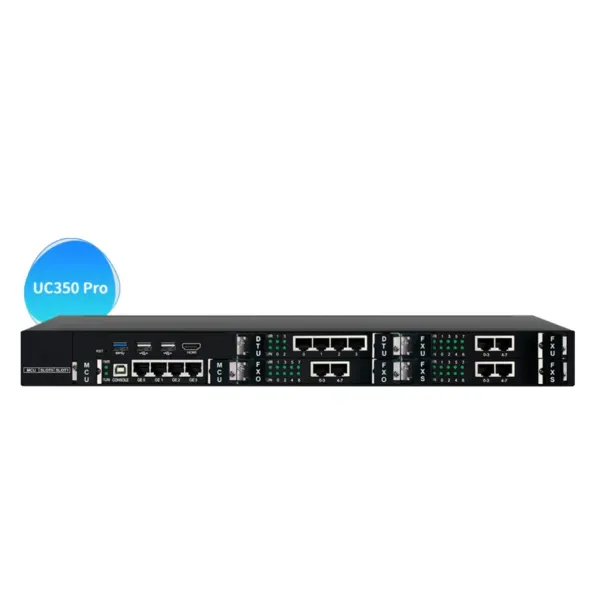
User-board slots for flexible FXS, FXO, mixed FXU or E1/T1 board combinations.
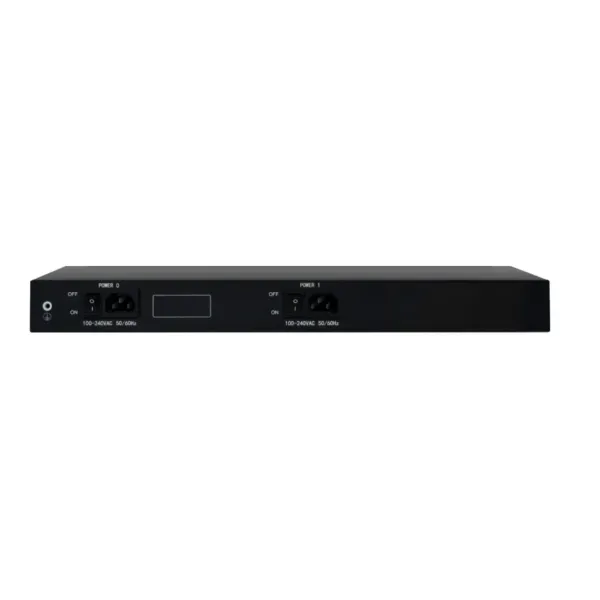
Redundant power-supply design for improved continuity in enterprise deployments.
What the Dinstar UC350 Pro Solves
Growing organizations often reach a point where a basic office PBX becomes difficult to scale. New branches create separate numbering plans, receptionists need more sophisticated call distribution, departments require queues and ring groups, management asks for recording and reporting, and legacy PSTN or analog devices still need to coexist with SIP services. The UC350 Pro addresses this type of mixed environment by combining IP PBX functions with modular telephony interfaces in a 19-inch, 1U rack-mounted appliance.
Its role is to become the call-control core. SIP phones and softphones can register to the platform, SIP trunks can connect external calling services, and optional boards can provide FXS, FXO or E1/T1 connectivity where legacy lines or devices remain necessary. Dinstar also lists multi-level IVR, call queues, ring groups, voicemail, voicemail-to-email, call recording, conferencing, call transfer, call park, paging, intercom, flexible routing, DID handling, phonebook functions and attendant-console support among the platform’s capabilities.
This makes the system relevant when an organization wants to standardize telephony across departments while retaining migration flexibility. Rather than replacing every analog endpoint or trunk on day one, planners can determine which components should move to SIP immediately and which should remain connected through the PBX’s modular interfaces during a phased transition.
Verified Dinstar UC350 Pro Features
High-capacity SIP platform
The UC350 Pro supports up to 5,000 SIP users and 500 concurrent calls. These figures make it suitable for larger organizations, multi-site deployments and environments with substantial simultaneous call activity, subject to proper trunk capacity, network design and endpoint planning.
Modular voice interfaces
Four user-board slots support combinations of FXS, FXO, mixed FXS/FXO and E1/T1 boards. This is valuable for enterprises that need to bridge SIP telephony with analog extensions, PSTN lines or digital trunks.
Reliability-oriented design
Dinstar documents hot-standby capability, redundant power, hot-swappable telephony boards, flexible routing, PSTN failover and load-balancing features. Deployment design should still include suitable UPS capacity, network redundancy and tested failover procedures.
Security functions
The platform includes TLS, SRTP and ZRTP encryption support along with Fail2ban, whitelist, blacklist, ACL and an integrated IP firewall. These controls should be incorporated into a broader voice-security architecture rather than treated as a substitute for perimeter security and disciplined administration.
Enterprise call handling
Multi-level IVR, queues, ring groups, call transfer, pickup, forwarding, conferencing, voicemail, recording, paging, intercom and attendant-console functions help structure complex inbound and internal call flows.
Administration and diagnostics
Dinstar provides a web interface, automatic phone deployment, monitoring, alarms, logs and diagnostic functions. Good operational practice includes documented extension plans, configuration backups, admin-role separation and change control.
Technical Planning Before You Buy
Capacity should be selected from real traffic, not only employee count. A company with 1,000 extensions might require relatively few concurrent external calls, while a contact center with fewer users can generate much heavier simultaneous traffic. Prepare the number of users, busiest-hour call volume, expected SIP trunks, inbound numbers, recording policy, conference requirements, branch count, analog devices, E1/T1 needs, remote users and growth horizon. This information helps determine whether the UC350 Pro capacity is appropriate and what interface boards are required.
The LAN must also be voice ready. Managed switching, VLANs, PoE budgets for IP phones, stable uplinks, QoS policy and reliable DNS/NTP services all affect user experience. Voice should not simply be connected to an unmanaged network and expected to perform consistently. FourTeck’s Tanzania portfolio also covers network switching and security, allowing the PBX discussion to be tied to the infrastructure it depends on.
Dinstar UC350 Pro Tanzania
For organizations evaluating the Dinstar UC350 Pro in Tanzania, the key decision is whether the business needs a central enterprise PBX with enough capacity and interface flexibility to support present communications while leaving headroom for expansion. Tanzania deployments can range from a head office in Dar es Salaam with regional branches to education groups, healthcare organizations, financial operations, hospitality groups, logistics businesses, government institutions and service companies that need a single extension plan across multiple sites. In these environments, the UC350 Pro can act as the central SIP call-control platform while branch phones, SIP trunks and selected legacy interfaces are integrated according to the organization’s network architecture.
A Tanzania procurement exercise should start with a communication inventory. Count existing extensions, direct numbers, hunt groups, reception positions, call queues, analog handsets, fax devices, door phones, paging endpoints and any digital trunks. Then document which services must survive during migration. If an existing PBX is being replaced, a phased approach may be preferable: configure the new extension plan, test SIP trunks and a pilot group, validate inbound and outbound routing, then migrate departments in controlled stages. The UC350 Pro’s modular interface options can help where analog or E1/T1 connectivity must remain during the transition.
Network readiness is equally important. Voice traffic needs predictable latency, adequate bandwidth and disciplined switching. For multi-branch Tanzania organizations, WAN links should be assessed for stability, failover and QoS. Security policy should define who can administer the PBX, whether remote extensions are allowed, how SIP signaling is protected and how voice services traverse the firewall. Recording should be treated as a business and governance requirement, with storage and access permissions planned accordingly.
For a quotation, provide user count, concurrent-call estimate, number of locations, trunk type, required analog/digital interfaces, recording needs, IP phone quantities and expected growth. FourTeck can then align the PBX with related IP phones, switching, firewall and structured-network requirements rather than treating the appliance as an isolated purchase.
Dinstar UC350 Pro IP PBX Dar es Salaam
Dar es Salaam organizations often operate from larger offices, commercial facilities, logistics environments, customer-service centers and multi-floor business premises where telephony must be coordinated with the data network. For a buyer considering the Dinstar UC350 Pro IP PBX in Dar es Salaam, a useful starting point is the building and department structure. Reception may need an attendant workflow, sales may require hunt groups or queues, finance may need controlled call permissions, management may need direct numbers, and service teams may require recording or reporting. The UC350 Pro provides the capacity and call features to consolidate these requirements under one platform.
A multi-floor deployment should be designed around structured cabling and managed switching. IP phones may be powered by PoE switches, with voice VLANs separating call traffic from general user data. Uplink capacity between floors and the core should be assessed, and DHCP provisioning should be documented so phones can be replaced or added efficiently. If the office currently uses analog extensions or PSTN lines, optional FXS and FXO boards can provide a migration path while SIP adoption expands.
For larger Dar es Salaam sites, business continuity deserves special attention. The PBX itself supports reliability features, but the surrounding design also matters: redundant internet where SIP trunks depend on IP connectivity, UPS protection for the PBX and switching, tested routing fallback, and clear procedures for failures. Where the business has remote warehouses or branches, extension dialing can be standardized so employees call colleagues by extension rather than maintaining separate local telephone systems.
When requesting a UC350 Pro quotation for Dar es Salaam, include the number of buildings, floors and departments, current telephone lines, desired direct inward dialing, peak call volume, call-recording policy, remote-user requirements and any integration expectations. That produces a more useful proposal than requesting the appliance alone because the required interface boards, network accessories, IP phones and deployment effort can be scoped together.
Dinstar UC350 Pro IP PBX Mwanza
Mwanza businesses evaluating an enterprise IP PBX may be planning a new office, replacing an aging PBX or connecting multiple operational sites. The Dinstar UC350 Pro suits projects where extension growth, centralized management and mixed SIP/legacy connectivity are important. Rather than sizing the system only from today’s headcount, a Mwanza buyer should map expected growth over the useful life of the deployment. New departments, branches, customer-service teams and remote employees can all increase extension and concurrent-call requirements even when the original office footprint remains unchanged.
A strong design starts with call flows. Define what should happen when a customer calls the main number: which IVR options are offered, how calls reach departments, what happens after hours, how unanswered calls are escalated and whether voicemail or queue announcements are required. These workflows should be documented before installation so users receive consistent behavior. The UC350 Pro’s multi-level IVR, queues, ring groups, follow-me and routing features provide the tools for this type of structured call handling.
Connectivity should also be reviewed carefully. If SIP trunks are supplied over internet or private IP connectivity, the WAN path must be stable enough for voice. Branch links should be assessed for latency and congestion, especially where large file transfers or cloud applications share bandwidth. Managed QoS can prioritize voice, while VLAN segmentation helps keep phones organized and easier to troubleshoot. A firewall policy should permit only the services genuinely required for telephony and remote administration.
For procurement in Mwanza, list existing analog devices that cannot yet be replaced, any FXO lines, E1/T1 needs, phone models, headset requirements and recording expectations. This clarifies whether optional boards are necessary and avoids buying interfaces that will remain unused. A well-scoped UC350 Pro project should result in a maintainable communication platform with documented numbering, routes, credentials, backups and support procedures.
Dinstar UC350 Pro IP PBX Arusha
Arusha has business environments where telephony can span hospitality, tourism, professional services, education, administration and multi-site operations. For these organizations, the Dinstar UC350 Pro offers a centralized approach to extension management and call routing. Hospitality or service businesses, for example, may have front-desk, reservations, accounts, management and back-office teams with very different calling patterns. A properly designed PBX should reflect those workflows rather than assign extensions without a structured routing plan.
The UC350 Pro is particularly useful when a site needs both SIP endpoints and traditional interfaces. Optional FXS interfaces can support selected analog devices, FXO can connect compatible analog lines, and E1/T1 boards can address digital trunk requirements where applicable. Buyers should confirm the exact current carrier service and interface requirement before selecting boards. Over-specifying interface cards increases cost, while under-specifying them can delay migration.
For Arusha deployments serving guests, customers or external partners, voice quality directly affects perceived service. The LAN therefore needs predictable performance. PoE switch capacity should cover all phones with sensible reserve, VLAN configuration should separate voice where appropriate, and cabling should be tested. For branch and remote extensions, the WAN path and security configuration become part of the phone-system design. TLS and SRTP support can contribute to protecting signaling and media, while firewall policies and strong administrator credentials remain essential.
A useful quotation request should include peak-season staffing where relevant, not only average headcount. If the organization adds temporary users or expands customer-service capacity during busy periods, that should influence endpoint count and trunk planning. Recording retention, voicemail use, after-hours routing and emergency-call policy should also be decided before commissioning. The objective is to build an Arusha business telephony environment that remains understandable and supportable as staff, departments and sites change.
Dinstar UC350 Pro IP PBX Dodoma
For organizations in Dodoma, including administrative offices, institutions, education environments, professional organizations and expanding enterprises, a high-capacity IP PBX can simplify communication when extension numbering and call routing have grown fragmented. The Dinstar UC350 Pro supports a large SIP-user population and provides call-control features that can centralize departmental telephony, branch extensions and external trunks. The value is strongest when deployment is accompanied by clear governance: who receives which extension, which users may make external calls, which departments require recording and who can modify system configuration.
Before installation, map the organization’s operational hierarchy into a sensible dial plan. Separate extension ranges can be allocated to departments or sites while still allowing short internal dialing. Main numbers can reach IVR menus, reception positions or queues depending on the organization’s service model. Time-based routing can send calls differently during office hours, evenings, weekends or public holidays. These decisions are better made during design than after users have already adopted inconsistent calling practices.
Dodoma buyers should also plan for power and network continuity. The UC350 Pro includes 1+1 redundant power support, but availability still depends on upstream switches, routers, firewalls and connectivity. UPS sizing should cover the communications chain that must remain active during short power interruptions. If SIP trunks use internet access, secondary connectivity may be considered for critical operations, with failover thoroughly tested rather than assumed.
When preparing procurement documentation, state required user capacity, concurrent external calls, number of reception operators, analog and digital interfaces, voicemail needs, conferencing use, recording, branch connectivity and security requirements. This allows the PBX, interface cards, IP endpoints and surrounding network components to be treated as a complete communication system rather than unrelated line items.
Dinstar UC350 Pro IP PBX UAE
Organizations procuring the Dinstar UC350 Pro for UAE projects typically need a structured enterprise telephony platform that can accommodate headquarters, branches, reception workflows, contact-center functions and a mix of SIP and legacy voice connectivity. The UC350 Pro’s capacity of up to 5,000 SIP extensions and 500 concurrent calls makes it relevant to larger deployments, while its modular user-board slots provide options for FXS, FXO and E1/T1 integration. Exact carrier and regulatory requirements should always be confirmed for the specific deployment before trunk or gateway architecture is finalized.
UAE deployments often include well-developed LAN infrastructure, but voice still needs deliberate configuration. IP phones should be connected to appropriately sized PoE switching, voice VLANs should be defined where useful, QoS policy should be applied consistently, and firewall rules should be limited to required signaling, media and management paths. If remote extensions or branch connectivity are part of the design, encryption, VPN architecture and public exposure of SIP services require careful security review.
For multi-office organizations, the PBX can support a unified extension plan so teams in different locations behave as one telephone environment. Reception and call queues can be centralized or distributed based on operational need. Dinstar’s IVR, ring group, routing, recording and attendant features can then be configured around actual business processes rather than generic defaults.
Regional buyers can also review FourTeck UAE integrated IT and telecom solutions when the PBX project requires supporting network, firewall, IP phone or infrastructure components. A complete quote should identify site count, users, simultaneous calls, trunk type, endpoint mix, analog requirements, recording capacity and required implementation scope.
Dinstar UC350 Pro IP PBX Uganda
For Uganda organizations, the Dinstar UC350 Pro can provide a central platform when business telephony spans headquarters, regional branches, service desks and remote users. A common challenge in growing organizations is that each location acquires phones and lines independently, leading to inconsistent numbering, duplicated administration and expensive inter-site calling arrangements. Centralizing around an IP PBX makes it possible to define one extension strategy and manage routing policies from a common system, provided the WAN and security design are suitable.
The UC350 Pro’s modular interfaces are useful where the transition to SIP is gradual. Existing analog handsets, PSTN lines or digital trunks may still need to operate while departments move to IP phones. The correct mix of FXS, FXO or E1/T1 boards should be based on a physical and carrier inventory rather than assumptions. At the same time, SIP trunks and branch endpoints should be sized from concurrent-call demand, not total employee count.
Uganda deployment planning should include connectivity resilience. If branch phones register across WAN links, the quality and availability of those links influence call stability. QoS, bandwidth monitoring and suitable failover can reduce disruption. The PBX’s security capabilities should be combined with strong firewall policy, restricted administration, secure passwords and current firmware practices.
FourTeck’s Uganda IT and VoIP solution portfolio provides a regional context for related PBX, networking and security requirements. For a useful quote, provide user count, branches, current trunks, required direct numbers, analog equipment, queue and IVR needs, recording policy and anticipated growth.
Dinstar UC350 Pro IP PBX Kampala
Kampala businesses considering the UC350 Pro are often looking for more than basic extension dialing. Larger offices may need departmental queues, professional IVR menus, reception handling, call recording, direct inward dialing, branch connectivity and policy-based call permissions. The Dinstar platform provides the building blocks for these workflows, but they should be translated into a documented call-flow design before configuration starts.
A Kampala head office may also become the communications hub for other Uganda branches. In that design, the PBX can be located in a secure equipment room or data center environment while remote extensions connect over managed WAN or secure IP paths. The choice between centralized and distributed telephony depends on branch connectivity, business-continuity requirements and the consequences of a WAN outage. Critical sites may require fallback options or local survivability planning beyond the PBX itself.
Endpoint planning matters as well. Receptionists may need phones with more programmable keys or an attendant console, executives may need multi-line devices, standard staff may need simpler SIP phones, and mobility users may rely on softphones. Selecting endpoints by user role controls cost while preserving usability. PoE switching, cabling and VLAN design should be included in the scope so phone deployment is not delayed by network shortcomings.
When requesting pricing for Kampala, include branch topology, expected simultaneous calls, SIP service details, required legacy interfaces, endpoint quantities and recording needs. A proper proposal should clarify what is included in hardware, licenses if applicable to the selected configuration, implementation, phone provisioning, trunk setup, testing and documentation. This avoids comparing quotes that appear similar but cover different levels of deployment work.
Dinstar UC350 Pro IP PBX Arua
Arua organizations planning a business phone upgrade may prioritize simplicity, stable branch communication and the ability to expand without replacing the core PBX. The Dinstar UC350 Pro provides substantial capacity, making it more appropriate when the system will serve many users, multiple branches or a long growth horizon. For a smaller standalone office, buyers should still compare required capacity against the broader Dinstar range rather than selecting the largest model by default.
Where Arua is connected to a larger national organization, centralized extension dialing can improve internal communication. Staff can call headquarters or other branches using short extensions, while external calls are routed according to policy. This architecture depends on reliable IP connectivity and should include a plan for what happens when the WAN is unavailable. The answer may involve alternate routing, mobile fallback, local trunks or business procedures depending on how critical telephony is to operations.
Migration planning should identify every analog dependency. Fax machines, security panels, paging interfaces or legacy handsets may need FXS connectivity, while analog PSTN lines can require FXO. If digital E1/T1 service exists, the correct board and carrier parameters must be confirmed. Documenting these items before procurement prevents surprises during commissioning.
Security should be treated as part of deployment from the beginning. Restrict management interfaces, use strong credentials, limit unnecessary SIP exposure, configure ACLs and monitor logs. For remote phones, use secure signaling and media where supported by the complete endpoint and trunk environment. A successful Arua installation is one where the PBX, connectivity, power, endpoints and support process are all planned together.
Dinstar UC350 Pro IP PBX Mbarara
Mbarara businesses, education groups, healthcare organizations and service providers can use an enterprise IP PBX to replace fragmented telephone arrangements with centrally managed extensions and routing. The UC350 Pro is designed for high-capacity unified communications, so it is best evaluated in projects where user scale, branch integration or significant call traffic justifies an enterprise-class platform. The system can combine SIP endpoints with optional analog or digital voice interfaces, which is valuable when migration must preserve existing telephone assets.
A Mbarara implementation should begin by separating user capacity from traffic capacity. Five thousand registered extensions does not mean every user can make an external call at the same time; the platform supports up to 500 concurrent calls, and actual carrier trunk capacity may be lower. Estimate peak simultaneous calls and add realistic growth headroom. Then identify queue concurrency, conference use and recording demands that may affect system and storage planning.
Department workflows should be translated into IVR options, hunt groups, queues and escalation paths. For example, a healthcare organization may route reception, appointments and administration differently, while an education environment may separate admissions, finance, academic departments and security. The PBX should support business processes rather than forcing every caller through a single generic route.
Infrastructure planning includes PoE switching, voice VLANs, QoS, secure firewall policy, UPS power and documented cabling. If branches register back to Mbarara, test WAN performance during busy periods rather than relying on nominal bandwidth. Procurement documentation should then cover PBX hardware, interface boards, SIP phones, headsets, switching additions, installation, configuration, testing, user training and post-deployment support expectations.
Dinstar UC350 Pro IP PBX Gulu
For Gulu organizations with expanding teams or distributed sites, the Dinstar UC350 Pro can serve as a long-term communication core when a smaller PBX would be constrained by extension count, trunk interfaces or call-processing capacity. Its enterprise feature set supports structured inbound calling, internal extension dialing, call queues, voicemail, recording and multi-level IVR. The challenge is to configure these features around real workflows so users receive a simple experience despite the complexity behind the scenes.
Start with a numbering plan that can accommodate growth. Reserve ranges for departments and branches so future users can be added without renumbering the organization. Define outbound call permissions by role, identify emergency dialing requirements and document how caller ID should be presented. Incoming numbers should have clear destinations during office hours and after hours. If the organization has a centralized reception function, overflow and no-answer behavior should be designed before go-live.
For Gulu branches connected to a national PBX, WAN performance and resilience become core telephony requirements. A data link that feels acceptable for email may still produce poor real-time voice if latency, jitter or packet loss are high. QoS, traffic prioritization and backup connectivity should be considered based on business criticality. Endpoint provisioning should also be standardized so replacement phones can be deployed predictably.
The UC350 Pro includes security tools such as Fail2ban, ACLs and encrypted SIP/media support. These features are most effective when administration is restricted, logs are reviewed and network security is designed consistently. A quotation for Gulu should therefore include not just PBX capacity but the surrounding connectivity, endpoint and security scope required for a dependable rollout.
Dinstar UC350 Pro IP PBX Kenya
Kenya organizations evaluating the Dinstar UC350 Pro typically need enterprise call handling, substantial extension capacity or a way to connect multiple sites under one telephony plan. The appliance supports up to 5,000 SIP extensions and 500 concurrent calls, making it suitable for larger business environments when traffic and growth justify the capacity. Buyers should still size the solution carefully because telephone-system design involves trunks, endpoints, network capacity, recording and operational workflows in addition to the PBX chassis.
A national organization may centralize the UC350 Pro in a primary location and register branch phones over IP connectivity. This can simplify numbering and administration, but branch survivability needs to be considered. If WAN connectivity fails, determine whether local calling must continue, whether alternate trunks are available and how customers should reach the branch. These decisions affect topology and may require additional equipment beyond the central PBX.
The platform’s modular FXS, FXO and E1/T1 capabilities can support mixed environments during migration. Before selecting boards, document existing carrier interfaces and legacy devices. SIP adoption can then be staged without unnecessary disruption. For cybersecurity, use restricted management, strong authentication, network segmentation and carefully defined firewall rules in addition to the UC350 Pro’s built-in protections.
Kenya customers can review FourTeck Kenya VoIP PBX and network solutions for related regional requirements. A quotation should specify users, sites, concurrent calls, trunk services, interface boards, IP phones, call recording and implementation scope so commercial comparisons reflect equivalent solutions.
Dinstar UC350 Pro IP PBX Kuwait
Kuwait enterprises considering the UC350 Pro may be replacing traditional PBX infrastructure, consolidating branches or expanding an existing SIP environment. The Dinstar platform combines a large SIP-extension capacity with modular analog and E1/T1 interfaces, enabling a staged transition where legacy connectivity cannot be removed immediately. This flexibility is important in complex sites because telephony migrations frequently involve dependencies that are not visible in an initial equipment list.
Before procurement, inventory all trunks and endpoints and classify them as SIP, analog or digital. Confirm which services are carrier-provided and which are internal. Then estimate concurrent traffic, including inbound service lines, outbound calls, conferencing and call-center use. Recording needs should be quantified separately because retention duration, call volume and access policy influence operational planning.
Enterprise Kuwait sites often have strong network infrastructure, but voice still needs consistent QoS, VLAN and security configuration across access switches, core networks and firewalls. Remote sites may use private WAN or VPN connectivity, and the architecture should account for failover. Dinstar’s TLS, SRTP, ACL and attack-defense functions can contribute to a layered security approach, while configuration backups and administrator-role controls support ongoing manageability.
For regional planning, FourTeck Kuwait IT, VoIP PBX and network security solutions provide a relevant supporting portfolio. A complete commercial request should include PBX hardware, boards, phone quantities, SIP-trunk configuration, network prerequisites, implementation, acceptance testing and documentation requirements.
Dinstar UC350 Pro IP PBX Ghana
Ghana businesses and institutions may consider the UC350 Pro when communication requirements have outgrown small-office telephony. Large user populations, branch networks, customer-service queues and mixed legacy interfaces are all scenarios where a higher-capacity IP PBX can simplify administration. Dinstar’s UC350 Pro combines SIP call control with modular FXS, FXO and E1/T1 options, supporting migration from traditional voice systems while new SIP phones are deployed.
The design process should start with business outcomes. Define how customers reach sales, support, finance or reception; determine which teams need queues; decide whether calls should be recorded; and document after-hours behavior. Once those workflows are clear, they can be implemented through IVR, ring groups, routing policies and voicemail. This approach produces a system that users understand and administrators can maintain.
For branch deployments, assess WAN quality and identify the impact of connectivity failures. Critical locations may need alternate routes or local fallback. At the LAN level, PoE capacity, VLAN segmentation and QoS should be planned before phones are connected. Security configuration should restrict unnecessary access and use encrypted signaling/media where supported end to end.
Ghana buyers can explore FourTeck Ghana business telephony and IT solutions when IP phones, switching, firewall or infrastructure are part of the project. For quotation accuracy, specify users, simultaneous calls, current lines, required boards, phone classes, branches, recording and support expectations.
Dinstar UC350 Pro IP PBX Nigeria
Nigeria organizations with large offices, distributed branches or high call volumes can evaluate the Dinstar UC350 Pro as an enterprise communication platform. Its scale allows thousands of SIP extensions to be managed centrally, while up to 500 concurrent calls provide substantial traffic capacity. These headline limits should be matched against actual trunk subscriptions and network design; a PBX cannot compensate for undersized carrier capacity or unreliable connectivity.
Multi-site Nigerian deployments can benefit from common extension dialing and centralized routing. Customer calls may reach one main number and be directed to departments or regional teams through IVR and queues. Internal calls between branches can use the organization’s IP network where architecture and policy allow. This can simplify user experience, but it makes WAN resilience and security important design factors. Each critical branch should have an agreed procedure for loss of central connectivity.
The UC350 Pro’s modular boards can connect traditional telephony where required. Buyers should identify every analog phone, fax, door phone, PSTN line and digital trunk before deciding the board mix. A phased migration can then move services to SIP while retaining specific legacy connections for operational reasons.
Security planning should include administrator access control, firewall policy, monitoring, strong credentials and regular configuration backups. For regional solution context, review FourTeck Nigeria IT and communication solutions. A procurement package should request clearly separated pricing for PBX hardware, expansion boards, phones, network additions, installation, trunk configuration, testing and documentation so suppliers are compared on equivalent scope.
Dinstar UC350 Pro IP PBX Seychelles
Seychelles organizations in hospitality, professional services, public administration and multi-site business environments can use enterprise IP telephony to centralize extensions, reception and call routing. The Dinstar UC350 Pro is relevant where the project needs substantial capacity or a platform that can integrate SIP devices with legacy analog or digital voice interfaces. In island and hospitality environments especially, the design should consider operational continuity and the relationship between the PBX, internet connectivity and guest or service workflows.
A hotel or service organization may need distinct call routes for reservations, front desk, management, maintenance and back office. Business offices may require departments, direct numbers, voicemail and remote extensions. These workflows can be mapped through IVR, queues, ring groups and time-based routing. If integration with third-party systems is expected, requirements and supported interfaces should be validated during design rather than assumed from generic PBX terminology.
Connectivity planning is particularly important for SIP trunks and remote extensions. The network should be monitored for latency, jitter and packet loss, and critical voice paths should have appropriate resilience. PoE switches and UPS systems should support phones and network devices that need to remain active during short power disruptions. Security policies should isolate voice management from unnecessary public access and use strong credentials and encrypted protocols where supported.
For procurement, define user count by site, peak simultaneous calls, trunk providers, analog requirements, recording, remote users and expected growth. If the UC350 Pro is significantly larger than the requirement, compare alternatives rather than purchasing unused capacity. The best solution is the one that meets business needs with sensible headroom and can be supported over time.
Related FourTeck Tanzania Infrastructure
An enterprise PBX depends on the network around it. FourTeck Tanzania covers IP phones, managed switching, firewall and VPN solutions, Wi-Fi, structured cabling, racks, UPS systems and broader IT support. For UC350 Pro projects, the most relevant dependencies are PoE access switching for phones, secure firewall rules for SIP and remote access, structured cabling, reliable WAN connectivity and protected power. You can review the Tanzania FourTeck shop, the broader Tanzania technology services portfolio, and the FourTeck Tanzania company overview when planning a complete deployment.
Quotation Checklist for Dinstar UC350 Pro
State current and projected extension count, number of offices, departments and branches.
Estimate peak concurrent calls and identify inbound queues, outbound calling and conferencing needs.
List SIP trunks, analog lines, FXS devices and E1/T1 services that must be supported.
Provide quantities for reception phones, executive phones, standard phones, conference devices, headsets and softphones.
Document IVR, queues, recording, voicemail, paging, remote users, attendant and reporting requirements.
Identify switch ports, PoE budget, VLANs, WAN links, firewall, UPS, rack space and cabling readiness.
Dinstar UC350 Pro Frequently Asked Questions
How many SIP extensions does the UC350 Pro support?
Dinstar specifies up to 5,000 SIP extensions for the UC350 Pro. Actual deployment should still be sized around traffic, endpoint count, trunks and business growth.
How many concurrent calls can the UC350 Pro handle?
The official specification lists up to 500 concurrent calls. Carrier trunk capacity and WAN bandwidth must also support the required simultaneous traffic.
Can it connect analog phones or lines?
Yes. The UC350 series supports optional FXS, FXO and mixed FXS/FXO user boards, allowing legacy analog devices or lines to coexist with SIP telephony when correctly configured.
Does the UC350 Pro support E1/T1?
Yes. Dinstar documents modular E1/T1 board support. The required board and carrier parameters should be confirmed for the specific deployment.
What security features are available?
Dinstar lists TLS, SRTP, ZRTP, Fail2ban, whitelist, blacklist, ACL and an integrated IP firewall. These should form part of a wider layered security design.
Is the UC350 Pro suitable for multiple branches?
It can support centralized extension and routing designs for multi-site organizations. Suitability depends on branch WAN quality, security, failover requirements and the desired architecture.
What information is needed for a quotation?
Provide extension count, concurrent-call estimate, branch count, trunk types, required analog or E1/T1 interfaces, phone quantities, recording needs, network details and implementation scope.
Decision Recap
Choose the Dinstar UC350 Pro when your organization genuinely needs enterprise-scale SIP capacity, up to 500 concurrent calls, modular legacy-telephony interfaces and advanced call-management features in a rack-mounted appliance. Its strongest use cases are larger businesses, institutions, multi-site organizations and communication-intensive operations that need central management and a structured migration path from traditional telephony.
Do not choose it purely because it has the highest capacity in the series. Confirm user count, busy-hour traffic, trunk services, interface requirements, network readiness and business-continuity objectives first. Correct sizing produces a more economical, easier-to-support system.
Talk to FourTeck About Your UC350 Pro Design
Share your current telephone environment, number of users, branch locations, trunk details, required call features and future growth. FourTeck can use that information to scope the Dinstar UC350 Pro together with compatible IP phones, switching, firewall, cabling and power requirements. For Tanzania enquiries, use the verified FourTeck Tanzania contact page.




Reviews
There are no reviews yet.