
Dinstar SIP Intercom • Tanzania Business Communication
Dinstar DP91 SIP Audio Intercom
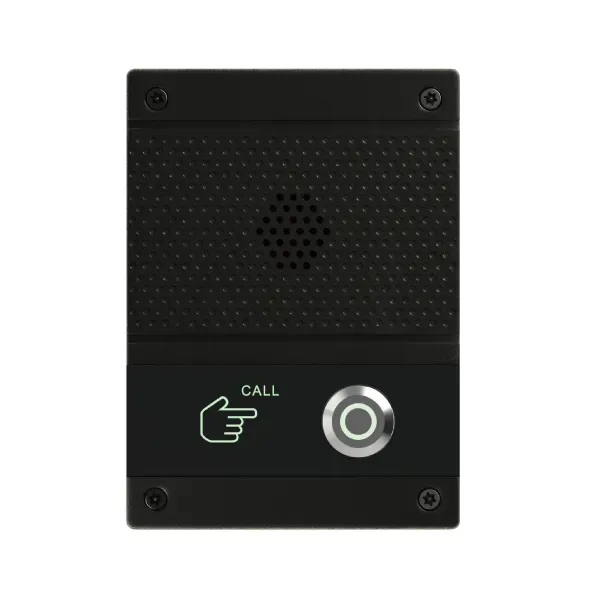
The Dinstar DP91 is a compact one-button SIP audio intercom built for locations where a simple, network-connected call point is more useful than a full video door station. It combines two-way HD voice, echo cancellation, SIP registration, PoE, DTMF-based remote door release, ONVIF-related linkage, auto provisioning and a rugged metal enclosure in a small form factor. For Tanzania deployments, that makes the DP91 relevant to entrances, gates, parking barriers, campuses, clinics, schools, warehouses, offices, tourism facilities, security posts and emergency communication points where a user needs to press one button and reach a defined extension or management endpoint.
Dinstar specifies HD voice, two-way audio, G.722 wideband audio and G.168 echo cancellation for clearer intercom conversations.
The DP91-S supports 802.3af PoE Class 3 or 12V DC power, giving designers flexibility in network-powered or locally powered installations.
DTMF door release can be used with a suitable electronic lock and correctly designed relay, power and safety arrangement.
Web management, auto provisioning, SNMP, TR-069, syslog and configuration backup tools support repeatable multi-unit deployment.
What is the Dinstar DP91 SIP Audio Intercom?
The DP91 is Dinstar’s mini audio SIP intercom family. The single-button DP91-S is designed around one-touch calling and can be registered to SIP servers or PBX platforms for IP-based voice communication. Dinstar publishes support for SIP v1 and SIP v2, SIP over TLS, SRTP, RTP/RTCP, DHCP, static addressing, PPPoE, STUN and multiple DTMF methods. This lets the device sit inside a conventional business VoIP architecture rather than requiring an isolated proprietary intercom network.
The official DP91-S datasheet lists two SIP lines and two SIP servers, full-duplex operation, default auto answer, speed dial, Action URL or Active URI remote control, a 10/100 Ethernet port with PoE, relay output, sensor input, exit-button input, microphone and speaker interfaces, RS232 and a DSS key interface. Dinstar also lists an IP54 environmental protection rating and an operating-temperature range of -35°C to 65°C. Those specifications make the device useful for protected outdoor or semi-exposed entry points as well as indoor call stations, but the final enclosure, mounting, cable entry, surge protection and local environmental exposure still need to be assessed for each site.
For buyers comparing the DP91 with a conventional doorbell, analog intercom or video door station, the important distinction is integration. A SIP intercom can call an IP phone, PBX extension or compatible endpoint across the network; it can become part of a wider voice and access-control design; and it can be centrally configured. The DP91 is therefore best evaluated as a network communications endpoint rather than as a standalone buzzer.
Verified Dinstar DP91 Technical Highlights
| Area | Verified DP91-S details | Why it matters |
|---|---|---|
| SIP | SIP v1 RFC2543, SIP v2 RFC3261, two SIP lines, two SIP servers | Supports resilient or flexible registration designs where the PBX environment allows them. |
| Secure media | SIP over TLS and SRTP | Allows encrypted signaling and media when correctly supported and configured end to end. |
| Audio | G.722, PCMA, PCMU, G.729, G.723 and G.726 variants, G.168 echo cancellation, VAD and CNG | Provides codec and echo-management options for SIP intercom voice paths. |
| Network | 1 × 10/100 RJ45 Ethernet, DHCP/static/PPPoE, 802.1p/q, DSCP, 802.1x | Supports managed voice VLAN and network-policy designs. |
| Power | 802.3af PoE Class 3 or 12V 1A DC | Can be powered centrally from a suitable PoE switch or by local DC supply. |
| Access interfaces | Relay output, sensor input, exit-button input; DTMF door release | Useful for integration with an electronic lock and related door hardware. |
| Management | HTTP/HTTPS web management, FTP/TFTP/HTTP/HTTPS/PnP provisioning, SNMP/TR-069, syslog, backup/restore | Helps administrators standardize configuration and troubleshoot deployments. |
| Physical | 88 × 120 × 35 mm; wall-mounted; aluminum surface and metal bottom shell | Compact footprint suits controlled entry points and embedded applications. |
| Environment | IP54; operating temperature -35°C to 65°C; storage -40°C to 70°C; 10%–90% RH | Supports demanding environments when installed in accordance with site conditions and manufacturer guidance. |
Where the DP91 Fits Best
Entry and gate communication
Visitors press the call button and communicate with reception, security or another defined extension. With a suitable electronic lock, authorized staff can use DTMF to release the door remotely.
Parking barriers and bollards
The compact DP91 form factor is specifically positioned by Dinstar for embedding into parking barriers or bollard-style installations where a large door station is unnecessary.
Emergency assistance points
One-touch dialing can connect a user to management, security or another emergency-response extension, making it relevant to campuses, clinics, institutions and operational facilities.
Compatibility, PBX Integration and Network Planning
The DP91 uses standard SIP, but buyers should still validate the actual PBX platform, firmware, signaling security, codec policy, DTMF method and call-flow behavior before deploying many units. A successful SIP registration proves that the device can reach the PBX; it does not automatically prove that every feature such as encrypted signaling, DTMF relay behavior, auto answer, action URLs or provisioning will behave identically across all platforms.
A well-designed deployment normally starts with one pilot unit. The installer confirms the SIP extension, outgoing destination, call timeout, auto-answer rules, audio level, DTMF door-release sequence, relay behavior, VLAN assignment, QoS markings and provisioning method. The door hardware then needs a separate electrical review: lock type, fail-safe or fail-secure behavior, power supply, exit button, door contact, emergency release and local life-safety requirements should all be addressed by a qualified access-control design.
For broader voice infrastructure, FourTeck Tanzania’s business technology services page explains how IP PBX, networking and access control should be planned together. Buyers can also review the Tanzania technology shop to understand related voice, switching and access-control requirements before procurement.
Related Dinstar Products on FourTeck Tanzania
The DP91 is usually only one endpoint in a communication architecture. Organizations planning a wider Dinstar voice environment can compare it with the Dinstar C63G Business IP Phone, which is useful as a SIP desk endpoint for staff who may receive intercom calls. The Dinstar C64G Business IP Phone offers another office endpoint option, while the Dinstar C64GP PoE Business IP Phone is relevant where PoE-powered desk telephony is preferred.
Where an organization needs to retain analog telephones or connect legacy devices to an IP PBX, the Dinstar DAG1000-1S FXS ATA can bridge one analog endpoint into a SIP environment. The Dinstar DAG1000-1S1O hybrid VoIP gateway is relevant when both FXS and FXO connectivity are part of the migration, and the Dinstar DAG1000-2O FXO gateway can connect analog PSTN interfaces to SIP-based infrastructure. These products solve different problems, but reviewing them together helps avoid treating the intercom, desk phones and legacy telephony as unrelated projects.
For an integrated project discussion covering SIP endpoints, PoE switching, access control, cabling and security, the FourTeck Tanzania technology solutions overview provides the wider system context.
Dinstar DP91 SIP Audio Intercom Tanzania
For Tanzanian organizations searching for the Dinstar DP91 SIP Audio Intercom, the most important decision is whether the project genuinely needs a compact audio-only SIP call point rather than a video door station or a conventional analog intercom. The DP91 is well suited when a user should press one clearly defined button, speak to a remote extension, and potentially allow authorized personnel to trigger an electronic door release. That workflow can fit office entrances, compounds, campuses, clinics, factories, warehouses, schools, accommodation facilities, parking systems and security checkpoints. Because it is a SIP endpoint, the device can become part of the same voice architecture used by IP phones and an IP PBX, which can simplify call routing and central administration when the network is designed correctly.
Tanzania deployments should begin by documenting the complete path from the DP91 to the person expected to answer. The design should identify the PBX or SIP server, destination extension, backup destination if required, VLAN, PoE switch, IP addressing method, firewall rules and whether encrypted SIP signaling and SRTP will be used. If the intercom is controlling a door, the design should separately document the lock, relay, local power, exit button and safety release. Treating the access-control circuit as a simple accessory can create problems later, especially when a lock draws more current than expected or when door hardware has specific fail-safe requirements.
Power availability is another practical consideration. Dinstar lists both 802.3af PoE Class 3 and 12V DC power. PoE can reduce local adapters and can make centralized UPS protection easier, but the switch must have sufficient PoE capacity and the cable path must be properly terminated. Sites with long outdoor runs should also consider surge protection, grounding and suitable cable protection according to the installation environment. The DP91’s published IP54 rating is useful, but it does not remove the need to examine direct rain exposure, dust, impact risk, sunlight, mounting orientation and cable-entry sealing.
A Tanzania quotation request should therefore include quantity, mounting locations, indoor or protected-outdoor conditions, PBX platform, target extensions, PoE switch details, cabling status, electronic-lock type, exit-button requirement and whether the project is new or an upgrade. With those inputs, the DP91 can be assessed as part of a complete communication and entry-control solution rather than as an isolated hardware item.
Dinstar DP91 SIP Audio Intercom Dar es Salaam
In Dar es Salaam, the Dinstar DP91 can be relevant to commercial offices, logistics operations, warehouses, gated compounds, hospitality properties, healthcare facilities, retail back offices and institutions that need controlled visitor communication without necessarily installing a video endpoint at every access point. A busy entrance can route the call to reception during working hours and to security or another extension after hours when the PBX supports that call-flow logic. This flexibility is one of the advantages of a SIP intercom: the physical button remains simple for the visitor while the organization can decide how calls are handled behind the scenes.
Dense business sites in Dar es Salaam often carry voice, computers, Wi-Fi, CCTV and access-control devices on shared switching infrastructure. The DP91 supports 802.1Q VLAN tagging, DSCP and 802.1x, allowing network teams to integrate it into a structured LAN rather than place every device on one flat network. The presence of these features does not automatically create a secure configuration, however. Administrators should define which network segment contains intercom endpoints, what systems they can contact, how management access is restricted, which provisioning servers are trusted and whether HTTPS, SIP over TLS and SRTP are required by policy.
For entry gates and parking barriers, physical installation deserves as much attention as SIP configuration. The enclosure should be mounted where users can reach the button and hear the speaker clearly without standing in vehicle movement areas. Microphone performance should be tested during real traffic and background noise. If the DP91 is embedded into a bollard or barrier housing, installers should preserve airflow, weather protection and service access. Cable routing should avoid pinch points and should be protected from moisture and accidental damage. Where the intercom controls an electric lock or barrier interface, the relay logic should be tested under both normal and power-loss conditions.
Dar es Salaam procurement teams should ask for a quotation that separates the intercom hardware from the supporting requirements: PoE switching, network configuration, PBX extension creation, cabling, lock interface, mounting accessories and testing. This makes it easier to compare proposals on the basis of a complete working solution rather than only the unit price of the DP91.
Dinstar DP91 SIP Audio Intercom Mwanza
Organizations in Mwanza may consider the Dinstar DP91 for office entrances, education campuses, healthcare sites, warehouses, service facilities, residential management points or branch locations that need one-touch IP communication. The compact format is especially useful where a large touchscreen station would be unnecessary or too visually prominent. A visitor, employee or patient can press one button and reach a programmed destination, while the receiving user can communicate through an IP phone or other compatible SIP endpoint according to the PBX design.
For branch environments, administrators should prioritize repeatability. Dinstar provides several deployment tools, including FTP, TFTP, HTTP, HTTPS and PnP auto provisioning, along with web management, SNMP, TR-069, syslog and configuration backup. A single DP91 can be configured manually, but a multi-site rollout becomes easier to support when every unit follows the same naming, firmware, VLAN, SIP-security and dial-plan standards. Central documentation should record the device address, physical location, SIP account, called extension, relay behavior and switch port. That simple discipline reduces troubleshooting time when a branch reports that a call button, door release or audio path is not behaving as expected.
Mwanza projects should also assess connectivity between the intercom and the PBX. If both are on the same LAN, call quality depends largely on local switching and configuration. If the PBX is hosted or located at another site, WAN reliability, NAT, firewall policy and jitter become more important. The DP91 supports STUN and several network protocols, but a robust architecture should avoid relying on accidental NAT behavior. Network teams should intentionally design the SIP path and test both normal calls and door-control signaling before handover.
Before ordering, Mwanza buyers should define whether the unit is indoor or outdoor, whether PoE is available, whether a lock or barrier must be controlled, what extension should answer, and what should happen when that extension is busy or unavailable. The answers determine the PBX configuration, network work and door hardware that must accompany the intercom.
Dinstar DP91 SIP Audio Intercom Arusha
Arusha businesses in tourism, hospitality, professional services, education, healthcare and facility management can use the Dinstar DP91 where a compact audio intercom is more appropriate than a camera-equipped door station. Hotel service gates, staff entrances, office receptions, campus points and managed compounds can all benefit from a call point that routes directly into the organization’s existing SIP communications system. The result can be a simpler user experience: one button at the entrance and familiar IP phone answering at reception or security.
Audio performance should be assessed in the actual installation position. Dinstar specifies HD voice, G.722 wideband audio, full-duplex communication and G.168 echo cancellation, but real-world intelligibility is influenced by background noise, mounting height, nearby vehicles, wind, reflective surfaces and the volume settings on both endpoints. A commissioning test should therefore include normal daytime conditions rather than only a quiet office test. The installer can adjust gain and verify that users can speak naturally without needing to stand extremely close to the device.
Arusha deployments connected to an access-controlled door should also distinguish communication from life safety. The DP91 relay can participate in electronic door release, but the complete door must still comply with the site’s security and emergency-egress requirements. Lock type, power supply, exit device, fire-release logic and door construction can all affect the correct design. If the intercom is only intended to speak with security and not directly operate a lock, the system can be simplified, but that decision should be explicit in the quotation.
For organizations that manage several facilities, standardized provisioning and a consistent extension plan can make support easier. A clear naming format such as building, entrance and device number helps operators identify where a call is coming from. Arusha buyers should include site count, intercom quantity, PBX details, network availability, PoE preference, access-control requirements and expected call destinations when requesting pricing, allowing the bill of materials to reflect the full operational workflow.
Dinstar DP91 SIP Audio Intercom Dodoma
In Dodoma, the Dinstar DP91 can fit government-adjacent offices, institutions, schools, healthcare environments, professional offices, compounds and controlled operational sites that need a defined voice path between an entrance and internal staff. The device is useful where the organization wants standards-based SIP integration and manageable configuration without giving visitors a complex interface. One-touch calling is easy to understand, while the PBX can control where the call is routed and how unanswered calls are handled.
For formal IT environments, security and administration may be central to the selection process. Dinstar lists HTTPS management, SIP over TLS, SRTP, 802.1x, SNMP, TR-069, syslog and configuration backup or restore. These features provide building blocks for a controlled deployment, but they should be configured within the organization’s overall policy. Administrators should avoid exposing device management directly to the public internet, should use strong credentials, and should define who is allowed to modify SIP accounts, relay settings and provisioning URLs. Configuration backups should be stored securely because they can contain operational network information.
PoE can be valuable in Dodoma offices where network equipment is already backed by UPS power. Powering the DP91 from an 802.3af switch can reduce the number of local adapters and can centralize power control, although the switch’s total PoE budget and the cable run must be checked. If 12V DC is used instead, the local power source and backup strategy should be documented. Outdoor runs may require additional protection against electrical surges or environmental exposure beyond the intercom’s own published rating.
A good Dodoma quotation should specify the exact number of DP91 units, mounting type, environment, PBX or SIP server, extension routing, PoE requirement, door-control interfaces, network segmentation, cabling and commissioning scope. This level of detail helps procurement teams understand whether two quotations are truly comparable and reduces the chance that essential installation components appear later as unplanned extras.
Dinstar DP91 SIP Audio Intercom UAE
UAE projects often involve structured commercial buildings, multi-site organizations, warehouses, parking systems, service entrances and facilities with mature IP networks. In those environments, the Dinstar DP91 can serve as a compact audio call point that integrates into a centralized SIP architecture without requiring a dedicated analog intercom controller. Its support for SIP, PoE, VLAN-related network features, encrypted signaling options and centralized provisioning makes it relevant to organizations that want intercom endpoints managed in a similar way to other IP communications devices.
The main design question is whether an audio-only station is suitable for the user journey. At a staff gate, loading area, parking barrier or service door, voice may be enough. At a visitor entrance where visual identification is essential, a video intercom may be a better fit. The DP91 should therefore not be selected simply because it is compact; it should match the security process. Where CCTV already covers the entrance, an audio intercom can sometimes complement the camera view by giving the operator a direct conversation path, but integration behavior should be confirmed during design.
UAE enterprise deployments can also benefit from clear network segmentation and centralized configuration. The DP91 supports 802.1Q, DSCP and 802.1x, while Dinstar lists auto provisioning and management functions appropriate to repeatable rollouts. IT teams can define standard profiles for codec preference, SIP security, VLAN ID, call destination and relay timing. Facilities teams should separately own the door hardware, mounting and electrical design, with coordination between both groups during commissioning.
Customers with UAE requirements can reference FourTeck UAE technology solutions for regional project coordination. When requesting a DP91 quotation, include site count, PBX platform, network design, PoE availability, lock or barrier interface, mounting environment and whether the installation must align with a wider access-control or CCTV platform.
Dinstar DP91 SIP Audio Intercom Uganda
Ugandan organizations can deploy the Dinstar DP91 as part of a SIP-based office, campus or facility communication system where users need a simple call button at an entrance, gate or assistance point. The device’s compact dimensions make it practical for spaces where a larger panel would be unnecessary, while two-way audio and PBX integration allow calls to be answered at conventional SIP endpoints. Schools, healthcare sites, offices, compounds, warehouses and branch facilities may all have workflows where this approach is more efficient than a standalone analog intercom.
For multi-branch organizations, the question is whether the SIP architecture is centralized or local to each site. If a Kampala PBX serves remote branches, WAN performance and resilience become part of intercom availability. An entrance call point is operationally important, so the organization should decide what happens if the WAN connection fails. Some sites may prefer a local PBX or backup route; others may accept that the device depends on central connectivity. The correct answer depends on risk, site function and available infrastructure rather than on the DP91 alone.
PoE can simplify branch deployment because one Ethernet cable carries network and power, provided the switch supports 802.3af and has enough power budget. A UPS-backed PoE switch can also help keep the intercom and IP phones available through short power interruptions. Cabling, surge protection and weatherproof installation remain important for outdoor or semi-outdoor points. Dinstar’s IP54 rating should be treated as a device characteristic, not a substitute for careful field installation.
Uganda customers can coordinate regional requirements through FourTeck Uganda. A complete enquiry should identify quantity, site locations, intended call destinations, PBX platform, switching, PoE, access-control interfaces and environmental conditions so the DP91 can be quoted as part of a working system.
Dinstar DP91 SIP Audio Intercom Kampala
Kampala offices and commercial properties often need visitor communication at entrances, parking access points, service gates and controlled internal doors. The Dinstar DP91 provides a straightforward way to connect those points to a SIP phone system: the visitor presses one button, the intercom places a call to a defined destination, and staff can speak with the caller before deciding whether to release a connected door or barrier. This keeps the user interface simple while allowing the PBX to provide more sophisticated routing behind the scenes.
A Kampala deployment should define call handling before installation. Reception may answer during business hours, security may answer after hours, and a secondary extension may receive calls when the primary destination is busy. These are PBX functions rather than physical intercom features, so coordination between telephony and security teams matters. The DP91’s two SIP lines and two SIP-server support create configuration options, but the organization should choose a design it can operate and troubleshoot rather than enabling complexity without a clear purpose.
Voice quality depends on the complete network path. Dinstar lists G.722, G.711-family and other codecs, echo cancellation, VAD and full-duplex operation, but packet loss and congestion can still degrade conversation. Managed switches, voice VLANs and QoS can help on busy networks that also carry cameras, cloud applications and guest Wi-Fi. If the PBX is hosted outside the site, firewall and internet connectivity also become part of the call-quality equation.
Kampala buyers should request a site-aware bill of materials rather than only a DP91 price. Include the intercom, PoE or DC power method, network port, cabling, mounting, electronic lock or barrier connection, PBX setup, security rules, testing and documentation. That approach makes it easier for facilities, IT and procurement teams to agree on responsibilities before the entrance system is commissioned.
Dinstar DP91 SIP Audio Intercom Arua
For Arua branches, institutions and operational sites, the Dinstar DP91 can be useful where a compact, manageable intercom endpoint is needed at a gate, reception point or restricted entrance. A branch may not require a large security console, yet staff still need a dependable way to communicate with visitors or delivery personnel. The DP91’s one-button approach reduces user confusion and can route calls to a designated IP phone or central PBX extension.
Remote support is particularly important for smaller branch locations. Dinstar provides HTTP or HTTPS management, several auto-provisioning methods, SNMP, TR-069 and syslog. When used within a secure network design, these tools can help a central IT team check configuration and standardize multiple devices without traveling to every site for routine changes. Administrators should still protect management access, document credentials and maintain firmware procedures. Remote management is useful only when it is intentionally secured.
Branch connectivity should also influence the call design. If the DP91 connects to a PBX in another city, the organization should verify latency, packet loss, firewall behavior and what happens during internet outages. A security entrance that cannot place a call whenever the WAN fails may need a local fallback workflow. That could be an operational process rather than another technical feature, but it should be decided during planning. The same applies to power continuity: a PoE switch and PBX endpoint may need UPS support if communication is considered critical.
An Arua enquiry should describe the site’s connectivity, the location of the PBX, the number of DP91 units, the answering extensions, access-control interfaces and environmental exposure. This gives the supplier and installer enough information to distinguish a simple single-unit deployment from a branch-wide security communication project and to quote the supporting network and installation work accurately.
Dinstar DP91 SIP Audio Intercom Mbarara
Mbarara businesses and institutions may use the Dinstar DP91 where reception, gate security or facility teams need a direct SIP voice channel from an entrance to an internal extension. Because the unit is compact, it can fit into controlled entry areas without introducing a large screen or keypad. This can be appropriate for staff entrances, delivery gates, clinic assistance points, office reception doors or sites where visitor identity is already supported by nearby CCTV and the intercom’s primary role is conversation.
The DP91 should be planned together with the switching and PBX environment. Dinstar specifies one 10/100 Ethernet port and 802.3af PoE Class 3, so the access switch needs a compatible port and sufficient remaining PoE budget. VLAN and QoS configuration may be useful when the same network also serves computers, wireless access points and cameras. The PBX should provide a clear extension naming scheme, and the device’s caller ID or account identity should make it obvious which entrance is calling. This becomes increasingly important when security staff answer calls from several buildings.
Door release should be tested carefully. Dinstar supports DTMF methods including in-band, RFC2833 and SIP INFO. The selected method needs to work reliably through the PBX or SIP path used in the project. Installers should verify that the receiving phone sends the expected digits, the DP91 responds correctly, and the relay activates for the intended duration. A commissioning checklist should include repeated tests, not just one successful door opening.
For Mbarara procurement, it is useful to document whether the intercom is replacing an analog unit or forming part of a new IP system. New projects can design PoE, VLANs and call flows from the start, while upgrades may need to reuse existing cabling or door hardware. Sharing those constraints before quotation produces a more realistic scope and helps identify any adapters, power supplies or network changes that may be required.
Dinstar DP91 SIP Audio Intercom Gulu
In Gulu, the Dinstar DP91 can serve organizations that need a simple, network-based communication point for controlled entries, educational facilities, medical environments, offices, warehouses or branch operations. A single call button makes the interface accessible to users who should not need instructions or a directory. The device can be configured to reach security, reception or another SIP destination, while auto answer and full-duplex audio on the receiving side can support fast interaction.
Environmental and physical installation issues should be reviewed early. Dinstar publishes an IP54 rating and a broad operating-temperature range, but actual site conditions may include direct rainfall, dust, insects, sunlight, vandalism risk or exposed cabling. A suitable mounting surface, sealed cable path and protective installation practice can be more important than the device specification alone. Where the intercom is placed at a remote gate, the network cable distance should also be checked against Ethernet standards, and fiber or an intermediate network design may be needed for unusually long distances.
If the Gulu site uses centralized PBX services, the organization should test call performance during normal network load and not only during installation. Voice traffic typically requires modest bandwidth, but it is sensitive to latency, jitter and packet loss. QoS can help prioritize communication on congested links, although it cannot repair an unstable internet service. A fallback process should be defined for critical entrances if the network connection becomes unavailable.
Gulu buyers can make quotation preparation easier by sharing a basic site diagram showing intercom position, nearest switch, PBX location, answering extension and any electronic lock or barrier connection. Add the number of units, cable distances, PoE availability and whether remote provisioning is required. This information allows the DP91 to be sized and installed as part of a documented communication path rather than treated as a generic door accessory.
Dinstar DP91 SIP Audio Intercom Kenya
Kenyan organizations evaluating the Dinstar DP91 may be planning new SIP telephony, upgrading security entrances or standardizing communication across several branches. The DP91 works best where the user journey can be reduced to one action: press the button and reach the correct staff member. That may be a security desk, reception team, facilities office or control room. Because the call travels through SIP, the answering point can be an IP phone or another compatible endpoint within the organization’s communication architecture.
For multi-site deployments, common configuration standards can reduce support effort. Each intercom should have a predictable device name, IP addressing policy, VLAN, SIP-account structure, firmware baseline, call destination and relay configuration. Dinstar’s provisioning and management options can support this approach, while syslog and SNMP may provide useful operational visibility when integrated appropriately. Organizations should avoid having every branch configure devices independently unless there is a clear reason, because inconsistent DTMF settings or codec preferences can create hard-to-diagnose differences.
Kenya projects that connect the DP91 to an electric lock should treat access-control engineering as a parallel workstream. The relay output provides a control interface, but lock current, power supply, fail-safe behavior, emergency release and door hardware are separate design choices. A qualified installer should confirm the complete circuit and test behavior during power interruption. If the unit is deployed at a parking barrier, the barrier controller’s dry-contact input and timing requirements should likewise be confirmed before wiring.
For regional coordination, buyers can use FourTeck Kenya. A strong request for quotation should include site count, quantity per site, PBX platform, planned extensions, PoE switching, lock or barrier interfaces, cabling and environmental conditions. Those details allow the intercom choice to be validated against the network and facility rather than quoted in isolation.
Dinstar DP91 SIP Audio Intercom Kuwait
Kuwait deployments can use the Dinstar DP91 as a compact SIP call point for commercial entrances, warehouses, parking systems, service gates and internal controlled doors. In many structured business networks, PoE switching and SIP PBX services are already available, making a standards-based intercom attractive because it can share the organization’s existing communications infrastructure while remaining logically segmented through VLAN and security policies.
Environmental planning is important in Kuwait because exposed equipment may face heat, dust and direct sun. Dinstar lists an operating range up to 65°C and IP54 protection, but the installer should still assess whether the chosen mounting location is consistent with those ratings and whether shading, enclosure protection or different equipment is needed for unusually harsh exposure. The device’s published specifications should be treated as engineering inputs, not as a guarantee that every outdoor location is appropriate.
For parking and gate workflows, the DP91’s compact design and DTMF-controlled relay can be useful. A visitor can call security, security can verify the request through voice and other available systems, and an authorized user can trigger the barrier or lock. The design should make sure that DTMF is transported reliably through the PBX and that relay timing matches the connected controller. Access should never depend on undocumented codes shared widely among users; the call flow and permissions should follow the organization’s security policy.
Customers can explore regional coordination through FourTeck Kuwait. Before requesting a quote, specify indoor or outdoor placement, expected ambient conditions, quantity, PBX, SIP security requirements, PoE switching, barrier or lock interface and whether centralized provisioning is required. That information supports a more accurate proposal and a cleaner commissioning process.
Dinstar DP91 SIP Audio Intercom Ghana
In Ghana, the Dinstar DP91 can support offices, institutions, schools, healthcare facilities, hospitality sites, warehouses and compounds that need straightforward visitor or emergency communication over an IP network. Its one-button interface is useful when the person initiating the call should not need to know an extension number. The PBX handles that complexity by routing the call to the appropriate reception, security or support endpoint.
Organizations planning a new voice network can include the DP91 alongside IP phones and SIP trunks from the start. Existing sites can add it to a compatible PBX after validating registration, codec choice, DTMF method and firewall behavior. The device’s support for dual SIP servers can be considered where resilience is required, although redundancy should be designed at the whole-system level. A secondary SIP registration is only useful when network paths, power and the answering endpoints also remain available.
For facilities teams, the physical entry workflow should be documented before hardware selection. Does the visitor only need to call? Should staff also release a door? Is the door already connected to an access-control system? Is there CCTV covering the entrance? Should the call be recorded by the PBX if policy allows? These questions determine whether the DP91 is sufficient or whether a different intercom or integrated security platform is more suitable. Product selection should follow the process rather than forcing the process around the product.
Ghana customers with broader regional requirements can review FourTeck Ghana. For quotation, provide the exact use case, number of entrances, PBX details, cabling, PoE switch information, lock interface and desired call destinations. A pilot installation is recommended before large deployments so audio, DTMF release and management workflows can be verified under real conditions.
Dinstar DP91 SIP Audio Intercom Nigeria
Nigerian enterprises and institutions can consider the Dinstar DP91 for entrance communication, security gates, warehouse access, parking systems and one-touch assistance points. It is particularly useful where organizations already operate IP PBX systems and want door or emergency call stations to behave like manageable SIP endpoints. Instead of building a parallel analog intercom system, the DP91 can use the LAN and SIP call routing already familiar to the IT team.
Power and network resilience deserve careful planning for critical entrances. PoE from a UPS-backed switch can keep the DP91 powered during short utility interruptions, but the PBX, router, firewall and receiving phone also need appropriate backup if the complete call path is expected to remain available. For remote branches, the WAN link becomes another dependency. A resilience design should therefore identify which parts of the chain are protected and what operational fallback is used when a component fails.
Security teams should also decide how door release is controlled. DTMF opening is convenient, but only authorized users should know or be able to send the relevant command. PBX call permissions, endpoint access and physical lock design should all support the intended policy. Management interfaces should be limited to trusted administrators, and remote configuration should use secure methods where possible. The DP91 supports HTTPS, SIP over TLS and SRTP, giving administrators options for stronger security when the rest of the system supports them.
For Nigeria-specific project coordination, buyers can visit FourTeck Nigeria. A complete quotation request should include quantity, sites, PBX architecture, network segments, PoE, electronic-lock details, cable distances and whether installation, configuration and testing are required. This prevents the hardware price from being mistaken for the total cost of a reliable intercom solution.
Dinstar DP91 SIP Audio Intercom Seychelles
Seychelles properties such as hotels, resorts, offices, managed residences, service facilities and institutional sites may use the Dinstar DP91 at staff entrances, service gates, parking access points or internal restricted doors. Audio-only SIP intercom can be attractive where the site already has CCTV for visual awareness and needs a simple conversation channel to reception or security. The compact unit can be integrated into a broader IP communications environment without requiring a separate analog intercom controller.
Coastal and humid environments require particularly careful installation choices. Dinstar publishes IP54 protection and a relative-humidity range of 10% to 90%, but site exposure can exceed what is appropriate for a given device if salt spray, direct rain or unprotected cable entries are present. Installers should select mounting positions that respect the product rating, use suitable glands and cable protection, and consider additional environmental protection where necessary. A product’s ingress rating should never be interpreted as permission to place it in any exposed location.
Network planning can also reflect the distributed nature of hospitality and resort sites. A remote gate may be far from the main network room, so copper Ethernet distance, intermediate switches and fiber uplinks may need to be reviewed. If PoE is used over a long run, cable quality and voltage drop must remain within Ethernet and PoE design limits. For multi-building sites, fiber between buildings can improve distance and electrical isolation, with local PoE switching serving the DP91 at the destination building.
A Seychelles quotation should include a site plan, estimated cable distances, mounting environment, number of intercoms, PBX location, answering points and door-control requirements. Where environmental exposure is significant, that fact should be highlighted before equipment is selected so the supplier can confirm whether the DP91 installation is appropriate or whether a higher-protection alternative should be considered.
Buying and Quotation Checklist
A useful DP91 quotation is based on the complete entry or call-point workflow. Before requesting pricing, prepare the following information so product, network and installation requirements can be checked together.
- Exact quantity of DP91 units and the location of each call point.
- Indoor, covered outdoor or other environmental conditions.
- PBX or SIP server brand, version and hosting location.
- Primary and secondary extensions that should receive calls.
- PoE switch model and available power budget, or 12V DC preference.
- Existing Ethernet cabling, distance and VLAN design.
- Electronic lock, barrier controller, exit button and sensor requirements.
- Preferred DTMF method and whether SIP over TLS or SRTP is required.
- Provisioning, monitoring, logging and documentation requirements.
- Installation, commissioning, training and handover scope.
Frequently Asked Questions
Is the Dinstar DP91 a video intercom?
No. The DP91 is positioned as a mini audio SIP intercom. Dinstar lists video linkage and ONVIF-related capability, but the DP91 itself is an audio endpoint without an integrated camera. If visual identification at the door is essential, consider a video intercom model or coordinate the DP91 with a separate CCTV view where the system design supports that workflow.
Can the DP91 open an electronic door lock?
Dinstar lists DTMF door release and a relay output. A complete door solution still requires the correct electronic lock, power supply, safety release and wiring design. The installer should verify the lock’s electrical characteristics and the required fail-safe or fail-secure behavior before connection.
Does the DP91 support Power over Ethernet?
Yes. The DP91-S datasheet lists IEEE 802.3af PoE Class 3 as well as 12V 1A DC power. Confirm that the chosen switch has sufficient PoE capacity and that the network cabling is suitable.
Which SIP security features are available?
Dinstar lists SIP over TLS and SRTP, along with HTTPS management and 802.1x network authentication. These capabilities only provide the intended protection when the PBX, certificates, network and endpoint configuration are designed consistently.
Can the DP91 be installed outdoors?
Dinstar publishes an IP54 rating and a -35°C to 65°C operating range. Installation suitability still depends on direct weather exposure, sun, dust, salt, vandalism risk, mounting and cable sealing. A site survey should confirm whether the planned location is appropriate.
What information should I send for a DP91 quote?
Provide quantity, site location, mounting environment, PBX details, call destinations, network and PoE information, cabling distance, door or barrier interface requirements, and whether configuration and installation are needed. This helps ensure that the quote includes the supporting components required for a working deployment.
Decision Recap
Choose the Dinstar DP91 when the requirement is a compact, one-button SIP audio intercom with PoE, HD voice, central management and optional DTMF-controlled door release. It is particularly relevant to entrances, gates, barriers and emergency-call points where a simple user interface is preferred and where the organization already uses or plans a SIP PBX.
Before ordering, validate PBX compatibility, DTMF behavior, PoE capacity, cabling, environmental exposure and access-control wiring. If the entrance requires built-in video identification, higher ingress protection or a different credential workflow, compare alternative Dinstar intercom models instead of forcing the DP91 into a role it was not selected to perform.
Talk to FourTeck Tanzania About Your DP91 Deployment
FourTeck Tanzania can help connect the DP91 requirement with IP PBX, SIP endpoints, PoE switching, structured cabling and access-control planning. Use the verified FourTeck Tanzania contact page to share your quantity, PBX, entrance layout and door-control requirements. For cross-border projects, the FourTeck network also supports regional planning across East Africa, the Gulf and other African markets.
The most useful enquiry is specific: explain what should happen when the button is pressed, who should answer, whether the door must unlock remotely, what network is available and how many locations are involved. That gives the project team enough information to recommend a practical configuration rather than quoting hardware without the infrastructure needed to make it work.


Reviews
There are no reviews yet.