
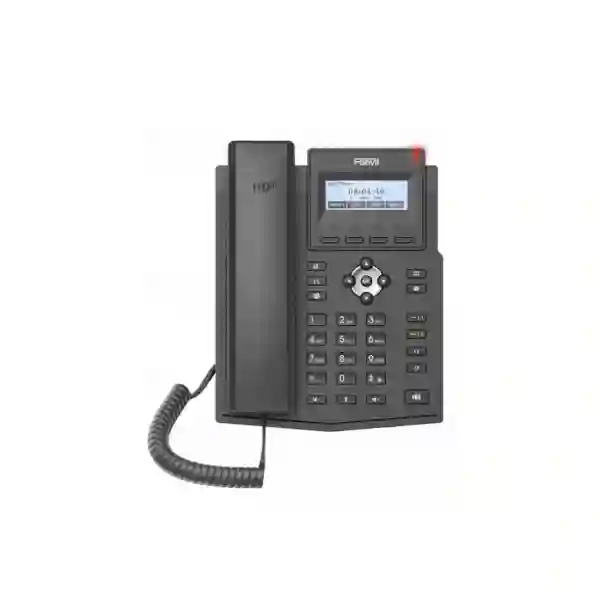
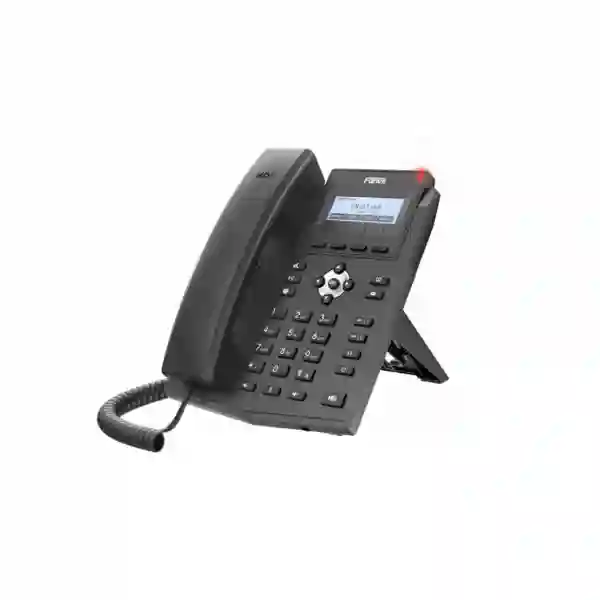
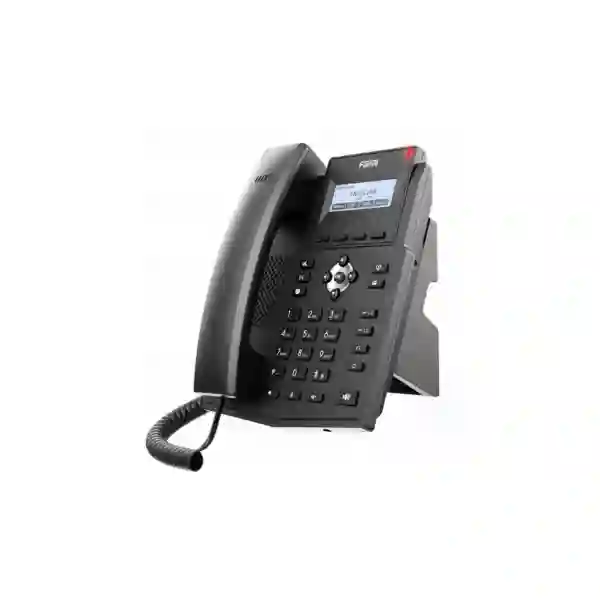
Fanvil X1SP Enterprise IP Phone
The Fanvil X1SP Enterprise IP Phone is an entry-level SIP desk phone for organizations that want straightforward business calling, integrated Power over Ethernet and practical compatibility with common IP PBX environments. Fanvil specifies two SIP lines, a 128×48 backlit dot-matrix display, HD audio with G.722 and Opus wideband codecs, full-duplex speakerphone audio, EHS wireless-headset support, dual 10/100 Mbps Ethernet ports and three-way conferencing. These capabilities make the X1SP suitable for standard office users, shared work areas, branch locations, reception points and other desks where reliable call handling matters more than a large color screen or executive-phone complexity.
Two registered SIP identities support ordinary extension use, secondary lines or role-based calling profiles depending on the PBX design.
The X1SP is the PoE-capable member of the X1S/X1SP pair, supporting cleaner centralized power from a compatible PoE switch.
Wideband G.722 and Opus support, full-duplex speakerphone operation and audio processing help provide clear business conversations when the surrounding voice path is correctly configured.
Fanvil documents EHS support for compatible wireless headsets, making the model useful for users who frequently handle calls away from the handset.
Verified Fanvil X1SP features and specifications
Fanvil positions the X1S/X1SP as an entry-level enterprise IP-phone family. The X1SP version adds integrated PoE while retaining the same compact 128×48 display and practical business calling focus. For procurement teams, the model suffix matters: X1S and X1SP should not be treated as identical power variants. The X1SP is the better fit where organizations want phones powered centrally from PoE switches, particularly when the switching layer is also protected by UPS power. The following points are based on Fanvil’s published product information and datasheet rather than inferred specifications.
| Area | Fanvil X1SP detail |
|---|---|
| SIP capacity | 2 SIP lines |
| Display | 128×48 dot-matrix display with backlight |
| Audio | HD voice; G.722 and Opus wideband codecs; full-duplex speakerphone |
| Conferencing | 3-way audio conference |
| Network | Dual 10/100 Mbps Ethernet ports |
| Power | Integrated PoE on X1SP; optional external power supply supported |
| Phonebook | Local phonebook up to 1000 entries; remote XML/LDAP phonebook support |
| Headset | Headset mode and EHS wireless-headset support with compatible accessories |
What the Fanvil X1SP solves for business users
The X1SP is designed for the large group of employees who do not need a premium touch-screen phone but still require dependable call handling. Typical functions include call hold, call transfer, call waiting, call forwarding, redial, do-not-disturb, auto answer, voicemail indication, speed dial and programmable DSS or soft keys. This makes the device appropriate for general administration, sales desks, finance teams, reception support, branch users and operational staff who primarily need consistent voice communication rather than advanced multimedia capabilities.
PoE is especially useful in a managed office environment because one Ethernet cable can carry network connectivity and electrical power from a compatible switch. This can reduce adapter clutter and help a business design more resilient telephony by placing the PoE switch and network edge on suitable UPS protection. PoE does not by itself guarantee voice availability: the PBX, router, firewall, SIP service, internet path and upstream network equipment must also remain available. For that reason, endpoint selection should be part of a complete voice-network design rather than an isolated handset purchase.
The dual 10/100 Mbps ports let the phone sit between a network outlet and a desktop computer when one wall data point serves both devices. This can simplify cabling, but procurement teams should check whether Fast Ethernet pass-through is adequate for the connected user’s data workload. Desks transferring very large files, using high-speed local applications or requiring faster wired throughput may justify a Gigabit-capable endpoint instead. A practical deployment balances the phone’s voice features with the real network needs of each user role.
IP PBX compatibility, provisioning and deployment planning
Fanvil lists the X1S/X1SP family as compatible with major platforms including Asterisk, BroadSoft, 3CX, Metaswitch, Elastix and Avaya. Compatibility should still be validated against the exact PBX version, firmware, provisioning profile and features expected in the final environment. Basic SIP registration can work while specialized features such as remote directories, feature keys, call pickup, voicemail indicators or secure signaling behave differently between platforms. A pilot device is therefore sensible before a large-scale rollout.
For multi-phone deployments, administrators should define consistent extension naming, time settings, codecs, VLAN parameters, directory sources, firmware policy, security settings and provisioning methods. Fanvil documentation covers web management and automatic provisioning capabilities, allowing an organization to reduce repetitive manual configuration when a supported provisioning method is prepared correctly. A tested template can help keep branches aligned and make future phone replacements easier because the intended configuration is documented rather than recreated from memory.
Network preparation is equally important. Voice VLANs, Quality of Service, secure firewall rules, dependable DNS and time services, sufficient PoE budget and stable SIP connectivity can have more effect on perceived call quality than many endpoint features. When IP phones share infrastructure with cameras, Wi‑Fi access points, servers and ordinary user traffic, managed switching makes segmentation and troubleshooting easier. Buyers should review the broader FourTeck Tanzania IT and telecom solution portfolio, the Tanzania technology shop and FourTeck Tanzania services when the phone is part of a wider PBX, switching, cabling or support requirement.
Related business IP phones on FourTeck Tanzania
The Fanvil X1SP is strongest when a user needs a simple two-line SIP endpoint with PoE. Organizations comparing adjacent endpoint classes can also review other verified business-phone pages on the Tanzania site. The Dinstar C60S Business IP Phone is an adapter-powered entry-level alternative, while the Dinstar C60SP PoE Business IP Phone targets a similar centralized-power use case. The Dinstar C62U Business IP Phone and Dinstar C63G Business IP Phone provide useful comparison points for buyers who need a different balance of line capacity, display features or network speed. These links help procurement teams compare endpoint roles rather than assuming one model is right for every employee.
Regional buying and deployment guidance
Fanvil X1SP Enterprise IP Phone Tanzania
Organizations buying the Fanvil X1SP Enterprise IP Phone in Tanzania should begin with the full communications requirement rather than handset quantity alone. The X1SP provides two SIP lines, PoE, HD audio, EHS headset support and Fast Ethernet connectivity, making it a practical standard desk phone for employees whose main needs are inbound and outbound calling, call transfer, voicemail indication, short conferencing and everyday extension use. It can suit offices, schools, clinics, hotels, logistics companies, professional firms, NGOs, retail administration, manufacturing sites and branch operations where a simple SIP endpoint is preferable to a premium executive phone.
The strongest Tanzania deployment plan should identify the existing or proposed IP PBX, SIP trunk arrangement, number of extensions, user roles, switch capability and power-continuity strategy. Because the X1SP supports integrated PoE, it can be powered from a compatible PoE switch, but the switch must have sufficient total power budget for every connected phone and any other PoE devices such as cameras or wireless access points. If continuity during short utility interruptions matters, the PoE switching layer, router, firewall and PBX should be considered together with UPS capacity. This system-level approach avoids a situation where the handset remains powered while another required voice component is offline.
Voice quality should also be treated as a network design issue. Managed switching, VLAN separation where appropriate, QoS, stable internet or WAN connectivity, correct firewall rules and controlled bandwidth can make calls more predictable. The phone’s dual 10/100 Mbps ports are convenient for a desk with one network point, but users who require high-speed wired data transfers should have their pass-through requirement reviewed before standardization. Businesses planning tens or hundreds of phones should test one or more units with the intended PBX, directory, headset and provisioning setup before committing to the full quantity.
A useful Tanzania quotation request should include the exact X1SP model, quantity, PBX platform and version, SIP-provider details where relevant, desired extension plan, switch models, available PoE capacity, headset requirement, network topology, branch count and any need for installation or configuration. FourTeck Tanzania’s verified contact page can be used to submit those details for a requirement-led discussion.
Fanvil X1SP Enterprise IP Phone Dar es Salaam
Dar es Salaam organizations often operate fast-moving commercial environments where reception, sales, logistics, finance and customer-service teams depend on reliable desk calling. The Fanvil X1SP can fit these ordinary business roles because it focuses on practical SIP functions rather than expensive display features. Two SIP lines can support a primary extension and a secondary identity or line arrangement depending on the PBX, while call hold, transfer, forwarding, redial, do-not-disturb and voicemail indication cover the tasks that most office users perform repeatedly during a working day.
For offices with many desks, PoE can simplify deployment. A compatible managed PoE switch can deliver network access and power on the same Ethernet cable, helping reduce the number of individual power adapters and making desk layouts cleaner. However, Dar es Salaam businesses should verify total switch PoE budget rather than only counting PoE ports. A switch may physically accept many endpoints while lacking sufficient power budget for all attached phones, access points and cameras. Where voice continuity is important, UPS sizing should include the switching, firewall, router and PBX components that keep the service operational.
Dense office networks frequently carry voice, cloud traffic, CCTV streams, backups, Wi‑Fi and general user data at the same time. The X1SP’s dual 10/100 Mbps interfaces can share one wall outlet between the phone and a computer, but that arrangement should be checked against the employee’s LAN requirements. Voice VLANs and QoS can help protect real-time calls from congestion, while clear port documentation makes support easier after staff moves or office changes. Businesses with multiple floors should also confirm cabling quality, uplink capacity and switch topology before a bulk endpoint rollout.
For a Dar es Salaam quote, provide the number of desks, expected simultaneous calling, PBX brand, SIP trunk, preferred headset models, extension groups, reception requirements and whether provisioning will be centralized. A staged pilot in one department can validate transfer behavior, directories, voicemail indication, codec negotiation and headset compatibility before the remaining phones are deployed.
Fanvil X1SP Enterprise IP Phone Mwanza
Mwanza businesses considering the Fanvil X1SP may be replacing analog handsets, adding extensions to an existing IP PBX or standardizing phones across an office and one or more operational sites. The X1SP is suited to standard users because its two SIP lines and core call features cover routine business telephony without creating unnecessary endpoint complexity. The backlit 128×48 display provides call and menu information, while HD audio and full-duplex speakerphone operation support desk conversations and short hands-free discussions when the wider voice path is configured correctly.
Branch-oriented deployments should give special attention to consistency. If several Mwanza departments or sites use the same phone model, administrators can document a common configuration for extension naming, time settings, codec preferences, network parameters, directory sources, function keys and firmware. Centralized or repeatable provisioning reduces the chance of small manual differences becoming support problems later. A pilot phone should be registered against the exact PBX and tested for inbound calls, outbound calls, attended and unattended transfer, voicemail indication, call pickup if required and any remote phonebook integration.
PoE can be valuable where offices want centralized endpoint power. The same design should include sufficient PoE budget, suitable UPS capacity and clear rack documentation. Businesses that connect a desktop computer through the phone should remember that the X1SP uses 10/100 Mbps Ethernet. This is adequate for many ordinary office tasks, but users working with large local files, media or high-throughput applications may require a different network design. Separating voice and heavier data flows with VLAN and QoS policies can make troubleshooting and performance management more predictable.
A well-prepared Mwanza procurement request should therefore specify quantities by user type rather than one undifferentiated number. Note how many standard staff, reception users and headset-heavy staff are involved; identify the PBX and switch models; state whether local or remote branches will be included; and list any installation or configuration assistance required. These details help determine whether the X1SP should be the common endpoint or one part of a mixed phone estate.
Fanvil X1SP Enterprise IP Phone Arusha
Arusha organizations in tourism, hospitality, professional services, education, administration and distributed operations can use the Fanvil X1SP where staff require uncomplicated SIP desk calling. The model supports two SIP lines and common business functions such as hold, transfer, call forwarding, waiting, redial, do-not-disturb and voicemail indication. This makes it useful for employees whose calling pattern is frequent but straightforward. The EHS headset capability is particularly relevant to reservation, front-desk and service roles where users need to move between a phone and nearby workstation tasks.
Hospitality and customer-facing environments should map phone roles carefully. A back-office user may need only one extension and occasional speakerphone calls, while a front desk may require faster transfer workflows, carefully programmed keys and reliable headset operation. Two SIP lines do not make the X1SP a high-capacity receptionist console, so sites with complex reception handling should compare a higher-feature endpoint for that role while using X1SP units for ordinary desks. Matching phones to user profiles generally gives better value than forcing one device to serve every role.
Infrastructure planning remains essential. The X1SP’s PoE support works best with managed switches that can provide enough aggregate power and allow voice VLANs or QoS. A UPS-backed PoE layer can improve resilience, but the PBX and network edge also need power protection if calls are expected to continue during short utility interruptions. Organizations with multiple buildings or remote facilities should also consider WAN stability and SIP reachability. Where internet links are shared with guest Wi‑Fi or heavy cloud workloads, traffic management can reduce avoidable call-quality issues.
For an Arusha quotation, include endpoint quantities by department, PBX platform, switch inventory, available PoE budget, SIP service information, headset requirements and any remote-site topology. Testing one X1SP with the exact network and PBX settings can confirm the intended experience before a full office or property rollout.
Fanvil X1SP Enterprise IP Phone Dodoma
Dodoma offices, institutions, project teams and professional organizations can consider the Fanvil X1SP when they need a manageable SIP endpoint for standard staff. The phone’s two SIP lines, PoE, HD voice, three-way conferencing and EHS headset support create a balanced entry-level feature set. It is not intended to replace a high-end executive terminal or dedicated operator console; instead, it is well suited to routine desks where users mainly place, receive, transfer and manage ordinary business calls through an IP PBX.
Procurement teams should consider lifecycle consistency as well as initial purchase cost. If dozens of endpoints will be deployed, standardized settings, labeling and documentation can reduce support effort. A repeatable provisioning approach should cover extension identity, display naming, time zone, codec order, function keys, directory configuration, firmware and network parameters. Administrators should keep a tested backup of the intended profile so replacement phones can be brought into service without recreating settings manually. PBX-side templates should also be documented where the platform supports them.
The network should be checked before phones arrive. Managed switches should have enough PoE budget, cabling should be tested, voice VLANs should be planned where useful, and firewall rules should allow the required SIP and media flows without exposing unnecessary services. The X1SP’s dual Fast Ethernet ports can reduce cabling at ordinary desks, but any computer connected through the phone will share that 100 Mbps-class link. Users with heavier local-network requirements may need direct Gigabit connectivity or a different phone model.
A Dodoma request for quotation is more useful when it describes user roles, phone quantity, branch count, PBX platform, SIP trunk provider, network-switch models, UPS expectations, headset needs and any installation scope. This information allows the endpoint decision to be evaluated as part of a complete telephony system rather than as a standalone hardware purchase.
Fanvil X1SP Enterprise IP Phone UAE
Businesses evaluating the Fanvil X1SP Enterprise IP Phone in the UAE can use it as a standard endpoint within SIP-based office communication environments. The phone is best matched to general staff who need two SIP lines, HD audio, common transfer and forwarding functions, speakerphone operation and PoE. Its compact display keeps the interface simple, which can be an advantage in large deployments where consistent everyday calling matters more than advanced visual features. Organizations can compare regional communications planning through FourTeck UAE when a requirement spans telephony, networking and supporting infrastructure.
A UAE deployment should still begin with PBX and network compatibility. Fanvil lists major SIP platforms for the X1S/X1SP family, but the exact PBX version, firmware and feature set should be tested. Some businesses use on-premises IP PBX systems, while others operate hosted or hybrid services. In each case, administrators should verify registration, transfer behavior, caller ID, voicemail indication, directories, secure signaling and any provider-specific requirements. A small pilot is especially useful where many endpoints will be rolled out across departments or sites.
PoE makes the X1SP convenient for structured office environments. Managed PoE switches can centralize power and simplify desk cabling, but total PoE budget and UPS design remain important. Voice traffic should be protected from congestion with appropriate VLAN and QoS policies, particularly in offices where the same network also carries cloud applications, Wi‑Fi, surveillance and file transfers. The dual 10/100 Mbps ports are suitable for many normal desks, but high-throughput users may be better connected directly to Gigabit switching.
Before requesting a UAE quotation, define the quantity, extension plan, PBX, SIP service, headset models, network topology, PoE requirements and installation scope. That information helps separate ordinary user endpoints from reception or management positions that may justify a higher-feature phone.
Fanvil X1SP Enterprise IP Phone Uganda
Ugandan organizations can deploy the Fanvil X1SP as a practical SIP desk phone for standard employees, branch users and service teams. Its feature set concentrates on business essentials: two SIP lines, HD voice, three-way conferencing, call handling functions, EHS headset support and integrated PoE. For companies with several branches, a simple common endpoint can make training and support easier because users see the same menu structure and IT teams can work from standardized provisioning profiles. Regional technology requirements can also be coordinated through FourTeck Uganda.
A branch rollout should focus strongly on network consistency. Each site should have adequate switching, PoE capacity, stable WAN access, correct DNS and time services, and firewall rules appropriate to the PBX architecture. If the PBX is centralized at a head office or hosted externally, call performance depends on the WAN link between the phone and that service. QoS can help prioritize voice, but it cannot repair an unstable or undersized circuit. Organizations should therefore evaluate connectivity and endpoint requirements together.
The X1SP’s two 10/100 Mbps Ethernet ports allow a computer to connect through the phone at desks with one wall outlet. This can reduce cabling needs, but businesses should confirm that Fast Ethernet performance is sufficient for the attached user. Where finance, design, engineering or media teams need higher LAN throughput, a direct Gigabit connection or a different endpoint may be more appropriate. PoE availability should be checked at every site rather than assumed from the head-office design.
For a Uganda quotation, provide quantities by branch, PBX location, SIP service, switch models, WAN design, headset needs and whether phones must be preconfigured before deployment. A pilot at one representative site can validate the common configuration before it is repeated across the rest of the organization.
Fanvil X1SP Enterprise IP Phone Kampala
Kampala offices often combine customer-facing teams, administrative departments and branch connectivity within the same network. The Fanvil X1SP can serve as a standard phone for employees who need dependable SIP calling without a premium endpoint. Two SIP lines provide enough capacity for ordinary extension use, while the backlit display, HD voice, speakerphone and EHS headset support cover common office tasks. Receptionists handling many simultaneous line appearances may need a higher-capacity phone, but the X1SP can still be a strong standardization choice for the wider staff population.
When many endpoints share one building, switch and cabling design matter. Managed PoE switching can power phones centrally and enable voice VLAN separation, but the total power budget must account for every connected device. If cameras and access points also use PoE, reserve realistic headroom rather than sizing the switch at its absolute limit. UPS protection can help maintain communications during short interruptions, provided the PBX, internet gateway and other required equipment are also protected.
The X1SP supports dual 10/100 Mbps networking, so a desktop PC can share the same wall connection by passing through the phone. This is practical for many clerical and service roles. It should not be assumed suitable for every user, especially where large cloud synchronizations, local server transfers or high-resolution content demand more throughput. Segmenting voice and data logically can also help IT teams isolate problems more quickly when users report intermittent audio or registration issues.
A Kampala deployment should be tested against the intended PBX for transfers, voicemail, caller ID, directories, time synchronization and any headset accessories. Quotations should identify department quantities, PBX brand, SIP trunk, network-switch details and whether configuration, installation or user guidance is required. This makes it easier to separate hardware cost from the work needed to deliver a functional communications environment.
Fanvil X1SP Enterprise IP Phone Arua
Arua organizations using or planning SIP communications can consider the Fanvil X1SP for standard business desks where simple operation, PoE and basic multi-line capability are more important than advanced display features. Two SIP lines allow a user to work with a primary extension and a secondary identity where the PBX supports that design. HD audio, three-way conferencing and speakerphone operation cover normal office communication, while EHS support can benefit service or administrative users who spend long periods on calls.
For organizations linking Arua to a central PBX in another city or to a hosted platform, WAN reliability deserves as much attention as the handset. Voice traffic is sensitive to delay, jitter and packet loss, so stable links and sensible QoS policies are important. If connectivity occasionally changes between primary and backup circuits, the firewall and PBX design should be tested to confirm how active calls and registrations recover. Phone configuration alone cannot compensate for an unstable network path.
Power planning is another practical consideration. The X1SP’s integrated PoE can reduce desk adapters, but the branch switch must actually support PoE and have enough power budget. Where a site uses a small switch, verify both per-port standards and total wattage before ordering phones. If continuity is a priority, protect the PoE switch, router and connectivity equipment with an appropriately sized UPS. Cabling should also be tested so intermittent physical faults are not mistaken for SIP problems.
A useful Arua quotation request should include the number of users, whether the PBX is local or remote, internet/WAN arrangement, switch model, PoE availability, headset needs and preferred rollout method. For a multi-site organization, using the same tested profile across locations can simplify support, but site-specific network differences should still be documented before phones are shipped or installed.
Fanvil X1SP Enterprise IP Phone Mbarara
Mbarara businesses and institutions can use the Fanvil X1SP where they need a cost-conscious SIP endpoint for routine office calling. The phone’s two SIP lines and standard call functions make it appropriate for general staff, branch administrators, back-office users and customer-service positions with moderate calling needs. The compact display reduces complexity, while HD voice and full-duplex speakerphone operation help support clear conversations when the PBX, codec selection and network are correctly configured.
Organizations replacing analog systems should plan the migration carefully. Moving to IP telephony changes the dependency model: phones now rely on Ethernet switching, IP addressing, the PBX, firewall rules and network power. PoE can make the physical installation cleaner, but IT teams should calculate power requirements and confirm that every target desk has suitable structured cabling. Voice VLANs can separate endpoint traffic logically, while QoS can prioritize real-time media across links that carry other applications.
The X1SP’s 10/100 Mbps pass-through can be convenient when one data outlet serves the phone and a computer. Before adopting that design everywhere, identify employees who need higher-speed LAN access. Those users may be better served by direct Gigabit cabling or a higher-speed phone model. The same role-based approach applies to features: ordinary staff may fit the X1SP well, while reception or executive users may justify phones with more programmable keys or larger displays.
For Mbarara procurement, provide quantities by user role, existing cabling, switch inventory, PoE budget, PBX platform, SIP-provider details and any desired headset accessories. If the site is part of a larger Uganda network, also describe inter-branch connectivity and whether provisioning should be centralized. This information helps ensure the endpoint specification aligns with the real environment instead of being selected from a feature list alone.
Fanvil X1SP Enterprise IP Phone Gulu
Gulu organizations evaluating IP telephony can deploy the Fanvil X1SP as a straightforward endpoint for ordinary business users. It is particularly useful where a common phone is needed across administration, finance, operations and branch staff without the cost or training overhead of premium touch-screen models. Two SIP lines support normal extension use, the backlit display presents essential call information, and HD audio with wideband codec support can improve voice clarity when both ends of the call and the network path support it.
A successful Gulu deployment should separate endpoint selection from connectivity assumptions. If the PBX is hosted or located at another site, WAN latency and stability can affect every call. Voice QoS, resilient routing and correct firewall behavior should be validated. When internet links are shared with cloud applications, backups or guest Wi‑Fi, bandwidth planning is essential. The phone does not require high throughput, but it does require consistent packet delivery and predictable signaling access to the PBX.
PoE can simplify desk installations and centralize power management. Before ordering, verify that the target switches support the required PoE standard and have enough aggregate budget. If the same switches power wireless access points or cameras, calculate the complete demand rather than considering phones alone. UPS runtime should be based on the total network load and the required continuity period. Structured cabling quality and port labeling should also be checked, particularly in buildings where network infrastructure has grown gradually over time.
A Gulu quotation should specify how many phones are required, which user roles will receive them, whether headsets are needed, the PBX and SIP-provider details, the switch and WAN environment, and whether installation or remote configuration support is expected. A pilot device can validate the complete call workflow and reduce rollout risk before the remaining endpoints are commissioned.
Fanvil X1SP Enterprise IP Phone Kenya
Kenyan businesses looking for a practical SIP desk phone can consider the Fanvil X1SP for standard office users, branches and service teams. Its two SIP lines, integrated PoE, HD audio, EHS headset support and three-way conferencing make it a straightforward building block for an IP PBX deployment. Regional projects can be coordinated through FourTeck Kenya when the requirement includes phones, PBX, switching, security or other office technology components.
Endpoint standardization is often useful for organizations with several Kenyan offices because a common phone model can simplify user training, spare management and configuration. The benefit depends on disciplined provisioning. Administrators should test and document extension templates, codecs, time settings, phonebook sources, function keys and firmware. The PBX-side configuration should be equally consistent. Where the same phone is deployed to locations with different switches or internet links, site-level network differences still need to be recorded and checked.
PoE allows centralized power, but procurement teams should inspect the switching layer before assuming every desk is ready. Count available PoE ports, confirm total power budget, verify uplink capacity and consider UPS coverage. The X1SP can pass Ethernet to a computer at 10/100 Mbps, which is adequate for many normal office workflows but may not meet the needs of users who rely on faster wired LAN performance. Those employees should be identified before bulk purchasing.
A Kenya quotation should include quantity by location, user roles, PBX platform, SIP service, switch models, headset preferences and any required implementation work. Pilot testing can verify call transfer, voicemail indication, directories and security before a broad rollout. Organizations comparing a standard two-line phone with more advanced devices should evaluate the actual user workflow rather than buying extra features that will not be used.
Fanvil X1SP Enterprise IP Phone Kuwait
Kuwait organizations can use the Fanvil X1SP as an entry-level enterprise desk phone for employees who need reliable SIP calling, PoE and headset support without a large color interface. Two SIP lines can support standard extension roles, while HD voice, speakerphone calling, transfer and forwarding functions address day-to-day communication. Businesses planning broader technology procurement can reference FourTeck Kuwait for regional IT, telephony and network solution context.
Large office deployments should establish clear endpoint tiers. The X1SP is a good candidate for general staff, but reception, management or call-intensive users may need more keys, more SIP identities or a larger display. Separating users into profiles avoids overspending on every desk while ensuring demanding roles receive the functions they need. Headset-heavy users should verify the exact EHS accessory and headset model before quantities are finalized.
PoE deployment depends on switch capacity and cabling quality. Organizations should calculate the aggregate PoE budget and consider the combined load from phones, access points and security cameras. UPS-backed switching can improve continuity when paired with protected PBX and gateway infrastructure. Voice VLAN and QoS policies can help keep real-time traffic stable on busy networks, especially where large file transfers or cloud applications share the same uplinks.
The phone’s dual 10/100 Mbps Ethernet ports provide convenient desk pass-through, but not every workstation should automatically be connected this way. High-throughput users may need direct Gigabit switching. For a Kuwait quotation, specify phone quantity, PBX platform, SIP service, switch environment, headset needs, user profiles and whether configuration or deployment assistance is required. Testing a representative phone against the actual PBX and network remains the best way to confirm feature behavior before full rollout.
Fanvil X1SP Enterprise IP Phone Ghana
Ghanaian businesses can consider the Fanvil X1SP for standard SIP desk positions where users require dependable calling, Power over Ethernet and basic two-line flexibility. The X1SP’s combination of HD voice, three-way conferencing, EHS headset support and familiar call functions makes it appropriate for administrative teams, branch users, customer-service desks and general office staff. Broader regional requirements can be reviewed through FourTeck Ghana, which covers IP phones, PBX, networking and related business infrastructure.
When replacing legacy telephony, organizations should plan for the network dependencies introduced by SIP phones. Each endpoint needs IP connectivity, access to the PBX and suitable power. PoE can simplify physical installation, but switches should be selected for enough power budget and management features. A voice VLAN can help organize endpoints, and QoS can protect calls from congestion. Firewall rules should be aligned with the chosen PBX or SIP service, particularly when remote or hosted systems are involved.
The X1SP can share a single wall data point with a PC through its dual 10/100 Mbps ports. This can reduce cabling at normal desks, but IT teams should identify users whose applications benefit from faster LAN access. The endpoint should not become an accidental bottleneck. Similarly, organizations should identify receptionists or supervisors who need more programmable keys or line appearances and assign them a different phone where appropriate.
A Ghana quotation should include quantities by user profile, office or branch location, PBX platform, SIP service, available PoE switching, headset requirements and any need for installation or centralized provisioning. A pilot deployment can verify the entire call workflow before wider distribution, helping ensure the selected configuration behaves consistently across users and sites.
Fanvil X1SP Enterprise IP Phone Nigeria
Nigerian organizations planning SIP-based business communications can deploy the Fanvil X1SP as a standard endpoint for general staff, branch offices and service functions. Two SIP lines support ordinary multi-line requirements, integrated PoE helps simplify structured deployments, and HD voice with wideband codec support provides a strong audio foundation. Organizations with broader infrastructure needs can use FourTeck Nigeria as a regional point of reference for telephony, networking and related IT solutions.
Multi-site deployments should focus on repeatable configuration and connectivity quality. If phones register to a central or hosted PBX, every branch depends on reliable WAN access. QoS can prioritize voice but cannot eliminate problems caused by unstable links, packet loss or poorly configured routing. Administrators should test registration recovery, transfer behavior and media flow under the actual branch network conditions rather than assuming a successful lab setup will behave identically everywhere.
PoE planning should include the whole access layer. Count endpoints, access points and cameras, then confirm the switch has enough aggregate power and port capacity with reasonable headroom. UPS design should protect the components required to keep calls working, not only the handset. The X1SP’s 10/100 Mbps PC pass-through is practical for many ordinary workstations, but high-throughput users should have a direct Gigabit option or a different endpoint profile.
For a Nigeria quotation, provide quantities by site, PBX platform and location, SIP-provider details, switch models, WAN structure, headset needs and rollout expectations. Larger organizations should pilot the phone in at least one representative environment and document a standard profile for future replacements, new branches and support. This approach makes the X1SP part of a manageable communications architecture rather than a collection of individually configured phones.
Fanvil X1SP Enterprise IP Phone Seychelles
Seychelles organizations in hospitality, professional services, administration and distributed business operations can consider the Fanvil X1SP where staff need dependable SIP desk calling and centralized PoE. The phone’s two SIP lines are suitable for routine extension roles, while HD audio, speakerphone functionality, three-way conferencing and EHS wireless-headset support address common office workflows. In hospitality environments, the X1SP is more naturally suited to back-office, reservations or administrative roles than to specialized guest-room requirements that may call for hotel-specific phone designs.
Sites spread across different buildings or islands should give careful attention to PBX location and connectivity. If extensions depend on a hosted or central system, voice quality is influenced by the WAN path as well as the endpoint. Stable links, suitable QoS and correct firewall policies are essential. Organizations should also determine how phones will be managed remotely, because consistent provisioning and documentation can reduce the need for manual site-by-site configuration.
PoE offers a cleaner installation when network switches support the required power budget. For hospitality or multi-building environments, the switching design may also carry Wi‑Fi access points and CCTV cameras, so phone power should be calculated as part of the whole PoE load. UPS planning should consider realistic runtime for the network edge, PBX and switches. The X1SP’s Fast Ethernet pass-through may be sufficient for many administrative PCs, but bandwidth-sensitive desks should be reviewed before adopting a single cabling pattern everywhere.
A Seychelles quotation should describe the number of phones, intended departments, PBX platform, inter-site connectivity, available PoE switching, desired headsets and any centralized provisioning requirement. This helps determine whether the X1SP fits the standard desk profile and whether other endpoint types should be mixed into the project for reception, management or specialized hospitality use.
Selection and quotation checklist
Separate standard staff, reception, management and headset-intensive users so the X1SP is assigned where its feature level fits.
State the exact PBX platform, version and SIP-provider details so registration and key functions can be validated.
Confirm PoE-capable ports, aggregate power budget, VLAN requirements, uplinks and UPS coverage before ordering.
Identify headset brand and model so the required EHS accessory and compatibility can be checked rather than assumed.
Frequently asked questions
Does the Fanvil X1SP support PoE?
Yes. Fanvil’s published X1S/X1SP comparison identifies the X1SP as the integrated-PoE version. The X1S is the non-PoE counterpart in the pair.
How many SIP lines does the Fanvil X1SP support?
The X1SP supports two SIP lines, making it suitable for users who need a straightforward business extension setup rather than a high-capacity multi-line console.
Does the X1SP support wireless headsets?
Fanvil documents EHS wireless-headset support. Exact headset and EHS-cable compatibility should be confirmed for the selected headset model before bulk procurement.
Can a computer connect through the X1SP?
Yes. The phone has dual 10/100 Mbps Ethernet ports, allowing a PC to connect through the phone. Check whether Fast Ethernet throughput is appropriate for the user’s data workload.
Which PBX platforms can work with the Fanvil X1SP?
Fanvil lists compatibility with major platforms including Asterisk, BroadSoft, 3CX, Metaswitch, Elastix and Avaya. Exact feature behavior should still be tested with the intended PBX version and configuration.
Is the X1SP suitable for a receptionist?
It can suit a small reception point with moderate call handling, but large reception desks may need a phone with more line appearances, programmable keys or an expansion module. Match the endpoint to the actual operator workload.
Decision recap
Choose the Fanvil X1SP when you need a compact two-line SIP phone with integrated PoE, HD voice, a backlit display, three-way conferencing and EHS headset support for standard business users. Validate PBX compatibility, network design, PoE capacity and headset accessories before a large rollout. Consider a different endpoint tier for users who need Gigabit pass-through, a larger display, more SIP identities or extensive programmable keys.
For cross-border or regional technology requirements, FourTeck also maintains verified regional resources for Africa IT solutions, Kenya, Uganda, UAE, Ghana, Nigeria and Kuwait.
Consultation panel
When requesting a quotation, share the exact quantity, user roles, PBX platform, SIP provider, switch models, PoE availability, branch locations, headset requirement and whether configuration or installation is expected. This information allows the phone to be assessed in the context of the network and voice architecture rather than treated as an isolated product.


Reviews
There are no reviews yet.