
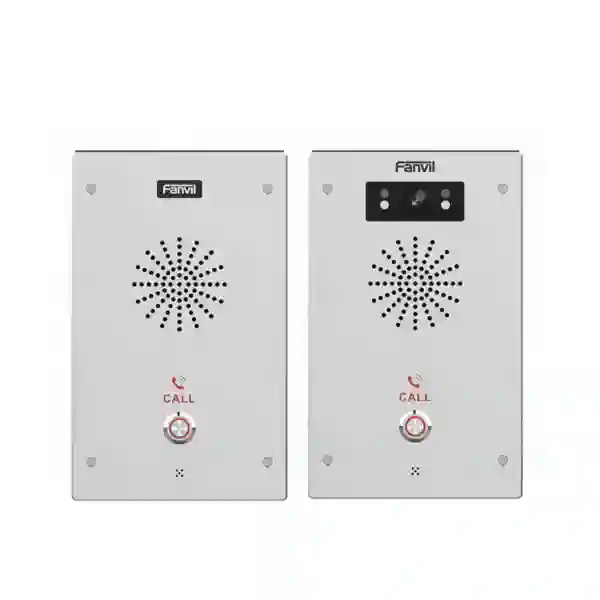
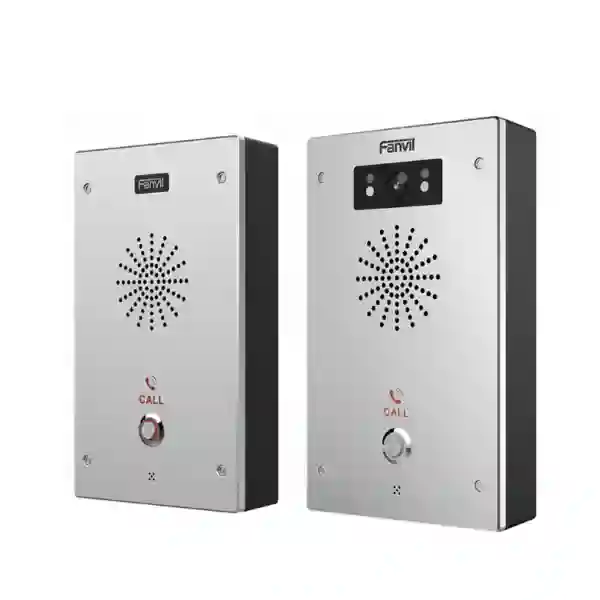
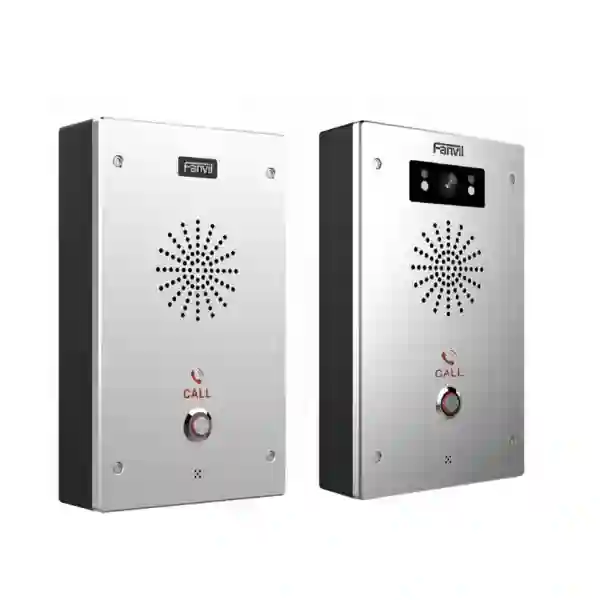
Fanvil i16SV SIP Video Intercom
The Fanvil i16SV is a rugged SIP video intercom designed for entrances, gates and operational access points where reliable voice, video and control interfaces need to work over an IP network. It combines a 2 megapixel camera, H.264 video, infrared illumination, full-duplex hands-free audio, SIP calling, PoE, relay inputs and outputs, anti-tamper functionality, TF-card support and a weather- and impact-resistant aluminum enclosure. For Tanzanian businesses, the practical value is the ability to connect an entry point to a wider IP telephony, security or access-control workflow rather than treating the intercom as a stand-alone doorbell.
FourTeck Tanzania can help buyers evaluate whether the i16SV matches the existing SIP platform, network design, PoE capacity, lock or gate interface and security process. The objective is to prepare a deployment that is technically compatible, maintainable and appropriately documented before equipment is ordered.
What the Fanvil i16SV is designed to solve
An entrance intercom sits at the point where visitors, staff, security teams, receptionists and door-control hardware meet. A basic analog intercom can provide voice, but modern business environments often need more: visual verification, integration with an IP PBX, remote answering, network management, event-triggered control and a durable enclosure suitable for exposed locations. The Fanvil i16SV is positioned for this kind of integrated requirement. Its SIP foundation allows it to function as a network endpoint, while the built-in camera adds video context and the relay interfaces support interaction with external door or gate systems when the overall design is engineered correctly.
The model is especially relevant where an organization already operates SIP extensions or plans to unify door communication with business telephony. A visitor can initiate a call from the intercom, and the receiving workflow can be designed around compatible SIP phones, PBX routing or security-desk endpoints. Because the device supports Ethernet and PoE, it can be incorporated into a structured network rather than relying on a separate proprietary cabling topology. That does not remove the need for careful design: VLANs, QoS, switch PoE budget, addressing, firewall policy and PBX registration still need to be considered.
For buyers comparing an IP intercom with a conventional door station, the important question is not simply whether video is present. It is whether the chosen device can be integrated into the building’s actual operational process. FourTeck therefore recommends documenting who answers calls, how doors or gates are released, what happens after hours, what network path the unit uses, where event logs are retained and who maintains credentials and firmware.
Verified Fanvil i16SV features and technical profile
Video
The i16SV uses a 1/2.8-inch color CMOS sensor rated at 2 megapixels. Fanvil lists H.264 video coding, 720p and 1080p resolution options, a minimum illumination figure of 0.1 lux and infrared illumination support. The published viewing angles are 126° diagonal, 98° horizontal and 65° vertical, supporting visual coverage at an entrance when mounting height and approach direction are planned correctly.
Audio
Fanvil specifies full-duplex hands-free operation with acoustic echo cancellation and a built-in 3 W speaker. Wideband codec support includes G.722 and Opus, while narrowband options include G.711 A/U, G.729A/B, iLBC, G.723.1 and G.726-32K. An audio line-out connection can be used with an external active speaker where the design requires additional output.
Network and SIP
The device provides 10/100 Mbps Ethernet, IPv4/IPv6 operation, static IP, DHCP and PPPoE addressing options, VLAN capability and SIP v1/v2 over UDP, TCP or TLS. Fanvil also lists RTP/RTCP/SRTP, STUN, SNTP, HTTP/HTTPS, FTP/TFTP and TR-069 among supported networking and management protocols.
Physical protection
The enclosure is specified as an aluminum-alloy housing with IP65 ingress protection and IK10 impact protection. Fanvil lists wall mounting, an operating temperature range of -30°C to 60°C, storage from -40°C to 70°C and operating humidity from 10% to 95%. These ratings support demanding placements, but installation details such as cable entry, drainage, shade and surge protection still matter.
I/O and control
The i16SV includes two short-circuit input and two short-circuit output interfaces, built-in relay capability, a tamper alarm switch, a TF-card slot, a recording output and a line-out interface. These connections can support door-control and monitoring workflows, but electrical compatibility with the lock, gate controller, sensor or third-party panel must be confirmed before wiring.
Power and management
Power can be supplied through PoE Class 3 or through a 12–24 V DC input according to Fanvil documentation. Deployment tools include a web management portal, configuration import/export, firmware upgrade, syslog, packet capture and auto-provisioning through methods including FTP, TFTP, HTTP, HTTPS, DHCP Option 66, SIP PnP and TR-069.
Where the i16SV fits in a business security architecture
The Fanvil i16SV is best considered as one endpoint in a complete entry-control architecture. The device can provide the communication point at the door or gate, but the business still needs to decide how identity is verified, which endpoint receives the call, how a lock is energized, how exit is handled, what happens during a network outage and how emergency egress requirements are protected. Where an organization already uses an IP PBX, the intercom can be designed as another SIP extension or routed endpoint. Where an access-control system is present, relay and sensor connections may be coordinated with that platform subject to interface compatibility and the required operating logic.
A useful project also considers surveillance. Video from the door intercom can provide immediate context to an answering user, while a separate CCTV camera may still be valuable for wider scene coverage, recording retention or forensic review. The two systems serve related but different purposes. Door-station video is optimized around the visitor interaction; surveillance cameras are usually optimized for continuous monitoring and recording. Combining both thoughtfully produces better coverage than asking one device to perform every security function.
For a broader view of integrated technology, buyers can review FourTeck Tanzania business technology solutions, where IP telephony, networking, CCTV, access control and supporting infrastructure are treated as connected project layers rather than isolated products.
Network, PoE and PBX planning before deployment
A SIP video intercom depends on the data network for signaling and media, so the switch, VLAN design and PBX path deserve the same attention as the physical mounting. The i16SV uses 10/100 Mbps Ethernet, which is adequate for its intended communications role, but network stability matters more than raw port speed. The switch port should be documented, assigned to the correct VLAN, protected from unauthorized changes and monitored in a way that lets support teams identify link or PoE problems quickly.
PoE simplifies installation because network and power can share the Ethernet cable, yet installers must confirm the switch has enough available PoE budget and that cable length and quality meet Ethernet requirements. If DC power is used instead, the power source, cable route and protection need to be documented. In both designs, UPS-backed switching can improve continuity during brief power disturbances, but the entire door-control chain must be reviewed because keeping the intercom online does not automatically keep the lock, PBX, switch and upstream network operating.
PBX integration should begin with a compatibility check and a call-flow plan. The i16SV supports two SIP lines, speed dial and auto-answer features, and it can be configured for SIP transport over UDP, TCP or TLS. The PBX administrator should define the extension, authentication details, destination, failover or alternate answer path, time schedules and DTMF behavior where relevant. Media security, NAT traversal, remote PBX connectivity and firewall rules should be addressed according to the organization’s network policy.
Businesses planning a wider voice system can use FourTeck’s Tanzania technology services overview to frame installation, configuration and integration requirements around the intercom rather than focusing only on the hardware unit.
Buying and quotation checklist
Information to prepare
State how many entrances are involved, whether each entrance is a door or vehicle gate, the desired answering point, the PBX brand and version, whether PoE is available, the distance from the nearest network switch, the type of lock or gate controller, any existing access-control panel and whether the site needs a separate surveillance camera. Photographs or drawings of the entrance can help clarify mounting, cable protection and field-of-view concerns.
Questions to confirm
Confirm SIP interoperability, power method, required relay logic, lock voltage and current through an appropriate interface, network security policy, visitor call routing, after-hours behavior, environmental exposure and the level of documentation expected at handover. Buyers should also ask whether additional equipment such as a PoE switch, UPS, access-control power supply, door contact, exit device, surge protection or weather-protected junction hardware is required.
For product and solution browsing, the FourTeck Tanzania shop provides a useful starting point for related business technology categories. Availability, final configuration, accessories and commercial terms should be confirmed through a current quotation rather than assumed from a general product page.
Fanvil i16SV SIP Video Intercom Tanzania
For Tanzanian organizations, the Fanvil i16SV is most relevant where a business wants a network-based entrance communication point that can work alongside SIP telephony, access control and IP networking. The model’s rugged enclosure is useful for entrances exposed to dust, rain or accidental impact, while the camera and two-way audio allow the receiving user to see and speak with a visitor before taking the next action. Typical project environments can include office compounds, warehouses, factories, education campuses, clinics, hotels, apartment or mixed-use developments and controlled service areas. The exact suitability depends on the mounting position, network path, answering workflow and door hardware rather than on the product specification alone.
A Tanzania deployment should begin with the site conditions. If the entrance is some distance from the communications room, structured cabling limits and the location of the nearest PoE switch need to be understood. Outdoor cable runs should be protected appropriately and kept away from sources of electrical interference. Where lightning exposure or unstable power is a concern, the broader network and door-control system may need surge protection and power conditioning. If the intercom is mounted at a vehicle gate, the camera position should be selected around the expected stopping point and driver height; if it is mounted at a pedestrian entrance, the mounting height should support face visibility without forcing the visitor to stand too close.
The SIP design also matters. Businesses using an on-premises IP PBX can plan the i16SV as an extension with defined destinations for reception, security or facilities teams. Organizations using hosted or multi-site communications should confirm registration, NAT, firewall and media behavior with the chosen platform. The two SIP lines can support a resilient call design, but routing logic should be documented clearly. Where video is required on the answering endpoint, compatibility should be tested rather than assumed from basic SIP voice registration.
Tanzanian procurement teams should request a quotation that separates the intercom hardware from the supporting items needed for an operational installation. Those items can include PoE switching, network patching, lock interfaces, door contacts, exit hardware, UPS protection, mounting accessories, configuration, testing and documentation. This approach makes comparisons more meaningful and reduces the risk of buying only the door station while leaving critical infrastructure unspecified.
Fanvil i16SV SIP Video Intercom Dar es Salaam
In Dar es Salaam, the Fanvil i16SV can suit commercial buildings, office compounds, logistics facilities, hospitality properties, retail service entrances and controlled residential developments that want IP-based visitor communication. Dense business environments often contain a mixture of legacy door equipment, newer IP networks and changing security procedures. The i16SV can provide a useful bridge where the organization wants the entrance to call a SIP endpoint instead of relying on a dedicated analog master station. Its IP65 and IK10 ratings also make it appropriate to evaluate for exposed entrances, although the mounting position should still protect connectors, cabling and adjacent control equipment.
A Dar es Salaam project should pay particular attention to network ownership. Some buildings use a shared structured cabling system controlled by a landlord or facility team, while tenant organizations operate their own PBX, firewall and VLANs. Before deployment, the project team should identify which switch will power the intercom, how the voice or security VLAN is routed, whether the PBX is local or cloud-hosted and who will have administrative access to the device. A clear responsibility matrix prevents faults from becoming disputes between telecom, security and building contractors.
At busy reception points, call routing can be designed around operating hours. During the working day, the visitor call may go to reception or a security desk; after hours, it may route to a different extension or follow a controlled fallback process. The i16SV’s time-plan and programmable functions can support structured behavior when configured with the surrounding system, but organizational policy should define what staff are allowed to do. Door release must never be based only on convenience: the lock interface, exit method and emergency requirements need to be engineered as part of the building’s access system.
For procurement, Dar es Salaam buyers should provide the exact location, required quantity, PBX platform, proposed answering devices and details of the door or gate mechanism. This allows the quotation to address compatibility and supporting materials. The result should be an integrated bill of materials rather than a single product line that leaves installation assumptions unresolved.
Fanvil i16SV SIP Video Intercom Mwanza
Mwanza organizations considering the Fanvil i16SV can use it to modernize entrance communication in branch offices, healthcare facilities, schools, warehouses, hospitality sites and other premises where the answering user may not be physically close to the door. Because the unit communicates over IP and SIP, the call can be integrated with the organization’s telephony design, allowing reception or security staff to answer from appropriate endpoints. This can be more flexible than a traditional point-to-point intercom, particularly when a site already operates managed Ethernet switching and a SIP PBX.
The physical environment still determines whether an installation performs well. Mwanza sites near open, dusty or weather-exposed areas should take advantage of the product’s IP65 enclosure rating while also protecting cable joints and any external power or lock-control components. IK10 impact protection adds resilience to the device body, but it does not make the surrounding installation immune to damage. Conduit, back boxes, mounting fasteners and cable routing should be chosen for the wall material and exposure. Camera orientation should be checked in daytime and low-light conditions so that the entrance provides usable visual context to the answering user.
For sites where the IT team is located elsewhere, remote management can be valuable. Fanvil provides web management, firmware upgrade, configuration import/export and provisioning options, which can make standardized deployments easier. A responsible design should limit management access to approved networks, use strong credentials and keep a record of the configured IP address, SIP account, firmware version and switch port. Remote administration is only useful when the underlying network path is secure and well documented.
When requesting pricing for Mwanza, businesses should describe whether the unit will be installed at a pedestrian door, reception entrance, perimeter gate or internal restricted area. Each use case has different requirements for mounting, relay wiring, call routing and supporting equipment. Including these details in the request helps produce a more accurate solution proposal and avoids underestimating the installation scope.
Fanvil i16SV SIP Video Intercom Arusha
In Arusha, the Fanvil i16SV can be assessed for offices, hospitality properties, lodges, educational campuses, operational compounds and service entrances where visitors need to communicate with staff before access is granted. The combination of video, full-duplex audio and SIP connectivity can help create a controlled interaction at the perimeter without forcing a receptionist or security officer to remain immediately beside the entrance. For hospitality and visitor-facing environments, the quality of this interaction matters because the intercom becomes part of the guest arrival experience as well as the security workflow.
A good Arusha installation should balance security with usability. The call button must be obvious, the microphone and speaker should not be obstructed, and the camera should capture the visitor at a natural standing position. Infrared illumination can help in low-light conditions, but external lighting should still be reviewed because backlighting, vehicle headlights or strong directional light can affect what the receiving user sees. Where the unit is mounted at an outer gate, network cabling distance and lightning exposure may influence whether copper Ethernet is appropriate all the way to the gate or whether the network design needs an intermediate protected point.
The access-control interface is another important planning area. The i16SV provides relay and short-circuit I/O capability, but the electrical characteristics of the actual lock, gate controller or access panel must be checked. The intercom should not be treated as a substitute for a complete safety-rated door-control design. For example, emergency release, fire-alarm interfaces, exit devices and local building requirements may dictate how the lock is powered and controlled. Those functions should remain part of the access-control engineering scope.
Arusha buyers should therefore ask for a combined technical and commercial review rather than only a unit price. The quote can then reflect the number of entrance points, PBX integration, PoE switching, field wiring, door-control accessories, configuration, commissioning and documentation. This provides a clearer basis for comparing solutions and planning long-term support.
Fanvil i16SV SIP Video Intercom Dodoma
Dodoma businesses and institutions can consider the Fanvil i16SV when they need a controlled entrance communication point connected to an IP network. Government-related facilities, offices, education sites, clinics, warehouses and commercial buildings may have reception or security functions located away from the main entrance. A SIP intercom allows the entrance call to reach a defined extension or call group, while the built-in camera adds visual information that can help staff decide how to respond. The device’s rugged enclosure supports installation in demanding positions, provided cabling and adjacent electronics receive comparable protection.
In a new building, the i16SV should be included early in the low-voltage design so that cable pathways, PoE switch capacity, rack space and the door-control power architecture are planned before finishes are complete. In an existing building, a survey should identify whether spare network ports and PoE budget are available, whether the nearest cable route stays within Ethernet limits and whether the PBX can register the device without introducing insecure firewall exceptions. Retrofitting is possible, but the cost often depends more on cabling and door hardware than on the intercom itself.
Operational policy is just as important as technical integration. The organization should define who answers visitor calls, how identity is checked, whether door release is permitted from every answering endpoint and what happens when reception is unattended. If multiple staff members can answer, call groups or sequential routing can be designed so that responsibility is clear. If video is an important part of verification, the receiving devices and PBX path should be tested for the required video behavior before final acceptance.
For a Dodoma quotation, include the number of doors or gates, wall or post mounting conditions, network availability, PBX model, desired call destinations and existing access-control hardware. This information lets the solution be sized around the actual site rather than around a generic intercom package.
Fanvil i16SV SIP Video Intercom UAE
For UAE projects, the Fanvil i16SV can fit commercial buildings, warehouses, service yards, offices and controlled entrances that already use SIP communications or managed IP infrastructure. The product’s combination of network calling, video, relay interfaces and an IP65/IK10 enclosure makes it useful to evaluate where the door station is exposed to dust, outdoor conditions or frequent public interaction. As with any access-control component, the specification must be matched to the project’s door hardware, PBX platform and security operating procedure rather than selected only from feature lists.
UAE deployments often involve multiple contractors across ELV, structured cabling, security, network and telephony scopes. The i16SV sits across several of those disciplines, so interface responsibility should be agreed in advance. The network contractor may provide the VLAN and PoE switch port, the voice integrator may provide SIP credentials and PBX routing, the access-control contractor may manage lock power and door contacts, and the facilities team may approve the mounting position. A commissioning checklist should confirm each handoff so that a problem is not left between contractors.
Environmental exposure also deserves attention. An IP65 rating protects the device from dust and water ingress to the published level, but high temperatures, direct sun and heat radiated from walls can still influence placement. The manufacturer lists operation up to 60°C, yet designers should avoid unnecessarily harsh mounting locations and should protect Ethernet cabling, junctions and power components according to site conditions. Shading, weatherproof cable entry and surge protection can be considered as part of the physical installation.
Organizations managing locations in both Tanzania and the Gulf may value a standardized SIP intercom approach because extension naming, VLAN policy and support documentation can be made more consistent across sites. Procurement teams should still verify each country’s local installation requirements and obtain current quotations for hardware, accessories and project services.
Fanvil i16SV SIP Video Intercom Uganda
Ugandan organizations can deploy the Fanvil i16SV as a SIP-connected entrance station for offices, warehouses, schools, clinics, hospitality sites and gated operational facilities. It is particularly useful where a business already has IP telephony and wants visitor calls to be handled through familiar extensions rather than through a separate intercom console. The camera, hands-free audio and programmable call behavior support a more informative visitor interaction, while the network architecture can centralize management across multiple entrances or branches.
Before deployment, the site should be checked for network and power readiness. A PoE-enabled switch can simplify cabling, but the switch’s power budget and the condition of the Ethernet run must be verified. Where the entrance is distant from the main building, designers should confirm cable length and exposure. Outdoor copper runs can be vulnerable to electrical surges, so the wider network protection strategy should be considered. If the gatehouse already has a local switch and UPS, the intercom can often be integrated more cleanly than running a long unprotected cable from the central rack.
Uganda deployments may also be part of regional communications standards. A group operating offices in Kampala and Tanzania, for example, can standardize SIP extension naming, security VLANs and documentation while still adapting each site to its physical entrance and telecom environment. The i16SV’s web management and provisioning support can help with repeatable configuration, but credentials and management interfaces should remain restricted to authorized IT personnel.
Businesses evaluating a broader East African rollout can also reference FourTeck Uganda for related regional technology requirements. Commercial availability and implementation scope should be confirmed through current project discussions rather than assumed to be identical between countries.
Fanvil i16SV SIP Video Intercom Kampala
Kampala offices, business parks, warehouses, institutions and multi-tenant properties can use the Fanvil i16SV where security teams want a modern visitor intercom connected to an IP PBX or managed network. In a busy urban site, the value of the video component is often the ability to visually check a caller before granting access or directing the visitor. The 2 MP camera and wide viewing angles can provide useful entrance context, but positioning remains important because a camera mounted too high, too low or toward strong backlight may not deliver the intended result.
Kampala projects frequently need to coordinate the intercom with reception operations. The visitor call might ring a front-desk SIP phone during office hours, a security extension outside office hours and an alternate destination when the primary endpoint is unavailable. This routing can be designed in the PBX and supported by the i16SV’s SIP functions. Organizations should decide whether video is required on every answering device, whether calls may be forwarded to remote users and whether remote unlocking is permitted. These are policy decisions as much as technical features.
Door-control integration should be designed with a clear wiring diagram. The i16SV provides relay I/O, yet the intercom should not carry loads or perform safety functions beyond its specified electrical limits. Electric strikes, magnetic locks, gate motors, request-to-exit devices and door contacts may require dedicated power supplies or controllers. The installation team should document normally open or normally closed behavior, fail-safe or fail-secure requirements and any emergency release mechanisms required by the building.
When requesting a Kampala quote, provide the door type, PBX platform, proposed receiving extensions, PoE availability and whether the location already has access-control equipment. This supports a more complete estimate and helps identify compatibility questions before installation begins.
Fanvil i16SV SIP Video Intercom Arua
For organizations in Arua, the Fanvil i16SV offers a way to connect a controlled entrance to the same IP communications environment used elsewhere in the business. This can be valuable for branch offices, NGOs, clinics, schools, logistics sites and compounds where the security desk or administrator is located away from the gate. Instead of installing a completely separate intercom wiring system, the project can use Ethernet and SIP, subject to the availability of a suitable network path and reliable power.
Branch-site resilience should be part of the design. If the PBX is hosted at another location or in the cloud, the intercom’s ability to place calls depends on the local network, WAN and upstream services. A practical project should define what happens during internet or VPN interruption. Some sites may want local call handling, while others may accept that the intercom is unavailable when the branch WAN is down. The right choice depends on risk and operational needs, but the behavior should be known before commissioning.
Power quality is another planning consideration. PoE can centralize power at the network switch and may allow that switch to be protected by a UPS. However, the lock, gate motor or access-control panel may use a separate power source. The complete entrance workflow should be tested under realistic failure conditions so security staff understand what remains operational. The i16SV’s tamper alarm and management features can support monitoring, but those events are useful only when the receiving platform and support process are configured to act on them.
Arua buyers should include site drawings or photographs where possible and specify whether the device will be mounted on a wall, gate post or guardhouse. These details help determine cable routing, mounting hardware, field of view and whether additional enclosure or surge-protection components are advisable.
Fanvil i16SV SIP Video Intercom Mbarara
Mbarara businesses can consider the Fanvil i16SV for entrance points where video verification and SIP-based communication need to be integrated into an existing network. Commercial facilities, educational campuses, healthcare environments, warehouses and hospitality properties may benefit from allowing reception or security teams to answer a gate call without installing a separate analog master station. The unit’s outdoor protection ratings also support use in sheltered or exposed positions when the installation is engineered around the site conditions.
The first technical question should be whether the network reaches the entrance reliably. A clean Cat6 path to a managed PoE switch can simplify the design, while distant gates may need a different architecture. The switch port should be assigned to the right VLAN and protected from accidental reconnection to an unrelated network. If the intercom has access to the PBX and management interface, firewall and ACL policy should allow only the traffic that is required. Security devices should not be placed on an unrestricted flat network simply because installation is easier.
From an operational perspective, the intercom should support a clear visitor journey. Signage can indicate the call button, the receiving team should know how to answer and verify the visitor, and any remote release function should be restricted to authorized staff. Where deliveries arrive frequently, it may be helpful to route calls differently from a staff-only entrance. The PBX and access-control design can accommodate these workflows when they are defined during planning instead of after installation.
For Mbarara procurement, the quote request should identify the number of devices, intended mounting areas, current PBX or hosted voice service, lock or gate type, available PoE switching and desired call destinations. If the installation is part of a larger security upgrade, it is also worth reviewing CCTV coverage, access-control records and UPS support at the same time.
Fanvil i16SV SIP Video Intercom Gulu
In Gulu, the Fanvil i16SV can provide a practical SIP video intercom for controlled office, education, healthcare, warehouse and compound entrances. The main benefit is that an entrance call can become part of the organization’s IP communications platform, allowing staff to use defined extensions and routing rather than a dedicated proprietary handset. For sites with limited on-site IT support, standardized web configuration and provisioning can also make future maintenance more structured when the network is securely accessible to authorized administrators.
Physical installation should be designed for durability. The aluminum enclosure carries IP65 and IK10 ratings, but the surrounding system should be equally robust. Outdoor cable sections, connectors, junction boxes and any DC power supply need appropriate environmental protection. The unit should be fixed to a stable mounting surface and positioned so the call button is accessible. A short commissioning test should check speech intelligibility, echo, video framing and nighttime visibility from the actual standing position of a visitor.
If the intercom controls a gate, the gate operator’s dry-contact interface and electrical requirements must be reviewed before connection. If it controls a pedestrian door, the design may involve an electric strike or magnetic lock plus exit and emergency-release hardware. These components have different fail-safe characteristics. The i16SV provides control interfaces, but the final circuit should be designed around the lock manufacturer’s requirements and the site’s life-safety obligations.
A Gulu quotation should therefore include more than the Fanvil model number. Buyers can provide the entrance type, network availability, PBX details, preferred answering point, gate or lock information and expected operating hours. This enables a solution discussion that covers the full communication and control path instead of creating hidden installation costs later.
Fanvil i16SV SIP Video Intercom Kenya
Kenyan businesses evaluating the Fanvil i16SV can use it in IP telephony and access-control projects where a rugged door station is required. The model is already visible in the Kenyan commercial market, and common search intent focuses on price, IP65/IK10 protection, PoE, HD video and compatibility with SIP platforms. Procurement teams should go beyond those headline features and confirm whether the exact PBX, receiving endpoints and door hardware will work together in the intended configuration.
For offices and commercial buildings in Nairobi or other cities, the i16SV can be placed at a reception entrance, loading area, staff-controlled door or perimeter gate. The network design should provide a managed switch port, PoE where used, appropriate VLAN membership and secure reachability to the PBX. If the intercom is installed in a multi-tenant building, the organization should confirm who owns the cabling path and whether a shared building network is involved. Keeping the security endpoint on an administratively controlled network is generally easier to support and audit.
Kenyan buyers comparing offers should ask vendors to separate hardware, installation and integration costs. A low unit price may exclude PoE switching, structured cabling, access-control power supplies, locks, exit hardware, UPS protection, configuration or commissioning. The correct comparison is therefore between complete operational designs, not only between product prices. Firmware support and configuration backup should also be included in the maintenance plan so the system can be recovered after replacement or reset.
Organizations with requirements in Kenya can explore FourTeck Kenya for related regional solutions. For groups operating in both Kenya and Tanzania, a standardized SIP intercom design can simplify documentation while still allowing each location to use the correct local network and door-control architecture.
Fanvil i16SV SIP Video Intercom Kuwait
Kuwait buyers searching for the Fanvil i16SV typically need an outdoor-capable SIP intercom that can link a gate or doorway with an IP PBX and door-control system. The i16SV’s IP65 and IK10 protection ratings, wide operating-temperature specification, PoE support, 2 MP camera and SIP connectivity make it a practical model to evaluate for commercial and industrial access points. However, high ambient temperature and direct sun can make actual mounting conditions more demanding than a simple specification comparison suggests.
Installation teams should therefore consider shade, enclosure color and surrounding heat sources, as well as the protection of cable entry points. The manufacturer’s environmental ratings apply to the device, while switches, junctions and door-control power supplies may have different limits. If the intercom is on an external wall or perimeter post, surge protection and earthing strategy should be reviewed in the context of the full low-voltage system. A device that remains online is useful only if the connected PBX, switch and access-control circuit are also stable.
Kuwait projects may involve a PBX integrator, security contractor and network team. A commissioning sheet should record the intercom IP address, SIP extension, switch port, VLAN, relay configuration, call destinations and administrator ownership. This reduces future troubleshooting time because support teams can identify whether a problem originates in the device, PBX, LAN or door controller. Where TLS or SRTP is used, certificate and platform compatibility should be confirmed during testing rather than assumed.
For procurement, request a complete bill of materials and installation scope. Useful details include the entrance type, number of units, PBX platform, door or gate interface, distance to the network rack, desired video-answering endpoint and any requirement for recording or separate CCTV coverage. Current pricing, availability and delivery terms should be established by quotation.
Fanvil i16SV SIP Video Intercom Ghana
In Ghana, the Fanvil i16SV is relevant to businesses looking for a durable SIP intercom with video for gates, entrances, industrial compounds, offices and institutional sites. Public commercial listings in Ghana emphasize its HD audio/video, relay I/O, PoE and rugged enclosure. For a professional deployment, the priority should be to confirm how those capabilities fit the organization’s PBX, access-control and network environment. The device can form an effective communications endpoint, but it is not a complete access-control system by itself.
A Ghana site survey should confirm whether the selected entrance has structured Ethernet nearby, whether PoE is available and whether the path is protected from weather and electrical exposure. Where the gate is remote from the main building, the network topology deserves special attention. Long outdoor copper runs may introduce reliability and surge concerns; in some cases a protected intermediate network point or fiber-based backbone can provide a cleaner architecture. The final approach depends on distance, existing infrastructure and budget.
The SIP workflow can be designed around reception, security or a centralized help desk. If the organization has multiple branches, calls can potentially be routed to a shared team, subject to PBX and WAN design. This can improve staffing flexibility but also increases dependence on inter-site connectivity. Organizations should decide whether each site needs local fallback when WAN services are unavailable. The two SIP lines and programmable behavior offer options, but resilience comes from the wider communications architecture rather than from one endpoint feature.
Ghana procurement teams should include the lock or gate controller specification with the request for quote. This helps the integrator determine whether relays can be connected directly or whether an intermediate controller or power supply is required. The quotation should also identify configuration, testing, documentation and any user training needed for the staff who answer and release entrances.
Fanvil i16SV SIP Video Intercom Nigeria
Nigerian organizations can consider the Fanvil i16SV for secure business entrances where voice, video and IP integration are required. Offices, estates, warehouses, industrial facilities, education campuses and healthcare properties may use a SIP door station to connect visitors with reception or security without creating a separate analog intercom network. The model’s PoE support can reduce local power requirements at the door, while its two SIP lines and programmable calling functions allow the communications team to build a structured answering workflow.
Power continuity is often a central project consideration, so the full entrance chain should be reviewed. A UPS-backed PoE switch may keep the i16SV powered during short interruptions, but the PBX, firewall, uplink, access-control panel and lock power must also remain available if the organization expects the entrance to function. In a larger site, security systems may already have dedicated backup power. Integrating the intercom into that strategy can provide a more coherent result than powering each device independently.
Network security is equally important. Because the intercom has a web interface and communicates with the PBX, administrator access should be limited, default credentials should not be retained and management traffic should be placed on an appropriate trusted network. Firmware should be tracked and changes documented. If the device is reachable across a WAN or VPN, firewall rules should be as narrow as practical. These measures turn the intercom from an unmanaged edge device into a controlled part of the business network.
For a Nigeria quotation, buyers should include site count, entrance count, PBX details, network topology, door hardware, desired answering devices and whether the project needs centralized management. That information helps identify whether additional switches, controllers, power supplies or cabling are required. The resulting proposal should make clear what is included in supply, installation, integration, commissioning and support.
Fanvil i16SV SIP Video Intercom Seychelles
Seychelles projects can use the Fanvil i16SV where hotels, offices, service facilities, gated properties or other sites need a SIP-connected visitor intercom. The weather-resistant enclosure and video capability are attractive for outdoor entrances, but coastal or marine-influenced environments deserve extra installation attention. Salt-laden air can affect metal fixtures, connectors and cable terminations even when the main device has an ingress-protection rating. Mounting hardware, junction boxes and exposed interfaces should therefore be selected for the actual environmental conditions.
Hospitality properties may use the intercom at service gates, staff entrances or controlled back-of-house areas. In these settings, call routing should align with operating roles. A service entrance might ring security or receiving staff rather than the front desk, while after-hours calls may follow a different path. SIP routing makes these workflows possible, but they should be designed around real staffing patterns. If a centralized team answers several entrances, the called extension or display should clearly identify which entrance originated the call.
Network resilience can also matter on island sites. If the PBX or controller is hosted remotely, the entrance service depends on WAN connectivity. A local PBX or branch gateway may offer different resilience characteristics. There is no single correct architecture; the decision should reflect how critical the entrance is and what level of service the organization expects during upstream outages. The intercom’s local Ethernet and SIP features provide the endpoint capabilities, while system availability comes from the larger network design.
For Seychelles procurement, include environmental exposure, entrance location, door or gate mechanism, network path and PBX platform in the quotation request. This enables the integrator to consider corrosion-resistant mounting accessories, protected cabling, PoE infrastructure and the correct access-control interfaces rather than supplying the device without the supporting installation context.
Compatibility, integration and deployment decisions
Fanvil documentation identifies compatibility with major SIP platforms including Asterisk, BroadSoft, 3CX, Metaswitch, Elastix and Avaya. That list is useful as a reference, but production deployment should still confirm the precise platform version, licensing model, video behavior, DTMF method and any provisioning requirements. SIP registration alone does not prove that every intercom feature will operate exactly as intended.
The same principle applies to door control. Relay outputs can trigger compatible external systems, but the intercom should be integrated through the correct electrical interface. Designers need to know whether the door uses an electric strike, magnetic lock, gate motor input or access-control controller. The lock’s power requirement should not be guessed. Where a dedicated access controller is present, it may be preferable for the intercom to signal that controller rather than directly switching the final locking device.
For multi-country businesses, consistency can reduce support effort. Standard configuration templates, VLAN IDs, extension naming, firmware records and commissioning checklists can be reused while still adapting the physical installation to each site. The value is not that every location becomes identical, but that the support team can recognize the architecture quickly and know where to find the relevant records.
Frequently asked questions
Does the Fanvil i16SV support video?
Yes. Fanvil specifies a 2 MP 1/2.8-inch color CMOS camera, H.264 video, 720p and 1080p resolution options, infrared illumination support and a wide field of view. The receiving endpoint and PBX must also support the required video behavior for end-to-end video calling.
Can the i16SV be installed outdoors?
Fanvil rates the unit IP65 for ingress protection and IK10 for impact resistance, with an aluminum-alloy enclosure and an operating-temperature range of -30°C to 60°C. Outdoor suitability still depends on correct mounting, protected cable entry and appropriate treatment of the connected network and door-control equipment.
Does the Fanvil i16SV support PoE?
Yes. Fanvil specifies PoE Class 3 support. A 12–24 V DC input is also documented. The selected power method should be included in the installation design, with sufficient switch PoE capacity or an appropriately specified DC supply.
Can the i16SV connect to an IP PBX?
Yes. It is a SIP intercom with two SIP lines, and Fanvil lists support for major SIP platforms. The exact PBX version, licensing, transport, video support, DTMF behavior and provisioning method should be confirmed before deployment.
Can the Fanvil i16SV open a door or gate?
The i16SV includes relay and short-circuit I/O that can be used in access-control workflows. The final wiring depends on the door lock, gate controller, access panel and power arrangement. Electrical compatibility and life-safety requirements must be checked before connection.
What information should I send for a quotation?
Provide the quantity, city and site type, door or gate description, PBX platform, answering extensions, PoE availability, distance to the network switch, existing access-control equipment, lock or gate-controller details and any requirement for installation or commissioning. This produces a more accurate quotation than requesting the intercom alone.
Decision recap
Choose the Fanvil i16SV when the requirement is a rugged SIP video intercom with a 2 MP camera, full-duplex audio, PoE, relay I/O and outdoor-focused protection. Confirm PBX compatibility, video behavior, PoE capacity, mounting position, lock or gate interface and operational call flow before purchase.
Consultation focus
FourTeck can structure the discussion around the complete entrance: intercom, SIP platform, LAN and VLAN, PoE, access-control interface, cabling, UPS, configuration, commissioning and documentation. This reduces compatibility surprises and gives procurement teams a clearer scope for comparison.
Why request a project-based quote?
The intercom itself is only one part of a working entrance. A project-based quotation can identify the correct accessories, network requirements, access-control interfaces and installation scope up front. It also gives the buyer a chance to confirm whether the existing PBX and receiving endpoints support the intended workflow, which is especially important when video and remote release are required.
FourTeck does not assume stock, delivery timing, warranty terms or platform compatibility from a generic page. Those items should be confirmed against the current project, supplier terms and technical environment when the quotation is prepared.




Reviews
There are no reviews yet.