
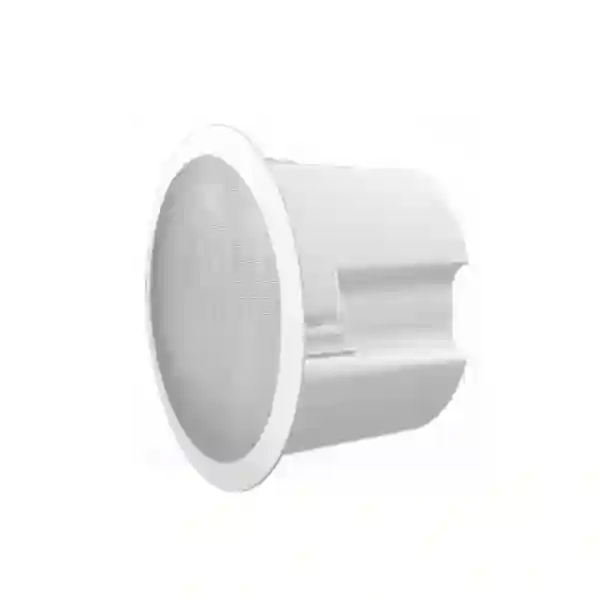


Fanvil FH-S01 SIP Ceiling Speaker
The Fanvil FH-S01 is a network-connected ceiling speaker for organizations that want paging, scheduled or live broadcasting, multicast announcements and two-way talkback on an IP network. Fanvil specifies two SIP lines, up to 10 multicast zones with priority, G.722 and Opus wideband codecs, a built-in omnidirectional microphone, 10/100 Mbps Ethernet, IEEE 802.3af Class 0 PoE, 12–24V DC input and audio output that scales with the power source up to 20W. For Tanzania projects, the value of the FH-S01 is not merely that it is a speaker: it can become an addressable SIP endpoint within a wider VoIP, alerting and security design.
Choose the FH-S01 when the project needs a flush ceiling-style SIP audio endpoint that can receive pages, multicast audio or broadcasts and also provide microphone-based talkback. Confirm the SIP platform, VLAN/QoS design, PoE or DC power plan, mounting depth, acoustic coverage and any security-alarm linkage before finalizing quantities.
What the Fanvil FH-S01 is designed to do
The FH-S01 combines the functions of an IP paging endpoint, ceiling loudspeaker and talkback device. Fanvil describes it as a SIP ceiling speaker for paging, multicasting, broadcasting and intercommunication. This positioning matters because a traditional ceiling speaker normally depends on separate amplification and a dedicated audio distribution path, while the FH-S01 connects directly to Ethernet and can be addressed through SIP or multicast workflows. That makes it relevant to organizations modernizing public-address or internal announcement systems around the same managed network used for business data and voice.
The device supports two SIP lines and up to 10 multicast zones with prioritization. In practical terms, an administrator can design different announcement groups or priority levels so that routine messages do not necessarily override higher-priority alerts. The exact behavior still depends on configuration and the originating paging platform, so a deployment should test the intended call and multicast flows rather than assume that every PBX implements paging identically.
Audio quality is supported by G.722 and Opus alongside G.711A/U, G.729A/B, iLBC, G.723 and G.726-32K. Fanvil lists a speaker frequency response of 100Hz–20kHz, 89dB ±3dB sensitivity at 1m/1W, 8-ohm impedance and maximum SPL of 96dB. Power output depends on the supply method: Fanvil lists 10W on PoE, 10W at 12V DC, 15W at 18V and 20W at 24V. This is why acoustic coverage and power planning should be treated together. A project should size the number and placement of speakers from room geometry, ceiling height, ambient noise and required intelligibility rather than simply using a fixed speaker-per-square-metre rule.
10 multicast zones
Supports up to 10 multicast zones with prioritization for organized paging and broadcast groups.
Built-in microphone
An omnidirectional microphone enables talkback, monitoring and intercom-style use cases when configured appropriately.
PoE or DC power
IEEE 802.3af Class 0 PoE simplifies single-cable deployments; 12–24V DC input allows alternate power designs and higher output at higher DC voltage.
SIP 2.0 endpoint
Uses SIP 2.0 over UDP, TCP or TLS, with RTP/RTCP/SRTP and common IP networking and provisioning protocols.
Verified Fanvil FH-S01 technical specifications
| SIP | 2 SIP lines; SIP 2.0 over UDP/TCP/TLS |
| Multicast | Up to 10 multicast zones with prioritization |
| Codecs | G.711A/U, G.729A/B, iLBC, G.723, G.726-32K, G.722 and Opus |
| Speaker | 100Hz–20kHz; 89dB ±3dB 1m/1W; 8Ω; maximum SPL 96dB |
| Audio power | PoE/10W, 12V/10W, 18V/15W, 24V/20W |
| Microphone | Omnidirectional; -36 ±3dB sensitivity; 2.2kΩ impedance; 2V bias |
| Network | 10/100 Mbps Ethernet; static IP, DHCP, PPPoE; VLAN, LLDP, QoS; IPv6 |
| Security / transport | TLS, SRTP, L2TP and OpenVPN support among listed protocols |
| Provisioning | FTP/TFTP/HTTP/HTTPS, DHCP Option 66, SIP PnP and TR-069 |
| Ports | 1× RJ45 network port; 1× 2-pin DC input; short-circuit input/output with integrated relay |
| Power | IEEE 802.3af Class 0 PoE or DC 12–24V/2A |
| Environment | Operating -20°C to 50°C; storage -30°C to 60°C; operating humidity 10–95% |
| Dimensions | Device 238.5 × 238.5 × 148.3mm; back box 202.5 × 202.5 × 139mm |
Compatibility, installation and deployment planning
The FH-S01 uses standards-based SIP, but standards support should not be treated as a guarantee that every paging feature behaves identically on every PBX. Before a quantity rollout, register a pilot unit to the intended IP PBX or paging controller and test inbound paging, auto-answer behavior, multicast groups, priority, codec negotiation, microphone talkback, alarm linkage and any secure signaling requirements. If the project uses SIP over TLS or SRTP, the certificate and media-security design should be tested end to end.
The network should also be voice-ready. Managed switching can provide a dedicated voice or paging VLAN, QoS, LLDP and visibility into link status. PoE is convenient because one cable carries both Ethernet and power, but the switch PoE budget must account for every connected endpoint. Where 24V DC is used to achieve the specified 20W maximum audio power, the design needs appropriate local power, cable routing and maintenance access. A project should not mix power assumptions casually because the available acoustic output changes with supply method.
Ceiling mounting requires physical planning. The unit and back-box dimensions should be compared with the available ceiling void, cutout strategy, fire compartment requirements, access panels and any local building rules. Speaker position should be chosen to produce intelligible coverage, not merely visual symmetry. High ceilings, open atriums, hard reflective surfaces, machinery, HVAC noise and partitions can all affect perceived speech clarity. For critical announcement areas, an acoustic review or pilot is preferable to relying solely on nominal SPL.
For related infrastructure, FourTeck Tanzania’s business technology shop provides context for networking, IP telephony and supporting infrastructure; the Tanzania services page explains design, installation and lifecycle support; and the FourTeck Tanzania contact page is the place to provide quantities, room details, PBX information and deployment requirements for a quotation.
Related SIP endpoints and network planning on FourTeck Tanzania
A ceiling speaker normally sits inside a wider SIP environment rather than operating alone. If the same project includes desk endpoints, the Dinstar C60S business SIP phone illustrates a basic two-account user endpoint, while the Dinstar C60SP PoE phone shows how centralized PoE can simplify endpoint power. Projects requiring different access methods can review the Dinstar C60U-W Wi-Fi IP phone and Dinstar C60U-T 4G IP phone. These are not replacements for the FH-S01; they are related SIP endpoints that help illustrate how paging, desk telephony and network infrastructure can be planned as one communications environment.
For users needing more line capacity, the Dinstar C62U business IP phone and Dinstar C62UP PoE business IP phone are additional internal product references. The important planning point is that SIP endpoints share dependencies: IP addressing, switching, power, VLANs, QoS, PBX registration, security policy and provisioning. Treating the FH-S01 as part of that architecture makes troubleshooting and future expansion easier.
Fanvil FH-S01 SIP Ceiling Speaker Tanzania
For organizations evaluating the Fanvil FH-S01 SIP Ceiling Speaker in Tanzania, the most useful starting point is to define the announcement workflow rather than the speaker count. A school may need class-change messages, administrative paging and emergency alerts. A hotel may need staff announcements in back-of-house areas. A warehouse can use zone-based broadcasts for operations or safety messages. An office may need reception-to-floor paging or integration with an existing SIP PBX. Because the FH-S01 is a SIP endpoint with multicast and talkback capability, each of these applications can use the same product differently.
Tanzania deployments should be planned around the network and power environment. The FH-S01 supports 10/100 Mbps Ethernet and IEEE 802.3af PoE, so a managed PoE switch can provide both connectivity and power through one cable. This can simplify ceiling installation and can also make central UPS protection possible if the switch itself is backed up. However, Fanvil specifies 10W audio power on PoE and higher output at 18V or 24V DC, reaching up to 20W at 24V. If a site needs the higher output level, the bill of materials and cable route should include the appropriate DC power design rather than assuming PoE and 24V operation are equivalent.
A Tanzania quotation should identify the number of rooms or zones, ceiling height, approximate floor area, ambient noise, SIP platform, switch models, PoE budget, VLAN structure and whether two-way talkback is required. If the speaker will link with a security alarm input or output, describe that workflow too. Fanvil lists a short-circuit input/output with an integrated relay, but the exact external device and trigger logic need project-specific validation.
For a complete voice project, FourTeck Tanzania can review the paging endpoints alongside IP PBX, desk phones, PoE switching, structured cabling and UPS requirements. Buyers should avoid specifying only “ceiling speakers” because that leaves unanswered questions about registration, multicast addressing, alert priority, power and coverage. A stronger request includes the operational objective, zone map and current network. This gives procurement and IT teams a clearer path to a testable design and helps distinguish product supply from installation, configuration and system integration.
Fanvil FH-S01 SIP Ceiling Speaker Dar es Salaam
Dar es Salaam organizations often operate multi-floor offices, retail outlets, hotels, logistics facilities, schools and mixed commercial sites where announcements must reach defined areas without relying on a separate analog amplifier chain. The Fanvil FH-S01 can fit these environments when the requirement is IP-based paging and talkback from an existing SIP or network platform. Its ceiling form factor is particularly relevant where the speaker should be integrated discreetly into an indoor ceiling rather than mounted as a visible horn or wall cabinet.
In a busy Dar es Salaam network, paging traffic may share switching infrastructure with business data, CCTV, Wi-Fi and IP phones. The bandwidth required for voice is not usually the dominant load, but congestion, poorly configured VLANs or unstable switching can still affect real-time audio. A managed network allows the deployment team to separate voice or paging traffic, apply QoS and document which ports feed each speaker. If multicast is used, the switching design should be tested so that audio reaches intended zones without creating unnecessary flooding across unrelated parts of the LAN.
Power design is another practical decision. PoE can reduce electrical work at the ceiling and centralize power at the rack. This is useful when the site already has PoE switches and UPS protection. If greater speaker power is needed, Fanvil lists higher output with higher-voltage DC supply, so each location should be assessed for power availability, service access and safe routing. Ceiling depth matters as well: the speaker body and back-box dimensions should be checked against suspended ceilings, concrete soffits, acoustic tiles, ducts and other building services before final quantities are ordered.
A Dar es Salaam buyer should provide floor plans where possible, mark paging zones, identify the PBX or SIP server, explain who initiates announcements and note whether the built-in microphone will be used for talkback or monitoring. For offices and hospitality properties, user simplicity may be as important as technical capability: staff need a clear method to select a zone and make a page without navigating complex controls. A pilot in one representative floor or room can verify loudness, intelligibility and SIP behavior before a larger roll-out.
Fanvil FH-S01 SIP Ceiling Speaker Mwanza
Mwanza businesses and institutions considering the Fanvil FH-S01 should think first about how many independently addressable audio areas are actually required. Fanvil supports up to 10 multicast zones with prioritization, which can be useful for a school campus, clinic, office, hotel or operational facility that needs different announcements in different areas. The zone design should match the way people work: reception, administration, corridors, training rooms, back offices and operational spaces may not all need the same messages at the same volume or priority.
The built-in microphone creates additional possibilities beyond one-way announcements. Where policy permits, an administrator can use talkback or intercom functions so that a remote caller and people near the speaker can communicate. That can help in controlled access areas, service counters or emergency verification workflows. Because microphone use raises privacy and acoustic considerations, the organization should decide in advance where talkback is appropriate, who can initiate it and how the function will be documented for users.
From an infrastructure perspective, the FH-S01 is straightforward to connect to standard Ethernet but still deserves careful IP planning. DHCP can simplify addressing, while static reservations or a documented addressing plan can make support easier. VLANs, LLDP and QoS are supported, and the device can be provisioned through common methods including HTTP/HTTPS, TFTP, FTP, DHCP Option 66, SIP PnP and TR-069. A Mwanza organization with several speakers can therefore create a repeatable configuration process instead of programming every unit manually at the ceiling.
Before ordering, buyers should document the network switch, available PoE budget, PBX registration method, multicast addressing plan, firmware policy and required alarm functions. A useful quotation also identifies whether installation includes ceiling cutouts, cable routes, patching, switch ports and UPS. These details matter because a speaker can be technically compatible yet difficult to deploy if the ceiling space, cabling or network configuration was never surveyed. Testing one room for audio coverage and then refining spacing can reduce both under-coverage and unnecessary speaker quantity.
Fanvil FH-S01 SIP Ceiling Speaker Arusha
Arusha hotels, tourism offices, schools, conference facilities and commercial workplaces can use the Fanvil FH-S01 where indoor announcements need to be integrated with an IP network. The ceiling-mounted design suits spaces where a cleaner visual finish is preferred, while SIP registration allows the endpoint to participate in a broader business communications system. In hospitality and conference settings, paging may be used for staff coordination, back-of-house announcements or controlled guest-area messaging, but the operational policy should define which zones are appropriate for each type of message.
Acoustics should receive particular attention in rooms with high ceilings, hard floors, glass, open lobbies or significant HVAC noise. A speaker that is loud enough is not automatically intelligible. The FH-S01’s wideband codecs and published audio response support quality speech reproduction, but room reflections and background noise can still make announcements difficult to understand. For larger spaces, it may be better to use more speakers at moderate level than a small number driven at maximum output. The final arrangement should be validated in the actual environment.
Arusha buyers should also decide whether to use PoE or DC power. PoE is attractive where structured cabling and managed switches are already available because it reduces local power adapters and supports central UPS protection. Higher-voltage DC can provide the greater audio output listed by Fanvil, but requires a different electrical design. The choice should therefore be made from coverage and resilience needs, not simply from which power source is easiest to obtain.
A well-scoped Arusha request should include the number and type of spaces, ceiling construction, expected noise level, required paging zones, PBX platform, network topology and any integration with alarm systems. If the organization has multiple properties, standardized provisioning can make future additions easier. The same naming convention, VLAN, multicast map and firmware baseline can be repeated across sites while allowing each building to have its own speaker count and acoustic design.
Fanvil FH-S01 SIP Ceiling Speaker Dodoma
Dodoma offices, institutions, education facilities and service organizations evaluating the Fanvil FH-S01 can treat the device as part of a structured communications and alerting system rather than as a standalone loudspeaker. Its two SIP lines can support registered calling scenarios, while multicast enables one-to-many audio distribution without requiring an individual SIP call to every device. This can be useful when an announcement must reach a defined group quickly, provided the network and paging controller are configured consistently.
For institutional environments, governance around alert priority is important. Routine messages, scheduled announcements and emergency notifications should not all be treated the same. Fanvil’s support for prioritized multicast zones allows a design in which higher-priority traffic can take precedence, but the organization should document the exact priority map and test it. Emergency use should also be evaluated against any applicable life-safety requirements; the FH-S01 should not be described as a certified emergency voice alarm system unless the full design and certifications support that claim.
IT teams in Dodoma can use the device’s web management and auto-provisioning capabilities to simplify larger deployments. Configuration export/import, firmware upgrade, syslog and packet capture can support troubleshooting and lifecycle management. A device-management plan should define administrator credentials, HTTPS use, firmware review, configuration backup and network access restrictions so that ceiling endpoints do not become forgotten unmanaged devices after installation.
For procurement, include exact model, quantity, power approach, required accessories, ceiling mounting conditions and whether the project includes switching and cabling. If the organization already operates an IP PBX, provide the brand and software version plus the desired call flow. If the project is new, define who will originate pages, whether desk phones or consoles will be used, and whether announcements must also integrate with security inputs. These details allow the FH-S01 to be assessed as one component of a complete, supportable system.
Fanvil FH-S01 SIP Ceiling Speaker UAE
For UAE projects, the Fanvil FH-S01 can be considered for offices, retail facilities, hotels, education sites and indoor operational spaces that already use managed IP networks and SIP communications. A multinational organization using the same paging architecture in Tanzania and the UAE may benefit from standardizing configuration templates, multicast naming, VLAN policy and support procedures. Standardization does not mean every site needs the same number of speakers; it means engineers can recognize the same logical design across locations.
Structured cabling and PoE switching are common in modern commercial environments, making the FH-S01’s IEEE 802.3af support useful. A PoE deployment can reduce the need for local ceiling power and allow centralized UPS protection. However, where acoustic requirements demand the higher 15W or 20W output levels stated by Fanvil, the design must evaluate 18V or 24V DC respectively. This distinction should be explicit in a UAE bill of materials so that purchasing, installation and acoustic expectations remain aligned.
Organizations should also validate SIP and cybersecurity policy. SIP over TLS, SRTP, OpenVPN and other network features are available, but secure deployment depends on the PBX, certificate process, firewall rules and device configuration. An enterprise network may also require dedicated voice VLANs, 802.1X at access ports or centralized monitoring. The FH-S01’s exact role in that policy should be confirmed during design rather than after mounting.
For regional coordination, FourTeck UAE provides broader IT and telecom project context, while the FourTeck IP phone specialist site covers business VoIP environments. A UAE quotation should include speaker count, zone map, PBX platform, switch models, PoE budget, ceiling details, required audio level and integration points. Buyers comparing quotations should check whether each proposal includes only the speakers or also configuration, cabling, switches, power design, mounting and testing.
Fanvil FH-S01 SIP Ceiling Speaker Uganda
Ugandan organizations can use the Fanvil FH-S01 where a SIP-based paging endpoint is needed for offices, schools, hospitality properties, clinics, retail spaces or operational facilities. The product’s main advantage is architectural: it uses the IP network and SIP ecosystem rather than requiring a completely separate analog paging backbone. For customers already operating an IP PBX, that can make it easier to originate announcements from approved phones or software endpoints, provided the PBX and paging method are validated.
A Uganda project should distinguish between one-way paging and talkback. One-way announcements are relatively simple: the endpoint receives a SIP or multicast stream and plays it. Talkback introduces microphone audio, user permissions and privacy considerations. The FH-S01 includes an omnidirectional microphone, so it can support intercom-style interaction, but the design should define who can call the speaker, whether calls auto-answer and how unauthorized access is prevented.
Branch and campus deployments benefit from centralized provisioning. Fanvil supports web management and several auto-provisioning methods, allowing administrators to prepare templates for SIP credentials, time, network parameters, codec preferences and multicast groups. This is more maintainable than configuring units individually after they are installed overhead. It is also useful to document MAC addresses, switch ports, physical locations and speaker names so remote support can correlate network information with the actual room.
For regional project support, FourTeck Uganda covers IP PBX, VoIP and networking context. A procurement request should specify whether the speakers are part of an existing PBX or a new solution, the number of zones, the type of switch, available PoE, ceiling construction and desired alert workflows. If the system spans Uganda and Tanzania, using consistent device naming and provisioning standards can simplify future troubleshooting and make replacement or expansion more predictable.
Fanvil FH-S01 SIP Ceiling Speaker Kampala
Kampala offices, universities, hotels, medical facilities and commercial buildings can consider the Fanvil FH-S01 for network-based announcements when a ceiling form factor and SIP integration are preferred. In a multi-floor office, the practical question is often how to divide the building into operational zones. Reception, executive floors, open-plan workspaces, meeting areas and service spaces may need different paging permissions. The FH-S01’s support for multiple prioritized multicast zones can help, but the organization must translate building use into a clear logical zone map.
Kampala networks may already carry video surveillance, Wi-Fi, cloud applications and VoIP. Paging traffic should therefore be designed within the LAN rather than added without documentation. Managed switching can provide VLAN separation and QoS, while multicast handling should be tested on the chosen switches. If an announcement reaches the wrong part of the network or fails to reach a remote floor, troubleshooting is much easier when IP ranges, switch ports and multicast groups have been documented.
Power continuity may matter for paging systems. PoE makes it possible to place access switches on UPS protection and keep connected speakers powered during short utility interruptions, subject to overall UPS runtime and switch load. If higher audio power is required through DC input, the site needs a different continuity plan. Buyers should therefore decide whether resilience or maximum output is the stronger priority in each zone and should not assume one method is universally best.
A Kampala quotation can be improved by sharing a floor plan, approximate room dimensions, ceiling height, background-noise level, desired speaker spacing, PBX or SIP server and whether the microphone is required. If installation is included, identify ceiling materials and existing cable pathways. A pilot in a representative room can validate speech clarity and output before the full site is cut and cabled, helping the project avoid either excessive speaker density or areas with weak intelligibility.
Fanvil FH-S01 SIP Ceiling Speaker Arua
In Arua, the Fanvil FH-S01 can suit organizations that need IP paging in schools, clinics, offices, hospitality venues or branch facilities and want the audio endpoint to be managed as part of the network. Smaller sites may not need complex paging software; a compatible SIP PBX or multicast source may be enough. Larger deployments can organize multiple zones and use centralized provisioning so configuration remains consistent across many speakers.
Remote support is an important design consideration for branch environments. The FH-S01 provides web administration, configuration import/export, firmware upgrade, syslog and packet-dump functions. These tools can help an administrator diagnose registration, network or audio issues without physically reaching every ceiling endpoint, but they are most useful when secure remote-management paths have been established. Management interfaces should not be exposed directly to the public internet; access should be controlled through the organization’s network-security design.
Arua projects should also plan spares and documentation proportionately. For a small installation, maintaining a clear record of device configuration, wiring and switch ports may be sufficient. For a larger campus or distributed organization, standardized configuration backups and a spare-unit strategy can reduce downtime. Because the speaker can use either PoE or DC power, a replacement process should also record which power mode is used in each area and the intended output level.
When requesting a quotation, include the number of buildings, rooms or zones, the distance from network racks, available copper cabling, PoE switch capacity, local power conditions and the SIP platform. If a site has limited structured cabling, that should be identified before product selection rather than after hardware arrives. The FH-S01 is an Ethernet device and depends on a stable wired network path, so cabling and switching are part of the solution. A complete proposal should make those dependencies visible so procurement can compare total deployment scope rather than only unit price.
Fanvil FH-S01 SIP Ceiling Speaker Mbarara
Mbarara organizations considering the Fanvil FH-S01 may be looking to replace a basic analog announcement system or add paging to an existing VoIP environment. The decision should begin with whether the business benefits from individually network-addressable speakers. If announcements need zoning, remote configuration, SIP registration, scheduled broadcasts or talkback, the IP approach can offer useful flexibility. If the requirement is simply one audio feed to a single small room, a more basic solution may be sufficient.
For education or healthcare settings, clarity and operational control are more important than maximum loudness. Speaker placement should aim for even speech coverage and avoid creating very loud areas close to a device while leaving distant areas weak. The FH-S01’s published maximum SPL and frequency response provide useful engineering inputs, but actual results depend on ceiling height, room volume, surfaces and ambient noise. Testing in the real environment can validate the number of speakers before a larger order.
Network management can also improve long-term support. A dedicated paging VLAN, clear DHCP or static address plan and descriptive switch-port labels make it easier to identify failed or disconnected devices. Syslog and packet capture can support fault diagnosis when audio is intermittent or SIP registration fails. Firmware should be managed deliberately: administrators should review release information, test updates and maintain configuration backups rather than updating every device without a rollback plan.
A Mbarara procurement request should identify the existing PBX, whether announcements are generated from desk phones, software or an alert system, and whether external alarm contacts will be connected. Quantities should be based on zones and acoustic coverage. The quote should also show which elements are included: speakers, PoE switching, DC supplies where required, cable runs, mounting, configuration, testing and user orientation. Making these items explicit allows the organization to compare proposals on a like-for-like basis and reduces surprises during installation.
Fanvil FH-S01 SIP Ceiling Speaker Gulu
Gulu schools, offices, hotels and operational sites can consider the FH-S01 for indoor SIP paging where conventional speakers would otherwise require separate amplifiers and audio cabling. Because the device combines network interface, amplifier, loudspeaker and microphone, the installation can be more integrated with the IP infrastructure. That does not remove the need for design; instead, the design focus shifts toward Ethernet, PoE, SIP registration, multicast routing and centralized management.
Organizations should decide early whether the paging system is intended for routine operations, emergency communication or both. Routine announcements may tolerate different coverage and redundancy assumptions from safety-critical messages. Fanvil allows customized WAV files for notifications and alarms, but any use in a formal emergency system should be evaluated against applicable requirements for supervision, backup power, certification and fault monitoring. Product features alone should not be used to imply regulatory compliance.
For branch operations, resilient power can be important. PoE enables centralized power from network switches, making UPS-backed operation possible if the switches and upstream network are protected. Where 24V DC is chosen to reach the highest specified audio power, a separate power path must be planned. The correct choice depends on the acoustic and continuity requirement of each location. A mixture can be used in a project, but it should be clearly documented for maintenance.
A practical Gulu deployment plan should include an inventory of speakers, room names, switch ports, IP addresses, multicast zones, SIP credentials and firmware versions. This makes remote administration much easier and allows a replacement unit to be configured predictably. Buyers should also confirm ceiling access and cabling routes before ordering, especially in existing buildings where hidden structural or electrical obstacles can affect installation. A site survey or detailed photos can help translate the product specification into a realistic installation scope.
Fanvil FH-S01 SIP Ceiling Speaker Kenya
Kenyan organizations can deploy the Fanvil FH-S01 in offices, education, retail, hospitality and industrial environments that need IP paging and talkback. For multi-country groups operating in Tanzania and Kenya, the product may be attractive as part of a standardized SIP architecture. The same configuration principles—device naming, VLAN design, multicast groups, codec policy and management access—can be reused even when each building has different speaker quantities and acoustic conditions.
A standards-based SIP approach also gives buyers flexibility in the wider communications platform, but compatibility should be verified against the exact PBX or paging controller. Registration, auto-answer, multicast, DTMF, codec negotiation and secure media may behave differently across platforms. A pilot unit can establish a validated configuration before procurement scales to many locations. This is particularly valuable for a regional standard where a configuration mistake would otherwise be repeated across multiple offices.
PoE design should account for quantity. One FH-S01 may be easy to add to an existing switch; dozens of units can materially change the switch PoE budget and UPS load. The project should calculate total power demand and leave reasonable headroom for other endpoints such as access points, cameras and IP phones. If some zones need higher audio output than PoE provides, DC-powered units can be planned separately rather than forcing the entire site into one power method.
For regional IT and VoIP context, FourTeck Kenya covers communications and network infrastructure. A Kenya request for the FH-S01 should include speaker quantity, rooms, ceiling type, PBX, switch models, available PoE, desired multicast zones and any talkback or alarm integrations. Procurement teams comparing suppliers should ask for a clear statement of included configuration, installation, testing and support so that a low hardware-only price is not mistaken for the cost of a complete working paging system.
Fanvil FH-S01 SIP Ceiling Speaker Kuwait
Kuwait offices, retail facilities, hospitality properties and institutional buildings can use the Fanvil FH-S01 where indoor paging needs to integrate with SIP communications and structured networking. The ceiling format is suitable for finished interiors, while the built-in amplifier and network interface reduce the dependence on a central analog amplifier for every audio path. The design still needs to account for acoustic coverage, ceiling depth, network ports and power.
In larger commercial projects, the FH-S01 should be coordinated with consultants and other building systems early. If security alarm contacts, access-control events or scheduled announcements will trigger audio, the exact integration path should be documented. Fanvil lists a short-circuit input/output and integrated relay, but the electrical ratings and logic of the connected system must be checked. Integrators should avoid connecting third-party alarm outputs without confirming voltage, dry-contact behavior and isolation requirements.
Environmental limits also matter. Fanvil specifies an operating range of -20°C to 50°C and humidity of 10–95%, but the FH-S01 is an indoor ceiling product and should not be assumed suitable for exposed outdoor conditions. In air-conditioned commercial interiors this is normally straightforward, while ceiling voids near heat sources should be reviewed. Adequate service access is also useful because firmware, cabling or power troubleshooting may require physical reach to the device.
A Kuwait quotation should list the exact speaker model, quantity, chosen power method, mounting scope, cabling and PBX integration. If the system is part of a regional standard, include the configuration profile used elsewhere so technical teams can maintain consistency. The objective is to avoid treating the project as a simple speaker purchase. Network paging works best when the endpoint, PBX, switching, multicast policy, power and physical installation are designed together and tested as one system.
Fanvil FH-S01 SIP Ceiling Speaker Ghana
Ghanaian businesses and institutions can evaluate the Fanvil FH-S01 for IP paging, announcements and talkback in offices, schools, hotels, retail environments and operational facilities. The product is most useful when the organization wants audio to be part of a managed IP communications environment. Each speaker can be identified on the network, registered to SIP and included in multicast groups, allowing more granular control than a conventional all-or-nothing audio feed.
For projects with several buildings or floors, the management model should be decided before installation. Device names can reflect building and room, IP addresses can follow a dedicated subnet, and multicast zones can follow operational areas. A simple convention such as site-floor-zone-device is easier to support than arbitrary labels. Auto-provisioning and configuration import/export can then help reproduce the correct settings consistently and reduce manual error.
Acoustic expectations should remain realistic. Fanvil publishes maximum SPL and power figures, but these do not directly translate into guaranteed coverage distance in every room. Furniture, ceiling height, reverberation and background noise change the listening experience. For speech, intelligibility matters more than raw loudness. Pilot testing with the actual announcement source and codec can provide evidence for speaker spacing and output settings before the final quantity is approved.
For cross-market IT projects, FourTeck Africa offers wider regional infrastructure context. A Ghana procurement team should provide the building layout, number of intended paging zones, SIP platform, available switching, PoE capacity and any security linkage requirements. If talkback will be enabled, user roles and access should also be defined. A complete project quotation should separate hardware, network upgrades, cabling, mounting, configuration and commissioning so decision-makers can understand the total scope.
Fanvil FH-S01 SIP Ceiling Speaker Nigeria
Nigeria projects can use the Fanvil FH-S01 in corporate offices, education, retail, hospitality, logistics and indoor industrial environments where paging needs to integrate with SIP. Larger organizations with multiple floors or branches may especially benefit from the ability to standardize the endpoint configuration and multicast structure. Instead of building an isolated paging system at every site, the organization can incorporate paging into the same IP architecture used for business telephony, subject to bandwidth, security and resilience planning.
Power resilience deserves deliberate attention. Network-based paging can remain available through short interruptions if the speakers use PoE and the switch, core network and PBX are UPS-backed. If speakers are powered from local DC supplies, those supplies need their own continuity strategy. The FH-S01’s output also varies by power source, so a resilience decision can affect acoustic output. An engineering design should balance these requirements rather than optimize only for the highest wattage or the simplest cabling.
Security should be handled like any other managed endpoint. Administrator credentials should be changed, management access should be limited, firmware maintained and unnecessary exposure blocked. SIP over TLS and SRTP can support secure signaling and media where the PBX supports them. If the speaker is connected to an alarm input or relay output, the physical interface should also be documented because it becomes part of the organization’s security and operational workflow.
A Nigerian buyer should ask prospective integrators how they will validate coverage, configure multicast, handle provisioning, document switch ports and test failover. The hardware specification is only one part of the project. A good handover should give the IT team a map of devices, addresses, zones and credentials along with a clear explanation of how staff originate a page. For organizations with regional operations, the same template can be extended to Tanzania, Kenya, Uganda or other offices while retaining local speaker counts and power design.
Fanvil FH-S01 SIP Ceiling Speaker Seychelles
Seychelles hotels, resorts, offices, schools and service environments can consider the Fanvil FH-S01 for indoor ceiling paging where network-based management and SIP integration are useful. Hospitality environments often contain different operational zones—reception, administration, staff areas, corridors, meeting spaces and service rooms—so a single broadcast to every area may not be appropriate. Multicast zoning can allow announcements to be directed more selectively when the paging platform is configured to match the property’s operational structure.
The physical environment should be considered carefully. The FH-S01 is designed for ceiling installation and Fanvil lists operating humidity up to 95%, but an indoor product should not be assumed suitable for direct weather exposure, salt spray or outdoor areas. Coastal properties should ensure speakers are installed in appropriate internal locations and that cable routes, connectors and network equipment are protected according to the building environment. Outdoor announcement zones may require purpose-built outdoor-rated speakers instead.
For guest-facing spaces, audio level and message governance are particularly important. Announcements should be intelligible without being intrusive. The organization can define which users have permission to page guest areas, which messages are reserved for staff zones and whether scheduled audio is used. If talkback is enabled, privacy policy and user awareness should be considered because the unit includes a built-in microphone.
A Seychelles project quotation should therefore include more than model and quantity. Provide room types, floor plans, ceiling height, expected ambient noise, paging zones, PBX platform, network switches and preferred power method. If the property has several buildings, identify inter-building links and where the SIP server resides. A pilot in a representative guest or staff area can verify audio behavior before a wider rollout, reducing the risk of visual, acoustic or network issues after many ceiling cutouts have already been made.
Selection and quotation checklist
List the rooms or areas and identify which messages each zone should receive.
Provide the PBX or paging controller brand, version and desired paging workflow.
Choose PoE or DC based on switch budget, UPS strategy and required audio output.
Confirm available depth, cable routes, mounting method and service access.
Use room dimensions, ceiling height and ambient noise to estimate placement, then pilot where practical.
Define administrator access, firmware policy, VLANs, TLS/SRTP use and alarm integration.
Fanvil FH-S01 frequently asked questions
Does the Fanvil FH-S01 support PoE?
Yes. Fanvil specifies IEEE 802.3af Class 0 PoE through the RJ45 network port. The datasheet lists 10W audio power when using PoE.
Can the FH-S01 be powered by DC?
Yes. It supports 12–24V DC at up to 2A. Fanvil lists 10W audio at 12V, 15W at 18V and 20W at 24V.
How many multicast zones does it support?
Fanvil specifies support for up to 10 multicast zones with prioritization.
Does the FH-S01 have a microphone?
Yes. It includes an omnidirectional microphone for talkback, intercom and monitoring scenarios when enabled and configured appropriately.
Which codecs are supported?
Fanvil lists G.711A/U, G.729A/B, iLBC, G.723, G.726-32K, G.722 and Opus.
Can it work with an existing IP PBX?
The FH-S01 uses SIP 2.0, but practical compatibility should be tested with the exact PBX version and paging features. A pilot should verify registration, auto-answer, multicast, codec, TLS/SRTP and any talkback or alarm behavior required by the project.
Is it suitable for outdoor installation?
The FH-S01 is specified as a ceiling-mounted product. Do not assume outdoor or weather-exposed suitability unless the planned environment and product documentation explicitly support it. For exposed areas, consider a purpose-built outdoor speaker.
Decision recap
The Fanvil FH-S01 is a strong fit when a project needs a ceiling-mounted SIP paging endpoint with multicast, talkback, web management, auto-provisioning and flexible PoE/DC power. Its value increases when the organization already has managed Ethernet and SIP communications because paging can be integrated into the same operational architecture. The main design questions are not only “how many speakers?” but “which zones, which call flows, which power method, which acoustic target and which management model?”
For pricing or procurement, provide exact quantity, deployment city, room or zone list, PBX details, switch models, PoE budget, ceiling type and whether configuration or installation is required. FourTeck can then evaluate the FH-S01 within the wider network and telephony requirement rather than quote an isolated hardware item.
Plan the FH-S01 as part of a complete SIP paging system
For a useful quotation, send the speaker quantity, floor plan or zone list, ceiling height, PBX platform, switch model, power preference and required talkback or alarm integration. FourTeck Tanzania can use that information to identify the supporting networking, cabling and configuration requirements.



Reviews
There are no reviews yet.