
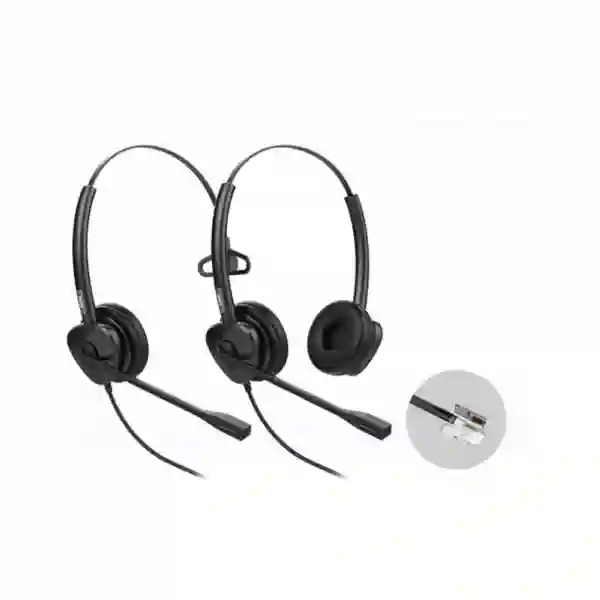
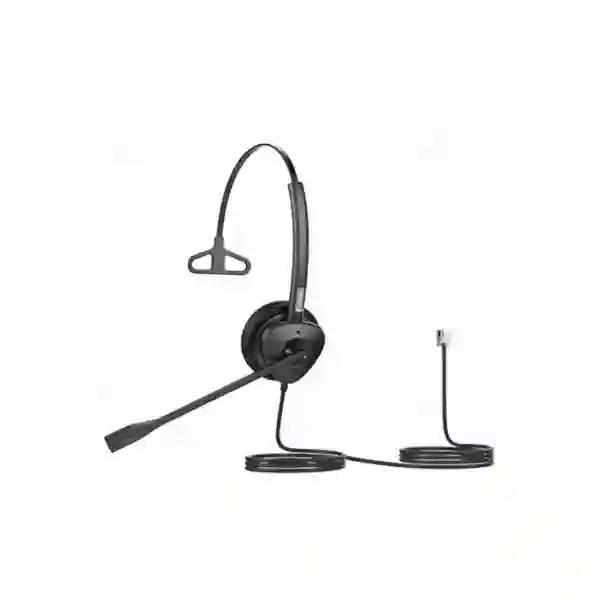
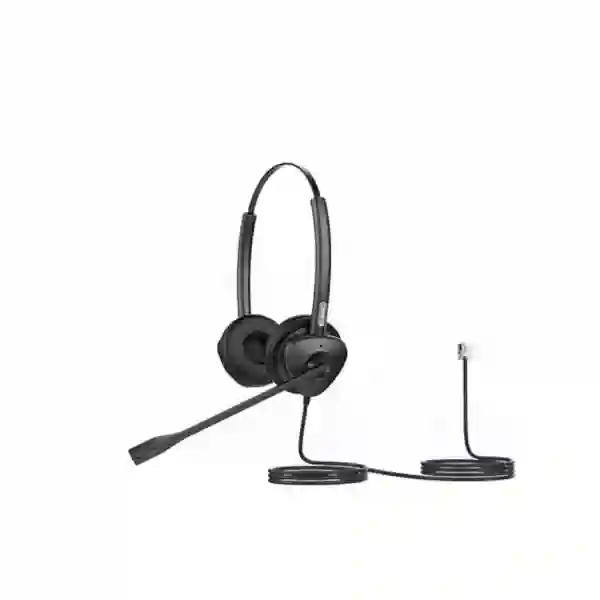
Fanvil HT301 RJ9 Headset
The Fanvil HT301 RJ9 Headset is a mono wired headset developed for office and call-center communication. Fanvil positions the HT301/HT302 family around HD audio, passive noise reduction, ergonomic comfort and direct RJ9 connectivity to compatible Fanvil and mainstream third-party IP phones. For teams that want a straightforward headset without batteries, Bluetooth pairing or a USB audio path, the HT301 provides a focused desk-telephony option.
Quick answer
Choose the HT301 when you need a mono RJ9 headset for a compatible desk IP phone and want to keep one ear open to the surrounding office. The related HT302 is the dual-ear model. Confirm RJ9 pin-out and phone compatibility before a volume purchase because RJ9 wiring can vary between phone and headset families.
Best suited to
Reception desks, sales teams, service counters, contact-center agents, help desks, booking teams and office users who take frequent calls from a desk phone and prefer a lightweight wired headset with direct RJ9 connectivity.
Important purchase check
RJ9 is a connector format, not a universal guarantee of electrical pin compatibility. Fanvil’s own compatibility guidance notes that telephone headsets can use different pin-outs, so the exact phone model should be checked before deployment.
Fanvil HT301 verified product overview
Fanvil describes the HT301/HT302 RJ9 series as professional headsets designed specifically for call-center and office communication. The HT301 is the mono option, while the HT302 is the dual-ear version. The family supports passive noise reduction and is promoted around an HD audio experience. The physical design uses a streamlined ergonomic form, soft leather ear cushions and a lightweight wearing concept intended to make longer calling sessions more comfortable. These are particularly relevant characteristics for users who repeatedly switch between phone calls, customer interaction and nearby colleagues during the working day.
The HT301’s mono format is often useful in environments where the wearer still needs awareness of the room. A receptionist may need to hear a visitor while handling a call, a sales coordinator may need to speak to nearby colleagues between conversations, and a service desk may require quick verbal coordination without removing the headset. A dual-ear headset can provide greater acoustic isolation, but that is not always desirable. This is the practical distinction procurement teams should make before choosing HT301 versus HT302.
RJ9 compatibility and deployment guidance
The most important technical buying question for the Fanvil HT301 is not simply whether the target phone has an RJ9-looking socket. Fanvil’s headset compatibility guidance explains that professional telephone headsets on the market can use different pin-outs. If the headset and phone pin configuration do not match, voice can fail or be extremely weak. This is why a procurement list should record the exact phone brand and model rather than only stating “RJ9 desk phone.” For a single headset, confirmation is easy. For dozens or hundreds of users, a short pilot test can prevent a costly compatibility mistake.
When the target endpoint is a Fanvil phone, check the manufacturer’s current RJ9 compatibility information for that phone family and firmware. For a third-party mainstream IP phone, check the phone vendor documentation as well as the headset wiring requirement. Phone-side headset settings can also influence user experience. Some phones allow the administrator to select headset mode, ring routing, automatic headset behavior or a dedicated headset key. These settings do not change the physical pin-out, but they can determine whether users can answer and manage calls efficiently from the headset.
For a business deployment, define the operational workflow before purchase: will agents answer from the phone, use a soft key, remain in headset mode all day, or alternate between handset and headset? Are desks shared between shifts? Does every user need mono audio, or do high-noise positions need dual-ear isolation? Is the phone mounted on a reception counter or placed at a standard workstation? These questions help determine whether HT301 is the correct wearing style and whether the RJ9 cable route is practical. Wired headsets remove battery charging and wireless-pairing tasks, but they also keep the user physically connected to the desk phone.
Who should buy the Fanvil HT301?
Call-center and support agents
Agents handling repeated inbound or outbound calls can benefit from hands-free desk-phone use. The mono design also makes it easier to hear supervisors or nearby teammates without removing the headset.
Reception and front desk
Reception staff frequently balance telephone conversations with face-to-face interaction. A one-ear headset can help them remain attentive to visitors while keeping both hands free for keyboard use and call handling.
Sales and booking teams
Sales, reservations and appointment teams often type notes or update CRM records during calls. A lightweight wired headset can make this workflow more comfortable than holding a handset for long periods.
Related FourTeck Tanzania telephony resources
The headset is only one part of a working extension. Buyers should also confirm the desk phone, PBX, switch infrastructure, power method and call-flow requirements. The FourTeck Tanzania technology shop provides broader purchasing context, while FourTeck Tanzania services explains deployment and support capabilities. For teams comparing alternative desk endpoints, the following live product pages provide useful examples of different phone configurations and power methods.
Regional procurement and deployment guidance
Fanvil HT301 RJ9 Headset Tanzania
For businesses searching for the Fanvil HT301 RJ9 Headset in Tanzania, the strongest fit is a desk-phone environment where staff spend a meaningful part of the day on voice calls and need hands-free operation without moving to a wireless headset. Customer-service desks, reservation teams, sales operations, reception areas, internal help desks and administrative offices can all use a mono headset effectively when the user must remain aware of colleagues or visitors. The HT301’s direct RJ9 connection keeps the deployment simple, but buyers should treat compatibility as a formal procurement step rather than assuming every RJ9 port is wired identically. Record the exact Fanvil or third-party phone model, confirm the headset interface, and where quantities are significant, test a sample with the production phone before completing the order.
Tanzania deployments also benefit from thinking about the full voice environment. A headset cannot fix poor SIP registration, overloaded internet connectivity, a congested LAN or unsuitable call queues. If the project involves new phones as well as headsets, review the PBX platform, voice VLAN, switch ports, PoE strategy, UPS protection and provisioning method at the same time. The FourTeck Tanzania technology overview explains how IP phones, network switching and broader business infrastructure fit together. For organisations that operate several branches, a standard phone-and-headset profile can simplify training, spares and support, but the standard should be validated against each phone model and user role before it is rolled out nationally.
When requesting a Tanzania quotation, include quantity, phone brand and model, whether users work from fixed desks or shared workstations, the expected daily call pattern and whether mono listening is preferred. Explain if the requirement is replacement headsets for an existing phone estate or part of a complete IP telephony refresh. Procurement teams should also state any deadline, city, and whether installation or configuration support is needed. Avoid relying on assumptions about stock, delivery time or warranty until these are confirmed in the quotation. A clear request makes it easier to distinguish the HT301 from the HT302 dual-ear model and from USB headsets such as the HT301-U, which use a different connection method and should not be treated as interchangeable products.
Fanvil HT301 RJ9 Headset Dar es Salaam
Dar es Salaam organisations often run busy front desks, sales offices, logistics operations, service centres and administrative teams where telephone handling remains a daily business process. In these environments, the Fanvil HT301 can be a practical accessory for users who need to type, search records or update customer information while speaking. The mono format supports room awareness, which is useful at reception counters and shared offices where employees still need to notice visitors or nearby colleagues. For call-heavy staff who do not need to walk away from the desk, a wired RJ9 headset also removes battery charging, Bluetooth pairing and wireless-device management from the routine. That simplicity is valuable when a business wants predictable equipment across many fixed workstations.
The purchasing decision should begin with the desk phone. Dar es Salaam businesses may have mixed estates built over several years, with different Fanvil models or third-party SIP phones used by different departments. An RJ9 connector by itself is not enough to guarantee correct headset operation because pin-outs can differ. Create a small compatibility matrix that lists each phone model and the intended headset. If only some desks are compatible, it may be more economical to standardise phones in the high-call departments rather than force one accessory across incompatible endpoints. A pilot at reception, sales and support positions can also reveal whether mono audio provides enough acoustic separation for the actual office noise level.
For a Dar es Salaam quotation, provide the office location, number of users, phone models, PBX platform and whether the project includes replacement handsets, switches or network configuration. If voice quality problems already exist, mention them before ordering accessories because the root cause may be network congestion, SIP configuration or cabling rather than the headset. Organisations managing multiple business locations can also coordinate voice requirements through the wider FourTeck IP Phone specialist site for additional telephony context. The objective should be a working user position: compatible phone, correctly configured headset mode, reliable call path and a wearing style that fits the employee’s actual workflow.
Fanvil HT301 RJ9 Headset Mwanza
Mwanza organisations evaluating the Fanvil HT301 RJ9 Headset may be expanding a branch, replacing worn call accessories or improving day-to-day productivity for staff who currently hold a handset for long periods. The HT301 is most relevant where the user works at a fixed IP phone and benefits from one-ear listening. This can suit customer support, accounts, procurement, branch administration and sales coordination because the free ear maintains awareness of the room while the headset keeps both hands available for a keyboard or paperwork. For quieter offices, passive noise reduction may be sufficient; for very noisy work areas, teams should evaluate whether the dual-ear HT302 or another headset format would better match the acoustic environment.
Branch deployments should be documented carefully. If a central IT team supports Mwanza from another city, record the phone model, firmware, headset connection, extension settings and any phone-side headset options. A replacement unit should be easy to install without rediscovering the configuration. Compatibility testing is particularly important when a business has inherited different phone brands across locations. Fanvil notes that RJ9 headsets can use different pin-outs, so purchasing by connector shape alone is risky. One verified sample on the exact production phone is a better basis for a large order than a generic statement that both devices use RJ9.
A useful Mwanza request for quotation should include the number of headsets, phone models, department names, whether the environment is quiet or noisy, and whether users need mono or dual-ear coverage. If the business is also refreshing IP phones, list the PBX platform, network switch type, PoE requirement and voice VLAN policy. This allows accessory selection to be coordinated with the endpoint rather than added later. For wider infrastructure planning, the FourTeck Tanzania services page describes how technology supply can be combined with installation, configuration, testing and support according to agreed scope. Confirm logistics and service availability for the specific Mwanza project during quotation rather than assuming local stock or guaranteed onsite coverage.
Fanvil HT301 RJ9 Headset Arusha
Arusha businesses in hospitality, tourism administration, professional services, education, logistics and general commerce often depend on telephone conversations for reservations, supplier coordination, customer enquiries and internal operations. The Fanvil HT301 can support these workflows when staff use compatible desk IP phones and want a wired mono headset. Reception and reservations teams are especially good examples because users may need to type booking information while continuing to hear colleagues or guests nearby. The one-ear wearing style is therefore not simply a cost choice; it is a workflow choice. Teams that require stronger isolation from surrounding conversations should compare the HT302 dual headset or another appropriate alternative before standardising.
For Arusha properties with front-office, back-office and reservations departments, it is useful to classify users rather than order one accessory for everyone. High-call users may need headsets at every desk, occasional callers may prefer the handset, and supervisors may want a different wearing style. Shared desks need hygiene and ownership procedures for ear cushions and microphone positioning. The RJ9 interface keeps the connection straightforward, but technical compatibility must still be checked against each phone model. This is particularly important in hospitality environments where phone systems may include a mix of front-desk consoles, ordinary SIP phones and specialised endpoints.
Before requesting an Arusha quotation, list the exact desk phones, quantities by department and any PBX or network upgrade planned at the same time. State whether the requirement is for a new property, an expansion or a replacement programme, because each scenario has different rollout and testing needs. If the company operates in several East African markets, keep the compatibility matrix and headset standard consistent where the same phone model is used. However, do not assume availability or identical commercial terms across countries. Use the quotation process to confirm supply, warranty and deployment scope for each site. The wider FourTeck Africa technology site can provide additional regional context for organisations coordinating communication requirements across multiple locations.
Fanvil HT301 RJ9 Headset Dodoma
Dodoma offices, institutions, professional organisations and service teams may consider the Fanvil HT301 where staff use SIP desk phones for routine inbound and outbound calling. The headset is especially relevant for administrative users who need to enter information while talking, switch between calls and in-person conversations, or remain aware of colleagues in an open office. Its mono form keeps one ear free, while the wired RJ9 connection avoids charging routines and wireless pairing. For formal procurement environments, the exact model designation should be written clearly as Fanvil HT301 RJ9 Headset so it is not confused with the HT302 dual-ear product or with the HT301-U USB headset family.
Institutional buyers should make compatibility evidence part of the evaluation. Request confirmation against the specific phone model, and where practical, test a sample on the same endpoint and firmware used in production. This can verify basic audio, microphone operation, headset-mode behaviour and comfortable microphone positioning before larger quantities are approved. The test should also consider real workspace noise. A headset can provide a better calling posture, but it does not remove the need for sensible room acoustics, appropriate call volumes and a reliable voice network. If users report echo, delays or dropped calls, investigate PBX, WAN and LAN conditions separately rather than attributing every issue to the accessory.
A Dodoma quotation request should state the number of users, departments, exact phone models, whether headsets will be personally assigned or shared, and whether the project requires configuration or user guidance. If the organisation is also buying new phones, include the PBX system, PoE and switching information so the complete extension can be evaluated. The FourTeck Tanzania shop provides related business technology options, while the live Tanzania contact page is the correct place to submit the final requirement. Commercial details such as stock, warranty, delivery and onsite work should be confirmed for the specific quotation.
Fanvil HT301 RJ9 Headset UAE
For UAE organisations, the Fanvil HT301 RJ9 Headset fits desk-based telephony where agents, receptionists, sales users or support staff require a simple mono wired headset on a compatible IP phone. Multi-country companies often prefer standardised accessories because training and replacement are easier when employees see the same equipment at each branch. The HT301 can support that approach if the underlying phone estate is also standardised and compatibility has been verified. A regional standard should identify the exact phone model and firmware alongside the headset, because RJ9 connector appearance does not guarantee a universal pin-out across every endpoint brand.
UAE offices may also have a wide range of user profiles, from executive desks to large service teams. The mono HT301 is most suitable where room awareness matters. A contact-centre position in a noisy open floor may need dual-ear coverage, while a reception desk can benefit from one free ear. The correct model should therefore be chosen by role rather than by ordering one headset for every employee. Wired equipment offers operational simplicity but limits movement to the desk; teams that need mobility should consider a wireless alternative. The HT301 is focused on the fixed-phone workflow rather than roaming communication.
For UAE procurement, document quantities by user role, phone model, PBX platform and required delivery location. Confirm warranty, availability and commercial terms at quotation stage rather than relying on assumptions from another market. Companies coordinating Tanzania and UAE offices can use FourTeck UAE for regional technology enquiries and FourTeck IP Phone for specialist business-telephony context. Keeping a shared compatibility document across offices can reduce procurement errors: list phone models, headset models, extension profiles and any approved accessories so new branches do not repeat the same technical testing from the beginning.
Fanvil HT301 RJ9 Headset Uganda
Ugandan businesses looking for the Fanvil HT301 RJ9 Headset may be expanding an IP PBX, adding customer-service capacity or replacing handsets with more ergonomic calling accessories for frequent users. The headset is well suited to fixed desks where the employee needs both hands free and still wants awareness of the surrounding office. The mono design can serve reception, finance, reservations, procurement, sales support and help-desk roles. Because the product connects over RJ9, procurement teams should identify the exact phone model used in Uganda and confirm pin compatibility before ordering a large quantity. Fanvil specifically warns that professional telephone headsets can use different RJ9 pin-outs.
For organisations with branches outside Kampala, standardisation can make remote support easier. A documented bundle might define one approved phone model, one HT301 headset, the correct phone-side settings and a consistent extension template. That allows IT staff to support a replacement remotely with fewer variables. However, the mono headset should not be selected automatically for every environment. Offices with substantial background conversation may benefit from dual-ear listening, while staff who need to walk away from the desk may require a wireless device. User role, noise level and mobility should be part of the requirement, not added after purchase.
When seeking an Uganda quotation, include site location, user count, phone models, PBX brand, call patterns and whether headsets are assigned individually or shared. Mention any branch rollout so quantities and compatibility can be reviewed consistently. The FourTeck Uganda technology site can provide regional project context, while the Tanzania page can remain the reference for Tanzania-specific procurement. If one organisation operates in both countries, use the same technical standard where the endpoint is identical but confirm commercial availability and service scope separately in each market.
Fanvil HT301 RJ9 Headset Kampala
Kampala offices often concentrate customer service, sales, administration and branch management in environments where telephone users may handle many calls while working in CRM, ticketing or business applications. The Fanvil HT301 can be useful for these fixed-desk users because its mono wired format keeps hands free while allowing awareness of nearby colleagues. A headset purchase should still be treated as part of the overall workstation. Check the desk phone’s RJ9 headset interface, the employee’s call volume, the noise level of the room and whether the cable length and desk layout allow comfortable movement around the immediate workstation.
Compatibility testing is particularly important for mixed estates. A company may have Fanvil phones in one department and another brand elsewhere. Even if both phones expose an RJ9 port, the pin arrangement can differ. The correct approach is to build a tested phone-headset list. Start with a pilot on each phone family, confirm transmit and receive audio, and check how the phone enters headset mode. If a model is not compatible, do not attempt to solve the issue through generic assumptions; use the manufacturer compatibility documentation or choose the appropriate supported accessory. This protects both user experience and the purchasing budget.
A Kampala buyer should provide a quotation request that separates requirements by department. For example, reception may need mono headsets for awareness, a high-density support team may prefer dual-ear models, and managers may not need dedicated headsets at all. Specify the phone models and expected quantities for each group. If the project also includes new SIP phones or an IP PBX, include that scope so the whole voice endpoint can be planned together. Regional organisations can coordinate requirements through FourTeck Uganda, while businesses buying for Tanzania should use the Tanzania contact channel. This keeps technical standardisation separate from market-specific commercial arrangements.
Fanvil HT301 RJ9 Headset Arua
Arua organisations that use SIP desk phones for branch communication, customer enquiries or administrative calling can consider the Fanvil HT301 when a simple wired mono headset matches the user’s role. The product is best suited to employees who remain near their phones and value hands-free calling more than wireless mobility. A branch office may have only a few heavy callers, so user profiling can keep the purchase focused: identify reception, service, logistics coordination or sales users who spend substantial time on calls rather than equipping every desk automatically.
Remote branches benefit from standardised, well-documented hardware. If the same Fanvil phone model is deployed across several sites, validating the HT301 once against that exact endpoint can create a repeatable standard. Record the model, connection method and any phone settings required for headset mode. Still review firmware and vendor guidance when equipment changes. If a different phone brand is present in Arua, repeat the compatibility check because RJ9 pin-outs are not universally identical. A small pilot also allows local users to confirm comfort and whether one-ear listening provides enough separation from the branch environment.
For procurement, include Arua as the project location, the exact number of headsets, phone models and whether installation or user support is expected. Explain the branch relationship if IT is managed from Kampala or another country so documentation and spares can be aligned. Logistics, warranty conditions and onsite support should be confirmed during quotation and not assumed. Where a broader Uganda voice project is being planned, the FourTeck Uganda site offers the relevant regional channel. The goal is to make the headset a predictable part of the branch telephony standard rather than an isolated accessory chosen without considering endpoint compatibility and user workflow.
Fanvil HT301 RJ9 Headset Mbarara
Mbarara businesses may use the Fanvil HT301 to improve fixed-desk calling for front office, customer support, accounts, reservations or sales coordination. The headset’s mono form is appropriate where staff need to continue hearing colleagues or visitors while a call is in progress. Its wired nature can also suit sites that want a simple accessory with no charging cycle. The main technical condition is phone compatibility: the target desk phone must have the appropriate RJ9 headset connection and matching pin-out. Buyers should verify the exact endpoint rather than making decisions based only on connector appearance.
A useful rollout method is to identify the busiest telephone users first. Equip a small group, confirm comfort, audio and phone operation, then expand if the workflow benefits are clear. This is especially helpful for organisations migrating gradually from older phone equipment to a newer SIP platform. During the transition, different departments may use different handsets, and the same headset may not behave identically on each one. Keep a compatibility list and avoid mixing USB and RJ9 product names in procurement documents. The HT301-U is a USB headset and should not be substituted automatically for the HT301 RJ9 model.
For a Mbarara quotation, provide quantities, phone models, office type, expected call volume and whether mono or dual-ear listening is preferred. If the project is part of a larger voice refresh, include the IP PBX, switch and network requirements so related dependencies can be reviewed. Confirm commercial matters such as delivery, warranty and support for the specific location when the quotation is prepared. Regional buyers can use FourTeck Uganda for Uganda enquiries and maintain the same technical documentation across branches where the phone estate is standardised. A consistent endpoint-and-headset record makes future replacements much easier for local staff and remote IT teams.
Fanvil HT301 RJ9 Headset Gulu
Gulu offices, institutions and service organisations can use a headset such as the Fanvil HT301 where staff rely on IP desk phones and frequently need to work on a computer while speaking. The one-ear design can support coordination in smaller office teams because it leaves the user aware of the room. For employees whose primary need is concentration in a noisy shared area, a dual-ear alternative may provide a better fit. User role should therefore drive selection. The HT301 is not simply a generic headset with an RJ9 plug; it is part of a business-phone workflow that depends on electrical compatibility with the exact endpoint.
For remote support, documentation is especially valuable. Record which phone model is installed, which headset has been verified, and how headset mode is enabled on the phone. If a device fails later, local staff can replace it with a known-compatible unit rather than starting a new troubleshooting cycle. For organisations operating several Ugandan branches, a small spare pool can be planned around standardised equipment, but stock policy and logistics should be decided by the customer and supplier based on actual requirements. Do not assume that accessories available in one city are automatically stocked in another.
A Gulu request for quotation should list the branch location, number of users, desk phone models, department or role for each user group, and whether the requirement is product supply only or part of a broader telephony deployment. If voice quality or reliability is already a concern, include those symptoms so the network and PBX can be considered separately. The FourTeck Uganda regional site is relevant for wider Uganda technology requirements. Technical standardisation across Tanzania and Uganda can be useful for multi-country organisations, but commercial scope, logistics and warranty conditions should always be verified per market and quotation.
Fanvil HT301 RJ9 Headset Kenya
Kenyan organisations considering the Fanvil HT301 RJ9 Headset can use it for call-heavy fixed desks in customer service, front office, sales coordination, bookings, support and general administration. Mono listening is useful where the employee must remain aware of colleagues or visitors while continuing a phone conversation. A wired RJ9 headset is operationally simple because it does not depend on batteries or Bluetooth pairing, but it is best for users who remain near the phone. Mobile staff and supervisors who regularly move away from the desk may need a wireless headset instead.
Compatibility should be tested against the exact phone estate. Businesses sometimes describe all modular headset ports as RJ9 and assume interoperation, but wiring can vary. Fanvil’s own guidance warns that different professional telephone headsets use different pin-outs. A Kenyan company with mixed Fanvil and third-party phones should therefore create a tested compatibility matrix before standardising on the HT301. Large contact or service teams can pilot a few units and collect user feedback on comfort, microphone positioning, room-noise awareness and the practicality of the wired connection before approving the final quantity.
For procurement, provide phone models, quantities, office locations and expected user roles. If the headset is part of a new IP PBX or desk-phone project, share the PBX platform, switch and voice-network information as well. Companies coordinating East African branches can keep technical standards aligned while using the appropriate regional supply channel. The FourTeck Kenya business technology site provides Kenya-specific project context. Availability, pricing, warranty and implementation arrangements should be confirmed in the current quotation rather than copied from another country. This approach gives procurement teams a clearer record of what was tested, what is compatible and which user profiles actually require the headset.
Fanvil HT301 RJ9 Headset Kuwait
Kuwait businesses can consider the Fanvil HT301 RJ9 Headset for reception, service, sales and administrative users who work from compatible IP phones and prefer a simple mono wired headset. The one-ear form can support awareness in offices where staff communicate with nearby colleagues, while hands-free calling makes it easier to type notes or update business systems during a conversation. The headset is most appropriate for fixed workstations. Users who regularly leave the desk while remaining on calls should evaluate wireless alternatives rather than selecting a wired model solely because it is familiar.
The technical check remains the same across markets: confirm the headset wiring against the exact phone model. RJ9 connector dimensions do not create universal compatibility. If an organisation uses Fanvil phones, consult the current manufacturer compatibility guidance. If it uses another phone brand, validate that endpoint as well. For a large rollout, test the proposed combination on production hardware and confirm the phone’s headset operating mode. This is a small step compared with replacing a batch that does not deliver correct microphone or receive audio.
A Kuwait quotation request should specify the number of headsets, phone model, location, user role and whether deployment support is required. If the requirement belongs to a larger PBX or office-technology project, include that scope so phone and accessory selection can be aligned. Multi-country businesses can preserve the same technical standard where the phone hardware is identical, but commercial conditions should be checked locally. The FourTeck Kuwait site provides the regional technology channel, while FourTeck IP Phone offers additional telephony context. Confirm availability, warranty and logistics on the live quotation rather than assuming they match another market.
Fanvil HT301 RJ9 Headset Ghana
Ghanaian companies can use the Fanvil HT301 RJ9 Headset in fixed-desk voice environments where employees need hands-free operation and awareness of the surrounding workplace. This can include customer service, front office, reservations, internal help desks, sales and back-office coordination. The mono form is particularly relevant to roles that alternate between phone conversations and nearby interaction. In a dense or noisy service floor, however, the dual-ear HT302 may be more appropriate. The selection should be based on actual acoustic conditions rather than assuming the mono model is right for every user.
Before procurement, validate the headset against the exact IP phone. This protects organisations that use several handset families across branches or departments. RJ9 pin-outs can differ, so test transmit and receive audio rather than relying only on the connector type. The pilot should also check how employees answer calls, switch between handset and headset, and position the microphone. If the phone supports configurable headset behaviour, document the preferred setting so replacement devices can be configured consistently. This kind of small operational detail becomes important when a company scales from a few headsets to dozens.
For Ghana quotations, include quantity, phone models, office or branch location and intended user groups. If the headset request accompanies a larger VoIP rollout, include PBX, switching and network information so dependencies can be reviewed together. The FourTeck Ghana technology site is the relevant regional channel for Ghana projects. Organisations coordinating multiple African markets can use the same documentation template for phone and headset compatibility, but they should confirm price, warranty, stock and support scope per country. A well-defined specification helps procurement compare like-for-like offers and prevents accidental substitution with the USB HT301-U or the dual-ear HT302.
Fanvil HT301 RJ9 Headset Nigeria
Nigeria organisations with busy telephone users can consider the Fanvil HT301 RJ9 Headset for reception, sales, customer service, support and administrative teams that work from compatible desk IP phones. A mono headset keeps one ear available for the surrounding environment, which can be helpful at front desks or in teams that coordinate verbally throughout the day. The wired connection also avoids battery management. However, it limits movement, so departments should decide whether users remain at their workstations or need to walk between desks and resources while staying on a call.
Compatibility is the first technical control. Document the precise phone model at each target desk. Where a company has different SIP phones across locations, validate each phone family rather than assuming a single RJ9 headset will work everywhere. Fanvil’s guidance on RJ9 pin-out differences makes this especially important. A pilot batch can test audio level, microphone operation, comfort and the way staff use headset mode. For large call teams, collect feedback from real shifts because short demonstrations may not reveal comfort or acoustic issues that appear after several hours of use.
A Nigeria request for quotation should include quantities by site, exact phones, expected user roles and whether the requirement is supply only or part of a voice-system project. If a PBX or network change is planned, provide that scope as well so the endpoint environment can be considered. The FourTeck Nigeria site is appropriate for Nigeria-specific technology enquiries. Multi-country businesses can standardise the technical specification where the same phone is used, but availability, warranty, delivery and implementation should be confirmed for each country. This approach prevents procurement from treating a headset as a universal commodity when compatibility and user workflow are central to successful deployment.
Fanvil HT301 RJ9 Headset Seychelles
Seychelles organisations in hospitality, travel, administration, customer service and professional services may use the Fanvil HT301 RJ9 Headset where fixed desk phones remain important for bookings, guest communication, supplier coordination and internal calls. The mono design can suit reception and reservations roles because staff often need to keep one ear available to hear a colleague or guest while continuing a telephone conversation. A wired headset also avoids the operational task of charging multiple devices, which can be useful in shared shifts, although hygiene and ownership procedures should be defined where headsets are shared between users.
The first technical step is to confirm that the installed desk phones support the correct RJ9 headset pin-out. Island properties and distributed hospitality sites may operate phone systems installed at different times, creating a mixed endpoint estate. A tested compatibility list is therefore valuable. Verify each phone family, record any headset-mode setting and keep the documentation with the property’s telephony records. If a large resort or organisation plans a refresh, test the HT301 with the proposed new phone before final approval. This makes the headset part of a planned endpoint bundle rather than an accessory selected after the phones arrive.
For a Seychelles quotation, state the island or site, phone models, number of user positions and departments. Mention whether the equipment will be deployed in front office, reservations, finance, back office or a central service desk because the acoustic environment and user workflow can differ. If the organisation operates in other markets, a standardised phone-and-headset bundle can help training and spares, but commercial conditions should still be confirmed locally. The FourTeck Africa site can provide broader regional technology context. Confirm supply terms, warranty and any onsite requirements at quotation stage rather than assuming coverage based on another country’s project.
Buying checklist for the Fanvil HT301 RJ9 Headset
Record manufacturer, model and firmware where relevant.
Do not assume every RJ9 headset socket uses the same wiring.
HT301 is mono; HT302 is dual. Match the wearing style to noise and room-awareness needs.
Test audio, microphone, comfort and phone headset mode with real users.
Prioritise employees who spend substantial time on desk-phone calls.
Check current price, availability, warranty, logistics and deployment support in the quotation.
Frequently asked questions
Is the Fanvil HT301 mono or dual ear?
The HT301 is the mono model. Fanvil pairs it with the HT302, which is the dual-ear model. Choose according to whether users need room awareness or stronger acoustic isolation.
Does the Fanvil HT301 use USB?
No. The product on this page is the HT301 RJ9 headset. Fanvil also sells USB models named HT301-U/HT302-U, which are different products and should not be substituted automatically.
Will the HT301 work with every RJ9 phone?
Not necessarily. Fanvil notes that telephone headsets can use different RJ9 pin-outs. Confirm compatibility with the exact phone model before purchase, particularly for large deployments.
Is the HT301 suitable for call centers?
Fanvil specifically positions the HT301/HT302 RJ9 family for call-center and office communication. The correct wearing style should still be selected according to noise level, user comfort and whether agents need to hear the room.
Does the headset include active noise cancellation?
Fanvil describes the HT301/HT302 RJ9 family as supporting passive noise reduction. Do not confuse this with powered active noise cancellation or with the ENC specifications published for some USB headset variants.
What information should I send for a quotation?
Send the required quantity, country and city, exact phone brand and model, user role, whether mono or dual-ear listening is preferred, and whether the request is headset supply only or part of a new IP telephony project.
Decision recap
The Fanvil HT301 is a focused choice for fixed-desk users who want a mono RJ9 business headset with HD audio positioning, passive noise reduction and a lightweight ergonomic design. Its strongest use cases are reception, call handling, sales, service and office roles where employees need their hands free but still want awareness of the room.
The deciding technical issue is compatibility with the exact phone. Validate the RJ9 pin-out and phone model, pilot the combination where quantities are large, and keep the product name distinct from the HT302 dual headset and HT301-U USB version. For regional procurement, confirm current price, stock, warranty, delivery and implementation in the quotation for the target market.
Request a Fanvil HT301 consultation
Send the exact phone model and quantity so the headset requirement can be reviewed before purchase. For a larger voice project, also share the PBX platform, number of extensions, site locations and any need for IP phones, switching or configuration. This makes the quotation more useful than a model-only request and reduces the risk of ordering an incompatible RJ9 accessory.
For related regional technology requirements, you can also reference FourTeck global, FourTeck UAE, FourTeck Kenya, FourTeck Uganda, and FourTeck Africa according to the location and project scope.




Reviews
There are no reviews yet.