
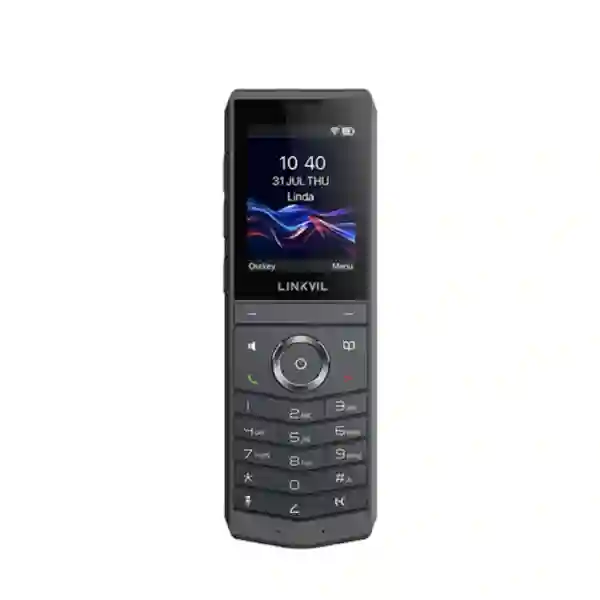
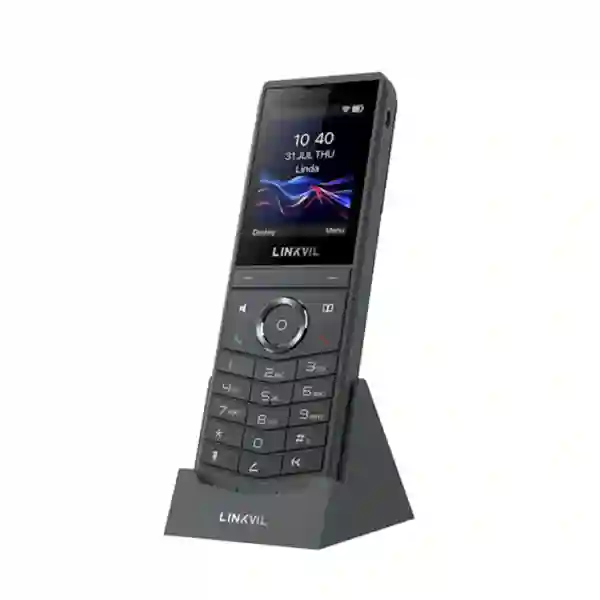
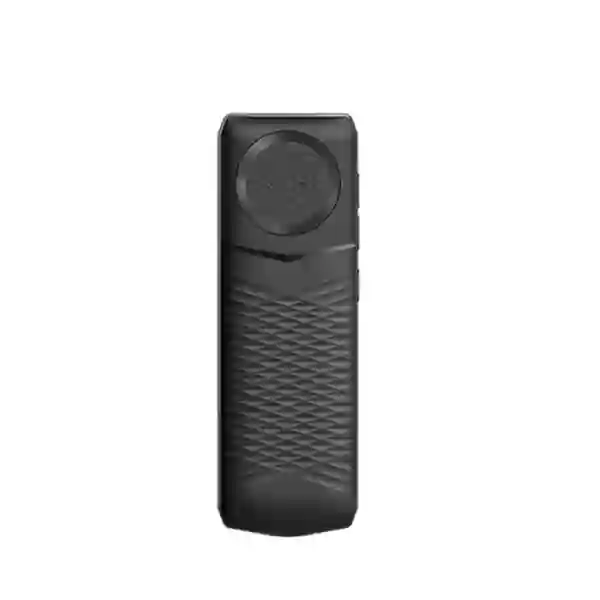
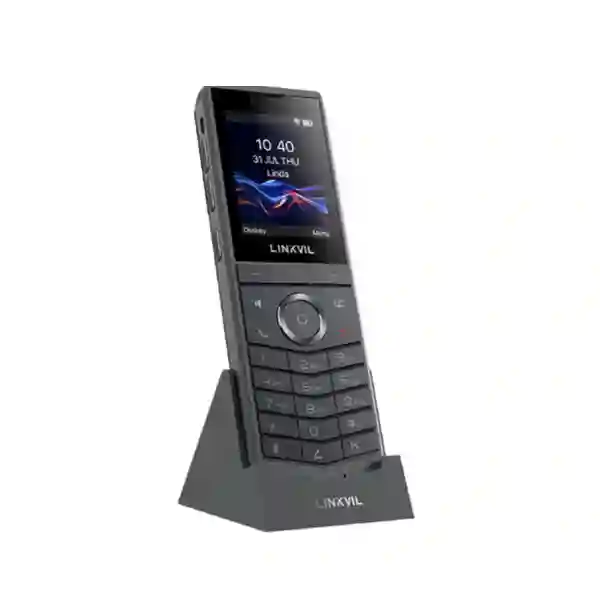
LINKVIL W620W Portable Wi-Fi Phone
The LINKVIL W620W is designed for organisations that need staff to remain reachable while moving between offices, hotel floors, warehouses, retail areas, security posts or other Wi-Fi-covered work zones. Rather than tying a user to a desk, it brings SIP calling to a portable handset with dual-band Wi-Fi 6, Bluetooth 5.0, roaming support, physical keys, push-to-talk operation and a removable high-capacity battery.

Dual-band 2.4GHz and 5GHz wireless with 802.11 a/b/g/n/ac/ax support.
Supports multiple SIP identities for business communication workflows.
IEEE 802.11k/v/r support helps maintain mobility across suitable multi-AP WLANs.
Manufacturer-rated for up to 13 hours talk time and 240 hours standby in stated test conditions.
What the LINKVIL W620W solves
A conventional desk phone works well when a user stays in one place. It becomes less effective for teams that spend the day moving between floors, aisles, rooms, reception zones, loading areas or customer-facing spaces. The W620W addresses that mobility problem by using the organisation’s Wi-Fi network as the access layer for SIP voice. This makes it relevant where a business already operates managed wireless coverage and wants staff to carry a purpose-built phone rather than depend exclusively on personal mobile devices.
The handset combines a 2.4-inch 240 x 320 colour display, physical keypad, custom DSS keys, vibration, handset, hands-free and headset modes, a side-mounted PTT key and six-way audio conferencing. Its dual-microphone noise reduction is intended to improve intelligibility in active environments. Fanvil also specifies H.264 video decoding up to 4 CIF, which can be useful in compatible SIP and access-control scenarios where a visual preview accompanies a call. The 1.8-metre drop-resistant design adds resilience for operational use, although procurement teams should still evaluate the actual environmental protection required for each site.
Verified technical highlights
| Display | 2.4-inch, 240 x 320 colour LCD |
| SIP | 8 SIP lines; direct IP call without SIP proxy is listed in the manufacturer datasheet |
| Wireless | 2.4GHz 802.11 b/g/n/ax and 5GHz 802.11 a/n/ac/ax; Wi-Fi 6; IEEE 802.11k/v/r roaming |
| Wireless security | WPA, WPA2-PSK, WPA3 and 802.1X EAP |
| Bluetooth | Bluetooth 5.0 |
| Audio | HD voice, dual-microphone noise reduction, G.722 and Opus wideband codecs plus listed narrowband codecs |
| Video decoding | H.264 up to 4 CIF |
| Battery | Removable 3000mAh lithium battery; up to 13 hours talk time and 240 hours standby under manufacturer test conditions |
| Charging | Desktop charging base and Type-C charging; DC input 5V/2A listed |
| Durability | Drop height specified at 1.8m |
| Operating environment | 0°C to 45°C operating temperature; 10–95% relative humidity listed in manufacturer data |
Buying and deployment guidance
The W620W should be treated as part of a voice-and-Wi-Fi system rather than as an isolated handset. Before ordering, confirm the SIP platform, extension count, authentication method, dial plan, voicemail and call-routing requirements. On the wireless side, verify coverage, channel planning, access-point density, roaming behaviour, VLAN design, DHCP, DNS, Quality of Service and firewall policies. A handset that supports Wi-Fi 6 and fast-roaming standards still depends on the access points and controller configuration around it. Where mobility is critical, test real walking paths rather than relying only on coverage maps.
For organisations comparing Wi-Fi handsets with DECT alternatives, the main architectural question is whether the existing WLAN is engineered for voice mobility. Wi-Fi can reduce the need for a parallel radio infrastructure, but voice roaming is sensitive to RF design and configuration. DECT can be attractive where dedicated cordless telephony is preferred. The right choice depends on site layout, user density, existing infrastructure and administration preferences. Fourteck’s Tanzania technology services overview explains how voice, Wi-Fi, switching and security requirements can be considered together instead of selecting endpoints without their dependencies.
Useful Fourteck Tanzania pages
For broader procurement planning, the Fourteck Tanzania home page summarises integrated IT, telecom, networking and security capabilities. Buyers who are comparing device categories can use the Fourteck Tanzania technology shop to review business technology categories and the checks that matter before purchase. The About Fourteck Tanzania page provides organisational context, while the Tanzania contact page is the correct route for quotation and product-selection enquiries.
LINKVIL W620W Portable Wi-Fi Phone Tanzania
For Tanzanian organisations, the LINKVIL W620W is relevant wherever staff mobility and business voice need to coexist on a managed wireless network. Offices with multiple floors, hospitality properties, warehouses, retail environments, clinics, schools, logistics facilities and security operations can all have users who are rarely seated at one desk. A portable SIP handset gives those teams a consistent extension and business call workflow while they move through Wi-Fi-covered areas. The main procurement question is therefore not simply whether the handset can connect to Wi-Fi, but whether the surrounding network is engineered to carry voice reliably.
A Tanzania deployment should begin with a review of the existing PBX or hosted SIP platform. The W620W supports eight SIP lines, so it can accommodate multi-line use cases where the telephony system supports them. Organisations should confirm registration parameters, codecs, call transfer, hold, conferencing, voicemail access and any feature codes needed by users. The device supports G.722 and Opus wideband codecs, which can help deliver high-quality speech when the complete call path supports them. The dual-microphone noise reduction and high-output speaker are particularly useful in operational spaces where ambient activity can make ordinary handsets difficult to hear.
Wireless design deserves equal attention. The W620W supports 2.4GHz and 5GHz Wi-Fi 6 and IEEE 802.11k/v/r roaming, but good mobility still depends on access-point placement, overlapping coverage, channel use, transmit-power balance and controller settings. Warehouses with metal racking, hotels with dense room layouts and offices with reinforced walls can behave very differently. A practical deployment should test common walking routes while calls are active. It can also separate voice traffic with an appropriate VLAN and apply Quality of Service policies where the network architecture supports them.
For quotation preparation in Tanzania, provide the number of handsets, expected users, site type, number of floors or coverage zones, existing access-point brand, PBX platform and whether PTT or video preview is part of the workflow. Include charging requirements and whether spare batteries are desired. This information helps turn a product request into a deployment-ready scope and avoids buying handsets before confirming that the Wi-Fi and telephony layers are prepared for them.
LINKVIL W620W Portable Wi-Fi Phone Dar es Salaam
In Dar es Salaam, the W620W suits organisations operating across busy commercial spaces where teams move frequently between rooms, counters, floors and service areas. Hotels, offices, warehouses, healthcare environments, shopping facilities and customer-service locations may need staff to remain reachable without carrying a fixed desk phone. A portable Wi-Fi SIP handset can extend internal business communication into those moving workflows while retaining extension-based calling and PBX control.
Dense buildings and mixed-use premises make RF planning important. An access point that provides acceptable web browsing at the edge of coverage may not provide the stable latency and roaming behaviour that real-time voice needs. For Dar es Salaam sites, it is worth surveying corridors, lifts, stair approaches, loading bays, reception areas and any transition points where users regularly walk while on calls. The W620W supports 802.11k/v/r roaming, but the WLAN infrastructure must also be configured appropriately. Multi-AP deployments should be tested for handoff performance under real traffic rather than judged only by signal bars.
The handset’s PTT button can be useful for teams that need rapid one-touch communication, subject to the call configuration chosen by the organisation. Its vibration function can help in louder environments, while dual-microphone noise reduction and the HD speaker can improve usability where background activity is high. The 1.8-metre drop resistance is a practical advantage for mobile staff, but buyers should still use protective procedures and evaluate whether the intended site has additional environmental requirements not covered by the published specification.
Procurement teams in Dar es Salaam should define whether the W620W will be added to an existing SIP estate or introduced as part of a broader PBX refresh. If it is an expansion, share current PBX model, firmware, SIP trunk arrangement, wireless network brand and authentication method. If it is a new deployment, include extension count, receptionist requirements, external calling needs, roaming zones and target user groups. The Fourteck Tanzania contact page identifies Dar es Salaam as a contact location and provides a central enquiry route, so a quotation request can include both handset quantities and the surrounding voice-network requirements in one scope.
LINKVIL W620W Portable Wi-Fi Phone Mwanza
Businesses in Mwanza evaluating portable business telephony can use the LINKVIL W620W where employees need an extension that follows them around the workplace. The device is particularly relevant to warehouses, hospitality venues, service operations, schools, clinics and multi-area offices where fixed desk endpoints leave gaps in communication. Because it registers as a SIP phone over Wi-Fi, it can be integrated into a structured business voice environment rather than operating as a separate consumer mobile service.
Planning should begin with coverage and capacity. A warehouse may have long aisles, shelving and loading zones that create RF shadowing. A hotel may have many partition walls and simultaneous client devices. A school may have peaks in wireless use at predictable times. The W620W supports both 2.4GHz and 5GHz bands, allowing the wireless design to make use of dual-band infrastructure, but band selection, channel planning and access-point placement must reflect the site. The goal is not merely to connect the phone; it is to maintain a stable call as the user moves.
Mwanza buyers should also define how the phone will be administered. With eight SIP lines and custom DSS functionality, different user profiles can be created for supervisors, reception staff, operations teams and security personnel. PTT can support fast communication patterns, while Bluetooth 5.0 and Type-C digital headset support give users options for hands-free operation. Battery planning matters for long shifts: the manufacturer specifies up to 13 hours of talk time and 240 hours of standby under its stated test conditions, but actual runtime varies with usage, signal conditions, screen activity and configuration. Charging bases should therefore be placed where handsets can be returned consistently.
For a useful Mwanza quotation, include handset quantity, number of concurrent users, shift pattern, floor plan or approximate coverage area, existing Wi-Fi access points, PBX platform, required SIP accounts and any special needs such as headset use or PTT. If the wireless environment is still being designed, treat the W620W purchase as part of that project rather than after it. This approach reduces the risk of discovering roaming or coverage limitations only after phones have been issued to staff.
LINKVIL W620W Portable Wi-Fi Phone Arusha
Arusha organisations often operate environments where guest service, administration and operations overlap. Hotels, travel and hospitality businesses, educational institutions, offices, healthcare facilities and logistics teams can benefit from a business handset that remains with the user as they move. The LINKVIL W620W brings SIP calling onto the enterprise WLAN and can help replace informal communication patterns with centrally managed extensions, call routing and business directories where supported by the PBX.
Hospitality is a good example. Front-desk staff may be stationary, but supervisors, maintenance teams, housekeeping coordinators and security staff move continuously. A portable phone can allow those users to receive PBX calls without remaining near a desk. The dedicated PTT key offers an additional workflow for rapid team communication, while the colour display and physical keypad make the handset familiar to users who prefer tactile controls. Dual-microphone noise reduction can help when calls take place in service corridors or busy operational areas.
Before deployment, Arusha sites should assess their Wi-Fi architecture as a voice network. If access points were originally installed only for guest internet access, they may need configuration changes before becoming the transport for business telephony. Voice and guest traffic should be appropriately separated, authentication should be planned, and access-point capacity should be reviewed during peak occupancy. IEEE 802.11k/v/r support on the handset can assist roaming in a compatible environment, but it does not replace correct RF design. Testing should include moving calls across floors and between key work zones.
For procurement, provide the number of mobile staff by department, typical shift length, handset-to-user assignment model, charging locations, current PBX and Wi-Fi platforms and the areas where uninterrupted calling is required. If the handset will be used with access-control or door-station video preview, confirm SIP and H.264 interoperability before purchase. Fourteck’s Tanzania contact page lists Arusha among its contact locations, making it appropriate to submit a combined request covering W620W handsets, SIP configuration and wireless-readiness considerations rather than treating the endpoint as an isolated item.
LINKVIL W620W Portable Wi-Fi Phone Dodoma
In Dodoma, the W620W can fit offices, institutions, service facilities and multi-building environments that need business telephony for staff who move beyond a fixed desk. Government-adjacent offices, education, hospitality, healthcare and operational teams may all have situations where a conventional wired endpoint is available in one room but the responsible employee spends much of the day elsewhere. A Wi-Fi SIP handset creates a portable extension that can remain under the control of the organisation’s PBX.
The product’s eight SIP lines allow flexible account configuration for users who manage more than one identity or call role. Custom DSS keys can be assigned to common actions, while six-way audio conferencing supports ad-hoc collaboration where the SIP environment allows it. The W620W also provides vibration, hands-free mode, Bluetooth 5.0 and Type-C headset support. For teams working around corridors, storage areas or public-facing service points, these physical features can be more practical than using a laptop softphone or relying on personal smartphones.
Dodoma deployments should pay attention to building layout and power continuity. Wi-Fi voice depends on access points, switches, routers, firewalls and the PBX remaining available, so UPS planning can be relevant where continuity is important. If PoE powers the access points, the PoE switches and upstream network should be included in the backup plan. Wireless authentication and VLAN design should also be documented, especially where staff, guests and operational devices share the same physical WLAN infrastructure. WPA3 and 802.1X EAP support on the W620W provide options for stronger enterprise wireless security when matched by the network.
A Dodoma quotation request should identify current infrastructure and expected growth. Include handset quantity, departments, number of coverage zones, expected simultaneous calls, PBX type, SIP trunking arrangement, access-point platform and whether the network already uses a dedicated voice VLAN. If additional access points are required, their placement should be determined from RF needs rather than simply installed near the users’ desks. The Fourteck Tanzania contact page lists a Dodoma office contact and can be used for a structured requirement that includes product supply together with compatibility and deployment questions.
LINKVIL W620W Portable Wi-Fi Phone UAE
For UAE organisations, the W620W is suited to high-mobility business environments such as hotels, warehouses, retail operations, facilities management, clinics, campuses and corporate premises. These sites often already have dense Wi-Fi infrastructure, making a Wi-Fi SIP handset attractive when the network is designed for voice roaming. The device can let users keep a company extension while moving through covered areas, reducing dependence on fixed desk endpoints for staff whose work is operational rather than desk-based.
The UAE deployment conversation should include RF density and roaming. Large hospitality properties, warehouses and multi-floor offices can have dozens of access points, and client handoff behaviour becomes critical. The W620W supports dual-band Wi-Fi 6 and IEEE 802.11k/v/r, providing the endpoint capabilities needed for modern managed WLANs. Still, access-point transmit power, minimum data rates, channel width, controller settings and coverage overlap need to be reviewed. Voice calls are particularly sensitive to latency, jitter and packet loss, so testing should include movement across realistic work routes.
The phone’s Bluetooth 5.0, Type-C digital headset support, PTT key and noise-reduction microphones suit teams that need hands-free or rapid-call workflows. The 1.8-metre drop resistance can be helpful for operational use. Businesses planning access-control integration can also evaluate the W620W’s H.264 video decoding capability in compatible SIP scenarios, but interoperability should be confirmed with the specific door station or platform before ordering. For a broader regional technology discussion, the Fourteck UAE IT and telecom site covers communication, networking and infrastructure requirements.
A UAE quotation should specify quantity, user roles, existing IP PBX or hosted voice platform, current Wi-Fi vendor, site size, expected roaming zones and whether central provisioning is required. If the phones replace another wireless solution, include the reason for change: coverage, administration, battery life, integration or feature needs. That context allows a supplier to compare the W620W against the existing architecture rather than quoting handsets without considering migration work.
LINKVIL W620W Portable Wi-Fi Phone Uganda
Ugandan businesses looking for portable IP telephony can consider the W620W where staff need to move through a Wi-Fi-covered workplace while remaining connected to the corporate PBX. Warehouses, hospitality sites, schools, clinics, retail branches and operations centres are common examples. The phone’s Wi-Fi 6 connectivity, SIP support and physical keypad give organisations a dedicated business communications endpoint rather than relying on employee-owned mobile devices for internal calling.
Network readiness is the main design issue. A wireless network that performs well for email and web access does not automatically provide seamless voice. The W620W supports IEEE 802.11k/v/r roaming, but the access points should provide predictable coverage and suitable handoff behaviour. Uganda deployments should identify low-signal transition zones, congested 2.4GHz channels and any backhaul bottlenecks. Where 5GHz coverage is available, it can provide additional capacity, but wall penetration and coverage range must be considered. Testing should include active calls while users walk between work areas.
The 3000mAh removable battery is useful for shift-based teams because batteries can be planned around working hours and charging cycles. Fanvil rates the device for up to 13 hours of talk time and 240 hours standby in its stated test environment, while real-world runtime will vary. The included desktop charging base helps create consistent return points at reception counters, staff offices or control rooms. Supervisors who need rapid contact can make use of the PTT key when the telephony configuration supports the intended one-touch workflow.
When preparing a Uganda request, include the PBX platform, number of SIP extensions, Wi-Fi coverage areas, access-point count, user roles and whether the deployment is single-site or multi-branch. The Fourteck Uganda technology site provides additional regional context around IP PBX, VoIP and networking. A complete scope should cover both handset quantities and the infrastructure changes needed to support reliable mobile voice.
LINKVIL W620W Portable Wi-Fi Phone Kampala
Kampala has a wide mix of office towers, hotels, retail properties, education facilities and service businesses where users may need to be reachable while moving through the premises. The W620W can provide a portable SIP extension over managed Wi-Fi, making it especially useful for supervisors, facilities teams, security staff, guest-services personnel and operational users who cannot stay next to a desk phone throughout the day.
In dense urban buildings, Wi-Fi performance can be affected by neighbouring networks, multiple tenants and large numbers of personal devices. For this reason, a Kampala deployment should be designed around spectrum use and capacity, not only coverage. Dual-band Wi-Fi 6 gives the W620W access to modern 2.4GHz and 5GHz networks, while 802.11k/v/r can support roaming in compatible WLANs. Administrators should still verify channel plans, access-point load and handoff thresholds. Voice quality should be assessed during peak periods because congestion that is invisible during quiet testing may appear when the building is busy.
The phone offers eight SIP lines, HD voice, vibration, a high-output speaker and dual-microphone noise reduction. These features support mixed office and operational roles. A manager may use Bluetooth or a Type-C headset, while a security or service team may use the PTT button for faster internal contact. Because the device also supports H.264 video decoding up to 4 CIF, organisations integrating compatible SIP door stations can evaluate video preview for visitor verification. The exact interoperability should be tested with the chosen door system and PBX.
For Kampala buyers, a practical quotation should list the number of users, departments, expected concurrent calls, site floor count, PBX model, SIP provider if applicable and WLAN vendor. If the project covers several branches, identify whether provisioning, extension numbering and security policies need to be standardised. It is also helpful to specify whether the phones are assigned permanently to individuals or checked out by shift. Those operational details affect charging, naming, spare-battery planning and support procedures after deployment.
LINKVIL W620W Portable Wi-Fi Phone Arua
For businesses and institutions in Arua, the W620W offers a way to extend structured IP telephony beyond fixed desks where a suitable Wi-Fi network is available. Sites such as education campuses, healthcare facilities, hotels, warehouses and administrative offices may have staff who move between rooms or buildings during the day. A portable SIP handset can keep those users connected to internal extensions and business call routing while reducing the need to place a desk phone at every work point.
Arua deployments should start with a realistic assessment of the network. If wireless coverage has grown gradually through ad-hoc access-point additions, voice roaming may expose gaps that were not obvious to data users. The W620W supports Wi-Fi 6 and 802.11k/v/r, but the overall experience depends on how the access points are positioned, configured and connected. Businesses should review weak-signal zones, backhaul quality, internet stability where hosted voice is used and firewall rules affecting SIP and media. A pilot of several handsets can validate these factors before a larger rollout.
Battery management is another operational consideration. The 3000mAh removable battery provides a strong baseline for mobile work, and the desktop charging base makes it easy to establish return points. Organisations with long or overlapping shifts should decide whether each employee receives a dedicated handset, whether devices are shared, and whether spare batteries are needed. Shared devices should have clear login, cleaning, naming and charging procedures so they are ready at shift change.
A useful Arua request should include handset quantity, coverage areas, shift schedule, PBX platform, expected call features and current wireless infrastructure. Buyers should also identify whether the W620W will be used mainly for ordinary SIP calls, PTT-style communication, or a mixture of both. If video preview or access-control integration is part of the plan, include the make and model of the door station or intercom so compatibility can be checked. This level of detail allows the product to be quoted as part of an operational communication system rather than as a standalone device.
LINKVIL W620W Portable Wi-Fi Phone Mbarara
Mbarara organisations can use the W620W to bring PBX-based voice to staff who move through a site rather than staying at one workstation. In hospitals, educational facilities, hotels, warehouses, retail operations and multi-department offices, communication delays often occur because the person responsible for a task is away from a desk extension. A portable Wi-Fi phone can preserve the convenience of extension dialing while allowing that user to remain mobile.
The handset’s physical design is suited to operational use. It provides a tactile keypad, colour screen, vibration, belt clip, PTT key and desktop charging base. The 1.8-metre drop-resistant specification adds resilience for everyday movement, while dual-microphone noise reduction is intended to improve clarity in active surroundings. Users can connect Bluetooth 5.0 accessories or supported Type-C digital headsets when hands-free operation is needed. These features should be mapped to roles rather than enabled indiscriminately; for example, a supervisor may need several DSS keys, while a general mobile user may benefit from a simpler configuration.
From a network perspective, Mbarara sites should treat the deployment as a voice-over-WLAN project. The access points should provide enough overlap for roaming, and the wired network should have suitable capacity and Quality of Service. If cloud PBX or hosted SIP services are used, internet resilience becomes part of the voice design. For on-premises PBX systems, local switching and power backup may be more critical. In both cases, authentication, firmware management and device provisioning should be planned before handsets are distributed.
When asking for a quote, specify the current PBX, access-point brand, extension count, site layout, number of W620W units and any required accessories. Also identify the areas where calls must continue without interruption, such as between wards, corridors, front office and stores, or between warehouse zones. A focused site pilot can reveal whether access-point adjustments are required. That is more valuable than ordering a large quantity first and then troubleshooting roaming after the phones have become part of daily operations.
LINKVIL W620W Portable Wi-Fi Phone Gulu
For Gulu businesses and institutions, the W620W can support mobile teams that need structured business calling across a Wi-Fi-covered property. Education, healthcare, hospitality, security, retail and logistics environments often have users who move between rooms or work zones and still need to receive calls on a company extension. A dedicated portable SIP phone can provide a clearer ownership model and more predictable PBX integration than using personal mobile numbers for internal operations.
The W620W’s eight SIP lines can support different account arrangements where the PBX design requires them. Call logs, caller ID, DND, conferencing and programmable DSS keys provide familiar business-telephony functions. The PTT one-touch key is particularly relevant to fast-moving teams such as security or facilities staff, while vibration and the high-output speaker can help in noisier spaces. The handset also includes a belt clip, making it practical for users who need both hands available during routine work.
Gulu deployments should examine Wi-Fi quality carefully, especially at building edges and between separated operational areas. If a site uses several access points connected through different switches or uplinks, the voice path should be tested end to end. Roaming support on the handset helps, but poor channel planning, high interference or overloaded backhaul can still affect calls. If the network currently supports only basic internet access, a voice VLAN, QoS policy and wireless optimisation may be useful additions. Any configuration should be aligned with the organisation’s existing security and management practices.
For procurement, share the quantity of phones, number of active shifts, charging expectations, PBX platform, SIP trunk or provider details where relevant, and the current Wi-Fi topology. If the site is expected to grow, include planned new buildings or coverage zones so the wireless architecture can be designed with future handset density in mind. Buyers should also confirm included accessories and warranty terms in the final quotation rather than assuming these from regional reseller listings, because package contents and commercial conditions can vary by supplier.
LINKVIL W620W Portable Wi-Fi Phone Kenya
Kenyan organisations researching the W620W will find it relevant to offices, hospitality, healthcare, schools, warehouses, retail and logistics sites where mobile staff need PBX calling. The handset is already visible through regional channel listings, but procurement should focus on verified manufacturer specifications and the fit with the site’s voice and wireless architecture rather than comparing price alone. The W620W provides dual-band Wi-Fi 6, eight SIP lines, Bluetooth 5.0, PTT, 802.11k/v/r roaming and a removable 3000mAh battery.
For multi-floor offices and larger properties, wireless design is central to the purchase decision. The phone can take advantage of modern managed WLANs, but access-point density and roaming parameters should be validated through call testing. Warehouses may need special attention around racking and open loading zones, while hotels can have heavy client density and many walls. Voice SSIDs, VLAN separation and QoS can help create a more controlled environment. Where the PBX is hosted externally, internet resilience and firewall configuration must also support consistent SIP media paths.
Kenya buyers should map user profiles before rollout. A security team may prioritise PTT and speaker volume; hotel supervisors may focus on roaming and battery life; office managers may value Bluetooth headset support and multiple SIP identities. The device’s custom DSS keys can be configured around the most common actions for each role. Centralised provisioning and naming conventions become important as handset count grows because they make replacements, firmware updates and troubleshooting more consistent.
For regional context, the Fourteck Kenya technology site covers VoIP, IP PBX, unified communications and networking. A quote request should identify handset count, city or site, PBX platform, existing Wi-Fi brand, number of access points, expected concurrent calls and whether any network redesign is part of the project. Buyers should also ask for exact included accessories, commercial warranty details and delivery scope in the quotation instead of assuming that reseller package descriptions are uniform.
LINKVIL W620W Portable Wi-Fi Phone Kuwait
Kuwait businesses can consider the W620W for portable enterprise voice in offices, hospitality properties, retail facilities, clinics, schools, warehouses and industrial administration areas. It is most useful when the organisation already operates a managed WLAN or is planning one. By registering to a SIP PBX over Wi-Fi, the handset can provide extension mobility without deploying a desk phone at every location where a user may work during the day.
The wireless environment should be designed for real-time traffic. Wi-Fi 6 capability can improve efficiency on modern networks, but voice quality still depends on access-point placement, interference, roaming and upstream network stability. Kuwait projects should review coverage around thick walls, equipment rooms, storage spaces and transitions between indoor zones. Where staff move continuously, active-call walk testing is essential. The W620W’s 802.11k/v/r support provides endpoint-side roaming capabilities that can be used with appropriately configured wireless infrastructure.
The handset offers practical features for mobile teams: a PTT key, dual-microphone noise reduction, vibration, Bluetooth 5.0 and Type-C digital headset support. Its 1.8-metre drop-resistant design may suit operational environments where accidental falls are more likely than at a desk. The removable 3000mAh battery and desktop charging base also support shift-based deployment, but actual battery life should be evaluated in the customer’s configuration and RF conditions rather than treated as a guaranteed runtime.
Organisations can review broader VoIP and wireless procurement themes on the Fourteck Kuwait business IT site. For a W620W quotation, provide quantities, PBX type, SIP account requirements, WLAN vendor, approximate coverage area and any special integration such as door-station video preview. If the phone will replace DECT or another Wi-Fi handset, include current pain points so the proposal can address whether the W620W solves them or whether infrastructure changes are also required.
LINKVIL W620W Portable Wi-Fi Phone Ghana
Ghanaian organisations planning mobile business communication can use the W620W where a managed Wi-Fi network already reaches the places staff work. Hotels, warehouses, offices, schools, clinics and retail operations can all have supervisors or service teams who need to carry an extension. The W620W provides that portability while retaining SIP-based calling and administrative control through the PBX.
Wireless performance should be evaluated against the operational layout. A warehouse with high shelving may require a different AP design from a multi-storey office, while a hotel must balance staff communication with guest-device density. The handset supports both 2.4GHz and 5GHz Wi-Fi 6 plus 802.11k/v/r roaming. Those capabilities are useful only when the WLAN has been designed with compatible roaming and adequate signal overlap. A site survey and active-call walk test are therefore important parts of a professional rollout.
The W620W’s eight SIP lines, DSS keys and six-way conferencing can be configured for different business roles. Security and facilities teams may use PTT, while supervisors may use a Bluetooth headset for longer conversations. Dual-microphone noise reduction and the handset’s speaker design support clearer communication in active environments. For access-control workflows, H.264 video decoding can enable visual preview in compatible SIP scenarios, but the specific intercom and PBX integration should be validated before procurement.
The Fourteck Ghana IT solutions site provides regional information on IP PBX, business telephony, networking and related infrastructure. A complete Ghana quotation request should include handset quantity, site location, PBX platform, current access-point environment, number of users, required call features and any network changes expected. If the phones will be shared between shifts, define charging and assignment procedures. If they are issued individually, include naming and provisioning conventions so administration remains manageable as the deployment grows.
LINKVIL W620W Portable Wi-Fi Phone Nigeria
Nigerian businesses can deploy the W620W in environments where operational mobility is important and the wireless network can support SIP voice. Corporate offices, logistics hubs, hotels, healthcare facilities, retail operations and educational institutions often have staff whose responsibilities take them across a site. A portable Wi-Fi phone can keep those users on a managed business extension and give the IT team a dedicated endpoint with consistent configuration.
Large or busy Nigerian sites should validate both WLAN capacity and power resilience. Wi-Fi voice depends on access points, switches and the PBX being available, so network UPS design can be important for continuity. If the PBX is cloud-hosted, internet resilience also affects calling. The W620W’s dual-band Wi-Fi 6 support gives administrators flexibility in radio design, but high client counts, neighbouring networks and thick building materials can still influence service quality. Roaming support through 802.11k/v/r should be paired with compatible controller settings and realistic walk testing.
The handset’s 3000mAh removable battery, charging base, vibration and belt clip suit mobile workers, while PTT allows faster one-touch communication patterns. Eight SIP lines and programmable DSS keys make the device configurable for supervisors and team leaders who need multiple call appearances or common actions. Bluetooth 5.0 and Type-C headset support are useful for users who need hands-free operation. Where the handset is expected to show SIP video from a door station, the H.264 integration should be verified against the exact equipment in use.
Regional buyers can review related communication and infrastructure offerings on the Fourteck Nigeria IT services site. A useful quotation should identify quantity, user roles, PBX or hosted voice service, Wi-Fi vendor, access-point count, expected roaming routes and any existing voice-quality issues. For larger projects, ask for a pilot or staged deployment so network tuning can be completed before every handset is put into service.
LINKVIL W620W Portable Wi-Fi Phone Seychelles
In Seychelles, hospitality and service environments are a natural use case for portable Wi-Fi telephony because staff often work across guest rooms, public spaces, back-office areas, restaurants, maintenance zones and security posts. The W620W can provide a business extension that travels with the user wherever the managed wireless network provides suitable coverage. Offices, healthcare facilities and other multi-area organisations can use the same approach when mobile internal communication is important.
Properties with guest Wi-Fi should avoid assuming that the same design automatically meets voice requirements. Staff communication should be considered as a separate service with appropriate SSID or VLAN design, security and Quality of Service. The W620W supports WPA/WPA2-PSK/WPA3 and 802.1X EAP, allowing several enterprise authentication options depending on the WLAN. Its 802.11k/v/r roaming support can help users move through multi-AP properties, but coverage overlap and controller settings remain essential. In hospitality, testing should include corridors, stairwells, back-of-house areas and outdoor transition zones used by staff.
The handset’s PTT key can support quick coordination for security, maintenance and operations teams, while the dual microphones and enhanced speaker are valuable where ambient noise is present. A removable 3000mAh battery supports long working periods, and charging bases can be positioned at staff offices or service counters. For properties operating around the clock, a rotation of batteries or handsets may be preferable to expecting a single device to remain continuously active without scheduled charging.
A Seychelles procurement request should include room or building count, staff groups, number of W620W units, wireless platform, PBX type and whether the voice system serves one property or several. Buyers should also indicate whether the site uses SIP door stations or access-control endpoints that may interact with the phone’s H.264 video preview capability. Defining these integrations before purchase makes the quotation more accurate and reduces the risk of discovering that a desired workflow depends on additional PBX or intercom configuration.
Compatibility, security and network design
The W620W supports standard SIP, but successful interoperability still depends on the exact PBX and its supported feature set. Confirm registration, authentication, codecs, DTMF mode, transfer behaviour, conferencing and provisioning with the selected platform. Where the handset is intended to work with door phones or intercoms, verify H.264 video behaviour and any access-control functions through a real integration test. Avoid assuming that two SIP products will expose every advanced feature automatically.
For Wi-Fi, use secure authentication appropriate to the organisation, keep firmware current, and document SSID, VLAN, DHCP and QoS settings. Voice traffic should not be forced through overloaded guest networks. Administrators should also consider how handset credentials are protected, how lost devices are handled and whether extension passwords need to be rotated. Central provisioning, device naming and a simple inventory of serial numbers can reduce support effort across larger fleets.
Who should consider the W620W?
Mobile supervisors, security, maintenance and guest-service staff who need a PBX extension across managed Wi-Fi.
Teams moving between aisles, loading areas and offices where PTT, speaker volume and drop resistance are useful.
Facilities, IT, security and operational users who need a portable extension without a separate DECT network.
Quotation checklist
For a useful quotation, provide the required handset quantity, country and city, user roles, current PBX platform, SIP account count, access-point vendor, approximate site size, number of floors, expected roaming areas, Wi-Fi security method, headset requirements, PTT requirements, charging plan and any compatible door-station or access-control integration. Also state whether you need only hardware supply or assistance with configuration, wireless readiness, PBX integration and testing.
Frequently asked questions
Does the LINKVIL W620W support Wi-Fi 6?
Yes. Fanvil specifies 2.4GHz 802.11 b/g/n/ax and 5GHz 802.11 a/n/ac/ax support, so the handset can operate on compatible Wi-Fi 6 networks while retaining support for listed earlier standards.
How many SIP lines does the W620W support?
The manufacturer datasheet lists eight SIP lines. The exact way those lines are used depends on the PBX configuration and user role.
Can it roam between wireless access points?
The W620W supports IEEE 802.11k/v/r. Seamless real-world roaming still depends on compatible WLAN infrastructure, correct RF design and controller configuration, so multi-AP sites should be tested with active calls.
What is the battery life?
Fanvil states up to 13 hours of talk time and up to 240 hours of standby from the 3000mAh removable battery under its specified test conditions. Actual results vary with calling, signal level, display use, settings and network behaviour.
Does the W620W support push-to-talk?
Yes. It includes a side-mounted PTT key for one-touch communication. The surrounding PBX or call configuration must be set up for the intended workflow.
Can the W620W be used with Bluetooth headsets?
The handset includes Bluetooth 5.0 and is specified for wireless earphone connectivity. It also supports Type-C digital headphones.
Is it suitable for warehouses and hotels?
Those are among the use cases highlighted by the manufacturer. Suitability for a specific site depends on Wi-Fi coverage, roaming, environmental conditions, shift patterns and the business call workflow.
Decision recap
Choose the LINKVIL W620W when the requirement is a purpose-built portable SIP handset for staff mobility over managed Wi-Fi. Its strengths include Wi-Fi 6, roaming support, eight SIP lines, Bluetooth 5.0, PTT, physical controls, HD audio features, a removable 3000mAh battery and a 1.8-metre drop-resistant design. Do not choose it solely because it is wireless; first confirm that the WLAN and PBX can provide the roaming, voice quality, security and administration needed by the site. For organisations already investing in enterprise Wi-Fi, that preparation can make the W620W a practical way to extend business telephony into mobile workflows.
Talk to Fourteck about the W620W
Send the exact handset quantity, location, PBX platform, Wi-Fi environment and user roles. Fourteck can use that information to discuss product availability, compatibility and the surrounding deployment scope. For specialist IP telephony information across the wider Fourteck network, you can also review Fourteck’s IP phone and business telephony site.


Reviews
There are no reviews yet.