
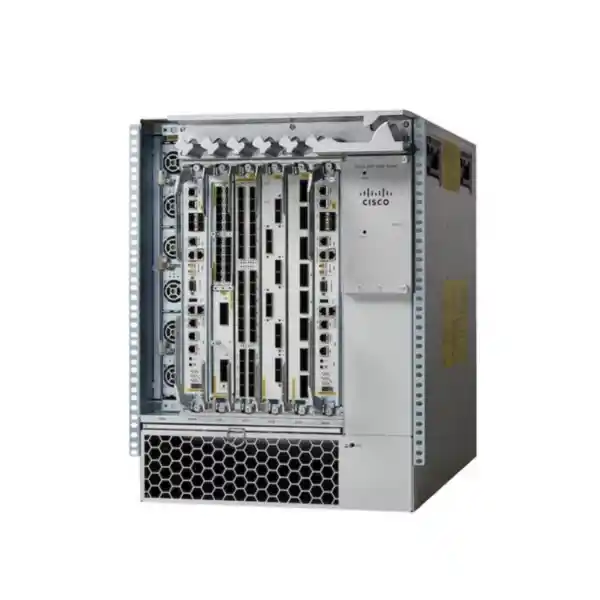
Cisco ASR 9906 Aggregation Services Router
Build a high-capacity aggregation or provider-edge platform around a modular 14-RU chassis designed for demanding carrier and large-network environments. The Cisco ASR 9906 combines four line-card slots, two Route Switch Processor slots, five dedicated fabric-card slots, up to 4 Tbps of bandwidth per line-card slot, and a Cisco-stated maximum system capacity of up to 32 Tbps. It is part of the ASR 9000 family and runs Cisco IOS XR, giving network teams a mature routing platform for scalable Layer 2 and Layer 3 services.
For deployments in Tanzania, the most important purchasing decision is not simply the chassis model. A working solution also depends on the correct RSPs, fabric cards, line cards, optics, power modules, software release, licensing, rack design, cooling, and resilience plan. FourTeck Tanzania can use your interface, traffic, redundancy, and growth requirements to help define the bill of materials for review before ordering.
ASR 9906 at a glance
These are platform-level figures, not a promise that every chassis configuration delivers every interface mix or feature at the maximum scale. Capacity and service behavior depend on the installed generation of line cards, selected RSP and fabric components, software release, licensing, optics, and the feature set enabled in the network design. A configuration review is therefore essential when comparing an ASR 9906 bill of materials with an existing router or a future traffic forecast.
Who should consider the Cisco ASR 9906?
The ASR 9906 is most relevant when a network has moved beyond the requirements of a small enterprise router and needs a modular service-provider-class platform. Typical buyers include telecommunications operators, internet service providers, metro-network operators, content or cloud connectivity providers, large data-center networks, universities or institutions with substantial backbone requirements, and enterprises operating carrier-scale WAN or aggregation infrastructure. The platform is especially useful where interface density, traffic growth, operational continuity, and the ability to change line-card combinations matter over a multi-year network lifecycle.
It can sit in aggregation and edge roles where many downstream or access links must be consolidated into higher-capacity uplinks. It can also be used in IP/MPLS and provider-edge designs where routing scale, traffic engineering, service separation, and resilient forwarding are part of the architecture. Cisco positions the wider ASR 9000 family for access, aggregation, and peering-edge functions, so the ASR 9906 should be evaluated as part of an end-to-end topology rather than as an isolated appliance.
It may be excessive for branch offices, small campuses, or simple internet-edge requirements where a compact fixed-form-factor router would meet the need with less rack space and operational complexity. The right question is therefore not “Is the ASR 9906 powerful?” but “Does its chassis scale, line-card ecosystem, software architecture, and redundancy model match the services we need to deliver?”
Modular capacity for growth
A key reason to choose the ASR 9906 is the separation of chassis, route-switch processing, fabric, and line-card functions. Four line-card slots allow the platform to be built around the required interface types and then adjusted as network demands change. Cisco documents support across multiple generations of ASR 9000 line cards, including high-speed Ethernet options, but compatibility must be validated against the exact RSP, fabric, software release, and licensing combination planned for the deployment.
Cisco lists up to 4 Tbps of bandwidth per slot and up to 32 Tbps of maximum platform capacity for the ASR 9906. These figures provide useful context when sizing a chassis, but interface speed alone is not a complete capacity plan. Engineers should also model aggregate offered load, expected oversubscription, packet-size distribution, QoS policy, multicast behavior, route scale, telemetry, service features, and anticipated traffic growth. A network designed around present-day average traffic can become constrained quickly if peak utilization, new peering links, or customer growth are not considered.
For procurement, define the required ports by speed and media, then map them to supported line cards and optics. Separate day-one requirements from planned expansion. This approach reduces the risk of buying capacity that cannot be used immediately or, conversely, choosing a configuration that leaves too little room for future upgrades.
Important: the chassis is only part of the solution
“ASR-9906” identifies the chassis platform, but a production deployment requires a complete and compatible system. Depending on the target design, the bill of materials can include route switch processors, switch fabric cards, line cards, power equipment, fan assemblies, optics or transceivers, cabling, software licenses, support coverage, and installation accessories. The exact selection changes the available port types, forwarding capacity, resiliency, feature support, power consumption, and software requirements.
Before requesting a quotation, provide a simple interface matrix: how many 10G, 25G, 40G, 100G, 400G, or other ports are required; whether links are client, core, peering, or transport-facing; required fiber type and approximate distances; redundancy expectations; preferred power input; current software environment; and projected growth. This is more reliable than requesting “one ASR 9906” without the supporting configuration detail.
Routing architecture and Cisco IOS XR
The ASR 9906 uses Cisco IOS XR, the service-provider routing operating system used across the ASR 9000 family. IOS XR is built around a distributed architecture intended for large routing systems and continuous network operation. Cisco documentation for the platform highlights features such as process isolation, modular software behavior, software maintenance updates, and field-programmable device upgrade mechanisms. In practical terms, this gives operations teams a platform designed to be maintained and evolved while supporting complex routing and service functions.
The value of IOS XR depends on operational readiness. Teams should confirm the target release train, feature support, interoperability with the rest of the network, automation method, AAA integration, logging, telemetry, backups, and change-control process before commissioning. Existing IOS or IOS XE operational procedures should not automatically be assumed to map one-for-one to IOS XR. Command structure, package handling, configuration workflow, software lifecycle, and troubleshooting methods have important differences.
For organizations already operating ASR 9000 infrastructure, standardizing on a compatible IOS XR release can simplify training, configuration templates, monitoring, and spare strategy. For a first IOS XR deployment, include lab validation and staff familiarization in the project plan. The goal is not only to install a router, but to integrate it cleanly into day-two operations.
High availability and resilient design
Cisco documents the ASR 9906 with two RSP slots and five dedicated fabric-card slots, and describes a redundant fabric architecture. This hardware structure enables architects to design around component redundancy rather than relying on a single control or fabric element. However, chassis redundancy is only one layer of availability. A resilient service also depends on redundant uplinks, diverse fiber paths, routing protocol design, power feeds, upstream providers, facility cooling, monitoring, spares, and tested operational procedures.
When availability is important, avoid evaluating only whether a component is “redundant.” Define what failure scenarios the network must survive. Examples include loss of one uplink, one upstream carrier, one RSP, a fabric component, a power module, a rack power feed, or an entire site. Then confirm how the intended ASR 9906 configuration behaves during those events and whether convergence meets the business requirement.
Maintenance planning matters as much as fault recovery. Validate supported online insertion and removal behavior for the exact line cards and system components, follow Cisco release guidance, and test software-change procedures in an appropriate environment. A well-designed modular router can reduce the impact of maintenance, but only when the surrounding network and operational process are designed for it.
Physical footprint, rack planning, and handling
The ASR 9906 is a substantial chassis. Cisco specifies a height of 24.39 inches (619.50 mm), which corresponds to 14 rack units, a width of 17.60 inches (447.04 mm), and a depth of 31.45 inches (798.83 mm). Cisco also publishes different weight figures depending on what is installed. A chassis with one power entry module is listed at 131.5 lb (59.65 kg), while a configuration with two fan trays, two RSPs, five fabric cards, and one power entry module is listed at 212.5 lb (96.4 kg), before considering the complete deployed configuration.
Those dimensions have practical consequences. Check rack depth, rail or mounting requirements, service clearance, cable-management space, floor loading, cabinet door clearance, and the safe handling method before equipment arrives. The 14-RU footprint also affects rack utilization when several network functions share the same cabinet. A site that has sufficient free rack units may still be unsuitable if cable bend radius, airflow, or maintenance access is restricted.
Plan optical and copper cable paths so that line-card access remains practical. Label both ends, document port purpose, and leave enough slack for maintenance without creating airflow obstruction. For heavy modular equipment, installation should follow the manufacturer’s hardware guidance and local workplace safety practices.
Power and cooling considerations for Tanzania
Power and thermal planning should be completed before the router is ordered. Cisco’s documentation directs customers to calculate power requirements based on the actual chassis configuration because consumption depends on installed cards and modules. Do not size UPS capacity, generator capacity, PDUs, breakers, or cooling from a generic chassis figure. Build the estimate from the exact bill of materials, then include an engineering margin appropriate to the facility and growth plan.
For Tanzanian deployments, power continuity can be a critical design factor depending on the site. Decide whether the router will be fed from protected utility power, UPS systems, generator-backed circuits, or a combination. Where resilient service is required, review whether power paths are genuinely independent from source to rack rather than simply connected to separate sockets on the same upstream circuit. Confirm the chosen ASR 9906 power configuration and supported input requirements before electrical work is finalized.
Cooling must also be engineered around the installed configuration and room conditions. Cisco lists a nominal operating temperature range of 5°C to 40°C for the ASR 9000 family and documents a short-term range for the ASR 9906 of -5°C to 55°C under specified conditions. Short-term limits should not be treated as a normal operating target. Maintain stable environmental control, monitor inlet temperatures, keep filters and airflow paths clear, and use the manufacturer’s installation guidance for hot-aisle/cold-aisle or other facility arrangements.
Humidity, dust, altitude, and airflow all influence reliability. Cisco lists operating humidity of 10% to 85% non-condensing and an operating altitude up to 4,000 m for the general platform specification, subject to component-specific restrictions. Confirm the specific cards and optics planned for the installation because individual components can have narrower environmental limits.
Interfaces, line cards, and optics: size the system from the ports inward
The ASR 9906 does not have one universal port configuration. Its four line-card slots are the foundation for building the required interface mix. Cisco documentation lists multiple generations of ASR 9000 line cards, including high-density Ethernet and flexible modular options. Some families provide fixed high-speed interfaces, while others use modular port adapters or flexible combinations. Exact availability, software support, and compatibility change by line-card generation and system component.
Start with the service requirement. For each connection, document speed, connector or optic type, fiber mode, wavelength, distance, breakout requirement, expected utilization, and whether the port must participate in link aggregation or a protected topology. This avoids a common procurement problem: selecting a line card by headline port count and later discovering that the required optics, breakout mode, or software feature is not supported in the intended configuration.
Optics should be validated separately. High-speed links can depend on transceiver type, fiber plant, reach, forward-error-correction requirements, and interoperability rules. For existing fiber routes in Tanzania, verify actual path length, connector condition, patch-panel losses, and available fiber pairs instead of assuming the nominal geographic distance is sufficient. Long-haul or metro optical transport designs may also place wavelength and line-system requirements outside the router itself.
A configuration review should therefore tie the ASR 9906 chassis, line cards, optics, and fiber design together. Treat these as one system rather than four independent purchases.
Layer 2 and Layer 3 aggregation use cases
Metro aggregation
Consolidate traffic from access nodes or metro rings into high-capacity uplinks while applying the routing, Ethernet, QoS, and service policies required by the network design.
Provider edge
Use the platform at the service-provider edge where customer, internet, transport, or backbone services require scalable routing and service separation.
IP/MPLS backbone edge
Integrate with MPLS-based architectures where the ASR 9000 family is used for transport, VPN, traffic-engineering, or service-edge roles, subject to the selected software and licenses.
Data-center interconnect edge
Aggregate high-speed links between data-center, cloud-connectivity, or backbone environments where modular capacity and routing scale are important.
The suitability of any specific protocol, VPN model, multicast design, segment-routing feature, or service function must be checked against the intended IOS XR release, hardware generation, and license entitlement. Avoid assuming that a feature supported somewhere in the ASR 9000 family is automatically available on every ASR 9906 configuration.
Capacity planning: look beyond port speed
A router can have enough physical ports and still be incorrectly sized. Capacity planning for an ASR 9906 should consider current traffic, peak-to-average ratios, growth, service policy, failure-mode traffic shifts, and the expected life of the platform. If a link normally runs at 40% utilization but must absorb traffic from a failed parallel path, the relevant design load may be much higher. The same principle applies to fabric, line cards, upstream connectivity, and peering.
Route scale also matters. Record current IPv4 and IPv6 route counts, VPN route counts, neighbor counts, label or service scale where relevant, and expected growth. Determine whether the router will accept full internet tables, act as a route reflector, maintain many customer VRFs, provide large Layer 2 domains, or support significant multicast state. These choices can affect memory, control-plane load, convergence, and component selection.
Then consider features that change forwarding behavior, including ACLs, QoS, NetFlow-style visibility, telemetry, encapsulation, and tunneling. A headline throughput figure does not describe every feature combination. The safest approach is to define a realistic service profile, map it to Cisco-validated platform capabilities, and leave deliberate headroom for growth and failover.
For a Tanzania network expansion, include expected subscriber growth, new enterprise connections, upstream bandwidth changes, CDN or cache deployments, cloud connectivity, and intercity capacity plans in the forecast. A modular chassis is most valuable when the growth path has been considered from the beginning.
Migration from an existing router
Replacing an aggregation or provider-edge router is a network migration project, not a simple hardware swap. Build an inventory of every interface, routing adjacency, VLAN, pseudowire, VRF, QoS policy, ACL, management dependency, timing requirement, and monitoring integration on the existing platform. Remove unused configuration before translating it, and identify features that behave differently on IOS XR.
A good migration plan includes staging, configuration review, physical installation, optics verification, management reachability, control-plane testing, service testing, cutover sequencing, rollback criteria, and post-change monitoring. For critical carrier links, decide which services can be moved incrementally and which require a coordinated maintenance window. Keep a verified rollback path until traffic and routing behavior are stable.
Do not assume that interface names, default protocol behaviors, QoS syntax, or route-policy constructs match the old platform. Where the migration is from another Cisco operating system, translate intent rather than performing blind line-by-line conversion. Where it is from another vendor, first document service outcomes and protocol requirements in vendor-neutral terms, then implement them using validated IOS XR constructs.
Lab testing is particularly valuable for BGP policy, MPLS services, QoS, link aggregation, fast convergence, automation, and telemetry. The larger the role of the existing router, the more value there is in rehearsing the cutover before touching production traffic.
Operations, monitoring, and automation
Day-two operations should be designed at the same time as the hardware. Decide how the ASR 9906 will be monitored, backed up, authenticated, patched, and audited. Integrate the router with centralized AAA where appropriate, use secure management protocols, limit management-plane exposure, and ensure configuration archives are stored outside the chassis. Define who is allowed to make changes and how emergency access is controlled.
Monitoring should cover more than interface up/down state. Track utilization, errors, discards, optical levels where supported, CPU and memory, environmental sensors, power status, fan status, routing-neighbor state, route counts, convergence events, fabric health, and critical system logs. Establish thresholds that reflect the actual design rather than relying only on generic defaults. Capacity alerts should trigger early enough to allow procurement and change planning before a service becomes constrained.
IOS XR supports modern operational and automation approaches, but the exact interfaces and capabilities vary by release. If the network uses NETCONF, RESTCONF, model-driven telemetry, YANG models, or external automation frameworks, validate the target release and data models before building workflows. Automation should reduce repetitive change risk while retaining strong validation, rollback, and audit controls.
For service providers, a consistent source of truth for interfaces, IP addressing, BGP peers, customer services, optics, and physical paths can make ASR 9906 operations significantly easier. The router should become part of a documented network system, not an isolated configuration file.
Security and edge hardening
An aggregation router often sits at a high-impact point in the network, so security should be designed explicitly. Separate management traffic from customer or internet-facing traffic where the architecture permits. Restrict administrative access to known management networks, use strong AAA controls, protect routing protocols, disable unnecessary services, maintain software according to Cisco security guidance, and monitor for unexpected control-plane or forwarding behavior.
At external edges, define route filters, prefix limits, bogon or policy controls, and anti-spoofing measures appropriate to the role. For BGP, document accepted and advertised prefixes, maximum-prefix behavior, communities, RPKI policy if used, and change ownership. For internal services, apply the principle of least privilege to management and routing adjacencies rather than assuming traffic is trusted because it originates inside the network.
The wider ASR 9000 family can participate in sophisticated edge-security designs, but security capability should never be inferred from a product-family marketing statement alone. Validate the exact hardware, software release, licenses, and scale needed for the intended security policy. If DDoS detection or mitigation is part of the requirement, design the complete solution including telemetry, detection, filtering, scrubbing, upstream coordination, and fail-safe procedures.
How the ASR 9906 compares within the ASR 9000 family
| Model | Rack size | Line-card slots | Cisco-stated max capacity | Typical sizing reason |
|---|---|---|---|---|
| ASR 9904 | 6 RU | 2 | Up to 16 Tbps | Smaller modular footprint |
| ASR 9906 | 14 RU | 4 | Up to 32 Tbps | Middle ground between footprint and modular scale |
| ASR 9910 | 21 RU | 8 | Up to 64 Tbps | More line-card expansion |
| ASR 9912 | 30 RU | 10 | Up to 80 Tbps | Large modular deployments |
This comparison is useful for chassis-level planning, but it does not replace a bill-of-materials comparison. The same port requirement can be achieved in different ways depending on line-card generation and desired spare capacity. A smaller chassis may reduce rack use while leaving less expansion room; a larger chassis may provide more slots but increase footprint and facility requirements. Evaluate total design needs, not only maximum capacity.
Tanzania deployment checklist
1. Traffic and topology
Document current and projected traffic, upstream providers, metro rings, core links, peering, customer aggregation, and failover paths. Include peak and failure-mode loads.
2. Port matrix
List every required interface speed, media type, optic reach, breakout need, and expected utilization. Identify which ports are needed immediately and which are future growth.
3. Rack and facility
Confirm 14 RU of usable space plus safe installation access, rack depth, cable routing, airflow, floor loading, power distribution, grounding, and cooling capacity.
4. Power continuity
Define utility, UPS, generator, and PDU architecture. Calculate demand from the exact installed cards and modules rather than a generic chassis estimate.
5. Software and licenses
Select an IOS XR release compatible with the intended hardware and required protocols. Confirm feature licensing, operational tooling, and lifecycle policy before deployment.
6. Spares and support
Decide which components require local or regional spare coverage based on restoration targets. Align support arrangements with the business impact of an outage.
Procurement information to provide for an accurate quote
A useful ASR 9906 quotation request should describe the required solution, not only the chassis name. Include the number and speed of interfaces, optic reach, expected bandwidth, routing role, redundancy level, power preference, target software environment, and any existing ASR 9000 components that must be reused. If the router will replace an installed platform, provide its current port utilization and important service functions.
Also state whether the requirement is for a new deployment, capacity expansion, migration, lab system, spare chassis, or refresh. This helps distinguish components that are mandatory for day-one operation from optional expansion items. If you already have Cisco product identifiers for required line cards, RSPs, optics, or licenses, include them for validation rather than assuming compatibility.
No price, stock position, delivery lead time, local warranty term, or Tanzania-specific authorization status is stated on this page because those commercial details can change and must be verified for the exact quotation. The ASR 9906 chassis SKU for a specific FourTeck Tanzania listing has also not been published here unless separately confirmed. Request a current quote for the final validated configuration.
Technical specifications
| Platform family | Cisco ASR 9000 Series Aggregation Services Routers |
|---|---|
| Model | Cisco ASR 9906 |
| Chassis height | 14 RU / 24.39 in. / 619.50 mm |
| Width | 17.60 in. / 447.04 mm |
| Depth | 31.45 in. / 798.83 mm |
| Line-card slots | 4 |
| RSP slots | 2, supporting dual redundant RSP architecture |
| Dedicated fabric cards | 5 |
| Bandwidth per slot | Up to 4 Tbps |
| Maximum capacity | Up to 32 Tbps, as stated by Cisco |
| Slot orientation | Vertical |
| Operating system | Cisco IOS XR; hardware and feature support depend on release |
| Nominal operating temperature | 5°C to 40°C |
| Short-term operating temperature | -5°C to 55°C for the ASR 9906 under Cisco-specified short-term conditions |
| Operating humidity | 10% to 85% non-condensing |
| Operating altitude | Up to 4,000 m for the general platform specification; component-specific limits may apply |
Specifications shown here describe the chassis or general platform and should be checked against the exact cards, optics, power components, software release, and licenses in the proposed bill of materials. Manufacturer documentation takes precedence for final engineering and installation decisions.
Planning for software and hardware compatibility
Cisco’s current IOS XR documentation identifies the ASR 9906 as supported in the 64-bit IOS XR family, with initial platform support documented from Release 6.3.1. That historical starting point should not be interpreted as a recommendation to deploy an old release. New deployments should select a currently appropriate release based on Cisco guidance, required features, hardware support, maintenance policy, and interoperability with the surrounding network.
Compatibility checking is especially important when mixing existing and new components. RSPs, switch fabric cards, line cards, optics, and software may each have minimum releases or supported combinations. A component can physically fit while still being unsupported in a particular software or fabric combination. Before purchase, validate the complete matrix rather than checking each part in isolation.
For a network already using ASR 9000 equipment, list all reusable components and their exact Cisco product IDs. Reuse can reduce cost, but only when the resulting combination remains supported and provides the required capacity. For new builds, choosing current-generation components can improve longevity, but requirements and budget should drive the final selection.
Plan the software lifecycle too. Define how releases are tested, how security advisories are reviewed, how maintenance is scheduled, and how rollback is performed. A modular carrier router is a long-lived platform; operating discipline is part of the investment.
Common design scenarios
Growing ISP aggregation node
An ISP consolidates traffic from multiple access areas and needs room to add high-speed uplinks. The design focuses on line-card expansion, redundant routing, upstream diversity, and sufficient headroom for subscriber growth.
Metro core refresh
An operator replaces an older chassis with a higher-capacity platform. Migration planning must preserve VLAN, MPLS, routing, QoS, and protection behavior while providing a clear path to faster interfaces.
Peering or internet edge
The router handles high-bandwidth external connectivity. The design emphasizes BGP policy, route scale, security, telemetry, redundant transit or peering paths, and operational control during route changes.
Large private backbone
A large organization uses service-provider-style routing to connect major sites or data centers. The business case depends on traffic scale, service separation, resilience requirements, and internal operational expertise.
Questions to answer before selecting the ASR 9906
What role will the router perform? Define whether it is metro aggregation, provider edge, internet edge, backbone, data-center interconnect, or another role. That decision changes the interface, route-scale, feature, and redundancy requirements.
What traffic must it carry today and after a failure? Include peak demand and the extra traffic that appears when another path, router, or site is unavailable.
Which interfaces are required? Specify speeds, quantities, optics, fiber distances, breakout modes, and any legacy connectivity that must remain during migration.
What routing and service scale is expected? Record internet routes, VPNs, peers, VLANs, MPLS services, multicast state, and policy complexity where relevant.
What availability target applies? Translate “high availability” into failure scenarios, convergence expectations, maintenance requirements, and spare strategy.
Is the facility ready? Confirm rack space, depth, power, grounding, UPS or generator strategy, cooling, airflow, cable management, and safe installation handling.
Who will operate IOS XR? Include skills, automation, monitoring, change control, configuration backup, and software lifecycle in the deployment plan.
Frequently asked questions
Is the Cisco ASR 9906 a six-line-card router?
No. Cisco describes ASR-9906 as a “6-slot chassis” in some product naming and software documentation, but the platform comparison identifies four line-card slots plus two RSP slots. It also has five dedicated fabric-card slots. For capacity planning, use four as the number of line-card slots.
How much capacity does the ASR 9906 support?
Cisco lists up to 4 Tbps of bandwidth per line-card slot and up to 32 Tbps of maximum system capacity. Actual usable capacity and interface mix depend on the installed hardware, software, and licensed features.
How large is the chassis?
The chassis is 14 RU high. Cisco lists dimensions of approximately 24.39 inches high, 17.60 inches wide, and 31.45 inches deep. Verify rack depth, mounting, service clearance, and facility loading before delivery.
Does the ASR 9906 include line cards and optics?
Do not assume so. The chassis identifier and the complete deployable system are different. A quotation should explicitly list the RSPs, fabric cards, line cards, optics, power components, licenses, and accessories required for the intended build.
Which Cisco IOS XR version should be used?
The correct release depends on installed components, required features, interoperability, and Cisco lifecycle guidance. Cisco documents initial 64-bit platform support from IOS XR Release 6.3.1, but a new deployment should select a currently appropriate supported release rather than using the initial-support version by default.
Can the ASR 9906 be used for ISP or carrier aggregation in Tanzania?
Yes, the platform is designed for service-provider access and aggregation roles. Suitability for a specific Tanzanian network depends on traffic, interfaces, routing scale, facility conditions, upstream design, software features, and commercial requirements. A configuration review should be completed before ordering.
What should be checked for power and cooling?
Calculate power from the exact installed configuration, verify input and PDU requirements, and include UPS or generator design where needed. Confirm room cooling and airflow using Cisco’s environmental guidance. Short-term temperature limits are not a substitute for stable normal operating conditions.
What is the difference between ASR 9904, 9906, and 9910?
They differ principally in chassis scale and expansion. Cisco lists the ASR 9904 at 6 RU with two line-card slots and up to 16 Tbps, the ASR 9906 at 14 RU with four line-card slots and up to 32 Tbps, and the ASR 9910 at 21 RU with eight line-card slots and up to 64 Tbps. The final choice should also consider component compatibility and growth requirements.
Is a local price shown for Tanzania?
Not on this page. Pricing depends on the complete configuration and current commercial terms. Request a quote based on the validated bill of materials rather than estimating from the chassis alone.
Request an ASR 9906 configuration review
Send your required port speeds and quantities, fiber distances, current and projected traffic, routing role, redundancy target, rack and power constraints, and any existing Cisco ASR 9000 components you plan to reuse. FourTeck Tanzania can use those requirements to prepare a configuration for commercial review.
Request a Cisco ASR 9906 quote and bill-of-materials review for your Tanzania deployment.



Reviews
There are no reviews yet.