
Up to 30W per port
StackWise-1.6T
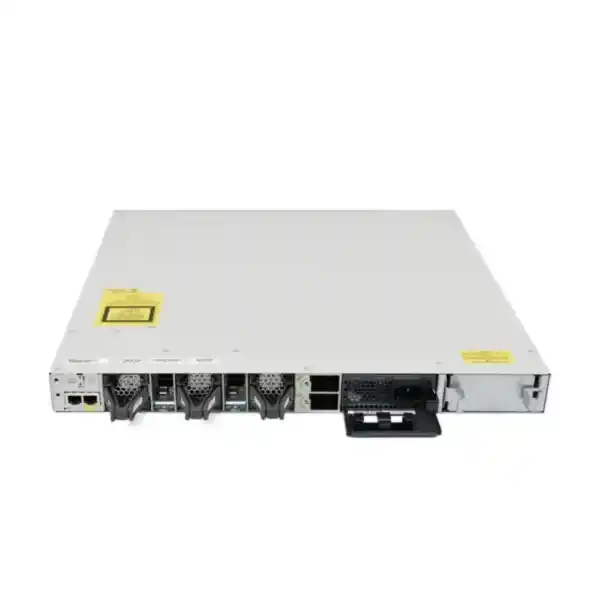
Modular uplinks
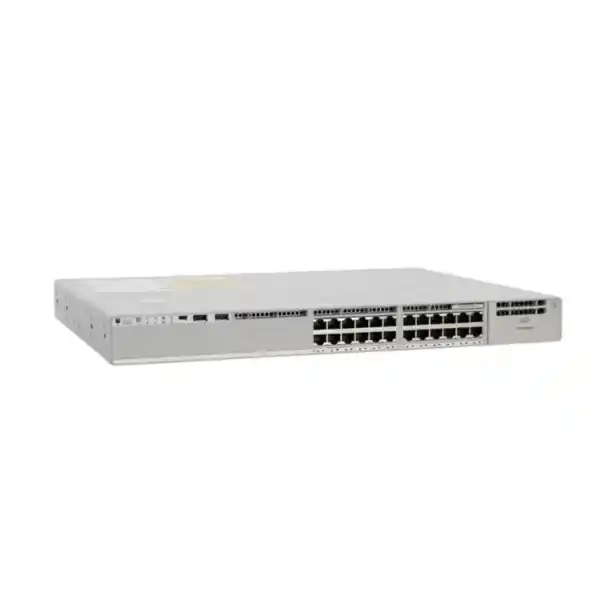
Cisco C9350-24P Smart Switch
For organizations planning a resilient wired access layer, the Cisco C9350-24P combines 24 Gigabit Ethernet copper downlinks, PoE+ power, high-speed modular uplink choices and enterprise switching features in a stackable 1RU platform. It is intended for campus and branch access networks where phones, wireless access points, cameras, sensors, thin clients and other Ethernet devices need dependable connectivity and where the network team wants a platform that can scale beyond a single standalone switch.
The buying decision should be based on more than port count. The correct configuration depends on the total PoE demand of connected devices, the selected uplink module and optics, required software license level, whether the deployment needs redundant power, and whether multiple C9350 switches will be stacked. FourTeck Tanzania can use these requirements to help shape a bill of materials for the intended network rather than treating the switch chassis as a complete solution by itself.
What the C9350-24P is designed to do
The C9350-24P is a fixed-form-factor Cisco enterprise access switch built for environments that need 24 copper access interfaces with Power over Ethernet Plus. Each downlink supports 10/100/1000 Mbps Ethernet and can deliver up to 30W of PoE+. That makes the model a practical fit when most edge devices operate at 1 Gigabit or below and their individual power requirements fall within the PoE+ class. Typical examples include business IP phones, many enterprise wireless access points, video surveillance cameras, badge readers, building sensors and other networked endpoints.
Cisco positions the wider C9350 family as a stackable smart-switch platform for modern enterprise campus access. The C9350-24P uses Cisco Silicon One A100/L hardware for forwarding and runs Cisco IOS XE. This combination gives network teams familiar enterprise routing, switching, telemetry, programmability and policy capabilities while adding a newer hardware architecture, much faster stacking than older access platforms and flexible management choices.
This model is not a multigigabit downlink switch. Buyers who need 2.5G, 5G or 10G speeds on access ports for high-performance Wi-Fi or specialized endpoints should compare other C9350 variants instead of assuming that the C9350-24P can provide those speeds on its 24 fixed copper downlinks. The strength of the 24P is its combination of mainstream 1G access, PoE+, modular uplinks, stacking and enterprise feature depth.
Key specifications at a glance
| Model | Cisco C9350-24P |
|---|---|
| Access ports | 24 × 10/100/1000 Mbps copper downlinks |
| PoE capability | PoE+ with up to 30W per access port |
| Maximum port-limited PoE budget | 720W across 24 ports; actual available budget depends on installed power supplies and redundancy mode |
| Default power supply in current ordering guide | PWR-C2-850WAC-I |
| Uplinks | Field-replaceable network-module slot; supported options provide high-speed fiber or copper uplinks depending on module |
| Maximum modular uplink bandwidth for this model | Up to 200 Gbps with a compatible uplink module |
| Stacking | Cisco StackWise-1.6T; up to eight C9350 switches in a supported stack |
| Standalone switching specification | 448 Gbps |
| Forwarding rate | 333.312 Mpps |
| Memory | 16 GB DRAM and 18 GB flash at the C9350 platform level |
| Management interfaces | RJ-45 console, USB Type-C console, and RJ-45 10/100/1000 management interface |
| Dimensions with 500W/850W PSU | 4.4 × 44.5 × 42 cm (1.73 × 17.5 × 16.5 in) |
| Weight with default PSU | Approximately 6.14 kg (13.54 lb) |
24 Gigabit Ethernet ports with PoE+ for the access layer
The fixed access side of the C9350-24P provides 24 RJ-45 ports that support 10 Mbps, 100 Mbps and 1 Gbps Ethernet. For many offices, branches, schools, healthcare facilities, retail environments and public-sector networks, 1G remains an appropriate speed for standard user endpoints and operational technology. The advantage of a dedicated enterprise access platform is that these endpoints can be connected, powered, segmented, monitored and governed from the network edge rather than through a collection of unmanaged devices.
PoE+ allows a single Ethernet cable to carry both network data and DC power to a supported endpoint. On the C9350-24P, each of the 24 fixed access ports can provide up to 30W. This reduces the need for local power adapters at desks, ceilings and camera positions, but it does not remove the need to calculate the full switch power budget. A network with twelve low-power phones behaves very differently from one with twenty-four devices drawing close to the maximum per-port allowance.
For procurement, record the expected power draw of each connected endpoint, add reasonable growth headroom and decide whether the network must continue powering devices if one power supply becomes unavailable. This simple exercise determines whether the default power supply is sufficient or whether additional power capacity is required. It also prevents a common design mistake: selecting a switch because every port is PoE-capable while overlooking the chassis-level power available to all ports at the same time.
PoE planning: understand the 625W default figure and 720W ceiling
Cisco’s current data sheet shows the C9350-24P with an 850W primary power supply and lists 625W of available PoE in that default configuration. The same table shows that the switch can reach the port-limited maximum of 720W with suitable additional or upgraded power configuration. The 720W limit comes directly from 24 ports multiplied by the 30W maximum per port. Because power can also be reserved for system operation and redundancy, the switch’s installed PSU wattage should never be treated as identical to usable PoE budget.
A design that needs the full 30W on all 24 access interfaces should therefore be specified for the required PoE capacity rather than assuming the default single supply will deliver the entire 720W. Conversely, many real networks use much less. IP phones may consume a fraction of the maximum, and cameras or access points vary by model, feature set, radio count, heaters, infrared illumination and connected USB accessories. Use the actual endpoint specifications when possible.
The C9350 family supports multiple field-replaceable power supplies and can be configured for redundancy as well as additional PoE capacity. Cisco also supports StackPower+ across compatible C9350 deployments, allowing power to be pooled between participating switches. Whether that architecture is appropriate depends on rack layout, resiliency requirements and the chosen bill of materials. Power design should be settled before ordering cables and supplies.
Modular uplinks help avoid a fixed-uplink dead end
The C9350-24P does not force the buyer into one permanently fixed uplink arrangement. Cisco provides a field-replaceable network-module slot so the access switch can be ordered with uplink capability that fits the upstream design. For this model, Cisco documents up to 200 Gbps of modular uplink bandwidth with compatible C9350 network modules. That gives network architects room to choose between different port counts, media types and speeds instead of overbuying access ports simply to obtain faster uplinks.
Compatible options documented by Cisco include the C9350-NM-2C, which provides two 100G/40G QSFP28 interfaces, the C9350-NM-8Y, which can provide eight 25G/10G/1G interfaces or four 50G configurations, and the C9350-NM-8M copper multigigabit network module. The exact transceivers, breakout behavior, cable type and supported combinations should be checked against the final Cisco configuration before purchase.
For a smaller branch, the uplink requirement may be only a pair of resilient links to a distribution layer. For a larger campus access block, faster uplinks can preserve headroom as traffic from wireless, video, collaboration and cloud applications grows. The key design point is that uplink bandwidth should be considered separately from the 1G user-facing ports. Twenty-four 1G downlinks do not mean the network should be connected upstream with an unnecessarily narrow uplink.
StackWise-1.6T for higher availability and simpler growth
Cisco StackWise-1.6T is a major differentiator for organizations that expect to operate more than one switch in the same access block. Cisco documents up to 1.6 Tbps of aggregate stacking bandwidth and support for as many as eight C9350 switches in a stack when the required compatibility and licensing conditions are met. The stack operates as a unified system with a common control plane and distributed forwarding, reducing the operational burden compared with treating every switch as a completely independent island.
Stacking can also make physical expansion more predictable. A site can begin with the port count needed today and expand with additional compatible C9350 units when user, phone, camera or wireless density grows. That does not eliminate normal capacity planning, because uplink design, failure domains, power, cooling and software strategy still matter. It does, however, give the access layer a consistent architecture for scaling across multiple switches.
An important purchasing detail is cable compatibility. Cisco specifies dedicated StackWise-1.6T cables for the C9350 series and states that stacking and StackPower cables from older Catalyst 9300 generations are not compatible with the C9350 platform. A migration project should therefore include the required new stacking cables rather than assuming existing stack accessories can be reused.
Enterprise switching, routing and policy at the edge
Cisco IOS XE provides the software foundation for the C9350 series. At the platform level Cisco lists Layer 2 switching, IP routing, multicast routing, IPv6 routing, enterprise quality of service, Flexible NetFlow, programmability and Software-Defined Access capabilities. For network teams, this means the switch can participate in an enterprise architecture rather than merely bridging Ethernet frames between endpoints.
The hardware scale is also substantial for an access platform. Cisco lists support for up to 64,000 MAC addresses, up to 4,000 active VLANs, up to 4,000 switched virtual interfaces and up to 192,000 IPv4 routes in the documented platform tables. These are platform maximums and the usable scale for a real deployment depends on configuration, software release and the selected SDM template. They should be interpreted as design ceilings, not as targets that every access network should attempt to reach.
Quality of service matters when voice, video, transactional applications and general internet traffic share the same access infrastructure. Access control lists and segmentation matter when users, cameras, guest devices and operational systems should not all sit in one trust zone. The C9350’s value is therefore not only raw packet forwarding; it is the combination of forwarding scale, policy enforcement, telemetry and automation in the same edge platform.
Secure platform foundation
Cisco documents Secure Boot, image signing and Trust Anchor technologies for the C9350 family. These mechanisms are intended to help validate hardware and software authenticity and protect the platform against unauthorized modification from startup into normal operation.
Traffic visibility
Flexible NetFlow, SPAN and ERSPAN capabilities give network teams tools to observe traffic behavior and feed monitoring or troubleshooting workflows. Visibility is especially useful when the access layer supports mixed user, voice, wireless and IoT traffic.
Programmable operations
IOS XE supports NETCONF, RESTCONF and YANG models together with streaming telemetry and on-box scripting capabilities, enabling teams to integrate switch configuration and monitoring with automation platforms instead of relying only on manual CLI work.
Flexible management: cloud, device or on-premises controller
A modern switching project often fails operationally when the hardware is chosen without deciding how it will be managed. Cisco designed the C9350 family to support multiple management approaches around the same IOS XE platform. Cisco documents cloud management through the Meraki dashboard as well as on-premises management through Cisco Catalyst Center, with device-oriented workflows also available depending on the selected operating mode.
This flexibility matters for organizations with mixed operating models. A distributed company may prefer centralized cloud visibility for remote branches. A large campus may already use Catalyst Center for automation and assurance. A network engineering team may require direct CLI access and API-driven workflows. The C9350 platform is designed so the management choice can be aligned with the organization’s operational model rather than forcing one universal approach.
Licensing is part of that management decision. Cisco’s current ordering guide uses unified per-device switching licenses and provides Essentials and Advantage feature levels for the access tier. For an up-to-24-port unit such as the C9350-24P, the applicable license size is the medium access tier. New unified switching subscriptions have a minimum term defined by Cisco’s current ordering policy. Because feature entitlements and commercial terms can change, confirm the required license level and subscription duration as part of the final quote.
Resiliency beyond the data plane
Availability at the access layer depends on more than forwarding performance. The C9350 chassis supports three power-supply bays and three field-replaceable fan modules. Cisco documents N+1 fan redundancy and supports multiple hot-swappable power supplies. This allows a network designer to build a power and cooling strategy that matches the importance of the connected users and devices.
For example, an access switch serving general office desks may tolerate a different recovery plan from a switch powering security cameras, wireless infrastructure, building systems or customer-facing phones. Adding power redundancy can reduce exposure to a PSU failure, while a StackWise design can improve switching resiliency across multiple members. Upstream links should also be designed with the required path diversity.
The practical lesson for buyers is to purchase the complete architecture. Confirm the number of power supplies, power cords, stack cables, network modules, optics or DAC/AOC cables, rack accessories, license level and support requirements. A chassis-only comparison can make two quotes look similar even when one includes the components needed for a production deployment and the other does not.
Physical and environmental planning for Tanzania deployments
The C9350-24P is a 1RU-class rack switch. Cisco lists chassis dimensions of 4.4 × 44.5 × 38.3 cm before the power-supply depth is included, and approximately 4.4 × 44.5 × 42 cm with the 500W or 850W supply. The listed weight with the default supply is about 6.14 kg. These dimensions are important when the switch is going into a shallow communications cabinet, a wall-mounted rack or an older rack with constrained rear clearance.
Cisco specifies front-to-back airflow for the platform and an operating range that varies with altitude: up to 50°C at sea level, with lower maximum temperatures at higher elevations. The minimum ambient temperature for cold start is 0°C. For deployments in Tanzania, cabinet ventilation, room cooling, dust management and uninterrupted power design should be planned around the actual site rather than relying only on the switch’s maximum environmental ratings.
The 850W AC power supply supports a 90V to 264V input range at 47 to 63 Hz according to Cisco’s current power-supply specifications. That wide electrical input range can be useful in varied facilities, but it does not replace proper electrical design. Use correctly rated circuits, grounding, surge protection and UPS capacity appropriate to the switch plus the powered endpoints. Where outages are frequent or critical devices depend on PoE, calculate UPS runtime using real switch load and endpoint power draw, not only the PSU nameplate rating.
Environmental design is especially important for PoE switches because power delivered to endpoints contributes to the overall electrical and thermal load of the rack. A fully loaded PoE deployment can behave very differently from a lightly populated office switch. Leave room for cable management, airflow and service access at both the front and rear.
Performance and scale for a 24-port access switch
Cisco’s model-specific bandwidth table lists the C9350-24P at 448 Gbps switching bandwidth and 333.312 million packets per second forwarding rate in standalone operation. With stacking, Cisco lists higher aggregate system figures because the stack fabric becomes part of the switching architecture. These numbers provide useful technical context, but they should be interpreted alongside the actual port mix: 24 fixed 1G access ports plus whichever compatible uplink module is selected.
The platform uses a Silicon One A100/L ASIC and includes 16 GB of DRAM and 18 GB of flash at the C9350 platform level. Cisco also documents optional SSD capacity and application-hosting resources for use cases that require supported on-box applications. For ordinary access switching, the more important result is that the hardware provides significant table scale and policy capacity while maintaining line-rate enterprise forwarding.
This capacity is useful in environments where access switches must do more than basic VLAN switching. Large organizations may need numerous VLANs, routed access, access-control policies, NetFlow records, multicast functions and automation telemetry. The C9350 platform is built to support that broader role, but the final design should still be validated against the actual IOS XE release and license feature set selected for the deployment.
Where the C9350-24P fits well
Enterprise office access
Connect user workstations, IP phones, printers and standard 1G devices while applying enterprise VLAN, QoS, security and monitoring policy at the edge.
Branch networks
Use a compact 24-port access footprint for branches that need enterprise IOS XE operations, PoE+ and resilient uplinks without requiring 48 access ports.
IP surveillance
Power compatible PoE cameras while segmenting surveillance traffic and planning uplink capacity around the aggregate video bitrate and recording architecture.
Unified communications
Support PoE IP phones with QoS and VLAN policy while retaining wired data connectivity for users and other endpoints on the same access platform.
Standard-power wireless APs
Power access points whose Ethernet speed and power requirements fit within 1G and PoE+ limits. For higher-speed or higher-power APs, compare multigigabit C9350 models.
Smart-building edge
Aggregate supported sensors, controllers and other Ethernet devices while keeping policy, visibility and power control in the managed network infrastructure.
When another C9350 model may be a better choice
The C9350-24P is deliberately focused on 24 ports of 1G Ethernet with 30W PoE+. That is a strong fit for many access networks, but not every one. If the project requires 60W per access port, the C9350-24U is the more relevant 24-port model. If endpoints require 2.5G, 5G or 10G Multigigabit Ethernet and higher power classes, the HX-class C9350 options should be evaluated. If the network needs 48 standard 1G PoE+ access ports in one chassis, the C9350-48P may provide a more efficient port density.
A data-only design can also avoid paying for PoE capability that will never be used. Cisco offers non-PoE C9350 variants for environments where every endpoint has local power. Likewise, fiber-access models may be more appropriate when the access medium itself must be optical due to distance, electromagnetic environment or architecture.
A good selection process starts with endpoint count, port speed, endpoint power, uplink bandwidth and resilience. Model comparison should come after those requirements are known. This prevents both under-sizing and over-specification and makes it easier to compare total deployed cost rather than only the list price of individual switch chassis.
Licensing and software considerations before ordering
Cisco’s C9350 family uses a unified licensing model. The current ordering guide identifies Switching Essentials and Switching Advantage options, with medium access-tier licenses applying to switches with up to 24 ports. The correct license level depends on the required capabilities and management design. Do not assume that every software feature mentioned for the C9350 platform is available under every license or in every IOS XE release.
Cisco’s current documentation lists IOS XE 17.18.1 as the introductory and minimum software release for the C9350-24P, while Cisco’s recommended-release guidance is updated independently over time. Network teams should therefore check the recommended software release when preparing a production deployment, especially where the environment depends on particular features, bug fixes, security updates or controller compatibility.
Cloud management through the Meraki dashboard, on-premises management through Catalyst Center, direct device management and automation interfaces can lead to different operational workflows. Decide who will own device configuration, monitoring, software lifecycle and license administration. Where a Cisco Smart Account is required for license management, make sure the account structure and responsible administrators are defined before deployment.
Subscription and support terms are commercial components of the solution, not afterthoughts. Include them in the quote and lifecycle budget so the organization knows which software entitlements, support services and renewal obligations apply during the planned ownership period.
Migration from older Cisco access switches
Cisco maps the C9350-24P as a modern 24-port PoE+ option corresponding broadly to earlier 24-port PoE access roles such as the Catalyst 9300-24P and older Catalyst 3850 24-port PoE models. A migration should not be treated as a part-number substitution, however. The C9350 introduces a different stacking architecture, a newer licensing model, different uplink modules and newer hardware capabilities.
Start by documenting the current switch configuration and dependencies: VLANs, trunks, spanning-tree settings, routed interfaces, QoS, authentication, access lists, DHCP snooping, monitoring, NetFlow, SNMP or telemetry, port descriptions, PoE endpoints and any controller integrations. Then compare those requirements against the target IOS XE release and intended license level. This reduces the risk of discovering during a maintenance window that a legacy configuration needs to be adapted.
Physical migration also needs attention. Existing Catalyst 9300 stack cables are not compatible with the C9350 StackWise-1.6T connectors, so new supported C9350 stack cables are required. Existing optics and uplink cabling should be checked against the selected C9350 network module rather than presumed compatible. Rack depth, power connections and airflow direction should be confirmed at the site.
For critical networks, stage the configuration and software before cutover, validate endpoint authentication and PoE behavior, test uplink redundancy, and retain a rollback plan. The switch may be capable of replacing an older access platform, but the migration quality depends on preparation around the surrounding network services.
Important buying checks for a complete C9350-24P solution
- Confirm endpoint count and speed. The 24 fixed downlinks are 1G-class copper ports, not multigigabit access ports.
- Calculate PoE consumption. List endpoint wattage and determine whether the default available PoE budget is enough or additional PSU capacity is required.
- Select the uplink module. The base platform uses a modular uplink approach; choose the module around required media, speed and port count.
- Match optics and cables. Transceivers, DACs, AOCs and fiber type must match the chosen network module and upstream equipment.
- Decide on stacking. Include supported StackWise-1.6T cables if multiple switches will operate as a stack.
- Plan power redundancy. Decide whether one PSU is sufficient or whether the deployment requires added capacity or N+1 power resilience.
- Choose the license level. Essentials and Advantage provide different feature entitlements; select against the actual technical requirements.
- Choose the management model. Define whether operations will use Meraki dashboard, Catalyst Center, direct device management, APIs or a hybrid model.
- Check rack and cooling conditions. Confirm rack depth, cable clearance, airflow, room temperature and UPS capacity.
- Validate the final Cisco bill of materials. Chassis, license, network module, optics, stack accessories, power components and support should be reviewed together before ordering.
Security and visibility for a modern access network
Access switches sit where users and devices enter the enterprise network, so security features need to operate close to the endpoint. Cisco documents hardware access-control capabilities, segmentation technologies, Secure Boot, image signing and Trust Anchor mechanisms across the C9350 platform. These capabilities help the network enforce policy and protect the integrity of the switch itself, but they are most effective when they are part of a broader identity, segmentation and monitoring design.
Flexible NetFlow can provide flow-level visibility into traffic patterns. SPAN and ERSPAN support packet-analysis workflows. IP Device Tracking helps maintain endpoint visibility, and IOS XE telemetry can feed operational systems with structured data. For organizations managing many branches or campus closets, these capabilities can reduce troubleshooting time because the access layer contributes useful evidence about where devices are connected and how traffic behaves.
Cisco also documents advanced encryption and newer cryptographic capabilities for the C9350 family. Because availability can depend on software release and licensing, treat such platform-level features as items to verify against the final configuration rather than assuming every capability is active by default. The same applies to integrations with broader Cisco security or assurance products.
The strongest deployment practice is to define security requirements first: who or what may connect, which VLAN or segment each endpoint belongs to, how administrators authenticate, how configuration changes are controlled, how logs and telemetry are retained, and what happens when a device violates policy. The switch then becomes an enforcement point inside that architecture rather than a standalone security product.
Automation, telemetry and application hosting
As networks grow, repeatable operations matter more than manually configuring individual switches. IOS XE supports model-driven interfaces including NETCONF, RESTCONF and YANG. These can be used by compatible automation systems to read state and apply configuration in a structured way. Streaming telemetry can provide ongoing operational data to monitoring platforms without relying only on periodic polling.
Cisco also supports on-box application hosting within the C9350 platform. The documented hardware includes dedicated application resources and optional SSD capacity, and Cisco cites supported services such as ThousandEyes and Cisco Spaces as examples of workloads that can run on the switch platform. Application availability, resource allocation and software requirements should be checked for the specific deployment.
For most buyers, the practical benefit is operational flexibility. A team can begin with conventional network management and later introduce automation, telemetry or supported edge applications without replacing the access switch simply because operational maturity has increased. That makes the platform suitable for organizations building toward more automated campus operations while still needing familiar IOS XE behavior today.
Deployment examples
Small enterprise floor
A 24-port switch can support a floor or department where the endpoint mix consists of desktops, phones, printers and several access points. PoE can power the phones and compatible APs, while VLANs separate voice, corporate devices and guest or facilities traffic. A redundant uplink design can connect the access switch to distribution or core infrastructure.
Camera and security network
The switch can power supported PoE cameras and carry video traffic toward recording or analytics systems. Designers should calculate camera power use and aggregate bitrate carefully. High-resolution, high-frame-rate video can create sustained traffic loads, so uplink sizing and storage architecture are as important as the number of camera ports.
Branch office with centralized operations
A branch can use the C9350-24P for user and voice access while the IT team manages configuration and monitoring through its chosen Cisco management model. The modular uplink slot provides options for matching the branch WAN or campus aggregation design, and PoE reduces dependence on separate adapters for edge devices.
Growing campus access stack
Multiple C9350 units can be combined using StackWise-1.6T when a larger port count or common control plane is needed. This can simplify expansion and operations, but the stack should still be designed for appropriate uplink diversity, power resilience and maintenance procedures.
Frequently asked questions
Does the Cisco C9350-24P provide PoE on all 24 ports?
Yes. Cisco specifies 24 PoE+ access ports, with each port capable of up to 30W. The total simultaneous power available across all ports depends on the installed power supplies and power mode. Cisco’s current data sheet shows 625W of available PoE with the default 850W supply configuration and a 720W port-limited maximum with suitable power configuration.
Are the 24 access ports multigigabit?
No. The fixed copper downlinks on the C9350-24P support 10/100/1000 Mbps. If an endpoint needs 2.5G, 5G or 10G access connectivity, compare a multigigabit C9350 model rather than the 24P.
Does the switch include fixed uplink ports?
The C9350 platform uses a field-replaceable network-module slot for uplinks. The selected network module determines uplink port count, connector type and supported speeds. The module should be selected as part of the final bill of materials.
How fast can the uplinks be?
Cisco documents up to 200 Gbps of total modular uplink bandwidth for the C9350-24P with compatible modules. Options include modules supporting 100G/40G QSFP28, 25G/10G/1G or 50G arrangements, and a copper multigigabit module. Exact compatibility should be validated for the intended configuration.
Can C9350-24P switches be stacked?
Yes. Cisco supports StackWise-1.6T on the C9350 family, with up to eight supported C9350 members in a stack. Dedicated C9350 StackWise-1.6T cables are required; older Catalyst 9300 stacking cables are not compatible.
Can I reuse Catalyst 9300 StackWise cables?
No. Cisco explicitly states that C9350 switches use their own StackWise-1.6T and StackPower cable types and are not compatible with stacking or StackPower cables from previous Catalyst 9300 generations.
Which power supply comes with the C9350-24P?
Cisco’s current ordering guide lists the PWR-C2-850WAC-I as the default power supply for the C9350-24P. Additional or upgraded power supplies may be needed when the design requires more PoE capacity or power redundancy.
Does the C9350-24P support Layer 3 routing?
The C9350 platform supports IP routing as part of its IOS XE feature set. The exact routing features available to a deployment depend on software release and license level, so requirements such as dynamic routing protocols should be checked against Cisco’s current licensing and feature documentation before ordering.
Can it be managed through the Meraki dashboard?
Cisco documents Meraki dashboard management options for C9350 Series Smart Switches, including cloud-configured and device-configured operating modes. The management model and required licensing should be chosen during solution design.
Can it be managed with Cisco Catalyst Center?
Yes. Cisco lists Catalyst Center as an on-premises management option for the C9350 family. Compatibility should be checked against the versions used in the customer environment.
Is 720W of PoE available with the default PSU?
Not according to Cisco’s current power table. The default 850W supply configuration is listed with 625W available PoE, while 720W is the maximum allowed by 24 ports at 30W each when the power configuration provides enough capacity. This is why endpoint power planning is important before purchase.
What should be included in a quote?
A complete quote should identify the switch model, required Cisco license, uplink network module, optics or cables, stack cables if used, additional power supplies if required, suitable power cords, support option and any other accessories needed for the installation. The exact list depends on the intended topology and endpoint load.
Request a Cisco C9350-24P configuration for your network
For the most useful quote, provide the number and type of connected devices, expected PoE wattage, required uplink speed and media, whether stacking is planned, whether redundant power is required, and the preferred management approach. This makes it possible to identify the chassis and the supporting components needed for a deployable solution.
Ask FourTeck Tanzania for a C9350-24P quotation and bill-of-materials review based on your access-port, PoE, uplink, stacking and licensing requirements. Pricing, availability, lead time and final Cisco configuration should be confirmed at quotation stage.


Reviews
There are no reviews yet.