
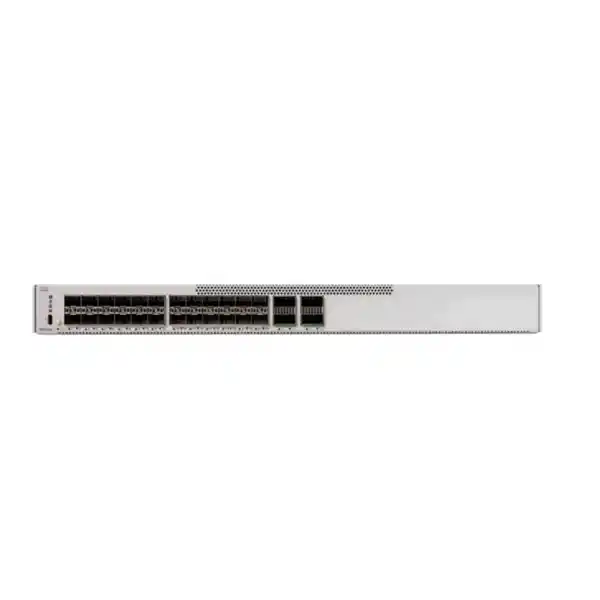
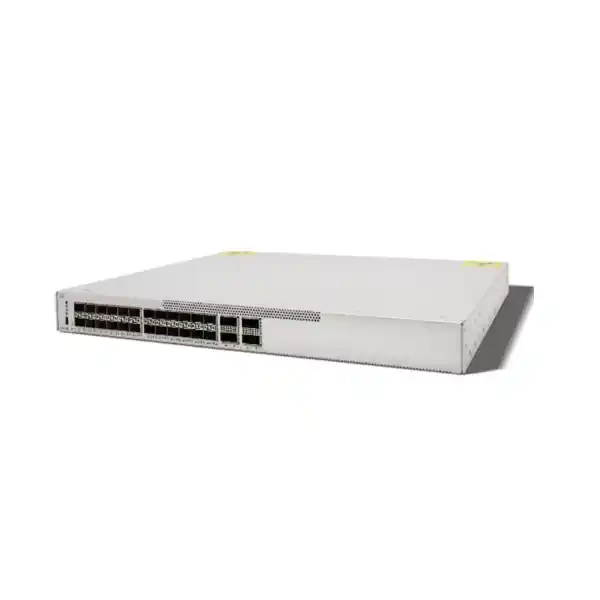
24 × SFP56
Up to 400G uplinks
1RU fixed core
Cisco C9550-24L4CD Smart Switch for high-speed campus core and distribution
The Cisco C9550-24L4CD Smart Switch is designed for organisations that need a compact, fibre-focused aggregation or core platform with significantly more backbone capacity than a conventional access switch. It combines twenty-four SFP56 downlink ports supporting 50, 25, 10 and 1 Gigabit Ethernet with four QSFP-DD uplink interfaces. Cisco documents these uplinks for 40G and 100G operation, or for two 400G uplinks on this model. That mix makes the switch particularly useful when several access-layer switches, server-facing aggregation links, or building-distribution connections need to converge into a resilient campus backbone without moving immediately to a large modular chassis.
For buyers in Tanzania, the most important procurement question is not simply whether the switch has enough ports. A successful C9550-24L4CD deployment depends on selecting supported optics, matching fibre type and distance, confirming the required Cisco unified license, planning airflow and rack depth, sizing power protection, and deciding whether a second power supply is required for 1+1 redundancy. FourTeck can use a project bill of materials, network diagram, current switch inventory, fibre schedule, or performance requirement to help shape a quotation around the intended deployment rather than around the chassis alone.
At-a-glance product fit
Who should consider the C9550-24L4CD?
This model is best evaluated as a core or distribution switch, not as a general-purpose user-access switch. Its port mix is centred on SFP56 and QSFP-DD connectivity rather than large numbers of copper Ethernet ports, and it does not replace a PoE access switch for directly powering phones, wireless access points, cameras, or other edge devices. A typical design uses the C9550-24L4CD to aggregate high-speed fibre links from access or distribution switches and then carry that traffic toward other core devices, data-centre services, WAN/security layers, or a campus backbone.
Cisco positions the C9550-24L4CD primarily for the core and distribution layers of small to medium enterprise campuses and as a consolidation point for multiple 50/25/10/1G access-switch uplinks. That makes it relevant to growing organisations that have outgrown 10G-only aggregation, are introducing 25G or 50G connectivity, or want a practical path toward 100G and 400G backbone links. It can also be considered where a fixed platform is operationally simpler than a modular chassis and where twenty-four high-speed downlinks provide enough density for the expected access-layer or service aggregation design.
It may be less suitable where the project requires dozens of copper access ports, integrated PoE, very high 100G port density, more than twenty-four 50G-class downlinks, or a chassis architecture with modular line cards. In those cases, a different access platform, the higher-density C9550-48L4CD, the C9550-32C for denser 100G-oriented connectivity, or another Cisco platform may be a better architectural fit. The decision should be driven by topology, interface requirements, growth headroom, redundancy objectives, and software features rather than by series name alone.
Technical specifications
| Model | Cisco C9550-24L4CD Smart Switch |
|---|---|
| Form factor | 1RU fixed switch |
| Downlink ports | 24 × SFP56, supporting 50/25/10/1G |
| Uplink interfaces | 4 × QSFP-DD physical ports; four 100/40G or two 400G uplinks on this model |
| ASIC | Cisco Silicon One E104 |
| Model system bandwidth | Up to 2.4 Tbps |
| Forwarding rate | Up to 2.6 Bpps |
| CPU and memory | AMD x86 CPU up to 3.8 GHz, 4 cores; 16 GB DDR5 DRAM; 18 GB flash |
| Optional SSD | Up to 960 GB SATA SSD for application hosting/storage when selected in the order configuration |
| Packet buffer | 64 MB shared-memory system buffer |
| MAC address scale | Up to 64,000 |
| Routing scale | Up to 512,000 IPv4 routes and 256,000 IPv6 routes on E104 models; actual scale depends on template and feature use |
| VLANs | Up to 4094 VLAN IDs and 4094 active VLANs |
| Management interfaces | RJ-45 management, RJ-45 console, USB Type-C console, USB host |
| Power | Two PSU bays; one C9K-PWR-750WAC is the default PSU, with optional second unit for 1+1 redundancy |
| AC input range | 90–264 VAC, 47–63 Hz for the 750W AC PSU |
| Fans | Five field-replaceable fan modules on the 1RU chassis, with N+1 fan redundancy |
| Dimensions | 4.39 × 44.45 × 46.1 cm (H × W × D), including fan/tray handles |
| Weight | Approximately 9.15 kg with two power supplies and built-in fan configuration |
| Minimum software | Cisco IOS XE 26.2.1 family; verify the exact recommended maintenance release for deployment |
Performance and scale values are platform limits, not a promise that every feature can use every maximum simultaneously. Cisco uses SDM templates and shared hardware resources, so routing, ACL, NetFlow, multicast, and host-table requirements should be checked together when the network is being designed.
High-speed port architecture: what the numbers mean
The twenty-four SFP56 downlink interfaces are the defining feature of the C9550-24L4CD. They allow the same fixed chassis to participate in networks that contain several generations of fibre speeds. A project can use 10G links today while reserving the ability to adopt 25G or 50G where the connected access switches, servers, appliances, or distribution devices support those rates. This can reduce the need to replace the core simply because the access layer is being upgraded in phases. However, the transceiver, fibre medium, distance, and remote interface must all support the selected speed. A port’s electrical capability does not guarantee that every optic or cable type is supported.
The four QSFP-DD uplink interfaces provide the backbone side of the design. Cisco describes the C9550-24L4CD as supporting four 100G or 40G uplinks, or two 400G uplinks. This distinction is important during capacity planning. A buyer should not assume that four physical QSFP-DD cages mean four simultaneous 400G links. The project design should specify the required uplink mode, expected oversubscription, resilient path layout, and the peer device on each link before optics are ordered.
For a campus environment, the practical question is how traffic will converge. Twenty-four 25G downlinks, for example, produce a very different oversubscription profile from twenty-four 50G downlinks. Likewise, a pair of 400G backbone connections may be attractive for future growth, but only if the upstream platform, optics, fibre plant, and operational model support them. FourTeck can review the intended port-speed map as part of a quotation so that optics and accessories are selected for the actual topology rather than purchased as an afterthought.
Performance, routing scale and segmentation
The C9550-24L4CD uses a Cisco Silicon One E104 ASIC. Cisco’s model-specific bandwidth table lists up to 2.4 Tbps of system bandwidth for the C9550-24L4CD and a forwarding rate of up to 2.6 billion packets per second. Cisco also publishes the E104 ASIC family capacity separately at up to 3.2 Tbps, which is why buyers may see both figures in C9550 documentation. For procurement and design, the model-specific 2.4 Tbps system bandwidth figure is the safer value to use when describing the C9550-24L4CD itself.
The platform supports advanced Layer 2 and Layer 3 functions through Cisco IOS XE. Published capabilities include IPv4 and IPv6 routing, IP multicast routing, BGP EVPN, SD-Access, Flexible NetFlow, quality-of-service functions, programmable interfaces, and out-of-band management. The E104-based models support up to 64,000 MAC addresses, up to 512,000 IPv4 routes and 256,000 IPv6 routes, with the exact usable distribution of resources affected by the configured SDM template and enabled features. The default SDM profile is a core template intended to suit core-routing workloads, while other template choices and future software releases can affect available scale.
These numbers matter most when they are tied to a real requirement. A straightforward office campus with a few hundred VLANs has different resource needs from a multi-building environment with extensive segmentation, telemetry, multicast, policy-based routing, or large routing tables. Before purchase, document the expected VLAN count, routed prefixes, host scale, multicast use, ACL requirements, telemetry volume, and growth assumptions. This prevents a design from being judged only on headline throughput while overlooking table resources that may be more important to the application.
Resiliency and high availability
Core and distribution switches sit in a part of the network where a failure can affect many users at once, so the C9550-24L4CD includes several mechanisms intended to reduce single-device and maintenance risk. Cisco supports StackWise Virtual on the C9550 family, allowing two compatible switches to operate as a virtual system for network-level redundancy. Stateful switchover is available with StackWise Virtual, and Cisco IOS XE also supports in-service software upgrades and software maintenance upgrades on the platform. These features can help an appropriately engineered pair maintain service through selected control-plane events and software maintenance operations.
Hardware redundancy should be planned separately from logical redundancy. The 1RU chassis contains two power-supply bays but ships with one power supply by default. A second 750W AC PSU can be ordered to provide 1+1 power redundancy. Five field-replaceable fan modules are used in the 1RU design and Cisco specifies N+1 fan redundancy. Fans are offered for opposite airflow directions, but all fan units in a switch must be the same airflow type. The rack layout therefore needs to establish a consistent cold-air intake and hot-air exhaust direction before hardware is ordered.
A resilient design also requires redundancy outside the chassis. Two switches installed in the same rack, powered by the same UPS, connected through the same fibre path, and dependent on the same upstream device can still share common failure points. For business-critical Tanzania deployments, consider separate power feeds where available, appropriately sized UPS capacity, diverse fibre paths, redundant upstream peers, labelled patching, spare compatible optics, configuration backup, and a documented recovery procedure. The C9550 provides the platform capabilities, but end-to-end availability depends on how the complete network is built.
Power, cooling and rack planning
The C9550-24L4CD is a 1RU device measuring approximately 4.39 cm high, 44.45 cm wide and 46.1 cm deep including the fan or tray handles. A fully equipped unit with two power supplies is listed at approximately 9.15 kg. Those dimensions are compact for a core-class switch, but rack planning should still account for front and rear clearance, fibre bend radius, cable management, power-cord routing, access to field-replaceable modules, and the direction of airflow. Dense fibre patching can become difficult to maintain when these physical details are left until installation day.
Cisco specifies the C9K-PWR-750WAC as the default power supply for this model. The PSU accepts 90 to 264 VAC at 47 to 63 Hz, and the chassis supports two power supplies with 1+1 redundancy when a second unit is installed. The published thermal output for this model with the 750W AC PSU is 1880 BTU per hour. Actual site planning should consider the entire rack load, not this switch in isolation. UPS capacity, power distribution units, grounding, upstream protection, generator arrangements where used, and cooling capacity should be sized around the complete network stack and realistic operating conditions.
Operating temperature also depends on airflow configuration and altitude. Cisco lists a higher sea-level operating limit for the front-to-back 1RU fan option than for the back-to-front option. In practical terms, the rack should have controlled ventilation and the chosen fan direction should match the room and rack airflow plan. For warm equipment rooms or sites where ambient temperature can rise during power or cooling interruptions, the thermal design deserves the same attention as bandwidth. A high-performance switch installed in a poorly ventilated rack can become an availability problem even when the logical design is correct.
Cisco IOS XE, management and automation
The C9550-24L4CD runs Cisco IOS XE, which gives network teams a familiar enterprise switching and routing environment while also supporting modern telemetry and automation workflows. Cisco lists programmability, Flexible NetFlow, Layer 2 switching, IP routing, multicast, IPv6, enterprise QoS, EVPN, SD-Access, and out-of-band management among the available platform capabilities. For teams standardising on Cisco, this can make the switch easier to incorporate into established configuration, monitoring, change-control, and troubleshooting practices than introducing a separate operating system at the core.
Cisco also supports Meraki dashboard integration for the C9550 family. Depending on the selected operating mode, the dashboard can provide cloud-based provisioning, monitoring, configuration, inventory, licensing, and Cloud CLI functions. Cisco documentation also describes Catalyst Center as part of the broader management strategy, but current availability can be release-dependent. Buyers should therefore confirm the exact management mode, software release, license entitlement, and feature support required by the project rather than assuming every management option is identical on day one.
The platform’s x86 control plane includes a four-core AMD processor operating up to 3.8 GHz, 16 GB of DDR5 memory, and 18 GB of flash. Cisco supports optional SATA SSD capacity up to 960 GB for application hosting or storage, with the SSD selected as part of the order configuration. E104 models can allocate resources for application hosting, including up to 4 GB of DRAM and up to two virtual CPUs, with two 10G AppGig interfaces. These capabilities can be useful for specialised on-box services, but they should not be treated as a reason to deploy applications without a defined support and lifecycle plan.
Automation is most valuable when it is tied to operational discipline. Before introducing programmatic changes, define configuration ownership, approved templates, role-based access, backup procedures, logging, rollback methods, and maintenance windows. Telemetry should also be designed around the questions the operations team needs to answer: which links are congested, where packet loss appears, which applications dominate traffic, which prefixes or VLANs are affected, and how quickly a change can be traced. The C9550 supplies the underlying capability; the operational process determines whether those capabilities reduce or increase complexity.
Security capabilities for the campus core
A core switch carries traffic from many users and systems, so segmentation and policy enforcement can be as important as raw forwarding speed. Cisco documents hardware access control lists, VXLAN segmentation, Cisco TrustSec, Flexible NetFlow, and line-rate MACsec capabilities on the C9550 family. The platform also supports AES-GCM-256 encryption and includes Cisco Trust Anchor technologies for hardware and software authenticity, Secure Boot, and protection against unauthorised modification. Which security functions are appropriate depends on the architecture, software version, license, connected devices, and cryptographic requirements of the organisation.
For buyers, the practical task is to map these capabilities to policy. Decide where segmentation boundaries belong, which traffic classes require encryption, which devices and administrators are trusted, how management access is protected, how logs are retained, and what should happen when a device or application behaves unexpectedly. In a multi-building campus, for example, MACsec may be relevant on selected high-speed links where both ends support the required mode. TrustSec or VXLAN may be part of a wider segmentation design, but neither should be enabled simply because the switch supports it.
Security design also includes lifecycle management. Use supported Cisco IOS XE releases, maintain configuration backups, restrict administrative access, monitor authentication and configuration changes, and establish a process for reviewing security advisories. Cisco supports software maintenance mechanisms including SMU and hot patching for selected fixes, but upgrade behaviour varies by release and feature set. A maintenance plan should be tested against the actual topology, especially where StackWise Virtual, routing adjacencies, encryption, or fabric functions are in use.
Licensing: include it in the project budget
The C9550 generation uses Cisco unified licensing. For the C9550-24L4CD, Cisco’s ordering guide maps the device to the LIC-CS-CO-M-A license, described as Cisco Switching Advantage Core Fixed License, Medium. Cisco currently states that only the Advantage tier is available for the C9550 Series and that a new unified switching subscription requires a minimum term of 36 months. The licensing model is designed to support flexible management and unified product support, but the exact commercial bundle, renewal structure, support level, and management requirements should be confirmed in the quotation.
This matters because comparing the chassis price alone can produce an incomplete budget. A complete bill of materials may include the switch, one or two power supplies, region-appropriate power cables, the required license term, supported optics or direct-attach components, rack accessories, optional SSD, spare transceivers, and any implementation or support services. Existing Cisco Smart Account arrangements and enterprise agreements can also affect how licensing is managed, so organisations with an established Cisco estate should identify the account and procurement model early.
If the switch will replace an older Cisco core, do not assume an existing software entitlement can simply be transferred. Verify the new platform’s license requirements, term, feature needs, management mode, and support arrangement. If a tender or procurement document lists only “C9550-24L4CD,” ask whether the license and redundant power supply are meant to be included. Clarifying these items before commercial comparison helps ensure that competing quotes describe the same functional configuration.
Important current compatibility and release considerations
The C9550 is a new platform generation, and current Cisco release notes should be part of the design review. Cisco IOS XE 26.2.x documentation lists some limitations that can directly affect optics and cabling choices. Breakout cables are not supported in the referenced release, CVR/QSA adapter modules are not supported, and the SFP-10G-T-X module cannot operate at 1G on the C9550. These restrictions are easy to overlook when migrating from an older switch where an existing adapter or breakout design may have been valid.
Before reusing optics from a current network, build a port-by-port inventory and verify each transceiver against Cisco’s current transceiver compatibility information for the intended C9550 software release. Record the optic part number, speed, fibre type, connector, wavelength, distance, peer interface, and whether the link is expected to run at its native speed or a lower rate. This is especially important for 50G and 400G projects, where optical form factor alone does not establish compatibility.
Software feature support should be validated in the same way. Cisco publishes a broad set of C9550 capabilities, but individual functions can be introduced, enhanced, or constrained by specific IOS XE releases. If a design depends on a particular routing protocol feature, EVPN behaviour, encryption mode, management integration, ISSU workflow, or automation interface, verify that feature against the planned release before finalising the deployment. A technically correct bill of materials includes software assumptions as well as hardware.
Planning a C9550-24L4CD deployment in Tanzania
Tanzania projects can range from a single headquarters network to multi-building campuses, institutions, hospitality sites, industrial facilities, service-provider-adjacent enterprise networks, and organisations with branches connected to a central location. The same C9550-24L4CD can play different roles in those environments, so the quotation should start with the network role rather than a generic product request. State whether the switch will be the campus core, building distribution layer, aggregation point for access switches, fabric border, or a replacement for an existing core. Include the number of connected switches, present and planned link speeds, critical applications, and expected growth period.
Fibre information is particularly important. List the fibre type, connector type, link distance, installed cores, patch-panel arrangement, and existing optic models wherever possible. A 10G single-mode link between buildings may have a different upgrade path from a short multimode link inside a data room. If the project expects 25G, 50G, 100G, or 400G, verify whether the existing fibre plant can support the selected optic and distance. Where fibre records are incomplete, testing or inspection before ordering can be less expensive than discovering incompatibility during cutover.
Power and environmental resilience should also be documented. The switch supports a wide AC input range through the 750W PSU, but the site still needs suitable power distribution, grounding, surge protection where required by the facility design, and UPS capacity appropriate to the desired runtime. If high availability is important, the project should consider the optional second PSU and whether the two power inputs can be connected to meaningfully independent sources. Cooling, dust control, rack ventilation, and maintenance access should be checked before installation, especially in rooms that contain servers, UPS systems, firewalls, and multiple high-speed switches.
Finally, define the operational owner. Decide who will configure IOS XE, who controls licensing and Smart Account access, how configuration changes are approved, which monitoring platform will be used, who receives alerts, and how escalation will work if a backbone link fails. A core switch is most valuable when the team responsible for it has current documentation, labelled interfaces, secure administrative access, backups, software-maintenance procedures, and a clear support path. FourTeck can use these requirements to prepare a more accurate product and accessory quotation without assuming stock, delivery dates, or site services that have not been confirmed.
Migration from an existing core or distribution switch
Replacing a core switch is different from replacing a desktop access switch because routing, spanning tree, default gateways, redundancy protocols, ACLs, multicast, management, and upstream dependencies can all converge on the same device. Start by exporting the current configuration and building a simple dependency map. Identify every physical link, VLAN, SVI, routing adjacency, static route, port channel, spanning-tree role, management network, monitoring destination, authentication dependency, access control policy, and special service. Old configurations often contain features that no longer have an operational purpose, so migration is also an opportunity to simplify.
Next, create a port translation sheet between the existing platform and the C9550-24L4CD. Include old port, new port, speed, optic, fibre path, peer device, link aggregation membership, VLAN or routed status, description, and rollback instruction. If link speeds are changing, test both ends before the maintenance window. A 10G link that is being upgraded to 25G or 50G may require new optics and possibly different fibre characteristics. A 100G uplink moving toward 400G has even more stringent compatibility and peer requirements.
Software migration requires the same discipline. Confirm the target IOS XE release, license status, boot variables, management reachability, time synchronisation, AAA method, telemetry, syslog, SNMP or other monitoring, and backup process. If StackWise Virtual is planned, design and test that architecture before production cutover. If an in-service upgrade strategy is important, confirm that the exact software path and configured features support the intended process. Avoid treating ISSU as a universal guarantee of zero impact; maintenance behaviour can depend on topology, release, protocol state, and feature combinations.
A staged migration can reduce risk. Preconfigure management and base routing, validate optics and physical links, move lower-risk services first where practical, monitor errors and convergence, and keep a tested rollback path until all critical services are stable. For regulated or business-critical environments, document the acceptance tests in advance: gateway reachability, routing adjacency, application access, voice/video traffic, internet paths, security policy, redundancy failover, monitoring visibility, and performance baselines. The switch should be accepted against business outcomes, not merely a successful boot.
How the C9550-24L4CD compares within the C9550 family
The C9550-24L4CD is the compact choice in the family for networks that need high-speed SFP56 downlinks but do not need the larger port counts of the higher-density models. Its twenty-four 50/25/10/1G interfaces can be a strong fit for smaller campus cores and distribution points. The C9550-48L4CD follows a similar design idea but doubles the number of SFP56 downlinks to forty-eight, which can reduce the number of aggregation devices required in a larger campus while using the same general 1RU class.
The C9550-32C targets a different requirement: denser 100G/40G QSFP connectivity. It can make more sense when the aggregation layer is dominated by 100G links rather than a mix of 10G, 25G, and 50G SFP56 connections. The larger C9550 models extend scale further, including 2RU platforms intended for very high port density and higher system capacity. These are not automatically “better” choices. A higher-density chassis can add cost, power, optics, and unused capacity if the network does not require it.
A useful comparison therefore starts with five questions: how many fibre links must terminate on the switch, what speeds are required now, what speeds are expected in the next growth cycle, how many independent backbone connections are needed, and what routing or policy scale is expected? Once those are known, the family comparison becomes practical. FourTeck can review the model choice against those inputs and identify when the 24-port platform has adequate headroom or when a denser C9550 model should be considered before procurement.
What to include in a quotation request
A detailed request helps separate the base chassis from the configuration needed to put it into service. For the C9550-24L4CD, include the following information wherever it is available:
- Required quantity and intended network role for each switch.
- Whether the design uses one switch or a redundant pair with StackWise Virtual.
- The number of 1G, 10G, 25G, 50G, 40G, 100G and 400G links required.
- Existing and required optic part numbers, fibre type, connector type and link distance.
- Whether a second 750W AC power supply is required for 1+1 redundancy.
- Required airflow direction and any rack or data-room constraints.
- Cisco unified licensing term, Smart Account details where relevant, and management preference.
- Current Cisco platform and software release if this is a migration or expansion.
- Needed routing, EVPN, SD-Access, multicast, encryption, telemetry, automation, or special feature requirements.
- Optional SSD requirement if application hosting or local storage is part of the design.
- Destination in Tanzania and any project deadline, while allowing availability and delivery to be confirmed at quotation stage.
If some of this information is not yet known, provide the current topology and the business goal. A requirement such as “replace two ageing distribution switches, aggregate twelve 10G access switches today, move half of them to 25G next year, and provide resilient 100G uplinks to the data centre” is more useful than a model number alone because it allows the hardware, optics, redundancy and license configuration to be checked together.
Frequently asked questions
Is the Cisco C9550-24L4CD an access switch?
It is primarily a fixed core, distribution, and aggregation platform. Its twenty-four SFP56 downlink interfaces and high-speed QSFP-DD uplinks are designed for fibre aggregation and backbone roles. It is not a typical copper PoE access switch for directly connecting and powering user devices, phones, cameras, or wireless access points.
Does it have four 400G uplinks?
No. The chassis has four physical QSFP-DD uplink ports, but Cisco specifies the C9550-24L4CD for four 100G/40G uplinks or two 400G uplinks. The desired mode should be confirmed before transceivers are selected, and the peer device and fibre path must also support the chosen link type.
What is the switching capacity of the C9550-24L4CD?
Cisco’s model-specific bandwidth table lists up to 2.4 Tbps of system bandwidth and up to 2.6 Bpps forwarding for the C9550-24L4CD. Cisco also publishes up to 3.2 Tbps for the E104 ASIC family and the 1RU chassis class, so model-level and ASIC-level numbers should not be confused when comparing specifications.
Is a redundant power supply included?
The switch has two PSU bays, but Cisco’s ordering guide lists one C9K-PWR-750WAC as the default power supply. A second PSU is optional and should be added when 1+1 power redundancy is required. The power cable for each PSU should also be selected for the intended deployment.
What license does the C9550-24L4CD use?
Cisco maps this model to the LIC-CS-CO-M-A Switching Advantage Core Fixed License, Medium. Cisco states that only the Advantage tier is available for the C9550 Series and that new unified switching subscriptions require a minimum 36-month term. Confirm the license term, support level, and management requirements in the commercial quote.
Can I reuse my existing Cisco optics?
Possibly, but each optic should be verified for this platform and the intended IOS XE release. Current release notes include limitations around breakout cables, CVR/QSA adapters, and 1G operation of the SFP-10G-T-X module. Do not assume that an optic or adapter supported on an older Catalyst platform will behave the same way on the C9550.
Does the switch support StackWise Virtual?
Yes. Cisco lists StackWise Virtual and stateful switchover support for the C9550 family, and specifically describes front-side StackWise Virtual support on the C9550-24L4CD. The design still needs to account for link selection, upstream/downstream redundancy, software compatibility, power diversity, and operational procedures.
Is the SSD included?
Not necessarily. Cisco’s ordering guide states that the SSD is optional and must be selected during ordering when enhanced application hosting or storage is required. The platform supports up to 960 GB SATA SSD capacity. Include the SSD only when there is a defined operational use for it.
Can FourTeck provide a price and availability for Tanzania?
A current quotation should be based on the exact configuration, quantity, license term, power redundancy, optics, accessories, and destination. This page does not assume local stock, fixed pricing, or a guaranteed delivery date. Share the required bill of materials or network requirement so the commercial configuration can be confirmed before ordering.
Before you order: a practical decision checklist
Choose this model when: you need a compact 1RU core or distribution switch; most aggregated links fit the 1G/10G/25G/50G SFP56 model; twenty-four downlinks provide sufficient density; four 40G/100G or two 400G backbone links meet the design; and Cisco IOS XE, StackWise Virtual, high routing scale, telemetry, segmentation, and automation align with your operating model.
Reconsider the model when: the requirement is primarily copper access with PoE, the project needs more than twenty-four SFP56 downlinks, it requires dense 100G connectivity, it depends on unsupported breakout or adapter behaviour, or the target software release does not support a required feature. Also reconsider if the organisation does not have a plan for the required unified licensing, compatible optics, cooling, power resilience, or ongoing software maintenance.
Validate before purchase: exact port-speed map, supported transceivers, fibre distance and type, upstream compatibility, software release, routing and table scale, StackWise Virtual design if used, power-supply count, airflow direction, rack depth, UPS capacity, license term, Smart Account ownership, support requirements, optional SSD need, and the complete accessory list. This checklist helps convert a chassis selection into a deployable solution.
Request a Cisco C9550-24L4CD configuration and quotation
Send the intended network role, quantity, destination in Tanzania, required link speeds, fibre distances, current switch models, redundancy requirement, license term, and any known optic or accessory part numbers. If you are replacing an existing core, include a topology or port schedule where possible. These details allow the C9550-24L4CD, licensing, power, optics, and related components to be reviewed as one solution.
Contact FourTeck Tanzania for a project-specific quotation and configuration review.



Reviews
There are no reviews yet.