
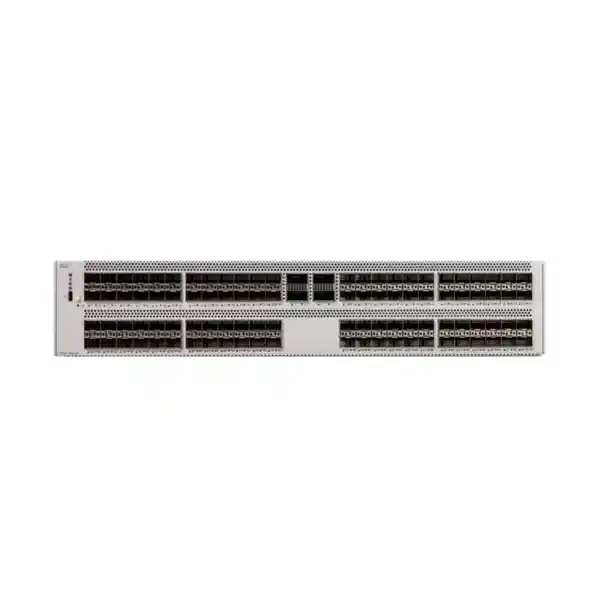
Cisco C9550 Series • High-density core and distribution
Cisco C9550-96L4D Smart Switch
The Cisco C9550-96L4D Smart Switch is designed for organizations that need to consolidate large numbers of high-speed access or aggregation links into a resilient enterprise core. Its 2RU chassis combines 96 SFP56 downlink ports supporting 50/25/10/1G with four QSFP-DD uplink ports supporting 400/100/40G. That port mix makes it practical for a campus that is still operating 10G and 25G connections today but expects higher-capacity 50G distribution links and 400G backbone connectivity as traffic grows.
For Tanzanian enterprises, institutions, service environments, and large multi-building networks, the key purchasing question is not simply whether the switch is fast enough. The important questions are how many access blocks must be aggregated, what optical reach is required, which uplink speeds will be used, how much routing scale is needed, what redundancy model is planned, and which software and subscription options will govern the deployment. The C9550-96L4D is a strong fit when those requirements point to dense fiber aggregation, very high core throughput, and a fixed-form-factor platform that can support a long migration path.
4 × QSFP-DD uplinks
Up to 6.4 Tbps
Up to 3.9 Bpps
2RU fixed platform
Quick technical summary
| Model | Cisco C9550-96L4D Smart Switch |
|---|---|
| Form factor | 2RU fixed core/distribution platform |
| Downlink interfaces | 96 × SFP56, supporting 50/25/10/1G speeds |
| Uplink interfaces | 4 × QSFP-DD, supporting 400/100/40G |
| System switching | Up to 6.4 Tbps full duplex |
| Forwarding rate | Up to 3.9 billion packets per second |
| ASIC | Cisco Silicon One E100 |
| Control plane | AMD x86 3.3 GHz, 8 cores, 32 GB DDR5 |
| Local application storage | Optional SSD capacity up to 960 GB |
| Power supply bays | 2, with 1100W AC as the default PSU for this model |
| Fan trays | 3 field-replaceable fan trays |
| Minimum software | Cisco IOS XE 26.2.1 family; confirm the exact supported release for the planned feature set |
Who should consider the C9550-96L4D?
This model is aimed primarily at very large enterprise campus edge, core, and distribution roles. It can also operate as a fabric border or aggregation point in large fabric designs, and it is suited to campus-edge or internet-gateway designs that require substantial IPv4 or IPv6 route scale. In practical terms, it belongs in designs where a conventional 48-port aggregation switch would create too many chassis, too many inter-switch links, or too little headroom for the next generation of access connectivity.
A typical buyer might be consolidating multiple 10G or 25G access switches, building a high-capacity backbone between data rooms, replacing an older modular or fixed distribution layer, or standardizing on 50G optics while reserving 400G for the core. The 96-port density can reduce the number of aggregation devices required, which may simplify topology and rack planning. However, density also concentrates traffic and failure impact, so the design should be paired with an appropriate redundancy strategy rather than treating one large switch as a universal answer.
The C9550-96L4D is less suitable when a site only requires a small number of 10G uplinks, when copper access switching is the main requirement, or when the network depends on unsupported breakout arrangements to achieve the desired port map. In those cases, a smaller C9550 model, a different fixed platform, or a modular design may be more appropriate. Choosing the platform by topology and interface plan is more important than choosing it by headline bandwidth alone.
96 multi-rate downlinks for dense fiber aggregation
The defining feature of the C9550-96L4D is its bank of 96 SFP56 downlink interfaces. These interfaces support 50G, 25G, 10G, and 1G operation, allowing a single switch to serve several generations of fiber-connected access and aggregation equipment. For an organization that already has 10G links but expects to introduce 25G or 50G over time, this range can reduce the need to replace the core each time a downstream layer is upgraded.
That flexibility should still be planned port by port. A multi-rate port does not automatically guarantee compatibility with every transceiver, cable type, reach, or third-party module. The selected optic must be supported for the exact switch software release, wavelength, fiber type, connector, distance, and peer device. Buyers should create an optics matrix before ordering so that each link has a defined local transceiver, remote transceiver, fiber plant type, target speed, and required reach. This is especially important in campuses with a mix of legacy multimode fiber, newer single-mode fiber, and links between separate buildings.
The dense SFP56 layout also makes patching discipline important. Labeling, fiber management, spare-port allocation, and clear documentation of which interfaces serve access blocks versus critical infrastructure will make operations safer. A high-density core is valuable when it simplifies the network, but its operational benefits are greatest when physical-layer records remain accurate.
400G uplinks for backbone growth
Four QSFP-DD uplink ports provide 400G, 100G, or 40G connectivity for the high-bandwidth side of the design. This gives network architects several migration choices. A deployment can begin with 40G or 100G where the installed backbone and peer platforms require those speeds, then move to 400G as traffic, optics, peer capacity, and backbone design evolve. The same uplink block can therefore support both immediate interoperability and longer-term bandwidth growth.
The correct uplink count depends on traffic engineering, resiliency, oversubscription, and peer topology. A pair of 400G links can provide substantial aggregate capacity, but the design must consider how traffic is distributed during maintenance or a link failure. When the switch is deployed as part of a redundant core, uplink placement should be coordinated with the peer switch, downstream devices, routing adjacencies, and any multichassis EtherChannel design. Capacity should be tested under degraded conditions, not only with every link available.
It is also important not to assume breakout support. Cisco’s current IOS XE 26.2.x release notes for the C9550 family list breakout cables as unsupported. If the desired architecture depends on converting one high-speed port into multiple lower-speed interfaces, confirm current support before finalizing the bill of materials. A design built around native interface speeds avoids an unpleasant mismatch between a logical port plan and the hardware/software combinations actually supported.
Switching performance and route scale
The C9550-96L4D uses a Cisco Silicon One E100 ASIC and delivers up to 6.4 Tbps of system switching with up to 3.9 Bpps forwarding. These figures matter when many high-speed interfaces are active at the same time and when the switch is expected to remain responsive under large volumes of small packets as well as conventional enterprise traffic. High port density without sufficient forwarding capacity can create an apparent upgrade that still leaves bottlenecks at the aggregation layer; this model is designed to avoid that problem in large campus environments.
Scale is not only about bandwidth. Cisco documents up to 128,000 MAC addresses for the E100-based model and large hardware routing tables, including up to approximately one million IPv4 routes in the platform’s published scale data for this model. The C9550-96L4D also supports hardware IPv6 forwarding, flexible Layer 2 and Layer 3 tables, security ACL resources, QoS resources, multicast scale, and Flexible NetFlow entries. Exact usable scale depends on the configured SDM template, enabled features, address-family mix, and software release, so design validation should use the required operating profile rather than a single maximum number taken in isolation.
For large enterprises, this flexibility can support segmentation, many routed interfaces, substantial endpoint populations, large campus fabrics, and high route counts at a border or aggregation point. During sizing, define the expected number of MAC entries, ARP/NDP entries, VRFs, VLANs, SVIs, routes, ACL entries, multicast groups, and NetFlow records, then leave growth margin. That approach turns platform scale into a measurable design decision rather than a generic performance claim.
Control plane, programmability, and on-box application hosting
The switch pairs its forwarding ASIC with an x86 control plane built around an AMD 3.3 GHz eight-core processor and 32 GB of DDR5 memory. Cisco also documents up to 960 GB of optional SATA SSD storage for local application hosting. This architecture separates high-speed packet forwarding from general-purpose compute resources that can support network services, programmability, telemetry, and approved container-based applications.
For operations teams, the practical value is the ability to integrate the switch into modern automation workflows rather than treating it as an isolated CLI-only device. The C9550 platform supports programmability and streaming or structured telemetry capabilities associated with Cisco IOS XE, helping teams build repeatable provisioning, monitoring, compliance, and troubleshooting processes. The exact APIs, models, and automation features available should be checked against the intended software release and management architecture.
Optional SSD capacity should be selected during ordering when the deployment requires it. Do not assume it can be added later under the same commercial conditions or that every application is supported. The correct approach is to define the application-hosting requirement in advance, verify resource needs, validate the supported container or service, and order the storage option as part of the planned configuration. If on-box applications are not required, the switch remains fully useful as a high-performance core and distribution platform without treating storage as a mandatory feature.
Resiliency with StackWise Virtual
Cisco supports StackWise Virtual on the C9550 family, including the C9550-96L4D, enabling two physical switches to operate with a coordinated logical system model for high-availability designs. For a core or distribution layer, this can simplify downstream and upstream connectivity while providing a path for multichassis EtherChannel connections across the two physical members. Cisco documents support for up to 96 multichassis EtherChannels on the C9550-96L4D.
A resilient design still needs careful implementation. StackWise Virtual links, dual-active detection, member placement, redundant power, uplink diversity, and downstream port-channel layout should be documented before deployment. Cisco’s current guidance notes that StackWise Virtual configuration requires the appropriate Advantage license tier and that 1G interfaces are not supported for StackWise Virtual links on the C9550 family. Teams should also confirm feature support in the exact IOS XE release chosen for production.
Redundancy should be designed around failure domains. Where possible, power feeds, upstream paths, downstream paths, and rack infrastructure should avoid sharing a single point of failure. The goal is not merely to deploy two switches; it is to ensure that maintenance or a single component failure does not remove all connectivity for a critical network block. A pre-production failover test should verify routing convergence, port-channel behavior, link-state handling, management reachability, and monitoring alerts.
Security capabilities for a modern enterprise core
The C9550 Series is positioned as a secure core and aggregation platform with hardware-supported policy enforcement and encryption capabilities. Across the platform, Cisco documents hardware ACLs, segmentation technologies such as VXLAN and Cisco TrustSec, line-rate MACsec capabilities, selected IPsec functionality, telemetry, and newer security features intended to improve protection against software and cryptographic threats. Availability and scale can depend on model, license, release, and deployment mode, so each feature should be validated rather than assumed from the family name.
For most buyers, the more immediate security value comes from architecture. A powerful core switch can enforce segmentation boundaries, carry routed traffic between security zones, feed network telemetry into monitoring systems, and apply ACL or policy decisions close to high-volume traffic. These functions are only effective when the policy design is clear. Define which networks may communicate, where inspection occurs, which flows require encryption, what management sources are trusted, and how administrative access is audited.
Management-plane hardening should be part of the commissioning checklist. Use secure administrative protocols, centralized authentication where appropriate, restricted management networks, protected credentials, configuration backups, logging, time synchronization, and a controlled software-update process. Security features should support an operational policy rather than becoming isolated settings that are enabled once and never reviewed.
Flexible NetFlow, telemetry, and operational visibility
Large aggregation switches need visibility as much as raw throughput. The C9550-96L4D supports Flexible NetFlow and programmability, giving operations teams tools to understand traffic patterns, identify top talkers, validate application paths, and build more evidence-driven capacity plans. Flow data can also help detect unusual behavior, investigate incidents, and confirm whether bandwidth growth is localized to a few applications or represents a broader architectural trend.
Telemetry planning should start with questions, not counters. Decide what the team needs to know during normal operation and during an outage: interface utilization, errors, packet drops, route changes, neighbor state, environmental status, power-supply status, fan state, CPU and memory trends, NetFlow records, and latency indicators from adjacent systems. Then choose a monitoring architecture that collects the required information at a useful interval without creating unnecessary management load.
Baseline measurements are especially important after migration. Capture normal utilization during business peaks, scheduled backups, cloud synchronization windows, voice or video periods, and other recurring events. This makes later troubleshooting faster because the team can distinguish genuine anomalies from expected daily patterns. A high-capacity core can hide emerging problems for a long time if monitoring focuses only on whether interfaces are up or down.
Software and licensing considerations
Cisco currently documents IOS XE 26.2.1 as the minimum software family for the C9550-96L4D. The C9550 series also uses Cisco’s current smart-switch licensing framework, with the C9550 positioned on the Switching Advantage tier for its operating-system license and corresponding subscription options. Licensing models can change over the life of a platform, so the purchase should be tied to the exact hardware configuration, management method, feature set, and subscription term required at the time of order.
Before deployment, create a feature-to-license checklist. Include StackWise Virtual, management platform integration, advanced analytics or security functions, cloud or on-premises management expectations, and any subscription-based services. Confirm what remains available if a subscription expires and which functions depend on ongoing entitlement. This prevents a technically valid hardware design from being constrained later by an overlooked software requirement.
Software selection should also be deliberate. The newest release is not automatically the best production release for every environment. Review supported optics, known limitations, interoperability with adjacent Cisco and third-party systems, required features, operational maturity, and the organization’s maintenance policy. Plan upgrades with rollback procedures and lab or staged validation where practical, especially for a switch that sits in a critical core or distribution role.
Power, cooling, airflow, and rack planning
The C9550-96L4D occupies 2RU and measures approximately 8.81 × 44.45 × 45.32 cm excluding the need to account for cabling and rack clearances. Cisco lists a weight of about 15.25 kg when configured with two power supplies and the built-in fan system. The model has two power-supply bays and three fan-tray bays, with a 1100W AC power supply used as the default AC PSU for this model. Supported configurations include redundant AC supplies and supported AC/DC combinations.
Power design should be based on the installed configuration and redundancy requirement rather than the PSU rating alone. For a resilient core, dual power supplies connected to independent protected feeds are preferable where the site electrical design supports them. UPS capacity, generator transfer behavior, power-distribution-unit loading, earthing, and maintenance bypass arrangements should be reviewed as part of the network project, because a high-availability switch cannot compensate for a single shared power failure upstream.
Cooling also needs attention. Cisco specifies operating ranges that depend on fan airflow direction, with the 2RU fan options supporting up to +35°C for one airflow direction and up to +45°C for the reverse-flow option at sea level under the published conditions. Heat output for the C9550-96L4D is listed at roughly 3200 BTU per hour in Cisco’s current chassis data. Confirm the selected airflow direction matches the rack’s hot-aisle/cold-aisle strategy and that the equipment room can remove the resulting heat load.
Dense fiber ports also add cable-management requirements. Reserve front clearance for transceiver servicing, avoid tight fiber bends, maintain clear airflow, and ensure rear service access for power supplies and fan trays. Physical planning should be finished before the switch arrives, not improvised during the installation window.
Optics and media planning
The C9550-96L4D’s value depends heavily on the optics selected around it. A complete bill of materials should include the switch, required power configuration, supported transceivers or direct-attach media, patch leads, fiber panels, rack accessories, console or management connectivity, and any spare optics policy. Ordering only the chassis and planning to “choose optics later” can delay commissioning because the correct module depends on speed, reach, fiber type, peer platform, connector format, and software compatibility.
For existing buildings, inspect the fiber plant before finalizing transceivers. Record whether each path is multimode or single-mode, approximate distance, connector type, available strands, patch-panel condition, and test results. Older multimode runs may be suitable for some 10G links but not for the desired 25G or 50G reach. New 400G uplinks may also impose different optical and cabling requirements from a legacy 40G or 100G backbone.
Use Cisco’s current transceiver compatibility information for the exact C9550 model and software release. The current 26.2.x release notes also state that CVR/QSA adapter modules are not supported and that the SFP-10G-T-X module cannot operate in 1G mode on the C9550. These details can affect migrations from copper or older transceiver arrangements. Treat the optics plan as a first-class design deliverable and verify it before purchase.
Tanzania deployment planning
For a deployment in Tanzania, the network design should account for the conditions of the actual site rather than rely on generic assumptions. Start with the facilities layer: stable power, UPS runtime, generator behavior if applicable, earthing, cooling, dust control, rack depth, physical security, and access for maintenance. Then map the communications layer: campus fiber routes, upstream internet or WAN handoffs, inter-building paths, routing boundaries, security inspection points, and the equipment that will connect to each high-speed interface.
If the C9550-96L4D will aggregate multiple buildings or remote network blocks, document the consequence of each fiber cut and each maintenance event. Critical links should not share an avoidable physical path simply because they terminate on different ports. Redundancy is strongest when both the electronic and physical routes are diverse. For organizations that depend on cloud applications or centralized data centers, upstream WAN resilience should be evaluated alongside LAN capacity so that a faster core does not merely move the bottleneck to an external link.
Procurement planning should separate verified requirements from assumptions. Confirm the exact chassis, PSU quantity and type, fan airflow direction, optics, software release, subscription licensing, management platform, rack accessories, and support plan before purchase. If import lead times or replacement logistics are operational concerns, define the spare strategy as part of the project rather than assuming a particular local stock level. No price, stock position, delivery interval, or warranty term should be treated as confirmed until it appears on the current quotation for the exact configuration.
Finally, document an acceptance test. It should cover port operation at intended speeds, redundant power behavior, management access, software level, routing adjacencies, VLAN and VRF functions, StackWise Virtual if used, telemetry, security policy, and failover. A documented acceptance test gives both technical and purchasing teams a clear definition of a successful deployment.
Common business scenarios
Large campus distribution
Aggregate many fiber-connected access switches into a compact distribution layer while preserving a migration path from 10G and 25G toward 50G downlinks and higher-speed backbone connections.
Core refresh
Replace older fixed core devices when route scale, uplink capacity, telemetry, or port density has become a constraint, while designing redundancy and software licensing into the refresh from the start.
High-density fiber consolidation
Reduce the number of aggregation switches required when many 10G, 25G, or 50G fiber links terminate in the same core location, provided the concentrated failure domain is addressed with resilient architecture.
Fabric border or aggregation
Use the platform in a large fabric design where high interface density, routing capacity, segmentation, and integration with the broader Cisco campus architecture are required.
Campus edge or gateway
Support designs that need substantial IPv4 or IPv6 route scale and high-speed external connectivity, with security policy, monitoring, and upstream redundancy defined as part of the solution.
Backbone modernization
Introduce 400G-capable uplinks while retaining lower-speed connectivity for current peers, creating a staged path toward higher backbone capacity without requiring every connected system to change on the same day.
How the C9550-96L4D compares within the C9550 family
The C9550 family includes several fixed models with different interface mixes. The C9550-24L4CD and C9550-48L4CD provide lower SFP56 port counts in 1RU form factors, while the C9550-32C focuses on dense 100/40G QSFP connectivity. The C9550-64C-XL is a 2RU model built around 64 100/40G ports and a different Silicon One ASIC profile. The C9550-96L4D is distinguished by its 96 SFP56 downlinks, four high-speed QSFP-DD uplinks, and 2RU form factor.
Choose the 96L4D when the requirement is a large number of 1G through 50G fiber-facing links that need to feed a smaller number of very high-speed uplinks. If the network instead needs dozens of native 100G ports, the 64C-XL or another platform may fit better. If 24 or 48 downlink ports meet the requirement, a smaller model can reduce rack use and may simplify the bill of materials.
The right model is therefore determined by port-speed distribution, not just total throughput. Build a five-year interface forecast that lists current links, committed projects, likely upgrades, and spare capacity. Then map that forecast to the available port types. This avoids buying a high-capacity switch whose physical interface mix does not match the network’s actual growth path.
Migration planning from an existing core or distribution layer
A core migration should be treated as a service-transition project, not a hardware swap. Begin by documenting every connected interface and service: VLAN trunks, routed links, routing protocols, VRFs, first-hop gateways, access-control policies, multicast, DHCP relay, monitoring, time synchronization, authentication, management networks, and any dependencies that live in old configurations. Remove obsolete items before migration rather than automatically copying years of accumulated configuration into a new platform.
Next, decide whether the move will be staged or completed in one maintenance window. A staged approach can migrate access blocks one at a time and may reduce outage scope, but it can temporarily create more complex routing and spanning-tree boundaries. A single cutover can produce a cleaner end state quickly but increases the importance of pre-staging, testing, and rollback readiness. The best method depends on topology, maintenance tolerance, and the ability to run old and new cores in parallel.
Pre-stage the target software release, licenses, management integration, base security, interface descriptions, routing policy, and telemetry. Test representative optics and peer devices before the change window. During cutover, use a written sequence with checkpoints so the team knows when to continue, when to investigate, and when to roll back. After migration, validate application reachability and user services rather than relying only on green interface status.
Finally, retain the old configuration and a topology snapshot for troubleshooting, but record the new design as the authoritative state. Updated diagrams and port maps are part of the migration deliverable, not optional documentation to complete later.
Key limitations and checks before ordering
Because the C9550 is a recently introduced platform family, software capabilities and supported combinations can evolve. Treat Cisco’s current documentation for the selected release as the authoritative source at the time of deployment. A quote should identify the exact hardware, licensing, optics, power, airflow, accessories, and support components rather than presenting the chassis as a complete solution by itself.
Procurement checklist
Before requesting a final configuration, collect the information below. It allows the switch and its supporting components to be matched to the real network instead of producing a generic bill of materials.
- Number of required 1G, 10G, 25G, and 50G downlinks now and over the planned growth period.
- Number and speed of 40G, 100G, and 400G uplinks, including redundant paths.
- Fiber type, connector, approximate distance, and peer device for every important optical link.
- Whether StackWise Virtual is required and how links will be split across the redundant members.
- Expected routing scale, VLANs, VRFs, MAC population, ARP/NDP scale, ACLs, multicast, and NetFlow requirements.
- Preferred management model, automation interfaces, telemetry platform, authentication, and logging design.
- Required software features and licensing/subscription tier.
- Power source, PSU redundancy, UPS strategy, airflow direction, rack size, and cooling capacity.
- Need for optional SSD-based application hosting.
- Maintenance window, migration method, rollback plan, and acceptance-test requirements.
- Spare optics, spare power supply, or other onsite replacement strategy based on business criticality.
- Required vendor support coverage and any organization-specific procurement documentation.
Frequently asked questions
Is the Cisco C9550-96L4D a core switch or a distribution switch?
It can serve both roles. Cisco positions the model for very large enterprise campus edge, core, and distribution deployments, as well as fabric-border, aggregation, and selected campus-edge or gateway use cases. The correct role depends on route scale, interface density, resilience, and the surrounding architecture.
How many 50G ports does the C9550-96L4D provide?
It provides 96 SFP56 downlink ports that can operate at 50G, 25G, 10G, or 1G using supported optics and media. Compatibility should be checked for the exact optic and IOS XE release.
Does it support 400G?
Yes. The switch has four QSFP-DD uplink ports supporting 400G, 100G, or 40G. The peer device, optics, fiber, and software support must match the intended speed and reach.
What is the switching capacity?
Cisco specifies up to 6.4 Tbps of system switching and up to 3.9 Bpps forwarding for the E100-based C9550-96L4D. Real design capacity should still consider traffic distribution, redundancy, features, and expected failure conditions.
Can two C9550-96L4D switches operate as a resilient pair?
The platform supports Cisco StackWise Virtual, which can be used to build a coordinated two-switch high-availability design. The required license, supported interfaces, dual-active detection design, software release, and failure-domain planning should be verified before implementation.
Does the switch support application hosting?
Cisco documents an x86 control plane and optional SSD storage up to 960 GB for container-based application hosting. The SSD option and supported applications should be confirmed during solution design and ordering.
What power supply does the model use?
Cisco lists the C9K-PWR-1100WAC as the default AC power supply for the C9550-96L4D. The chassis has two PSU bays and supports redundant configurations. Confirm the exact power option, connector, site input power, and redundancy design in the final bill of materials.
How much rack space is required?
The switch is a 2RU platform. The chassis is approximately 44.45 cm wide and 45.32 cm deep, but rack planning must also account for rail or mounting hardware, rear power connections, front fiber management, airflow, and maintenance clearance.
Are breakout cables supported?
Cisco’s current IOS XE 26.2.x release notes list breakout cables as unsupported for the C9550 family. Because support may evolve, verify the current release documentation before using any design that depends on fan-out cabling.
Can existing 10G optics be reused?
Some supported 10G optics may be usable, but reuse must be confirmed against Cisco’s current transceiver compatibility information and the intended IOS XE release. Do not assume that every optic from an older Catalyst platform is supported. Cisco also notes specific limitations such as SFP-10G-T-X not operating at 1G on the C9550 in the current release notes.
Is pricing or stock included on this page?
No fixed price, stock status, delivery time, or warranty term is stated here because those details depend on the exact configuration and current quotation. Request a configuration-based quote that identifies hardware, optics, power, licensing, accessories, support, and any other required components.
Request a C9550-96L4D configuration review
Share your current core or distribution topology, required port speeds, fiber distances, redundancy goals, routing scale, preferred management model, and target migration window. A configuration review can then identify the appropriate chassis setup, optics, power supplies, software and licensing requirements, airflow direction, and supporting components for the deployment.
For the most accurate quote, include both present requirements and expected growth. This helps avoid under-sizing the backbone while also preventing unnecessary components that do not match the actual design.


Reviews
There are no reviews yet.