
10G to 400G connectivity
Cisco IOS XE
Cisco C9610 Series Smart Switches in Tanzania
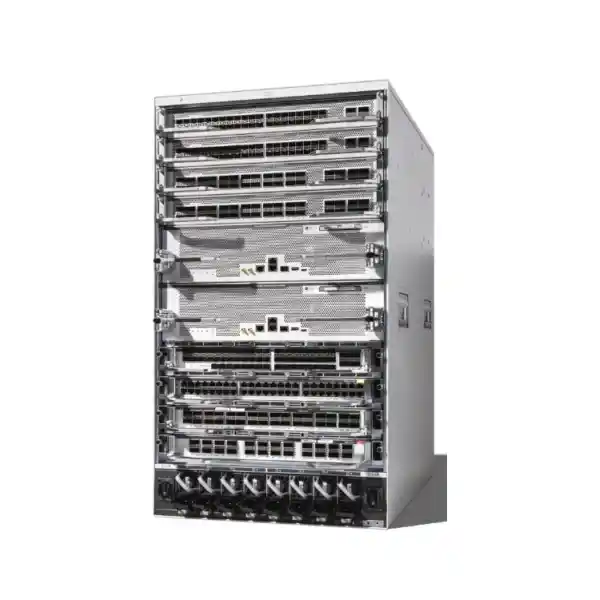
Cisco C9610 Series Smart Switches are designed for organizations that need a highly scalable, resilient and programmable campus core or distribution platform. The family centers on the C9610R 10-slot modular chassis and combines high-density multi-gigabit fiber options, redundant supervision, flexible power designs, advanced Layer 2 and Layer 3 services, and a modern Cisco IOS XE software foundation. Cisco lists switching capacity of up to 51.2 Tbps per chassis and up to 6.4 Tbps per line-card slot, giving network architects room to aggregate large numbers of access switches, high-speed servers, campus buildings and upstream services without forcing an immediate move to a different chassis architecture.
For Tanzanian enterprises, universities, financial institutions, public-sector environments, hospitality groups, healthcare networks and other large multi-building organizations, the most important question is not simply whether the C9610 is powerful. The practical question is how to configure it correctly for the required port speeds, route scale, resilience target, optics, rack space, power feeds, cooling, licensing and migration plan. This page explains those decisions in a buyer-focused way so that a technical team can move from “we need a new core” to a configuration that can be validated before quotation and deployment.
Who should consider the Cisco C9610?
The C9610 is best suited to networks where a fixed-form-factor switch is no longer the ideal answer. A modular chassis is valuable when the core must support different interface speeds, grow in stages, use redundant supervisors, provide multiple power-supply options, or preserve selected investment in existing Cisco Catalyst 9600 line cards. It is especially relevant when the network has become a shared platform for business applications, cloud access, collaboration, large wireless estates, security services, cameras, research traffic, data-heavy workloads or AI-related infrastructure.
Aggregate multiple buildings, access layers and services where 25G, 50G, 100G or 400G links are part of the design roadmap.
Consolidate high-density downstream connectivity while keeping room for larger routing, security and telemetry tables.
Modernize older modular Cisco campus cores while evaluating what existing optics, cabling and Catalyst 9600 line cards can be retained.
Build around redundant supervisors, multiple power supplies and software high-availability mechanisms where planned maintenance and failure recovery matter.
Fast technical profile
| Design area | Cisco C9610 capability | Why it matters |
|---|---|---|
| Chassis | C9610R, 10 slots total: 8 line-card slots and 2 supervisor slots | Supports modular growth, redundancy and mixed interface designs. |
| Switching capacity | Up to 51.2 Tbps per chassis; up to 6.4 Tbps per line-card slot | Creates headroom for high-speed campus aggregation and future uplink growth. |
| Supervisors | C9610-SUP-3 and C9610-SUP-3XL | Lets architects align route, ACL, NetFlow and buffering scale with the deployment. |
| Network interfaces | Line-card options spanning 10/25/50G SFP56, 40/100G QSFP and up to 400G QSFP-DD | Supports mixed-speed transitions rather than a single-speed core design. |
| Power | 8 power-supply bays; 3000W AC, 2000W AC and 2000W DC options; combined, N+1 and N+N modes | Allows the power architecture to be matched to redundancy and facility requirements. |
| Software | Cisco IOS XE with model-driven programmability, telemetry and application hosting | Supports automation and integration with modern operations workflows. |
| Management | On-premises management plus Meraki dashboard functions, with feature availability dependent on software release | Provides a migration path between operational models without changing the chassis hardware. |
Architecture built for a long-lived campus core
A core switch has to survive more than the first installation year. Access-layer speeds rise, Wi-Fi generations increase aggregate demand, application traffic changes, more services move between local and cloud environments, and security policies require more segmentation and inspection. The C9610 addresses this by using a modular architecture in which the chassis, supervisors, line cards, fan trays and power supplies are separable building blocks. That structure makes it possible to design the platform around the current requirement while preserving options for later changes.
The C9610R provides eight line-card slots and two dedicated supervisor slots. Cisco also supports multiple line-card families, including native C9610 cards and selected Catalyst 9600 cards through the C9610-LC-ADPT adapter. That compatibility can be important in a phased migration because it may reduce the need to replace every interface module at the same moment. Compatibility still needs to be checked against the exact card, supervisor and IOS XE release; “Catalyst 9600 compatible” should never be assumed for an arbitrary module.
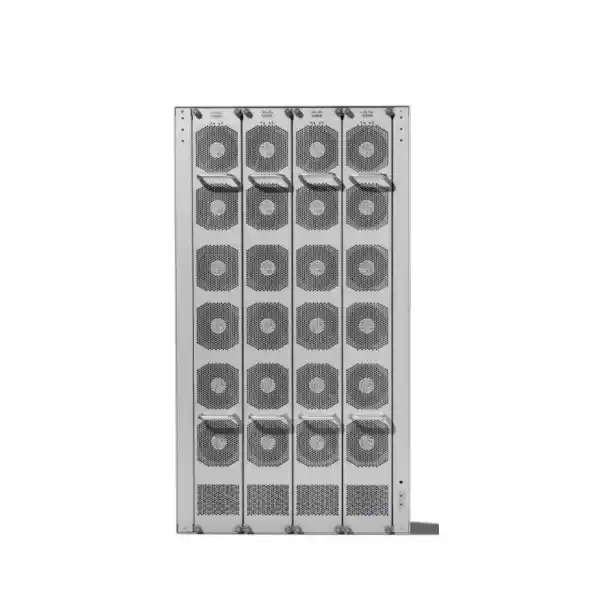
The chassis uses front-to-back airflow, while most removable components are accessible from the front and fan trays are serviced from the rear. The chassis occupies 18 rack units and Cisco lists its dimensions at approximately 79.93 cm high, 44.20 cm wide and 66.29 cm deep. A fully equipped chassis is a substantial infrastructure component, so rack depth, rail compatibility, cable bend radius, front and rear service clearance, floor loading and cooling should be reviewed before purchase rather than after delivery.
Performance and scale: what the numbers mean
Cisco specifies up to 51.2 Tbps of switching capacity for the C9610 platform and up to 6.4 Tbps per line-card slot. Those headline values matter, but a sound design should also consider port mix, forwarding-table scale, buffering, oversubscription objectives and the traffic patterns between buildings, server environments and upstream networks. A campus where many access switches communicate mostly with shared services can place different demands on the core than an environment dominated by east-west flows, large research transfers or distributed application clusters.
Both supervisor options use Cisco Silicon One technology and support high-speed interfaces, but their scaling profiles differ. The C9610-SUP-3 is aimed at medium-to-high-scale distribution use, while the C9610-SUP-3XL is aimed at the highest-scale distribution, core and gateway designs. Cisco lists up to 128,000 MAC addresses for both. For the default core-oriented scale profile, Cisco lists up to 1,000,000 IPv4 routes on SUP-3 and up to 2,000,000 on SUP-3XL, with corresponding IPv6 scale differences. The SUP-3XL also offers larger security ACL, QoS ACL and NetFlow scales in Cisco’s published specifications.
Buffering is another meaningful difference. The standard supervisor provides dedicated low-latency shared-memory buffers, while the 3XL adds high-bandwidth memory designed for deeper packet buffering and expanded scale. This can be relevant where bursts move from faster interfaces toward slower links, where multiple high-speed flows converge, or where the core performs demanding aggregation functions. Deep buffers do not replace good traffic engineering, but they can provide useful headroom in designs with transient congestion.
The correct approach is therefore to size the supervisor against measured or forecast requirements rather than choose the largest option by default. Route counts, segmentation model, access-control policy, telemetry requirements, multicast use, internet or WAN edge functions, expected growth and the operational life of the platform should all be part of the decision.
C9610-SUP-3 or C9610-SUP-3XL?
| Decision point | C9610-SUP-3 | C9610-SUP-3XL |
|---|---|---|
| Typical fit | Medium-to-high-scale distribution | Highest-scale distribution, campus core, edge or gateway |
| Published IPv4 route scale | Up to 1,000,000 | Up to 2,000,000 |
| Published IPv6 route scale | Up to 500,000 | Up to 1,000,000 |
| NetFlow scale | Lower published scale | Higher published scale |
| Buffering | Low-latency shared memory | Low-latency shared memory plus high-bandwidth memory for deeper buffering |
| Best buying question | Is our distribution scale comfortably within the standard tables? | Do we need larger route, policy, telemetry or burst-handling headroom over the platform life? |
Both supervisors support enterprise Layer 2 and Layer 3 functions, IPv4 and IPv6 routing, multicast routing, programmability and out-of-band management. Cisco also lists StackWise Virtual, Stateful Switchover, Software-Defined Access and Flexible NetFlow support, with some capabilities dependent on the software release. For procurement, feature availability should be checked against the exact IOS XE train intended for deployment rather than inferred only from the hardware specification.
Line-card choices from 10G to 400G
The value of a modular core depends heavily on choosing the right line cards. The C9610 family provides native cards for high-density SFP and QSFP connectivity, while selected Catalyst 9600 line cards can be carried forward using the C9610 line-card adapter. The choice should start with the actual fiber plant, transceiver standards and required reach, not only the port count printed on a card.
C9610-LC-32CD
Designed for high-density QSFP connectivity. Cisco describes 30 ports of 100/40GE QSFP28 plus two QSFP-DD ports supporting high-speed 400G-class uplinks. This is a strong fit where the core aggregates many 40G or 100G links or needs a small number of very high-speed upstream connections.
C9610-LC-40YL4CD
Combines 40 multi-rate SFP56 ports for 50/25/10GE with higher-speed QSFP and QSFP-DD uplinks. It suits distribution and core designs that need many SFP-based downstream links plus integrated high-speed uplink capacity.
Catalyst 9600 line-card reuse
Selected cards such as C9600X-LC-32CD, C9600-LC-40YL4CD, C9600X-LC-56YL4C and C9600-LC-48TX are listed by Cisco for use in C9610R with the required adapter. Exact software and optics compatibility still needs validation.
Optics deserve their own bill-of-materials review. A port supporting a given Ethernet speed does not mean every transceiver, breakout cable or distance option is automatically supported. Before ordering, map each link by speed, media type, fiber grade, connector, reach, redundancy path and transceiver part number. This prevents a common core-upgrade problem: the switch chassis arrives correctly specified, but an overlooked optic or legacy fiber constraint delays commissioning.
High availability and service continuity
Core-network reliability is a system design, not a single feature. The C9610R supports two supervisor modules, and Cisco IOS XE provides high-availability mechanisms such as Stateful Switchover and In-Service Software Upgrade capabilities where supported by the selected topology and release. Cisco also lists StackWise Virtual and Graceful Insertion and Removal in the platform’s resilience portfolio. These features can reduce the impact of component failures or maintenance, but they need to be designed, configured and tested as part of an end-to-end resilient architecture.
Power is equally important. The chassis has eight power-supply bays and supports 3000W AC, 2000W AC and 2000W DC power supplies. Cisco documents combined, N+1 and N+N operating modes. Power supplies in redundancy modes have specific requirements, including equal wattage, and Cisco notes particular input-voltage requirements for some configurations. A procurement list should therefore be generated from the chosen line cards, supervisors, optics and redundancy policy instead of assuming a generic PSU count.
For a Tanzanian deployment, the facility plan should include the quality and independence of electrical feeds, UPS runtime, generator behavior where used, grounding, rack power distribution and cooling during utility transitions. These are site-engineering matters rather than switch specifications, but they directly determine whether chassis-level redundancy delivers the intended outcome. A resilient switch connected to a single unprotected electrical path or a single upstream fiber route still creates a business risk.
Security-first switching for the campus core
The C9610 is designed as more than a high-capacity forwarding chassis. Cisco IOS XE includes enterprise security capabilities, access controls and hardware-backed trust mechanisms. Cisco describes Trust Anchor technologies that help establish hardware and software authenticity through mechanisms such as image signing and secure boot. In practical terms, this matters because the core is a privileged point in the network: compromise or misconfiguration there can affect many downstream systems.
The platform supports large access-control tables and integrates with broader Cisco policy and identity architectures. Cisco Identity Services Engine can be used as part of a policy-based access design, while 802.1X support and segmentation features can contribute to controlling which users and devices gain network access. The correct policy architecture depends on the wider environment, so the switch should be assessed together with identity, authentication, network segmentation, logging, monitoring and incident-response requirements.
Cisco also positions the C9610 generation for emerging security capabilities such as post-quantum cryptography and zero-day mitigation through Cisco security technologies. Some of these functions are explicitly identified by Cisco as software-release dependent or future-release capabilities. They should therefore be treated as roadmap or version-specific features until the exact software release, license and deployment mode confirm availability.
For buyers, the most useful security question is not “does the switch have security?” but “which controls are required in our target architecture, and which software, license and external Cisco components enable them?” That approach turns marketing features into an auditable deployment requirement.
Cisco IOS XE, automation and telemetry
Cisco IOS XE gives the C9610 a programmable operational model in addition to traditional command-line management. Cisco documents model-driven interfaces including NETCONF, RESTCONF and YANG, on-box Python scripting, streaming telemetry and support for container-based application hosting. These capabilities are useful when a network team wants repeatable configuration, automated compliance checks, integration with orchestration tools or more granular operational visibility than periodic manual CLI reviews can provide.
Streaming telemetry can continuously export selected operational data to external collectors rather than relying only on polling. This supports faster detection of faults and performance changes when paired with the right monitoring platform. APIs also make it possible to build configuration workflows that are version-controlled and repeatable. Automation does not eliminate the need for change control; it increases the importance of template validation, role-based access, peer review and rollback planning because a bad automated change can be applied very quickly.
Cisco also supports software patching and upgrade mechanisms intended to improve operational resilience. The exact behavior of in-service upgrades, hot patching and feature support can vary by release and configuration. Maintenance procedures should therefore be validated in a lab or staging environment that resembles the production topology, especially when the chassis is carrying critical campus, internet, WAN or data-center connectivity.
Management choices: on-premises, cloud-assisted and hybrid operations
The C9610 is part of Cisco’s move toward a more unified operating model. Cisco Catalyst Center remains an on-premises option for centralized campus management, assurance and automation. Cisco also documents Meraki dashboard functions for the C9610, including inventory and license visibility, guided onboarding and a device-configuration operating mode in which engineers retain IOS XE CLI configuration while using cloud-based monitoring and access functions.
Cisco’s current data sheet distinguishes between device-sourced configuration and full cloud-sourced configuration, with the latter marked as software availability dependent. That distinction matters during procurement. A buyer who specifically requires full Meraki-style cloud provisioning should verify that the required feature is supported in the intended software release rather than assuming the hardware purchase alone guarantees it.
Organizations with regulated or isolated networks may also value the fact that Cisco positions the same hardware for cloud, on-premises or air-gapped deployment approaches. The management architecture should be decided alongside identity, logging, software-update, backup and remote-access policies so that operational convenience does not conflict with security or compliance requirements.
Local application hosting and storage
The C9610 supervisors include x86 processing resources and support removable SATA SSD storage, with Cisco listing capacities up to 960 GB. The storage can be used for functions such as packet captures, operational logs and application hosting. Cisco’s architecture documentation describes the ability to host applications locally on the network device, allowing selected automation, monitoring, integration or service functions to run close to the traffic rather than always depending on an external server.
This is useful for advanced operations teams, but it should be treated as a controlled infrastructure capability. Application support, resource consumption, security hardening, lifecycle ownership and software compatibility need to be defined before placing workloads on a core switch. The core’s primary responsibility remains reliable network forwarding. Local compute should add operational value without creating an unmanaged dependency that makes troubleshooting or upgrades more difficult.
Planning a Cisco C9610 deployment in Tanzania
A successful deployment starts with the environment around the switch. The chassis itself is only one part of the solution. Before quotation, document the existing core topology, current and future port speeds, fiber types, rack dimensions, electrical feeds, cooling capacity, routing scale, redundancy targets, management platform and migration window. This reduces both over-specification and last-minute changes.
Confirm input voltage, PDU capacity, connector types, independent circuits, UPS sizing and generator transition behavior. Match the PSU plan to the selected redundancy mode.
Allow for an 18RU chassis, rail requirements, front-to-back airflow, rear fan access, fiber management and safe service clearance.
Verify every transceiver and cable against distance, fiber grade, connector and Cisco compatibility for the exact line card and software release.
Map upstream routers, firewalls, provider handoffs and diverse physical paths. Do not let a resilient core collapse into a single external circuit.
Choose the management model, telemetry destination, backup process, configuration standard, admin access controls and software-maintenance workflow.
Size the platform for realistic growth and confirm licensing, support and replacement strategy for the period the chassis is expected to remain in service.
Migration from older Cisco modular cores
The C9610 is relevant to organizations moving away from older Cisco Catalyst 6500 or 6800-class campus cores, or from earlier modular platforms whose throughput, software lifecycle or interface density no longer matches business requirements. A migration should begin with dependency discovery. Inventory VLANs, routed interfaces, first-hop redundancy, spanning-tree roles, routing protocols, multicast, ACLs, QoS policies, NetFlow, management addresses, external monitoring, firewall adjacencies, WAN links and any unusual features that have accumulated over years.
Next, separate “must preserve” behavior from “should redesign” behavior. A core replacement is often the best time to simplify old configurations, remove unused VLANs, rationalize routing, modernize uplink speeds and improve resiliency. Copying every historical command to a new platform can preserve technical debt. At the same time, changing too many architectural elements in one maintenance window raises risk. The migration plan should clearly define what changes with the chassis replacement and what will be postponed.
Organizations already using compatible Catalyst 9600 line cards may be able to reuse selected modules through the C9610-LC-ADPT. That can support a phased investment strategy, but compatibility must be checked at part-number level. The adapter changes the mechanical and backplane fit and supports the airflow transition required by the new chassis; it is not a universal compatibility device for every Catalyst line card.
Finally, define a rollback plan. Core migrations affect a large failure domain. Pre-stage configurations, label fibers, validate optics, test redundant paths, document expected routing neighbors and establish measurable acceptance tests. A successful change is not merely “the chassis booted”; it is confirmation that business-critical paths, monitoring, redundancy and management all behave as designed.
Use cases for the C9610 platform
Enterprise campus core
Aggregate multiple access or distribution blocks with high-speed fiber while maintaining redundant control, power and uplink paths.
University or research network
Support large routing tables, dense fiber connectivity and bursts from labs, wireless networks, collaboration platforms and data-intensive services.
Financial or service organization
Build a resilient central switching layer with segmentation, telemetry and controlled maintenance for business-critical applications.
Large hospitality or healthcare campus
Aggregate many wired and wireless access zones while preserving modular expansion for new buildings, services and higher-speed uplinks.
High-scale distribution
Use dense SFP56 line cards to consolidate downstream 10/25/50G connections with integrated 100G or 400G-class uplink options.
Core modernization
Create a migration path from older modular Cisco cores while evaluating the selective reuse of supported Catalyst 9600 line cards.
What to specify before requesting a quote
A C9610 quote is most useful when it describes the intended system rather than only the chassis. At minimum, provide the required downlink and uplink counts by speed, the preferred supervisor scale, redundancy requirement, expected power source, optics and cable distances, rack type, management approach and any existing Catalyst 9600 modules that may be candidates for reuse.
- Port plan: count 10G, 25G, 40G, 50G, 100G, 200G and 400G requirements separately, including spare capacity.
- Supervisor plan: identify whether standard distribution scale is enough or whether the larger SUP-3XL tables and deep buffering are justified.
- Resilience plan: define single or dual supervisors, number of power feeds, PSU mode and diverse uplink paths.
- Optics plan: list fiber type, distance, connector and transceiver requirement for every link class.
- Software and licensing: identify required IOS XE features, management platform and Cisco Networking Subscription requirements.
- Migration plan: document existing chassis, line cards, routing protocols, VLANs, security policies and the target cutover method.
- Facility plan: confirm rack units, depth, airflow, cooling, grounding, input power and UPS capacity.
Buying considerations and limitations
The C9610 is a premium modular infrastructure platform, and it is not automatically the right fit for every network. Smaller sites with modest port counts may be better served by fixed core or aggregation switches. A chassis also requires more rack space, power planning and operational discipline than a compact fixed switch. The business case becomes stronger where modularity, port density, high-speed growth, redundant supervision or long service life justify that infrastructure footprint.
Feature availability is another important limitation to manage. Cisco’s platform literature includes functions that are tied to specific IOS XE releases or marked for future software availability. Buyers should validate the exact required function, software train, license and management mode before making it a design dependency. This is especially important for newly introduced cloud-management and advanced security capabilities.
Transceivers and cabling can materially affect the total project cost. High-speed optics, breakout designs and long-distance fiber links should be specified alongside the chassis and line cards. Reusing existing optics can be economical only when compatibility, wavelength, fiber type and remaining lifecycle are suitable. The same principle applies to reused Catalyst 9600 line cards: compatibility is valuable, but it should be verified rather than assumed.
Finally, support expectations should be documented. Cisco publishes a Limited Lifetime Warranty for the C9610 family, but warranty scope is not the same as a complete operational support contract. Organizations that require defined response, software support, technical assistance or sparing should evaluate the appropriate Cisco support and subscription options for their operating model.
Physical and environmental readiness
Cisco specifies an operating temperature range that reaches 45°C at sea level under the documented conditions, with a lower upper limit at higher altitude. That specification is useful for equipment-room design, but it should not be treated as a target room temperature. A core chassis should operate in a controlled environment with sufficient cooling margin for the switch, optics, adjacent equipment and any loss of cooling capacity. Dust control, airflow direction and unobstructed fan paths are also important because high-density interfaces and power supplies concentrate heat inside the rack.
The physical installation should be planned as carefully as the logical design. Confirm that the selected rack supports the chassis dimensions and mounting kit, that technicians can safely install and remove heavy modules, and that fiber trays do not block service access. Maintain clear labeling for line cards, redundant uplinks, power circuits and patch panels. Good physical documentation reduces restoration time during a fault because engineers can identify the intended redundant path without tracing cables under pressure.
Before the change window, test power redundancy, supervisor failover behavior, routing convergence and monitoring alarms in a controlled sequence. The purpose is to verify the design assumptions that justified the modular platform. A resilient chassis delivers the most value when the surrounding facility, cabling and operating procedures are equally deliberate.
Frequently asked questions
What is the Cisco C9610 Series?
It is Cisco’s modular smart-switch family for high-scale campus core and distribution deployments. The C9610R chassis provides eight line-card slots, two supervisor slots, eight power-supply bays and four fan trays.
How much switching capacity does the C9610 provide?
Cisco lists up to 51.2 Tbps of switching capacity per chassis and up to 6.4 Tbps per line-card slot when configured with the current Supervisor 3 options.
What is the difference between SUP-3 and SUP-3XL?
Both support the platform’s core switching and routing functions, but SUP-3XL is aimed at higher-scale core, edge and gateway environments. Cisco publishes larger route, ACL and NetFlow scales for the 3XL and adds high-bandwidth memory for deeper buffering.
Does the C9610 support 400G?
Yes. Cisco provides C9610 line-card options with QSFP-DD ports capable of 400G-class connectivity. Exact transceiver and speed support should be confirmed for the chosen line card and software release.
Can existing Catalyst 9600 line cards be reused?
Selected Catalyst 9600 and 9600X line cards are supported in the C9610R with the C9610-LC-ADPT adapter. Reuse should be checked by exact part number, transceiver requirements and IOS XE compatibility.
Does the chassis support redundant power?
Yes. The C9610R has eight power-supply bays, and Cisco documents combined, N+1 and N+N power modes. The final PSU count and input-power design depend on the installed modules and chosen redundancy policy.
Can it be managed from the Meraki dashboard?
Cisco documents Meraki dashboard onboarding, monitoring, inventory and license functions for the C9610, including a device-configuration mode. Full cloud-sourced configuration is software-release dependent, so confirm the required management mode before purchase.
Does the C9610 support automation?
Yes. Cisco IOS XE supports model-driven programmability with technologies such as NETCONF, RESTCONF and YANG, along with streaming telemetry, Python scripting and application-hosting capabilities.
What should be checked for a Tanzania installation?
Review the rack and cooling environment, electrical feeds and UPS, fiber plant, optics, redundancy, WAN and internet handoffs, software licensing, management architecture and migration window. Local conditions should be validated at the actual site rather than assumed.
Is there one standard C9610 configuration?
No. The chassis must be built around a supervisor choice, line cards, power supplies, fan trays, optics, licensing and optional storage or accessories. The right bill of materials depends on the port mix, scale, redundancy and lifecycle objectives.
Request a Cisco C9610 configuration review
If you are planning a new campus core, a distribution upgrade or a migration from an older Cisco modular platform, prepare your current topology, required port speeds, expected growth, redundancy target, rack and power details, and any Cisco modules you hope to reuse. A configuration review can then align the C9610R chassis, supervisor, line cards, optics, power supplies and software requirements with the actual deployment instead of relying on a generic bundle.
Ask for a validated bill of materials and quotation for your Tanzania deployment.



Reviews
There are no reviews yet.