
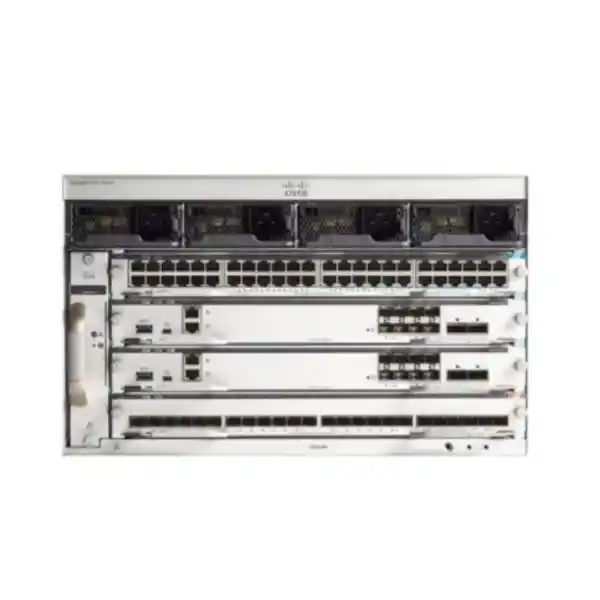
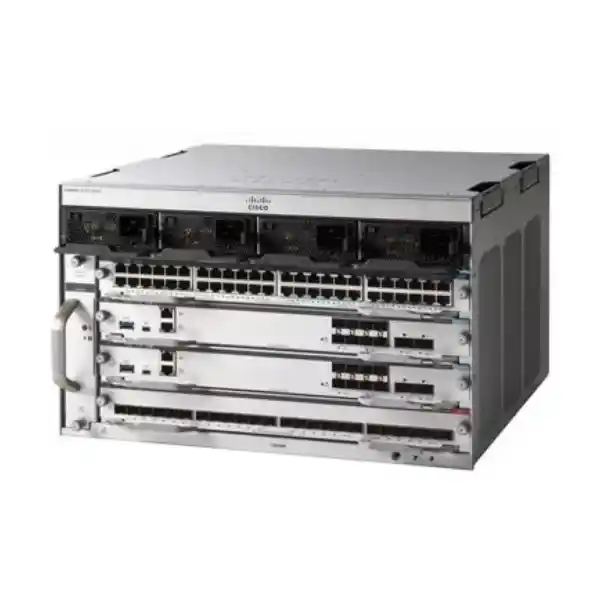
4-slot modular chassis
6RU rack mount
Cisco Catalyst C9404R Network Switch Chassis for Tanzania
The Cisco Catalyst C9404R is a compact modular chassis for organizations that want enterprise-class switching with replaceable supervisor engines, line cards and power supplies instead of a fixed-port access switch. It is particularly relevant when the network must support a mix of user access, Wi-Fi, IP telephony, cameras, building systems or fiber aggregation while retaining a clear path for redundancy and later changes in port type.
Important buying note: C9404R identifies the chassis. A deployable system also requires the correct supervisor engine, line card or line cards, power supplies, software licensing and any required optics or cables. A quote should therefore be built around the intended design rather than treating the chassis part number as a complete populated switch.
Two slots are dedicated to supervisor engines and two to line cards.
Using two compatible 48-port line cards, subject to line-card choice and software support.
Available with C9400X-SUP-2XL; other supervisors provide different slot bandwidth.
Supports resilient power designs using compatible Catalyst 9400 power supplies.
For standard 19-inch rack deployments; chassis with fan tray weighs about 17.2 kg.
Who the C9404R is designed for
The C9404R suits buyers who need modularity but do not need the physical scale of the larger C9407R or C9410R chassis. Its two line-card slots make it a practical platform for a building, headquarters floor, campus block, branch hub or distribution point where the network design benefits from supervisor redundancy and replaceable interface modules. Because the platform can be configured with copper, multigigabit, PoE-capable or fiber interfaces, it can support very different traffic profiles without changing the chassis family.
For Tanzania projects, the most useful way to assess the C9404R is not simply by counting ports. Network designers should start with the required endpoint mix, uplink capacity, power budget, equipment-room conditions and resilience target. A 96-port office access design using 1G PoE+ ports has a different bill of materials from a Wi-Fi 6/6E access design requiring multigigabit and high-power PoE, or from a fiber-heavy distribution design using SFP, SFP+, SFP28 or QSFP interfaces. The same chassis can participate in all of these designs, but the correct supervisor and line cards must be selected.
The chassis is therefore most valuable when an organization wants a platform that can be engineered around its actual requirements. It is less suitable when the requirement is a small fixed number of ports, no need for modular expansion, and no business case for redundant supervisors or modular power. In those cases, a fixed-port Catalyst switch may be simpler to procure, install and operate.
C9404R chassis architecture: what each slot does
Cisco assigns specific roles to the four slots. Slots 2 and 3 are reserved for supervisor engines, while slots 1 and 4 are reserved for line cards. A line card cannot be installed in a supervisor slot. The platform supports one supervisor for a nonredundant control plane or two matching supervisors for 1+1 supervisor redundancy. When two supervisors are installed for high availability, Cisco requires the same supervisor model rather than a mixed pair.
| Slot | Role | Typical decision | Buying implication |
|---|---|---|---|
| 1 | Line card | Copper, PoE, multigigabit or fiber access/aggregation | Choose interface type, port speed and power requirements. |
| 2 | Supervisor | Primary or redundant supervisor position | Supervisor choice sets slot bandwidth, uplink capability and feature support. |
| 3 | Supervisor | Second supervisor for 1+1 resiliency or alternate single-supervisor position | Use the same supervisor type when building a redundant pair. |
| 4 | Line card | Second access or aggregation module | Can match or complement slot 1 depending on the approved combination. |
This layout is one reason the C9404R is easier to size than larger modular chassis: there are only two line-card positions, so the maximum front-panel port density can be calculated directly from the chosen modules. Two 48-port access cards provide up to 96 front-panel ports. Two 24-port fiber cards provide up to 48 ports. High-speed 25G, 40G or 100G options have different port counts and supervisor dependencies, so the exact design should be validated against the current Cisco line-card support matrix.
Supervisor choice: the key performance decision
The chassis does not determine forwarding capacity by itself. The supervisor engine is central to system bandwidth, uplink options, supported software releases and several advanced capabilities. Cisco currently lists C9400-SUP-1, C9400-SUP-1XL, C9400-SUP-1XL-Y, C9400X-SUP-2 and C9400X-SUP-2XL as supported supervisor families for C9404R, subject to the required Cisco IOS XE release and compatible line-card combination.
| Supervisor family | C9404R bandwidth per line-card slot | Design guidance |
|---|---|---|
| C9400-SUP-1 | 80 Gbps | Suitable where legacy 1G access and modest aggregation needs align with its capabilities. |
| C9400-SUP-1XL | 240 Gbps | Higher slot bandwidth for denser or faster access designs. |
| C9400-SUP-1XL-Y | 240 Gbps | Adds a different uplink profile; validate exact uplink and software requirements. |
| C9400X-SUP-2 | 240 Gbps | Newer supervisor generation supporting current high-speed platform options. |
| C9400X-SUP-2XL | 480 Gbps | Maximum documented bandwidth per C9404R line-card slot and the strongest fit for high-throughput designs. |
A common procurement mistake is selecting line cards first and treating the supervisor as a generic controller. For the Catalyst 9400 platform, the correct sequence is to define required port speeds and uplinks, estimate aggregate traffic, identify resilience and software features, and then select a supervisor that supports those requirements. Some line cards and high-speed interface modes require the SUP-2 or SUP-2XL generation, so compatibility must be checked before the bill of materials is finalized.
If the project requires redundant supervisors, budget for two matching units and confirm the intended software release supports the complete module combination. If the project accepts a single supervisor, document the operational impact of supervisor maintenance or failure. High availability is not created by the chassis alone; it comes from the complete hardware, software, power and network design.
Line-card options: build the port mix around the endpoints
C9404R supports a broad Catalyst 9400 line-card family. This allows a chassis to be configured for standard Gigabit Ethernet user access, high-power device access, multigigabit wireless access, fiber access or high-speed aggregation. The correct card is determined by port medium, speed, PoE requirement, uplink design and supervisor compatibility rather than by chassis model alone.
1G copper data
Cards such as C9400-LC-48T provide 48 ports of 10/100/1000 Ethernet without PoE. Two 48-port cards can provide 96 data ports in C9404R.
PoE+, UPOE and UPOE+
PoE-capable cards support devices such as IP phones, wireless access points, cameras and other powered endpoints. Available power per port and total chassis PoE budget depend on the exact card and power-supply design.
Multigigabit copper
C9400 multigigabit options can support 2.5G, 5G and, on selected cards, 10GBASE-T. These are relevant where wireless access points or other edge devices need more than 1 Gbps over copper.
1G and 10G fiber
SFP and SFP+ line cards allow fiber-heavy access, building interconnects or aggregation designs. Examples include 24-port and 48-port 1G/10G line-card families.
25G, 40G and 100G
Selected high-speed line cards provide SFP28 or QSFP-based interfaces. Cisco documents SUP-2/SUP-2XL dependencies for these high-speed options, so supervisor selection must be validated together with the card.
Mixed role design
Because C9404R has two line-card slots, one card can serve user or powered-device access while the second card serves fiber aggregation, provided the combination is supported and fits the performance plan.
Port-count figures should always be tied to a specific card. “Up to 96 ports” is a chassis maximum for suitable 48-port modules, not a statement that every C9404R configuration contains 96 ports. Likewise, “up to 100G” refers to supported high-speed module options in appropriate configurations; the bare chassis has no fixed front-panel access ports. For a reliable quotation, specify endpoint quantity, copper versus fiber, required speed, PoE class, optic type, connector, cable distance and expected growth.
PoE planning: calculate watts, not only ports
Cisco documents integrated PoE capability for the Catalyst 9400 platform and lists up to 4320 W of maximum PoE per slot for current shipping line-card configurations, while noting that the chassis architecture is capable of approximately 4800 W per slot. Those figures are platform ceilings, not a promise that every C9404R build will deliver that power. Actual available PoE depends on the installed line card, the number and rating of power supplies, selected power mode, system consumption, redundancy reserve, cabling and endpoint demand.
A Tanzania office or campus design may include IP phones, Wi-Fi access points, surveillance cameras, access-control devices and other powered equipment. The practical method is to build an endpoint power schedule: list each powered device, its required PoE standard or maximum draw, quantity, planned port allocation and growth allowance. Then calculate the required switch PoE budget and choose power supplies with the desired redundancy margin.
Do not size power purely on average consumption if the business requires all endpoints to remain powered during a failed power-supply condition. A resilient design should be checked under the intended redundancy mode and under worst-case endpoint draw. UPS capacity, upstream electrical circuits and generator or backup-power policy should also be evaluated as part of the site design; the chassis cannot protect powered services if the rack itself loses upstream power.
Power supplies and redundancy modes
C9404R provides four power-supply bays. Cisco lists compatible 2100 W AC, 3200 W AC and 3200 W DC power-supply options in the Catalyst 9400 documentation, with specific models and software requirements depending on the supply generation. The platform supports N+N, N+1 and combined power modes. The correct mode determines how much installed capacity is reserved for resilience and how much can be used by the system and PoE load.
| Mode | Purpose | What to verify |
|---|---|---|
| N+N | Uses independent power groups to tolerate loss of a corresponding feed or group. | Separate circuits, feed design, supply count and remaining power after failure. |
| N+1 | Provides one additional supply beyond the active requirement. | Whether a single supply failure still leaves adequate system and PoE capacity. |
| Combined | Pools power to maximize usable capacity. | Lower reserve for failure scenarios compared with a deliberately redundant design. |
When requesting a quote, provide the input-power environment and redundancy objective. If the site requires dual independent feeds, that should be stated explicitly. If the deployment uses DC power, the exact DC supply and site electrical design need separate validation. Power cords, plug types, upstream breaker ratings and UPS interfaces should be confirmed for the installation rather than assumed from the chassis part number.
High availability: design beyond a single component
The C9404R supports redundant supervisor engines, which is a major reason to choose a modular chassis over many fixed-port alternatives. However, true service resilience depends on more than installing a second supervisor. The design should consider supervisor redundancy, power-supply redundancy, upstream path redundancy, physical uplink diversity, routing or switching convergence, software maintenance strategy and the failure domain of downstream endpoints.
Cisco Catalyst 9400 platforms support advanced high-availability functions and can participate in designs such as StackWise Virtual, but the exact feature set depends on supervisor generation, Cisco IOS XE release and software licensing. Treat these as system-design features that must be verified for the proposed bill of materials, not automatic capabilities of the empty chassis.
For critical environments, ask the network designer to document what should happen when one supervisor fails, one power supply fails, one upstream fiber path is cut, one upstream switch is unavailable, or a planned software upgrade is performed. This makes the resilience requirement measurable and prevents a “redundant” chassis from still having a single external point of failure.
Software and licensing considerations
Catalyst 9400 runs Cisco IOS XE, and software support varies by supervisor and line card. Cisco documents minimum releases for each major hardware option; for example, the C9400X-SUP-2 and C9400X-SUP-2XL require later IOS XE releases than the original SUP-1 generation. The required release should be checked against every installed module and every feature required by the project.
Cisco licensing models evolve, so licensing should be confirmed at quotation time using current Cisco ordering guidance. Current Cisco documentation for the Catalyst 9400 family lists Network Advantage as the base license and DNA Advantage as the add-on license under the stated licensing model. Features can be tied to the software license level, so a hardware-only quote is not enough for an enterprise deployment that depends on advanced capabilities.
Before purchase, identify which features are operationally required: advanced routing, segmentation, automation, telemetry, virtual switching, security functions or controller integration. Map those requirements to the current Cisco license and software release rather than buying a subscription simply because it appears in a bundle. Smart Account requirements and entitlement handling should also be reviewed as part of the procurement process.
Where an organization already standardizes on Cisco Catalyst 9000, the C9404R can fit into the same IOS XE operational model, but configuration standards, image management and monitoring still need to be planned. Software maintenance should be treated as an ongoing lifecycle activity rather than a one-time commissioning task.
Security capabilities: select and license the features you intend to use
The Catalyst 9400 family includes hardware and software capabilities designed for secure enterprise networking. Cisco documents functions such as MACsec on supported modules and supervisor-dependent security features across the platform. Newer supervisor engines add capabilities that are not identical to earlier generations. Security should therefore be evaluated as a combination of chassis, supervisor, line card, software release, license and network architecture.
For access-layer deployments, practical security requirements often include authenticated access, segmentation, protected management, secure software lifecycle practices and visibility into connected devices. For distribution roles, organizations may also need secure uplinks, route controls and resilient policy enforcement. The C9404R can provide a strong hardware foundation, but these controls are not achieved merely by installing the chassis.
During solution design, document required security outcomes and verify each against current Cisco feature documentation for the chosen supervisor and IOS XE release. Avoid assuming that every feature described for the broader Catalyst 9400 family applies to every C9404R configuration.
Physical installation and equipment-room planning
The C9404R chassis is 6RU high and measures approximately 26.53 cm high by 43.94 cm wide by 41.40 cm deep. Cisco lists chassis weight with the fan tray at about 17.2 kg. It is designed for a standard 19-inch rack and uses side-to-side chassis airflow. The selected power supplies, installed line cards, supervisors, optics and cabling add weight and affect service access, so rack loading should be calculated for the finished configuration rather than the empty chassis only.
Cisco specifies normal operation from -5°C to +45°C up to 1800 m altitude, and -5°C to +40°C up to 3000 m, with separate short-term exceptional limits. These published limits do not remove the need for proper equipment-room cooling. In warm environments, the target should be stable operating conditions with unobstructed airflow, clean intake paths and sufficient cooling capacity for the entire rack. Local dust, heat load, power quality and room ventilation should be considered during site survey.
Allow practical service space for front access to removable components and cable management. Plan fiber bend radius, copper patching, power-cord routing and labeling so that replacing a supervisor, line card or power supply does not require disturbing unrelated connections. If redundant uplinks are used, route them through physically diverse paths where the building design allows.
Before installation, verify rack depth, vertical space, grounding, power circuits, UPS capacity and the direction of airflow for adjacent equipment. A modular chassis often becomes a long-lived part of the network, so good physical planning reduces maintenance risk across future line-card and supervisor changes.
Common deployment scenarios
Enterprise access
Two 48-port copper line cards can create a high-density access platform for users, phones and other Ethernet devices. Add PoE-capable cards when endpoints require power.
Wireless access aggregation
Multigigabit line cards can support access points that exceed 1G Ethernet. High-power PoE options may be needed for newer radios, so both data rate and watts per port must be sized.
Converged building network
A PoE design can consolidate phones, cameras and building-connected devices onto a common access platform, provided segmentation, power reserve and security policy are engineered correctly.
Fiber distribution
SFP, SFP+ and high-speed fiber cards can support building aggregation, distribution or fiber-to-the-desk architectures where copper access is not the primary requirement.
Compact resilient core/distribution role
Where port scale fits two line-card slots, redundant supervisors and resilient power can make C9404R useful for a compact distribution role. Routing and virtual-switching requirements must be matched to licensing and supervisor capability.
Growth within a defined footprint
A buyer can populate one line-card slot initially and retain the second for later expansion, provided the initial supervisor and power design anticipates the future card and bandwidth requirement.
C9404R vs C9407R vs C9410R
All three chassis belong to the Catalyst 9400 modular family, but they target different port-density requirements. C9404R is the most compact chassis and provides two line-card slots. C9407R provides five line-card slots, while C9410R provides eight. The larger chassis may be a better fit when the project needs more physical interface capacity in one system, while C9404R can be preferable where rack space and the required port count align with its smaller footprint.
| Feature | C9404R | C9407R | C9410R |
|---|---|---|---|
| Total slots | 4 | 7 | 10 |
| Line-card slots | 2 | 5 | 8 |
| Supervisor slots | 2 | 2 | 2 |
| Maximum 48-port line-card density | Up to 96 ports | Up to 240 ports | Up to 384 ports |
| Rack height | 6RU | 10RU | 13RU |
| Power-supply bays | 4 | 8 | 8 |
The choice should not be based on current port count alone. Consider expected growth, redundancy strategy, uplink concentration, rack space, power availability and whether a future second access block would be better served by another chassis. In some networks, two smaller chassis can create better fault-domain separation than one very large chassis; in others, a larger chassis simplifies aggregation. The right answer depends on network topology and operational priorities.
A practical configuration workflow for Tanzanian projects
Separate users, phones, access points, cameras, servers, fiber links and other device classes.
Identify 1G, multigigabit, 10G, 25G, 40G or 100G needs and copper versus fiber media.
Record power standard and maximum draw for every powered endpoint, including growth.
Estimate aggregate traffic and redundancy paths to avoid oversizing access ports but undersizing uplinks.
Match slot bandwidth, uplink capability, software version and feature requirements.
Confirm each required card is supported with the chosen supervisor and software release.
Select supply quantity and redundancy mode based on system load, PoE and failure policy.
Map required features to the current Cisco license model and entitlement process.
Specify transceivers, fiber type, patch cords, copper category and link distance.
Confirm 6RU space, rack depth, airflow, cooling, grounding, UPS and electrical circuits.
Following this sequence reduces the risk of receiving a chassis that cannot meet the intended port, power or software requirement. It also makes vendor quotations easier to compare because every supplier is responding to the same documented bill of materials and design assumptions.
What should be included in a C9404R quotation?
A complete quote should clearly separate the chassis from all components required to make it operational. Ask for line-item visibility rather than a vague “Catalyst 9400 switch” description. This is especially important when comparing alternatives, because two C9404R quotations can differ significantly in performance and capability even though both use the same chassis part number.
- C9404R chassis and any included rack-mount or cable-management hardware.
- One or two supervisor engines, with exact part numbers and redundancy design.
- Line cards, including exact port type, speed and PoE capability.
- Power supplies, supply count, AC or DC type and intended redundancy mode.
- Power cords appropriate to the installation and electrical design.
- Optical transceivers, DACs or other uplink media where required.
- Cisco IOS XE software and current license/subscription components needed for the required feature set.
- Support coverage if requested, with provider, duration and service level clearly stated.
- Any installation, configuration, migration, testing or documentation services included in the scope.
Availability, lead time, price, warranty terms and support eligibility should be confirmed for the exact quoted configuration. They should not be inferred from the C9404R model name or from a listing for a different country or reseller.
Key limitations and decisions to understand before purchase
The chassis is not a fixed-port switch. Without a supervisor, line card and power supply, the C9404R is not a complete production system. Product pages that describe it simply as a 96-port or 100G switch can be misleading unless they identify the required modules.
Maximum figures are configuration-dependent. Up to 96 ports assumes suitable 48-port cards. Up to 480 Gbps per line-card slot requires C9400X-SUP-2XL. High PoE budgets require compatible PoE line cards and sufficient power supplies. High-speed 25G/40G/100G line cards have supervisor requirements.
One fan-tray bay is provided. The Catalyst 9404R hardware documentation lists one fan-tray assembly. The broader platform provides replaceable cooling components, but the buyer should understand the specific cooling architecture and maintenance procedure for this chassis rather than assuming multiple independent fan trays.
Software compatibility matters. Newer supervisors and line cards have minimum IOS XE release requirements. An old standardized image may not support newly selected hardware, while a newer image can introduce its own operational validation requirements.
Modularity adds planning responsibility. The advantage of choosing ports, power and supervisors independently also means the bill of materials must be engineered carefully. For buyers without in-house switching expertise, configuration validation before purchase is more valuable than selecting parts based only on headline specifications.
Technical specifications summary
| Product | Cisco Catalyst 9400 Series 4-slot chassis |
|---|---|
| Manufacturer part number | C9404R |
| Total chassis slots | 4 |
| Line-card slots | 2, slots 1 and 4 |
| Supervisor slots | 2, slots 2 and 3; supports 1+1 supervisor redundancy |
| Maximum front-panel density | Up to 96 ports with compatible 48-port line cards |
| Maximum documented line-card slot bandwidth | Up to 480 Gbps per slot with C9400X-SUP-2XL |
| Power-supply bays | 4 |
| Supported power categories | Cisco documents 2100W AC, 3200W AC and 3200W DC options for the platform; validate exact supply model and software support. |
| Rack height | 6RU |
| Dimensions (H × W × D) | 26.53 × 43.94 × 41.40 cm |
| Chassis weight | Approximately 17.2 kg with fan tray |
| Mounting | Standard 19-inch rack compatible |
| Chassis airflow | Side-to-side |
| Normal operating environment | -5°C to +45°C up to 1800 m; -5°C to +40°C up to 3000 m, per Cisco chassis specifications |
Frequently asked questions
Is the Cisco C9404R a complete switch?
C9404R is the four-slot chassis. It needs a compatible supervisor engine, one or more line cards, power supplies and the appropriate software/licensing to become an operational switch. Optics and cables may also be required depending on the design.
How many ports can C9404R support?
The chassis has two line-card slots. With two compatible 48-port cards, it can provide up to 96 front-panel access ports. Other line cards have different port counts, so actual density depends on the installed modules.
Does C9404R support redundant supervisors?
Yes. Slots 2 and 3 are dedicated supervisor positions and the chassis supports 1+1 supervisor redundancy. Cisco requires matching supervisor types in a redundant pair.
What is the maximum bandwidth per line-card slot?
Cisco documents up to 480 Gbps per line-card slot for C9404R when it is used with C9400X-SUP-2XL. Other supervisor engines provide lower per-slot bandwidth, including 80 Gbps or 240 Gbps depending on model.
Can C9404R provide PoE?
Yes, when compatible PoE-capable line cards and sufficient power supplies are installed. PoE+, UPOE and UPOE+ options exist in the Catalyst 9400 line-card family. The available power budget must be calculated for the exact build.
Can it support Wi-Fi 6 or Wi-Fi 6E access points?
The platform offers multigigabit line cards and high-power PoE options that can suit high-performance wireless access designs. The access point’s Ethernet speed and PoE requirement should be matched to the exact line card and power budget.
Does C9404R support 10G, 25G, 40G or 100G interfaces?
The Catalyst 9400 line-card family includes 10G SFP+, 25G SFP28 and 40G/100G QSFP options. Higher-speed cards have specific supervisor and software dependencies, so support must be validated for the intended combination.
Which supervisor should I choose?
Choose based on required slot bandwidth, uplinks, line-card compatibility, software features and expected lifetime of the design. C9400X-SUP-2XL provides the highest documented C9404R slot bandwidth, but a lower-tier supervisor may be sufficient for a simpler access design.
How many power supplies fit in C9404R?
The chassis provides four power-supply bays. The number and rating of installed supplies should be selected for system load, PoE demand and the chosen redundancy mode.
What rack space is required?
C9404R requires 6RU and is designed for a standard 19-inch rack. Allow additional rack planning for patch panels, cable management, UPS equipment and the airflow needs of adjacent devices.
Is C9404R suitable for a core switch?
It can be used in certain compact core or distribution designs when the port scale, routing requirements, supervisor capabilities and resilience model fit the project. It should not automatically be classified as a core solution without assessing the complete network architecture.
Is StackWise Virtual available?
The Catalyst 9400 family supports StackWise Virtual in supported hardware, software and licensing combinations. Verify the exact supervisor, IOS XE release and license requirements for the proposed design before making it a project dependency.
What licensing is required?
Licensing depends on current Cisco policy and the features required. Current Cisco guidance lists Network Advantage as the base license and DNA Advantage as the add-on for Catalyst 9400 under the stated model. Confirm the current ordering structure at quotation time.
Can I start with one line card and add another later?
Yes, that is a common benefit of a modular chassis. Plan the original supervisor, software, power and uplinks so the intended future card can be added without creating a performance or power constraint.
What information should I provide for a quote in Tanzania?
Provide port count, required copper and fiber speeds, PoE device quantities and wattage, uplink speeds, redundancy requirement, software features, rack and power environment, optical distances and any support or installation scope. This enables a complete bill of materials instead of a chassis-only price.
Request a correctly configured C9404R quotation
For an accurate Cisco Catalyst C9404R proposal, share the required port count, interface speeds, PoE endpoints, uplink design, redundancy target and software features. The quotation should then specify the chassis, supervisor engine or engines, line cards, power supplies, optics, licenses and support as separate validated components.
If you are replacing an existing switch, include the current port utilization, uplink topology and powered-device inventory. If you are designing a new network, include expected growth and resilience requirements. This makes it possible to determine whether C9404R is the right chassis size or whether another Catalyst platform would provide a better fit.


Reviews
There are no reviews yet.