
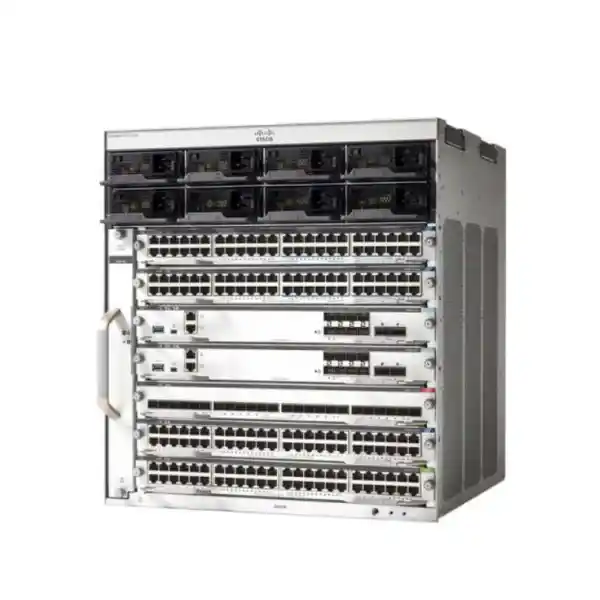
Cisco Catalyst C9407R Network Switch
The Cisco Catalyst C9407R is a modular seven-slot chassis designed for enterprise campus networks that need more scale and service continuity than a typical fixed-configuration access switch. It is especially relevant when a network team wants to consolidate many wired users, wireless access points, IP phones, cameras, building systems, or other Ethernet endpoints into a resilient switching platform while retaining the ability to change interface types as requirements evolve. Instead of buying a single appliance with a fixed port count, the C9407R is built as a configurable system: the chassis, supervisor engine, line cards, power supplies, software licensing, optics, and accessories are selected to match the intended design.
Buying guidance: treat the C9407R as the foundation of a switching solution, not as a fully populated switch. Before requesting a quote, define current and future port counts, copper versus fibre requirements, PoE class and wattage, uplink speeds, supervisor performance, power redundancy, software capabilities, rack space, cooling, and the resilience expected during maintenance or failure.
Who the C9407R is for
The strongest fit is an organisation that expects a high concentration of campus endpoints and wants modularity without moving to the physically larger ten-slot C9410R chassis. The five line-card slots create a useful middle ground: more expansion than the two-line-card C9404R, while keeping the chassis at 10RU. Typical environments include headquarters buildings, higher-education campuses, hospitals, hotels, government facilities, large offices, manufacturing sites, mixed-use commercial buildings, and other locations where network access must serve many device classes and where maintenance windows are difficult to schedule.
A modular platform can also make sense when endpoint technologies are changing. One area may require conventional 1G copper, another may need multigigabit access for modern Wi-Fi access points, and another may need fibre. The C9407R can accommodate different supported line-card families in one chassis, subject to supervisor and software compatibility. That flexibility can reduce the need to replace an entire switch when the desired interface mix changes, but it also makes accurate design important because not every line card, supervisor, software release, or feature combination is interchangeable.
For a small branch, a compact office with modest port growth, or a deployment that does not need chassis-level redundancy, a fixed-port Catalyst switch may be simpler and more economical. The C9407R is most compelling when modular scale, higher availability, dense PoE, interface diversity, or long-term expansion is part of the requirement.
Chassis architecture and slot layout
The C9407R contains seven front-facing module positions. Slots 3 and 4 are dedicated to supervisor engines, while line cards occupy slots 1, 2, 5, 6, and 7. A deployment can operate with a single supported supervisor or use two compatible supervisors for control-plane redundancy. Because the two supervisor positions are reserved, they cannot be repurposed as extra line-card slots. The practical line-card capacity is therefore five modules, which is the basis for the platform’s maximum access-port density.
Cisco documents the chassis with eight power-supply bays and one fan-tray bay. The platform uses side-to-side airflow and is designed for a standard 19-inch rack. The chassis dimensions are approximately 44.22 cm high, 43.94 cm wide, and 41.40 cm deep, and the bare chassis with fan tray is about 28.58 kg. Those measurements should be considered before installation because a fully configured system also adds the weight and cabling of supervisor engines, line cards, power supplies, transceivers, patch leads, and cable-management hardware.
For an equipment-room design in Tanzania, verify usable rack depth, rail and mounting arrangements, front and side clearances, airflow direction, cable pathways, earthing, UPS capacity, circuit loading, generator strategy where relevant, and the operating conditions of the room. The chassis specification is only one part of the deployment: reliable switching depends on the complete physical environment, particularly power continuity, cooling, and clean cable management.
Key C9407R specifications at a glance
| Design item | C9407R capability | Why it matters |
|---|---|---|
| Chassis size | 10RU | Plan rack capacity before ordering. |
| Total slots | 7 | Two are reserved for supervisors and five for line cards. |
| Supervisor redundancy | Supported | Allows resilient control-plane design with compatible supervisor modules. |
| Maximum access-port density | Up to 240 ports | Actual count depends on installed line cards and interface types. |
| Power-supply bays | 8 | Supports power-capacity and redundancy planning. |
| Supported PSU classes | 3200W AC, 2100W AC, 3200W DC | Final quantity and mode depend on chassis load and resilience requirements. |
| Per-slot bandwidth | Up to 480 Gbps with Supervisor 2XL | Supervisor choice directly affects available line-card bandwidth. |
These are chassis-level figures. They should not be interpreted as a promise that every interface, PoE level, uplink speed, or feature can be used simultaneously in every configuration. Supervisor model, line-card type, software release, licensing, power budget, and transceiver compatibility determine the capabilities of the finished system.
Supervisor engines: choose performance and lifecycle together
The supervisor engine is central to the C9407R design because it provides the control plane, forwarding resources, uplink capabilities, and the bandwidth available to the line-card slots. Cisco currently documents support across multiple Catalyst 9400 supervisor generations. For the C9407R, the C9400X-SUP-2 delivers up to 240 Gbps per line-card slot, while the C9400X-SUP-2XL can provide up to 480 Gbps per line-card slot. Older Supervisor 1 family modules have lower per-slot bandwidth in this chassis and also require careful lifecycle review.
Cisco announced end-of-sale for the original C9400-SUP-1 hardware, with the last order date having passed in 2025. That does not mean every Supervisor 1-family network must immediately be replaced, and it does not make the C9407R chassis itself obsolete. It does mean a new design should evaluate current supervisor options, software support, feature needs, and expected service life rather than copying an older bill of materials. Existing installations should also compare their specific supervisor part numbers and software trains with Cisco’s current lifecycle and support documentation before an expansion.
Supervisor selection should be tied to the installed line cards. A high-speed line card cannot deliver its intended architecture if the supervisor or chassis bandwidth becomes the limiting factor. For greenfield deployments with multigigabit access, high-density fibre, or faster distribution uplinks, it is sensible to size the supervisor first and then confirm every line card against that choice.
Line cards and port-density options
The C9407R’s main value is its ability to use different Catalyst 9400 line cards to build an access or distribution platform around the interfaces the site actually needs. Cisco lists 48-port copper cards for conventional Gigabit Ethernet, PoE+, Cisco UPOE, UPOE+, and multigigabit access, as well as fibre-oriented cards for 1G, 10G, 25G, 40G, and 100G connectivity in supported combinations. Five 48-port access cards produce the well-known maximum of 240 front-panel access ports, but not every high-speed fibre card has 48 ports, so the maximum port number changes with the selected modules.
For modern wireless access, multigigabit copper can be valuable because an advanced access point may need more than 1 Gbps while still relying on copper cabling and inline power. For user desks and standard IP phones, large numbers of 1G copper ports may remain appropriate. Fibre cards can serve aggregation, building interconnects, server connectivity, or access scenarios where distance, electromagnetic conditions, or existing fibre infrastructure make optical interfaces preferable.
Do not select line cards only by headline port speed. Confirm connector type, supported optics, cable category, PoE capability, required supervisor generation, oversubscription considerations, software support, and whether the card is still current for new procurement. Cisco has issued lifecycle notices for some Catalyst 9400 components over time, so a present-day bill of materials should be checked component by component rather than assuming that every historically supported module remains orderable.
PoE, UPOE and power-budget planning
A major use case for a modular campus switch is powering connected devices directly over Ethernet. Depending on the chosen line cards, Catalyst 9400 can support PoE+, Cisco UPOE, and UPOE+/IEEE 802.3bt-class power for suitable endpoints. This can reduce the number of local power adapters and can centralise backup-power planning for wireless access points, IP phones, cameras, access-control devices, sensors, and other compatible equipment. However, high-density PoE design must be based on watts as well as ports.
Cisco specifies a chassis capability of up to 4320W PoE per line-card slot for currently shipping line-card designs, with the chassis itself architected for approximately 4800W per slot. The available PoE budget in a real deployment is determined by the number and type of power supplies, redundancy mode, supervisor and line-card consumption, and the endpoint demand. A 240-port configuration in which most devices draw only modest power is a very different electrical design from a configuration attempting high-power IEEE 802.3bt delivery across many ports.
For Tanzania deployments, power design should include the upstream electrical environment. Confirm supply voltage and circuits at the installation site, UPS output capacity, generator transfer behaviour where used, earthing, surge protection strategy, and whether redundant feeds actually originate from independent sources. Installing multiple power supplies does not automatically create end-to-end power resilience if every PSU is connected to the same unprotected circuit.
When requesting a quote, provide either the expected endpoint model list or at least a count by device class and maximum PoE requirement. That allows the network and electrical budgets to be designed together and helps avoid discovering after installation that the chassis has enough data ports but insufficient available inline power for the connected devices.
High availability inside the chassis
The C9407R supports two dedicated supervisor-engine slots so a network can be built with supervisor redundancy rather than relying on a single control-plane module. In a properly designed redundant configuration, the platform can use stateful switchover capabilities to reduce disruption when control transfers between compatible supervisors. This is useful for campus environments where a switch outage can affect many floors, departments, classrooms, wards, cameras, wireless access points, or voice endpoints at once.
Redundancy must be considered as a system property. Two supervisor modules address one class of failure, but resilient service may also require redundant power supplies, independent electrical feeds, diverse uplinks, EtherChannel design, redundant upstream devices, appropriate routing, and tested operational procedures. A single chassis can still represent one physical failure domain, so organisations with stricter availability requirements may use a pair of chassis rather than depending entirely on internal redundancy.
Maintenance strategy is equally important. A design should consider software upgrade methods, supervisor compatibility, change windows, backup configuration, recovery procedures, and what traffic behaviour is acceptable during planned or unplanned events. The purpose of high availability is not simply to purchase duplicate hardware; it is to create predictable behaviour when a component or path fails.
StackWise Virtual for a two-chassis design
Cisco StackWise Virtual can combine two supported Catalyst 9400 chassis into a logical switching system for designs that need chassis-level resiliency and simplified multi-chassis operation. In this architecture, the pair uses a StackWise Virtual Link and dual-active detection mechanisms, while stateful switchover synchronises relevant control-plane state between the active and standby members. Multi-Chassis EtherChannel can then provide downstream or upstream links across both physical chassis while presenting a logical bundled connection to connected devices.
This design can reduce the impact of a single chassis failure and allows forwarding to remain distributed across the two members. Cisco also supports Nonstop Forwarding with SSO for compatible routing scenarios to minimise network disruption during a control-plane switchover. Nevertheless, StackWise Virtual is not a checkbox that should be enabled without topology planning. Both members require compatible software, licensing, supervisors, link design, and configuration, and the StackWise Virtual Link must be engineered with sufficient capacity and physical diversity.
For organisations deciding between one heavily redundant C9407R and a pair of C9407R chassis, the correct answer depends on acceptable failure domains, port density, rack space, power, fibre availability, maintenance objectives, and budget. A design review should explicitly identify which failures the network must survive and how connected access switches, servers, firewalls, wireless controllers, or routers will connect across the redundant system.
Performance and uplink planning
A modular chassis should be sized by traffic patterns, not only by the number of sockets. The C9407R’s per-slot bandwidth varies with the chosen supervisor. Current Cisco documentation shows up to 480 Gbps per line-card slot with C9400X-SUP-2XL and up to 240 Gbps per slot with C9400X-SUP-2. Older Supervisor 1XL and 1XL-Y options provide up to 120 Gbps per slot in the C9407R, while the original Supervisor 1 provides up to 80 Gbps per slot. This makes the supervisor a material design decision when line cards carry higher-speed interfaces.
For access switching, much user traffic may be local or bursty, and full simultaneous line-rate demand on every edge port may be unlikely. In other environments, such as high-density Wi-Fi, video production, imaging, research, large file movement, or server-facing networks, oversubscription ratios deserve more attention. The design should compare endpoint capacity, uplink capacity, application traffic, inter-VLAN routing, east-west traffic, and expected growth.
Supervisor 2 and 2XL also provide high-speed uplink choices appropriate to contemporary campus designs. The exact number and speed of usable uplinks depends on the selected supervisor, optics, software, and configuration. Rather than assuming that every uplink should be the fastest available, choose the rate based on the upstream architecture, fibre plant, redundancy model, and realistic aggregate demand. This keeps the design balanced and avoids paying for interfaces that the rest of the network cannot use.
Security capabilities for enterprise campus networks
The Catalyst 9400 family is built around Cisco IOS XE and programmable UADP forwarding silicon, with capabilities intended for policy, segmentation, visibility, and secure transport in enterprise networks. Depending on the supervisor, line cards, software release, and licensing, the platform supports technologies such as access control lists, Quality of Service, segmentation features, telemetry, Trustworthy Systems capabilities, secure boot and image validation mechanisms, and MACsec link encryption. Newer Supervisor 2/2XL modules use UADP 3.0sec architecture and add hardware capabilities that differ from older supervisor generations.
Security features should be mapped to an architecture rather than presented as a list of product badges. For example, a university may need separate policy for staff, students, guests, cameras, and building systems; a hospital may need controlled access between clinical devices and general user networks; an enterprise may need identity-based access, encrypted backbone links, or segmentation between business units. The switching chassis provides technical building blocks, but authentication sources, policy engines, logging, monitoring, and operational processes determine the final security posture.
Before ordering licenses or designing a security feature around the switch, confirm that the exact capability is supported on the chosen supervisor, line card, and Cisco IOS XE release. Some capabilities have hardware-generation dependencies, and not every feature described for the broader Catalyst 9400 family applies identically to every module.
Cisco IOS XE, automation and management
Catalyst 9400 switches run Cisco IOS XE, which provides the familiar enterprise switching and routing environment while supporting model-driven programmability and automation. The platform can participate in conventional CLI-managed networks, and it can also be integrated into broader Cisco management and automation architectures when those capabilities are part of the organisation’s strategy. Cisco documents support for open programmability models and an x86-based supervisor architecture that can support application-hosting use cases on compatible modules.
For operations teams, the management model should be decided before deployment. Some customers want traditional device-by-device administration with central logging, monitoring, AAA, backups, and templates. Others want policy-driven campus automation, telemetry, software-image management, and central assurance. The switch can support different operational approaches, but the software subscriptions, controller components, integrations, and staff workflows must be planned accordingly.
Software version selection should follow Cisco’s current recommended-release, feature-support, and lifecycle guidance rather than simply installing the minimum release that first supported the chassis. The C9407R was introduced years ago and remains supported by later software generations, while individual IOS XE trains have their own lifecycle milestones. A production rollout should standardise on a release that fits the chosen hardware and organisational support policy, with upgrade and rollback procedures documented before the network becomes business-critical.
Licensing considerations before purchase
Cisco Catalyst 9000 procurement includes software licensing decisions in addition to the hardware bill of materials. Cisco’s ordering guidance describes base and add-on software packages and Smart Account-based license management. The specific entitlement required depends on the features being used and the current Cisco commercial model. Buyers should therefore avoid comparing chassis prices without also comparing the associated supervisor, software, subscription term, and support requirements.
For a new C9407R project, decide which capabilities are actually required: basic switching and routing, advanced segmentation, policy, automation, analytics, or other features. That prevents over-ordering an edition whose capabilities are not used, but it also prevents a later design problem where a planned feature cannot be activated under the purchased entitlement. If the chassis will be centrally managed, make sure the management platform and device licensing are aligned.
Licensing changes over time, so a quote should reflect the current Cisco ordering rules at the time of purchase. Renewal obligations and feature behaviour after a subscription term should be confirmed for the exact package being quoted. The product page therefore does not assume a specific license edition or term as included with the chassis.
C9407R for access, distribution and collapsed-core roles
The Catalyst 9400 family is commonly positioned as a modular enterprise campus access platform, but Cisco campus design guidance also identifies Catalyst 9400 as an option for distribution-layer deployments. The right role depends on topology, bandwidth, feature needs, and network size. In a large access layer, the C9407R can aggregate many local endpoints. At a distribution layer, it can aggregate downstream access switches and provide policy, routing, high availability, and higher-speed uplinks. In some smaller or medium campus designs, one redundant pair may perform a collapsed-core/distribution role when the scale and resilience requirements fit.
Role selection affects module choice. A dense access chassis may prioritise many 48-port copper PoE line cards and sufficient power budget for connected devices. A distribution-focused design may prioritise fibre density, faster interfaces, routing scale, resilient multi-chassis links, and supervisor performance. A mixed design may combine both, but the capacity model should make sure that the high-density access side cannot overwhelm the uplinks during peak conditions.
Network design should also account for failure-domain size. Concentrating hundreds of users and many building systems into a single chassis simplifies some operations but increases the number of endpoints affected by a physical chassis outage or room-level incident. High-density consolidation therefore belongs together with redundancy, environmental resilience, and a realistic recovery plan.
Tanzania deployment planning
For organisations deploying the C9407R in Tanzania, the network requirements should be translated into a complete site design rather than a chassis-only purchase. Start with the physical location: rack capacity, room temperature, airflow, dust control, cable-entry routes, earthing, power continuity, and access for service. The chassis uses side-to-side airflow, so the rack layout should not obstruct intake or exhaust. The equipment room should also have enough space for dense copper and fibre patching without blocking removable modules.
Next, document the endpoint mix. Separate ordinary user ports from wireless access points, IP phones, security cameras, access-control devices, printers, servers, building-management systems, and any industrial or specialist equipment. Record which devices need PoE and their maximum power draw. For wireless refresh projects, check whether the access points need 2.5G, 5G, or 10G multigigabit Ethernet and whether existing cabling supports the desired rate over the installed distance.
Then define upstream connectivity. Identify whether uplinks run within one building, between buildings, or to a data centre; record available fibre type and strand count; and choose optics only after confirming distance, connector, wavelength, and peer-interface compatibility. Do not assume an optic based only on speed. A 10G, 25G, 40G, or 100G link can have multiple optical standards for different media and distances.
Finally, agree on business continuity. Decide whether a single supervisor is acceptable, whether dual supervisors are required, whether one chassis is enough, and whether a two-chassis StackWise Virtual or routed design is more appropriate. Confirm UPS runtime and generator behaviour for the full PoE load, not only the chassis electronics. These decisions have more impact on the success of the installation than the chassis model alone.
C9404R vs C9407R vs C9410R
Cisco offers three chassis sizes in the Catalyst 9400 family. The C9407R sits between the compact C9404R and the larger C9410R. Choosing the middle chassis is not automatically best; the correct model depends on line-card density, rack space, growth expectations, failure-domain planning, and cost of unused capacity.
| Chassis | Rack size | Line-card slots | Maximum 48-port density | Typical decision point |
|---|---|---|---|---|
| C9404R | 6RU | 2 | Up to 96 ports | Smaller modular deployments or tighter rack space. |
| C9407R | 10RU | 5 | Up to 240 ports | Balanced modular density with significant expansion room. |
| C9410R | 13RU | 8 | Up to 384 ports | Highest chassis density and broader line-card scale. |
A useful sizing approach is to calculate the number of line cards required today, add realistic growth, and then compare the result with rack and power constraints. If a design needs only one or two cards for its expected life, C9404R may be sufficient. If five slots provide appropriate headroom, C9407R can avoid the space of C9410R. If the design already needs six or more cards, beginning with C9410R may avoid an early chassis expansion or a second switch.
Physical installation and rack readiness
The C9407R is approximately 17.41 inches high, 17.30 inches wide, and 16.30 inches deep, corresponding to 10 rack units. Cisco specifies a chassis weight of about 63 lb or 28.58 kg with the fan tray before the additional weight of modules and power supplies. Installation should therefore be planned as a rack-and-power task, not treated like placing a small desktop switch on a shelf.
Confirm that the rack can support the loaded weight, that mounting hardware is appropriate, and that the cabinet has sufficient working clearance. Dense Cat6/Cat6A copper patching can become bulky, particularly with five 48-port cards. Cable managers should preserve module serviceability and avoid pulling on connectors. Fibre jumpers require bend-radius protection and clear labelling. Power leads should be routed separately enough to support safe PSU replacement and to identify independent feeds.
Airflow deserves special attention. The Catalyst 9400 chassis uses side-to-side airflow, which differs from the front-to-back airflow common in many data-centre servers. Cabinet panels, adjacent equipment, or cable bundles must not block the air path. The environmental limits published for the chassis cover a range of operating temperatures and altitudes, but a stable, cooled equipment room is still preferable for long-term reliability.
Document every installed module and optic after commissioning. A modular chassis may be upgraded over many years, and a clean inventory of supervisors, line cards, power supplies, transceivers, software versions, licenses, serial numbers, and port assignments makes future expansion and support significantly easier.
Migration from older modular campus switches
The C9407R is often considered when an organisation is replacing an older modular access or distribution platform. A successful migration should not assume that ports can simply be moved one-for-one. Older chassis may use different optics, line-card densities, PoE standards, software commands, spanning-tree designs, routing features, monitoring systems, or redundancy methods. The refresh is an opportunity to verify what the network actually needs rather than reproducing legacy assumptions.
Begin with discovery. Record active and inactive ports, VLANs, trunks, EtherChannels, routing adjacencies, access-control policies, PoE consumption, optic types, uplink utilisation, and device dependencies. Identify endpoints that require static configurations, special QoS, voice VLANs, multicast behaviour, or nonstandard cabling. Then create the target design and map each existing service to a destination interface or policy on the C9407R.
Migration sequencing should minimise the blast radius. Where practical, stage and test the new chassis before the cutover, preconfigure management and uplinks, validate software and licenses, label patching, back up old configurations, and maintain a rollback plan. High-density modular migrations often involve many physical moves, so disciplined port maps and change records are as important as the switching configuration itself.
If older Cisco hardware uses modules or optics being considered for reuse, verify exact compatibility against current Cisco documentation. Mechanical fit, connector type, or the fact that two components are from the same vendor is not enough to guarantee supported operation.
Designing for Wi-Fi 6E and newer access points
High-performance wireless is one of the clearest reasons to look beyond conventional 1G PoE switching. Modern enterprise access points can have aggregate wireless capacity above 1 Gbps and may require multigigabit Ethernet to avoid making the wired edge the bottleneck. They may also need higher PoE classes than older access points, especially when all radios and advanced features are active. Catalyst 9400 multigigabit and UPOE+ line-card options allow the C9407R to be designed for these requirements when the exact access-point model and cable plant are known.
The planning process should consider three resources together: port speed, inline power, and uplink capacity. Installing 48 multigigabit access-point ports on a card is only useful if the cabling supports the negotiated speed, the available PoE budget can power the devices, and the chassis uplinks can carry the expected aggregate traffic. A wireless refresh can therefore become a broader LAN, electrical, and fibre-planning exercise.
For existing buildings, test or certify copper cabling before assuming that a planned multigigabit rate will be reliable on every run. Also confirm whether access points have single or dual Ethernet interfaces, their actual maximum draw, and the redundancy model required by the wireless design. The switch should be configured around verified endpoint requirements rather than generic Wi-Fi generation labels.
Operational visibility, telemetry and troubleshooting
A chassis serving hundreds of endpoints should be designed for operations as carefully as for forwarding. Centralised logs, time synchronisation, authenticated administration, configuration backups, interface monitoring, environmental alerts, power-supply status, fan status, and capacity trends should all be part of the deployment. The Catalyst 9400 software platform supports modern telemetry and programmability options, while conventional SNMP and CLI-based operations may still be used where appropriate.
Useful baselines include CPU and memory behaviour, interface utilisation, error counters, PoE consumption, uplink load, temperature, module status, and routing or spanning-tree stability. Baselines make it easier to distinguish a real fault from normal peak traffic. In a dense PoE network, watching the power budget is particularly important when new cameras, phones, or access points are added over time.
Troubleshooting procedures should identify which symptoms suggest a local endpoint issue, a line-card problem, a supervisor issue, a power constraint, an uplink fault, or a software problem. A modular chassis can isolate some failures to one component, but effective operations still depend on clear escalation paths and spares strategy. Organisations with strict uptime targets may choose to hold compatible optics, power supplies, or other field-replaceable components based on procurement lead times and support arrangements.
Before handover, capture the final as-built configuration, topology diagrams, software release, license state, module inventory, uplink details, addressing, management access method, backup location, and maintenance contacts. This transforms the chassis from installed hardware into an operationally supportable network service.
What to include in a C9407R bill of materials
A correct bill of materials should identify every element needed to make the system operational. The chassis product number alone does not define the final switch. At minimum, a design normally needs the chassis, at least one compatible supervisor engine, the required line cards, sufficient power supplies, software licensing, and any required uplink or downlink transceivers. Redundant designs may need a second supervisor and additional power supplies, while a StackWise Virtual design requires two chassis plus the links and optics needed for the inter-chassis architecture.
Accessories and infrastructure also matter. Confirm rack-mount hardware, cable managers, patch panels, fibre trays, copper patch leads, optical jumpers, console access, UPS capacity, PDUs, grounding materials, and labelling. If high-power PoE is required, the electrical design and PSU quantity should be calculated from the actual endpoint load and redundancy mode. If the system uses fibre, select transceivers only after confirming wavelength, reach, fibre type, connector, and compatibility on both ends.
Software and support should appear explicitly rather than being hidden assumptions. Record the intended Cisco software package, term, Smart Account ownership, support coverage, and any central management dependencies. This is especially important for quotations being compared across suppliers: two proposals that both say “C9407R” may represent very different functional systems if one includes dual supervisors, high-performance line cards, full redundant power, optics, and licensing while another lists only a basic chassis configuration.
Compatibility and lifecycle checks
Catalyst 9400 is a long-lived modular family, and that longevity means multiple generations of supervisors, line cards, and software can exist in the field at the same time. Compatibility should therefore be verified at the exact part-number level. A line card supported with Supervisor 2 may have different behaviour or bandwidth with an older supervisor. Some newer high-speed cards require Supervisor 2 or 2XL. Certain older components have reached end-of-sale even though other parts of the platform remain current.
The same caution applies to software. Minimum software release tables are useful for understanding when hardware support began, but a production deployment should not automatically use the oldest supported release. Check current Cisco release guidance, known defects, feature requirements, security support, and interoperability with the organisation’s other Catalyst devices. For an expansion of an existing C9407R, the software version already running may constrain which new modules can be added without an upgrade.
Optics, stacking or virtualisation features, and management integrations also have compatibility matrices. A supported physical connector is not proof of end-to-end support. When the network is business-critical, record the exact source of compatibility approval as part of the implementation documentation.
Because lifecycle notices can be issued after a page is published, procurement should always revalidate the planned supervisor, line card, power supply, optic, and software combination at quotation time. This page intentionally avoids presenting a frozen prebuilt configuration as universally correct.
Implementation checklist
1. Capacity
Count active ports, future growth, port speeds, PoE endpoints, uplinks, fibre runs, and the number of modules needed. Keep enough line-card headroom for expected expansion without leaving excessive unused capacity.
2. Resilience
Decide whether the design needs dual supervisors, redundant power, dual upstream paths, Multi-Chassis EtherChannel, StackWise Virtual, or two independent routed chassis. Identify the failures each measure is intended to survive.
3. Power
Calculate chassis and PoE load, PSU quantity, redundancy mode, UPS capacity, PDU outlets, circuit diversity, generator requirements, and expected runtime. Include worst-case endpoint draw where continuity is required.
4. Software
Choose a supported IOS XE release, required license level, Smart Account ownership, management approach, AAA, logging, telemetry, backup, and upgrade process before the production cutover.
5. Cabling
Verify copper category, fibre type, optic reach, connector types, patching, bend radius, cable management, labels, and pathways. For multigigabit access, validate existing cable runs against the intended rate.
6. Acceptance
Test supervisor redundancy where deployed, power-feed loss, uplink failover, routing or EtherChannel behaviour, PoE delivery, management access, monitoring, configuration backups, and agreed endpoint connectivity.
Frequently asked questions
Is the Cisco C9407R a complete switch by itself?
It is a modular chassis platform, so the final system requires compatible components such as a supervisor engine, line cards, power supplies, software licensing, and any necessary optics or accessories. The exact items depend on the required design. For that reason, a chassis-only price should not be compared directly with a fully configured switch solution.
How many ports can the C9407R support?
With five 48-port line cards, the chassis can provide up to 240 front-panel access ports. The actual port count may be lower when using 24-port or 12-port high-speed fibre modules, and some interface types require specific supervisor generations. Port density should therefore be calculated from the actual cards in the bill of materials.
Does it support PoE for wireless access points and IP phones?
Yes, when compatible PoE-capable line cards and an adequate power configuration are installed. Catalyst 9400 line-card options cover PoE+, Cisco UPOE, and UPOE+/IEEE 802.3bt-class use cases. The exact power available per port and across the chassis depends on the line cards, power supplies, endpoint demand, and redundancy mode.
Can the C9407R use two supervisor engines?
Yes. Slots 3 and 4 are dedicated supervisor slots, and the chassis supports a redundant supervisor configuration with compatible modules. Dual supervisors can improve control-plane resilience, but complete availability planning should also address power, uplinks, upstream devices, physical failure domains, and software maintenance.
What is the maximum bandwidth per line-card slot?
Current Cisco documentation specifies up to 480 Gbps per line-card slot on the C9407R with the C9400X-SUP-2XL supervisor. C9400X-SUP-2 supports up to 240 Gbps per slot. Older supervisor options provide lower slot bandwidth, so the supervisor and line cards should be selected as one performance design.
Can two C9407R chassis operate as one logical system?
Cisco StackWise Virtual is supported on Catalyst 9400 platforms, including C9407R, when the required hardware, software, licensing, and link design are used. It can support a two-chassis logical architecture with stateful switchover and Multi-Chassis EtherChannel scenarios. The implementation should be engineered and tested rather than treated as a default configuration.
Is the C9407R suitable for multigigabit Wi-Fi access?
Yes, with supported multigigabit line cards. Cisco offers Catalyst 9400 copper cards with 2.5G, 5G, and, on selected modules, 10GBASE-T capabilities plus suitable PoE options. Confirm the exact access-point Ethernet rate, maximum power draw, cable category, cable length, and supervisor requirements before choosing the card.
Does the chassis support 100G interfaces?
The Catalyst 9400 family supports selected 100G interface options in combinations that require newer Supervisor 2 or 2XL architecture and compatible line cards. A 100G requirement should be checked against the exact module, optic, software release, peer interface, and intended topology rather than inferred from the chassis name alone.
Which supervisor should a new C9407R deployment use?
There is no single answer for every network, but current Supervisor 2 and Supervisor 2XL options deserve consideration for new designs because they provide higher per-slot bandwidth and current-generation capabilities. The original Supervisor 1 has passed its end-of-sale milestone. The final choice should reflect throughput, line cards, uplinks, software features, lifecycle, availability, and budget.
What should I provide for an accurate Tanzania quotation?
Provide the number of copper and fibre ports required now and later, port speeds, PoE device counts and wattage, desired uplink speeds, single or dual supervisor preference, high-availability expectations, available rack space, power-feed details, and any required Cisco management or security capabilities. If replacing an existing switch, include the current model, module list, optics, and topology where possible.
Are price, stock and delivery time fixed?
No fixed price, stock level, or delivery time is stated here because a C9407R solution depends on the chosen modules and current supply conditions. A quotation should be based on a validated bill of materials and current commercial availability for the requested configuration.
Request a Cisco C9407R configuration review
If your requirement is for a new campus switch, an expansion, or a migration from an older modular platform, start with the design inputs rather than a chassis-only request. Share the required port counts and speeds, PoE devices, uplinks, rack and power environment, resilience target, and expected growth. A configuration review can then identify the supervisor, line cards, power supplies, software, optics, and redundancy components that should be included in the bill of materials.
For existing C9407R systems, also provide the current supervisor, line cards, Cisco IOS XE release, power-supply arrangement, and the change you want to make. This helps verify compatibility and lifecycle before new modules are ordered. Ask FourTeck Tanzania for a configuration-based quotation rather than assuming that every C9407R installation uses the same hardware mix.



Reviews
There are no reviews yet.