
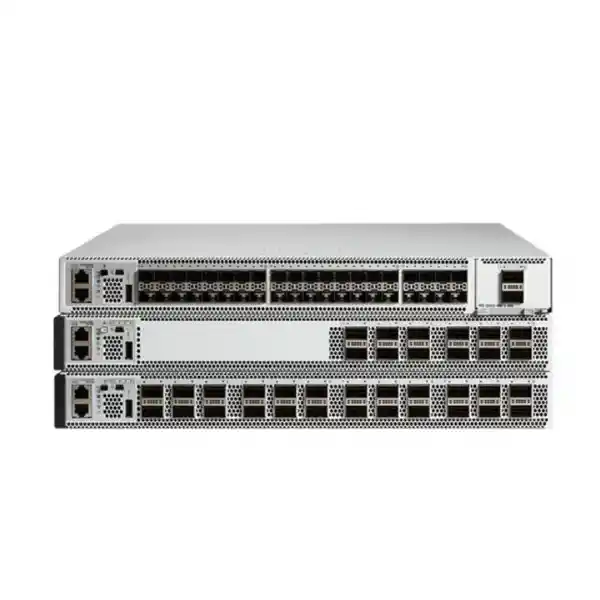
Up to 960 Gbps
1RU Core / Aggregation
Cisco End-of-Sale Model
Cisco Catalyst C9500-12Q Network Switch
The Cisco Catalyst C9500-12Q is a fixed enterprise core and aggregation switch built for networks that need high-density 40 Gigabit Ethernet in a compact 1RU platform. It provides twelve native 40G QSFP+ ports and supports 10G breakout operation, making it useful for organizations that have an established 40GbE architecture, require a like-for-like spare for an installed Catalyst 9500 estate, or need to preserve existing optics and cabling during a controlled migration.
Cisco ended sale of the C9500-12Q on 30 April 2024. Cisco identifies the C9500-32QC as the migration replacement. This means the C9500-12Q should be evaluated primarily in the context of installed-base continuity, spares, controlled expansion, or other situations where its exact interface profile is still required. Availability, condition, support status, licensing, software entitlement, included power supplies, and optics should all be verified before procurement.
Need help deciding whether to maintain a C9500-12Q design or migrate? Ask FourTeck Tanzania for a technical compatibility and sourcing review based on your existing switches, optic types, port speeds, resilience design, software requirements, and expected growth.
At a glance: what the C9500-12Q is designed to do
Twelve 40 Gigabit Ethernet QSFP+ ports provide a straightforward fit for 40GbE campus core, aggregation, data-center interconnect, and high-bandwidth distribution designs.
Cisco documents port mapping that allows each 40G native interface to operate as four 10G interfaces with supported breakout cabling, for as many as forty-eight logical 10G ports when the design and optics are compatible.
Cisco documentation lists up to 960 Gbps switching capacity and up to 720 Mpps forwarding performance for C9500-12Q, helping it handle demanding aggregation and core traffic patterns.
The chassis provides two power-supply slots and field-replaceable fan modules. A correctly designed deployment can use redundant power and resilient network topology rather than relying on a single point of failure.
Who should consider the Cisco C9500-12Q?
This switch is no longer a general-purpose choice for a brand-new greenfield core simply because newer Catalyst 9500 models offer a longer lifecycle and higher-speed options. Its strongest use cases are more specific. A Tanzanian enterprise, service organization, university, financial institution, industrial operation, hospitality group, or multi-site business may already have a Catalyst 9500 design with 40G QSFP+ uplinks, standardized operating procedures, spare optics, established configurations, and staff familiarity. In that situation, replacing a failed unit or keeping a compatible spare may be more operationally practical than introducing a different platform immediately.
It can also be appropriate for a controlled transitional design. For example, an organization may need to keep an existing campus core stable for another budget cycle while planning a migration to 100G or a newer Catalyst platform. The C9500-12Q can preserve the existing 40G physical layer and configuration model while the organization audits dependencies, updates optics, validates application traffic, changes downstream switches, and schedules the final migration.
The model is less attractive where a project needs a long new lifecycle, native 100G expansion, higher port density, or a clean new support strategy. For those cases, Cisco’s documented migration path to the C9500-32QC deserves serious consideration. The correct choice therefore depends not only on port count, but on whether the network is being maintained, extended, modernized, or replaced.
Verified technical specifications
| Model | Cisco Catalyst C9500-12Q |
|---|---|
| Primary role | Fixed enterprise core and aggregation switching |
| Native front-panel ports | 12 × 40 Gigabit Ethernet QSFP+ |
| 10G breakout mapping | Each native 40G port can map to four 10G interfaces using supported breakout cabling; up to 48 logical 10G interfaces across all 12 native ports |
| Switching capacity | Up to 960 Gbps |
| Forwarding rate | Up to 720 Mpps |
| ASIC architecture | Two Cisco UADP 2.0 XL ASICs |
| Form factor | 1 rack unit |
| Dimensions | Approximately 4.4 × 44.5 × 56.7 cm (H × W × D) |
| Weight | Approximately 11.68 kg with two power supplies and built-in fan modules |
| Power-supply slots | 2; supports 950W AC or 950W DC power-supply modules for this model family |
| Cooling | Field-replaceable, variable-speed fan modules; default front-to-back airflow |
| Lifecycle | End of sale: 30 April 2024; Cisco last date of support: 30 April 2029, subject to applicable entitlement and Cisco terms |
Specifications describe the Cisco platform and do not imply that every feature, optic, license, software release, power supply, support service, or accessory is included with a particular unit. Confirm the exact bill of materials and entitlement before ordering.
40G QSFP+ connectivity and 10G breakout planning
The defining characteristic of the C9500-12Q is its twelve 40GbE QSFP+ interfaces. That makes the switch particularly relevant to networks built around 40G fiber or direct-attach connectivity. In a traditional campus design, those interfaces can aggregate multiple distribution blocks, high-capacity server zones, data-center links, firewall clusters, or other network segments that require more bandwidth than a 10G uplink. In an installed environment, keeping the same interface type can also reduce the number of simultaneous changes during maintenance because existing compatible 40G optics and structured fiber may remain usable after validation.
Cisco’s hardware documentation maps every native 40G port on this model to four configurable 10G interfaces when supported breakout cabling is used. Port 1 maps to 10G interfaces 1–4, port 2 maps to 5–8, and the sequence continues through native port 12, which maps to logical 10G interfaces 45–48. This capability gives designers a useful transition option where some connected devices still use 10GbE. Instead of consuming a full 40G interface for a single low-speed link, a suitable breakout design can create four 10G connections from one native port.
Breakout capability does not remove the need for careful compatibility checking. The QSFP+ module, breakout cable type, far-end interface, supported Cisco software, fiber grade, connector type, and intended distance must all be matched. The optical budget and polarity of a fiber solution also matter. When a network mixes direct-attach copper, active optical cables, multimode optics, or single-mode optics, treat each link as an engineering decision rather than assuming that every QSFP+ assembly can be broken out in the same way.
- How many native 40G links must remain 40G, and how many can be allocated to 4×10G breakout?
- Are the existing transceivers and cables supported by the target IOS XE release and exact switch model?
- Will any downstream switch or server be upgraded to 25G or 100G during the same project?
- Does the migration require temporary parallel links while old and new cores coexist?
- Have both physical redundancy and Layer 2/Layer 3 convergence been designed, rather than relying only on port count?
Performance for enterprise core and aggregation
Cisco documents up to 960 Gbps switching capacity and up to 720 million packets per second of forwarding for the C9500-12Q. Those numbers are useful for understanding the class of platform, but they should not be treated as a substitute for network design. Real traffic includes mixed packet sizes, routing policy, multicast, access control lists, quality-of-service classification, encryption, telemetry, control-plane activity, and failure scenarios. A sound design looks at both aggregate throughput and the behavior of critical applications under normal and degraded conditions.
For a campus core, the goal is usually to keep the backbone simple, predictable, and resilient. The switch can participate in Layer 2 and Layer 3 designs, but large enterprises often prefer routed access or routed distribution boundaries where appropriate because smaller Layer 2 failure domains can simplify convergence and troubleshooting. The exact topology should follow the organization’s current Cisco architecture, application dependencies, multicast requirements, security zones, and operational skill set.
The Catalyst 9500 family supports established enterprise routing technologies such as OSPF, EIGRP, IS-IS, BGP, IPv6 routing, multicast protocols, and routed subinterfaces. The family also supports capabilities such as MPLS features, policy controls, quality of service, network telemetry, and Cisco IOS XE programmability, with exact feature availability depending on licensing and software release. For the C9500-12Q, confirm the specific feature set against the software release you plan to run, especially because the hardware has passed its end-of-software-maintenance milestone.
The most important performance question for a Tanzania deployment is therefore not only “how fast is the switch?” but “does the existing design fit this specific hardware and lifecycle?” A maintenance replacement may need identical interface behavior and predictable restoration more than new features. A modernization project may need higher-speed uplinks, longer support, new automation, or additional scale. Those are different procurement problems and should be evaluated separately.
High availability with StackWise Virtual and redundant infrastructure
The Catalyst 9500 platform supports Cisco StackWise Virtual, a system-virtualization technology used to operate two compatible physical switches as a logical system for improved operational continuity and multichassis connectivity. In a correctly engineered pair, this can simplify the topology seen by downstream devices and allow Multichassis EtherChannel designs across both members. Cisco also documents Stateful Switchover and in-service software upgrade capabilities in the Catalyst 9500 family when used in supported StackWise Virtual configurations and software releases.
High availability is broader than chassis pairing. The C9500-12Q has two power-supply slots, and Cisco supports 950W AC or 950W DC modules for this platform. Where the hardware configuration and electrical design permit, dual power supplies can be connected to independent power sources or UPS paths so a single supply or feed does not automatically stop the switch. The rear panel also contains field-replaceable fan modules, and Cisco documents variable-speed fans with default front-to-back airflow. Airflow direction, rack layout, blanking, temperature, dust control, UPS design, generator transfer behavior, and grounding remain important parts of overall availability.
For Tanzanian sites where utility power quality or continuity varies by location, network resilience should be coordinated with the electrical infrastructure. That does not mean assuming a particular local power condition; it means verifying the real environment at the deployment site. A switch with dual PSUs provides little benefit if both are fed by the same unprotected circuit. Similarly, redundant core switches provide limited protection if both depend on one upstream fiber path, one rack PDU, one cooling unit, or one carrier handoff.
When replacing an existing C9500-12Q, record the current StackWise Virtual topology, link assignments, port-channel design, spanning-tree or routing role, first-hop gateway configuration, QoS policy, management addressing, out-of-band access, timing requirements, and failure behavior before changing hardware. The objective should be to reproduce the required service deliberately rather than relying on a generic configuration copy without validating software and interface differences.
Security, segmentation, and traffic control
A core switch is part of the security architecture because it sits on important traffic paths and often enforces boundaries between network segments. Cisco documents security capabilities across the Catalyst 9500 family including secure boot mechanisms, image signing, access control lists, Trustworthy Solutions components, MACsec support, control-plane protection, and enterprise routing policy. These features can help reduce risk when they are configured as part of a broader security design, but they do not make a legacy hardware lifecycle irrelevant.
Cisco lists 256-bit AES-GCM MACsec encryption for Catalyst 9500 models. MACsec can be useful for protecting Ethernet links between trusted network devices where supported transceivers, topology, licensing, and software meet the design requirements. Before depending on MACsec in a C9500-12Q deployment, validate the exact IOS XE release, peer capability, key-management method, performance requirements, and operational procedures. Do not assume that every Catalyst 9500 security feature applies identically across every model and software train.
Segmentation may be implemented with VLANs, VRFs, routed boundaries, access control lists, or other Cisco architecture features depending on the environment. For a replacement project, preserving segmentation behavior is often more important than adding new policy during the same maintenance window. For a modernization project, the migration can be used to review whether legacy VLAN spans, broad access rules, and old routing adjacencies are still required.
Because Cisco’s end-of-software-maintenance date for this hardware has passed, organizations should place additional emphasis on lifecycle risk management. Review current security guidance, software entitlement, approved images, vulnerability response expectations, and the planned retirement date of the platform. Cisco’s published end-of-vulnerability/security-support and last-support milestones provide an outer lifecycle boundary, not a reason to postpone migration planning until the final date.
Cisco IOS XE operations, automation, and visibility
Catalyst 9500 switches run Cisco IOS XE, which provides an enterprise network operating environment with traditional CLI management alongside modern programmability and telemetry capabilities. Cisco documents model-driven programmability, streaming telemetry, on-box scripting, and APIs across the platform. This is valuable in environments that want repeatable configuration, centralized monitoring, faster fault isolation, and integration with network-management systems rather than relying exclusively on manual changes.
For an existing C9500-12Q, operational compatibility may be one of the strongest reasons to source the same model. Network teams may already have validated configuration templates, monitoring thresholds, interface descriptions, automation jobs, backup procedures, and change-control steps for this platform. A like-for-like replacement can reduce the number of variables during recovery, provided that hardware revision, licenses, software image, boot variables, and optics are checked rather than assumed.
For long-term modernization, however, operational tooling should be reviewed together with hardware selection. A newer replacement may change port numbering, supported optics, performance scale, power modules, fan design, software minimums, or feature behavior. Migration planning should therefore include configuration translation, lab validation where practical, telemetry comparison, monitoring updates, and a documented rollback plan.
Management security also matters. Restrict administrative access, use authenticated and encrypted management protocols, maintain current credentials and certificates, centralize logging, protect management-plane interfaces, and document who can make changes. These practices are especially important for a core switch because a small configuration error can affect many downstream systems at once.
Physical installation and power considerations
The C9500-12Q is a 1RU fixed switch. Cisco’s hardware guide lists dimensions of approximately 4.4 cm high, 44.5 cm wide, and 56.7 cm deep, with a weight of about 11.68 kg when populated with two power supplies and the built-in fan modules. Rack planning should allow for chassis depth, rail or mounting hardware, cable bend radius, rear clearance, power-cable routing, airflow, and access for replacing field-replaceable components.
The switch has two power-supply slots. Cisco documents 950W AC and 950W DC supply options for the C9500-12Q family. A specific unit may arrive with one or two supplies depending on how it is sourced, so the procurement specification should explicitly state the required power configuration. Do not treat “dual PSU capable” as equivalent to “two PSUs included.” The same principle applies to power cords, rack hardware, fan modules, console accessories, transceivers, breakout cables, and software licenses.
Cisco’s hardware design uses multiple field-replaceable fan modules with default front-to-back airflow. Correct airflow is important in a dense rack: network equipment that exhausts hot air toward the switch intake can create thermal problems even when the room temperature appears acceptable. Confirm the rack’s cold-aisle and hot-aisle arrangement, keep intake and exhaust areas unobstructed, and monitor environmental alarms after installation.
Before deploying at a site in Tanzania, verify the actual electrical feed, UPS topology, grounding, earthing practices, surge protection strategy, generator behavior, rack PDU capacity, and connector requirements. These details are site-specific and should be confirmed by qualified personnel. The objective is to give the network core stable power and predictable recovery behavior, not merely to fit the switch physically into the rack.
Lifecycle status: what end of sale means for procurement
Cisco announced end-of-life milestones for the C9500-12Q, C9500-24Q, and C9500-40X. For the C9500-12Q, the end-of-sale date was 30 April 2024, meaning it can no longer be ordered through Cisco’s normal point-of-sale mechanisms as a current product. The last ship date was 30 July 2024. Cisco’s published end-of-software-maintenance date was 30 April 2025, and the end of new service attachment was also 30 April 2025.
Cisco lists 29 July 2028 as the end-of-service-contract-renewal date and 30 April 2029 as the last date of support for the affected hardware, subject to applicable service entitlement and Cisco terms. Cisco also lists 30 April 2029 for vulnerability/security support on this product lifecycle. These dates are important because they put a finite horizon around continued use. A buyer should verify the actual entitlement of the exact unit rather than assuming that the published lifecycle automatically includes support.
End of sale does not automatically make every installed C9500-12Q unusable. Many organizations operate enterprise switches for years after a sales transition when the hardware remains stable, the software is controlled, spares are available, and the risk is understood. The procurement question changes, however. Instead of asking only whether the switch meets today’s port requirement, the buyer must also ask how long the organization intends to keep it, how failures will be handled, what support remains, how security risk will be governed, and when migration will occur.
Cisco notes that some end-of-sale equipment may be available through its certified refurbished program in certain countries and in limited supply. That statement does not guarantee availability in Tanzania or through FourTeck. Any listing should therefore be treated as subject to sourcing verification. Ask whether the offered unit is new old stock, refurbished, previously used, or another condition; confirm the serial number handling, entitlement status, included accessories, and acceptance-test process before purchase.
Choose a C9500-12Q when compatibility with an existing 40G Catalyst 9500 environment is the dominant requirement and the lifecycle risk is understood. Choose a newer platform when the project is a fresh core build, needs native higher-speed growth, or requires a longer forward support window.
C9500-12Q versus the Cisco migration replacement
Cisco identifies the C9500-32QC as the migration replacement for C9500-12Q product identifiers in the end-of-life notice. This is not a statement that the two units are identical. The C9500-32QC is a higher-performance Catalyst 9500 platform with a different port architecture and supports 40G and 100G modes. A migration therefore requires a real design review rather than a simple assumption that the newer chassis can be inserted without changes.
| Decision area | C9500-12Q | Migration perspective |
|---|---|---|
| Native ports | 12 × 40G QSFP+ | Review the C9500-32QC port modes and whether 100G growth is required. |
| Installed optics | Existing 40G QSFP+ design may be standardized | Validate each optic, cable, distance, and port mode on the replacement. |
| Configuration | Known platform behavior may simplify like-for-like recovery | Translate and test interface, routing, QoS, security, and redundancy configuration. |
| Lifecycle | End-of-sale model with final support milestone in 2029 | Prefer newer lifecycle where long-term deployment is the priority. |
| Best fit | Sparing, maintenance, compatible expansion, transition | Core refresh, capacity growth, longer lifecycle strategy |
A migration assessment should document every used port, optic, VLAN, routed interface, routing neighbor, multicast dependency, port channel, spanning-tree role, policy map, access list, VRF, management function, authentication dependency, monitoring integration, and redundancy mechanism. This avoids discovering hidden dependencies during the change window. It also helps determine whether a staged migration is safer than a single cutover.
Typical deployment scenarios in Tanzania
Existing campus core spare
An organization already operates C9500-12Q switches and wants a compatible standby unit to reduce restoration time after a hardware failure. The priority is matching hardware, software, optics, and configuration rather than adding new functionality.
Like-for-like hardware replacement
A failed or unreliable chassis must be replaced while retaining the surrounding 40G design. The change should include validation of serial-specific entitlement, power modules, fans, software image, licenses, and interface state before production cutover.
40G aggregation during a phased refresh
A business is replacing access or distribution layers first but will modernize the core later. Keeping 40G aggregation temporarily may reduce simultaneous change, provided the retirement timeline is clear and lifecycle risk is accepted.
10G breakout consolidation
A network needs multiple 10G interfaces from a compact 40G-based platform. Supported breakout cabling can create four logical 10G links per native 40G port, but compatibility and interface mapping must be planned carefully.
Migration staging platform
The switch remains in service while a newer Catalyst core is introduced in parallel. Routing adjacencies, trunks, or temporary cross-connects are used to move services in controlled stages rather than all at once.
Lab or disaster-recovery matching
A technical team needs the same platform family for configuration validation, recovery documentation, or disaster-recovery compatibility. Hardware condition and support needs should still be checked even when the unit is not the primary production core.
What to verify before ordering a C9500-12Q
Because the C9500-12Q is end of sale, procurement needs more verification than a current catalog switch. A simple product name is not enough. The exact condition and bill of materials can materially change the usefulness of the unit.
Confirm whether the unit is unused old stock, certified refurbished, seller-refurbished, or previously deployed. Ask what functional testing has been completed and what accessories are included.
Verify AC or DC requirements, the number of power supplies, supported PSU part numbers, power cords, and whether redundant feeds are required in the target rack.
List every planned 40G and 10G link, distance, connector, fiber type, transceiver, DAC or AOC, breakout requirement, and far-end device. Validate compatibility before purchase.
Document the software release, license level, features in use, entitlement status, boot settings, and compatibility with the existing environment. Do not assume a used chassis carries the rights or services you need.
Check whether support is available for the exact serial number and deployment, recognizing that Cisco’s published lifecycle dates do not automatically provide entitlement to any particular unit.
Set a target date for moving to a current platform and budget for replacement optics, cabling, licensing, implementation, and testing. A spare without a migration plan can become technical debt.
A practical deployment checklist
For a core or aggregation change, success depends on preparation. Use the following checklist as a starting point and adapt it to your organization’s formal change-management process.
- Inventory the current environment. Record chassis model, serials, PSU types, fan state, optics, cable labels, port descriptions, VLANs, routed interfaces, VRFs, routing peers, port channels, StackWise Virtual links, monitoring, authentication, and management addressing.
- Back up configuration and operational state. Save the running and startup configuration plus key show-command outputs so the team can compare pre-change and post-change behavior.
- Validate target software and licenses. Confirm that the intended IOS XE image and license set support the features currently used. Avoid introducing an untested software jump at the same time as hardware replacement unless the plan explicitly requires it.
- Verify optics offline. Match each link to the correct Cisco-supported interface type and inspect fiber cleanliness, polarity, transmit/receive levels, and labeling where applicable.
- Prepare power and rack space. Verify rack depth, available RU, PDU receptacles, UPS capacity, independent feeds where required, grounding, airflow, and cable access.
- Define a rollback point. State exactly when the change will be reversed, how the old device will be restored, and how configuration divergence will be controlled during the window.
- Test redundancy deliberately. Validate member failover, uplink loss, power-feed loss, routing reconvergence, gateway behavior, and monitoring alerts rather than considering the change successful only because normal traffic passes.
- Document the next lifecycle step. Record the long-term replacement plan, especially if this end-of-sale hardware is being installed only to extend an existing environment temporarily.
Frequently asked questions
Is the Cisco C9500-12Q still a current Cisco product?
No. Cisco’s end-of-life notice states that the C9500-12Q reached end of sale on 30 April 2024. That is why buyers should treat it as an installed-base, spare, transitional, or secondary-market requirement rather than a normal new-platform recommendation.
What is the Cisco replacement for the C9500-12Q?
Cisco lists the C9500-32QC as the migration replacement for C9500-12Q product identifiers. Migration still requires verification of optics, port modes, configuration, licensing, software, power, and network design because the replacement is not an identical chassis.
How many 40G ports does the C9500-12Q have?
It has twelve native 40 Gigabit Ethernet QSFP+ ports. Cisco’s hardware guide also documents 10G breakout mapping for those native ports.
Can the 40G ports be used for 10G connections?
Yes, Cisco documents that a native 40G port can be configured as four 10G interfaces with supported breakout cabling. Across twelve native ports, the mapping extends to forty-eight logical 10G interfaces. Optic, cable, far-end, and software compatibility must still be validated.
What is the switching capacity of the C9500-12Q?
Cisco documentation lists up to 960 Gbps switching capacity and up to 720 Mpps forwarding rate for the C9500-12Q.
Does the switch support redundant power supplies?
The chassis has two power-supply slots and supports compatible 950W AC or DC modules. Whether a specific unit includes one or two supplies must be confirmed. A resilient design also requires independent power paths where appropriate.
Does the C9500-12Q support StackWise Virtual?
Cisco documents StackWise Virtual support across the Catalyst 9500 platform. Use only supported software releases and validated configurations, and confirm the exact design before relying on it for high availability.
Is this switch suitable for a brand-new core deployment?
It can meet certain technical requirements, but because it is end of sale, a new greenfield design should normally compare current Catalyst options with longer lifecycle and higher-speed growth. The C9500-12Q is strongest where exact compatibility with an existing 40G environment is valuable.
Can FourTeck Tanzania confirm stock, price, or warranty from this page?
Those commercial details should be confirmed for the exact offered unit. This page does not assume current stock, price, condition, warranty, Cisco entitlement, or delivery time. Request a quote and technical check for the precise bill of materials you need.
Request a C9500-12Q compatibility and sourcing review
If you are maintaining a Cisco Catalyst 9500 environment in Tanzania, send FourTeck Tanzania your current switch model, required number of 40G and 10G links, optic or cable part numbers, AC or DC power requirement, software version, licensing needs, redundancy design, and whether the unit is for production replacement, spare stock, lab use, or migration staging.
The review should confirm whether the C9500-12Q remains the right fit or whether moving to a current replacement platform is more appropriate. Because this model is end of sale, request explicit confirmation of unit condition, included power supplies and accessories, compatibility, support considerations, and commercial terms before placing an order.


Reviews
There are no reviews yet.