
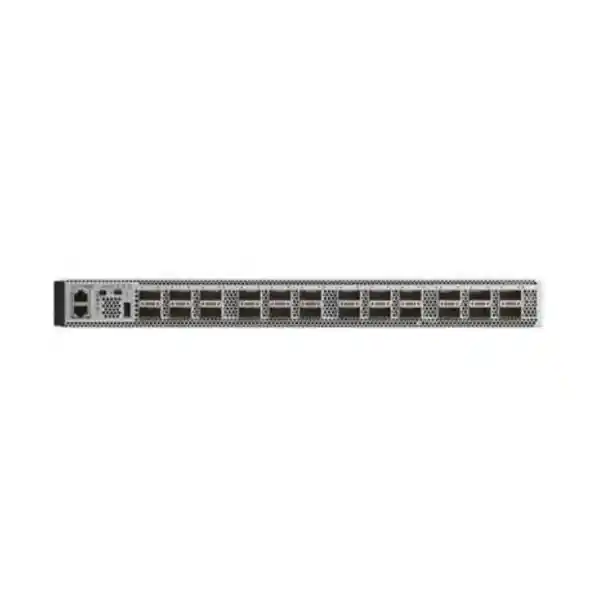
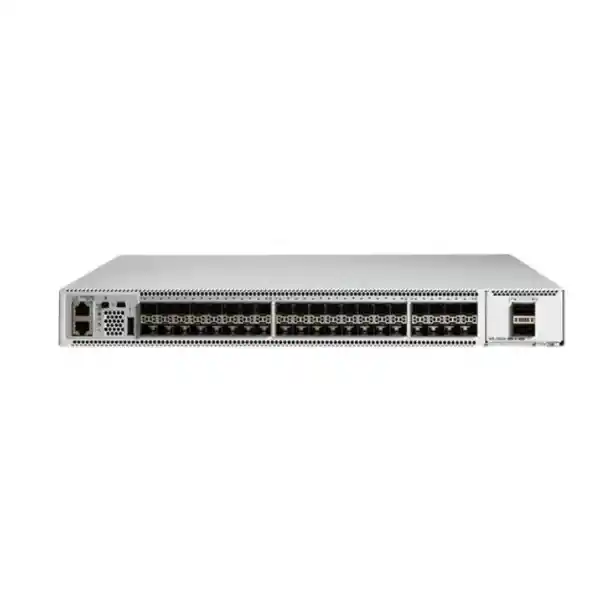
1RU fixed core / aggregation
Cisco end-of-sale model
Cisco Catalyst C9500-24Q Network Switch
The Cisco Catalyst C9500-24Q is a 24-port 40 Gigabit Ethernet QSFP+ switch built for enterprise core and aggregation roles where high-capacity fiber connections, resilient architecture and Cisco IOS XE operations are required. It can be relevant for organizations extending an existing Catalyst 9500 environment, replacing a failed like-for-like unit, maintaining a standardized design, or planning a controlled migration from an installed 40G core. Because Cisco has already ended normal sale of this model, every procurement decision should start with lifecycle, support entitlement, optics, licensing and replacement-path checks rather than with port density alone.
Useful when compatibility, installed optics, operational standards or an existing Catalyst 9500 design justify retaining the C9500-24Q platform.
Dense 40GbE fiber connectivity for aggregation, routed uplinks and high-bandwidth inter-switch links, subject to supported Cisco optics and software.
New projects should compare current Catalyst 9500 alternatives before committing to legacy stock or secondary-market sourcing.
Cisco’s lifecycle notice lists the C9500-32C as the replacement product for affected C9500-24Q orderable variants.
What a Tanzania buyer should decide first
A request for a Cisco C9500-24Q in Tanzania can describe several very different projects. One customer may need a replacement chassis for an installed StackWise Virtual pair. Another may be extending a campus distribution design with spare 40G ports and already owns compatible QSFP+ optics. A third may simply be searching for a high-capacity Cisco core switch and may not yet know that this exact model has reached end-of-sale status. These scenarios should not receive the same recommendation.
For an existing environment, the first step is to document the current switch model, software release, license level, installed optics, port assignments, routing role, redundancy design, support contract status and the reason a replacement or expansion is required. Like-for-like hardware can sometimes reduce migration work, but lifecycle and support conditions still matter. For a new deployment, the selection should be compared with current Catalyst 9500 platforms so that the organization does not create a fresh dependency on hardware that Cisco no longer sells through normal point-of-sale mechanisms.
FourTeck Tanzania can use that requirement information to frame a quote or migration discussion. The objective should be to match the network design, not merely the model number. Port speed, port density, optics, software features, high availability, rack environment, power continuity and the intended service life all affect whether the C9500-24Q remains appropriate for a particular requirement.
Verified C9500-24Q hardware profile
| Specification | C9500-24Q detail |
|---|---|
| Platform role | Cisco Catalyst 9500 fixed enterprise core and aggregation switch |
| Front-panel data ports | 24 × 40 Gigabit Ethernet QSFP+ ports |
| Chassis size | 1 rack unit (1RU) |
| Dimensions | Approximately 1.73 × 17.5 × 21.5 in. (4.4 × 44.5 × 56.7 cm) |
| Weight | Approximately 25.75 lb (11.68 kg) with two power supplies and built-in fan configuration |
| Power-supply slots | Two; supported platform power options include Cisco 950W AC and DC modules for the standard Catalyst 9500 models |
| Cooling | Field-replaceable variable-speed fan modules with default front-to-back airflow |
| Operating temperature | 0°C to 40°C under the hardware guide’s stated environmental conditions |
| Operating system | Cisco IOS XE; exact feature availability depends on software release and license entitlement |
| High availability | Cisco StackWise Virtual is supported on the C9500-24Q in applicable IOS XE releases and designs |
Specifications should be checked again against the exact hardware, software train, license and transceiver list used in the final bill of materials. A chassis model alone does not confirm the optics, software subscription, power cords, support entitlement or accessory configuration included in a commercial offer.
Why 24 × 40G ports mattered
The C9500-24Q was designed for environments that needed many native 40 Gigabit Ethernet interfaces in a compact fixed form factor. In a campus core or aggregation layer, those ports can connect distribution blocks, high-capacity downstream switches, routed infrastructure or other systems that require significantly more bandwidth than traditional 1G or 10G links.
That density can still be operationally useful where 40G is already standardized. The important question is whether preserving 40G interfaces solves a compatibility problem or simply postpones a platform refresh. Newer designs may have different speed, optics and lifecycle priorities, so port count should be evaluated together with the expected network roadmap.
Fixed core and aggregation design
Cisco positions the Catalyst 9500 family as a fixed core and aggregation platform. A fixed chassis can simplify rack planning compared with a modular chassis because port types and physical dimensions are known in advance, while organizations can deploy multiple switches for resilience where the design requires it.
The tradeoff is that expansion is bounded by the fixed front-panel layout. When evaluating a legacy C9500-24Q today, buyers should therefore examine current and forecast 40G port demand. A switch that fits the present requirement but leaves no sensible growth path can create another migration sooner than expected.
Lifecycle status: the most important buying consideration
Cisco announced end-of-sale and end-of-life milestones for the C9500-24Q together with selected other Catalyst 9500 models. The hardware end-of-sale date was 30 April 2024, meaning Cisco no longer accepts normal new hardware orders for this model through its point-of-sale mechanisms after that date. Cisco’s published milestone table also lists 30 April 2025 as the end of software maintenance releases for the affected hardware and 30 April 2029 as the last date of support. Security or vulnerability support and service-contract rules are governed by the detailed lifecycle schedule and the customer’s active entitlement.
This does not automatically mean that every installed C9500-24Q must be removed immediately. Existing systems can remain in service when the organization has an appropriate support, risk and replacement plan. It does mean that buyers should distinguish an operational replacement need from a new-network design. A spare or like-for-like unit may be justified for a controlled legacy environment, while a brand-new site with a multi-year lifecycle usually deserves comparison against current hardware.
The lifecycle position also changes what should be requested in a quote. Do not assume that a listed unit is factory-new current stock, supported under the same terms as a current product, or accompanied by a transferable service contract. Ask whether the proposed hardware is new old stock, refurbished, used or otherwise supplied; what exact part number is offered; which power supplies and fans are included; what software and license state is present; and what support options, if any, are valid for that serial number and customer.
For migration planning, Cisco identifies the C9500-32C as a replacement product for affected C9500-24Q part numbers. Replacement does not mean a blind one-for-one swap. Interface speeds, optic compatibility, software, licensing, cabling, configuration, power and design assumptions should be reviewed before selecting the migration platform.
Cisco IOS XE and operational fit
The Catalyst 9500 platform runs Cisco IOS XE, giving network teams a familiar enterprise switching and routing operating environment with programmable management capabilities. Cisco describes the series as part of the Catalyst 9000 architecture and as a foundation for software-defined enterprise networking. For a procurement page, the practical point is that the chassis is not just a collection of 40G ports: it participates in a broader software, licensing and automation ecosystem that must be matched to the organization’s operating model.
Before deployment, confirm the intended IOS XE release against the exact feature set required. Routing scale, high-availability behavior, management integrations, telemetry, SD-Access roles and security functions can depend on release, license level and design. An installed environment may also have a change-management policy that limits how far software can be upgraded at one time. A replacement chassis therefore needs more than compatible interfaces; it needs a software plan that preserves the required network functions and interoperability.
Cisco’s current documentation for Catalyst 9500 models includes different Switch Database Management templates designed to allocate hardware resources for use cases such as distribution, core, SD-Access and NAT-oriented deployments. The appropriate template affects how hardware tables are prioritized. This is a useful reminder that the intended role should be documented before configuration. A switch used primarily for a campus core can have different scale priorities from one used in a distribution or specialized collapsed-core design.
For teams adopting automation, IOS XE supports model-driven approaches that can reduce reliance on manual per-device configuration. Whether that capability is used depends on the customer’s management tools and operational maturity. The most useful buying conversation therefore includes not only ports and throughput but also how the switch will be configured, monitored, backed up, upgraded and integrated into the wider network-management process.
Network Essentials and Network Advantage
Cisco historically offered C9500-24Q orderable variants with Network Essentials and Network Advantage licensing, including part numbers such as C9500-24Q-E and C9500-24Q-A. These suffixes matter because they can indicate different software entitlements and therefore different feature eligibility.
For an existing switch, identify the actual entitlement rather than assuming that every C9500-24Q has the same routing or high-availability feature rights. For a legacy hardware purchase, ask for evidence of the device’s license state and confirm how current Cisco licensing policies apply to the intended use. Do not base a design on a feature until its required license and supported software release have been verified.
StackWise Virtual for resilient designs
Cisco StackWise Virtual can pair supported Catalyst 9500 switches into a logical system for high-availability network designs. Cisco documentation lists the C9500-24Q among supported models in applicable IOS XE releases. This can simplify the logical topology and provide redundancy options when two switches are deployed as a pair.
A StackWise Virtual design must still be engineered. Confirm supported links, software requirements, dual-active detection design, licensing, physical path diversity and the failure scenarios the network is expected to survive. Existing configurations should be reviewed before replacing either member of a pair, especially when software versions or hardware state differ.
Optics, fiber and 40G link planning
The C9500-24Q uses QSFP+ interfaces for its 40 Gigabit Ethernet ports. The switch should therefore be specified together with the optical or cable solution required for each link. A quote that includes only the chassis is incomplete when the project also needs transceivers, patch leads, fiber panels or direct-attach connectivity. The correct choice depends on link distance, fiber type, connector format, the device at the far end and the transceiver combinations supported by Cisco for the intended software release.
Start with a port-by-port connection schedule. Record the source switch port, destination device, destination port type, expected speed, approximate path distance, existing fiber type and patch-panel details. This prevents a common procurement mistake: purchasing a switch with the right nominal speed but the wrong optical ecosystem. Multimode links within a building, longer single-mode links between buildings and short rack-level connections can require different components even though all operate at 40G.
Existing optics should not be assumed compatible solely because they physically fit a QSFP form factor. Verify Cisco support and the specifications on both ends of the link. Also check whether the project intends to reuse structured fiber that was installed for lower-speed services. Higher-speed optics can have stricter distance and fiber-quality requirements, so a design review may need fiber test records or a site survey rather than only a visual inspection.
For migration projects, map every active 40G connection and every spare port before selecting the replacement platform. If some links are expected to move to 100G or another speed, the migration may be an opportunity to simplify the topology rather than reproducing the old port map exactly. Conversely, where remote equipment remains fixed at 40G, optic and port compatibility must remain part of the replacement decision.
Power, cooling and rack planning in Tanzania
Enterprise core switching should be planned as infrastructure, not as a desktop device. The C9500-24Q occupies 1RU but is approximately 21.5 inches deep, so rack depth, rail space, cable management and rear service clearance should be checked before installation. The chassis supports two power-supply slots, and Cisco documentation lists 950W AC and DC power modules for the standard Catalyst 9500 models. The final power design should match the exact supply modules, facility circuits and redundancy objective included in the bill of materials.
For critical network roles, power continuity is normally considered across the entire path. A redundant switch design can still fail to deliver service if both power supplies depend on the same upstream circuit or if connected distribution equipment loses power first. Where the organization uses UPS systems, document which switch power input is connected to which protected power path and estimate runtime together with the other network equipment sharing that UPS.
Cooling direction matters as well. Cisco documents field-replaceable variable-speed fan modules with front-to-back airflow for this standard Catalyst 9500 platform. Rack rows should maintain a consistent airflow strategy so that hot exhaust from one device is not drawn into the intake of another. The hardware guide specifies an operating temperature range of 0°C to 40°C under stated conditions, but the correct facility target should include margin for local room conditions, dust management, equipment density and cooling outages.
If the switch is intended for a communications room outside a major data-center environment, verify environmental control before commissioning. A high-capacity core switch, optical modules, firewalls, servers and UPS equipment can collectively create significant heat. Monitoring room temperature, power state and device alarms is more useful than relying on occasional manual checks after users report instability.
Where the C9500-24Q can still make sense
Like-for-like replacement
An organization with a failed or at-risk C9500-24Q may prioritize restoring the existing design with minimal reconfiguration. The quote should still identify hardware condition, licensing, support status and compatibility with the surviving peer or surrounding network.
Installed 40G standard
A network with many 40G QSFP+ links and validated optics may have a business reason to extend the platform temporarily while a broader refresh is prepared. That decision should have a defined exit plan rather than becoming an indefinite default.
Spares strategy
Some organizations retain a tested spare for a legacy production platform until migration is complete. The spare should be inventoried, software-aligned, stored appropriately and periodically checked so that it is usable when required.
Controlled migration phase
A temporary C9500-24Q requirement may support a staged project in which distribution blocks are migrated one at a time. The final architecture should still be designed around current lifecycle objectives, not around preserving legacy hardware indefinitely.
When a current Catalyst 9500 platform is the better direction
A new site, major refresh or multi-year core redesign should usually compare the C9500-24Q requirement against current Cisco options before any purchase decision. Cisco’s own end-of-life notice names the C9500-32C as the replacement product for C9500-24Q orderable part numbers. That is a strong signal that migration planning should look beyond the older 24-port 40G format.
The C9500-32C belongs to the higher-performance Catalyst 9500 models and offers a different interface and platform profile. A replacement project therefore needs a port-map exercise rather than a model-name substitution. Identify which existing links must remain at 40G, which can move to higher speeds, which optics can be reused, whether cabling changes are required, and how the software and licensing model will change. High availability should be rebuilt and tested intentionally rather than copied line by line without reviewing current Cisco guidance.
Lifecycle planning can also influence total cost. A legacy chassis might have a lower acquisition cost in some channels, but procurement cost is only one part of ownership. Support options, spare strategy, engineering time, software constraints, energy and rack planning, future port-speed requirements and the timing of the next migration all matter. In many environments, selecting a current platform reduces the risk of paying for two migrations in a short period.
The correct answer can still be the C9500-24Q when an existing environment has a specific compatibility or continuity requirement. The key is to make that choice deliberately and document why it is preferable to migration at this stage.
Information to provide before requesting a quote
A complete requirement helps separate a genuine C9500-24Q compatibility need from a broader core-switch project. Provide as much of the following information as possible:
A practical deployment and migration workflow
Capture the current state
Back up configuration, inventory optics, record serial and part numbers, identify software and licenses, map routing adjacencies, document management addresses and note every connected device. This becomes the baseline for replacement or migration testing.
Confirm the target architecture
Decide whether the target is another C9500-24Q, a current Catalyst 9500 migration, or a wider core redesign. Confirm required speeds, port count, routing scale, high availability and management approach before ordering hardware.
Validate optics and physical infrastructure
Match transceivers, fiber and link distance; verify rack depth, airflow and power; and confirm that both ends of every critical link support the intended interface. Do this before the maintenance window, not during cutover.
Align software and licensing
Select the supported IOS XE release, verify the license level for required features and review configuration compatibility. For high-availability pairs, confirm the software and hardware requirements for the final design.
Stage and test
Power the switch in a controlled environment, check fans and power supplies, confirm software, validate management access and test representative optics. Pre-stage configuration where appropriate and compare the result with the documented baseline.
Cut over with rollback criteria
Define which links move first, what constitutes success, who validates applications and what conditions trigger rollback. After cutover, verify routing, redundancy, management, logs and critical business connectivity rather than checking only interface-up status.
Operational checks after installation
A successful hardware installation is only the start of production acceptance. Check that both power inputs are operating as designed, fan status is normal, temperature readings are within expected range and management access is restricted to the intended network. Confirm that every optical interface negotiates or operates at the planned speed and that error counters do not indicate cabling, optic or fiber problems.
At Layer 2 and Layer 3, validate the actual services carried by the core. That can include VLAN reachability, routed adjacencies, gateway availability, multicast behavior, access policies, telemetry and any high-availability state relevant to the deployment. If StackWise Virtual is used, test the logical and physical redundancy behavior according to the approved design rather than assuming that a healthy status screen proves every failure scenario.
Monitoring should capture device health and link behavior over time. Baseline interface utilization, errors, CPU, memory, environmental status and routing stability shortly after installation so that future troubleshooting has a known reference. For legacy hardware, keep lifecycle and support milestones in the operational calendar. This prevents a temporary replacement from quietly becoming a long-term platform without an owner for the eventual migration.
Documentation should be updated immediately after cutover. Record the final port map, optic types, software version, license state, management details, power-feed mapping, rack position and any deviations from the planned design. Good documentation reduces outage duration when the next hardware or link issue occurs.
Frequently asked questions
Is the Cisco C9500-24Q still a current model?
No. Cisco published an end-of-sale and end-of-life announcement for the C9500-24Q. The hardware end-of-sale date was 30 April 2024. Existing units may still operate and may have support rights under applicable contracts, but new projects should account for the published lifecycle.
How many 40G ports does the C9500-24Q provide?
The chassis provides 24 standard 40 Gigabit Ethernet QSFP+ front-panel ports. Optics and cabling are selected separately according to distance, fiber type, remote device and Cisco support requirements.
Can the C9500-24Q be used as a core switch?
Yes. Cisco positions Catalyst 9500 as a fixed enterprise core and aggregation family. Whether this specific legacy model is appropriate now depends on required port speeds, routing features, scale, lifecycle and the duration of the planned deployment.
Does it support StackWise Virtual?
Cisco documentation lists the C9500-24Q among Catalyst 9500 models that support StackWise Virtual in applicable IOS XE releases. The detailed design should verify software, licensing, link and dual-active-detection requirements before implementation.
What license versions were offered for the C9500-24Q?
Cisco orderable variants included Network Essentials and Network Advantage forms, such as C9500-24Q-E and C9500-24Q-A. The license state of a specific unit must be checked because feature eligibility can differ.
What replaces the C9500-24Q?
Cisco’s end-of-life notice lists the C9500-32C as the replacement product for affected C9500-24Q part numbers. A migration should still verify interface mapping, optics, software, licensing and redundancy rather than treating the change as a transparent hardware swap.
Should I buy a C9500-24Q for a new Tanzania network?
Only after comparing it with current Cisco platforms. A legacy C9500-24Q can make sense for compatibility, spares or a controlled existing environment, but a new long-life deployment should evaluate current alternatives and their support horizon.
Are QSFP+ transceivers included with the switch?
Do not assume they are included. A commercial offer should explicitly state the chassis, power supplies, fan modules, optics, cables, software, licenses and support components supplied. Optics must be selected for the intended links.
What should I check when buying legacy stock?
Confirm exact part number, physical condition, serial information, included components, software and license state, support eligibility, return terms and the reason the unit is being purchased. Avoid assuming that unused appearance means current factory support.
Decision guide: retain, replace or redesign?
| Situation | Likely direction | Key checks |
|---|---|---|
| Failed unit in an existing matched environment | Consider like-for-like replacement if lifecycle risk is accepted | Software, license, peer compatibility, optics, support state |
| Need a tested spare during migration | A C9500-24Q spare may be practical | Hardware condition, staging, software alignment, storage |
| New campus or enterprise core | Compare current Catalyst 9500 platforms first | Lifecycle, port speeds, scale, redundancy, licensing |
| Existing 40G network with future 100G growth | Plan migration rather than simply adding more legacy hardware | Optics, fiber, remote interfaces, migration windows |
| Unclear requirement based only on model name | Start with a design and inventory review | Current topology, active links, applications, support horizon |
Build the bill of materials around the network, not just the chassis
A C9500-24Q quotation can appear simple because the product name identifies the main chassis, but a production-ready core-switch bill of materials usually contains several decisions that must be made separately. Start with the exact chassis part number and license form, then identify the required power-supply modules, power cords, fan configuration, rack accessories, QSFP+ transceivers, fiber patching or direct-attach cables, support components and any management or software subscriptions that apply to the intended environment. Every item should have a reason tied to the design.
Power components are especially important in redundant installations. If the design requires two independent electrical paths, the bill of materials and rack plan should make that possible. Buying two power supplies does not by itself create power resilience when both feeds return to the same unprotected source. Likewise, a second switch does not create network resilience when both switches share a single fiber route, single upstream dependency or untested configuration. The commercial list and the topology should be reviewed together.
Optics can represent a meaningful share of project cost and operational risk. Record how many ports are active on day one, how many are reserved for resilience, how many are held for growth and which remote systems they connect to. That prevents unnecessary optics purchases while still protecting the project from discovering missing modules during commissioning. For existing networks, capture the installed transceiver part numbers rather than describing every link generically as “40G fiber.”
Finally, separate essential launch items from optional spares. A spare power supply, fan, optic or chassis can be useful in a critical environment, but the spare strategy should reflect failure impact, replacement lead time, support status and the organization’s maintenance capability. Legacy platforms deserve an especially explicit spare plan because availability can become less predictable as the lifecycle advances.
Risk questions for legacy C9500-24Q sourcing
When hardware is beyond normal end of sale, procurement quality becomes part of network engineering. Ask the supplier to identify whether the unit is factory-sealed old stock, previously deployed equipment, refurbished hardware or another condition. The answer can affect acceptance testing, support expectations and internal asset policy. Request the exact included components rather than relying on a photograph or a generic family description.
Licensing should be treated as a separate verification item. A chassis may physically boot and pass traffic while still not matching the feature entitlement assumed by the design. Record the offered part number, the expected Network Essentials or Network Advantage level where applicable, and how the customer will confirm entitlement after receipt. For any feature that is essential to production, validate its license and software prerequisites before the change window.
Support status also needs precision. Cisco’s lifecycle notice allows applicable support to continue only within the published milestones and according to valid service contracts or warranty terms. The existence of a model in Cisco documentation does not prove that a particular serial number can receive a new contract, a renewed contract or the same service level as current hardware. Support eligibility should therefore be confirmed for the exact procurement case rather than inferred from the family name.
Plan an acceptance test before the unit is considered ready for service. Inspect the chassis and modules, verify boot behavior, software and license state, check environmental and power status, test management access and validate representative 40G interfaces with known-good supported optics. Where possible, stage the intended configuration and high-availability relationship before touching production. This is useful for any enterprise switch, but it is especially valuable when the hardware comes from a legacy supply channel.
Important procurement note
This page does not claim current stock, price, warranty, Cisco authorization status, service entitlement or delivery time for the C9500-24Q. Those details must be confirmed for the exact unit and quotation. Because the model is end-of-sale, buyers should pay particular attention to product condition, part number, support eligibility, licensing and the business reason for choosing legacy hardware.
Request a C9500-24Q compatibility or migration review
Share the existing switch part number, IOS XE release, license level, 40G port map, optic types, redundancy design and whether the requirement is for replacement, expansion, a spare, or a new deployment. FourTeck Tanzania can then structure the requirement around the actual network instead of assuming that the legacy model is automatically the best choice.
For new projects, ask for a comparison with the current Catalyst 9500 migration path before finalizing the bill of materials.



Reviews
There are no reviews yet.