
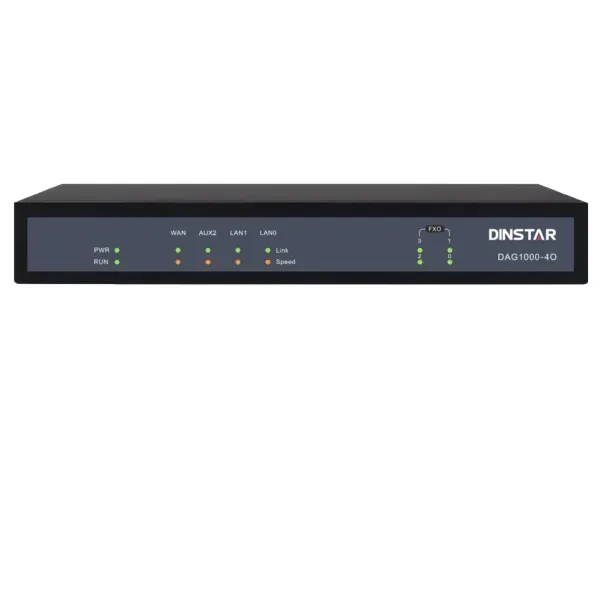
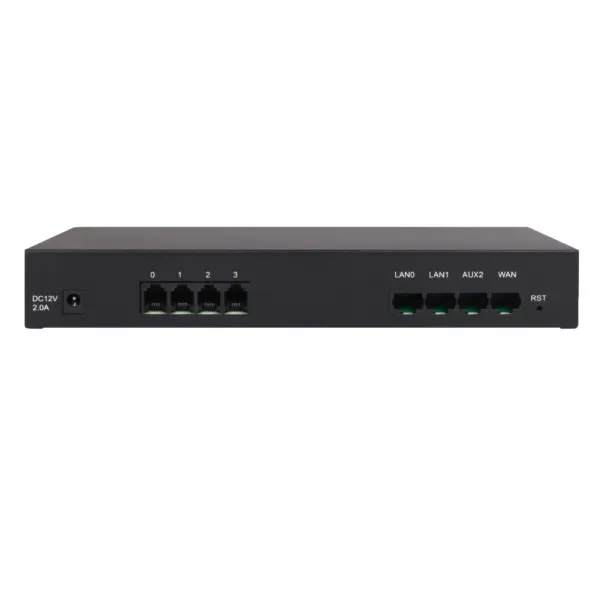
Dinstar DAG1000-4O FXO VoIP Gateway Tanzania
The Dinstar DAG1000-4O is a four-port FXO analog VoIP gateway designed for organisations that need to connect traditional PSTN lines or analog PBX trunks with a SIP-based IP telephony environment. It gives businesses a practical migration path when existing telephone numbers, carrier lines or analog trunk resources must remain in service while the internal communication platform moves toward an IP PBX, SIP server or unified voice architecture. The model supports SIP and IMS, T.38 fax, flexible call routing and dial plans, TLS/SRTP security, IPv4 and IPv6, VLAN and QoS functions, web-based administration, SNMP/TR-069, automated provisioning, configuration backup and restore, logs and main/secondary SIP server failover. For Tanzania buyers, the strongest use case is controlled integration: preserve useful analog carrier access while gaining more structured routing, management and interoperability with modern voice systems.
Dinstar DAG1000-4O Overview
A company does not always need to replace every analog telephone service when it deploys an IP PBX. In many offices, PSTN numbers remain important because customers already know them, a carrier contract is still active, selected departments depend on analog lines, or the organisation wants a backup route separate from its primary SIP service. The Dinstar DAG1000-4O addresses that requirement by presenting four FXO interfaces that can connect external analog telephone lines or analog PBX trunk ports to a SIP-based voice system. In practical terms, it becomes a bridge between the public analog side and the IP telephony side.
The device is suitable for small and medium businesses, remote offices, service counters, branch locations and organisations with multiple sites. It can be used in migration projects, backup line designs, reception routing, branch telephony, fax continuity and mixed analog/IP environments. The right deployment still depends on the customer’s carrier line type, PBX platform, network design, call volume, dialing rules and operational requirements. Before ordering, buyers should confirm that the four FXO port capacity matches the number of analog lines they actually intend to connect and that the target SIP/IP PBX platform supports the planned interconnection.
Analog-to-IP Bridge
Connect up to four analog carrier lines or compatible analog PBX trunk interfaces to SIP-based systems without removing every legacy resource at once.
Routing Control
Flexible routing and dial-plan functions help administrators define how inbound and outbound calls move between FXO lines and the IP voice platform.
Fax Continuity
T.38 and fax pass-through support can help preserve selected fax workflows when used with compatible networks, endpoints and service conditions.
Managed Deployment
Web administration, SNMP, TR-069, provisioning, system logs, backup and restore make the gateway easier to deploy and maintain within a structured IT environment.
Verified Dinstar DAG1000-4O Features
Dinstar positions the DAG1000-4O as a 4 FXO analog VoIP gateway. Official product information lists support for SIP and IMS, SIP v2.0 over UDP/TCP/TLS, fax over T.38 and pass-through, IPv4 and IPv6, VLAN tagging and QoS, call waiting, transfer, forwarding, speed dial, three-way conferencing, hunting groups, voicemail indication, flexible routing and dial plans, system logs and call detail records, firmware and configuration updates over HTTP/HTTPS, backup and restore, SNMP/TR-069, TLS/SRTP and music on hold. The vendor also identifies interoperability with leading softswitches, IP PBXs and SIP servers, while buyers should always confirm compatibility against the exact platform and firmware used in their own environment.
| Area | DAG1000-4O Capability | Buyer Relevance |
|---|---|---|
| Analog interfaces | 4 FXO ports | Connects analog carrier lines or compatible PBX trunk interfaces. |
| VoIP signaling | SIP / IMS; SIP v2.0 over UDP/TCP/TLS | Supports integration with suitable SIP platforms and security policies. |
| Fax | T.38 and pass-through | Useful where fax remains part of business workflows. |
| Network management | Web interface, SNMP, TR-069, provisioning, backup/restore | Helps standardise deployment and ongoing administration. |
| Security | TLS / SRTP | Supports secure SIP signaling/media designs when interoperable systems are configured accordingly. |
Selection, Integration and Deployment Guidance
The first buying question is whether FXO is the correct interface. FXO ports are normally used to accept analog line service from a telecom carrier or a matching analog PBX interface. They are not the same as FXS ports, which provide an analog station interface for a telephone or similar endpoint. A customer who needs to connect four PSTN lines to an IP PBX is therefore considering the right class of product; a customer who needs to connect four analog desk phones may instead require an FXS gateway. Clarifying that distinction avoids one of the most common analog gateway purchasing errors.
The second question is capacity. The DAG1000-4O gives four FXO ports, so the buyer should list every analog line that must be connected, decide whether all four lines may need simultaneous use, document incoming-number behavior, and define whether any line is intended as a backup route. The IP PBX administrator should then map routes, prefixes, permissions and failover behavior. Network planning should cover IP addressing, VLAN placement if used, firewall policy, SIP registration or peer configuration, time synchronisation, remote-management access and the security settings supported by both ends.
For fax deployments, T.38 is useful only when the surrounding environment supports it reliably. Buyers should confirm the fax machine or application, PBX settings, SIP provider behavior and network quality. Similarly, TLS and SRTP are valuable security capabilities, but successful deployment depends on certificate handling, compatible cipher/support settings and correct configuration on the peer system. The correct procurement conversation is therefore not simply “Does this gateway have four ports?” It is “Do these four FXO ports, SIP features, management tools and network requirements match the specific call flow we need?”
Dinstar DAG1000-4O FXO VoIP Gateway Tanzania
For Tanzania organisations, the Dinstar DAG1000-4O is relevant where analog carrier lines remain part of daily communications but the business wants the control and flexibility of an IP PBX. A company may have customer-facing landline numbers that appear on invoices, signage and long-standing contact records; replacing those lines abruptly may not be desirable. By connecting up to four suitable analog lines through the FXO interfaces, the gateway can bring those line resources into a SIP-based phone environment. This is particularly useful for SMEs, multi-branch businesses, schools, clinics, hospitality properties, retail operations, service centres and administrative offices that want gradual migration rather than an all-at-once replacement.
A Tanzania procurement team should begin by documenting its existing line arrangement. Confirm how many analog PSTN lines are active, which numbers receive customer calls, whether any line is used for fax, whether the existing PBX provides analog trunks, and how calls should be routed after the gateway is introduced. If the business already runs an IP PBX, verify its SIP interconnection method and supported codecs/security options. If the business is also replacing the PBX, design the complete voice architecture first so that the gateway is purchased as part of the correct solution rather than as an isolated appliance. This avoids oversizing, undersizing and configuration rework.
Network readiness also matters in Tanzania deployments, especially where voice traffic shares switching and internet infrastructure with normal business applications. VLAN and QoS functions can help administrators separate and prioritise traffic when implemented correctly. A stable LAN, suitable power protection, controlled administrative access and clear configuration records make ongoing support easier. If remote management is required, define the security policy before exposing any management interface. SNMP, TR-069, provisioning, logs, backup and restore are useful because they allow structured administration rather than depending on ad-hoc manual changes.
When requesting a quotation for Dinstar DAG1000-4O Tanzania, provide the quantity, the number of analog lines per site, current PBX or SIP platform, desired incoming and outgoing call flow, fax requirements, network details and deployment city. That information allows the supplier to discuss the model in context. Buyers comparing FourTeck’s broader Dinstar portfolio can also review the FourTeck Dinstar product family for related analog gateways and voice infrastructure. The aim should be a clean integration plan that preserves required legacy connectivity while improving manageability and migration readiness.
Dinstar DAG1000-4O FXO VoIP Gateway Dar es Salaam
Dar es Salaam organisations often operate in communication environments where older analog numbers coexist with newer IP-based systems. Corporate offices, trading companies, logistics operators, clinics, educational institutions, hotels and service businesses may have established PSTN lines that customers already use while internal teams increasingly depend on SIP extensions or IP phones. The Dinstar DAG1000-4O offers a practical bridge by allowing up to four analog lines to be introduced into a compatible SIP architecture. This can support a staged telephony upgrade without forcing the business to discard every existing line at the start of the project.
For a Dar es Salaam office, planning should start with the call flow rather than the device. Identify which analog numbers must ring reception, sales, accounts or support. Decide whether outbound calls should choose a particular FXO line, follow a sequence, or use the analog path only when another route is unavailable. Document business hours, overflow rules and any special dialing prefixes. These requirements become the foundation for the gateway’s flexible routing and dial-plan configuration. Where more than four analog lines are required, the buyer should evaluate a higher-capacity FXO gateway instead of attempting to force a four-port model into an unsuitable design.
The city’s mixed office, warehouse, retail and branch environments also make network design important. Put the gateway on a stable LAN, assign addressing according to the IT policy, use VLAN and QoS where appropriate, and ensure the IP PBX can reach the device with the required SIP settings. For internet-dependent SIP environments, administrators should consider resilience at the wider network level, while remembering that the FXO lines themselves may offer a useful alternate route in some architectures. Dinstar’s main/secondary SIP server failover capability can also support a more resilient signaling design when paired with compatible SIP servers.
A Dar es Salaam buyer asking for “Dinstar 4 FXO gateway,” “PSTN to SIP gateway,” or “DAG1000-4O price” should include technical context in the enquiry. Share current PBX model, analog line count, quantity, preferred deployment date, intended fax use, branch count and whether configuration assistance is required. This produces a more accurate procurement discussion and helps determine accessories or related voice components that may be required. The value of the DAG1000-4O is strongest when it is treated as part of a planned IP telephony design rather than simply a box with four ports.
Dinstar DAG1000-4O FXO VoIP Gateway Mwanza
In Mwanza, businesses with multiple departments or dispersed operations may need to modernise telephony while maintaining familiar analog lines. The DAG1000-4O suits sites where four or fewer external analog lines must be connected to a SIP-based IP PBX or voice server. Typical examples include administrative offices, distributors, service centres, medical practices, educational organisations and branch locations that want to centralise call handling but cannot immediately discontinue existing PSTN access. The gateway enables that transition by converting the analog-line connection into a manageable IP voice path.
The practical buying decision in Mwanza should be based on line usage. A four-port gateway is appropriate when there are up to four active analog circuits that need to participate in the IP PBX call plan. If only two lines are needed, a smaller model may be sufficient; if eight lines are needed, a higher-capacity option may be more efficient. This sizing discipline matters because port count is not merely a specification: it defines how many analog line interfaces the system can physically connect. Buyers should also check whether fax traffic is required, whether analog caller identification must be handled, and how incoming calls should be mapped to extensions, ring groups or IVR destinations.
Mwanza deployments should also account for maintainability. Dinstar provides a web interface, configuration backup and restore, logs, CDR support, SNMP/TR-069 and automated provisioning features. These functions are helpful when an IT administrator or service partner needs to support equipment consistently. Keep a copy of the working configuration after commissioning, document IP addresses and routing rules, and limit administrative access to trusted management networks or secure remote-access paths. If TLS/SRTP will be used, confirm that the PBX and gateway are configured with compatible security settings rather than assuming encryption activates automatically.
For procurement, Mwanza organisations should describe the current system and the desired outcome in plain operational terms. For example: “We have three analog carrier lines and a SIP IP PBX; we want all incoming calls to reach a reception group, while selected outbound calls use specific PSTN lines.” That statement gives the supplier and installer more useful information than a model name alone. The result is a clearer quotation, a more accurate compatibility discussion and a smoother deployment plan for the Dinstar DAG1000-4O.
Dinstar DAG1000-4O FXO VoIP Gateway Arusha
Arusha has a wide mix of hospitality, tourism, professional services, education, healthcare, NGO and commercial organisations that may retain analog phone lines even as their internal communications become IP based. The Dinstar DAG1000-4O is useful when a site wants to keep up to four such lines connected to a SIP environment. A hotel office might preserve an established public number while moving staff extensions to an IP PBX; a professional office may use analog lines as external trunks; a service organisation may keep fax or reception workflows active during a broader migration. The gateway supports this hybrid stage without requiring the analog and IP worlds to remain separate.
For Arusha buyers, interoperability should be validated before purchase. Dinstar states that the gateway works with leading softswitches, IP PBXs and SIP servers, but any real deployment should confirm the exact target platform, software version, SIP transport, codec plan and authentication method. Where the environment uses VLANs, configure tagging consistently across the switch, gateway and voice platform. Where QoS is used, ensure end-to-end policy rather than configuring only one device. These details influence call quality and reliability more than marketing labels do.
The DAG1000-4O also offers useful operational tools for sites where support may be handled centrally. Web management simplifies initial setup, while logs and CDR data can assist troubleshooting and call analysis. Backup and restore reduce the risk of losing a known-good configuration. SNMP and TR-069 can support monitoring or remote provisioning workflows depending on the management platform. For organisations with multiple branches, standardising configuration templates can reduce inconsistency, but each location should still have site-specific line mappings and dialing rules.
An Arusha quotation request should therefore include more than quantity. Specify the analog provider line count, PBX platform, required call routes, branch topology, fax requirement, expected administrative model and whether the site needs installation or configuration support. If the organisation expects growth beyond four analog lines, discuss a larger model before purchase. If the goal is only to attach analog endpoints rather than carrier lines, ask about FXS alternatives. Correct interface selection at the beginning is the simplest way to prevent deployment delays and unnecessary equipment changes.
Dinstar DAG1000-4O FXO VoIP Gateway Dodoma
Dodoma organisations planning a voice-system upgrade may need to balance continuity with modernisation. Government-related offices, institutions, professional firms, schools, clinics, service organisations and commercial offices can have long-established analog numbers that remain important for public contact. The Dinstar DAG1000-4O allows up to four analog PSTN lines or compatible analog PBX trunk interfaces to connect into an IP telephony environment. This is particularly useful when the desired outcome is centralised extension management, SIP-based routing and gradual migration without immediately changing all external telephone connectivity.
A well-designed Dodoma deployment starts with inventory. Record each line number, its current purpose, the department that answers it, whether it supports fax, its normal inbound traffic, and any outbound restrictions. Then translate that business information into the IP PBX route plan. A line used for reception may terminate on a ring group, while another may be dedicated to a department or backup function. Flexible dial plans and routing on the gateway can support this structure, but the design should remain simple enough for administrators to troubleshoot.
Security should also be part of the plan. The gateway supports TLS and SRTP, yet secure operation depends on the complete SIP environment. Administrators should use strong credentials, restrict management access, keep firmware under controlled maintenance practices, and avoid exposing the web interface directly to untrusted networks. Where remote support is necessary, use an organisation-approved secure access method. Backup the configuration after commissioning and again after major changes. These basic operational controls are especially valuable for institutions where communication systems must remain documented and supportable over time.
When requesting Dinstar DAG1000-4O pricing or availability for Dodoma, provide sufficient scope for a meaningful response: quantity, analog-line count, current PBX, target SIP system, expected installation location, fax use, and whether configuration is part of the requirement. Buyers should avoid assuming that every legacy analog setup behaves identically. Line characteristics, PBX interfaces and carrier services can vary, so a pre-deployment review is prudent. With correct sizing and configuration, the DAG1000-4O can serve as a practical transition component in a structured business telephony upgrade.
Dinstar DAG1000-4O FXO VoIP Gateway UAE
UAE organisations often maintain a mix of established analog services, branch PBXs, SIP trunks and cloud or on-premise IP telephony. The Dinstar DAG1000-4O fits projects where four analog carrier lines or analog PBX trunks need to be integrated with a SIP-based platform. Its role is not to replace the IP PBX; rather, it provides the FXO interface required to bring traditional analog line access into the IP voice environment. This can be useful for phased migration, legacy number retention, branch calling, fallback routing and selected fax workflows.
The UAE market also places strong emphasis on interoperability and managed deployment. Buyers should verify the target PBX or SIP server, define how the four FXO ports will be used, and confirm local telecom requirements applicable to their deployment. Dinstar’s SIP/IMS support, T.38 fax, TLS/SRTP, VLAN/QoS, logging and management functions provide a useful toolkit, but configuration must match the surrounding infrastructure. For example, secure SIP signaling requires compatible TLS settings on both peers, and T.38 fax requires support throughout the relevant communication path.
For organisations with Dubai, Abu Dhabi, Sharjah or other UAE sites, central support may be desirable. Standardised configuration, backup files, documented dial plans and monitoring help keep multiple gateways consistent. Main/secondary SIP server failover can support a resilient voice design, while analog lines may also be used as an alternate call path depending on the PBX logic. The exact continuity behavior should be tested rather than assumed. Businesses can review the existing FourTeck Dinstar DAG1000-4O Dubai product page for the same model in the UAE context.
A strong UAE quotation request should state the quantity, site, number of analog lines, PBX platform, required routing, fax needs and whether the equipment is part of a new installation or a migration. Buyers planning more than four analog lines should compare larger FXO models before finalising. Buyers needing analog extension interfaces should ask about FXS or hybrid gateways. Correct specification at the procurement stage avoids costly rework and helps the DAG1000-4O perform the specific bridging function it was designed to provide.
Dinstar DAG1000-4O FXO VoIP Gateway Uganda
Uganda businesses moving from traditional telephony to IP-based communications may still rely on analog PSTN lines for customer contact, backup calling or branch connectivity. The Dinstar DAG1000-4O provides four FXO interfaces that can connect those lines to a compatible SIP IP PBX or voice server. It is therefore suitable for organisations that want to modernise call management while preserving selected existing telephone services. SMEs, clinics, schools, NGOs, hotels, distributors and branch offices can use the gateway where the line count and call-flow requirements fit the four-port design.
Uganda procurement should begin with a technical line audit. Determine how many analog circuits are actually active and whether each one is intended for inbound, outbound, fax or emergency/backup use. Verify the existing PBX type and whether the organisation already has SIP extensions or is planning a new IP PBX. Once these facts are known, routing rules can be designed so that calls reach the correct departments and outbound traffic follows the intended line sequence. The DAG1000-4O supports flexible routing and dial plans, but the value of those features depends on accurate business rules.
Network and support planning are equally important. A stable LAN and controlled IP addressing reduce troubleshooting complexity. VLAN tagging and QoS can support voice segregation and prioritisation when the switching environment is configured accordingly. The gateway’s web interface, logs, CDR, SNMP/TR-069, provisioning, backup and restore functions can help a central IT team maintain devices at multiple sites. If administrators use remote access, the method should follow the organisation’s security policy rather than relying on direct internet exposure.
For broader regional planning, buyers can also visit FourTeck Uganda to review relevant business technology coverage for the Ugandan market. A quotation request for the gateway should include quantity, city, current PBX, analog line count, fax requirement, call-flow notes and configuration expectations. This information helps determine whether the four-port FXO model is appropriate or whether another Dinstar analog gateway size would better match the deployment.
Dinstar DAG1000-4O FXO VoIP Gateway Kampala
Kampala offices frequently have established public phone numbers and a growing need for more manageable internal communications. The Dinstar DAG1000-4O is designed for the point where these requirements meet: four FXO ports connect suitable analog lines or PBX trunks, while SIP provides the path into an IP PBX or voice server. An organisation can therefore preserve familiar external numbers while moving internal users to IP phones, software clients or centrally managed extensions. This is useful for service companies, healthcare sites, schools, hospitality businesses, NGOs, corporate branches and customer-facing offices.
A Kampala deployment should map each physical line to a business purpose. If line one is the main reception number, define its destination and overflow behavior. If line two supports accounts or a fax workflow, treat it separately. If lines three and four provide outbound capacity or backup, define routing priorities. This planning makes configuration easier and reduces accidental call loops or unexpected routing. The gateway supports call functions and flexible dial plans, but the IP PBX usually remains the central place for extension-level business logic, IVRs, ring groups and permissions.
Administrators should also consider how the device will be monitored and maintained. Dinstar supports SNMP and TR-069, as well as web management, automated provisioning, logs and configuration backup/restore. A company with several Kampala branches can benefit from a common configuration standard, yet each site still needs its own IP, analog line identifiers and call-routing details. Keep a change record whenever routing or SIP parameters are modified. After commissioning, test inbound calls on every FXO port, outbound calls through each intended route, failover behavior if configured, and fax operation where required.
When comparing gateway quotes in Kampala, avoid choosing solely by headline price. Confirm model identity, port count, included accessories, technical compatibility and support scope. Ask whether configuration assistance is included or separate. Share the target PBX and line information before ordering. These steps help the business procure a gateway that fits the real environment and make it easier to deploy the DAG1000-4O as a stable bridge between analog services and SIP-based communications.
Dinstar DAG1000-4O FXO VoIP Gateway Arua
Arua businesses and institutions may approach VoIP migration differently from large headquarters. Branch offices, service organisations, schools, clinics, NGOs and regional operations often need a compact system that preserves existing telephone access while enabling modern IP-based call control. The Dinstar DAG1000-4O fits that scenario when no more than four analog lines need to be connected to a SIP environment. Its small port count can be an advantage at remote or branch sites because it avoids deploying a large gateway with unused capacity.
The first design task is to identify whether analog lines are a primary service or a resilience option. If they carry normal inbound and outbound calls, routing should be designed for daily traffic. If they are intended mainly as a fallback to another SIP service, the IP PBX should define when and how calls switch to the FXO path. Dinstar supports main/secondary SIP server failover on the IP side, but overall continuity depends on the complete design. Buyers should therefore test real failover scenarios instead of relying on theoretical assumptions.
For remote support, the gateway’s web administration, logs, backup/restore and management protocols can reduce the need for physical intervention. However, remote management should be secured. Use organisation-approved VPN or protected administrative access, strong credentials and clear ownership of configuration changes. Store a current backup and maintain a simple site sheet containing port assignments, line numbers, IP settings and PBX peer details. This operational discipline makes troubleshooting much faster when a line, network path or SIP registration issue occurs.
Arua customers requesting a Dinstar DAG1000-4O should communicate whether the site has one, two, three or four analog lines today and whether expansion is expected. They should also state the current PBX, desired call routing, fax usage and internet/LAN environment. If growth beyond four FXO lines is likely soon, considering an eight-port or larger model may offer better long-term fit. If the requirement is to attach analog phones, an FXS gateway should be discussed instead. This simple pre-sales clarification protects the project from interface and capacity mistakes.
Dinstar DAG1000-4O FXO VoIP Gateway Mbarara
Mbarara organisations that still depend on analog telephone services can use the Dinstar DAG1000-4O as a controlled migration point toward IP telephony. Four FXO ports provide the physical interfaces for up to four compatible analog lines or PBX trunks, while SIP connectivity links those resources to an IP PBX or voice server. This supports a hybrid stage in which familiar external numbers remain available but internal call handling can move toward extensions, ring groups, routing policies and centralised administration.
For a typical Mbarara SME or institutional site, the gateway can be considered when reception, accounts, service and management each depend on different analog lines, or where several lines are pooled for outbound calls. The correct design should identify which lines are customer facing, whether any are reserved, and how incoming calls should be distributed. Flexible dial plans help translate these needs into routing behavior. The PBX should also be configured with appropriate permissions so that extensions use the correct outbound paths and do not accidentally access restricted trunks.
Call quality depends on more than the gateway. The analog circuit, local wiring, network switching, PBX configuration, codecs and overall LAN condition all contribute. Before blaming a gateway for echo, delay or poor audio, administrators should isolate each layer methodically. Dinstar’s logs, CDR and web diagnostic tools can assist troubleshooting. Where VLAN and QoS are implemented, configuration should be consistent across the network. Where fax is important, test T.38 or pass-through operation using the actual service path before declaring the deployment complete.
For a quotation in Mbarara, provide the model name exactly as Dinstar DAG1000-4O, quantity, number of analog lines, PBX brand/model, network information and the intended purpose of each line. This allows a supplier or integrator to confirm whether four FXO ports are sufficient and whether additional components are required. A clear scope also helps distinguish product supply from installation, configuration, testing and ongoing support, which should be discussed separately rather than assumed.
Dinstar DAG1000-4O FXO VoIP Gateway Gulu
Gulu branch offices, educational institutions, NGOs, healthcare organisations and commercial operations may have modest line counts but still need dependable integration between traditional and modern voice systems. The Dinstar DAG1000-4O is a sensible candidate where up to four analog PSTN lines need to be brought into a SIP-based IP PBX environment. Because the unit focuses on FXO connectivity, it is most appropriate for outside analog lines rather than analog telephone endpoints. Confirming this interface requirement is the first step in correct procurement.
In a Gulu deployment, the gateway can support an incremental upgrade strategy. The organisation can retain its external analog numbers while moving internal users to IP extensions. Incoming calls from an FXO line can then be routed by the IP PBX to reception, ring groups or other destinations. Outbound traffic can be assigned to analog lines based on prefixes, permissions or failover rules. This staged design may reduce disruption compared with replacing carrier access and internal telephony simultaneously.
The site should still be prepared properly. Use stable power and network connectivity, document all cables and line assignments, and keep the gateway in a controlled location. The web interface makes setup accessible, but configuration should be handled by someone who understands both analog telephony and SIP. Incorrect impedance, dialing, SIP or routing assumptions can cause symptoms that appear unrelated. Testing each FXO port individually during commissioning helps confirm that the analog side and IP side both work as intended.
Gulu buyers should ask for a quote that separates hardware, configuration and installation scope if those services are required. Provide line count, PBX details, expected route behavior and quantity. If a site will soon expand beyond four analog circuits, size for the future instead of buying twice. If an organisation has multiple regional sites, use a consistent documentation template so that gateway settings, credentials, IP addresses and line mappings remain easy to support. The DAG1000-4O is most valuable when it is selected as part of a deliberate communications architecture rather than as an isolated device.
Dinstar DAG1000-4O FXO VoIP Gateway Kenya
Kenya has a mature mix of analog business lines, SIP services, cloud telephony and on-premise PBX environments. The Dinstar DAG1000-4O serves organisations that need four FXO interfaces to connect legacy analog carrier lines or PBX trunks with a SIP-based system. It can support a phased migration in which the company preserves valuable existing numbers and external line access while introducing IP phones, software clients, central call routing and more structured administration behind the scenes.
For Kenyan buyers, the port count should be treated as a hard design constraint. Four FXO ports mean four analog line interfaces. If the business has five or more active analog circuits that all need connection, plan for a higher-capacity gateway. If only one or two lines are required, a smaller device may be sufficient. Correct sizing is particularly important for multi-branch deployments where small inefficiencies multiply across sites. Prepare a per-branch line inventory before choosing hardware quantities.
The DAG1000-4O’s support for SIP/IMS, T.38, routing and dial plans, VLAN/QoS, TLS/SRTP and management protocols makes it adaptable, but the surrounding system determines the outcome. Confirm SIP interoperability with the chosen PBX, map DTMF and codec settings carefully, and test any firewall or NAT behavior involved in the design. For fax, validate the actual end-to-end path. For secure SIP, ensure compatible configuration on both sides. For remote management, restrict access and maintain configuration backups.
Kenya customers can consult FourTeck Kenya for regional business technology coverage. When requesting a DAG1000-4O quotation, include city, quantity, line count, PBX platform, fax requirement and installation scope. If the project spans Nairobi and branch locations, define whether all gateways will use one central PBX, local PBXs or a cloud platform. That architecture affects SIP routing, resilience and support. A well-scoped purchase turns the gateway from a simple converter into a controlled part of the organisation’s voice migration strategy.
Dinstar DAG1000-4O FXO VoIP Gateway Kuwait
Kuwait businesses that maintain analog telecom lines alongside modern IP PBX systems can use the Dinstar DAG1000-4O to bridge those environments. The gateway provides four FXO ports for suitable analog line or PBX trunk connections and uses SIP to communicate with an IP voice platform. This can be useful for offices, retail groups, warehouses, clinics, hospitality operations and branch sites that want to retain selected analog numbers while gaining IP-based routing and management.
The procurement process should confirm local line characteristics and compatibility. Analog services can vary, and a gateway should be configured to match the actual provider environment. The IP side should also be reviewed for SIP transport, authentication, codecs, DTMF, network addressing and firewall behavior. Dinstar supports SIP v2.0 over UDP/TCP/TLS and security with TLS/SRTP, but the chosen PBX must support compatible settings. The goal is a tested interconnection, not merely a list of features.
Kuwait organisations often value central management across multiple branches. The DAG1000-4O provides web administration, SNMP/TR-069, provisioning, logs, backup and restore. These tools can support a repeatable rollout when administrators define a standard configuration baseline. Still, each branch requires site-specific analog line assignments and routing. Create a commissioning checklist that tests every incoming line, outbound selection rule, failover path and fax workflow. Store the final configuration after testing so that recovery is straightforward if settings are changed later.
A Kuwait enquiry should specify whether the gateway will connect to an existing IP PBX, a new PBX or a hosted SIP platform. State the quantity, number of active analog lines, call-flow requirement and whether installation is required. If the business expects immediate growth, compare higher-capacity FXO models. If a mixed set of analog phones and PSTN lines must be supported, ask whether a hybrid FXS/FXO gateway would better match the project. Choosing the correct interface family saves time and reduces unnecessary conversion stages.
Dinstar DAG1000-4O FXO VoIP Gateway Ghana
Ghana organisations modernising office telephony may encounter a familiar challenge: established analog PSTN lines remain useful even though internal communications are moving to SIP and IP phones. The Dinstar DAG1000-4O is built for this transition. Four FXO ports connect up to four compatible analog lines or PBX trunks, while the IP side integrates with a SIP-based voice system. This makes the gateway suitable for SMEs, schools, clinics, NGOs, hospitality sites, distributors and branch offices that need a controlled hybrid phase.
The business case should be based on continuity and manageability. Existing analog numbers may be well known to customers, suppliers and partners. By preserving those lines and routing them through an IP PBX, the organisation can modernise internal extensions without changing every external contact point at once. The PBX can then apply ring groups, schedules, extension permissions and other business logic, while the gateway handles the analog/SIP border. Flexible routing and dial plans support this process when correctly configured.
A Ghana deployment should include a simple technical survey. Record line count, provider details, PBX platform, network topology, intended SIP transport, fax use and power/network resilience. Configure VLAN and QoS only when the rest of the network supports the same design. Keep gateway administration protected and documented. Logs, CDR, SNMP/TR-069, provisioning and backup/restore can help support teams maintain the device over its operational life. Where central IT supports branches, consistent configuration naming and records reduce troubleshooting time.
For a commercial quotation, provide quantity, destination, current PBX, analog line count and desired call flow. Avoid assuming availability, delivery time or warranty terms before they are confirmed in the quote. Buyers should also ask whether the supplier can provide configuration or integration assistance if internal IT resources are limited. The gateway itself is only one part of a successful project; correct line mapping, SIP interoperability, network readiness and user acceptance testing determine how effectively it supports the organisation’s communications.
Dinstar DAG1000-4O FXO VoIP Gateway Nigeria
Nigeria businesses often operate multi-layer communication environments that combine SIP trunks, mobile services, analog landlines and branch PBXs. Where four analog PSTN lines must be connected to an IP telephony system, the Dinstar DAG1000-4O provides a focused FXO gateway option. It can preserve external analog connectivity while allowing the organisation to introduce SIP-based call control, IP extensions and centralised routing. This makes it relevant for offices, service centres, healthcare providers, educational organisations, hotels, warehouses and distributed businesses.
Resilience is often a key design consideration. An organisation may want analog lines available as an alternate outbound path or as retained inbound numbers. The DAG1000-4O supports flexible routing and main/secondary SIP server failover, but these capabilities need to be combined with PBX policies and tested under realistic failure conditions. Determine what should happen if the primary SIP server is unavailable, if internet connectivity fails, or if one analog line is down. A documented failover matrix is more valuable than an untested assumption of continuity.
Nigeria deployments should also consider power quality and network stability as part of the overall system design. The gateway should be installed with suitable power protection and connected to reliable switching. QoS and VLAN can help when implemented consistently across the LAN. Web management, SNMP/TR-069, automated provisioning, logs and backup/restore make the device easier to support across branches. Administrators should apply access controls and maintain a known-good configuration backup after commissioning.
When seeking pricing for Dinstar DAG1000-4O Nigeria, buyers should provide line count, existing PBX, city, quantity, desired route behavior and whether fax is needed. Projects with larger analog trunk requirements should compare higher-port models before purchase. Projects connecting analog handsets rather than carrier lines should evaluate FXS gateways. These distinctions matter because the wrong interface type cannot be corrected by software configuration. Careful scoping ensures the purchased gateway matches the physical and operational telephony environment.
Dinstar DAG1000-4O FXO VoIP Gateway Seychelles
Seychelles organisations may have smaller sites and limited line counts, making a compact four-port FXO gateway an appropriate fit for selected telephony migrations. The Dinstar DAG1000-4O can connect up to four compatible analog telephone lines or PBX trunks to a SIP-based IP PBX. Hotels, offices, service businesses, clinics and institutions can use this approach when they want to preserve established analog connectivity while adopting IP phones, centralised extensions or SIP-based call routing.
For island and multi-site operations, supportability is important. A gateway that can be administered through a web interface and supported with logs, configuration backup, SNMP/TR-069 and automated provisioning gives IT teams more options than a purely local analog device. Still, remote management should be secured and tested. Keep configuration backups off the device, document port-to-line mapping and maintain clear contact details for the party responsible for carrier lines and the party responsible for the PBX. Separating those responsibilities helps troubleshoot issues quickly.
The four FXO ports should be mapped deliberately. One line may carry a public reception number, another a reservation or service desk number, and others may be used for outbound or fallback calling. The PBX should route each line according to business need. Fax requirements should be tested with the real provider and PBX environment, even though the gateway supports T.38 and pass-through. Likewise, TLS/SRTP should be validated end to end if secure SIP is part of the design.
A Seychelles quotation request should specify island/site, quantity, analog line count, current PBX and desired call behavior. If the deployment must support more than four analog lines, choose a suitable higher-capacity model rather than adding complexity unnecessarily. If the customer needs analog extension ports, ask about FXS or hybrid gateway options. Correctly matching interface type, port count and voice architecture is the most important step toward a stable deployment, especially where onsite technical access may be limited.
Related Dinstar and VoIP Planning Resources
Buyers comparing models should not assume that every analog gateway performs the same role. FXO gateways connect analog lines toward the IP system, FXS gateways connect analog endpoints, and hybrid products combine both interface types. FourTeck’s Dinstar analog gateway category provides examples of related Dinstar gateway families and capacities. Reviewing adjacent models helps procurement teams choose the correct port count and interface mix rather than selecting only by brand name.
Before purchase, document the full voice environment: analog line quantity, carrier type, PBX model, SIP topology, desired routing, fax needs, network addressing, VLAN/QoS policy, remote management method and expected future growth. This information should accompany the quote request. It allows the sales and technical teams to distinguish between a straightforward four-line integration and a larger migration project that may need additional gateways, an IP PBX, switching changes or installation services.
Dinstar DAG1000-4O FAQs
What does the Dinstar DAG1000-4O do?
It is a four-port FXO analog VoIP gateway that connects suitable analog PSTN lines or analog PBX trunks with SIP-based IP telephony systems. It is commonly used when a business wants to retain analog line connectivity while moving call control to an IP PBX or SIP server.
Is FXO the same as FXS?
No. FXO ports are typically used to connect to analog telecom lines or corresponding PBX interfaces. FXS ports provide the analog station interface used by a telephone or similar endpoint. Buyers should confirm which side of the analog connection they need before selecting a gateway.
Does the DAG1000-4O support fax?
Dinstar lists fax over T.38 and pass-through support. Successful fax operation still depends on the complete environment, including PBX settings, network conditions, fax equipment and service-provider support, so end-to-end testing is recommended.
Can it work with an IP PBX?
The gateway supports standard SIP and is positioned for interoperability with leading IP PBXs, SIP servers and softswitches. Compatibility should nevertheless be checked against the exact PBX model, software version and planned SIP configuration.
How many analog lines can it connect?
The DAG1000-4O has four FXO ports, so it is designed for up to four compatible analog line interfaces. Projects requiring more lines should consider a higher-capacity FXO gateway.
Does it support secure SIP?
Dinstar lists SIP over TLS and SRTP support. Secure deployment requires compatible configuration on the peer PBX or SIP server and correct handling of certificates, credentials and network policy.
Can the gateway be managed remotely?
The product supports web administration, SNMP, TR-069, automated provisioning, backup and restore. Any remote management design should follow the organisation’s security policy and avoid unnecessary exposure to untrusted networks.
Quotation Checklist for Dinstar DAG1000-4O
For the most useful sales and technical response, include the exact model name, required quantity, deployment city/country, number of active analog lines, current PBX or SIP platform, expected inbound and outbound call behavior, fax requirement, branch count, network-management preference and whether installation/configuration support is needed. If the project is a migration, describe what equipment must remain in service and what will be replaced.
Decision Recap
Choose the Dinstar DAG1000-4O when the project specifically requires up to four FXO interfaces for analog PSTN lines or compatible PBX trunks, plus SIP connectivity to a modern voice platform. Its value comes from preserving useful analog services while adding routing control, SIP interoperability, fax support, management tools and security capabilities. It is not the right choice when the requirement is to connect four analog telephones; that normally calls for FXS interfaces. It may also be undersized when more than four analog lines must be active.
For procurement, focus on fit rather than only price. Confirm interface type, port count, PBX compatibility, network readiness, routing logic, fax use, security settings and future growth. A short pre-sales technical review can prevent the common mistakes of buying the wrong analog interface or insufficient capacity.
Consult FourTeck for Dinstar DAG1000-4O Tanzania
Contact FourTeck with your current analog-line count, PBX platform and desired call flow to discuss whether the Dinstar DAG1000-4O is the correct four-port FXO gateway for your project. The discussion can cover model suitability, compatibility questions, configuration scope and quotation requirements without assuming stock, delivery timing or service coverage until these are confirmed for the specific enquiry.



Reviews
There are no reviews yet.