
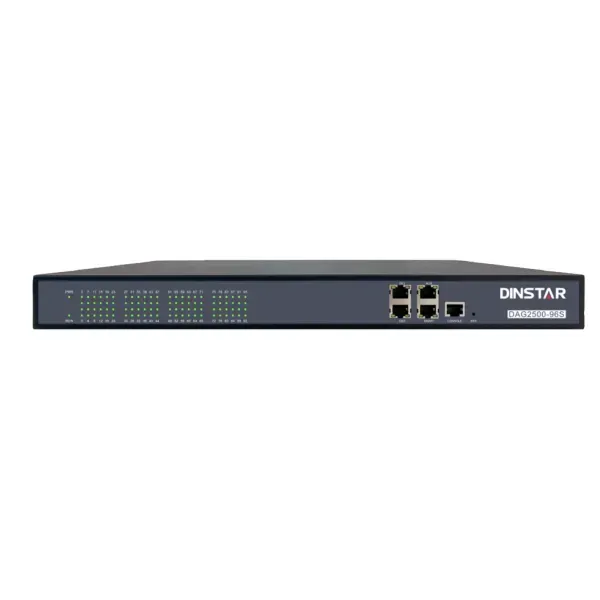
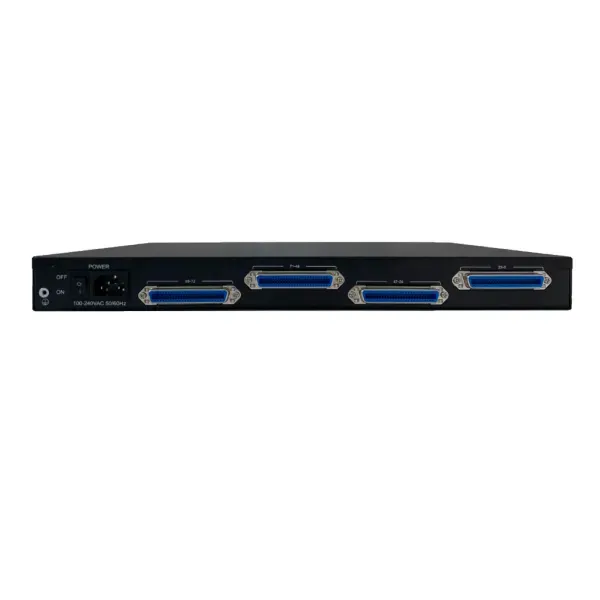
72-port analog-to-IP voice migration
Dinstar DAG2500-72S FXS VoIP Gateway
The Dinstar DAG2500-72S is a high-density analog VoIP gateway for organisations that want to retain existing analog telephones, fax machines and legacy PBX endpoints while moving call control onto SIP-based IP infrastructure. With 72 FXS ports in a rack-friendly platform, it gives hotels, hospitals, schools, campuses, enterprises, service providers and multi-branch organisations a practical way to modernise voice without replacing every analog endpoint at once.
Quick answer: choose the DAG2500-72S when your project needs up to 72 analog FXS extension ports connected to an IP PBX, softswitch, SIP server or IMS environment.
Before ordering, confirm the required analog endpoint count, connector preference, SIP platform, fax requirements, rack/power design and future expansion plan.
What the Dinstar DAG2500-72S solves
Many organisations have already invested in analog room phones, desk phones, fax machines, modems, elevator or service phones and older PBX cabling. Replacing every endpoint simply because the core telephone system is moving to SIP can add cost and operational disruption. The DAG2500-72S acts as the bridge between those analog devices and the newer IP voice platform. Each FXS port presents an analog station interface to an attached device while the gateway communicates upstream using SIP. This allows a staged migration in which the call-control layer can be modernised first and selected endpoints can be replaced later according to business priorities.
Dinstar positions the DAG2500 family as a high-density analog VoIP gateway for 48, 72 and 96 FXS deployments. Official current documentation lists SIP v2, IPv4/IPv6, T.38/pass-through fax, flexible routing and dial plans, TLS/SRTP, VLAN/QoS, SNMP/TR-069, configuration backup and restore, automated provisioning and Dinstar management options. The 72S model is therefore most relevant where analog-extension density is high enough that several small gateways would create unnecessary rack, addressing and management overhead.
A high-density port count for analogue endpoints such as telephones and supported fax devices.
Designed to interoperate with SIP-based IP PBX, softswitch, SIP server and IMS environments after compatibility validation.
Supports voice codecs plus T.38 and pass-through fax modes for mixed legacy requirements.
Web administration, SNMP, TR-069, provisioning, backup/restore and diagnostics help large deployments remain supportable.
Verified technical highlights
| FXS capacity | 72 FXS ports for the DAG2500-72S model. |
| Voice protocols | SIP v2.0 with UDP/TCP/TLS support; RTP-related functions and SIP/IMS interoperability are documented by Dinstar. |
| IP networking | IPv4 and IPv6 support, VLAN and QoS functions. |
| Fax | T.38 and pass-through fax capability. |
| Voice codecs | Dinstar documentation lists G.711 A/U-law, G.723.1, G.729A/B, G.726, iLBC and additional codec options depending on software/variant. |
| Security | TLS and SRTP are listed for signalling/media protection, alongside access-control related functions. |
| Management | Web interface, SNMP, TR-069, provisioning, logs/CDR, firmware upgrade, backup and restore. |
| Form factor | DAG2500 family is designed for high-density 1U deployment. |
Connector options and some physical details can vary by production configuration. Confirm the exact ordered hardware variant, included accessories and current Dinstar documentation before procurement.
Compatibility, deployment and sizing guidance
An FXS gateway is not selected only by counting ports. The attached analog devices must be inventoried, including normal telephones, fax machines, modems or special-purpose lines. The upstream call platform must then be checked for SIP registration method, authentication, numbering, codecs, DTMF method, fax behaviour, NAT/firewall path and failover expectations. Where a legacy PBX is being retained, confirm whether the gateway is presenting station-side FXS interfaces to analog endpoints or whether another gateway type is required for trunk-side integration. FXS and FXO solve different problems and should not be substituted without reviewing the call path.
For a 72-port deployment, operational planning matters as much as protocol compatibility. Numbering plans should be documented before configuration. VLAN and QoS policies should be coordinated with managed switching. The gateway should sit on protected power, preferably within an organised rack with appropriate ventilation and UPS strategy. For large hotels, hospitals or campuses, analogue cabling routes should be surveyed and labelled, especially when many extensions terminate through telecom distribution blocks. Dinstar documentation references long-line support, but real installations should still be validated for cable condition, loop characteristics and the attached endpoint.
Fax deserves separate testing. T.38 can provide reliable fax transport when both sides and the SIP path support it correctly, while pass-through may be required in other environments. Do not assume that a fax function works end-to-end simply because the gateway supports the protocol. Test with the real SIP trunk, PBX and destination pattern used by the organisation.
Who should consider the DAG2500-72S?
This model is most compelling for high-density analogue environments: hotels retaining guest-room handsets during an IP PBX upgrade; hospitals and clinics with many conventional extensions or fax points; universities, schools and campuses with established copper voice cabling; residential or mixed-use properties with analogue apartment phones; factories and warehouses with simple wall phones; call centres or service providers that need controlled analogue extension density; and enterprises consolidating multiple smaller gateways into a more manageable rack design. A smaller gateway is often more economical when only a few analogue extensions remain, while a higher-density model may be better when the installed base exceeds 72 ports. Capacity should be chosen from the actual migration plan rather than from an arbitrary preference for the largest model.
FourTeck resources for a complete voice project
FourTeck Tanzania servicesUseful when the gateway is part of a wider installation, configuration, integration or support scope.
Dinstar gateway portfolioCompare other Dinstar gateway families and understand when FXS, FXO, GSM/LTE or digital gateway types are appropriate.
FourTeck UgandaRegional resource for Uganda IP PBX, VoIP and networking requirements.
FourTeck KenyaRegional resource for Kenya business voice, IP PBX and network infrastructure projects.
Regional buying and deployment guidance
Dinstar DAG2500-72S FXS VoIP Gateway Tanzania
For Tanzania organisations, the DAG2500-72S is particularly relevant when a telephony upgrade must preserve a substantial analogue endpoint base. A hotel may have dozens of guest-room telephones already wired to telecom closets; a hospital may have simple analogue phones across wards plus fax devices in administration; a university or government site may have extensive copper voice cabling that remains serviceable even though the central PBX needs modernisation. In these situations, replacing all endpoints at the same time can be disruptive. The gateway allows the organisation to introduce SIP-based call control while retaining suitable analogue devices behind 72 FXS interfaces. The design should start with an endpoint audit, not with an assumption that every existing line should be migrated unchanged.
Tanzania procurement teams should document the exact number of active analogue extensions, expected growth, whether fax or modem functions remain necessary, and what upstream PBX or SIP service will be used. Where sites are distributed, decide whether each branch should have its own gateway or whether a centralised call platform will register gateways across routed or VPN-connected networks. Voice quality depends on the LAN and WAN path, so VLAN design, QoS, firewall policy and internet or private-WAN stability must be considered alongside the gateway itself. Power resilience is also important: a gateway may keep legacy phones usable during short electrical disturbances only if the gateway, switching, PBX and upstream network equipment are all protected appropriately.
For quotation preparation in Tanzania, include the exact model name, quantity, preferred connector arrangement if known, number of analog endpoints, PBX brand/model, SIP trunk provider where relevant, site city, rack and UPS requirements, and whether configuration or migration assistance is needed. This produces a more useful commercial response than asking only for “Dinstar gateway price Tanzania.” FourTeck Tanzania can use that project context to discuss model fit, supporting infrastructure and a phased migration path without making unsupported assumptions about stock or lead time.
Dinstar DAG2500-72S FXS VoIP Gateway Dar es Salaam
Dar es Salaam businesses often operate dense offices, hotels, hospitals, education facilities, logistics sites and multi-floor commercial buildings where existing analog telephone cabling may still have useful life. The DAG2500-72S can fit projects that need a large number of analogue extensions but want modern SIP call control. A key planning question is whether the gateway will be installed in the same main equipment room as the PBX or closer to the distribution point where analogue cables terminate. Locating the gateway intelligently can reduce unnecessary recabling and make fault isolation easier, but it requires a clear inventory of cable routes and telecom distribution frames.
In a Dar es Salaam hotel, for example, guest-room phones may remain analogue while reception, reservations and management move to IP phones. A 72-port gateway can act as the analogue access layer, with the IP PBX providing extension logic, voicemail, routing and trunk connectivity. In a medical environment, ordinary wall phones and supported fax points can be integrated similarly, but emergency and specialised lines should be reviewed separately rather than migrated by default. The project team should test caller ID, DTMF, ring behaviour, fax, transfer and failover using the actual PBX and service provider.
Commercial evaluation should compare the cost and manageability of one high-density gateway with several smaller gateways. High density can simplify rack space and centralised management, but it also concentrates many endpoints into one device, making power protection, backup configuration, spare strategy and change control more important. Procurement documents should therefore cover not only the gateway price but also connectors, patching, rack space, UPS capacity, network ports, VLAN settings, installation, configuration, testing and handover documentation.
Dinstar DAG2500-72S FXS VoIP Gateway Mwanza
Mwanza organisations considering analogue-to-IP voice migration may have a different priority from large head offices: preserving reliable local extension service while reducing dependence on ageing PBX hardware. The DAG2500-72S provides a path to retain analogue endpoints and move the intelligence of the phone system to a modern SIP platform. This can be useful in hospitality, healthcare, education, industrial and administrative sites that already have structured telephone cabling across several floors or buildings. Before choosing a 72-port unit, count only active and planned analogue endpoints; disconnected legacy numbers should not drive the sizing decision.
Network readiness should be assessed at the same time. The gateway needs stable IP connectivity to the PBX or SIP servers. If that call-control platform is located at another site, WAN reliability, routing, firewall rules and failover strategy become part of the voice design. A secondary route may be desirable for business continuity, but it must be engineered end-to-end rather than assumed from a checkbox in the gateway. For sites using fax, validate T.38 support across the entire call path and retain pass-through testing as an alternative where appropriate.
For Mwanza quotations, provide a port map or at least an extension count by building or department. This helps determine whether one central 72-port gateway is sensible or whether smaller distributed gateways could shorten analogue cable runs and reduce the impact of a single-device fault. Also identify power conditions, rack environment and local access for maintenance. A technically strong quotation should make clear which items are the Dinstar gateway, which are supporting network or rack components, and which are optional implementation services.
Dinstar DAG2500-72S FXS VoIP Gateway Arusha
Arusha has hospitality, tourism, education, NGO, professional-service and administrative environments where telephony requirements can combine modern SIP services with a significant installed base of analogue handsets. The DAG2500-72S is relevant when the analogue count is high enough to justify a dense gateway and the organisation wants to modernise its PBX layer without immediately replacing every endpoint. Hotels are a clear example: room phones may need only reliable calling, wake-up or service-desk access, while front-office staff may benefit from richer IP phone features. A mixed endpoint strategy can control migration cost while keeping the network architecture modern.
The most important design exercise is the call-flow and endpoint map. Identify which extensions must remain analogue, which can become SIP phones, how incoming calls are distributed, what happens after hours, whether fax remains operationally necessary, and how emergency or service numbers are handled. Then test the Dinstar gateway against the chosen IP PBX or hosted voice platform. SIP standards provide broad interoperability, but real deployments still depend on registration, codecs, DTMF, caller ID and vendor-specific behaviours.
Arusha buyers should also include physical implementation details in the bill of materials. High-density analogue projects often need telecom breakout hardware, labelled patching, rack space and controlled power. Keeping these components organised is valuable because future moves and changes are common in hotels, campuses and growing offices. A quotation request that includes endpoint quantity, PBX platform, building type, cabling condition and target migration date gives suppliers enough context to distinguish a simple hardware sale from a full voice-modernisation project.
Dinstar DAG2500-72S FXS VoIP Gateway Dodoma
Dodoma organisations planning new administrative offices or upgrading established sites may need to integrate legacy analogue telephony with newer IP networks. The DAG2500-72S suits environments where many simple extensions remain useful but the organisation prefers SIP-based call control for central administration, routing and future growth. Government-related offices, education facilities, healthcare sites and larger commercial operations can all face this transition. The correct architecture depends on whether analogue endpoints are concentrated in one building or distributed across several blocks and whether the PBX is local, centralised or hosted.
A useful planning method is to separate the project into four layers: endpoint, gateway, IP network and call-control/trunk. At the endpoint layer, verify analogue phones and fax requirements. At the gateway layer, map ports and numbering. At the IP layer, prepare VLANs, QoS, addressing, DNS/NTP and firewall rules. At the call-control layer, configure SIP credentials, routes, dial plans and failover. Testing should include inbound and outbound calls, internal extension calling, DTMF to IVRs, transfer, caller ID and fax where used. This structure makes faults easier to isolate during commissioning.
For procurement in Dodoma, ask for the current exact hardware variant and included accessories rather than relying on an old online photograph or discontinued datasheet. Dinstar has published multiple DAG2500 documentation revisions over time. The requested model should therefore be matched to the current vendor specification available at order time. FourTeck can help frame the requirement around endpoint count, PBX integration and infrastructure so that the commercial offer reflects the real project instead of only a model number.
Dinstar DAG2500-72S FXS VoIP Gateway UAE
In the UAE, high-density FXS gateways are commonly evaluated for hotels, serviced apartments, hospitals, campuses and enterprises that need to preserve analogue extension estates during SIP migration. The DAG2500-72S provides 72 FXS interfaces in a high-density design and can connect those endpoints to IP PBX, softswitch or SIP/IMS infrastructure. Buyers should first determine whether the analogue devices are station endpoints that require FXS; PSTN carrier lines require FXO or a different gateway approach. This distinction prevents one of the most common procurement errors in analogue VoIP projects.
UAE deployments often place strong emphasis on rack density, documentation and centralised management. A 72-port gateway can reduce the number of individual appliances in a telecom room, but the design still needs structured patching and a clear port-to-room or port-to-extension map. If the installation serves hotel rooms, the PBX may also integrate property-management workflows depending on the chosen call-control system; those functions are not provided by the FXS gateway alone and should be validated separately. SIP trunk regulatory and operator requirements should likewise be checked with the selected service provider.
For regional buyers, FourTeck’s Dinstar gateway resources at fourteck.com can help compare FXS, FXO, GSM/LTE and digital gateway families before ordering. When requesting a quote, provide city, quantity, endpoint count, connector preference, PBX platform, rack requirements and any installation scope. Price and availability change with configuration and supply conditions, so they should be confirmed at quotation time rather than assumed from an old catalogue.
Dinstar DAG2500-72S FXS VoIP Gateway Uganda
Uganda organisations can use the DAG2500-72S as part of a phased transition from analogue extensions to VoIP. FourTeck Uganda’s current site focuses on IP PBX, VoIP and networking solutions, which aligns naturally with a high-density FXS gateway project. The gateway is not a complete PBX by itself; it is the analogue access component that places legacy phones or supported fax devices onto a SIP environment. An IP PBX, softswitch or SIP server still provides call-control functions such as extension logic, IVR, queues, voicemail and routing.
For national organisations with several offices, a standard gateway configuration can simplify support. Administrators can standardise VLAN IDs, addressing, SIP server priorities, codec policy, backup naming and port documentation. However, each site may need a different gateway size. A 72-port model makes sense only where analogue endpoint density justifies it. Branches with ten or twenty analogue lines may be better served by smaller Dinstar models, while very large properties may need multiple gateways or a higher-density design.
Procurement should include technical acceptance criteria. Specify successful registration to the chosen PBX, inbound and outbound calling, internal dialling, DTMF, caller ID, transfer and fax tests where relevant. Confirm power, rack and network requirements before shipment. If the project spans Kampala, Arua, Mbarara, Gulu or other cities, document which functions must be identical and which depend on local site connectivity. This prevents a central configuration standard from ignoring practical branch differences.
Dinstar DAG2500-72S FXS VoIP Gateway Kampala
Kampala enterprises, hotels, universities, hospitals and service organisations may have enough analogue extensions in one building to make a 72-port gateway commercially attractive. The advantage is consolidation: rather than operate many small FXS devices, the organisation can centralise more analogue endpoints into a rackmount platform and manage SIP registration, routing and maintenance from a smaller device set. Consolidation must be balanced with resilience; if dozens of phones depend on one gateway, configuration backup, spare strategy, protected power and clear recovery procedures become more important.
A Kampala project should start by tracing the existing PBX distribution. Where analogue cables already terminate in a main telecom room, the DAG2500-72S can often be positioned near that distribution to reuse cabling. Where extensions are split across separate buildings, distributed gateways may be operationally cleaner. The IP network between the gateway and PBX should be monitored for latency, packet loss and congestion. QoS can prioritise voice but cannot repair an unreliable WAN link, so connectivity design remains fundamental.
When comparing suppliers, ask whether the quote includes only the hardware or also breakout cables, patching, rack accessories, configuration, PBX integration, extension mapping and testing. These scopes can materially change project cost. For a fair comparison, make every bidder respond to the same endpoint count and acceptance test. This also makes it easier to distinguish a lower hardware price from a more complete deployment offer.
Dinstar DAG2500-72S FXS VoIP Gateway Arua
Arua deployments may place greater importance on maintainability and self-contained site operation than on maximum feature complexity. Where an institution, hotel, hospital or commercial site has many analogue endpoints, the DAG2500-72S can allow those endpoints to remain in service while the call-control platform becomes IP based. The design should be simple enough that routine support tasks—checking port status, reviewing registration, restoring a saved configuration and tracing an extension—can be performed consistently by the responsible technical team.
Connectivity to a central PBX must be treated as a dependency. If the PBX resides in Kampala or another data centre, the WAN path becomes part of voice availability. Consider whether local calling must continue during a WAN outage and whether the chosen architecture supports that requirement. The gateway itself provides SIP connectivity and failover-related mechanisms, but business continuity depends on the broader call platform and route design. A resilient project therefore examines network, power, SIP servers and trunks together.
For Arua quotations, provide realistic endpoint numbers and identify the critical phones that cannot tolerate extended downtime. This information helps determine whether one 72-port unit is appropriate, whether redundancy is needed, or whether two smaller gateways would reduce failure impact. Also specify cable termination details and rack environment so that the physical installation is not left as an afterthought. Good documentation is particularly valuable when specialist support is not always physically nearby.
Dinstar DAG2500-72S FXS VoIP Gateway Mbarara
Mbarara organisations modernising voice systems can use high-density FXS gateways to protect useful investment in analogue handsets and copper cabling. The DAG2500-72S creates an interface between those endpoints and a SIP-based PBX environment. This is especially useful when the business value lies in central call management rather than in replacing every handset. For example, administrative staff may move to feature-rich IP phones while common areas, hotel rooms, wards or service points continue to use simple analogue phones.
The migration should include a clean numbering plan. Existing extensions may be retained, but duplicate or obsolete numbers should be removed before configuration. Port labels should match room or department identifiers rather than relying only on numerical channel positions. Configuration backups should be saved after commissioning and again after major changes. SNMP or other monitoring can be considered where the organisation already operates a network management platform.
A quote request from Mbarara should describe whether the project is replacement, expansion or a new installation. Replacement projects need details of the old PBX, existing analogue ports and carrier lines. Expansion projects need spare capacity and call-load expectations. New projects should question whether analogue endpoints are actually the best choice everywhere; in some offices, direct SIP phones may be preferable. The DAG2500-72S creates flexibility precisely because the final design can mix analogue and IP endpoints instead of forcing a single technology across the site.
Dinstar DAG2500-72S FXS VoIP Gateway Gulu
Gulu buyers evaluating the DAG2500-72S should focus on the practical reason for retaining analogue endpoints. If existing phones are reliable, staff need only basic calling and the cabling is already installed, an FXS gateway can reduce migration disruption. If the site is being fully recabled or users need richer endpoint features, IP phones may be a better fit for some areas. A mixed design can use the Dinstar gateway for legacy extensions while deploying SIP phones for reception, supervisors and users who need programmable keys or advanced features.
High-density gateways benefit from disciplined change management. When seventy or more lines are available, undocumented moves and port swaps can quickly create confusion. Maintain an extension register showing user or room, FXS port, cable pair, PBX extension, and any special restrictions. Use configuration backups and version notes whenever dial plans or server settings change. These operational practices cost little but significantly improve troubleshooting.
For Gulu procurement, ask the supplier to confirm the exact current Dinstar variant, supported connector arrangement and included power configuration. Add any necessary patching, UPS and rack accessories to the same bill of materials. If remote PBX registration is required, test over the actual WAN or VPN path before full cutover. A controlled pilot with a few representative extensions can reveal caller-ID, DTMF, fax or codec issues before dozens of users are migrated.
Dinstar DAG2500-72S FXS VoIP Gateway Kenya
Kenya businesses and institutions with large analogue estates may consider the DAG2500-72S when modernising to IP PBX or hosted SIP infrastructure. FourTeck Kenya’s current public focus includes IP PBX communication systems, VoIP business phones and enterprise networking, which are the surrounding technologies required for a successful gateway deployment. The gateway should be treated as one component within that architecture: phones attach on the FXS side, the gateway communicates over IP, and the PBX or softswitch controls calls and services.
Hotels and campuses are natural high-density scenarios because they may have many endpoints that need only dependable basic voice service. A 72-port gateway can reduce device count in the rack, but cabling and patching still require careful organisation. For enterprise branches, centralised PBX administration can standardise extension numbering and policies across sites. If voice traffic crosses internet or private WAN links, QoS, VPN design and failover must be coordinated with networking teams so the telephone project does not become isolated from infrastructure planning.
Kenya procurement teams should compare gateway size against realistic future growth. Buying far more analogue ports than necessary can waste budget, while under-sizing can force another appliance soon after deployment. Provide the expected number of analog phones for today, the next expansion phase and the estimated endpoint-retirement plan. Also state fax requirements, SIP platform, rack/power expectations and whether commissioning support is needed. These inputs enable a technically comparable quotation and reduce the chance of hidden accessories or integration work appearing late in the project.
Dinstar DAG2500-72S FXS VoIP Gateway Kuwait
Kuwait organisations can use the DAG2500-72S for hospitality, healthcare, campus and enterprise migrations where analogue endpoints remain valuable but the central voice platform needs SIP connectivity. High-density FXS gateways are particularly suitable for properties with many simple phones, because endpoint replacement can be separated from PBX replacement. The core system can move to an IP PBX or softswitch while legacy phones continue to receive analogue service from the gateway.
In rack-heavy environments, review power and thermal design alongside port density. A 1U gateway conserves space, but dense telecom racks can still become difficult to service if patch cords and breakout connections are not managed carefully. Label each analogue circuit and maintain a port map. Use UPS-backed power where voice availability is important, and include network switches and the PBX in the same protection plan. Redundant or secondary SIP server mechanisms should be configured only as part of a tested overall resilience design.
Kuwait quotation requests should specify the exact number of analogue endpoints, expected connector format, SIP platform, fax requirements and whether existing telecom cabling will be reused. Regulatory and carrier-side SIP trunk requirements should be verified with the selected telecom provider. FourTeck’s regional network can support cross-market procurement discussions, but stock, delivery and local implementation scope should always be confirmed in the formal quotation rather than inferred from a product page.
Dinstar DAG2500-72S FXS VoIP Gateway Ghana
Ghana deployments may use the DAG2500-72S when organisations want to move call control to SIP without discarding working analogue handsets and cabling. The model’s 72 FXS ports suit larger properties and institutions better than small branches. Before purchase, map the existing voice estate by active extension, physical location and device type. Fax machines, modems and specialised analogue devices deserve separate verification because they may behave differently from ordinary telephones over packet networks.
For multi-site companies, central administration can provide consistency while local gateways preserve analogue connectivity at each site. The WAN then becomes a key design element. Define what should happen if connectivity to the primary SIP server is interrupted and test any secondary server or alternate route. Packet loss, jitter and latency can degrade voice even when data applications appear acceptable, so monitoring should focus on voice quality rather than only link uptime.
A Ghana procurement package should include the gateway, appropriate rack/power accessories, breakout or patching components, and professional services where needed. Ask bidders to state assumptions about configuration and integration. If an IP PBX license, SIP trunk, firewall change or managed switch configuration is required, it should be identified separately. This creates transparent project costing and gives IT teams a clearer handover record for future support.
Dinstar DAG2500-72S FXS VoIP Gateway Nigeria
Nigeria has many large hospitality, education, healthcare, industrial and enterprise environments where analogue telephone networks remain operational even as organisations adopt SIP and unified communications. The DAG2500-72S can serve as the bridge for up to 72 analogue endpoints, allowing the business to modernise the PBX layer without creating a compulsory handset-replacement project. This phased approach is often easier to budget and schedule across large sites.
Power and connectivity resilience deserve particular attention in any critical voice deployment. The gateway, PBX, switches and routers should be considered as one service chain. UPS capacity should match realistic outage expectations, and generator or alternate power transitions should be tested. If the SIP platform is remote, dual connectivity or resilient routing may be considered, but the design must be validated as a complete system. The presence of a secondary SIP server setting does not by itself guarantee business continuity.
Nigeria buyers should prepare a detailed port schedule and migration plan before asking for a final price. Include existing PBX details, analogue extension count, trunk type, fax usage, branch topology, rack requirements and preferred support scope. Where many departments are involved, stage the cutover by floor or function and maintain rollback options. A controlled migration reduces user disruption and makes it easier to identify any endpoint-specific issues before the full 72-port estate is transferred.
Dinstar DAG2500-72S FXS VoIP Gateway Seychelles
Seychelles hospitality and resort environments can be a strong fit for high-density FXS gateways because guest-room phones often provide simple, reliable service while the underlying PBX and trunks become IP based. The DAG2500-72S can connect a large block of analogue room or service phones to a SIP platform, allowing the property to retain suitable handsets and cabling. This can be valuable where room refurbishment and telecom-platform replacement occur on different schedules.
Island or distributed-property operations should plan for supportability. Keep spare patching components, configuration backups and a clear port-to-room map. Where the PBX or SIP service is remote, verify WAN performance and define how internal calls or essential services behave during connectivity loss. If multiple buildings are connected by fibre or campus networks, decide whether gateways should be centralised or distributed according to cable topology and fault domains.
For Seychelles quotations, include the number of rooms or endpoints, any staff extensions remaining analogue, fax needs, PBX platform, connector and rack requirements, and desired installation scope. Hotels should also list any property-management or wake-up-call workflows expected from the PBX, because those features are separate from the FXS gateway itself. Confirm logistics, availability and support arrangements at order stage rather than assuming them from another country’s product page.
Frequently asked questions
What does a 72-port FXS gateway do?
It provides analogue station interfaces for up to 72 attached endpoints and connects those endpoints to an IP voice environment using SIP. It is commonly used to retain analogue telephones or fax devices during a migration to IP PBX or softswitch infrastructure.
Is the DAG2500-72S an IP PBX?
No. It is an analogue VoIP gateway. An IP PBX, SIP server, IMS platform or softswitch normally provides call control, extensions, IVR, queues, voicemail and trunk routing.
Can it connect PSTN lines?
The DAG2500-72S is an FXS model intended for analogue station endpoints. Traditional PSTN operator lines normally require FXO interfaces or another gateway type. The exact call path should be checked before ordering.
Does it support fax?
Dinstar lists T.38 and pass-through fax support. End-to-end success still depends on the PBX, SIP trunk and remote fax path, so real-world testing is recommended.
Will it work with any IP PBX?
The gateway uses standard SIP and Dinstar positions it for broad interoperability, but exact compatibility should be validated against the specific PBX release, registration method, codecs, DTMF, caller ID and fax requirements.
What information is needed for a quotation?
Provide the exact model, quantity, analogue endpoint count, site location, PBX or SIP platform, connector preference if known, fax requirements, rack/power context and whether installation or configuration support is required.
Quotation checklist
Decision recap
The Dinstar DAG2500-72S is a strong candidate when you need a high-density 72-port FXS bridge between analogue endpoints and a SIP-based voice platform. Its value is not simply the port count; it is the ability to preserve working analogue infrastructure while moving call control, management and trunking toward IP. The best fit is a site with many analogue extensions, organised telecom cabling and a clear PBX migration plan.
Choose the gateway only after confirming endpoint quantity, FXS versus FXO requirement, SIP compatibility, fax behaviour, network readiness, connector arrangement, rack/power needs and resilience expectations. A well-documented design is easier to commission, support and expand.
Discuss your Dinstar gateway requirement with FourTeck Tanzania
Share your current PBX, number of analogue extensions, site city and desired migration outcome. FourTeck can use that information to prepare a more useful product quotation and identify whether the DAG2500-72S, another Dinstar port density, or a different gateway type is the better technical fit.




Reviews
There are no reviews yet.