
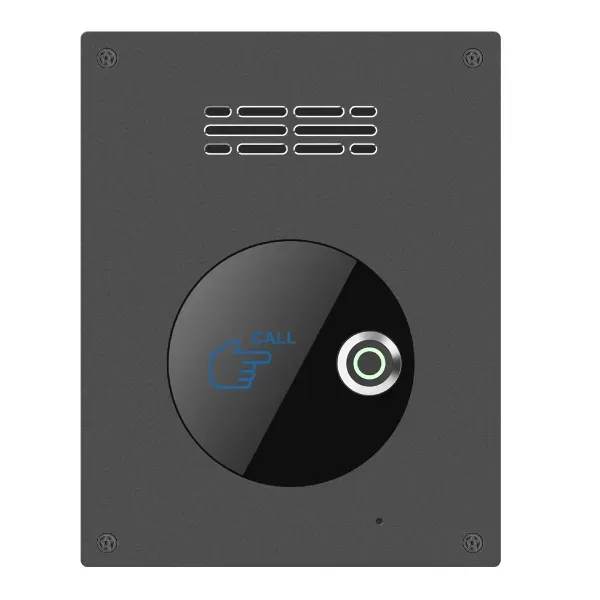

Dinstar DP81 SIP Audio Intercom
The Dinstar DP81 is a dual-button SIP audio door phone for organizations that want entrance communication to operate as part of a standards-based IP network. Dinstar positions the DP81 for business, institutional and residential applications and lists HD voice, two-way audio, dual SIP lines and servers, DTMF door release, SIP over TLS, SRTP, PoE, web management and automatic provisioning. Its metal construction, IP65 ingress rating and IK10 impact rating make it suitable for protected outdoor and demanding entrance locations when installation conditions are properly assessed. FourTeck Tanzania can help buyers connect the device to a compatible IP PBX, managed PoE network and electronic door-lock workflow rather than treating the intercom as an isolated product.
Dinstar lists G.722 wideband audio, two-way full-duplex communication, echo cancellation, VAD and comfort-noise generation for clearer entrance conversations.
DTMF-based remote unlocking can be used with an appropriately integrated electronic lock, allowing authorized users to answer and release a door through the communication workflow.
The official DP81 datasheet lists 10/100 Ethernet and IEEE 802.3af PoE Class 3, helping simplify entrance cabling when the switch and power budget are designed correctly.
Dinstar publishes IP65 and IK10 ratings for the DP81 family and uses an aluminum surface with a metal bottom shell, supporting entrance installations where physical resilience matters.
What the Dinstar DP81 is designed to solve
Traditional doorbells and stand-alone intercoms often create a separate communication system that has little relationship with the company telephone network. The DP81 approaches the entrance as a SIP endpoint. A visitor presses a call button, the intercom can place a SIP call to a configured destination, and authorized staff can communicate through the same standards-based voice environment used elsewhere in the organization. This design can be useful for reception desks, security stations, gatehouses, controlled offices, warehouses, schools, clinics, residential compounds and other sites that need a voice path between the entrance and an internal user.
Dinstar lists two SIP lines and two SIP servers. That provides design flexibility for primary and secondary registrations or separate calling arrangements, but the exact behavior should be validated against the intended PBX. The DP81 also supports DTMF in-band, RFC2833 and SIP INFO, which is relevant because remote door release often depends on a defined DTMF method. A successful deployment therefore requires more than registering the unit: the installer should confirm SIP credentials, dial plan, codec policy, DTMF mode, relay behavior, door-lock power, exit-button logic and any network security rules.
For projects that already use an IP PBX, the DP81 can be evaluated as another managed extension at the edge of the voice network. For new sites, the intercom decision should be made together with PBX selection, PoE switching, structured cabling, UPS coverage and access-control hardware. FourTeck Tanzania’s business technology shop provides a broader procurement context, while the Tanzania technology services page explains how network, telephony and security components can be planned together.
Verified Dinstar DP81 technical highlights
| Area | Verified detail | Planning relevance |
|---|---|---|
| SIP | SIP v1/v2, two SIP lines, two SIP servers | Validate registration, failover design and feature behavior with the intended PBX. |
| Security | SIP over TLS, SRTP, HTTPS management and 802.1X listed by Dinstar | Useful where encrypted signaling/media and controlled LAN access are part of the security design. |
| Audio | G.722 plus PCMA, PCMU, G.729, G.723 and G.726 options; echo cancellation, VAD and CNG | Codec policy should match PBX and network conditions. |
| Network | 10/100 Ethernet, DHCP/static/PPPoE, 802.1p/q and DSCP | Supports managed voice-network designs with VLAN and QoS planning. |
| Power | 12V DC or IEEE 802.3af PoE Class 3 | Check switch PoE budget, UPS strategy and cable run before installation. |
| Management | FTP/TFTP/HTTP/HTTPS/PnP provisioning, web management, SNMP/TR-069, syslog, backup/restore | Useful for standardized deployments and remote administration. |
| Housing | Aluminum surface, metal bottom shell, IP65 and IK10 | Assess mounting, water exposure, cable sealing and physical impact risk at the actual entrance. |
Compatibility, door hardware and network integration
A SIP intercom sits at the intersection of telephony, networking and physical security. On the voice side, the PBX must accept the device registration and route calls to the correct extension, ring group, security desk or other destination. On the network side, the switch must provide suitable Ethernet connectivity and, when PoE is used, sufficient power. On the door side, the electronic lock, relay, exit button and power supply must be selected according to the actual door hardware and safety requirements. These layers should be tested together before handover.
Dinstar lists relay outputs, sensor inputs, exit-button interfaces and a Wiegand reader interface in the official DP81 datasheet. These interfaces create useful integration possibilities, but they should not be interpreted as proof that every third-party lock, controller or reader will work without design verification. The installer should confirm voltage, current, normally-open or normally-closed logic, fail-safe or fail-secure behavior, emergency release requirements and how access events are expected to be managed. Where the site already has a dedicated access-control platform, the DP81 may be used primarily as a SIP communication endpoint while the access system retains responsibility for credentials and door policy.
For telephony-adjacent procurement, buyers can review the Dinstar C63G business IP phone, Dinstar C64G business IP phone, Dinstar C64GP PoE business IP phone, Dinstar C66G business IP phone and Dinstar C66GP PoE business IP phone. These related endpoints are useful when a project needs desk phones for the staff who will answer intercom calls through the same SIP environment.
Dinstar DP81 SIP Audio Intercom Tanzania
Organizations searching for the Dinstar DP81 SIP Audio Intercom in Tanzania are usually solving a practical entrance problem: visitors need a dependable way to reach reception, security or another internal team, and authorized staff need a controlled method to communicate before granting access. The DP81 is especially relevant where the business already uses SIP telephony or plans to standardize communications on an IP PBX. Instead of installing a separate proprietary voice path at the door, the intercom can be planned as part of the Ethernet and SIP environment, subject to compatibility testing with the PBX and door hardware.
For Tanzanian offices, warehouses, schools, clinics, compounds and commercial buildings, procurement should begin with the entrance workflow rather than the model number alone. Decide who should receive the call, whether calls must ring one user or a group, whether calls should divert after hours, how the door is released, what happens if the PBX or LAN is unavailable, and whether the entrance location is exposed to rain, dust or physical impact. Dinstar’s IP65 and IK10 ratings are useful design inputs, but good mounting, sealing, cable protection and suitable door hardware remain important. PoE can simplify installation by carrying network connectivity and power over one Ethernet run, but switch capacity and UPS backup should be confirmed.
Tanzania deployments should also account for network segmentation and security. An intercom does not need broad access to the corporate LAN. A managed switch can place voice and security endpoints in an appropriate VLAN, while firewall and ACL policies can limit unnecessary communication. SIP over TLS, SRTP and HTTPS management are available according to Dinstar, but they need matching support and configuration on the PBX and management side. Before requesting a quotation, buyers should provide quantity, site type, PBX platform, switch model, PoE availability, door-lock type, cable distance, preferred call destination and any need for external reader, exit button or sensor integration.
Dinstar DP81 SIP Audio Intercom Dar es Salaam
Dar es Salaam businesses often combine reception, security, delivery access and employee movement at busy entrances, making an IP intercom useful when the communication path needs to be fast and easy to administer. The Dinstar DP81 can be considered for corporate offices, logistics facilities, hotels, clinics, schools, mixed-use buildings, warehouses and gated business sites that already maintain structured cabling and managed network infrastructure. Its SIP architecture allows a visitor call to be routed to a desk phone, security extension or other configured destination on a compatible PBX, which can reduce the need for a completely separate voice system at the door.
A Dar es Salaam project should pay close attention to switch and cabling design. If the entrance is far from the communications rack, confirm Ethernet distance and cable route before choosing the final topology. PoE is convenient, but only when the switch has available Class 3 budget and the cable path is correctly installed and protected. If the business wants intercom availability during short power interruptions, the PoE switch, PBX and upstream network should be connected to an appropriate UPS strategy. Where the device is installed near an exposed gate or building perimeter, enclosure placement, drain paths, surge risk and mechanical protection should be reviewed even though the DP81 itself carries published IP65 and IK10 ratings.
Call flow matters just as much as hardware. Reception may answer during office hours while security answers after hours. A warehouse could route the second button to a dispatch team. A clinic may separate visitor and service access. These are PBX and operational decisions that should be mapped before programming. For organizations operating across borders, FourTeck’s UAE technology solutions and Africa technology resources can provide regional context for standardized voice and security architecture across multiple locations.
Dinstar DP81 SIP Audio Intercom Mwanza
In Mwanza, the Dinstar DP81 can suit branch offices, education sites, healthcare facilities, commercial compounds and operational premises where a visitor needs to reach staff before a controlled entrance is opened. The value of a SIP intercom is strongest when the organization already has an IP network and wants entrance calling to follow the same extension logic used by office phones. A security desk can receive calls on a SIP handset, a reception team can use a ring group, or the call can be directed according to the organization’s normal PBX rules. The two-button format can also support two distinct destinations when the business process requires it.
Mwanza deployments should be documented carefully if support staff are not always at the site. Dinstar’s web management, auto-provisioning, SNMP/TR-069, syslog and configuration backup features can support repeatable administration, but only when credentials, firmware policy, network access and configuration ownership are defined. A useful commissioning record should note the intercom IP address or DHCP reservation, SIP extension, PBX server, VLAN, switch port, relay wiring, DTMF method and call destinations. This turns future troubleshooting into a controlled process instead of an exercise in rediscovering how the entrance was built.
Power and lock integration also deserve attention. PoE can reduce local power requirements for the intercom, but the electronic lock may still require its own appropriately rated power supply. The installer should confirm whether the lock is fail-safe or fail-secure, what emergency release method applies, and whether a door contact or exit button is required. The DP81 offers useful interfaces, but the full access solution remains a system. For a quotation, Mwanza buyers should share the number of entrances, desired call destinations, PBX details, switch type, available cabling, door construction and electronic-lock information so the bill of materials reflects the real site.
Dinstar DP81 SIP Audio Intercom Arusha
Arusha organizations in hospitality, tourism support, education, healthcare, professional services and commercial property management may need entrance communication that is simple for visitors but manageable for IT and security teams. The Dinstar DP81 provides a standards-based SIP path for this requirement. A visitor can place a call from the door station, staff can answer through a compatible IP telephony environment, and DTMF can be used as part of a remote-unlock workflow when an electronic lock has been correctly integrated. This approach can be especially useful when reception and security teams already use SIP desk phones and the organization wants one coordinated communications platform.
Hospitality and public-facing sites should define service behavior before configuration. For example, a hotel administration entrance may ring reception first and security second, while a staff entrance could follow a different rule. A school or institution may need calls to reach a gatehouse during the day and a duty phone after hours. The DP81’s two SIP lines and dual SIP-server capability provide options, but these functions should be tested on the chosen PBX rather than assumed from the datasheet alone. The network should also prioritize reliable voice, particularly where large guest Wi-Fi loads, CCTV streams or cloud applications share the same uplinks.
Arusha installation planning should include environmental exposure. IP65 and IK10 are helpful product attributes, yet cable entry, wall surface, canopy protection, drain direction and surge protection still affect long-term reliability. If the entrance is a gate rather than a building wall, cable distance and grounding conditions may change the design. Buyers should provide photos or site drawings where possible, plus lock information, PBX details and PoE-switch capacity. This allows a quotation to include the intercom together with relevant network, power and access-control dependencies instead of leaving critical installation components to be discovered later.
Dinstar DP81 SIP Audio Intercom Dodoma
Dodoma offices and institutions may evaluate the Dinstar DP81 when they need controlled visitor communication at administrative entrances, restricted offices, campus buildings, clinics, compounds or facilities that already use IP telephony. The intercom’s SIP-based design makes it possible to fit door communication into a broader extension plan rather than maintain a stand-alone proprietary station. Dinstar lists two SIP lines, dual SIP servers, HD voice, DTMF access control and several management protocols, which can support both user convenience and structured IT administration when the system is configured carefully.
For environments with formal IT processes, secure management can be an important selection factor. HTTPS configuration, SIP over TLS and SRTP are available according to Dinstar, but encryption should be enabled as part of a deliberate design. The PBX must support the same transport and certificate arrangement, and the device should be placed on a network segment that exposes only the services it needs. Administrative passwords should be changed, configuration backups should be stored securely, and firmware upgrades should be planned instead of applied without change control. Syslog or SNMP can be useful when the organization monitors network devices centrally.
Door safety and operational policy remain separate from SIP configuration. Before remote unlocking is enabled, the project team should confirm who is authorized to release the door, whether a camera or visual-verification method is also required, and how the entrance behaves during power or network failure. A voice-only intercom can be entirely appropriate, but some security environments may require video or credential-based access as well. Dodoma buyers should therefore describe the security objective, not only request a model. That enables the DP81 to be positioned correctly within the overall door, network and communications design.
Dinstar DP81 SIP Audio Intercom UAE
UAE commercial projects often use structured cabling, managed PoE switches and centralized IP PBX platforms, conditions that can make the Dinstar DP81 a natural candidate for entrance communication. The device can register as a SIP endpoint, use PoE for simplified cabling and communicate with reception or security extensions. For branch-standardization projects, the same basic design principles can be repeated across sites: defined VLAN, documented extension, fixed call destinations, consistent DTMF behavior, controlled management access and a standard relay interface to approved door hardware.
UAE buyers should still avoid treating the intercom as a plug-and-play door controller. Building access requirements, lock type, life-safety rules and existing security systems can determine whether the DP81 should directly drive a relay or communicate alongside a dedicated access-control controller. In offices with existing card or biometric access, the intercom may be most useful for visitors and delivery personnel while the access system continues to handle employee credentials. In gated warehouses or industrial facilities, the device may be part of a larger gate-control arrangement with additional sensors, barriers or cameras.
Network security is especially relevant when many branches share corporate standards. Dinstar lists 802.1X, SIP over TLS, SRTP and HTTPS, giving network teams options for stronger endpoint controls. Organizations should test these features with the actual PBX, switch and certificate infrastructure before mass rollout. FourTeck’s UAE IT and telecom platform can support broader regional requirements, including IP telephony and access-control planning. A complete quote request should include site count, quantity per site, PBX platform, PoE-switch models, cabling status, lock interface, required call flow and any centralized provisioning requirement.
Dinstar DP81 SIP Audio Intercom Uganda
Ugandan businesses and institutions can consider the Dinstar DP81 when they need an IP-based visitor intercom that integrates with existing SIP telephony. A branch office may route the entrance to reception, a warehouse may route it to security, and a school or clinic may use different destinations for separate buttons. Because the device supports two SIP lines and two SIP servers, there is flexibility in registration design, although the exact high-availability or multi-server behavior should be validated with the chosen PBX rather than assumed.
Uganda deployments often benefit from centralized configuration when an organization manages several sites. Dinstar provides automatic provisioning through common protocols, HTTP/HTTPS administration, TR-069, SNMP, syslog and configuration backup/restore. These tools can reduce site visits if the WAN path and security policy permit remote administration. A standard template can define SIP credentials, codec preferences, DTMF method, speed-dial destinations, time settings and management access. Each unit should still have a site-specific record showing switch port, IP details and door-relay wiring so remote support teams can distinguish network faults from door-hardware problems.
For organizations with regional operations, the FourTeck Uganda technology site can provide country-level context for IP PBX, VoIP and networking requirements. Procurement should state whether the PBX is on-premises or remote, because WAN-dependent intercom calling requires stable connectivity and correctly configured firewall rules. Buyers should also define local power conditions, PoE availability, entrance exposure and lock type. The DP81 can be a useful endpoint, but reliable service depends on the complete chain from visitor button to network to PBX to answering extension and then to the physical door-release circuit.
Dinstar DP81 SIP Audio Intercom Kampala
Kampala offices, hospitals, schools, hotels, logistics companies and multi-tenant commercial facilities may use SIP door intercoms to connect a busy entrance with reception or security without deploying a separate analog communication system. The Dinstar DP81 provides dual-button calling, HD audio and network-based management in a metal enclosure. Where a site already uses SIP desk phones, the intercom can be integrated into a familiar call-handling environment so staff can answer from an extension and, when authorized, send the DTMF command used by the door-release workflow.
Kampala network planning should consider traffic separation and supportability. If voice, cameras, Wi-Fi and ordinary office data share one switch stack, VLANs and QoS can help keep services organized. The DP81 supports 802.1p/q and DSCP according to Dinstar, which allows it to participate in a structured network design. That does not remove the need to configure the switches correctly. The device should receive predictable IP addressing, use secure administrative credentials and communicate only with required services. Where encrypted SIP is required, TLS and SRTP should be tested with the PBX before rollout.
At the physical entrance, the project team should verify the wall or gate mounting surface, cable route, lock power supply, relay logic, exit button and door contact. If a door must unlock automatically during an emergency, the intercom should not be made the sole safety mechanism. For a Kampala quotation, include site photos, number of doors, whether each door needs one or two call destinations, PBX make and version, switch type, PoE budget, lock specification and any required external reader. These details help move the conversation from simple product price to a deployable entrance solution.
Dinstar DP81 SIP Audio Intercom Arua
Arua branch offices and institutions may value the Dinstar DP81 for a different reason from a large headquarters: a compact site still needs controlled visitor communication, but support staff may not be permanently available on premises. A SIP intercom can allow the entrance to call a local reception extension or, where the PBX and WAN design support it, a centrally managed destination. This makes the quality of network connectivity and documentation particularly important because a remote support team needs to understand whether a failure comes from the LAN, the SIP registration, the PBX route or the physical lock circuit.
Dinstar’s management features can help with distributed support. Automatic provisioning, web configuration, SNMP/TR-069, syslog and backup/restore make it possible to maintain a standard device profile. Administrators should still restrict management exposure, use strong credentials and keep an asset record. Where the branch relies on an internet VPN to reach a central PBX, voice latency and packet loss should be checked. An intercom conversation is short, but it is operationally important; a visitor who cannot reach staff may block deliveries or prevent legitimate access.
Physical resilience also matters for smaller sites. The DP81’s metal housing, IP65 rating and IK10 rating are relevant for exterior-facing installations, yet the installer should inspect water exposure, direct sun, gate movement, cable protection and local power conditions. PoE can reduce the number of local adapters at the entrance, while a UPS-backed switch may improve continuity. The electronic lock may require separate protected power. Arua buyers should provide the expected answering destination, connectivity to the PBX, entry-door construction and local support model so the deployment can be designed for simplicity rather than unnecessary complexity.
Dinstar DP81 SIP Audio Intercom Mbarara
In Mbarara, the Dinstar DP81 can support offices, schools, healthcare facilities, warehouses, compounds and commercial sites that need staff to speak with visitors before releasing a controlled entrance. Its dual-button format can be useful where two different functions share one entrance, such as reception and security, office and warehouse, or visitor and service access. The correct mapping depends on the PBX dial plan and operating procedure. The goal is to make the visitor experience clear while ensuring staff can identify which entrance is calling and respond consistently.
For IT teams, the DP81 behaves more like a network endpoint than a traditional doorbell. It requires an IP address, SIP registration, switch connectivity and appropriate security policy. Dinstar lists DHCP and static addressing, VLAN/QoS-related features, SIP TLS, SRTP and HTTPS administration. A managed deployment can reserve addresses, label switch ports, separate the device into a voice or security VLAN and log key events. Where a local PBX is used, the design may remain independent of the internet. Where the PBX is hosted or located elsewhere, WAN quality and firewall configuration become more important.
Mbarara procurement should also identify who owns the door hardware. If a security contractor already manages an access-control panel, the intercom should be integrated without bypassing established safety and authorization policies. If the project is new, the lock, power supply, exit method and relay wiring must be included in the design. The DP81 can trigger remote unlocking by DTMF when correctly wired, but authorization comes from the business process. A useful quotation request lists intercom quantity, door type, lock type, call recipients, PBX platform, PoE availability, cable distance and any need for centralized monitoring or configuration.
Dinstar DP81 SIP Audio Intercom Gulu
Gulu organizations considering the Dinstar DP81 may be upgrading from a simple doorbell, analog intercom or manual gate process to a system that can call staff over the IP network. The main benefit is not simply that the unit supports SIP; it is that entrance communication can follow the same extension plan and management practices as business telephony. A security office can answer from a standard SIP endpoint, and an alternate destination can be configured through the PBX when the primary user is unavailable. This can make after-hours or departmental call handling more predictable.
The design should remain resilient. If the local switch or PBX loses power, the intercom may no longer place calls even if the device itself is physically intact. A continuity plan can therefore include UPS-backed networking, clearly documented manual access procedures and a lock design that meets the site’s safety requirements. PoE simplifies intercom power, but it also concentrates dependence on the network rack. The power budget, UPS runtime and switch port should be reviewed as part of the entrance-security discussion rather than left to the networking team after installation.
Gulu sites with limited on-site IT support should favor clear documentation and standardized settings. Record the SIP account, PBX route, DTMF mode, relay logic, network configuration and management credentials in a secure location. Dinstar’s configuration backup and provisioning functions can help preserve consistency. For procurement, provide quantity, entrance locations, local network topology, PBX location, lock details and the staff groups expected to answer. That information determines whether the DP81 is a straightforward single-door endpoint or one component of a wider access and communications project.
Dinstar DP81 SIP Audio Intercom Kenya
Kenyan businesses with offices, warehouses, schools, clinics, hospitality sites and gated facilities can use the Dinstar DP81 as part of a structured SIP and security architecture. The device is particularly relevant where the organization already uses managed Ethernet and IP telephony, because the intercom can share established network and call-routing practices. A visitor presses one of the two call buttons, the PBX routes the call, and authorized staff can communicate before deciding whether to release the door through a configured DTMF process.
Multi-site organizations should decide whether each branch registers locally or to a centralized PBX. Local registration can reduce dependence on WAN connectivity, while a central platform can simplify administration when connectivity is reliable and securely designed. Dinstar supports dual SIP servers, which may be useful in some redundancy architectures, but buyers should test failover behavior with the chosen PBX. QoS, VLANs, DHCP design and firewall rules should also be standardized. The DP81 supports secure SIP and encrypted media options, but they should be enabled consistently with the organization’s certificate and PBX policies.
For regional coordination, FourTeck’s Kenya business technology site provides context for IP PBX, networking and security requirements. Kenyan buyers should specify whether the door already has an electronic lock, whether an access-control panel is present, what the desired call destinations are, and how many intercoms are required. Where several entrances are involved, naming conventions and extension numbering become important so staff can recognize the calling door immediately. A complete quote should include the endpoint, networking, installation and door-interface requirements rather than assuming the intercom alone completes the solution.
Dinstar DP81 SIP Audio Intercom Kuwait
Kuwait commercial and institutional sites can evaluate the Dinstar DP81 for entrances that need robust audio communication over a SIP network. Offices, warehouses, education facilities, residential compounds and controlled service entrances can benefit from a door station that fits into an existing PBX. The DP81 combines dual-button operation with HD audio, PoE and remote DTMF release support, while its metal housing and published IP65/IK10 ratings make it suitable for environments where a conventional indoor handset-style intercom would be inadequate.
Environmental placement should still be engineered carefully. High temperatures, direct sunlight, dust exposure, reflective surfaces and the physical location of the entrance can affect user experience and equipment life even when a device has protective ratings. The installer should choose a mounting position that keeps microphone and speaker performance usable and protects cable entry. Network equipment should be located in a controlled environment where possible. If PoE is used, switch temperature, power budget and UPS support should be included in the design.
Kuwait buyers with multiple facilities can standardize the PBX and network profile for each intercom, then vary only the extension and destination. Provisioning, HTTPS administration, SNMP/TR-069 and syslog support can assist this approach. FourTeck’s Kuwait technology platform can support regional solution planning. Before ordering, procurement should confirm the exact quantity, call-routing requirement, PoE availability, cable distance, door-lock voltage and logic, desired security settings and any need for local or centralized management. This avoids a common mistake: purchasing the door phone before determining how it will interact with the actual door and telephone environment.
Dinstar DP81 SIP Audio Intercom Ghana
Ghanaian companies and institutions can consider the Dinstar DP81 where visitor communication needs to be integrated with office telephony rather than handled by a stand-alone bell or analog intercom. The device can support reception desks, security rooms, gated offices, schools, clinics, warehouse entrances and residential or mixed-use developments. Using SIP means call destinations can be managed through the PBX, allowing the entrance workflow to reflect normal business rules such as ring groups, time conditions or alternate answering points where supported by the platform.
A Ghana deployment should be planned around reliability and serviceability. PoE can simplify field wiring, but the access switch must have available power and should be backed up appropriately if entrance communication is considered operationally important. The electronic lock may use separate power, and door-release wiring should be protected from accidental or unauthorized access. If the entrance is outdoors, mounting, water paths, cable glands and surge protection should be assessed. IP65 and IK10 ratings are valuable but do not replace sound installation practice.
FourTeck’s Ghana IT and business communications site provides regional context for telephony, switching and access-control projects. Organizations should decide who will administer the intercom after handover. Dinstar’s web interface, provisioning, SNMP/TR-069 and backup functions are useful when ownership is clear. For quotations, provide the number of sites and doors, PBX details, desired extensions or ring groups, network and PoE information, lock hardware and any requirement for a reader, door sensor or exit button. These inputs determine the real deployment scope much more accurately than a product name alone.
Dinstar DP81 SIP Audio Intercom Nigeria
Nigeria’s large offices, estates, warehouses, schools, clinics and multi-branch companies often need entrance communication that can scale beyond a single receptionist and one doorbell. The Dinstar DP81 can be part of that architecture because SIP allows door calls to use a business PBX and network. One button can reach reception while another reaches security or a different department, depending on the configuration. For organizations with multiple locations, standardized device profiles can make it easier to deploy and support the same entrance workflow across branches.
Power continuity is an important design issue. If the intercom uses PoE, the access switch and PBX infrastructure must remain powered for calls to work. UPS capacity should therefore reflect the criticality of voice, security and network systems together. Where power conditions vary, the team should document what happens when mains power fails and how the door behaves. A fail-safe lock, fail-secure lock and magnetic lock can have very different operational consequences. Those decisions should follow the site’s security and life-safety requirements rather than be determined by the intercom alone.
Network teams can take advantage of Dinstar’s listed support for SIP TLS, SRTP, HTTPS, VLAN-related features and centralized management. These functions should be incorporated into a consistent security baseline, especially for multi-site systems. FourTeck’s Nigeria technology solutions site can support regional planning. Nigerian buyers should submit quantity, site list, PBX architecture, WAN topology, switch/PoE information, door and lock details, desired call flow and management requirements. A pilot installation at one representative entrance can be useful before a larger rollout so relay timing, DTMF behavior and audio levels can be validated under real conditions.
Dinstar DP81 SIP Audio Intercom Seychelles
Seychelles hospitality, commercial and institutional environments can use a SIP intercom to connect controlled entrances with reception, security or operations teams over the existing IP network. The Dinstar DP81 is relevant where a voice-only entrance station is preferred and the organization wants two call buttons, HD audio, PoE and remote DTMF unlock capability. Hotels, service entrances, offices, clinics, schools and residential facilities may each use the same underlying technology but require very different call flows and physical installation details.
Coastal and humid environments require careful installation discipline. An IP65-rated device provides useful ingress protection, yet installers should still protect cable terminations, avoid water traps, consider corrosion around mounting hardware and position the unit where users can hear clearly in wind or rain. External gate installations may also need surge protection and careful earthing. The PoE switch, PBX and associated network equipment should be installed in a suitable indoor or protected location. If the door lock has its own power supply, that supply should be chosen for the environment and required hold/release current.
Because islands and remote properties may rely on centralized IT support, clear documentation is valuable. Dinstar’s provisioning, web management, SNMP/TR-069, syslog and backup features can assist remote administration, but secure network access should be maintained. A property should document the SIP extension, PBX destination, DTMF mode, relay wiring, switch port and recovery procedure. For a Seychelles quotation, buyers should share property type, number of entrances, indoor or outdoor placement, PBX details, network availability, lock type, cabling distance and who will answer each call button. This makes it possible to design a practical system rather than assume that all hospitality or residential entrances have identical needs.
Selection, installation and quotation checklist
A strong quotation for the Dinstar DP81 should define the complete environment around the unit. This reduces scope gaps and helps procurement compare proposals on a like-for-like basis.
Frequently asked questions
Is the Dinstar DP81 a SIP door phone?
Yes. Dinstar describes the DP81 as a SIP audio intercom or SIP door phone. It supports SIP v1 and v2, two SIP lines and two SIP servers, allowing it to register to compatible SIP communications platforms.
Does the DP81 support PoE?
Yes. The official DP81 datasheet lists IEEE 802.3af PoE Class 3 as well as 12V DC power. The PoE switch should be checked for available budget and should be included in any power-continuity planning.
Can the DP81 unlock an electronic door?
Dinstar lists DTMF-based door access and relay interfaces. The complete design still depends on the electronic lock, power supply, relay logic and local safety requirements. The lock circuit should be verified by a competent installer.
Does it support secure SIP?
Dinstar lists SIP over TLS and SRTP. These features require matching PBX support and correct certificate, network and provisioning configuration to deliver an encrypted signaling and media path.
Is the DP81 suitable for outdoor entrances?
The DP81 is published with IP65 ingress protection and IK10 impact resistance. Suitability for a specific entrance should still consider mounting, direct weather exposure, cable sealing, surge protection and local environmental conditions.
What information is needed for a quotation?
Provide quantity, location, PBX details, desired call destinations, PoE/network information, electronic-lock type, cabling distance, entrance exposure and any reader, sensor or exit-button requirement. This produces a more accurate scope than requesting the intercom alone.
Decision recap
Choose the Dinstar DP81 when the requirement is a dual-button, voice-only SIP intercom that can integrate with a compatible IP PBX and electronic-door workflow. Its strongest fit is an organization that already values managed Ethernet, SIP standards, PoE and centralized configuration. The hardware specification is only one part of the decision: PBX interoperability, network security, lock interface, mounting, power continuity and operating procedure should all be validated before purchase.
If the project instead requires built-in video, local credential reading or a larger multi-button directory, another model in the Dinstar intercom range may be more appropriate. FourTeck can help compare the entrance requirement against the device family and prepare a solution-oriented quotation.
Consultation panel
For a useful pre-sales discussion, send the number of entrances, photographs of each mounting point, PBX information, switch and PoE details, lock model, preferred call destinations and any existing access-control platform. FourTeck Tanzania can then help identify network, telephony and door-integration dependencies before a final quotation is prepared.



Reviews
There are no reviews yet.