
DINSTAR BUSINESS VOIP ENDPOINT • TANZANIA
Dinstar C66G Business IP Phone
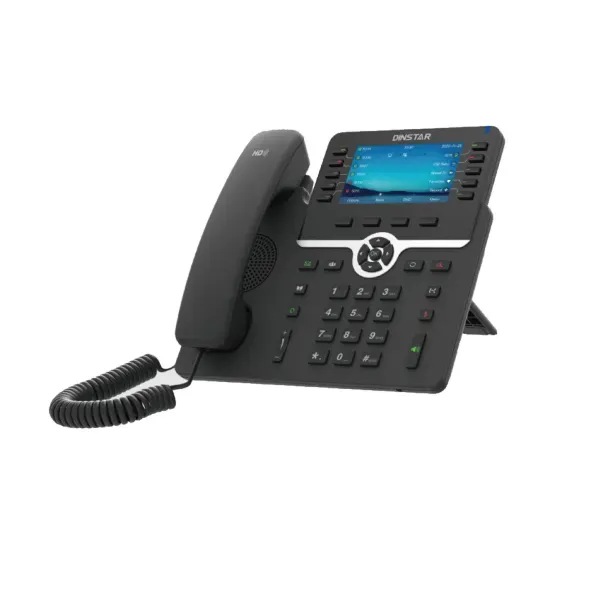
The Dinstar C66G is a high-end SIP desk phone for organizations that need a larger color display, substantial programmable-key capacity, multiple SIP registrations and Gigabit desktop networking without moving to a touch-screen executive terminal. It supports up to 20 SIP accounts, 50 line keys, six-way audio conferencing and HD voice, making it suitable for reception, management, operations, customer-service and shared business environments where users routinely handle more than one line or call flow.
What is the Dinstar C66G?
The Dinstar C66G is a business SIP phone built around a 4.3-inch 480 × 272 color graphical LCD with backlight, dual 10/100/1000 Mbps Ethernet ports and a broad set of call-handling functions. DINSTAR positions the C66G/C66GP family for high-end business use and publishes support for up to 20 SIP accounts, 50 programmable line keys, four soft keys, six function keys and six-way conferencing. These capabilities make the phone especially relevant for users who need fast access to monitored extensions, speed dials, line appearances, transfers and conference functions without relying on a computer softphone for every task.
The C66G and C66GP share the core user experience but differ in power delivery. The C66G does not support Power over Ethernet and is designed to use a power adapter. The C66GP adds PoE support. This distinction matters during procurement because many office voice projects assume that an Ethernet cable from a PoE switch will power every desk phone. For a C66G rollout, power outlets and adapters must be considered at each desk. If the project specifically requires switch-powered handsets, ask for the C66GP rather than assuming that C66G and C66GP power specifications are interchangeable.
For Tanzanian buyers, the C66G is best evaluated as part of the complete voice environment: IP PBX or hosted SIP platform, switch and VLAN design, internet or WAN quality, headset requirement, provisioning method, extension plan and power arrangement. FourTeck Tanzania can help customers map these requirements before quotation so the requested model, quantity and accessories match the intended deployment. You can also review the FourTeck Tanzania technology shop for related business infrastructure and the FourTeck Tanzania services portfolio when installation, configuration or broader network work is part of the project.
Verified Dinstar C66G Features
4.3-inch color display
The graphical LCD uses a 480 × 272 resolution with backlight, giving users a clear view of call status, menus, contacts and programmable functions.
Up to 20 SIP accounts
Multiple SIP registrations support advanced business scenarios involving several extensions, services, departments or line identities on one handset.
50 programmable line keys
Programmable keys can be assigned to frequently used functions such as speed dial, BLF-style monitoring and other supported telephony actions.
6-way conferencing
The phone can host six-party audio conferencing, helping teams bring several participants into a discussion directly from the desk phone.
Dual Gigabit Ethernet
Two 10/100/1000 Mbps Ethernet ports allow the phone to sit between the LAN and a connected workstation where the network design permits this topology.
USB 2.0
A USB 2.0 interface adds flexibility for supported accessories and can be used with compatible Wi-Fi or Bluetooth dongle options according to DINSTAR guidance.
HD voice processing
DINSTAR specifies full-duplex speaker and microphone operation, DSP processing and wideband codecs including G.722 and OPUS-WB for compatible call paths.
EHS headset support
DINSTAR lists EHS wireless-headset support for compatible Plantronics, Jabra and Sennheiser environments, useful for call-intensive roles.
C66G vs C66GP: choose the correct power option
| Model | Display | Ethernet | PoE | Power planning |
|---|---|---|---|---|
| C66G | 4.3-inch color | Gigabit | No | Use the specified power adapter and plan desk-side power. |
| C66GP | 4.3-inch color | Gigabit | Yes | Can use compatible PoE infrastructure; adapter status should be confirmed in the quoted bundle. |
This model distinction is one of the most important buying checks. A company standardizing on UPS-backed PoE switches may prefer C66GP because the handset can remain powered from the switch during short utility interruptions when the switching infrastructure itself is protected. A C66G can still be deployed effectively, but each desk requires the correct local power arrangement. Procurement teams should therefore specify whether they want C66G or C66GP and avoid using only the generic term “C66 phone” on purchase requests.
Who should consider the Dinstar C66G?
The C66G is most compelling for people who handle many contacts or call states during a working day. Receptionists can use programmable keys to reach frequently called colleagues and handle transfers. Managers can register several SIP identities and use conferencing for quick multi-party discussions. Operations teams can map speed dials and monitored extensions. Customer-service users can benefit from headset integration, HD voice and direct access to common telephony functions. Shared administrative desks can use the color display and programmable keys to reduce dependence on memorized feature codes.
Organizations with very simple calling needs may not require 20 SIP accounts or 50 line keys, in which case a lower-tier model could be more economical. The C66G should be selected because its capacity and interface solve real user needs, not simply because it has more features. When requesting a quotation, identify user profiles—reception, executive, supervisor, standard office, shared desk—and assign the C66G where the additional key capacity or account flexibility has a practical value.
Compatibility, SIP security and management
The C66G/C66GP family is based on SIP and DINSTAR lists compatibility with several widely used IP telephony ecosystems, including 3CX, Asterisk, Yeastar, Xorcom, VoIP.ms, BroadSoft and FreeSWITCH. Compatibility should still be confirmed for the exact PBX version, firmware and feature set used by the customer. Registration alone is not the same as complete feature interoperability. Busy-lamp fields, directory access, provisioning, transfer behavior, voicemail notification, TLS certificate handling and special call-routing features may require platform-specific configuration.
DINSTAR publishes support for SIP over TLS and SRTP, along with common network and management functions. These capabilities can help protect signaling and media where the PBX, service provider and network are configured to support the same methods. Encryption should be treated as an end-to-end design decision rather than a checkbox on the handset. Certificates, time synchronization, firewall rules and PBX settings all need to align. For distributed deployments, automatic provisioning using FTP, TFTP, HTTP, HTTPS or PnP can reduce manual configuration, while the web interface and DINSTAR NMS options can support administration workflows.
Before a multi-phone rollout, create a standard template covering extension format, SIP server, VLAN, QoS, time zone, language, directory source, firmware policy, key assignments and administrator credentials. Test the template with a small pilot group, including reception and ordinary users, before mass deployment. This process catches PBX and network issues early and gives support teams a consistent reference for troubleshooting.
Network and deployment planning
A business IP phone depends on the local network. Voice packets compete with data traffic unless the network is planned for predictable performance. For C66G deployments, review switch-port capacity, voice VLAN design, QoS policy, DHCP and DNS behavior, NTP availability, firewall traversal and WAN reliability. If the phone is connected in front of a workstation, confirm that the daisy-chain topology matches the organization’s network security policy and that the Gigabit ports provide the required desktop throughput.
Power is equally important. Because the C66G does not use PoE, the desk needs appropriate mains power for its adapter. In locations where power stability is a concern, consider how the phone and upstream network equipment will be protected. A handset with local power cannot place calls if the switch, router, PBX or internet link has failed. For critical communications, resilience planning may include UPS protection for core network devices, redundant WAN paths, PBX failover or mobile alternatives depending on the business requirement.
For larger projects, documentation is valuable. Record each handset’s extension, user, MAC address where required for provisioning, switch port, VLAN, location and firmware version. Label patch-panel and switch ports clearly. Keep a configuration backup or provisioning source under controlled access. This turns a collection of desk phones into a manageable enterprise voice deployment.
Related FourTeck Tanzania products and services
A C66G deployment may be part of a broader migration from analog telephony to SIP. If one legacy analog handset or fax endpoint must remain connected, the Dinstar DAG1000-1S Analog Telephone Adapter provides a single FXS interface for that type of migration. Where an installation requires one analog station and one analog trunk interface, the Dinstar DAG1000-1S1O Hybrid VoIP Gateway is a different gateway class that can be evaluated separately. Buyers needing two analog-station interfaces can review the Dinstar DAG1000-2S Analog Telephone Adapter. These products are not substitutes for the C66G; they serve different roles in the same IP telephony ecosystem and can be useful when a business is migrating in stages.
For regional projects, FourTeck’s wider network can also support planning conversations across markets. The FourTeck Uganda site, FourTeck Kenya site, FourTeck UAE site, FourTeck Ghana site and FourTeck Nigeria site provide regional starting points where a customer is standardizing voice and network equipment across more than one country.
Dinstar C66G Business IP Phone Tanzania
Businesses in Tanzania looking for the Dinstar C66G typically need more than a basic SIP handset. They may be replacing aging analog extensions, standardizing a new IP PBX deployment, equipping managers and reception desks, or creating a consistent phone model across several offices. In these projects the handset must match the voice platform, LAN design, user role and power environment. The C66G is attractive when the user needs a large number of programmable functions, up to 20 SIP identities and a clear color interface while retaining the familiar ergonomics of a desk telephone.
For Tanzanian organizations, start with the call-flow requirement. A receptionist may need monitored extensions, transfer targets and frequently called numbers. A senior manager may use fewer keys but appreciate multiple accounts, conferencing and headset support. A branch administrator might register both a local extension and a centralized corporate SIP identity. Mapping those needs before ordering helps determine whether every employee needs a C66G or whether a mixed endpoint strategy is more cost effective. Premium phones can be assigned to heavy call handlers while simpler phones serve ordinary users.
Network design is another central consideration. Many Tanzanian offices combine cloud applications, CCTV, Wi-Fi and IP telephony on the same switching infrastructure. A voice VLAN can help separate and manage handset traffic, while QoS can protect calls from congestion. The C66G’s dual Gigabit Ethernet ports are useful where a phone and workstation share a desk network drop, but the organization should verify VLAN behavior and security policy before using the phone as a pass-through device. If a user’s workstation handles large file transfers or real-time applications, test the complete desk path rather than assuming that advertised Gigabit capability alone guarantees call quality.
Power planning deserves special attention because C66G is not the PoE variant. Every desk needs the specified adapter and suitable mains power. This may be acceptable in existing offices where power is already available at each workstation. New builds that are designed around centralized PoE and UPS-backed switching may find C66GP operationally cleaner. Procurement teams should therefore mention the exact model on RFQs and ask for the quoted power arrangement. A FourTeck Tanzania request should include quantity, city, PBX or SIP provider, whether headsets are required, preferred key functions, network switch model where known, and whether configuration assistance is needed. These details produce a more useful quotation and reduce surprises during rollout.
Dinstar C66G Business IP Phone Dar es Salaam
In Dar es Salaam, the Dinstar C66G is well suited to corporate offices, logistics companies, professional services, hospitality operations, retail headquarters and service organizations that handle substantial telephone traffic. A common requirement is to combine central reception, departmental extensions, SIP trunks and branch connectivity in one IP telephony environment. The C66G gives call-intensive users direct access to many programmable functions while supporting multiple SIP accounts and six-way conferencing.
For offices in business districts or multi-floor buildings, deployment planning should begin at the switch. Confirm that enough Ethernet ports are available for phones and computers, determine whether the phone will share a cable with a workstation, and define the voice VLAN. If the organization has separate guest, staff, CCTV and voice networks, firewall rules and routing should be documented. Real-time voice is sensitive to latency, jitter and packet loss, so internet speed alone is not a sufficient measure of readiness. A high-bandwidth connection can still deliver poor calls if congestion, Wi-Fi uplinks, overloaded firewalls or unstable routing introduce delay.
Reception areas in Dar es Salaam often need quick transfer and extension visibility. The C66G’s programmable key capacity can help, but the key assignments should reflect the actual PBX design. Decide which staff members should appear as monitored targets, how calls overflow when an extension is busy, and whether calls should route to mobile or voicemail after hours. Configure a pilot phone for reception and run real call scenarios before duplicating the template. Testing should include incoming calls, attended and blind transfer, hold, pickup, conferencing, voicemail indication and any directory functions the PBX provides.
When requesting a Dar es Salaam quotation, state whether the requirement is only hardware or includes provisioning, user setup, PBX integration, VLAN configuration or headset selection. If the office relies on uninterrupted voice, describe the UPS and network resilience environment. Since the C66G uses an adapter instead of PoE, desk-side power protection differs from a C66GP deployment. Clear scope at the quotation stage helps the project team account for all supporting equipment rather than discovering power or network gaps after the phones arrive.
Dinstar C66G Business IP Phone Mwanza
Mwanza businesses can use the C66G for branch offices, commercial operations, education, healthcare administration, retail, hospitality and professional workplaces that need structured SIP calling. The phone is especially relevant when a branch connects to a central IP PBX or hosted voice platform and users need more than a single extension. Multiple SIP registrations can separate departmental identities or support a mix of local and centralized services, subject to PBX design.
Branch connectivity should be reviewed carefully. If a Mwanza office reaches the PBX across VPN, SD-WAN or public internet, call quality depends on the entire path. Measure latency, jitter and packet loss during busy hours, not only during installation. QoS can prioritize voice on managed links, but it cannot fix every upstream congestion problem. Where multiple WAN links exist, define how SIP sessions behave during failover and whether the PBX or service provider supports rapid re-registration. Users should understand what to expect if the internet path changes during an active call.
The C66G’s management options can simplify distributed support. Instead of configuring each handset manually, an administrator can prepare a standard template covering server addresses, time settings, language, codecs, key mappings and security. Controlled provisioning reduces variation between branches and makes replacement phones faster to deploy. Configuration backups and documented firmware versions are useful when troubleshooting, especially if onsite IT resources are limited. Remote administration should still be restricted to trusted networks or secure management paths.
A Mwanza RFQ should specify quantity, intended users, PBX platform, WAN connection type, whether the site has a dedicated voice VLAN and how the phones will be powered. If the company is purchasing for several branches, provide the total quantity and site breakdown so each location’s network and power needs can be checked. The objective is not simply to deliver phones but to create a repeatable deployment where the same user experience and support process can be maintained across locations.
Dinstar C66G Business IP Phone Arusha
Arusha has a diverse business environment that includes tourism, hospitality, NGOs, professional services, education, travel operations and regional administration. Many of these organizations depend on reception and coordination calls throughout the day. The C66G can fit front-desk and management roles where users need quick transfers, frequent speed dials, conferencing and access to multiple SIP identities.
Hospitality and travel businesses should map the desk-phone requirement to actual workflows. A central reservation or administration desk may need many programmable destinations, while guest-room telephony uses a different endpoint class. The C66G should therefore be placed where its features are operationally valuable rather than used as a universal handset. For an NGO or multi-department office, key mappings can be organized around teams and shared services. For a hotel back office, keys may represent front office, reservations, finance, security and management contacts.
Network readiness matters where voice shares links with booking systems, cloud applications, guest Wi-Fi or surveillance. Segmenting voice traffic and monitoring internet utilization can help prevent contention. If a site has more than one building, check how VLANs and routing extend between switches and whether fiber or wireless bridges introduce additional latency. Test calls across the actual network topology, including inter-building paths, before rolling out a large number of phones.
Arusha buyers should also confirm headset needs. Call-heavy reservations or administrative staff may prefer compatible EHS wireless headsets so they can answer or manage calls away from the handset. Compatibility should be checked against the exact headset model and any required EHS cable or interface. Include these accessories in the quotation rather than treating them as an afterthought. A complete Arusha procurement request should list user roles, extension quantity, PBX environment, desired headset type, power arrangement and whether onsite or remote configuration assistance is expected.
Dinstar C66G Business IP Phone Dodoma
In Dodoma, the C66G can serve government-related offices, professional organizations, project teams, education, NGOs and growing private-sector operations that require structured business telephony. Its multiple accounts and extensive programmable-key capacity are particularly useful where one person coordinates several departments, service lines or contact groups. The phone can support a conventional desk-based workflow while integrating with modern SIP infrastructure.
Organizations planning new offices should decide early whether they want adapter-powered C66G phones or PoE-capable C66GP units. In a greenfield installation, centralized PoE may simplify cabling and UPS planning because power originates from the switch. In an existing office with ready access to mains outlets, the C66G can be a practical choice. There is no universal answer; the decision depends on network design, budget, resilience requirements and operational preference. Procurement documents should state the exact model to prevent power assumptions from changing between the design and purchasing stages.
The phone’s 20-account capacity does not mean every user should be assigned 20 accounts. Keep configuration aligned with the business process. Too many line appearances and keys can confuse users if they are not organized consistently. Develop standard key layouts for roles such as reception, executive, supervisor and shared service desk. Train users on hold, transfer, conference, voicemail and headset behavior. Consistent templates make support easier when staff move desks or phones are replaced.
For Dodoma quotations, include the number of phones, PBX platform, whether SIP trunks are already in service, LAN switch details, preferred VLAN design and the deployment schedule. If the office is part of a national organization, state whether phones must connect to a PBX in another city. This allows WAN and security requirements to be considered alongside the handsets. A well-designed project treats the C66G as an endpoint in a complete communications system rather than a standalone consumer telephone.
Dinstar C66G Business IP Phone UAE
Organizations with Tanzania and UAE operations may want a consistent SIP handset strategy across both markets. The C66G can support that objective when the same PBX, provisioning standards and call-handling requirements are used. Multi-country deployments benefit from standard device templates, naming conventions, firmware policy and security settings, while local telecom and SIP-trunk requirements should still be reviewed separately.
UAE offices often use managed PoE switching extensively, so model selection should distinguish C66G from C66GP at the design stage. If the corporate standard expects phones to be powered from the network switch, C66GP may fit the architecture more naturally. If C66G is selected, power adapters and desk outlets must be included in the deployment plan. This distinction is simple but can affect installation speed, UPS strategy and spare-parts planning across many desks.
For multinational call flows, consider whether each handset needs a local UAE extension, a Tanzania extension, or both. The C66G’s support for multiple SIP accounts can accommodate sophisticated identity designs, but the PBX and regulatory environment should determine how numbers are assigned and routed. Keep country-specific calling policies, emergency dialing and outbound caller identification under central governance. Standardization should improve manageability without forcing identical telecom configurations where local requirements differ.
FourTeck’s UAE network can be a useful counterpart for organizations coordinating procurement or deployment across offices. A cross-border RFQ should include quantities by country, PBX topology, expected SIP accounts per user, headset requirements and support scope. This helps the project team identify where a common configuration can be reused and where country-specific changes are necessary.
Dinstar C66G Business IP Phone Uganda
Ugandan organizations evaluating the C66G may include banks, NGOs, education, hospitality, retail, healthcare administration and multi-branch businesses. The handset’s strength is advanced desk call handling rather than simple single-line calling. Up to 20 SIP accounts, 50 programmable line keys and six-way conferencing allow the device to support supervisors, receptionists and administrators who coordinate many contacts.
For a Tanzania-Uganda group, a shared IP PBX can centralize dialing and policy, but WAN quality becomes critical. Branch-to-branch voice should be tested over the actual VPN or internet paths. Codec selection, QoS and bandwidth should match the network design. Where the PBX is centralized, create a contingency plan for WAN outages so users understand whether local calling remains available. This may involve secondary registration, mobile fallback or local services depending on the architecture.
The C66G can be centrally provisioned, which is valuable when supporting several Ugandan sites. Use standardized templates but keep per-site VLAN, time and numbering details configurable. Protect administrator credentials and do not expose the web interface directly to the public internet. Where SIP TLS and SRTP are deployed, verify that the PBX and network support the same security configuration.
A Uganda quotation should identify site count, handset quantity, PBX location, WAN topology and power preference. If PoE is required, request C66GP rather than C66G. If the project uses C66G, include the correct power adapters and consider how phones will be supported during utility interruptions. These details allow procurement to compare complete deployed cost rather than handset price alone.
Dinstar C66G Business IP Phone Kampala
Kampala businesses often operate busy reception points, sales teams, professional-service desks and regional headquarters where rapid transfer and extension visibility are important. The C66G’s programmable keys can be organized around departments, executives, branches or service queues, reducing the time users spend navigating menus. Multiple SIP accounts also support complex PBX environments where a user handles more than one identity.
Before rollout, build a Kampala pilot with representative users. Reception, management and standard-office teams should each test a template. Confirm that BLF or monitored-extension behavior works with the PBX, that transfers are intuitive, that directory searches return expected results and that voicemail notification is reliable. If headsets are used, test answer/end-call behavior with the selected EHS accessories. A short operational test can prevent dozens of phones from being deployed with an inconvenient key layout.
The LAN should also be evaluated for voice. Managed switches, voice VLANs and QoS are valuable in larger offices, but they must be configured consistently across access and core switches. If the phone passes a workstation connection through its second Gigabit port, confirm that the data VLAN and voice VLAN are separated as intended. Document switch ports and cable labels so support teams can trace faults quickly.
When seeking a Kampala quote, provide the number of users, call-handling roles, IP PBX vendor, switch environment and expected deployment scale. For a new office, mention whether the network is being designed at the same time as the telephony system. Coordinating phones, switching, cabling and power at one stage usually produces a cleaner deployment than treating each item as a separate purchase.
Dinstar C66G Business IP Phone Arua
For Arua, the C66G can be useful in branch offices, NGOs, logistics, healthcare administration, hospitality and commercial service points that connect to a centralized SIP platform. Distributed sites often need capable phones but may have limited onsite IT support. In that scenario, standardized provisioning and remote management are as important as the handset’s visible features.
Prepare the phone configuration centrally and minimize per-device manual changes. Extension credentials, server addresses, firmware versions and key templates should be managed from a controlled process. Keep documentation of each unit and maintain secure configuration backups. If a handset must be replaced, support teams should be able to restore the user’s service without rebuilding every setting from memory.
Connectivity from Arua to a remote PBX should be tested for latency and packet loss. If the site uses a variable-quality internet connection, choose codec policy and bandwidth management carefully. Voice traffic should be prioritized where possible, and large updates or backups should not saturate the link during business hours. The C66G provides good endpoint capabilities, but it cannot compensate for an unstable WAN path.
For procurement, clarify whether the office needs only a few advanced phones or a complete set. A small branch may place C66G units at reception and management desks while using simpler SIP phones elsewhere. This role-based approach controls cost without sacrificing functionality where it matters. Include power availability in the Arua site survey because the C66G uses an adapter rather than PoE.
Dinstar C66G Business IP Phone Mbarara
Mbarara organizations can deploy the C66G in commercial offices, education, health administration, hospitality, distribution and regional branches that need a feature-rich desk phone. The color interface and programmable keys can make busy call handling easier for users who repeatedly contact the same internal teams or need to monitor several extensions.
When designing the deployment, decide whether calls are primarily internal, branch-to-branch, customer-facing or routed through a contact-center platform. This determines how keys should be configured and which PBX features should be prioritized. A manager may prefer direct access to conference, transfer and mobile colleagues. A branch receptionist may need a larger set of monitored extensions. A customer-service desk may prioritize headset operation and queue-related functions provided by the PBX.
Power and network resilience should be part of the site plan. Because C66G requires local power, the desk-side adapter and outlet need to be protected appropriately where continuity is important. If the office already has a PoE switch and wants centralized backup power, C66GP may be worth comparing. The correct choice depends on existing infrastructure and operational priorities rather than on feature count alone.
A Mbarara RFQ should include PBX details, quantity, user roles, switch type, power preference and whether remote provisioning is expected. If the office is part of a larger organization, include branch dialing requirements and WAN topology. Clear technical context helps ensure the phone configuration, accessories and support approach are aligned with the broader communications environment.
Dinstar C66G Business IP Phone Gulu
In Gulu, the C66G can support NGOs, education, healthcare administration, professional services and branch operations that require dependable SIP calling and centralized configuration. A key advantage is the ability to give advanced users many programmable functions while keeping the handset familiar to staff accustomed to traditional desk phones.
For remote or distributed offices, avoid overly complex configurations. Although the C66G supports many accounts and keys, assign only the functions that users actually need. A clean template reduces training time and support calls. Keep the same key positions for common actions across all phones so staff moving between desks can work predictably. Reception and supervisory models can use additional monitored keys while standard users receive a simpler layout.
If the PBX is hosted outside Gulu, monitor WAN quality and define failover behavior. SIP registration intervals, DNS, firewall rules and secondary servers should match the service design. Do not expose phone management interfaces to the public internet. Use secure management channels and restrict administrative access. For troubleshooting, maintain logs from the PBX and network as well as the handset so faults can be isolated to the correct layer.
A Gulu quotation should state whether the phones will be installed on an existing LAN or as part of a network upgrade. If switches are being replaced, compare C66G and C66GP early so the power strategy can be incorporated into switch sizing. For existing adapter-powered desks, C66G may fit without changes. The best result comes from matching the endpoint to the local infrastructure rather than assuming one power model is universally superior.
Dinstar C66G Business IP Phone Kenya
Kenyan businesses considering the C66G may be standardizing offices across Nairobi, Mombasa and regional branches or connecting Kenyan users to a shared East African voice platform. The phone’s multiple SIP accounts and programmable key capacity can support regional headquarters, reception desks and shared-service teams that coordinate across locations.
A regional East African deployment benefits from common templates but should still account for local network and telecom conditions. Standardize firmware, admin security, user key layouts and directory behavior where possible. Keep trunk routing, emergency dialing and country-specific numbers under local policy. If one PBX serves multiple countries, build clear dial plans so users know how to reach colleagues and external destinations without confusion.
For Kenya, inspect network segmentation and switch capacity. If the organization uses PoE as the default for desk phones, the C66GP variant may reduce local power adapters. If the organization specifically chooses C66G, include adapters and desk power in the bill of materials. When phones share cabling with workstations, confirm Gigabit operation end to end and ensure VLAN policy is applied correctly.
A Kenya quotation should include user roles, site quantities and PBX architecture. Organizations buying for both Kenya and Tanzania should request consistent model naming and configuration standards so spares and support documentation can be shared. The regional goal should be operational consistency without ignoring local requirements.
Dinstar C66G Business IP Phone Kuwait
Kuwait-based offices can use the C66G for reception, executive and operations roles requiring multi-line SIP access and fast programmable-key workflows. In multinational businesses, the same device can form part of a standardized endpoint policy across Gulf and East African sites, simplifying training and spare planning.
Before standardizing, compare the phone’s adapter-powered design with the organization’s network architecture. Many modern offices prefer PoE for centralized power and simplified desk cabling. If PoE is mandatory, the C66GP should be evaluated. If adapter power is acceptable, C66G retains the same broad call-handling capabilities without PoE. Procurement should keep the suffix visible on all documents so the intended variant is not lost.
For SIP integration, confirm platform compatibility and provisioning. A cross-border PBX design may use centralized directories, extension dialing and conferencing, but numbering and outbound caller-ID rules should follow the telecom environment. Test encrypted signaling and media if TLS and SRTP are required. Maintain secure administrator access and keep firmware under a controlled update process.
A Kuwait RFQ can include handset quantity, local PBX or hosted provider, headset models, provisioning method and whether the project also covers switches or network segmentation. For companies with Tanzania branches, share the desired common configuration so differences between the two sites can be identified before deployment.
Dinstar C66G Business IP Phone Ghana
Ghanaian organizations can use the C66G as an advanced SIP endpoint for reception, administration, management and multi-department call handling. The 4.3-inch display and large programmable-key capacity are most valuable when users need quick access to many extensions or frequent call functions rather than simple one-line calling.
For a multi-site Ghana deployment, central provisioning can reduce configuration effort and improve consistency. Define a standard firmware version, admin security policy, SIP server template and key layout. Use site-specific settings for VLANs, time, numbering and WAN behavior. Keep a tested replacement process so failed or relocated phones can be restored quickly.
Network quality should be assessed with live voice traffic in mind. Business internet may be shared with cloud applications, surveillance and guest Wi-Fi, so QoS and traffic visibility are important. If a branch uses VPN to reach a central PBX, monitor packet loss and jitter during peak periods. SIP phones perform best when the network is engineered for real-time traffic instead of relying only on headline bandwidth.
A Ghana quotation should state the exact C66G model, quantity, PBX, preferred accessories and whether a PoE alternative should be considered. Where standardized PoE is desired, compare C66GP. Where adapter power is appropriate, include the power arrangement in the scope. This level of detail helps procurement compare complete solutions rather than incomplete handset-only pricing.
Dinstar C66G Business IP Phone Nigeria
Nigeria’s large and varied business environments make role-based endpoint selection important. A Dinstar C66G can be deployed for call-intensive positions in corporate offices, financial services, professional services, logistics, hospitality, education and multi-branch operations. Its strength lies in advanced SIP capacity, programmable functions and Gigabit desktop connectivity.
For sites with many users, avoid configuring every handset individually. Use a standardized provisioning architecture and role templates. Reception can have broad monitored-extension coverage; executives can have selected direct contacts and conferencing; supervisors can receive department-specific keys. Consistency reduces errors and makes user training easier. Store configuration securely and restrict administrative access.
Power resilience can be a major operational issue. C66G requires local adapter power, so a large rollout creates many desk-side power dependencies. If the network already uses UPS-backed PoE switches, C66GP may offer a cleaner continuity model. If C66G remains the preferred device, evaluate power protection for critical desks and remember that the complete voice path—including switches, routers, PBX and WAN—must remain available.
A Nigeria quote should include site breakdown, handset count, current PBX or planned platform, power strategy, headset needs and WAN architecture. Organizations with Tanzania operations can ask for a common endpoint standard while maintaining country-specific trunks and call-routing policy. This balances centralized IT management with local telecom realities.
Dinstar C66G Business IP Phone Seychelles
Seychelles businesses in hospitality, professional services, administration and tourism operations can use the C66G for front-office and management telephony where multiple lines, direct extension access and conferencing are useful. The phone is better suited to business desks than to guest rooms or very simple extensions because its value comes from the richer key and account capacity.
Island and multi-property deployments should consider WAN dependence carefully. If a hosted PBX or remote system serves the site, the internet connection becomes part of the voice service. Monitor latency and packet loss, and define what happens during an outage. Where a hotel or resort has several buildings, check inter-building network links and VLAN continuity before deploying phones widely.
For hospitality back-office teams, programmable keys can map reservations, reception, housekeeping administration, security and management contacts. A consistent layout across properties can simplify staff movement and training. Headset integration may be valuable for reservation or administration teams spending long periods on calls. Confirm the exact EHS accessory requirements before ordering.
A Seychelles quotation should list the property or office type, number of advanced users, PBX platform, power preference and network topology. If the project is designed around PoE, compare C66GP. If adapter power fits the site, C66G can be deployed with the correct power accessories. Planning these details early is particularly useful where shipping and replacement logistics benefit from accurate spare and accessory lists.
Buying guide: questions to answer before requesting a quote
Which exact model?
Confirm C66G if adapter power is acceptable, or C66GP if PoE is required. Do not leave the suffix off the RFQ.
Which PBX?
State the IP PBX or hosted SIP platform and version where known so registration, provisioning and feature interoperability can be reviewed.
How many advanced users?
Separate reception, managers, supervisors and standard users. Not every desk necessarily needs the same high-end endpoint.
Headsets required?
Identify wired or EHS wireless headset requirements and verify the exact compatible accessory path before ordering.
What network design?
Provide switch model, VLAN approach, WAN path and whether workstations will connect through the phone’s second Ethernet port.
What support scope?
Clarify whether the quote covers hardware only, provisioning, installation, PBX configuration, user training or ongoing support.
Quotation checklist
To prepare a useful Dinstar C66G quotation, provide the exact model name, quantity, deployment city or country, IP PBX or SIP provider, number of SIP accounts expected per user, required programmable-key behavior, headset requirements, network-switch model where known, VLAN and QoS requirements, whether phones share connections with workstations, and whether configuration or installation is required. Also state whether the site prefers local power adapters or requires PoE so the C66G versus C66GP decision is explicit.
For multi-site deployments, list quantities by location and identify where the PBX is hosted. Describe WAN links between branches and whether secondary SIP servers or failover paths exist. For new offices, include cabling and switch plans. For existing offices, note any current IP phones and the migration approach. This information allows the endpoint design to be evaluated as part of the complete communications environment.
Frequently asked questions
Does the Dinstar C66G support PoE?
No. DINSTAR’s model table distinguishes C66G from C66GP: C66G uses Gigabit Ethernet but does not support PoE, while C66GP adds PoE. If your project requires phones to be powered by a PoE switch, request the C66GP variant.
How many SIP accounts does the C66G support?
DINSTAR specifies support for up to 20 SIP accounts on the C66G/C66GP family. The actual number used should match the user’s role and PBX design rather than assigning accounts simply because capacity is available.
Can the C66G work with 3CX or Asterisk?
DINSTAR lists compatibility with platforms including 3CX, Asterisk, Yeastar, Xorcom, VoIP.ms, BroadSoft and FreeSWITCH. Exact feature interoperability should still be tested against the customer’s PBX version, firmware and provisioning method.
Does the C66G support conferencing?
Yes. DINSTAR publishes six-way audio conferencing for the C66G/C66GP family, allowing the organizer to bring multiple participants into a call from the phone.
Can I use a wireless headset?
The phone supports EHS wireless-headset integration for compatible Plantronics, Jabra and Sennheiser environments according to DINSTAR documentation. Confirm the exact headset model, EHS cable or accessory requirements before purchase.
Does it support Wi-Fi and Bluetooth?
DINSTAR positions Wi-Fi and Bluetooth as dongle-based options for the C66 family rather than stating that both radios are built into the base phone. Confirm the supported USB dongle and firmware before ordering if wireless connectivity is required.
Is the C66G suitable for reception?
It can be a strong reception choice when the PBX supports the required monitored-extension and transfer workflows. The 50 programmable line keys provide substantial capacity, but the key layout should be designed around the actual call flow and tested with reception staff.
What should I send to get a Tanzania quotation?
Send the quantity, city, PBX or SIP provider, required model variant, user roles, headset needs, switch and VLAN information where available, and whether you need configuration or installation. For multi-site projects, include the quantity and network details for each site.
Decision recap
Choose the Dinstar C66G when you need a business SIP phone with a 4.3-inch color display, up to 20 SIP accounts, 50 programmable line keys, six-way conferencing, dual Gigabit Ethernet, USB 2.0, HD voice and advanced provisioning options—and when local adapter power is acceptable. Choose the C66GP instead when PoE is a required part of the network design.
The best deployment starts with user roles, PBX compatibility, network readiness, power strategy and management standards. FourTeck Tanzania can use those inputs to prepare a quotation and help align the handset choice with the wider IP telephony and LAN environment.
Consult FourTeck Tanzania about your C66G deployment
Share the quantity, destination, PBX platform, power preference and user roles. FourTeck can help you decide whether C66G or C66GP better matches the site, identify network and provisioning considerations, and include relevant telephony infrastructure in the quotation. For general information about integrated IT, telecom, networking and security planning, visit FourTeck Tanzania.




Reviews
There are no reviews yet.