
DINSTAR BUSINESS SIP PHONE • TANZANIA
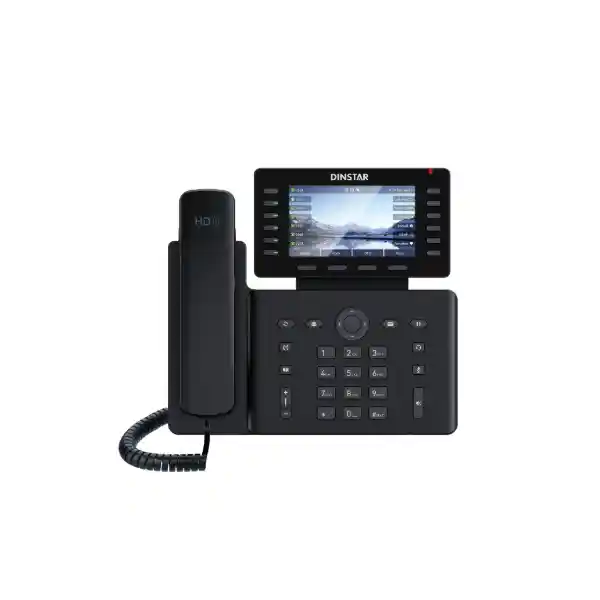
Dinstar G500P PoE Business IP Phone
The Dinstar G500P is a high-end business SIP phone built for users who handle many calls, multiple SIP identities and frequent transfers or conferences. Its 5-inch 1280×720 color display, twenty SIP accounts, ten-way audio conferencing, programmable keys, dual Gigabit Ethernet and IEEE 802.3af Power over Ethernet make it a practical endpoint for modern IP-PBX deployments. For Tanzanian organizations planning a reception desk, management office, customer-service position, sales desk or branch-office telephony rollout, the G500P combines rich call handling with a clean one-cable PoE deployment model.
What is the Dinstar G500P?
The G500P is the PoE-enabled member of Dinstar’s G500 business IP phone family. Dinstar positions the series for professional office environments where a basic two-line handset is not enough. The phone supports twenty SIP accounts and exposes twelve line keys across five pages, giving administrators and users extensive scope for line appearances and one-touch functions. One line key can also be customized as an AI key according to Dinstar’s current product documentation. The large backlit color display is designed to make account status, calls, menus, contacts and programmable functions easier to read during a busy workday.
The G500P connects through two 10/100/1000 Mbps RJ45 Ethernet ports and supports IEEE 802.3af PoE. That distinction matters during procurement: the G500P is specifically the PoE model, while Dinstar documents the G500 as the adapter-powered variant. A 12V/1A adapter can be used when required, but for the G500P the adapter is optional rather than the primary deployment method. For businesses already using managed PoE switches, a single Ethernet cable can therefore carry network connectivity and electrical power to the handset.
The phone is based on SIP and is documented for compatibility with Dinstar UC/IP-PBX platforms and widely used third-party systems including 3CX, Asterisk, Yeastar, Xorcom, VoIP.ms, BroadSoft and FreeSWITCH. Compatibility should still be confirmed against the exact PBX version, feature set, provisioning method and SIP trunk design used by the customer. FourTeck can help businesses assess the endpoint together with the voice VLAN, PoE switch, firewall, call-flow and PBX requirements instead of treating the desk phone as an isolated purchase.
High-volume call handling
Twenty SIP accounts, call waiting, forwarding, transfer, hold, mute, DND, speed dial, hotline, redial, auto-answer and other SIP call functions provide a flexible toolset for users who handle varied inbound and outbound calls.
HD business audio
The G500P supports HD voice, a full-duplex speakerphone, DSP processing, G.722 and OPUS-WB wideband codecs, echo cancellation, dynamic jitter handling, VAD and comfort-noise generation for clear professional conversations.
PoE and Gigabit networking
Dual Gigabit Ethernet ports allow the phone to sit neatly in a modern LAN design, while IEEE 802.3af PoE reduces desk-side power adapters when the access switch provides sufficient PoE budget.
Headset-ready workflow
Dinstar documents EHS wireless-headset support for Plantronics, Jabra and Sennheiser environments, making the phone suitable for receptionists, supervisors, sales teams and other users who need hands-free mobility.
Verified Dinstar G500P technical highlights
| Display | 5-inch color SPI display, 1280×720, backlit |
| SIP accounts | Up to 20 |
| Conference | 10-way audio conference |
| Network | 2 × RJ45 10/100/1000 Mbps Ethernet |
| Power | IEEE 802.3af PoE or 12V DC; adapter optional for G500P |
| Wideband codecs | G.722, OPUS-WB |
| Security / transport | SIP over TLS, SRTP, HTTPS, 802.1X, OpenVPN |
| Provisioning | FTP, TFTP, HTTP, HTTPS and PnP auto provisioning |
| Management | Web configuration, SNMP, TR-069, network capture, syslog, NMS support |
| Directory | Local phonebook up to 1,000 groups, LDAP and up to 5 remote phonebook URLs |
| Physical | Approx. 258 × 238 × 33 mm without foot stand; phone approx. 800 g plus 70 g stand |
Where the G500P fits in a business VoIP deployment
The strongest use case for the G500P is a desk where call control and visibility matter. Reception staff can use programmable keys for monitored extensions, frequently called numbers, transfer destinations and feature shortcuts. Supervisors may use multiple SIP registrations for departments, branches or service lines. Executives can benefit from the larger display, full-duplex speakerphone and headset options. Customer-service and sales users can combine the phone with an EHS-compatible headset so they can work at a computer while remaining available for calls.
The phone should be considered as one layer of the complete voice system. A reliable deployment needs an IP PBX or hosted SIP platform, correctly sized PoE switching, DHCP or planned addressing, DNS and NTP access, suitable firewall policies, QoS where the network requires it, and tested SIP connectivity. For multi-floor or multi-branch projects, standardized provisioning templates make it easier to keep line keys, firmware, regional settings and security parameters consistent.
FourTeck Tanzania’s business IT and telecom solution portfolio covers IP telephony together with the switching, firewall, Wi-Fi, cabling and infrastructure that voice endpoints depend on. Buyers planning several phones should also review the FourTeck Tanzania technology shop for related products and the FourTeck Tanzania services page when the requirement includes installation, configuration or broader infrastructure work.
PoE planning: what to check before ordering
PoE is one of the practical advantages of the G500P, but the switch design still needs to be checked. Confirm that the access switch supports IEEE 802.3af and has enough remaining power budget for the number of phones being connected. A switch may have many PoE-capable ports while still having a total power budget that is lower than the sum of the maximum power for every port. For sites combining phones, wireless access points and IP cameras on the same switch, power budgeting is particularly important.
Network continuity should be considered as well. A PoE phone depends on the access switch, so backing the switch and voice infrastructure with suitable UPS capacity can help keep internal calling and IP-PBX services available during short power interruptions. The exact resilience level depends on the customer’s PBX architecture, SIP trunk, internet connection and power design. For offices with strict availability requirements, the power path should be mapped from handset to switch, core network, firewall, PBX and service-provider connection.
For broader regional projects, FourTeck’s Uganda technology solutions site, Kenya technology solutions site, UAE FourTeck business technology site, Ghana FourTeck site and Nigeria FourTeck site provide regional reference points for organizations standardizing communications across several countries.
Dinstar G500P Tanzania
For businesses searching for the Dinstar G500P in Tanzania, the buying decision should start with user roles rather than only the number of handsets required. A finance officer making occasional calls has different needs from a receptionist monitoring extensions, a sales representative moving between CRM screens and calls, or an operations manager who needs several SIP registrations. The G500P is best suited to desks that benefit from its large display, numerous programmable functions and twenty-account capacity. That makes it attractive for head-office users, front desks, customer-service positions and branch supervisors where call handling is more intensive than on a basic entry-level phone.
Tanzania deployments should also be reviewed from the network side. The phone can be powered by IEEE 802.3af PoE, which can simplify desks and reduce the need for local power adapters, but the access switch must be correctly specified. Voice VLAN design can separate business telephony from ordinary data traffic, while QoS can be applied where congestion or shared WAN links make prioritization important. Stable DNS, NTP and PBX connectivity support predictable registration and administration. Where branch offices use VPNs to reach a central PBX, the firewall and tunnel design should be checked for SIP and RTP behavior rather than assuming that every security policy will work automatically.
For procurement teams, an effective quotation request should state handset quantity, current PBX or hosted platform, expected SIP accounts per user, need for headsets, available PoE switches, branch locations and whether configuration or installation is required. It is also useful to identify whether the project is replacing analog phones, extending an existing SIP system or starting a new IP-PBX environment. FourTeck can then evaluate the handset alongside switching, cabling, PBX, firewall and UPS requirements. This systems approach is especially valuable when organizations need one repeatable phone profile across multiple Tanzanian offices.
Dinstar G500P PoE Business IP Phone Dar es Salaam
In Dar es Salaam, the G500P can fit busy commercial environments where reception, sales, logistics, administration and customer care teams depend on desk telephony throughout the day. A growing company may operate several departments from one building, share incoming numbers through an IP PBX and need clear visual access to monitored extensions or call functions. The G500P’s programmable keys and large display can reduce the amount of menu navigation required for repeat tasks. Its support for twenty SIP accounts also gives system designers flexibility where separate lines, departments or services are presented to selected users.
A Dar es Salaam deployment may also involve dense office networking, multiple floors, managed switching and shared internet connectivity. In that environment, the phone’s dual Gigabit Ethernet ports can help maintain a modern desktop network design, while PoE allows power and data to travel over the same access cable. The LAN should still be audited for switch capacity, cable quality, available ports and PoE budget. For voice quality, attention should be given to jitter, congestion and internet-path stability, particularly if the PBX or SIP provider is reached through an external WAN connection.
Companies with multiple Dar es Salaam branches can gain operational consistency from centralized provisioning. Dinstar supports FTP, TFTP, HTTP, HTTPS and PnP provisioning methods, with additional web, SNMP and TR-069 management options documented for the phone. Standard configuration templates can define accounts, line keys, time settings, directories and security choices in a controlled way. Before purchase, the IT team should document the PBX type, number of sites, extension plan, headset requirements and any branch VPN topology. This provides a stronger basis for quotation and helps avoid ordering a capable phone into an unprepared network.
Dinstar G500P PoE Business IP Phone Mwanza
Organizations in Mwanza considering the Dinstar G500P may be planning anything from a professional office upgrade to a branch connected back to a central PBX. For branch scenarios, the endpoint is only one part of the call path. The phone must register reliably, the local LAN must carry voice traffic cleanly, and any VPN or internet connection between the branch and the call platform must be stable enough for real-time media. That makes early network assessment useful, especially where the same WAN circuit carries cloud applications, file transfers, video meetings and business voice.
At the user level, the G500P supports a broad range of familiar functions including call waiting, call forward, blind and attended transfer, hold, mute, DND, speed dial, auto-answer and call return. Those features can serve supervisors, service counters and administrative teams that need more than a basic handset. The 10-way conference capability can also be useful for internal coordination without requiring every short discussion to move to a separate meeting platform, provided the PBX and call environment are configured appropriately.
For Mwanza procurement, planning should include physical environment and power continuity. Because the phone is normally powered from a PoE switch, the resilience of that switch and its UPS becomes part of voice-service availability. Cabling should be tested rather than assumed, particularly when older desk outlets are reused. Buyers should identify whether an EHS headset is required and confirm the intended headset model before purchasing accessories. When the project includes several endpoints, request a configuration standard covering extension naming, VLANs, NTP, firmware, line-key behavior and administrator access. Consistency reduces support effort later and makes replacement or expansion easier.
Dinstar G500P PoE Business IP Phone Arusha
For Arusha businesses, professional IP telephony may support offices, travel and hospitality operations, service organizations, education, administration and multi-site teams. The G500P is especially relevant where selected users need a richer desktop interface: receptionists monitoring extensions, coordinators handling many calls, managers with several SIP identities or sales staff using headsets. The five-inch display and multi-page programmable line-key design provide more visible control than an entry-level phone, while the full-duplex speakerphone gives users an alternative for hands-free conversations.
Hospitality and service environments often care about fast call routing and clear internal communication. The phone can participate in an IP-PBX design with functions such as voicemail indication, music on hold, intercom, multicast, call pickup and group pickup. The usefulness of each function depends on the PBX configuration, so a requirements workshop should define which features each user role actually needs. Giving every desk every possible key often makes a deployment harder to use; a better approach is to create role-based templates for reception, management, service staff and general office users.
Arusha sites should also consider remote support and lifecycle administration. Dinstar’s documented auto-provisioning options and management interfaces can help administrators update or standardize a larger estate without touching every phone individually. For organizations linking Arusha to Dar es Salaam or another headquarters, routing and security policies should be checked before rollout. If voice crosses site-to-site VPNs, measure network behavior under normal business load. A purchase plan that combines handset selection, PoE switching, VLAN design, PBX configuration and user training will generally deliver a more predictable outcome than buying phones first and solving network dependencies afterward.
Dinstar G500P PoE Business IP Phone Dodoma
In Dodoma, the Dinstar G500P can serve structured office environments where staff need dependable SIP communications and administrators want a centrally manageable desk-phone platform. Its twenty SIP accounts allow selected users to handle several identities or services, while programmable keys can be assigned to common call functions, monitored lines or speed dials. For executive assistants, administrators and front-office users, the combination of visual clarity and one-touch controls can make everyday call handling more efficient than on a small-screen endpoint.
Public-sector, institutional and corporate environments often place value on network segmentation and access control. The G500P supports SIP over TLS, SRTP, HTTPS, 802.1X and OpenVPN according to Dinstar documentation. These capabilities are tools rather than automatic security guarantees; they must be integrated into the customer’s identity, certificate, network and PBX design. Administrators should decide whether phones receive addresses from a dedicated voice VLAN, how configuration access is protected, where provisioning files are stored and which systems can communicate with the phone management interfaces.
For Dodoma projects with many endpoints, rollout preparation should include a device inventory, extension plan and acceptance checklist. Test registration, inbound and outbound calling, attended and blind transfer, hold, voicemail indicators, directories, headset operation and emergency or priority call requirements relevant to the organization. The switch should be checked for PoE headroom and the UPS should be sized around the network equipment that must remain active during a short outage. This moves the procurement discussion beyond unit price and toward the complete operational result: a desk phone that is correctly powered, registered, secured, documented and easy for staff to use.
Dinstar G500P PoE Business IP Phone UAE
For organizations with UAE operations, the G500P can be evaluated as part of a cross-border standard for office telephony. A common handset model can simplify training and support when the same company operates in Tanzania and the UAE, but the surrounding telephony environment may differ by country. SIP trunks, hosted PBX services, numbering, firewall rules and regulatory requirements should therefore be validated separately for each location. Standardization should focus on the user experience and device-management model while allowing the voice service and network design to follow local requirements.
Large UAE offices may use the G500P for reception, support desks, management and back-office teams that need multi-line visibility. Its dual Gigabit ports and PoE support match common managed-office network architectures, and centralized provisioning can help reduce manual deployment effort across floors or branches. Administrators should create configuration profiles for different roles, verify compatibility with the chosen IP PBX and test headset models before a large order. Where corporate security requires encrypted signaling and media, the phone’s TLS and SRTP capabilities can be considered as part of the end-to-end design.
For procurement teams coordinating Tanzania and UAE offices, it is useful to maintain one technical specification sheet covering model, firmware policy, SIP account requirements, line-key templates, headset accessories, power method and switch requirements. The UAE project can be coordinated through FourTeck UAE, while Tanzania requirements can be handled through the Tanzania site. This provides a clearer path for businesses that want consistent endpoint standards without making unsupported assumptions about local stock, delivery or telecom service conditions.
Dinstar G500P PoE Business IP Phone Uganda
Ugandan organizations evaluating the G500P can use the same role-based planning approach: reserve the richer handset for users who benefit from many SIP identities, programmable controls and a large display. A standard office user may not require twenty accounts, while a receptionist or service coordinator may use multiple monitored keys every hour. Matching endpoint capability to role helps procurement teams avoid under-specifying critical desks or overspending on positions that only need basic calling.
For branch connectivity, organizations should examine how voice reaches the PBX. If the PBX is hosted locally, in another city or in another country, network latency, packet loss, firewall behavior and internet resilience all influence call quality. The G500P includes echo cancellation and dynamic jitter handling, but endpoint audio processing cannot compensate for every network problem. Voice readiness should therefore be assessed from switch port through WAN edge. Where PoE is used, check the switch power budget and UPS runtime as part of the same exercise.
Uganda projects can also benefit from centralized administration. Provisioning and remote-management functions can reduce repetitive configuration when many phones share similar settings. Document which users need EHS headsets, whether remote directories or LDAP will be used, and how account credentials are protected. Organizations purchasing for Uganda alongside Tanzania can align endpoint standards and naming conventions while maintaining country-specific PBX and telecom settings. For Uganda-specific requirements, the FourTeck Uganda technology site is a relevant regional reference.
Dinstar G500P PoE Business IP Phone Kampala
Kampala offices can use the G500P in environments where professional call handling and centralized IT management are both priorities. Reception areas, contact desks, sales teams and managers may benefit from direct access to transfers, speed dials, monitored extensions and conference functions. The five-inch screen gives more room for visual status and menus, while the handset’s programmable function model allows administrators to tailor the experience to a department rather than rely on the same key layout for every person.
When a Kampala office is part of a larger company network, the phone should be included in the branch architecture from the design stage. Decide whether voice traffic remains local or crosses a VPN, whether failover internet is available, and how calls behave if the WAN fails. If the business uses a hosted PBX, confirm the provider’s supported SIP parameters and provisioning approach. If it uses an on-premises PBX, include server resilience and backup in the telephony plan. The endpoint’s documented compatibility with common systems provides options, but exact interoperability testing is still the safe procurement practice.
A good Kampala quotation request should include quantity, PBX platform, current handset models, switch details, available PoE budget, headset needs and rollout timeline. For deployments beyond a few desks, also specify whether the phones should arrive preconfigured, whether user training is required and whether the network needs remediation. This information allows the solution to be costed as a functioning communications system rather than a box count. It also gives the customer a clearer comparison between a straightforward endpoint supply and a fully planned voice deployment.
Dinstar G500P PoE Business IP Phone Arua
For an Arua branch or regional office, the G500P can provide the same professional desk-phone experience used at a headquarters while still allowing the local network to be sized for the site. Branch standardization can simplify staff transfers and IT support because users encounter familiar call controls and administrators can reuse provisioning templates. The phone’s twenty SIP accounts do not mean every branch user needs twenty lines; instead, they provide capacity for the few roles that require multiple registrations or monitored services.
Connectivity deserves particular attention in any branch deployment. If the phone registers to a PBX across the internet, administrators should test latency and packet loss during normal busy periods rather than only during initial installation. If a VPN is used, confirm that voice traffic follows the intended route and that firewall inspection or NAT does not interrupt SIP signaling or RTP media. QoS can help inside a congested LAN or WAN path, but it must be designed consistently across the relevant devices to be effective.
Power strategy also matters. PoE can reduce the number of adapters at desks, but all phones then depend on the access switch and its upstream power protection. A suitable UPS for switch, router, firewall and PBX equipment can improve resilience through short interruptions, depending on the site’s requirements. Before ordering for Arua, document extension numbers, user roles, headset needs, PBX address, VLAN ID, provisioning server and administrator policy. A structured commissioning sheet makes later fault diagnosis easier because the intended configuration is known rather than reconstructed from memory.
Dinstar G500P PoE Business IP Phone Mbarara
Mbarara businesses planning an IP-telephony refresh can use the G500P for the users who need advanced desk controls while selecting simpler endpoints for ordinary extensions. Mixed-model deployments are often sensible: the reception desk may require many programmable keys and a large screen, managers may prefer speakerphone and headset flexibility, while low-use areas need only reliable calling. The G500P therefore works well as a premium role-based endpoint rather than necessarily being the only phone model in an organization.
The phone’s directory and management features can support organized business workflows. Dinstar documents a local phonebook capacity of up to 1,000 groups, remote phonebook URLs and LDAP support. These options can reduce dependence on paper contact lists and make commonly used numbers easier to access, provided the business has an appropriate directory source. Administrators should decide whether contacts are managed locally, centrally or through the PBX and should test how updates are distributed before a large rollout.
For Mbarara branches, an acceptance test should cover voice quality, inbound and outbound call routing, transfer behavior, voicemail indication, time settings, line-key programming and recovery after a network or power interruption. If users depend on wireless headsets, test the exact EHS accessory and headset combination. If the phone shares its network connection with a workstation, verify VLAN and PC-port behavior according to the organization’s network policy. This commissioning discipline is more important than simply confirming that the screen turns on and the phone can place one test call.
Dinstar G500P PoE Business IP Phone Gulu
In Gulu, the G500P can be considered for professional offices, institutions and branch operations that want feature-rich SIP telephony with PoE deployment. The ability to power the phone from the network switch can simplify desk installation, particularly where new structured cabling and managed switches are being introduced as part of a broader office upgrade. The key is to plan voice, data and power together so that the network can support the handset fleet without hidden bottlenecks.
The G500P’s audio platform supports both wideband and narrowband codecs, allowing it to work across different SIP environments. Actual call quality depends on the codec negotiated with the PBX or service provider and on the path between endpoints. When bandwidth is constrained, codec choice may need to balance audio quality and traffic usage. When bandwidth is plentiful, wideband options such as G.722 or OPUS-WB can provide a more natural voice experience when supported end to end.
For a Gulu deployment connected to another city, prepare for support before installation. Record switch port numbers, MAC addresses, extension numbers, firmware versions and user assignments. Define who can access the phone’s web interface and whether remote administration will be permitted. Keep configuration backups and provisioning templates under controlled access. These practices make moves, replacements and troubleshooting easier, particularly where the technical team is not physically present at the branch every day. The G500P provides the management capabilities; the operational process determines how effectively they are used.
Dinstar G500P PoE Business IP Phone Kenya
Kenyan businesses evaluating the G500P can place it within a broader SIP standard for East African operations. Companies with teams in Kenya, Tanzania and Uganda may want employees to see similar handsets and key layouts across offices, reducing retraining and making remote support easier. The G500P’s combination of twenty SIP accounts, programmable line keys, ten-way conferencing and headset support gives administrators enough flexibility to create profiles for reception, management, service and sales roles.
A cross-country standard should separate device configuration from telecom service configuration. The phone model, firmware policy, line-key template and security baseline may remain common, while SIP trunks, emergency calling, numbers and carrier settings can vary by market. This distinction prevents teams from copying an entire branch configuration into a new country without validating local requirements. For cloud PBX deployments, confirm regional service reach and latency. For central PBX designs, evaluate WAN resilience and whether local survivability is required.
PoE switching, QoS and UPS design should also be included in the Kenya bill of materials. The endpoint is most reliable when its network dependencies are engineered rather than improvised. Procurement teams can use FourTeck Kenya for Kenya-specific technology discussions and maintain the Tanzania project through the Tanzania site. This approach supports regional standardization while keeping each deployment grounded in its local network and service environment.
Dinstar G500P PoE Business IP Phone Kuwait
For Kuwait operations, the G500P can be assessed as a professional SIP endpoint for desks that require advanced call handling. International organizations often want a common user experience across branches, but they should avoid assuming that one PBX or SIP configuration can be copied unchanged between countries. The endpoint standard can remain consistent while local telecom, numbering and security conditions are separately validated.
The G500P’s Gigabit connectivity and PoE capability suit modern managed-office networks. Where IP phones and computers share a desk location, network policy should define how voice and data VLANs are presented and whether the phone’s PC port is used. Where the organization requires certificate-based network access, 802.1X support can be considered, but deployment should be tested with the selected authentication design. TLS and SRTP can protect SIP signaling and media where supported by the PBX and properly configured.
A Kuwait rollout should include administrator documentation and user guidance. For advanced phones, the value of programmable keys is realized only when the key layout reflects real workflows. Reception may need monitored destinations, managers may need frequent contacts and customer-service staff may need queue or transfer shortcuts. Build profiles around tasks, pilot them with representative users and then apply standardized provisioning. For multi-country procurement, maintain a master device standard with local configuration appendices so future replacements remain consistent without ignoring regional requirements.
Dinstar G500P PoE Business IP Phone Ghana
Ghanaian organizations can use the G500P in offices where a high-function SIP handset supports day-to-day operations. The product is particularly appropriate for users who need multiple accounts, frequent transfers, status visibility and conference capability. Its full-duplex speakerphone can support hands-free calls, while EHS headset support can help staff who spend long periods at a computer and need to move around a desk without holding the handset.
The network plan should identify how many phones are powered from each PoE switch and how much additional budget is required for access points, cameras or other devices sharing the switch. This is important in converged networks because a switch that has enough Ethernet ports can still be under-sized for total PoE demand. Voice traffic should also be considered in WAN sizing and traffic-management policies, especially for branches that send calls to a centralized PBX.
For Ghana projects, administrators should decide whether the phonebook is maintained locally, through LDAP, remote directories or the PBX. They should also define firmware-update policy, provisioning-server security and logging. These operational choices determine how manageable the phone estate remains as it grows. The FourTeck Ghana site provides a regional point for technology requirements, while organizations with Tanzania offices can maintain common endpoint standards across both environments.
Dinstar G500P PoE Business IP Phone Nigeria
Nigeria deployments can benefit from the G500P when call-intensive teams need a capable desktop endpoint and the IT department wants structured provisioning. Large organizations may have several floors, branches or service units with different calling patterns. Using role-based templates can keep the phone interface consistent while exposing only the functions each team actually needs. That can make training easier and reduce incorrect transfers or unused keys.
In larger networks, the phone’s support for SNMP, TR-069, web management, network capture and syslog can assist with administration and troubleshooting. These features should be placed behind suitable access controls. Management interfaces should not be exposed unnecessarily to untrusted networks, default credentials should be changed and provisioning resources should be protected. The organization should also decide how logs are retained and who is authorized to make configuration changes.
Business continuity is another planning factor. A PoE handset is dependent on the switching environment, so UPS design and network redundancy may matter for teams that rely heavily on voice. Where the PBX is hosted or centralized, consider secondary internet paths and how failover affects SIP registration. Test rather than assume. For Nigeria-specific requirements, the FourTeck Nigeria site is a relevant regional resource, while Tanzania projects can follow the same device standard with locally appropriate network and telecom configuration.
Dinstar G500P PoE Business IP Phone Seychelles
For Seychelles businesses, the G500P may fit hotels, professional offices, service companies, administration teams and multi-site organizations that need a feature-rich SIP endpoint. A hospitality or service operation may have front-desk users who require fast transfer, monitored extensions and clear visual call information. Managers may use multiple accounts or speakerphone features. The G500P can support these roles while simpler phones are used in locations with lighter requirements.
Island and multi-site deployments can make remote management particularly valuable. Centralized provisioning lets administrators prepare repeatable configurations, and documented remote-management tools can assist with troubleshooting when a technician is not immediately beside the handset. The network should still be designed for secure remote administration. Configuration access should be limited, firmware controlled and provisioning paths protected. A remote-support plan should include enough documentation to identify the device, extension, switch port and configuration profile without relying on informal knowledge.
When voice is carried over internet or inter-island links, bandwidth and latency should be assessed under real operating conditions. Audio codecs and jitter handling help the endpoint adapt, but poor WAN performance can still affect conversation quality. If the business depends heavily on inbound calls, evaluate resilience of internet, PBX and power together. A G500P quotation for Seychelles should therefore include not only handset quantity but the broader architecture: PBX type, network paths, PoE access switches, UPS, headset needs, user roles and the expected support model.
Compatibility and integration checklist
Dinstar lists compatibility with Dinstar UC/IP-PBX products and several widely used third-party systems, including 3CX, Asterisk, Yeastar, Xorcom, VoIP.ms, BroadSoft and FreeSWITCH. This is a useful starting point, not a substitute for testing the exact environment. PBX software evolves, SIP providers use different authentication models and organizations enable different feature sets. Confirm registration, inbound and outbound calling, hold, transfer, DTMF, caller ID, voicemail indication, directories, BLF behavior and any required headset functionality before a large deployment.
Confirm platform, version, SIP transport, codecs, provisioning and feature-key behavior.
Confirm voice VLAN, DHCP, DNS, NTP, routing, QoS and firewall policies.
Confirm IEEE 802.3af switch capability, available ports and total power budget.
Confirm the exact EHS headset and accessory combination before volume ordering.
Buying guidance: choosing the right desks for the G500P
The G500P is a high-function phone, so procurement should identify which employees will actually benefit from its capabilities. Reception desks are a strong fit because programmable keys can be assigned to transfer destinations or monitored users. Managers and executive assistants can benefit from multiple line appearances, quick access to contacts and a large display. Call-handling teams may value headset integration and programmable functions. General office users with one extension and light calling may be better served by a simpler handset from the same ecosystem, depending on the organization’s standardization goals.
It is also useful to separate mandatory requirements from preferences. Mandatory items might include PoE, Gigabit Ethernet, TLS, SRTP and a specific number of SIP accounts. Preferences might include screen size, adjustable angle or a particular headset workflow. This distinction gives procurement teams a defensible basis for comparing alternatives and prevents the decision from becoming a checklist race with no connection to user needs.
Finally, plan the deployment effort. A phone that is correctly preconfigured and connected to a ready PoE VLAN can be quick to commission; a phone ordered into an undocumented network may uncover DHCP conflicts, missing switch capacity or PBX credential issues. For several units, invest time in one tested pilot profile, then scale the proven configuration. The pilot should include the actual PBX, switch, firewall, headset and WAN conditions expected in production.
Quotation checklist for Dinstar G500P
To prepare an accurate business quotation, provide as much of the following information as possible. These details help distinguish a simple handset supply from a complete IP-telephony implementation and reduce the risk of missing network or accessory requirements.
- Required number of G500P phones and expected future expansion.
- PBX or hosted voice platform name and version where known.
- Number of SIP accounts, lines or monitored extensions for each user type.
- Existing switch model, free port count and available PoE budget.
- Whether voice VLANs, QoS and structured cabling are already in place.
- Headset requirement and preferred wired or EHS wireless workflow.
- Branch locations and whether phones register locally or across a WAN/VPN.
- Need for installation, provisioning, testing, documentation or user training.
- Directory integration requirements such as LDAP or remote phonebooks.
- Security requirements for TLS, SRTP, 802.1X or VPN operation.
Frequently asked questions
Does the Dinstar G500P support PoE?
Yes. Dinstar specifies IEEE 802.3af Power over Ethernet for the G500P. A compatible PoE switch can therefore provide power and Ethernet connectivity over the network cable. Check the switch’s total PoE budget before deploying multiple phones.
How many SIP accounts does the G500P support?
Dinstar specifies support for up to 20 SIP accounts. The practical number used at a desk should reflect the user’s role and PBX design rather than simply using the maximum available.
Does the G500P have Gigabit Ethernet?
Yes. It has two RJ45 10/100/1000 Mbps Ethernet ports, supporting a modern Gigabit desktop network design.
What display does the G500P use?
The current Dinstar datasheet lists a 5-inch high-resolution 1280×720 color SPI screen with backlight and an adjustable screen angle.
Can the G500P work with 3CX or Asterisk?
Dinstar lists 3CX and Asterisk among the third-party IP-PBX platforms supported by the G500/G500P family. Exact feature behavior should still be validated with the PBX version and configuration used by the customer.
Does it support encrypted SIP calls?
The datasheet lists SIP over TLS and SRTP. Encryption requires compatible PBX configuration, appropriate certificates or credentials where applicable, and correct network design.
Can I use a wireless headset?
Dinstar documents EHS wireless-headset support for Plantronics, Jabra and Sennheiser ecosystems. Confirm the exact headset and any required EHS cable or accessory before purchasing.
Is a power adapter included with G500P?
Dinstar’s documentation identifies G500P as the PoE model and states that the power adapter is optional. If the site will not use PoE, specify the required adapter as part of the quotation.
Can the G500P be centrally provisioned?
Yes. Dinstar lists auto provisioning through FTP, TFTP, HTTP, HTTPS and PnP, along with web management, SNMP, TR-069 and Dinstar NMS support. The selected method should be secured and standardized by the IT team.
Decision recap
Choose the Dinstar G500P when the user needs a professional SIP phone with a large 5-inch display, many programmable controls, up to 20 SIP accounts, 10-way conferencing, HD audio, Gigabit Ethernet, PoE and enterprise-oriented management options. It is especially suitable for reception, management, service and high-call-volume roles.
Before ordering, verify PBX compatibility, required features, PoE switching, headset accessories and branch connectivity. For larger rollouts, pilot one complete configuration and create standardized provisioning profiles. This approach turns a capable handset into a predictable business communications platform rather than a collection of independently configured phones.
Plan your Dinstar G500P deployment with FourTeck Tanzania
FourTeck can help assess the G500P alongside the wider voice environment: IP PBX, SIP connectivity, PoE switching, VLANs, QoS, firewall policies, cabling, UPS, provisioning and user-role requirements. For existing systems, share the PBX model and current network details. For a new project, provide the number of users, departments, branches and expected call workflows so the endpoint and infrastructure can be evaluated together.
Use the FourTeck Tanzania contact page to request a quotation or discuss a deployment. No stock, delivery-time, warranty or authorization claim is implied here; commercial availability and project scope should be confirmed at the time of enquiry.


Reviews
There are no reviews yet.