
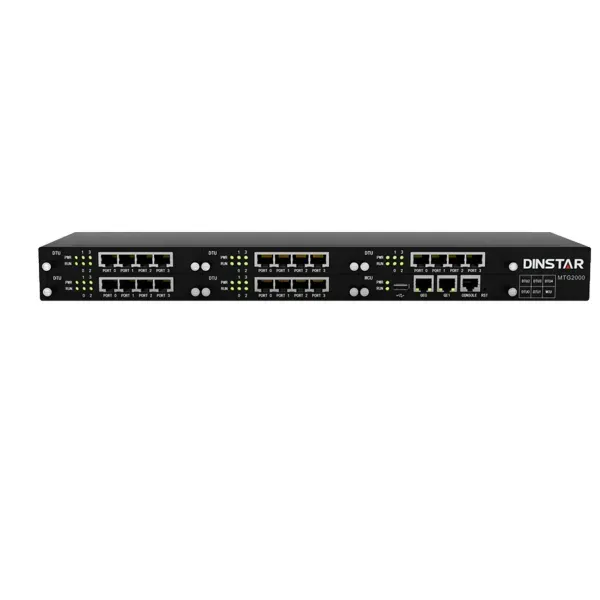
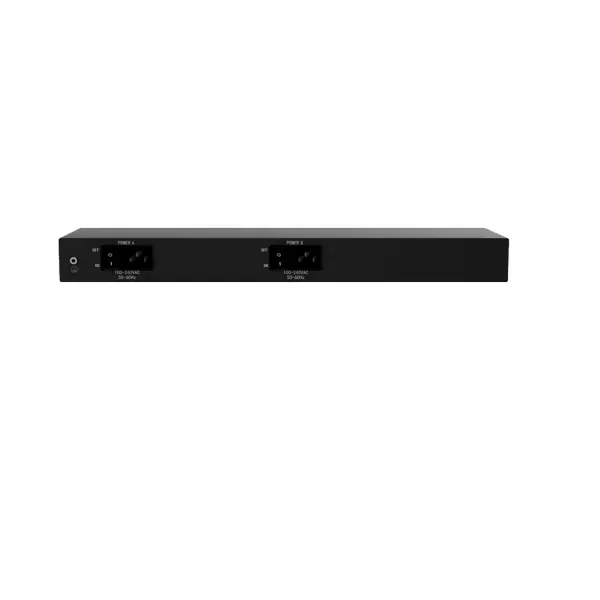
Dinstar MTG2000 Digital VoIP Gateway
The Dinstar MTG2000 Digital VoIP Gateway is built for organizations that need to connect high-capacity SIP environments with existing digital telephony infrastructure. Its role is straightforward but strategically important: it converts and routes traffic between IP-based SIP networks and traditional E1/T1 trunks that may use ISDN PRI, SS7 or R2 MFC signaling. This makes it relevant to telecom operators, service providers, call centers, large enterprises, branch networks and institutions that cannot replace every legacy voice component at once. Instead of forcing a disruptive migration, the MTG2000 can sit at the boundary between old and new communication systems and help preserve useful trunk, PBX and PSTN investments while introducing modern VoIP transport and management.
Dinstar positions the MTG2000 as a carrier-grade gateway scalable from 4 to 20 E1/T1 ports in a 1U chassis, with support for up to 600 simultaneous calls. The platform supports multiple SIP trunks, dual power supplies, routing between PSTN and IP domains, FoIP using T.38 and pass-through methods, modem and POS applications, and web/SNMP-centered administration. For buyers in Tanzania, the practical value is the ability to plan a controlled transition from digital trunks or legacy PBX architecture to SIP-based communications without treating migration as an all-or-nothing project.
Modular digital trunk capacity across 4, 8, 12, 16 or 20 E1/T1 interfaces using RJ48 connectivity.
Designed for high-call-volume environments where concurrent voice sessions and trunk utilization matter.
Supports common digital PSTN signaling options for integration with carriers, legacy PBXs and service platforms.
Provides SIP interoperability, T.38/pass-through fax capability and routing between IP and PSTN domains.
What the Dinstar MTG2000 solves
Many organizations operate in a mixed telephony environment. The business may have invested in a legacy PBX that still performs reliably, while new applications such as SIP trunks, hosted call-center platforms, unified communications or IP-based branch connectivity are being introduced. A telecom provider may need to exchange traffic between a softswitch and E1/T1 interconnects. A large enterprise may have digital PRI circuits at one site and SIP-based communications at another. In these cases, the challenge is not simply adding VoIP; it is maintaining signaling compatibility, preserving numbering and routing logic, managing call quality and planning a migration that does not unnecessarily disrupt working services.
The MTG2000 is designed for this interworking layer. It allows SIP to connect with traditional ISDN PRI and SS7 environments and also supports R2 MFC. Its flexible route methods support PSTN-to-PSTN, PSTN-to-IP and IP-to-PSTN call paths, which gives architects options when defining how traffic enters, exits or traverses the gateway. That flexibility is useful during staged migrations, carrier interconnection, call-center modernization, branch consolidation and situations where a business needs to keep certain digital trunks operational while new SIP services are introduced.
The important procurement point is that a gateway should be selected from the actual trunk plan rather than only from headline port count. Buyers should document the number of active E1/T1 circuits, signaling type on each circuit, expected concurrent call load, codec requirements, SIP peer details, numbering format, fax behavior, high-availability expectations and management responsibilities. Those inputs determine whether the MTG2000 capacity and feature set are appropriate and help avoid surprises during configuration.
Verified MTG2000 technical capabilities
| Area | Verified capability | Buyer relevance |
|---|---|---|
| Digital interfaces | 4/8/12/16/20 E1 or T1, RJ48 | Supports staged sizing from smaller carrier/enterprise deployments to higher-density trunk aggregation. |
| Call capacity | Up to 600 simultaneous calls | Suitable for high concurrent-call environments when capacity is correctly engineered. |
| Signaling | SIP v2.0, SIP-T, ISDN PRI, SS7, R2 MFC | Helps bridge modern SIP systems with legacy or carrier digital trunk signaling. |
| Voice codecs | G.711 A/μ-law, G.723.1, G.729A/B, iLBC 13k/15k, AMR | Provides codec options for interoperability and bandwidth planning. |
| Fax | T.38 and pass-through | Useful where fax workflows still operate across migrated IP voice infrastructure. |
| Resilience | Dual power supplies and redundant dual MCU design | Supports more resilient hardware planning in environments where voice continuity is important. |
| Management | Web interface, SNMP, automated provisioning, cloud management, backup/restore, debug tools | Improves operational visibility and repeatability for administrators and service teams. |
Voice quality, routing and interoperability considerations
Carrier-grade gateway performance depends on more than port density. Voice quality is affected by codec choice, packet delay, jitter, packet loss, echo behavior and the condition of both the IP network and the digital trunk. The MTG2000 includes functions such as G.168 echo cancellation up to 128 ms, silence suppression, comfort noise, voice activity detection and adaptive dynamic buffering. These mechanisms can help stabilize voice behavior, but they do not replace sound network design. The LAN/WAN path carrying SIP and RTP should be monitored for congestion, and Quality of Service should be coordinated with switches, routers and firewalls where applicable.
Routing is another major design area. The gateway supports intelligent routing and time-based routing, along with routing based on calling and called prefixes. That allows administrators to map specific number ranges or traffic classes toward different trunks and peers. In a migration project, this can be used to keep selected destinations on the legacy side while moving others toward SIP. In a service-provider environment, routes can be aligned to trunk groups, interconnect policies or customer destinations. The numbering plan must be documented before implementation, including national/international prefixes, extension lengths, leading-digit manipulation and emergency or special service numbers.
Interoperability should always be validated against the exact platform versions involved. Dinstar states that MTG2000 is compatible with mainstream VoIP platforms and the product family is designed for integration with legacy PBXs and service-provider PSTN networks. In real deployments, however, SIP header expectations, DTMF mode, early media, caller ID presentation, overlap dialing, fax behavior and timer values may still require tuning. A structured test plan should cover inbound and outbound calls, transfer scenarios, fax where used, failure recovery and call clearing under busy or unavailable conditions.
Who should consider the MTG2000?
The MTG2000 is most relevant where digital trunks are substantial enough to justify a dedicated carrier-grade gateway. Typical buyers include telecom operators interworking SIP platforms with E1/T1 networks, large contact centers with PRI or SS7 connectivity, enterprises migrating a legacy PBX toward SIP, institutions consolidating multiple digital trunks, and service providers building controlled PSTN-to-IP transition paths. Smaller offices with only a few analog lines may be better served by a lower-density analog or compact digital gateway rather than a 4–20 E1/T1 carrier platform. FourTeck Tanzania can also help buyers compare related Dinstar products such as the Dinstar DAG1000-1S analog telephone adapter, the Dinstar DAG1000-1S1O hybrid VoIP gateway and the Dinstar DAG1000-2O FXO VoIP gateway when the requirement is analog rather than E1/T1 based.
Dinstar MTG2000 Digital VoIP Gateway Tanzania
For organizations in Tanzania, the Dinstar MTG2000 fits projects where traditional digital telephony still has operational value but the broader communications strategy is moving toward SIP. This can occur in enterprises with established PRI-connected PBXs, call centers that require high concurrent-call capacity, operators or service providers handling E1 interconnects, and institutions that want to modernize voice transport without replacing the entire telephony estate at the same time. A Tanzania procurement discussion should therefore start with the existing trunk map: how many E1/T1 circuits are active, which signaling type is used, which numbers terminate on each trunk and whether the target design is a full migration, gradual migration or long-term hybrid architecture.
The MTG2000 gives project teams substantial headroom because the platform scales from 4 to 20 E1/T1 ports and supports up to 600 simultaneous calls. That capacity should still be matched to real traffic measurements. A call center, for example, may have hundreds of extensions but a very different external concurrency profile depending on campaign activity, shift patterns and inbound queue behavior. A corporate head office may have fewer calls but stricter continuity requirements. A service provider may prioritize interconnect stability, routing granularity and management visibility. Each case leads to a different port-count and resiliency decision even when the same gateway family is considered.
Network readiness is equally important. SIP and RTP traffic should traverse a stable IP path with appropriate addressing, routing and security controls. If the gateway connects to a remote SIP platform, internet or private-WAN characteristics become part of voice design. Packet loss and jitter can undermine quality even when the gateway itself is correctly configured. Power planning also matters: dual power supplies provide platform-level resilience, but the surrounding switches, routers and WAN devices should be backed by an appropriate power strategy if continuity is important.
For procurement teams in Tanzania, a useful quotation request should include required E1/T1 port count, signaling type, expected concurrent calls, SIP peer details, codec preferences, fax requirement, routing rules, redundancy objectives and whether installation/configuration assistance is required. This creates a more accurate technical and commercial discussion than asking only for “MTG2000 price in Tanzania.”
Dinstar MTG2000 Digital VoIP Gateway Dar es Salaam
Dar es Salaam organizations often manage the highest concentration of business communications requirements in Tanzania, including head offices, contact centers, financial operations, logistics businesses, hospitality groups and multi-branch organizations. In these environments, a digital VoIP gateway can become part of a broader modernization project rather than an isolated appliance purchase. A legacy PBX may remain connected to PRI trunks while a new SIP-based call-center platform is introduced. Alternatively, an organization may want to retain existing digital operator interconnects while routing selected traffic through a SIP service or centralized communications platform. The MTG2000 is designed precisely for such interworking scenarios.
A Dar es Salaam deployment should be planned around call flow and business criticality. Reception traffic, customer service queues, outbound sales, branch calls and executive lines can have different priorities. Intelligent routing by called or calling prefix and time-based rules can help structure how traffic moves between PSTN and IP domains. During migration, selected number ranges can remain on legacy trunks while others are moved to SIP, allowing technical teams to validate behavior incrementally. This reduces the operational risk associated with a single cutover event.
For larger contact centers, up to 600 simultaneous calls can be significant, but sizing should still include codec use, trunk availability and peak busy-hour traffic. Engineers should also validate DTMF requirements for IVR systems, caller ID behavior, fax handling where applicable and failover actions if a SIP peer or digital circuit becomes unavailable. Monitoring through SNMP, logs and call statistics can be integrated into operational processes so voice teams are not dependent on user complaints to detect service degradation.
Before purchasing in Dar es Salaam, confirm rack space, power feeds, grounding, environmental conditions, patching for RJ48 E1/T1 interfaces and the Ethernet path toward SIP peers. A complete bill of materials may include patching, rack accessories, UPS capacity, network switching and implementation services in addition to the gateway itself.
Dinstar MTG2000 Digital VoIP Gateway Mwanza
Businesses and institutions in Mwanza may use the MTG2000 when voice infrastructure includes digital trunks that need to coexist with IP telephony. A multi-site organization, for example, may centralize SIP services while keeping an existing PRI connection at a regional office. A service operation may need to route calls between a local digital circuit and a remote SIP platform. In both cases, the gateway acts as a protocol and media bridge, helping preserve working trunk infrastructure while extending voice services across IP networks.
For Mwanza deployments, connectivity planning deserves close attention. If the SIP side is hosted in another city or country, the quality and resilience of the WAN path influence call quality and continuity. Voice traffic is sensitive to latency variation and packet loss, so it should not be treated like ordinary best-effort file traffic. Bandwidth should be estimated from the expected number of simultaneous calls and chosen codecs, then combined with appropriate network prioritization. Where internet links are used, teams should also determine what happens during a link outage and whether a secondary path is necessary.
The MTG2000’s dual power supplies can support a resilient design, but resilient operation depends on the whole chain. The gateway, router, switch, SIP peer connectivity and any legacy PBX all need suitable power and network continuity if uninterrupted calling is a business requirement. Configuration backups should be stored securely, and operational staff should understand how to check alarms, trunk state, SIP registration or peer reachability and call statistics.
Procurement in Mwanza should therefore combine hardware selection with deployment planning. Provide the number of E1/T1 circuits, signaling protocol, expected concurrency, physical termination details, current PBX or softswitch information and desired migration outcome. These inputs help determine whether the 4-, 8-, 12-, 16- or 20-port MTG2000 configuration is appropriate and what supporting network work should be included.
Dinstar MTG2000 Digital VoIP Gateway Arusha
Arusha has a varied business environment that includes hospitality, tourism, NGOs, institutions, corporate offices and service organizations with regional or international communications needs. Where these organizations still use PRI or other digital trunks, the Dinstar MTG2000 can provide a controlled bridge toward SIP-based telephony. This is especially useful when an existing PBX remains operational but new branches, remote users or cloud communications services are being introduced. Rather than replacing the full system at once, the gateway can support a phased architecture in which traditional and IP voice services operate together.
A good Arusha design should identify which call types must remain local and which can traverse SIP. Hotel groups, for example, may have established internal call flows and external trunking that they do not want to disturb during a technology refresh. NGOs or multi-country organizations may want to centralize communications while maintaining local number presentation. Call routing by prefixes and time can help implement this policy, but the routing plan must be documented so emergency numbers, reception lines, direct-dial ranges and after-hours behavior continue to function as expected.
The gateway’s support for T.38 and fax pass-through can also be relevant to organizations that still exchange fax traffic with partners or government processes. Fax over IP can be sensitive to network conditions, so it should be explicitly tested rather than assumed to work simply because voice calls are successful. DTMF behavior should likewise be validated for IVR access, voicemail and automated services.
When requesting an MTG2000 quotation for Arusha, include the existing PBX model, trunk signaling, number of E1/T1 interfaces, SIP destination, peak call volume and whether dual-power operation will be used. Also include rack, UPS, Ethernet switching and implementation requirements. This turns the purchase into a defined migration solution instead of a standalone hardware order.
Dinstar MTG2000 Digital VoIP Gateway Dodoma
Organizations in Dodoma that operate large office campuses, public-sector communication environments, service desks or branch networks may encounter a common modernization challenge: existing digital telephony remains in service while newer SIP platforms are introduced. The MTG2000 provides a migration layer between these domains. Its E1/T1 capacity and support for PRI, SS7 and R2 MFC allow it to connect digital trunks or PBXs to SIP-based infrastructure while maintaining substantial concurrent call capacity.
For institutional deployments, governance and documentation are particularly important. Voice systems often have numbering plans that evolved over many years. Direct-dial ranges, operator-assisted calls, internal extensions, departmental hunt groups and special routing rules may be poorly documented. Before configuring a gateway, the project team should capture the current call behavior and identify what must remain unchanged. This creates a baseline for migration testing and prevents important services from being lost when routes are reorganized.
The MTG2000’s web interface, SNMP support, call statistics and diagnostic tools can assist operational teams, but management access should be protected. Administrative interfaces should be limited to trusted networks, credentials should be controlled and configuration backups should be maintained. The voice gateway should also sit within a security architecture that defines how SIP signaling and RTP media are permitted through firewalls and between network segments.
For Dodoma procurement, capacity should be chosen from measured or estimated busy-hour call traffic, not simply from the total number of extensions. Buyers should also verify the physical interface type and patching, supported signaling required by the carrier or PBX, codec policy, fax or modem use and expected failover behavior. These details allow the final design to address actual operational needs while preserving room for future growth.
Dinstar MTG2000 Digital VoIP Gateway UAE
The UAE market includes many multi-site enterprises, hospitality groups, logistics operations, contact centers and service providers that maintain a mixture of SIP and legacy digital telephony. The Dinstar MTG2000 can be considered where E1/T1 trunks, PRI or SS7 services must interoperate with a modern SIP environment. For organizations operating across the UAE and East Africa, a standardized gateway strategy can also simplify cross-border voice architecture by using a consistent interworking platform while adapting routing policies to each location.
A UAE deployment should begin by confirming local carrier presentation, signaling and numbering expectations rather than assuming that an existing configuration from another country can be copied directly. SIP trunk authentication, source IP restrictions, caller ID formatting and codec preferences may differ between providers. E1/T1 interface settings and signaling parameters must likewise match the connected system. The MTG2000 supports the key protocol families, but successful interoperability still depends on correct configuration at both ends.
Large contact centers may value the ability to scale to 20 E1/T1 ports and up to 600 calls, while enterprise projects may value flexible routing and dual power supplies more than absolute maximum capacity. Service providers may focus on PSTN-to-IP and IP-to-PSTN interconnection, route control, SNMP monitoring and troubleshooting visibility. The correct configuration should therefore be driven by the service model and availability objective.
Customers managing projects between Tanzania and the Gulf can also use FourTeck UAE for related enterprise IT and IP telephony requirements. For an MTG2000 quotation, share E1/T1 port count, signaling protocol, SIP peer details, expected call load, redundancy needs and installation scope so the commercial proposal reflects the full solution rather than hardware alone.
Dinstar MTG2000 Digital VoIP Gateway Uganda
In Uganda, the MTG2000 is relevant to enterprises, service providers and high-volume communication environments that need to connect E1/T1 digital telephony with SIP. A common scenario is a regional business that operates a legacy PBX at an established site but wants to centralize SIP services, reduce dependence on isolated phone systems or connect branches through an IP network. The gateway can provide the transition point without requiring the existing digital side to be removed immediately.
Project teams should first map the physical and logical trunk environment. Physical review includes E1/T1 quantity, cable termination, rack location, power and Ethernet connectivity. Logical review includes signaling type, number ranges, inbound and outbound route behavior, caller ID, DTMF, fax and any special carrier requirements. If several circuits are being consolidated, utilization records can help determine whether all existing capacity needs to be replicated or whether the new design can be sized more efficiently.
Where voice traffic crosses a WAN between Ugandan branches or a remote SIP platform, network behavior is critical. QoS policy, latency, jitter and packet loss should be checked during realistic traffic periods. If the voice service is operationally important, failover design should include both network and power layers. Dual power supplies on the gateway contribute to resilience, but they are most useful when connected to appropriately separate or protected power sources.
Organizations with projects spanning Tanzania and Uganda can review broader IP PBX, VoIP and networking services through FourTeck Uganda. A procurement request should state trunk count, signaling, concurrency, SIP platform, migration objective and support scope to enable accurate selection and deployment planning.
Dinstar MTG2000 Digital VoIP Gateway Kampala
Kampala is a natural location for larger corporate offices, service desks, contact centers and multi-branch communications platforms, making high-density digital-to-SIP interworking a practical requirement in some environments. The MTG2000 can connect an existing E1/T1-based trunk estate to a SIP core, softswitch or modern PBX, allowing organizations to modernize in phases and retain digital services during transition.
For contact-center use, peak concurrency is more important than extension count. Campaign-based outbound calling may create concentrated busy periods, while inbound service centers can experience spikes around billing cycles, incidents or promotional events. The gateway’s up-to-600-call capacity offers a high ceiling, but the SIP platform, WAN, SBC or firewall and carrier circuits must be engineered for the same load. A bottleneck elsewhere in the call path will limit the practical benefit of gateway capacity.
Operational teams should establish monitoring before cutover. SNMP, call statistics, syslog and diagnostic tools can provide evidence when troubleshooting one-way audio, call drops, signaling mismatches or intermittent circuit issues. Time synchronization should also be correct so logs from the gateway, PBX, firewall and carrier can be correlated during incident analysis. Configuration backups should be taken before and after major routing changes.
A Kampala buyer comparing suppliers should request more than a unit price. The proposal should specify the exact MTG2000 port variant, included power arrangements, implementation scope, routing configuration, interoperability testing and handover documentation. It should also identify dependencies such as E1 patching, Ethernet switches, IP addressing and remote SIP connectivity. This gives procurement and technical teams a common view of what is required for the gateway to become an operational service.
Dinstar MTG2000 Digital VoIP Gateway Arua
For organizations operating in Arua, digital voice modernization may be shaped by branch connectivity, centralized IT management and the need to keep established telephony services available during migration. The MTG2000 can fit an architecture where a local E1/T1 trunk or digital PBX remains in service while SIP connectivity is extended to another location, a hosted platform or a centralized communications environment. This approach allows change to be introduced in manageable stages.
Remote-site planning should pay particular attention to supportability. A gateway installed outside a main IT center needs clear remote management access, documented IP addresses, current configuration backups and a practical escalation process. Web and SNMP management can assist, but access should be securely limited. A local technician should also be able to identify power, link and trunk status without having to understand the entire call-routing design.
WAN dependency should be evaluated realistically. If calls are routed to a SIP platform in another city, voice service becomes dependent on the network path between the locations. Redundant internet or private links may be worth considering where business impact from a voice outage is high. If no secondary path exists, routing policy can potentially be designed so certain calls continue through local PSTN resources during a WAN interruption, depending on the connected architecture and numbering plan.
Before ordering for Arua, confirm whether the project actually requires a carrier-grade 4–20 E1/T1 gateway or a smaller model would better match the branch. The right decision should account for present circuits, realistic growth, concurrency and redundancy. Oversizing adds cost without necessarily improving operations, while undersizing can create an early replacement requirement. A structured sizing discussion is therefore an essential part of the quotation process.
Dinstar MTG2000 Digital VoIP Gateway Mbarara
Mbarara businesses with regional operations, customer-service teams or established PBX infrastructure can use a digital VoIP gateway to connect legacy trunks with newer SIP communications. The MTG2000 is most appropriate when the environment already has meaningful E1/T1 capacity or expects to aggregate multiple digital trunks. Its 1U form factor and range of 4 to 20 ports allow the design to be aligned with current circuits while preserving expansion room.
A migration project should define its success criteria before configuration begins. If the goal is to move outgoing calls to SIP while retaining inbound PRI numbers, routes should be documented accordingly. If the goal is full replacement of a legacy PBX, then extension migration, DID mapping, voicemail and call-flow behavior may also need to be coordinated. If the gateway is being used by a service provider, traffic policy, trunk groups and monitoring requirements can be more important than end-user features.
Testing should include normal calls and failure scenarios. Engineers should intentionally test what happens when a SIP peer is unavailable, when a digital trunk is disconnected and when a route has no valid destination. Caller ID presentation, DTMF, call transfer behavior and call release should be checked in both directions. Where fax is used, T.38 and pass-through behavior should be validated with representative documents rather than a single test page.
A complete Mbarara deployment plan should also address environment and lifecycle. Confirm rack cooling, UPS capacity, protected power, Ethernet switch ports, cabling and management access. Record the final configuration, route logic and interface assignments at handover. These practices reduce dependence on individual technicians and make future expansion or troubleshooting more predictable.
Dinstar MTG2000 Digital VoIP Gateway Gulu
In Gulu, organizations planning voice modernization can use the MTG2000 where legacy digital trunks remain important but centralized or SIP-based communication is becoming the preferred direction. A gateway is often the practical middle layer that allows both sides to operate together. This can reduce migration risk, especially when a business cannot interrupt customer-facing numbers or internal calling while systems are being changed.
The selection should be based on trunk density and traffic. If a site has only one or two digital circuits, another Dinstar model may be a better commercial fit. If multiple E1/T1 trunks are being aggregated, the MTG2000’s 4–20 port scale becomes more relevant. Peak concurrent calls should be estimated from actual traffic where possible. A design with significant spare capacity can support growth, but excessive unused capacity should not substitute for a proper expansion plan.
For remote or regional deployments, observability is essential. The MTG2000 supports web management, SNMP, call statistics and diagnostic functions that can assist centralized IT staff. Those features should be incorporated into operational procedures: define which alarms are monitored, how logs are retained, who is permitted to change routes and how backups are stored. Good administration turns the gateway from a black box into a manageable part of the communications network.
A Gulu quotation request should identify the connected carrier or PBX interface, signaling type, number ranges, SIP platform, expected busy-hour traffic, physical rack location and required support. If connectivity to a remote SIP core is used, provide WAN details and any failover link. This information enables the technical design to account for voice quality, continuity and maintainability from the beginning rather than after the gateway is installed.
Dinstar MTG2000 Digital VoIP Gateway Kenya
Kenyan enterprises and service providers often operate sophisticated IP communications environments while still needing integration with established digital trunking. The Dinstar MTG2000 addresses that bridge with E1/T1 density, SIP interworking and support for PRI, SS7 and R2 MFC. It can be used during a legacy PBX migration, as a trunk gateway for a call center, or as an interconnect device between a service-provider PSTN edge and SIP infrastructure.
For Kenya-based buyers, it is useful to separate two questions: how much physical trunk capacity is required, and how much simultaneous call capacity is actually needed. The MTG2000 can scale to 20 E1/T1 interfaces and up to 600 concurrent calls, but a project may need fewer ports while still experiencing high utilization on those circuits. Conversely, a network may have many trunks for geographic or carrier reasons while average concurrency is lower. Sizing should account for both dimensions.
Call routing and policy can be especially important for organizations with offices in Nairobi, Mombasa or other locations connected to a centralized SIP platform. Number normalization should be standardized so local, national and international formats are predictable. If several carriers are present, route priorities and fallback behavior should be defined in advance. Monitoring and reporting should make it possible to identify whether a problem originates on a specific digital trunk, SIP peer or network path.
Organizations with cross-border projects can review related IP PBX, VoIP and network solutions through FourTeck Kenya. For MTG2000 procurement, include technical interconnect information and implementation scope so the proposal covers configuration, testing and documentation as well as equipment.
Dinstar MTG2000 Digital VoIP Gateway Kuwait
Kuwait enterprises, hospitality groups, contact centers and service providers may need to connect mature PRI-based infrastructure with SIP-based applications or centralized communication systems. The MTG2000 offers a carrier-grade approach for these environments, with substantial E1/T1 density and flexible route handling. The gateway can support gradual migration, allowing organizations to retain existing digital trunks while testing and introducing SIP services in a controlled sequence.
A Kuwait project should confirm the exact signaling and carrier interconnect details at the beginning. PRI variants, numbering presentation, caller ID rules and SIP trunk requirements need to be aligned between systems. The gateway’s protocol support provides flexibility, but the configuration still depends on the connected carrier, PBX or softswitch. A technical discovery session should therefore include interface diagrams and representative call examples rather than only a device specification.
For organizations with high business impact from voice outages, the MTG2000’s dual power supplies and redundant control design can form part of a resilient platform, but redundancy should extend beyond the appliance. Network switches, WAN paths, SIP infrastructure and upstream digital circuits can each become single points of failure. A complete availability design should identify those dependencies and decide where redundancy is economically justified.
Procurement teams in Kuwait should request a quotation that distinguishes hardware capacity, configuration, testing, integration and support. Include port count, expected simultaneous calls, SIP peers, digital signaling, fax or modem requirements, routing policies and rack/power conditions. Clear scope is especially valuable in multi-vendor environments where responsibility must be coordinated between the gateway supplier, carrier, PBX team and network team.
Dinstar MTG2000 Digital VoIP Gateway Ghana
Ghana-based service providers, call centers and enterprises can consider the MTG2000 where digital E1/T1 infrastructure needs to connect with modern SIP communications. The gateway’s role is particularly valuable during transition periods, when established trunking and numbering must remain operational while a new PBX, softswitch or centralized communications platform is introduced. This reduces pressure for a single high-risk cutover and provides time to validate interoperability.
Before sizing, teams should review call detail records or other traffic evidence if available. Peak concurrent sessions, average holding time and busy-hour patterns can reveal whether current trunk capacity is heavily used or over-provisioned. The MTG2000’s maximum of 600 simultaneous calls is substantial, but the correct port configuration should reflect actual needs and forecast growth. For service providers, route groups and interconnect policy may influence capacity more than user count.
Security should also be planned because the gateway connects two trust domains. Management access should be restricted, SIP peers should be explicitly defined where possible, and the surrounding network should control which hosts can send signaling or media. Configuration backups and firmware management should be included in lifecycle procedures. Call statistics and syslog can support both troubleshooting and operational audit.
A Ghana quotation request should specify the business objective as well as the hardware requirement. State whether the gateway is for PBX migration, SIP trunk conversion, carrier interconnection, call-center expansion or multi-site voice consolidation. Include E1/T1 count, signaling, SIP platform, codec preferences, fax needs, redundancy objectives and installation scope. This helps ensure that the recommended configuration supports the intended architecture rather than simply matching a model name.
Dinstar MTG2000 Digital VoIP Gateway Nigeria
Nigeria has a wide range of high-volume voice environments, including financial services, telecom operations, customer support centers, logistics, hospitality and large distributed enterprises. Where these organizations retain E1/T1 digital trunks while moving toward SIP, the Dinstar MTG2000 can provide a scalable interworking point. Its support for multiple digital signaling methods and substantial call density makes it suited to projects where basic analog gateways would not provide enough capacity or the right interfaces.
A Nigerian call-center design should calculate end-to-end capacity. The gateway may support up to 600 concurrent calls, but the SIP server, SBC, WAN, firewall, agent platform and carrier circuits also need sufficient performance. Codec selection influences bandwidth. The network should be tested under realistic load so voice quality does not deteriorate during peak traffic. If the organization records calls, media paths and recording architecture should also be considered in the broader design.
Route design can help manage multiple carriers or service classes. Prefix-based routing may direct specific destinations to preferred trunks, while time-based rules can alter routes after hours. Failover routes can be defined where compatible alternatives exist. These features are powerful, but complex routing should be documented in a readable matrix so operations teams can troubleshoot it later.
For Nigeria procurement, provide exact E1/T1 density, signaling, current PBX or carrier details, SIP peer architecture, peak call load and resilience expectations. Ask the supplier to identify configuration and testing scope separately from hardware supply. Where migration is involved, include a rollback plan and acceptance checklist covering inbound/outbound calls, DTMF, caller ID, transfers, fax if used and recovery from link or trunk failures.
Dinstar MTG2000 Digital VoIP Gateway Seychelles
Organizations in Seychelles may have smaller overall user populations than large mainland markets, but hotels, resorts, government institutions, service organizations and multi-property groups can still operate complex voice systems. The MTG2000 is appropriate where the environment has several E1/T1 trunks or requires carrier-grade digital-to-SIP interworking. For smaller sites, however, buyers should verify that the platform is not unnecessarily oversized and compare lower-density gateway options when appropriate.
Hospitality environments can be especially sensitive to migration quality because guest calling, reception, reservations and back-office communication must remain dependable. If a legacy PBX is being retained while SIP trunks are introduced, the gateway can help bridge the systems during a phased upgrade. Numbering and call-flow behavior should be tested carefully, including external presentation, reception fallback and any specialized hotel telephony integration that depends on the PBX rather than the gateway.
Remote support is another key consideration for island deployments. Configuration should be well documented, management access should be securely available to authorized administrators and backups should be stored outside the device. SNMP and syslog monitoring can help identify faults without requiring immediate physical access. Spare-part and replacement planning should be discussed as part of lifecycle management rather than after a failure occurs.
A Seychelles quotation should therefore include both capacity and support assumptions. Specify digital trunk count, expected concurrency, signaling, SIP platform, remote-management approach, power protection, rack conditions and installation responsibilities. If the gateway is supporting a critical hospitality or government service, include resilience and operational handover requirements. This creates a project scope that reflects the real cost of dependable operation, not only the purchase price of the appliance.
Deployment and configuration checklist
A successful MTG2000 deployment starts before the appliance is racked. Confirm the physical interface plan, E1/T1 pinout and patching, signaling type, clocking requirements, SIP peer addresses, VLANs, routing, firewall policy, DNS/NTP where used and management subnet. Document the numbering plan and every route transformation. Confirm DTMF mode for IVR and voicemail interaction, and test fax if business processes still depend on it.
Record E1/T1 quantity, signaling, number ranges, rack location, power feeds, Ethernet ports, IP addresses, SIP platform and expected concurrent calls.
Build trunk groups, routes, prefix rules, codecs, DTMF, fax settings, monitoring and management access using a documented change plan.
Test calls in both directions, failures, caller ID, IVR digits, fax, route fallback and monitoring; then capture configuration backup and final diagrams.
How to size the correct MTG2000 configuration
The MTG2000 family supports 4, 8, 12, 16 and 20 E1/T1 ports, so capacity selection should start with physical circuits and expected growth. Count active trunks today, then separate circuits that will remain long term from those scheduled for retirement during migration. If the gateway is temporary migration infrastructure, buying maximum port density may not be necessary. If it will become a permanent interconnect platform, additional headroom can reduce the need for early replacement.
Next calculate concurrent calls. An E1 commonly represents many voice channels, but the number of trunks alone does not reveal actual busy-hour usage. Call-center traffic, operator interconnects and enterprise usage have very different occupancy patterns. Use call records where available. If not, estimate conservatively from the number of external users and peak business processes, then validate after deployment. Capacity should also be checked on the SIP side: softswitch sessions, SBC limits, firewall throughput and WAN bandwidth must align with the intended call count.
Finally consider resilience. If a site cannot tolerate downtime, dual power should be connected to an appropriately resilient power architecture, and SIP or WAN path redundancy may be required. If the business uses two carriers, routing logic should identify whether they are active/active, primary/backup or separated by destination. These operational decisions should be made before purchase because they influence port count, cabling and implementation effort.
Frequently asked questions
How many E1/T1 ports does the Dinstar MTG2000 support?
Dinstar lists MTG2000 configurations with 4, 8, 12, 16 or 20 E1/T1 ports using RJ48 interfaces. Select the port density from the number of circuits required today, planned migration changes and reasonable future expansion.
What is the maximum simultaneous call capacity?
The official Dinstar product information states up to 600 simultaneous calls. End-to-end capacity must also account for E1/T1 circuits, SIP platform limits, WAN bandwidth, SBC or firewall capacity and codec choice.
Does MTG2000 support ISDN PRI and SS7?
Yes. Dinstar lists ISDN PRI, SS7 and R2 MFC among the supported traditional signaling options, alongside SIP-based IP connectivity. The exact parameters still need to match the connected carrier or PBX.
Can it connect a legacy PBX to SIP?
That is one of the core use cases. When the PBX exposes a compatible E1/T1 digital trunk and signaling type, MTG2000 can interwork calls between the digital side and SIP. Interoperability should be tested with the actual PBX and SIP platform.
Does it support fax?
Yes. The product supports T.38 and fax pass-through. Fax over IP should be specifically validated because its success depends on codec and network behavior as well as gateway configuration.
What management options are available?
Dinstar lists a web interface, SNMP, automated provisioning, cloud management, configuration backup/restore and advanced debug tools. Management access should be limited to authorized administrators and protected networks.
Is MTG2000 suitable for call centers?
Yes, Dinstar identifies call centers as a target use case. Buyers should size the complete call path, including trunks, SIP server, recording platform, WAN and edge security, rather than relying only on gateway capacity.
What information is needed for a quotation?
Provide required E1/T1 port count, signaling protocol, estimated concurrent calls, SIP platform or peer details, codec/fax requirements, routing objectives, redundancy expectations, rack/power conditions and whether configuration or migration services are required.
Quotation checklist for the Dinstar MTG2000
To receive an accurate proposal, include the exact number of E1/T1 ports, whether each link is E1 or T1, signaling type, current carrier or PBX connection, expected simultaneous calls, SIP peer or PBX information, codec preferences, DTMF mode if known, fax/modem requirements, desired routing rules, power-resilience objectives and rack location. If the gateway is part of a migration, include the existing and target architecture and the intended cutover sequence.
Also indicate whether you need only equipment supply or assistance with design, configuration, interoperability testing, cutover support and documentation. This distinction helps avoid comparing a bare hardware quote with a complete implementation proposal as if they were the same scope.
Decision recap
Choose the Dinstar MTG2000 when the requirement is specifically for carrier-grade digital trunk interworking between SIP and E1/T1 environments, with a need for 4 to 20 digital ports, up to 600 simultaneous calls, PRI/SS7/R2 signaling, flexible routing and resilient hardware design. It is particularly suitable for service providers, larger enterprises and contact centers rather than small analog-line deployments.
Before purchase, validate the signaling, port count, concurrency, SIP compatibility and migration plan. The gateway should be selected as part of an end-to-end voice architecture that includes the IP network, carrier circuits, PBX or softswitch, power, security and operational monitoring. A well-scoped design reduces implementation risk and makes the migration easier to support after handover.
Plan your MTG2000 deployment with FourTeck Tanzania
Share your current trunk environment and target SIP architecture with FourTeck Tanzania. We can use the information to structure a quotation around the correct MTG2000 port density and the practical deployment requirements around it. The most useful starting details are your E1/T1 count, signaling type, current PBX or carrier, expected busy-hour calls, SIP destination, location, rack/power status and preferred migration timeline.
If the requirement is still being defined, provide an existing network or telephony diagram and a brief explanation of what you want to change. That is enough to begin separating must-have interfaces from optional capacity and to identify which questions need confirmation before ordering.



Reviews
There are no reviews yet.