
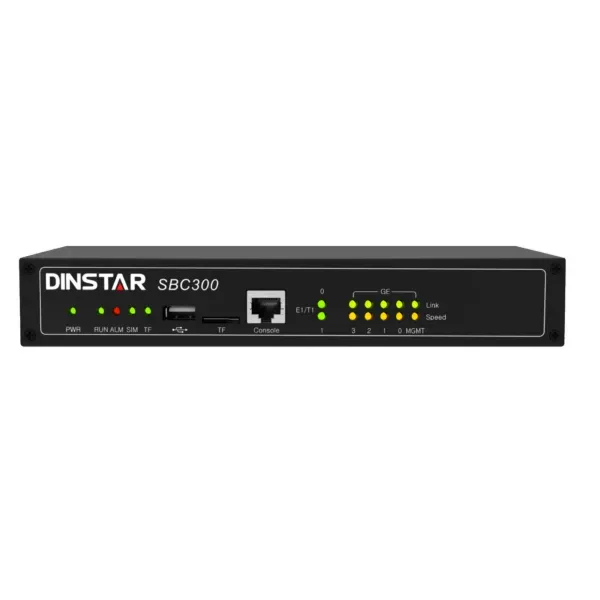
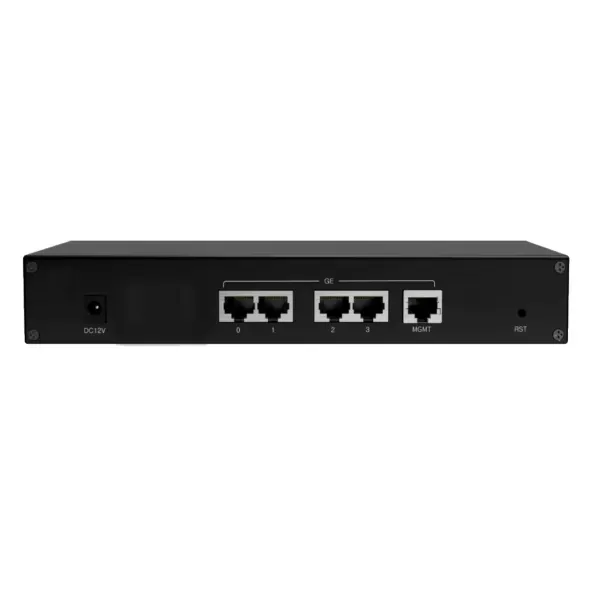
Dinstar SBC300 Session Border Controller
The Dinstar SBC300 is built for organizations that need a controlled, secure boundary between an internal VoIP environment and external SIP services. It is designed for SME and service-provider interconnection scenarios where SIP trunk security, signaling mediation, routing flexibility, codec compatibility, NAT traversal and operational visibility matter. For Tanzanian businesses moving from legacy telephony toward IP PBX and SIP trunking, the SBC300 can form a practical control point between the business voice platform and telecom or hosted voice networks.
Verified vendor highlights
Scalable from 5 to 50 simultaneous SIP calls with corresponding transcoding capacity, depending on licensing and configuration.
Supports SIP 2.0 over UDP, TCP and TLS, plus SRTP for media security.
Includes SIP anti-attack controls, topology hiding, flexible routing, NAT traversal, QoS and 1+1 active-standby support.
What the Dinstar SBC300 does
A Session Border Controller sits at the edge of a voice network and controls how SIP signaling and real-time media cross that boundary. That role becomes important when an IP PBX must connect to one or more SIP trunks, when two SIP platforms use different signaling expectations, when an organization wants to limit exposure of internal addressing, or when media codecs need translation. The SBC300 combines border security and interoperability functions in a compact appliance intended for smaller deployments rather than very high-capacity carrier environments.
Dinstar positions the SBC300 for SMEs and smaller service-provider scenarios. The product supports SIP mediation, header manipulation, caller and called-number manipulation, routing by prefix, SIP URI, method and other policy criteria, plus dynamic load balancing. These capabilities help engineers normalize connections between different PBX platforms, service-provider trunks and branch voice networks without forcing every endpoint to behave identically.
For an organization evaluating the SBC300 in Tanzania, the purchasing question should therefore go beyond the appliance itself. The voice architecture, SIP provider, required concurrent calls, codec plan, firewall design, redundancy expectations, public IP strategy, failover path and PBX compatibility should be reviewed before a final bill of materials is prepared.
SIP security
Embedded VoIP firewall functions, SIP request and registration rate limiting, malformed-packet protection, DoS/DDoS protection, access policies, white/black lists and topology hiding help reduce exposure at the voice edge.
Interoperability
B2BUA operation, SIP mediation, header manipulation and number normalization can bridge practical differences between PBXs, SIP trunks and telecom platforms.
Media handling
The SBC300 supports common voice codecs including G.711, G.723.1, G.729, iLBC, AMR and OPUS, with transcoding capability for environments where both sides do not share the same codec preference.
Routing and continuity
Flexible routing, dynamic load balancing, QoS and 1+1 active-standby support help create a more controlled and resilient SIP edge when the surrounding design is correctly implemented.
Dinstar SBC300 technical overview
| Target deployment | SME and smaller service-provider SIP interconnection |
| Concurrent SIP calls | License-scalable from 5 to 50 simultaneous calls |
| Transcoding | 5 to 50 concurrent transcoding calls according to licensing/configuration |
| SIP registrations | Up to 1,000 on the current vendor product page/datasheet set referenced for this page |
| SIP trunks | Unlimited SIP trunks stated by vendor |
| Signaling | SIP 2.0, UDP, TCP, TLS; B2BUA |
| Media/security | RTP/RTCP, SRTP, TLS/SRTP call security, QoS and NAT traversal |
| Management | Web interface, configuration backup/restore, firmware upgrade, CDR export, logs, reports, network capture and diagnostics |
| High availability | 1+1 active-standby redundancy supported |
Specification note: Dinstar has published multiple documentation revisions over time. This page uses the current SBC300 product-page and related datasheet positioning for customer-facing capacity statements. Final procurement should confirm the exact hardware revision, license tier and current vendor datasheet associated with the supplied unit.
Where SBC300 fits in a business voice architecture
A typical deployment places the SBC300 between the enterprise IP PBX and the external SIP trunk or hosted voice service. Internally, the PBX handles extensions, IVR, queues, voicemail, call recording and user features. Externally, the telecom provider delivers numbers and PSTN reachability over SIP. The SBC becomes the controlled intermediary that presents defined signaling, routing, security and media policies to both sides. This architecture is particularly useful where an organization wants to avoid direct exposure of the PBX to the internet.
The surrounding LAN must still be voice-ready. VLANs can separate voice endpoints from general user traffic, QoS can prioritize delay-sensitive traffic, firewall policies should be explicit, DNS and NTP should be reliable, and the internet path should have adequate quality. The SBC cannot compensate for severe packet loss or unstable circuits, so WAN quality and failover design remain part of the solution.
Customers can review FourTeck Tanzania’s integrated IT and telecom solution overview to see how IP telephony, firewalling, switching, cabling and support fit together. For product browsing and related business technology, the FourTeck Tanzania shop provides another useful procurement starting point.
Dinstar SBC300 Session Border Controller Tanzania
Businesses in Tanzania adopting SIP trunks, IP PBX platforms and branch-to-branch VoIP increasingly need a clear security and interoperability boundary. The Dinstar SBC300 is relevant where a company wants to connect an office PBX to a telecom operator while controlling SIP signaling, hiding internal topology, applying access rules and maintaining routing flexibility. Its 5-to-50-session positioning suits many smaller and mid-sized offices that do not require the scale of carrier-class SBC platforms but still need professional edge control.
For Tanzanian procurement teams, call concurrency should be estimated from real busy-hour behavior rather than employee count alone. A 100-person company may not need 100 simultaneous external calls, while a contact-oriented business with fewer employees can generate much higher concurrency. The design should therefore consider inbound and outbound peaks, future growth, remote users, branch traffic, conference usage and whether transcoding is expected on many calls. If codec normalization is required between a provider and PBX, transcoding capacity becomes as important as session count.
Security planning should include public-IP exposure, trusted SIP peers, TLS where supported end-to-end, SRTP requirements, white-listing and rate limits. For installations where voice availability is business-critical, the 1+1 active-standby capability can be considered alongside redundant internet, redundant switching and resilient power. High availability is a system design, not merely a checkbox on one appliance.
FourTeck can use the SBC300 as part of a wider IP telephony design that includes the PBX, SIP trunk, IP phones, PoE switching, firewall, UPS and structured cabling. Businesses evaluating regional standards can also reference FourTeck IT Solutions Africa for wider African infrastructure context.
Dinstar SBC300 Session Border Controller Dar es Salaam
Dar es Salaam organizations often operate customer-facing offices, logistics businesses, professional services, hotels, financial operations, retail networks and multi-branch environments where dependable telephone service is part of everyday operations. In these settings, the Dinstar SBC300 can provide an edge layer between a business IP PBX and SIP trunk providers, reducing the need to expose the PBX directly and giving administrators more control over how sessions enter and leave the network.
A Dar es Salaam deployment should begin by documenting the existing voice system. The engineer should know the PBX brand and version, current number ranges, expected SIP provider, public IP availability, NAT design, extension count, busy-hour call volume and codecs used by both sides. That information allows routing, normalization and security policies to be planned before cutover. If a business is replacing ISDN, analog trunks or gateway-based connectivity, migration can be staged so existing call flows remain understandable during transition.
Companies with customer-service desks should pay particular attention to call peaks. Reception, reservations, dispatch, collections and support teams can create short periods of heavy concurrent calling. The SBC license tier should reflect those peaks and include reasonable growth headroom. Where voice and general internet share the same circuit, QoS and firewall policy should protect voice from large downloads, cloud backups and other bandwidth-intensive applications.
For a quotation, businesses should provide the expected simultaneous-call requirement, SIP provider details, PBX information, number of sites and whether redundancy is mandatory. That produces a more accurate proposal than ordering an SBC by model name alone.
Dinstar SBC300 Session Border Controller Mwanza
Mwanza businesses considering SIP trunking can use the Dinstar SBC300 as a controlled border between internal IP telephony and external voice services. The value is strongest when a company has multiple departments, branch connectivity, remote extensions or mixed voice systems that need predictable routing. Rather than relying entirely on a PBX’s internet-facing SIP settings, an SBC creates a dedicated place for access rules, topology hiding, session policies and interworking.
Network readiness is an important part of the project. Voice quality depends on latency, jitter and packet loss, so a technically correct SIP configuration can still perform poorly on an unstable WAN. Before deployment, the organization should review internet consistency, router and firewall behavior, available QoS features, LAN congestion and UPS coverage. If the voice service is critical to sales or operations, a secondary WAN may be justified, but failover behavior should be tested with the SIP provider because IP changes, DNS behavior and trunk authentication can affect reconnection.
The SBC300’s flexible routing is useful where different number ranges, departments or trunks need different treatment. Routing can be designed around prefixes and policy, while caller/called-number manipulation can normalize dial plans between the PBX and carrier. This can simplify migrations where legacy dialing habits differ from the format required by a new SIP trunk.
For Mwanza procurement, the recommended approach is to document the present call flow, identify pain points, verify trunk compatibility and then select the license tier. Businesses should also keep configuration backups and a simple change record so later troubleshooting does not depend on memory.
Dinstar SBC300 Session Border Controller Arusha
Arusha organizations in hospitality, tourism, professional services, education and multi-site operations can benefit from secure SIP interconnection when voice services connect staff, guests, suppliers and remote offices. The Dinstar SBC300 gives smaller environments an appliance designed specifically for SIP border control rather than treating voice as ordinary data traffic through a generic firewall alone.
For hospitality and service environments, reliability during busy periods matters. Reservation lines, reception desks and operations teams may see sharp traffic changes by season or time of day. Session sizing should therefore be based on measured or estimated peak calls. Codec compatibility is also worth checking when connecting different providers or hosted systems. If transcoding is used widely, the selected SBC300 capacity tier must account for that requirement rather than only the number of signaling sessions.
The appliance supports TLS/SRTP, but secure deployment requires both sides to support and correctly configure the same methods. Access lists, white/black lists, rate limiting and SIP anti-attack functions should be tuned to the intended traffic pattern. Overly open rules increase exposure, while overly restrictive policies can interrupt legitimate trunks. Testing should cover inbound calls, outbound calls, DTMF, transfers, call forwarding, hold, caller ID, fax requirements if applicable and after-hours routing.
Arusha buyers should include network and voice details in the RFQ: PBX type, SIP carrier, simultaneous-call target, redundancy expectation, WAN design and required codecs. This makes the project easier to size and reduces commissioning surprises.
Dinstar SBC300 Session Border Controller Dodoma
Organizations in Dodoma that depend on structured business calling can deploy the Dinstar SBC300 to add a dedicated control layer between IP PBX systems and SIP-based telecom services. The product is suitable for offices that need stronger SIP security, interoperability and routing without moving to the higher capacities associated with large carrier SBC platforms. It can be particularly relevant during a migration from older trunk technologies to SIP.
A well-planned implementation should separate technical requirements from licensing. First define the architecture: which PBX will connect, which SIP trunks will be used, whether remote branches connect through the SBC, which codecs are required, whether TLS/SRTP is available, and what failover behavior is expected. Then size sessions and transcoding. This avoids paying for unsuitable capacity or discovering later that the chosen tier does not match the actual call pattern.
Management features such as configuration backup/restore, logs, CDR export, network capture, ping and traceroute are useful during commissioning and support. Administrators should establish a backup routine before major changes. A documented baseline makes it easier to distinguish provider faults, PBX issues and policy changes when a voice problem occurs.
For Dodoma sites with critical communications, power continuity deserves equal attention. The SBC, PBX, switches, router and access equipment should be considered together for UPS coverage. An SBC that remains powered while the upstream switch or WAN router shuts down will not preserve calls. Resilience works only when the complete voice path is designed accordingly.
Dinstar SBC300 Session Border Controller UAE
Organizations operating between Tanzania and the UAE may want a consistent SIP edge design across offices. The Dinstar SBC300 can be evaluated for smaller sites where call concurrency remains within its licensed range and where a dedicated Session Border Controller is needed for trunk security, mediation and routing. Multi-country projects should avoid assuming that one telecom configuration can simply be copied between markets, because provider authentication, numbering plans, regulatory requirements and available SIP services can differ.
A regional voice standard can still define common technical principles: supported PBX versions, preferred codecs, encryption requirements, logging, configuration backup, number normalization rules and change-control procedures. The SBC300’s policy-driven routing and SIP manipulation can help adapt those standards to each carrier connection without requiring the internal PBX dial plan to be completely redesigned for every location.
For UAE projects, customers can review FourTeck UAE integrated IT and telecom solutions. The regional link is useful for organizations that maintain technology standards across East Africa and the Gulf. Procurement teams should still validate local SIP-trunk requirements and current telecom rules with the selected service provider before implementation.
When comparing an SBC300 deployment across countries, focus on measurable requirements: simultaneous calls, transcoding demand, trunk count, HA expectations, signaling security and support workflow. This keeps the architecture consistent while allowing local carrier-specific configuration where necessary.
Dinstar SBC300 Session Border Controller Uganda
Ugandan businesses using IP PBX and SIP services can consider the Dinstar SBC300 when they need a secure and manageable border between internal voice infrastructure and external trunks. The device is especially relevant for organizations with branch offices, central reception, customer-service teams or mixed vendor environments where SIP interoperability matters.
The main design task is to map calls before configuring policies. Engineers should understand inbound DID routing, outbound dialing patterns, emergency or special numbers where applicable, after-hours treatment, branch prefixes and caller-ID presentation. The SBC can then normalize and route traffic consistently. Where the provider and PBX prefer different codecs, transcoding can resolve the mismatch, but the expected number of simultaneous transcoded calls must remain within the licensed capacity.
Security rules should be provider-specific whenever possible. Trusted SIP peers, access lists, rate limits and topology hiding reduce unnecessary exposure. Logs and network captures can support troubleshooting when a call reaches one side but fails on the other. Administrators should also coordinate SBC changes with PBX and firewall teams so duplicated NAT or conflicting SIP helpers do not create unexpected behavior.
Organizations managing projects in both Tanzania and Uganda can refer to FourTeck Uganda IP PBX and VoIP solutions for regional communications context, while keeping the technical design aligned to the exact service-provider environment in each country.
Dinstar SBC300 Session Border Controller Kampala
Kampala businesses with active reception, sales, support and branch calling can use a Session Border Controller to make SIP connectivity more controlled and supportable. The Dinstar SBC300 sits between internal voice systems and external SIP services, applying routing, security and interoperability policies that would otherwise need to be distributed across multiple platforms.
For a Kampala office, the most important sizing input is peak simultaneous external calling. The SBC300 is license-scalable between 5 and 50 simultaneous sessions. A business that routinely reaches the top of its licensed call count may experience blocked calls, so growth margin should be considered at procurement. The same applies to transcoding: codec conversion consumes a defined capacity and should be estimated from actual interconnection requirements.
The network should also be checked for SIP ALG or helper features that can conflict with SBC operation. In many architectures, the SBC is intended to own SIP normalization and NAT traversal, so intermediate devices should not unexpectedly rewrite signaling. Deployment testing should include long calls, transfers, holds, DTMF, simultaneous inbound/outbound traffic and WAN interruption scenarios.
Kampala procurement teams should request an implementation scope that clearly states who configures the PBX, SBC, firewall and SIP carrier side. Clear responsibility is essential during cutover because a signaling issue can span all four components. A documented test plan and rollback path are more valuable than relying on ad-hoc troubleshooting during business hours.
Dinstar SBC300 Session Border Controller Arua
Arua organizations adopting VoIP can use the Dinstar SBC300 where secure SIP trunk access and predictable interworking are priorities. Smaller regional sites often need a solution that is technically capable without the complexity and scale of a carrier platform. The SBC300’s license-based 5-to-50-session range supports that type of deployment when the call profile is understood.
Connectivity quality should be reviewed carefully. If voice shares a general-purpose internet connection, business applications can create congestion that affects calls. QoS can help inside the managed network, but the end-to-end internet path still matters. Businesses should measure latency, packet loss and stability and consider whether a backup link is justified. If a secondary link uses a different public IP, the SIP provider’s authentication and failover behavior should be confirmed in advance.
The SBC’s logging and network-capture features can be valuable where remote support is necessary. Good documentation should record interface addressing, trunk peers, routing policies, codecs and security settings. That allows support teams to diagnose whether a failure is local, provider-side or related to policy changes without starting from zero.
For Arua procurement, businesses should include a current network diagram and desired call flow in the project request. Even a simple diagram showing internet links, firewall, SBC, PBX and switch connections can eliminate ambiguity and speed up accurate sizing and configuration planning.
Dinstar SBC300 Session Border Controller Mbarara
Mbarara businesses upgrading from traditional voice trunks to SIP can use the Dinstar SBC300 as a migration control point. The device can separate internal PBX behavior from the external carrier interface, allowing number manipulation, header adjustments and routing policy to be handled at the border. This can reduce the need for extensive changes to established internal extension plans.
A migration plan should identify which calls move first, how old and new trunks coexist temporarily, and how users are affected. The SBC can support multiple SIP trunks, allowing staged transitions or separate routing policies where appropriate. However, every provider has its own requirements, so trunk settings should be validated rather than copied from a different carrier or country.
Businesses should also decide whether the SBC is only protecting one site or forms part of a broader branch architecture. If branches register centrally or route calls through a main office, WAN dependency and failover become more important. The maximum session requirement should include branch traffic that crosses the SBC, not only calls generated at the headquarters site.
Mbarara project documentation should include trunk credentials handling, configuration backup, admin access policy and logging expectations. Administrative interfaces should not be broadly exposed to the internet. Where remote access is necessary, it should be limited and protected according to the organization’s network-security policy.
Dinstar SBC300 Session Border Controller Gulu
Gulu organizations can evaluate the Dinstar SBC300 for secure SIP access when implementing IP PBX, hosted voice interconnection or branch telephony. An SBC is particularly useful where the business wants explicit control of which external peers can exchange SIP traffic with internal systems. This reduces reliance on broad firewall rules and gives voice administrators tools designed specifically for SIP.
The security configuration should be deliberately narrow. Access policies can restrict expected peers, rate limiting can reduce abnormal request floods, and topology hiding can prevent unnecessary exposure of internal addressing. TLS and SRTP can improve signaling and media confidentiality when supported by both ends, but certificate management and compatibility should be included in the implementation plan.
Operational resilience should include backups of the SBC configuration and a tested recovery process. If high availability is required, 1+1 active-standby can be considered, but redundant appliances should be complemented by resilient switching, power and WAN paths. Otherwise the overall service may still have a single point of failure elsewhere.
A Gulu quotation request should state whether the need is a new deployment, migration or troubleshooting replacement. That context changes the engineering scope. New projects can be designed cleanly, while migration projects need coexistence planning and existing configurations may need to be assessed before cutover.
Dinstar SBC300 Session Border Controller Kenya
Kenyan organizations with SIP trunking and IP PBX environments can use the Dinstar SBC300 for controlled interconnection when their session requirements fit the 5-to-50-call range. The same product can be useful in regional standardization projects where a company wants a familiar SBC interface across smaller East African branch offices, while adapting each deployment to local carriers and numbering plans.
Standardization should focus on architecture and operations rather than copying every configuration. A company can define common policies for admin access, backups, logging, encryption, routing documentation and change control, then apply local trunk settings at each site. This makes support easier because engineers understand the same platform while still respecting country-specific telecom details.
Interoperability testing should cover the complete feature set the business actually uses. Basic inbound and outbound calling is only the first step. Transfers, hunt groups, caller-ID presentation, DTMF-based IVRs, forwarding, voicemail, call recording and fax traffic where applicable can expose differences between SIP platforms. The SBC’s mediation and manipulation features provide tools to resolve many of these differences, but the rules should be documented and kept as simple as practical.
For cross-border projects, customers can review FourTeck Kenya business IT and VoIP solutions alongside the Tanzania deployment. Procurement teams should still obtain current carrier requirements before final configuration.
Dinstar SBC300 Session Border Controller Kuwait
Businesses with operations in Tanzania and Kuwait may use a common SBC platform to simplify internal support standards where local telecom services permit. The Dinstar SBC300 is suitable for smaller sites requiring SIP security, mediation, routing and transcoding within its licensed capacity range. A regional procurement team can standardize documentation and management practices while leaving local trunk configuration to the relevant carrier requirements.
Before deployment, confirm whether SIP trunks are presented over public internet, managed connectivity or another approved architecture. That determines how NAT, addressing, firewall rules and security are implemented. If TLS/SRTP is used, certificate and encryption compatibility should be tested with the provider. If the carrier presents fixed SIP peers, white-listing those addresses can help narrow the permitted signaling surface.
For a multi-country company, change control becomes especially important. A small routing adjustment at one site should not be replicated everywhere without review. Maintaining per-site diagrams and configuration backups helps support teams distinguish standard settings from local exceptions. The SBC300’s diagnostic features can support remote troubleshooting when voice engineers are not physically present at the branch.
The buying decision should consider license tier, HA needs, spare strategy and support responsibility. The appliance should be part of a documented communications architecture rather than treated as a standalone box whose behavior is understood only by the installer.
Dinstar SBC300 Session Border Controller Ghana
Ghanaian businesses evaluating secure SIP trunk connectivity can consider the Dinstar SBC300 for smaller and mid-sized VoIP environments. The product’s core value is the combination of SIP security, interworking, routing and transcoding at the communications perimeter. It can help isolate the internal PBX from provider-specific behavior and create a consistent place to enforce voice-edge policy.
When preparing a Ghana deployment, administrators should first document the number plan. International formats, local dialing patterns, extension prefixes and caller-ID requirements may need normalization between systems. The SBC’s caller/called-number manipulation and flexible routing can address these differences. Rules should be kept readable, with comments or external documentation describing why each transformation exists.
Security should be matched to risk. The vendor provides SIP anti-attack measures, malformed-packet protection, access policies, rate limiting, embedded VoIP firewall functions and TLS/SRTP support. These features need deliberate configuration and should complement, not replace, perimeter firewall policy. Management access should be restricted, credentials controlled and configuration backups stored safely.
For regional organizations, the SBC300 can be one element of a repeatable branch-voice standard. Capacity, however, must be assessed separately at every location. A sales-heavy office may need substantially more sessions than a similarly sized administrative branch, so headcount alone is not a reliable license metric.
Dinstar SBC300 Session Border Controller Nigeria
Nigerian organizations with SIP-based business communications can use the Dinstar SBC300 where a dedicated voice perimeter is needed for smaller deployments. The appliance supports up to 50 simultaneous calls at its upper license tier and provides routing, codec handling, SIP mediation and security features suitable for connecting an enterprise PBX to service-provider trunks.
Large or rapidly growing organizations should validate whether 50 sessions remains sufficient over the expected lifecycle. It is generally better to select the correct SBC family member at the beginning than to design around a capacity ceiling that will soon be reached. For branch offices with moderate call volumes, however, the SBC300 can offer an efficient fit without the footprint of a higher-capacity service-provider platform.
Call quality planning should include both LAN and WAN. Voice VLANs, QoS, stable switching and disciplined cabling support predictable internal performance. External quality depends on provider and internet connectivity. Where two WAN paths are used, test how the SIP trunk behaves when the public source IP changes and how quickly registrations or peer connections recover.
Support teams should retain CDRs, logs and captures only according to organizational policy and relevant privacy requirements. The SBC provides diagnostic visibility, but operational procedures should define who can access call metadata and configuration. Clear governance is especially important in multi-site organizations where several administrators share responsibility.
Dinstar SBC300 Session Border Controller Seychelles
Seychelles businesses in hospitality, services and distributed operations may use SIP to connect offices and external telecom services. The Dinstar SBC300 is suitable for smaller deployments that need secure interconnection, especially when an IP PBX must communicate with a provider while preserving control over routing, signaling and media behavior.
For hospitality environments, telephony can interact with front-desk workflows, back-office extensions and guest services. Any SBC deployment should therefore be assessed alongside the PBX features and integrations already in use. The objective is not to disturb internal workflows while introducing a more controlled external SIP boundary. Number manipulation and SIP mediation can be helpful during migrations, but every rule should be tested against real call scenarios.
Resilience can be particularly important where replacement lead times or travel logistics make emergency hardware intervention difficult. Configuration backups, clear diagrams and remote diagnostic capability help reduce dependence on physical access. If the business requires HA, 1+1 active-standby can be part of the design, accompanied by redundant power and networking where practical.
Before ordering, a Seychelles customer should provide the PBX model, SIP provider details, expected call concurrency, codec requirements and desired failover behavior. That information allows the SBC300 to be evaluated against the actual communications environment instead of relying on generic product specifications.
Related FourTeck solutions for a complete SBC deployment
An SBC performs best when the rest of the voice path is designed coherently. Tanzania projects may require IP PBX configuration, SIP phones, managed PoE switching, VLANs, firewall policy, UPS protection, structured cabling and WAN failover. FourTeck’s Tanzania platform covers these integrated business technologies, while regional sites support organizations managing infrastructure across multiple markets.
Buying and sizing guidance
Choose the SBC300 only after estimating the busy-hour concurrent call requirement. The relevant number is how many calls may cross the SBC at the same time, not how many phones are installed. Include inbound and outbound trunks, branch traffic and any calls that traverse the device between systems. Add reasonable growth capacity so a routine expansion does not immediately require a license change or platform replacement.
Next, determine how much transcoding is required. If both sides use the same preferred codec, many calls may pass without transcoding. If one side requires G.729 while the other side uses G.711 or OPUS, media conversion may be necessary. The SBC300’s transcoding capacity is license-scalable, so this requirement should be understood during design.
Finally, decide whether high availability is necessary. A business that can tolerate a short telephony outage has a different requirement from a contact center, hotel or operations team that depends on incoming calls. HA decisions should include appliance redundancy, WAN redundancy, switch redundancy, power and the PBX itself.
Quotation checklist
Dinstar SBC300 FAQ
How many simultaneous calls does the Dinstar SBC300 support?
Dinstar positions the current SBC300 as license-scalable from 5 to 50 simultaneous SIP calls. The required tier should be selected from busy-hour concurrency and expected growth rather than total employee count.
Does the SBC300 support transcoding?
Yes. Dinstar lists codec support including G.711, G.723.1, G.729, iLBC, AMR and OPUS, with transcoding capacity that scales with the licensed session tier. Exact codec requirements should be checked against the PBX and SIP provider.
Can the SBC300 improve SIP security?
The product includes SIP-focused controls such as topology hiding, embedded VoIP firewall functions, DoS/DDoS protection, rate limiting, malformed-packet protection, access policies, white/black lists and TLS/SRTP support. These controls should be integrated with the wider firewall and network-security design.
Does it support high availability?
Dinstar lists 1+1 active-standby redundancy for the SBC300. A complete HA design should also review WAN links, switching, power and PBX resilience.
Can SBC300 connect different SIP vendors?
That is one of its intended roles. B2BUA behavior, SIP mediation, header manipulation, number manipulation and media transcoding can help interconnect platforms with differing SIP expectations. Compatibility should still be tested for the features the business uses.
What should be tested before production cutover?
Test inbound/outbound calling, caller ID, DTMF, transfers, hold/resume, forwarding, voicemail, long-duration calls, simultaneous traffic, trunk failover where applicable and any fax or special call flows required by the organization.
Decision recap
Choose the Dinstar SBC300 when you need a compact SBC for a smaller SIP environment, expect no more than 50 simultaneous sessions at the platform’s upper licensed tier, require SIP security and mediation, and value codec transcoding plus flexible routing. Consider a higher-capacity SBC family member if expected growth, registration scale or transcoding demand is materially above the SBC300 range.
For the best result, treat the SBC as one component of a complete VoIP architecture. The SIP carrier, PBX, firewall, switch, WAN, power and support process all influence call reliability. A short discovery exercise before ordering can prevent avoidable redesign later.
Consult FourTeck about SBC300 deployment
Share your PBX model, SIP carrier, required concurrent calls, branch design and redundancy goals. FourTeck can use those details to prepare a more relevant product and deployment discussion for Tanzania rather than treating the SBC as an isolated hardware purchase.


Reviews
There are no reviews yet.