
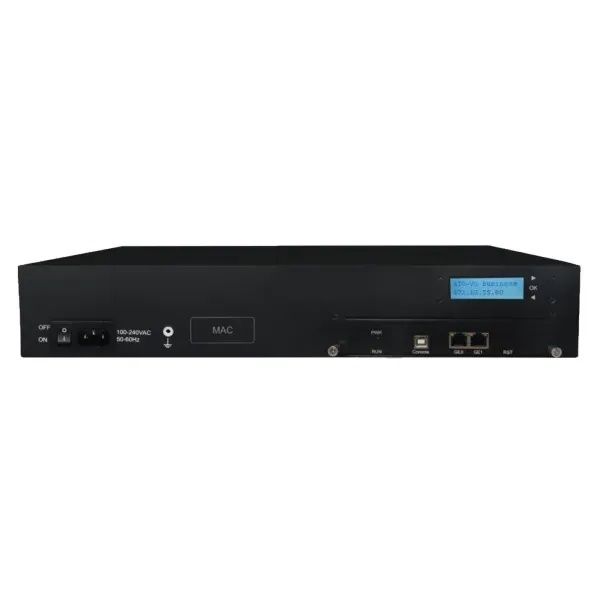
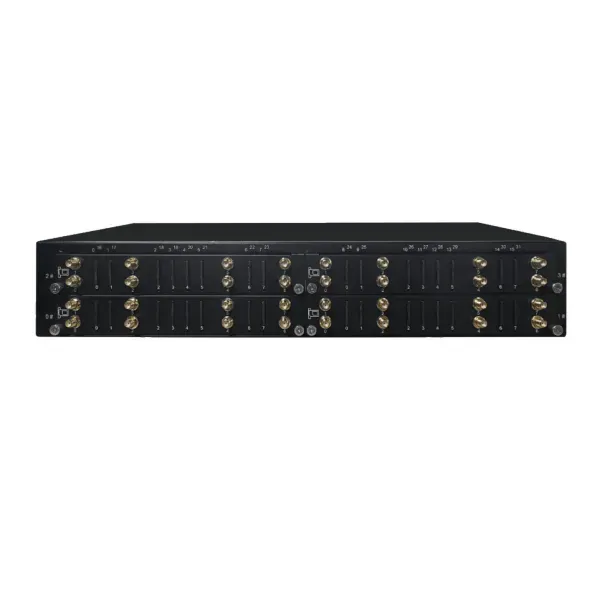
Dinstar UC2000-VG Multi-SIM VoIP Gateway
The Dinstar UC2000-VG Multi-SIM VoIP Gateway is designed for organizations that need to connect mobile networks with SIP-based voice infrastructure at scale. The Multi-SIM UC2000-VG combines 32 GSM/WCDMA/LTE mobile channels with 128 SIM slots, allowing four SIM positions per mobile channel and supporting SIM rotation, VoLTE calling, SMS/USSD functions, SIP interoperability, centralized management options and API-driven messaging. For enterprises, multi-site organizations, contact centers, service providers and operations that depend on mobile connectivity, it creates a structured bridge between cellular services and IP telephony without forcing every communication workflow onto fixed-line trunks.
Best-fit buying profile
Choose this class of gateway when the requirement involves many cellular channels, SIM rotation, mobile-to-SIP or SIP-to-mobile call routing, SMS integration, and centralized operational control. Before quotation, confirm mobile bands, operator compatibility, intended SIM policies, PBX or softswitch platform, expected concurrent calls and messaging workflows.
The Multi-SIM UC2000-VG supports 32 mobile channels for high-capacity GSM/WCDMA/LTE voice connectivity.
Four SIM slots per mobile channel support flexible local SIM allocation and rotation strategies.
SIP v2.0 integration and VoLTE support enable interworking between modern VoIP systems and compatible mobile networks.
SMS sending and receiving, HTTP API and SMPP functions support messaging workflows and system integration.
What the Dinstar UC2000-VG Multi-SIM VoIP Gateway solves
Many organizations have an IP PBX, SIP server or softswitch but still need reliable access to cellular networks for inbound and outbound calls, branch connectivity, mobile-number presentation, backup trunks, SMS applications or regional communications. A conventional SIP trunk does not automatically provide direct mobile-network access, while small cellular gateways can become difficult to scale when dozens of channels and SIMs are required. The UC2000-VG Multi-SIM platform addresses this gap by placing a high-density cellular gateway between the mobile network and the IP voice environment.
The product is especially relevant where SIM management is part of the operating model. With 128 SIM slots distributed across 32 mobile channels, administrators can apply SIM rotation based on operational policies such as run time or balance. Dinstar also provides features for balance checking, call-minute limits and automatic call or SMS generation. These functions can reduce manual intervention in larger deployments, although the exact policy must remain compliant with each mobile operator’s terms and applicable telecom regulations.
The gateway should be treated as part of a complete communication architecture rather than as an isolated appliance. The PBX, SIP routing, LAN design, firewall policy, QoS, numbering rules, mobile operator subscriptions, antenna arrangement, rack space, power continuity and monitoring process all influence the final result. A well-scoped project starts by defining call direction, expected concurrency, destination patterns, messaging use, SIM ownership and security requirements before deciding how the UC2000-VG will be configured.
Verified UC2000-VG Multi-SIM capabilities
Mobile interfaces
Dinstar specifies 32 mobile channels with 128 SIM slots for the UC2000-VG Multi-SIM model. The platform supports GSM, WCDMA and LTE variants, with frequency options that differ by hardware version and destination market. Band selection must therefore be confirmed for the intended operator before ordering.
Voice and SIP
The gateway supports SIP v2.0 and common VoIP media functions, including G.711 A/U, G.723.1 and G.729AB codecs, echo cancellation, DTMF methods and signaling/media security options. It can route calls from mobile to VoIP and from VoIP to mobile.
Messaging functions
SMS/USSD, HTTP API, SMPP, SMS-to-email and email-to-SMS functions allow the gateway to participate in operational messaging workflows. Applications should be designed around operator policies, consent requirements and applicable messaging rules.
Management and diagnostics
Web-based administration, backup and restore, firmware upgrade, call statistics, CDR storage, logs, traffic statistics, SIP/RTP/PCM capture and abnormal-call monitoring help administrators operate and troubleshoot the gateway within a managed voice environment.
SIM operations
The Multi-SIM design supports hot-swappable SIM cards, flexible SIM allocation, SIM rotation, PIN management, balance checking and operational limits. These capabilities are useful where many subscriptions must be managed in a consistent way.
Remote SIM options
Dinstar’s wider gateway ecosystem includes SIMBank and SIMCloud options for centralized or remote SIM management. Where these are required, compatibility, licensing, architecture and security should be confirmed as separate project components rather than assumed to be included with the gateway.
Deployment and integration planning
A production deployment should begin with a call-flow diagram. Identify which calls enter from cellular networks, which calls originate from the PBX, how numbers are transformed, which SIP trunks or trunk groups will be used, and how failures are handled. The UC2000-VG supports trunk and port grouping, caller and called-number manipulation, SIP code mapping, white and black lists, hotline behavior and multiple call-control functions. These features are powerful, but the configuration should stay as simple as the business requirement allows.
Network readiness is equally important. The gateway should have stable Ethernet connectivity, appropriate IP addressing, secured management access, time synchronization and a clear path to the PBX or SIP server. Where voice traffic crosses VLANs, firewalls or VPNs, test SIP signaling and RTP in both directions. If TLS or SRTP is planned, verify that the PBX and any intermediary systems support a compatible security profile. Avoid exposing management interfaces directly to the public internet.
Mobile-network design requires its own validation. Frequency bands vary by UC2000-VG radio option, so the exact hardware version must match the selected operator. Antenna placement, signal quality and the radio environment can affect service. SIM plans must also be appropriate for the intended call and messaging volumes. Before a large rollout, validate a representative set of SIMs, call scenarios and SMS flows under real working conditions.
Related FourTeck Tanzania voice products and services
The UC2000-VG is a cellular-to-SIP gateway, so it often sits alongside other voice interfaces. For smaller analog migrations, review the Dinstar DAG1000-1S analog telephone adapter, which connects a single FXS endpoint to SIP. Where an existing PSTN line must enter a VoIP system, the Dinstar DAG1000-2O FXO VoIP Gateway is a different interface class and should be evaluated separately.
For mixed analog environments, the Dinstar DAG1000-2S2O Hybrid VoIP Gateway can support projects that need both FXS and FXO ports rather than cellular channels. For broader selection across IP PBX, IP phones, networking and telecom hardware, the FourTeck Tanzania business technology shop provides a useful procurement starting point.
Organizations with multi-country telecom requirements can also use the FourTeck Uganda technology portal as a regional reference for PBX, networking and communication projects. Product selection should always be based on interface type, channel count, radio compatibility and the intended PBX architecture rather than choosing a gateway only by brand family.
Dinstar UC2000-VG Multi-SIM VoIP Gateway Tanzania
For Tanzanian organizations, the Dinstar UC2000-VG Multi-SIM VoIP Gateway is best considered as a high-density mobile trunking and integration platform rather than simply a GSM gateway. Its 32 mobile channels and 128 SIM positions suit projects where cellular connectivity must be presented to an IP PBX, SIP server, softswitch, contact-center platform or messaging application in a structured way. Potential users include enterprises with many outbound mobile calls, distributed operations, service desks, call centers, logistics businesses, hospitality groups, institutions and organizations that need a cellular backup path when fixed voice services are unavailable or unsuitable.
Tanzania procurement should begin with operator and band validation. Dinstar publishes different LTE radio options for different countries, so the exact UC2000-VG hardware variant must be checked against the mobile networks intended for use. Buyers should list the operators, SIM quantities, expected concurrent calls, voice direction, SMS requirements, PBX brand, SIP authentication method and whether VoLTE is required. This information is more useful than asking for a generic “32-port GSM gateway” because it allows the radio and SIP design to be assessed together.
Operationally, the Multi-SIM architecture can simplify handling of many subscriptions because four SIM slots are associated with each mobile channel. SIM rotation, balance checks and minute limitations can support disciplined administration, but every organization must use these features within operator terms and applicable regulations. For large-scale messaging, HTTP API or SMPP integration should be tested with the intended application, character encoding, throughput expectations and error-handling process.
A Tanzania quotation request should therefore include more than quantity. State the destination, required channel capacity, preferred mobile operators, whether the gateway will integrate with an on-premises or hosted PBX, the expected call patterns, messaging use, rack and power conditions, and whether configuration assistance is required. This gives procurement and technical teams a common basis for comparing the UC2000-VG with other Dinstar gateway classes and avoids choosing a model whose capacity or mobile bands do not match the real deployment.
Dinstar UC2000-VG Multi-SIM VoIP Gateway Dar es Salaam
Dar es Salaam businesses often operate complex communication environments combining corporate internet, private networks, cloud services, call centers, branch offices and mobile users. In that context, the UC2000-VG Multi-SIM can provide a controlled mobile-network edge for organizations that want cellular trunks connected to an existing SIP system. A contact center may use it for outbound and inbound mobile calls; a logistics company may connect field-facing mobile numbers to a centralized PBX; a multi-site organization may use cellular channels as an alternate voice route; and an application team may integrate SMS through the gateway’s API capabilities.
The technical design should account for both IP and radio conditions. In a busy office or data-room environment, position the gateway and its antennas so that mobile signal quality is not compromised by metal racks, building structure or interference. Confirm whether external antenna arrangements are needed and whether the selected model includes any optional antenna-combining hardware. The LAN side should be connected to managed switching with clear addressing, access control and monitoring. Where the PBX is hosted off-site, test internet latency, packet loss and firewall behavior rather than assuming that raw bandwidth alone guarantees call quality.
For large Dar es Salaam deployments, configuration governance matters. Define naming conventions for ports, SIMs, trunks and route groups. Document which operators are associated with each SIM pool and how calls are distributed. If SIM rotation is used, define the business rule and monitoring process. CDR, call statistics and logs should be reviewed as operational data, not only as troubleshooting tools. These records help identify busy channels, failed calls, SIM balance issues and routing anomalies.
Procurement teams should also separate hardware capability from service availability. The UC2000-VG supports LTE/WCDMA/GSM options and VoLTE, but actual operation depends on the radio module, operator support, SIM plan and network policies. A Dar es Salaam pilot with representative SIMs and real call flows is a sensible step before committing to a high-volume rollout. The quotation should clearly identify the exact gateway variant, required accessories, mobile bands, configuration scope and any optional SIM-management components.
Dinstar UC2000-VG Multi-SIM VoIP Gateway Mwanza
In Mwanza, the UC2000-VG Multi-SIM can suit organizations that need centralized voice control while relying on mobile networks for regional communications. Businesses in distribution, healthcare, hospitality, education, transport and branch operations may have an IP PBX at a head office or cloud platform while requiring cellular channels for local calling, backup or customer-facing numbers. A 32-channel gateway provides significantly more capacity than small 4- or 8-channel devices and is therefore most appropriate where the expected traffic justifies centralized, high-density hardware.
For a Mwanza site, the first design question should be whether all 32 channels are needed at one location or whether a lower-channel model would be easier to operate. High-density gateways concentrate many calls and SIM subscriptions into one appliance, so power continuity, ventilation, network resilience and monitoring become important. Where voice continuity is business-critical, consider how the PBX, switch, firewall, gateway and upstream internet or WAN path will remain available during power or service interruptions. A UPS can protect the local equipment, but it does not replace network redundancy.
The Multi-SIM feature is particularly useful when several operators or tariff plans are part of the communications strategy. Administrators can allocate multiple SIMs to channels and configure rotation based on defined criteria. This should not be treated as an automatic cost-saving guarantee; the correct policy depends on operator tariffs, fair-use rules, business calling patterns and telecom compliance. Organizations should maintain clear ownership records for every SIM and review usage regularly.
When requesting the UC2000-VG for Mwanza, describe the intended PBX or softswitch, number of active channels, operators, expected call destinations, SMS workflows and management model. If the gateway will be managed remotely from another city, include secure administration, configuration backup and monitoring in the deployment plan. A standardized build can make branch support more predictable, especially when the same Dinstar architecture is used across multiple sites.
Dinstar UC2000-VG Multi-SIM VoIP Gateway Arusha
Arusha organizations in tourism, hospitality, transport, professional services, education and multi-branch operations often communicate with customers and field teams across mobile networks. The Dinstar UC2000-VG Multi-SIM can integrate those cellular routes with a SIP-based communications platform so calls can be controlled through PBX extensions, queues, IVR, reporting or centralized routing. This is useful where a business already has an IP telephony platform but needs a dedicated mobile-network interface rather than relying exclusively on fixed SIP trunks.
The project should start by mapping user groups and call destinations. Reception, reservations, sales, support and operations may generate different traffic patterns. A routing policy can then direct calls through selected mobile channels or trunk groups while preserving a manageable numbering plan. Dinstar provides caller/called-number manipulation, trunk grouping and port grouping, but these should be configured according to a documented dial plan. Overly complex rules can make troubleshooting difficult, particularly if the PBX also performs number translation.
For SMS use, define the application before enabling bulk functions. A hotel may want notification messages, a transport company may need dispatch alerts, and a customer-service platform may integrate two-way messaging. The UC2000-VG supports HTTP API, SMPP and SMS-to-email workflows, but the surrounding application must handle authentication, destination formatting, retries, delivery outcomes and consent requirements. Messaging volume and operator policy should be confirmed before production use.
An Arusha quotation should include expected call concurrency, the number of SIMs, mobile operator preferences, PBX details, whether VoLTE is needed, messaging requirements and the site’s rack/power/network conditions. If the organization has remote lodges, offices or field sites, consider whether the high-density gateway should remain at a central location with SIP connectivity to those branches or whether smaller gateways at remote locations offer better resilience. The correct topology depends on WAN reliability and operational priorities.
Dinstar UC2000-VG Multi-SIM VoIP Gateway Dodoma
For organizations in Dodoma, the UC2000-VG Multi-SIM is relevant when institutional, administrative or enterprise telephony needs to connect with mobile networks at scale. Offices with central PBX systems may need cellular trunks for departments, outreach teams, service desks or backup communications. Because the gateway supports 32 mobile channels, it should be selected for a clearly defined high-capacity requirement rather than used simply because it offers more ports than smaller models.
Procurement documentation is particularly important for structured institutional projects. The bill of materials should identify the exact UC2000-VG Multi-SIM variant, radio-band option, SIM quantity, antenna arrangement, Ethernet connectivity, rack requirements and any optional SIMBank or SIMCloud components. The technical scope should state whether FourTeck is expected to provide supply only, configuration assistance, PBX integration, testing or ongoing support. Separating hardware, software and service scope prevents assumptions from entering the purchase process.
Security should also be part of the design. SIP credentials, administrator accounts and API access are sensitive. Use strong credentials, restrict management access, back up configurations securely and log changes. Where SIP TLS or SRTP is used, confirm compatibility with the complete voice path. The gateway’s SMS API should not be exposed unnecessarily, and application credentials should be protected. If remote administration is required, place it behind controlled network access rather than publishing the management interface openly.
Before deployment in Dodoma, create an acceptance test covering inbound and outbound mobile calls, DTMF, caller ID, routing rules, failover behavior, SMS send/receive, SIM rotation and recovery after reboot. Record the expected result for each test. This produces a clearer handover for IT teams and helps distinguish gateway issues from mobile-operator, PBX or LAN problems. A detailed quotation request should include this operational context so the proposed configuration reflects the real service requirement.
Dinstar UC2000-VG Multi-SIM VoIP Gateway UAE
UAE organizations evaluating the UC2000-VG Multi-SIM typically have mature IP telephony environments and are looking for controlled cellular integration. Use cases can include enterprise mobile trunking, contact-center connectivity, backup voice paths, SMS applications and multi-branch communication. The gateway’s 32 mobile channels and 128 SIM positions make it more suitable for centralized, professionally managed deployments than for a small office needing only one or two cellular lines.
Mobile regulations and operator policies must be treated as a core project constraint. Businesses should verify that the intended use of multi-SIM cellular gateways, SIM rotation, call termination and messaging is permitted under their service agreements and applicable UAE telecom rules. Hardware capability does not override operator policy. For legitimate enterprise use, the deployment should be documented with clear ownership of SIMs, authorized applications and controlled access to the gateway.
Integration with an enterprise PBX should follow normal voice-security practices. Define SIP trunks, authentication, media paths, dial plans, emergency calling expectations and failover behavior. If the organization uses session border controllers or centralized firewalls, include those components in the call-flow design. The UC2000-VG supports SIP signaling and RTP security functions, but end-to-end encryption requires compatible configuration across all participating systems.
For UAE procurement, buyers should request the radio option compatible with the intended mobile operators and specify whether LTE/VoLTE is required. Include call concurrency, SIM count, message volumes, API integration requirements and any need for remote SIM management. A proof-of-concept is valuable when integrating with a new PBX or operator because it validates registration, codec negotiation, DTMF, caller ID and mobile-network behavior before scaling to the full channel count.
Dinstar UC2000-VG Multi-SIM VoIP Gateway Uganda
In Uganda, the UC2000-VG Multi-SIM can support enterprises and organizations that want cellular voice capacity integrated with IP PBX infrastructure. Multi-site businesses, NGOs, service providers, contact centers and regional operations may need mobile trunks for inbound customer calls, outbound field communication or resilience when fixed voice connectivity is limited. A central 32-channel gateway can make sense when traffic from several departments or branches is aggregated into one managed telephony platform.
The design should reflect Uganda’s mix of urban and regional connectivity. If branches connect back to a centrally located UC2000-VG over internet or VPN links, measure latency, jitter and packet loss from each site. Remote extensions and branch PBXs may function well when the WAN is stable but degrade when links are congested. QoS on the LAN and WAN can help, but it cannot fully compensate for unreliable upstream connectivity. Decide whether cellular gateways should be centralized or distributed based on business-continuity needs.
SIM management can be a major operational benefit in larger Ugandan deployments. The gateway allows multiple SIM positions per mobile channel and supports rotation, balance checks and limits. Administrators should maintain a register of SIM ownership, operator, tariff, assigned channel and intended use. This supports cost control and makes it easier to investigate routing or balance issues. Any automated rotation should follow operator terms and organizational policy.
A quotation for Uganda should identify the destination, number of channels needed, mobile networks, PBX or softswitch, call directions, SMS/API use and whether remote management is required. If the project spans Kampala and regional cities, define whether each site needs local mobile breakout or whether a central gateway can serve all locations. This decision has a larger impact on resilience and support than the gateway feature list alone.
Dinstar UC2000-VG Multi-SIM VoIP Gateway Kampala
Kampala businesses with call centers, corporate PBXs, distributed branches and high mobile-call volumes can use the UC2000-VG Multi-SIM as a cellular interconnection point. The gateway can receive calls from mobile networks and present them to SIP systems or originate calls from PBX users toward mobile destinations. This allows call routing, queues, IVR and reporting to remain centralized in the IP telephony platform while cellular access is provided by dedicated gateway channels.
A high-density Kampala deployment should be designed like production network infrastructure. Mount the gateway in an appropriate rack or equipment area, provide stable power, label antenna and SIM assignments, connect it through managed switching and restrict administrative access. Use configuration backups before major changes. CDR and system logs should be retained according to the organization’s operational and privacy policies so support teams can correlate PBX events with gateway events.
Where SMS is part of the requirement, application design becomes important. The gateway can provide HTTP API and SMPP access, but the business application should manage user authorization, message templates, character encoding, destination formatting, retries and rate controls. Marketing or bulk messaging should only be used where permitted and with appropriate consent. For transactional workflows, monitoring failed sends and maintaining audit records can be as important as raw message throughput.
Kampala buyers should also verify future scale. Thirty-two mobile channels may be appropriate for a large contact center but excessive for a smaller office. Dinstar offers lower-channel gateway families, so sizing should be based on concurrent calls, not only total staff count. Request a capacity review if the organization is uncertain. The goal is a gateway that has useful headroom without creating unnecessary SIM administration, rack usage or capital cost.
Dinstar UC2000-VG Multi-SIM VoIP Gateway Arua
For organizations serving Arua and northwestern Uganda, the UC2000-VG Multi-SIM may be considered when a central communications system requires substantial mobile-network capacity. Branch operations, NGOs, healthcare networks, education groups and distribution organizations can use SIP connectivity to extend central PBX functions to remote users while a cellular gateway provides access to local or national mobile networks. The design is particularly useful when mobile communication is a major part of business operations and must be managed through one telephony platform.
Remote support requirements should strongly influence the architecture. If the gateway is installed in Arua while specialist administrators are located elsewhere, configure secure management access, maintain current documentation and keep tested configuration backups. Dinstar’s web management, logging, statistics and capture tools can help diagnose issues remotely, but support teams also need visibility into the WAN, PBX and mobile-network status. A clear escalation process can prevent every call-quality issue from being attributed to the gateway.
Power and environmental planning matter at branch sites. A cellular gateway, Ethernet switch, firewall and PBX components all depend on stable power. If continuity is important, use appropriately sized UPS protection and verify restart behavior after outages. Antennas should be positioned for reliable signal and protected from accidental movement or damage. Any external antenna installation should use suitable cabling and mounting practices.
When requesting a UC2000-VG for Arua, describe whether the device will serve only local users or multiple branches. Provide expected peak simultaneous calls, operators, SIM count, SMS requirements and the SIP platform. If traffic volumes are modest, compare smaller Dinstar models before finalizing. High-density hardware is most valuable when its channel capacity and multi-SIM management features solve a real operational problem rather than simply providing unused expansion.
Dinstar UC2000-VG Multi-SIM VoIP Gateway Mbarara
Mbarara businesses and institutions may use the UC2000-VG Multi-SIM where mobile calling is central to customer service, field coordination or branch communication. A regional office can connect the gateway to an IP PBX so staff use normal extensions and call queues while mobile channels handle external routes. This keeps the user experience within the PBX and gives administrators a central point for routing, monitoring and policy.
Capacity planning should use actual call statistics where possible. Estimate busy-hour concurrent calls, average call duration and distribution across operators. A company with many employees does not necessarily need 32 channels if only a small fraction make calls at the same time. Conversely, a contact center with concentrated outbound calling may require high concurrency even with fewer users. Proper sizing avoids both congestion and unnecessary hardware.
The 128 SIM slots allow several subscriptions to be managed within one chassis, but operating procedures should remain disciplined. Label every SIM, define which channels or route groups may use it, document top-up and balance policies, and restrict physical access to the gateway. Hot-swappable SIM functionality can simplify maintenance, yet changes should still be recorded so troubleshooting and billing remain accurate.
For Mbarara deployments connected to a PBX in Kampala or another city, WAN quality is part of the voice system. Test calls during peak internet usage and monitor packet loss. If the site uses VPN tunnels, confirm that SIP/RTP traffic is handled correctly. The final quotation should identify whether the gateway is local to Mbarara or centralized elsewhere, because this affects radio coverage, WAN dependence and support planning. A clear topology diagram is often the most useful document for aligning procurement, networking and telephony teams.
Dinstar UC2000-VG Multi-SIM VoIP Gateway Gulu
Gulu organizations that manage regional programs, branches, customer-service teams or mobile workforces can consider the UC2000-VG Multi-SIM when they need many cellular channels integrated with SIP. A central PBX can provide extensions, queues, IVR and reporting while the gateway handles mobile-network access. This separates user-facing telephony features from cellular interface management and can simplify policy across departments.
A Gulu project should compare local mobile breakout with centralized breakout. Installing the gateway locally may reduce dependence on a long WAN path for the cellular leg and can provide local resilience, but it creates equipment and support requirements at the branch. Centralizing the gateway at a larger office can simplify physical maintenance but makes branch calling dependent on WAN availability. The correct choice depends on traffic, connectivity quality and business-continuity priorities.
Remote diagnostics are valuable when technical staff are not permanently on site. Dinstar supports call statistics, traffic statistics, logs, CDR and packet/call capture functions. These tools can help identify whether failed calls are caused by SIP registration, routing, media, SIM status or radio conditions. Support procedures should define what information is collected before escalating to the PBX, ISP or mobile operator.
Before buying for Gulu, verify the mobile bands and operators, identify required concurrent channels and confirm PBX compatibility. If SMS is used for notifications or operational workflows, document message volumes and application interfaces. A good quotation request also states whether installation, remote configuration, testing or user training is needed. This avoids treating the gateway as a plug-and-play appliance when the real project involves several interconnected systems.
Dinstar UC2000-VG Multi-SIM VoIP Gateway Kenya
Kenyan enterprises and service organizations can use the UC2000-VG Multi-SIM where cellular connectivity must integrate with an IP PBX, softswitch or messaging platform. High mobile usage in sales, logistics, customer care and field operations can make mobile trunks an important part of the communication architecture. The gateway’s 32 channels and 128 SIM positions support larger environments where many SIM subscriptions and call paths must be administered centrally.
In Nairobi or other major business centers, integration may involve enterprise firewalls, session border controllers, redundant internet services and cloud PBXs. The design should specify whether SIP registration terminates directly on the gateway or through an SBC, how media flows, which codecs are allowed and how failover is handled. For multi-site firms, determine whether branches route calls through a central UC2000-VG or have their own local gateways. This choice affects WAN utilization and resilience.
Kenyan procurement teams should pay close attention to operator compatibility and use policies. Confirm radio bands for the exact hardware variant and validate the intended SIM plans. If SIM rotation is part of the requirement, ensure the use case is legitimate and compliant with operator terms. Large-scale SMS applications should also observe applicable consent and messaging requirements. The gateway provides technical capabilities; the business remains responsible for lawful and permitted use.
For a quotation, include channel count, SIM quantity, operators, expected busy-hour calls, SMS/API needs, PBX details, rack conditions and support expectations. If the organization is comparing the UC2000-VG with lower-capacity Dinstar units, use concurrent-call demand and SIM-management complexity as the main decision criteria. A 32-channel platform delivers the most value when centralization reduces operational effort or when traffic would overwhelm smaller gateways.
Dinstar UC2000-VG Multi-SIM VoIP Gateway Kuwait
Kuwait organizations considering the UC2000-VG Multi-SIM are typically looking for enterprise-grade integration between cellular networks and SIP communications. Potential use cases include contact centers, multi-site corporate telephony, mobile backup trunks and messaging applications. The high channel density allows one platform to handle many mobile connections, but the project should be approved against local telecom rules and operator contracts before SIMs are deployed.
Radio compatibility must be validated for Kuwait. Dinstar offers several LTE band options for the UC2000 series, and not every hardware variant supports every network. State the intended operators in the request so the suitable radio configuration can be identified. If VoLTE is required, verify both device variant and operator support. Do not assume that a generic LTE label guarantees compatibility with all bands or voice services.
Enterprise IT teams should integrate the gateway into existing security and monitoring standards. Management access should be limited, configurations backed up, firmware changes controlled and SIP credentials protected. Where traffic traverses a firewall or SBC, document the necessary signaling and media policies. If the device is used with a cloud PBX, test NAT behavior and internet failover. A second internet circuit does not automatically preserve calls unless routing and SIP registration behavior are planned.
A Kuwait quotation should therefore include technical and governance details: exact use case, channel count, SIM quantity, operators, PBX or softswitch, SMS application, expected traffic, security requirements and whether centralized SIM management is needed. This allows the UC2000-VG Multi-SIM to be assessed as part of a controlled communications system rather than as an isolated mobile gateway.
Dinstar UC2000-VG Multi-SIM VoIP Gateway Ghana
Ghanaian businesses with large mobile-call volumes can use the Dinstar UC2000-VG Multi-SIM to connect cellular services with SIP-based communications. Enterprises in Accra and regional centers may operate central PBXs while sales, support and logistics teams communicate mainly with mobile users. A cellular VoIP gateway can bring those calls into the same routing, queue and extension environment as other business voice services.
The multi-SIM design is useful when several subscriptions or operators are involved, but administrators should treat SIM management as a formal process. Keep records of SIM number, operator, tariff, assigned channel, balance and purpose. Use rotation and limits only according to approved business rules. This is particularly important in high-volume environments where a missing or misassigned SIM can affect routing and billing.
For contact-center use, test answer supervision, caller ID, DTMF and codec behavior with the target mobile networks. Configure route groups so that failed or unavailable channels do not create confusing call outcomes. If SMS is integrated with a CRM, notification system or customer platform, confirm API authentication and error handling. The gateway can provide transport and interface functions, but the business application must manage customer data and consent responsibly.
Ghana procurement should include mobile-band validation and a clear channel-sizing exercise. Requesting 32 channels makes sense when busy-hour traffic or growth requires that capacity. Otherwise, a smaller Dinstar model may provide a lower-complexity solution. Share the PBX platform, operators, number of SIMs, messaging needs, site location and support model when asking for pricing so the proposed solution can be evaluated against the full deployment rather than the chassis alone.
Dinstar UC2000-VG Multi-SIM VoIP Gateway Nigeria
Nigeria’s large mobile communications market creates many legitimate enterprise scenarios for cellular-to-SIP integration. The UC2000-VG Multi-SIM can serve organizations that require 32 mobile channels and extensive SIM capacity for corporate calling, contact centers, distributed operations, backup voice routes or SMS applications. Its role is to create a managed boundary between cellular networks and IP telephony so users and applications can access mobile services through centralized routing.
Because Nigerian deployments may involve multiple operators and significant traffic, radio and SIM planning should be done before ordering. Identify operator bands, VoLTE requirements, number of subscriptions and expected call distribution. If several operators are used to improve reachability or resilience, define how routing selects them. The gateway can group ports and trunks, but the dial-plan policy must be aligned with the PBX to avoid loops or inconsistent number presentation.
High-volume usage requires strong operational controls. Monitor call statistics, SIM balances, abnormal-call alerts and CDRs. Use call-minute limits or rotation policies only for legitimate business management and according to operator terms. If the gateway handles customer SMS, protect the API and maintain appropriate consent records. Security should extend to the network layer with restricted management access, controlled firmware updates and protected configuration backups.
A Nigeria quotation should include the city, rack environment, expected busy-hour calls, SIM count, operators, PBX or softswitch details, messaging use and any requirement for SIMCloud or SIMBank. For organizations with offices in Lagos, Abuja, Port Harcourt or other cities, determine whether one centralized gateway can serve multiple sites reliably or whether local gateways provide better continuity. That architecture decision often has more impact on service quality than choosing between nearby hardware models.
Dinstar UC2000-VG Multi-SIM VoIP Gateway Seychelles
Seychelles businesses in hospitality, tourism, professional services and multi-property operations may need mobile-network connectivity integrated with centralized SIP telephony. The Dinstar UC2000-VG Multi-SIM provides high channel capacity for organizations whose call volume and multi-SIM needs justify a 32-channel platform. It can connect mobile calls with PBX extensions, queues and routing while also supporting SMS functions for operational workflows.
For island environments, WAN and local infrastructure planning are critical. If the PBX is hosted in another country or a central data center, test the internet path for latency, jitter and resilience. If the gateway serves several properties over VPN or private links, determine how calls behave during WAN interruption. A local cellular gateway can offer mobile-network access, but SIP calls to remote extensions still depend on IP connectivity unless local PBX functions are available.
Radio compatibility should be confirmed carefully because the gateway is available in different band configurations. Identify the intended mobile operators and whether VoLTE is required. Antenna placement should suit the building and signal environment, and equipment should be protected from heat, humidity and unstable power according to good IT-room practices. Keep adequate ventilation and use UPS protection where continuity is important.
Seychelles procurement teams should specify whether the requirement is for one high-capacity gateway or several smaller devices across properties. Centralization simplifies SIM administration and configuration, while distributed gateways can reduce dependence on inter-site connectivity. Share the site topology, PBX platform, call volumes, SIM quantities, operators and messaging needs in the quotation request. That information supports a solution based on operational fit rather than simply selecting the largest available gateway.
Selection, sizing and quotation checklist
Estimate busy-hour simultaneous mobile calls. Confirm that 32 channels are justified by current use and expected growth.
List the intended operators and bands. Request the exact radio variant that matches those networks.
State the number of SIMs, allocation policy, rotation requirement and how balances or usage will be managed.
Provide the PBX, softswitch or hosted platform and any SBC, NAT, TLS/SRTP or codec requirements.
Explain whether SMS is manual, API-based, SMPP-based or connected to another business application.
Confirm rack space, power protection, Ethernet connectivity, antenna placement and secure administration.
Frequently asked questions
How many channels and SIM slots does the Dinstar UC2000-VG Multi-SIM have?
The UC2000-VG Multi-SIM version is specified with 32 mobile channels and 128 SIM slots, providing four SIM positions per mobile channel. This is different from the standard UC2000-VG configuration that is commonly described with 32 SIM slots, so buyers should request the Multi-SIM version explicitly.
Does the UC2000-VG support 4G and VoLTE?
Dinstar publishes LTE and VoLTE support for appropriate UC2000-VG variants. Frequency-band choices differ by radio version, so the exact model must be matched to the intended mobile operator and country.
Can it connect to an IP PBX?
Yes. The platform supports SIP v2.0 and is designed to interconnect cellular networks with SIP servers, IP PBXs and softswitch environments. Compatibility should still be validated with the specific PBX, codec, authentication and security configuration used in the project.
Can the gateway send and receive SMS?
Yes. Dinstar specifies SMS sending and receiving, SMS/USSD, HTTP API, SMPP, SMS-to-email and email-to-SMS functions. Any automated or bulk messaging should follow operator policies, consent requirements and applicable regulations.
What is SIM rotation?
SIM rotation allows the gateway to change which SIM is associated with a mobile channel based on configured operating rules such as run time or balance. It can reduce manual SIM handling in larger installations, but the configuration must remain consistent with mobile-operator terms and the organization’s policies.
Does it support remote SIM management?
Dinstar offers remote SIM-management options through SIMBank and SIMCloud in its gateway ecosystem. These are optional components and should be scoped separately for compatibility, licensing, network architecture and security.
How should I choose between UC2000-VG and smaller Dinstar gateways?
Base the choice on simultaneous mobile calls, number of SIMs, operator diversity, messaging use, rack strategy and support model. The 32-channel Multi-SIM UC2000-VG is best for substantial centralized requirements. Smaller sites may be easier and more economical to serve with lower-channel models.
Decision recap
The Dinstar UC2000-VG Multi-SIM is a specialized high-density gateway for organizations that need to bridge mobile networks and SIP infrastructure while managing many SIMs. Its strongest differentiators are 32 cellular channels, 128 SIM slots, SIM rotation, VoLTE capability on compatible variants, SIP interoperability, SMS/USSD, HTTP API/SMPP messaging and a wide set of routing and diagnostic tools. It is not automatically the right choice for every office; the capacity and SIM-management functions should match real traffic and operational needs.
Before purchasing, verify the precise radio-band variant, supported operators, PBX compatibility and intended call flows. Define whether SMS integration, remote SIM management or centralized monitoring is required. Treat the gateway as part of the production voice network, with secure management, configuration backups, stable power, appropriate rack conditions and clear documentation.
For procurement teams, the most useful quotation request includes location, quantity, channel requirement, number of SIMs, mobile operators, PBX or softswitch details, busy-hour traffic, messaging use and any installation or configuration scope. This enables a technically meaningful proposal and reduces the risk of receiving a generic model recommendation that does not fit the local mobile network or operational workflow.
Consultation panel: what to send with your enquiry
To evaluate the Dinstar UC2000-VG Multi-SIM accurately, provide a concise technical brief. Include the country and city of deployment, required quantity, expected simultaneous calls, preferred mobile operators, number of SIMs, PBX or softswitch platform, whether VoLTE is required, SMS/API needs and the intended use of SIM rotation. If the gateway will serve several offices, add a simple diagram showing where the PBX, gateway and branches are located.
Also state whether you need supply only, remote configuration, onsite integration, testing, documentation or ongoing support. If you are replacing another GSM gateway, include its model, channel count and the problem you are trying to solve. A clear requirement makes it easier to confirm whether the UC2000-VG Multi-SIM is the correct Dinstar platform or whether another gateway size or interface type would provide a better fit.



Reviews
There are no reviews yet.