
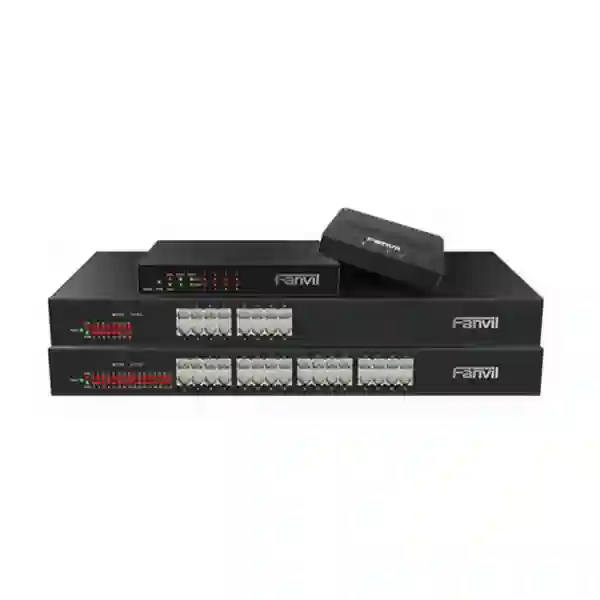
Fanvil VoIP Gateway • Tanzania
Fanvil GA100 Series FXO VoIP Gateway
The Fanvil GA100 Series FXO VoIP Gateway is designed for organizations that need to connect analog telephone lines from telecom operators or legacy enterprise PBX systems to SIP-based voice infrastructure. It gives businesses a controlled way to preserve useful PSTN connectivity while modernizing call routing, IP PBX services, branch communications and softswitch integration.
Four models cover different line counts: GA100-4T, GA100-8T, GA100-16T and GA100-32T. Choosing the correct model starts with the number of FXO lines, network interface requirements, rack preference, call concurrency, SIP platform design and future expansion. FourTeck Tanzania can help buyers translate those requirements into a practical gateway selection and deployment plan.
Quick answer: Use the GA100 Series when analog PSTN or PBX lines must be presented to an IP voice environment through SIP.
Models: 4, 8, 16 or 32 FXO ports.
Typical use: IP PBX migration, call centers, multi-branch voice networks and analog-trunk preservation.
What the Fanvil GA100 Series solves
Many businesses still depend on analog carrier lines, traditional PBX trunks or existing telephone services even after moving users and applications to IP. Replacing every part of a voice environment at once can be disruptive, while maintaining two isolated systems creates operational complexity. The GA100 Series provides a bridge between those worlds by converting analog line connectivity into SIP-based call handling. This allows an organization to retain selected PSTN connections while introducing an IP PBX, a SIP softswitch, centralized call routing or a multi-site voice design.
The gateway is particularly relevant when a company wants to preserve known telephone numbers or analog trunk services, connect legacy PBX resources to a newer IP platform, create resilient inbound or outbound call paths, or consolidate branch telephony. Because the gateway sits at the boundary between analog and IP services, proper planning matters. Line type, polarity behavior, caller-ID format, SIP credentials, codec selection, dial plans, routing rules, network addressing, firewall policy and failover expectations should be defined before rollout.
For customers planning a wider phone-system project, FourTeck Tanzania also provides guidance around IP PBX and VoIP communication solutions, where extension design, IVR, call queues, voicemail, recording and branch routing can be considered together. Buyers can also review the FourTeck Tanzania technology shop to frame the gateway as part of a complete communications and network requirement rather than as an isolated appliance.
Analog-to-SIP migration
Connect existing analog operator or PBX lines to a SIP-based environment so voice modernization can proceed without forcing an immediate replacement of every legacy dependency.
Multi-line scaling
Select 4, 8, 16 or 32 FXO ports according to current trunk requirements and realistic near-term growth, reducing the risk of buying a gateway that is too small or unnecessarily large.
Managed deployment
Web-based configuration, provisioning options, monitoring features and standard network protocols make the gateway suitable for structured business deployments where administrators need repeatable configuration and troubleshooting.
Verified GA100 Series model comparison
| Model | FXO ports | Ethernet ports | Network rate | Rack mount |
|---|---|---|---|---|
| GA100-4T | 4 | 2 | 10/100 Mbps | No 1U rack specification published |
| GA100-8T | 8 | 2 | 10/100 Mbps | No 1U rack specification published |
| GA100-16T | 16 | 4 | 10/100/1000 Mbps | Yes, 1U |
| GA100-32T | 32 | 4 | 10/100/1000 Mbps | Yes, 1U |
Across the published series, Fanvil lists FSK/DTMF caller-ID support, polarity reversal detection, echo cancellation, IPv6, SRTP, SIP over UDP/TCP/TLS, automatic provisioning methods, T.30/T.38 fax support and codecs including G.711A/U, G.723, G.729A/B, iLBC and AMR. Exact interoperability should still be confirmed against the intended carrier, PBX, softswitch and firmware environment before procurement.
Deployment, network and integration planning
An FXO gateway is not simply a port-count decision. The analog side must be mapped to the IP side with clear call-routing behavior. Each incoming PSTN line should have a defined destination, such as an auto attendant, queue, receptionist, department or emergency fallback path. Outbound rules should specify which users or dial patterns can access each analog trunk and what should happen when a preferred route is busy or unavailable. In multi-branch environments, administrators should also decide whether calls are processed locally or centralized across a WAN or VPN.
Network readiness is equally important. The GA100 Series supports IP networking and SIP transport, but call quality still depends on stable switching, appropriate VLAN design, correct duplex and speed negotiation, low packet loss, manageable latency and consistent DNS/NTP where used. Customers can review FourTeck Tanzania guidance on network switching and LAN infrastructure because voice gateways often share the same switching environment as IP phones, servers, access points and other business systems. Where segmentation or controlled access is required, the firewall, VPN and network-security section is relevant to protecting management interfaces and SIP connectivity.
Power, grounding and physical placement should also be treated as design items. The 16T and 32T models are published as 1U rack-mountable devices, which fits centralized communications racks and larger branch installations. Smaller models can suit lower-density locations. A project checklist should include available rack space, socket type, UPS capacity, cable labeling, analog-line termination, Ethernet patching and environmental conditions. FourTeck Tanzania’s structured cabling, racks and UPS guidance can help buyers consider these dependencies together.
Which GA100 model should you choose?
Choose the GA100-4T when the requirement is a small number of analog trunks and the site needs a compact migration bridge. The GA100-8T provides double the FXO capacity for a branch, reception-heavy office or small call-handling environment. The GA100-16T is a stronger fit when a business needs a rack-oriented design, gigabit Ethernet connectivity and a higher concentration of analog lines. The GA100-32T is the densest published FXO model in this series and is suited to larger analog-trunk migration projects, call centers or centralized voice environments where many PSTN lines must connect to SIP.
Do not size only from today’s active lines. Confirm whether spare ports are needed for growth, temporary migration overlap, disaster-recovery routing or additional branches. At the same time, avoid assuming every analog line must remain permanently. A voice modernization project can sometimes reduce the number of traditional trunks by moving suitable call traffic to SIP services. The correct gateway size therefore follows a call-flow and carrier review rather than a simple count of telephone numbers.
Fanvil GA100 Series FXO VoIP Gateway Tanzania
Businesses in Tanzania evaluating the Fanvil GA100 Series typically have one of three goals: preserve existing PSTN services while introducing an IP PBX, connect a legacy PBX to a SIP-based communications platform, or consolidate analog trunks across a more manageable voice architecture. In each case, the key buying question is not only which gateway has enough FXO ports. The important question is how those lines will behave once they become part of an IP call-routing environment. A practical Tanzania deployment should begin with an inventory of active lines, published telephone numbers, inbound destinations, outbound calling requirements, fax or legacy-device dependencies and any lines reserved for resilience or special functions.
The four GA100 FXO variants allow an organization to choose a capacity that matches the project. Smaller sites may use the 4T or 8T, while offices with more analog trunks or centralized call handling may prefer the 16T or 32T. For Tanzanian businesses operating several branches, gateway selection can also be standardized by site type: for example, a small branch profile, a regional office profile and a head-office profile. That approach simplifies documentation and support while avoiding over-sizing every location.
Before ordering, confirm the carrier line characteristics, desired caller-ID behavior, SIP platform, dial plan, codec policy, security requirements and network addressing. If the gateway will connect to an existing IP PBX, document the SIP trunk parameters and route patterns before installation. If it forms part of a new communications platform, define extension ranges, reception workflows, office-hours routing, queues and failover at the same time. FourTeck Tanzania’s IP phones and business desk telephony guidance is useful where the gateway is only one component of a broader endpoint refresh.
For procurement teams, request a quotation with the exact model, quantity, power requirements, mounting expectation, analog-line count, IP PBX or softswitch brand, required installation scope and any rack, UPS, switching or cabling dependencies. This produces a more useful comparison than asking only for “Fanvil GA100 price Tanzania,” because the cost of a successful deployment depends on the surrounding voice and network design as well as the gateway itself.
Fanvil GA100 Series FXO VoIP Gateway Dar es Salaam
Dar es Salaam organizations often operate larger offices, customer-service teams, hospitality facilities, logistics operations, professional-services environments and multi-site businesses where telephone continuity remains commercially important. A Fanvil GA100 Series FXO gateway can support modernization projects in which analog operator lines remain active while a company introduces SIP-based call management. The strongest design starts by mapping every current trunk to a business purpose. A main reception line may need IVR or queue treatment, a sales number may need departmental routing, and a legacy fax or contingency line may need a separate path. This mapping determines whether a 4T, 8T, 16T or 32T model is appropriate.
In a busy Dar es Salaam head office, rack space and cable organization can be as important as port density. The 16T and 32T models are published as 1U rack-mountable, which can help keep higher-density voice infrastructure organized alongside switches, firewalls, servers and UPS equipment. A procurement specification should therefore state not only FXO capacity but also rack availability, patching method, Ethernet uplinks, grounding and backup-power expectations. Where the site carries voice, business data, CCTV and Wi-Fi over the same LAN, VLAN and QoS planning should be considered so that voice traffic remains predictable during busy periods.
For branch-to-head-office calling, decide whether the analog lines terminate locally for resilience or are centralized through the IP PBX. Local termination can preserve a site-specific route when a WAN link is interrupted, while centralization can simplify policy and reporting. The right answer depends on the organization’s tolerance for outages and operational model. If a VPN or routed WAN is involved, test SIP signaling, RTP paths, NAT rules and firewall behavior before production cutover.
When requesting a Dar es Salaam quotation, provide a list of existing PSTN lines, current PBX model, desired IP PBX or softswitch, expected concurrent calls, branch topology and any requirement to retain legacy services during migration. This allows the gateway to be selected as part of a controlled transition instead of as a stand-alone box added after the rest of the voice design is complete.
Fanvil GA100 Series FXO VoIP Gateway Mwanza
For businesses in Mwanza, the GA100 Series can be useful when analog lines remain important for customer contact, branch operations or continuity but the organization wants the management advantages of an IP-based phone system. A regional office may have fewer lines than a head office yet still require reliable inbound routing, extension dialing and controlled outbound access. In this situation, the GA100-4T or GA100-8T can be appropriate starting points, while larger operations with more trunks can consider the 16T or 32T after a line-count and growth review.
A Mwanza deployment should pay special attention to the relationship between the voice gateway and available connectivity. If an IP PBX is hosted at another site or in a data center, the gateway’s SIP traffic will depend on the WAN path. The design should define what happens when that path is unavailable. Some organizations may prefer local call survivability, while others accept central dependence because their main priority is unified routing and administration. Neither approach should be assumed without discussing the business impact of an outage.
The physical environment also matters. Place the gateway in a secure, ventilated equipment area with stable power, labeled analog lines and clean Ethernet patching. For sites where power fluctuations or outages are an operational concern, include appropriate UPS planning for the gateway and the associated network equipment. A gateway that remains powered is useful only if the switch, router, firewall and IP PBX path required for calls are also available.
Procurement teams should document the exact number of lines being migrated, whether caller ID is required, whether any fax or analog service must traverse the gateway, the preferred SIP transport, and who will manage configuration after installation. That information also helps define testing: inbound and outbound calls, busy-line behavior, number presentation, DTMF, failover, echo, fax where used and post-cutover monitoring. A structured acceptance test is especially valuable for remote or regional sites because it reduces the need for repeated troubleshooting visits after handover.
Fanvil GA100 Series FXO VoIP Gateway Arusha
Arusha has a diverse mix of hotels, tour operators, NGOs, professional offices, education organizations and regional businesses where customer-facing phone services can still depend on analog carrier lines. The Fanvil GA100 Series allows those lines to participate in a SIP environment without forcing an immediate abandonment of existing telecom services. A hotel, for example, may need to preserve a known public number while modernizing internal extensions; an NGO may need a predictable reception workflow; a tour operator may need several inbound lines routed to sales or reservation teams.
The first design step is to classify every analog line. Is it primarily inbound, outbound, both, a fax-related service, a backup path or tied to a published business number? Next, define what the IP platform should do with it. Calls may route to an IVR, ring group, queue, operator or time-based schedule. Outbound access may be restricted to specific departments or dial patterns. These rules determine how the gateway must be configured and what testing is required.
For Arusha sites where equipment is distributed between a reception area, communications room and branch locations, network documentation is essential. Record IP addresses, gateway ports, analog-line labels, switch ports, VLAN assignments and SIP trunk names. If the 16T or 32T is selected for a larger deployment, the published 1U rack form factor can simplify placement in a central rack. Smaller models suit lower-density environments where only a few analog trunks need integration.
Organizations should also plan the migration window. Running old and new call routes in parallel for a short controlled period can reduce disruption, but only if numbers, forwarding and routing are documented. A quotation request should therefore include the desired cutover method and configuration scope, not just the hardware model. Buyers can combine the gateway requirement with FourTeck Tanzania’s technology services when they need broader planning, configuration, testing or lifecycle support around the communications project.
Fanvil GA100 Series FXO VoIP Gateway Dodoma
Organizations in Dodoma that are modernizing administrative, institutional or corporate communications may need to preserve analog telephone services while introducing centralized SIP calling. The GA100 Series is designed for this transition. Its practical value comes from allowing PSTN or PBX analog lines to connect into an IP voice platform, so users can benefit from modern call routing without requiring every external line to change at the same moment.
For a Dodoma project, start with governance as well as technology. Identify who owns the telephone numbers, which departments depend on them, who approves call-flow changes and who will administer the gateway after commissioning. This prevents a common migration problem in which technical installation is completed but business routing expectations are unclear. A line used by a public-facing office may require a very different treatment from a general outbound trunk or backup line.
Model selection should then follow the verified FXO count. The 4T and 8T suit smaller line groups; the 16T and 32T address higher-density requirements and are published with 1U rack capability. If several buildings or sites are involved, decide whether each location will have its own gateway or whether analog lines are centralized. Local gateways can keep local trunks near the users they serve, whereas centralized designs can simplify administration. Connectivity, survivability and call-reporting requirements will influence the final architecture.
Security should not be ignored merely because the analog side is traditional. Management interfaces, SIP signaling and network access still need appropriate credentials and firewall policy. The GA100 Series supports secure transport capabilities including TLS and SRTP according to Fanvil’s published specifications, but use of those features must match the connected platform. Include firmware, backup of configuration, logging and administrator access in the handover plan. A well-documented deployment gives procurement, IT and operations teams a shared record of how external lines enter the voice system and how they can be maintained or expanded later.
Fanvil GA100 Series FXO VoIP Gateway UAE
Organizations in the UAE often operate mixed voice environments across head offices, branches, warehouses, hospitality sites and service centers. The Fanvil GA100 Series can act as a migration boundary where traditional analog carrier or PBX lines need to feed a SIP-based communications platform. The same model-selection logic applies: confirm the actual number of FXO trunks, concurrency expectations, physical deployment requirements and future growth before choosing between 4T, 8T, 16T and 32T variants.
In a multi-site UAE environment, centralized management and standardized configuration can be valuable. Businesses can define a repeatable template for branch gateways, including IP addressing, SIP server settings, dial-plan conventions, line labels, administrator access and monitoring. Standardization reduces troubleshooting complexity when several sites are supported by the same IT team. Where larger sites require a rack-based gateway, the GA100-16T and GA100-32T offer published 1U mounting support.
Procurement should distinguish hardware capability from carrier interoperability. Before deployment, confirm the analog service characteristics and the SIP platform’s expectations. Run test calls for inbound and outbound routing, DTMF, caller ID, busy behavior, number translation and audio quality. If secure SIP transport or VPN connectivity is part of the design, validate end-to-end compatibility rather than enabling features independently on only one side.
For customers with regional operations, FourTeck’s broader technology network can assist with related planning. The FourTeck UAE technology portfolio is relevant to UAE procurement and integration requirements, while the specialist IP phone and business telephony resource can help frame endpoints and voice infrastructure around the gateway. The goal is to treat the GA100 as part of a complete communications architecture rather than simply a replacement for analog termination hardware.
Fanvil GA100 Series FXO VoIP Gateway Uganda
Ugandan businesses with legacy analog lines can use an FXO gateway as a practical transition point toward SIP. The GA100 Series is especially relevant when a company wants to introduce an IP PBX but cannot immediately replace every PSTN circuit or legacy trunk. The gateway converts those analog connections into an IP-facing form that can participate in centralized call routing, extension dialing and branch communications.
A national or multi-branch Uganda deployment benefits from consistent site profiles. Small branches may need four analog lines, larger branches eight, while a central office can require sixteen or thirty-two. Standard profiles make spare planning, configuration templates and operational support easier. They also give procurement teams a clear framework for forecasting expansion rather than buying each gateway in isolation.
The network path between gateway and SIP platform should be evaluated carefully. If a branch gateway registers or trunks to a central system, confirm WAN stability, routing, DNS, NTP, firewall policy and the RTP media path. Where analog trunks are intended to provide resilience, ensure the call-flow design actually preserves useful calling when primary IP services are interrupted. Testing failover is more valuable than assuming it from the presence of analog lines.
FourTeck’s Uganda technology site is the relevant regional point of reference for organizations procuring across Uganda, while Tanzanian customers operating cross-border can coordinate standards for numbering, branch voice design and equipment selection. A quotation should list line count, gateway model, SIP platform, deployment city, required configuration, rack or desktop placement and any associated switching, firewall or UPS need. This helps compare complete project scope rather than only unit price.
Fanvil GA100 Series FXO VoIP Gateway Kampala
Kampala-based enterprises often require a blend of customer-facing telephone continuity and modern internal communications. The GA100 Series can support that blend by connecting analog trunks to a SIP environment. For a head office or call-handling team, the 16T or 32T may suit higher line counts, while smaller offices can consider the 4T or 8T. The choice should be linked to peak concurrent analog calls, expected growth and whether the gateway will be located in a central rack.
A useful Kampala design exercise is to draw the call path from the public telephone network to the final user. The path may include the FXO gateway, Ethernet switch, firewall or router, SIP PBX, queue or IVR, and IP handset. Each component can affect call success. If the system is split across sites, the WAN is also part of that path. Documenting the full chain makes fault isolation faster because administrators know which device or service is responsible for each stage.
Security and management practices should be defined before go-live. Use strong administrator credentials, restrict management access to trusted networks, keep configuration backups and maintain a record of firmware and gateway settings. Where TLS or SRTP is planned, confirm compatibility on both gateway and SIP platform. Monitoring should include registration or trunk status, line availability, call failures and unusual patterns that could indicate configuration errors.
For quotation preparation, include whether installation is new or a migration from an existing PBX. A migration may require temporary coexistence, number forwarding, parallel routing or a rollback plan. These operational requirements can influence project effort more than the gateway hardware itself. Kampala buyers should therefore request a solution scope that includes testing and handover criteria alongside the selected Fanvil model.
Fanvil GA100 Series FXO VoIP Gateway Arua
In Arua, a business or institution may need to connect a modest number of analog carrier lines to an IP-based phone system without introducing unnecessary complexity. The GA100-4T or GA100-8T can be particularly relevant for smaller sites, while the larger models remain available where line density is greater. The right approach is to count active trunks, identify any spare capacity required and define whether the gateway is expected to support normal calling, resilience or a staged migration.
Remote-site operability deserves attention. If the SIP PBX is located in Kampala, another city or a hosted environment, the local gateway depends on connectivity to that platform. Administrators should know what happens when the WAN link is degraded or unavailable. If local analog trunks are intended as a continuity mechanism, the phone system must be configured so that users can actually access them during the relevant failure scenario. This should be demonstrated during acceptance testing rather than left as an assumption.
Physical installation should prioritize labeling and maintainability. Each FXO port should correspond to a clearly labeled carrier line, and the documentation should state which telephone number and routing function belongs to each port. Ethernet switch ports, VLANs and gateway addresses should also be recorded. This is particularly useful when support is delivered remotely, because technicians can guide local staff through checks without ambiguity.
Arua buyers should provide the exact line count, SIP system details, preferred model, desired call routes and support scope when requesting pricing. If the gateway is part of a larger site upgrade, include switch, firewall, rack and UPS information. That allows the communications requirement to be assessed as a complete operational system and reduces the risk of discovering missing infrastructure only after the gateway arrives.
Fanvil GA100 Series FXO VoIP Gateway Mbarara
Mbarara businesses can use the Fanvil GA100 Series to modernize telephony while maintaining analog connectivity where it remains useful. A common project pattern is to keep selected PSTN lines for inbound business numbers or backup while moving users to SIP extensions and centrally managed IP phones. The gateway becomes the interface that allows those two environments to work together.
The selection process should start with actual traffic. Four analog lines may be sufficient for a small branch even if the organization has many internal extensions, because internal calls do not necessarily consume FXO ports. Conversely, a customer-service site may need more external trunks than its employee count suggests. Review busy-hour calling patterns, inbound queue demand and outbound requirements to size the gateway sensibly. Then include a reasonable expansion margin where growth is expected.
Integration testing should cover more than a successful phone call. Check caller ID, DTMF interaction with IVR menus, call release, busy signals, ring detection, number translation, echo and audio levels. If fax is part of the requirement, test it on the actual carrier and SIP path because fax behavior can be sensitive to network conditions and codec handling. Fanvil publishes T.30 and T.38 support for the series, but successful operation still depends on end-to-end configuration.
For long-term maintenance, keep configuration backups and a simple port map showing which external line is attached to each FXO interface. Include administrator credentials in the organization’s controlled password-management process rather than leaving them undocumented at the device. Mbarara procurement requests should mention whether the customer needs hardware supply only, remote configuration, on-site installation, call-flow programming or post-deployment support so that scope and pricing can be compared accurately.
Fanvil GA100 Series FXO VoIP Gateway Gulu
For organizations in Gulu, the value of the GA100 Series is its ability to preserve analog telephone access while introducing SIP-based control. This can be useful for offices, institutions, service organizations and branch locations where existing numbers or telecom lines should remain active during modernization. The gateway’s 4-, 8-, 16- and 32-port options allow the project to match capacity to the site instead of forcing a single model across every deployment.
A good Gulu design separates business requirements from technical settings. Business requirements include which numbers must remain reachable, which departments answer them, after-hours behavior, outbound authorization and what happens during an outage. Technical settings include SIP server addresses, authentication, codecs, DTMF mode, IP configuration, VLAN placement and firewall rules. Keeping these layers clear makes the system easier to review with both management and technical teams.
If the gateway connects across a WAN to a central PBX, test call quality during realistic network load rather than only when the link is idle. Packet loss, jitter and congestion can affect voice even when ordinary web applications appear usable. QoS and traffic separation may be appropriate, but they should be applied as part of an end-to-end network design. Backup power should also cover the full call path, including switches and routers.
When seeking a quotation in Gulu, specify whether the analog lines are already installed and active, how many need to be connected on day one, the expected expansion period and whether there is an existing IP PBX. Add any requirement for rack installation, labeling, documentation and user or administrator training. This makes the quote more actionable and reduces uncertainty around implementation effort.
Fanvil GA100 Series FXO VoIP Gateway Kenya
Kenyan organizations operating mixed analog and IP telephony environments can use the GA100 Series as a controlled migration bridge. The gateway allows traditional carrier lines or legacy PBX connections to interface with a SIP platform, which can help businesses modernize call handling without discarding every existing external line at once. This is relevant to single offices as well as organizations with branches across several cities.
Kenya deployments should pay close attention to numbering and route policy. If several branches use local analog trunks, decide whether outbound calls should use the local gateway, a central SIP trunk or a least-cost routing policy. Inbound calls should have clear destinations and overflow behavior. A head office may use the GA100-32T for a larger trunk concentration while smaller branches use lower-port models, but configuration standards should remain consistent so support staff can manage all sites efficiently.
The gateway’s published support for SIP/IMS, secure SIP options, IPv6, web administration, automatic provisioning and common voice codecs provides a strong technical base, but successful integration still requires compatibility testing with the selected PBX or softswitch. Do not assume that two SIP-capable systems will behave identically with caller ID, DTMF, fax or failover. Establish a test plan before migration.
FourTeck’s Kenya technology site supports regional procurement context for customers operating in Kenya. Cross-border organizations can benefit from standardizing gateway models, labeling conventions and documentation across Tanzania and Kenya. A regional standard simplifies spares and support while still allowing each site to choose the FXO port count that reflects its local carrier-line requirement.
Fanvil GA100 Series FXO VoIP Gateway Kuwait
The Fanvil GA100 Series can support Kuwait businesses that need to connect analog telephone lines to a SIP environment during PBX modernization or branch integration. The core planning question remains the same: how many analog trunks must be preserved, and what role will they play after the IP platform becomes the primary call-control system? Some may carry published inbound numbers, some may be used for outbound access, and others may be retained as contingency paths.
For a centralized office environment, the 16T and 32T models provide higher FXO density with published 1U rack mounting, making them appropriate candidates for organized communications racks. Smaller sites can evaluate the 4T or 8T. The gateway should be installed with clear analog and Ethernet labeling so administrators can relate a physical port to a telephone number and SIP route without tracing cables during an incident.
Where the voice system uses VLANs, firewalls or VPN links, the gateway should be included in the same network-security design as IP phones and PBX servers. Restrict web administration, use strong authentication and document permitted traffic flows. If TLS or SRTP is required, confirm the settings supported by the SIP platform and test them before production rollout.
Customers can review the FourTeck Kuwait technology site for regional procurement context. Organizations comparing quotes should ask suppliers to state the exact gateway model, included accessories, configuration scope, installation assumptions, rack or desktop requirements and testing responsibilities. A precise scope prevents a low hardware price from hiding additional work required to make the analog and IP sides operate correctly together.
Fanvil GA100 Series FXO VoIP Gateway Ghana
In Ghana, the GA100 Series can help businesses retain useful analog telecom services while modernizing internal calling with SIP. This is particularly useful in phased migrations where telephone numbers, customer contact routes or legacy PBX trunks need to remain available during a transition to IP telephony. The gateway converts analog line access into a format that can be routed by a SIP-based call-control system.
A phased project should define which lines move first and what constitutes a successful cutover. Start with a non-critical line where possible, validate inbound and outbound routing, caller ID, DTMF and audio, then repeat the process for business-critical numbers. For larger port counts, create a port-by-port migration worksheet. This reduces the risk of misrouting public numbers or losing track of which analog circuit is connected to which gateway interface.
Capacity should reflect traffic rather than just total employee count. An office with many extensions may need only a few analog trunks if most traffic moves to SIP services, while a customer-facing operation can need more external lines because several callers must be handled simultaneously. The four GA100 variants provide a useful range for these different profiles.
FourTeck’s Ghana technology site provides regional context for Ghana-based procurement. For cross-border businesses, using a consistent gateway family across countries can simplify training and spares, but each site should still be sized independently. Quotations should state the line count, deployment topology, SIP system, power and rack needs, configuration responsibilities and acceptance tests expected at handover.
Fanvil GA100 Series FXO VoIP Gateway Nigeria
Nigeria-based organizations with significant customer call volumes, distributed branches or legacy PBX infrastructure may use the Fanvil GA100 Series to bridge analog trunks into a modern SIP environment. The 32-port model is relevant where many external analog lines remain concentrated at one site, while the 4T, 8T and 16T variants give smaller branches or staged migrations more proportional capacity.
For larger deployments, call-routing documentation becomes essential. A spreadsheet or diagram should map each carrier line to its physical FXO port, SIP route, inbound destination, outbound permission and failover behavior. This record is useful during support incidents, carrier troubleshooting and future expansion. It also helps when several teams—telecom, network, security and procurement—share responsibility for the communications platform.
Network design should consider voice as a real-time application. Ensure adequate LAN and WAN stability, and verify firewall behavior for SIP and RTP traffic. Where the gateway connects to a remote PBX, test under real operating conditions. Security controls should include restricted administration, configuration backups and monitored changes. Published TLS and SRTP support can be useful when secure SIP transport is part of the design, subject to interoperability with the connected platform.
The FourTeck Nigeria technology site is the relevant regional reference for Nigerian procurement. Buyers should request quotations that separate hardware supply, configuration, installation, migration support and ongoing maintenance. This makes proposals easier to compare and ensures that the project budget includes the work required to integrate analog carrier services successfully into the SIP environment.
Fanvil GA100 Series FXO VoIP Gateway Seychelles
Businesses in Seychelles may operate hospitality properties, service companies, offices or multi-site organizations where established analog telephone services remain important to customer contact. The Fanvil GA100 Series provides a way to retain those lines while moving internal communications toward SIP. This can reduce disruption during modernization because public numbers and carrier circuits do not necessarily need to change at the same time as the PBX.
Smaller properties or offices may find the GA100-4T or GA100-8T sufficient, while larger hospitality or centralized communications environments can consider the 16T or 32T. The selection should be based on simultaneous external call demand, not only the number of extensions. A hotel with many rooms might use an IP PBX for internal calling yet need a smaller number of PSTN trunks; another property with reservation and front-desk traffic may require more external channels.
Because island and remote-site operations can place a premium on resilience, the design should explicitly state what happens if internet or WAN connectivity is interrupted. If local analog lines are intended to keep essential calling available, ensure the PBX and gateway routing support that objective. Backup power should cover the gateway, switching and call-control components required for the continuity plan.
A Seychelles quotation request should include the property or office type, line count, SIP platform, existing PBX status, deployment location, support model and any requirement for remote administration. Configuration should be documented so local staff can identify port status and basic faults, while remote support teams retain a clear record of network settings and call routes. The strongest deployment is one that can be operated confidently after the initial installation team has left the site.
Compatibility, security and maintenance guidance
Fanvil publishes support for SIP/IMS, common narrowband codecs, SRTP, TLS, IPv4/IPv6 networking, web management, SNMP and automated deployment features across the GA100 Series. These capabilities are valuable, but buyers should distinguish a supported protocol from guaranteed interoperability with every carrier or PBX. Before a large order, test the exact combination of analog line service, firmware version, SIP platform and call-flow requirements.
Maintenance should include periodic review of configuration backups, administrator access, firmware, logs and line status. Keep a change record so administrators know when routing or security settings were modified. In organizations with many gateways, use consistent naming and IP-address conventions. If remote administration is required, avoid exposing management interfaces directly to the public internet; use controlled network access or an appropriate VPN architecture instead.
The gateway may also depend on supporting infrastructure. A managed switch can help separate voice traffic; a firewall can control signaling and remote access; a UPS can protect the voice path during short outages; and structured cabling can make analog and Ethernet connections maintainable. FourTeck Tanzania’s integrated IT solutions and lifecycle services are relevant where customers want these dependencies reviewed together.
Related FourTeck resources
IP PBX planning
Review call routing, IVR, queues, voicemail and branch telephony requirements through the Tanzania IP PBX and VoIP section.
IP phone selection
Match reception, executive and general-user endpoints using the business IP phone guidance.
LAN readiness
Evaluate VLANs, uplinks and managed switching through the network switches and LAN section.
Security controls
Protect SIP and management traffic using principles described in the firewall and VPN guidance.
Racks and UPS
Plan power, rack space and cabling with the structured cabling and UPS section.
Technology shop
Browse surrounding business technology categories in the FourTeck Tanzania shop.
Implementation services
Coordinate design, configuration and lifecycle work through FourTeck Tanzania services.
Quotation checklist
For a useful Fanvil GA100 quotation, provide the exact number of analog FXO lines, preferred model if known, existing PBX or SIP platform, deployment location, expected concurrent calls, caller-ID requirement, fax requirement if applicable, rack or desktop preference, network topology, power/UPS expectations, configuration scope, migration window and desired support. Also identify whether the project must preserve specific published phone numbers, whether branches are connected over VPN or WAN, and whether analog lines are expected to provide a fallback route.
A complete scope helps suppliers identify the correct hardware and avoids surprises around mounting, power, cabling, switch capacity or configuration. It also gives procurement teams a better basis for comparing proposals because every bidder is responding to the same technical and operational assumptions.
Frequently asked questions
What is the Fanvil GA100 Series FXO VoIP Gateway used for?
It is used to connect analog telephone lines from carriers or enterprise PBX systems to SIP-based IP voice environments, allowing organizations to integrate existing analog services with IP PBXs or softswitch platforms.
Which GA100 FXO models are available?
Fanvil publishes GA100-4T, GA100-8T, GA100-16T and GA100-32T models with 4, 8, 16 and 32 FXO ports respectively.
Can the GA100 connect to an IP PBX?
Yes, that is a primary deployment scenario. The gateway converts analog lines to SIP so they can be routed by an IP PBX or compatible softswitch. Exact interoperability and configuration should be validated with the chosen platform.
Does the GA100 support secure SIP?
Fanvil lists TLS and SRTP support for the GA100 FXO Series. Secure deployment still requires compatible settings on the SIP platform and appropriate network-security policy.
Which model is best for a small office?
A small office commonly starts by evaluating the GA100-4T or GA100-8T, but the right choice depends on active analog trunks, simultaneous call demand, future growth and resilience requirements.
Are the larger GA100 models rack mountable?
Fanvil publishes the GA100-16T and GA100-32T as 1U rack-mountable. The smaller 4T and 8T are not listed with that 1U rack designation in the series comparison.
Does the series support fax?
Fanvil lists T.30 and T.38 support. Because fax can be sensitive to carrier, codec and network conditions, verify operation using the actual end-to-end environment before relying on it for business-critical workflows.
What should I provide when asking for a quote?
Provide line count, gateway model if known, SIP PBX or softswitch details, site location, deployment topology, expected concurrent calls, migration requirements, rack and power needs, and whether configuration, testing or support is required.
Decision recap
The Fanvil GA100 Series is a strong candidate when analog carrier or PBX lines must be retained while the organization moves call control to SIP. Choose the model by FXO port count and deployment density, then validate carrier behavior, SIP interoperability, network quality, security, power and migration routing. For a small site, evaluate the 4T or 8T. For higher-density or rack-based environments, evaluate the 16T or 32T. The final decision should come from a documented call-flow and infrastructure review rather than from port count alone.
Plan your Fanvil GA100 deployment with FourTeck
Share your analog line count, current PBX, target SIP platform, branch layout and migration goals. FourTeck can help structure the gateway choice around the complete communications environment, including switching, IP phones, firewall rules, racks, UPS and implementation requirements. For regional projects, the FourTeck network includes FourTeck Africa, FourTeck global technology resources, and country-specific sites for Kenya, Uganda, Ghana and Nigeria.



Reviews
There are no reviews yet.