
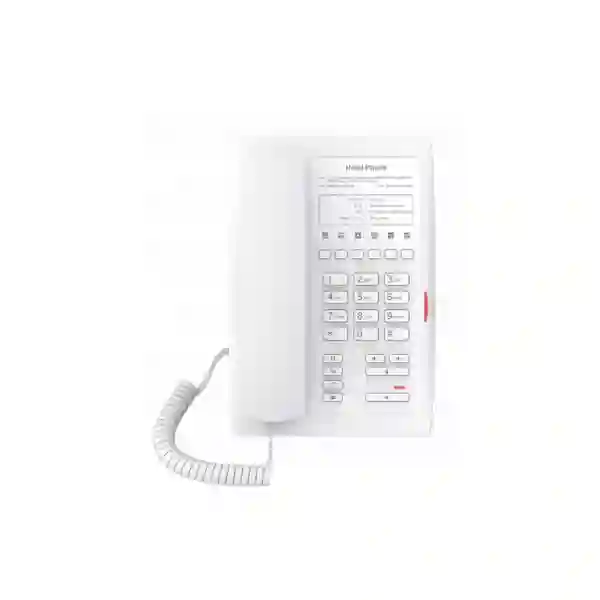
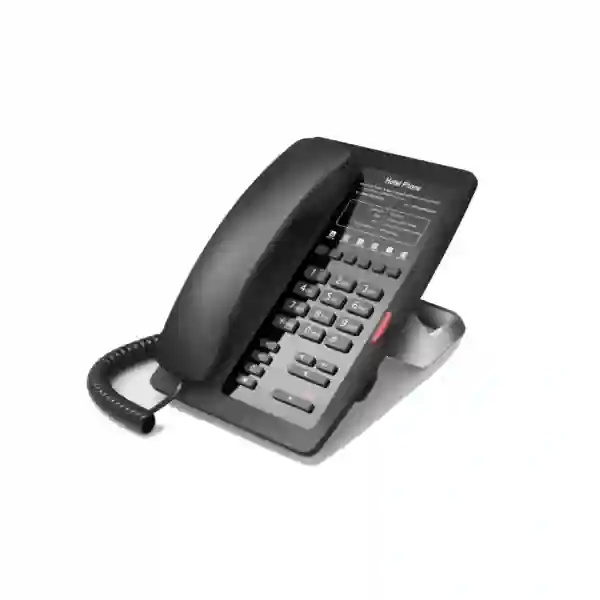
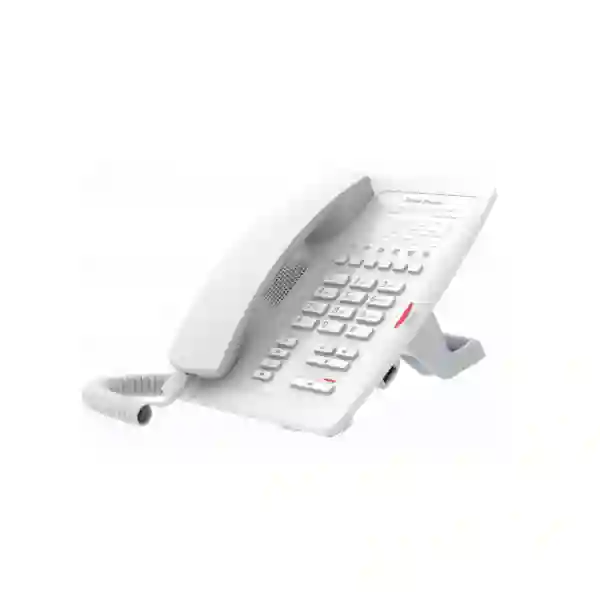
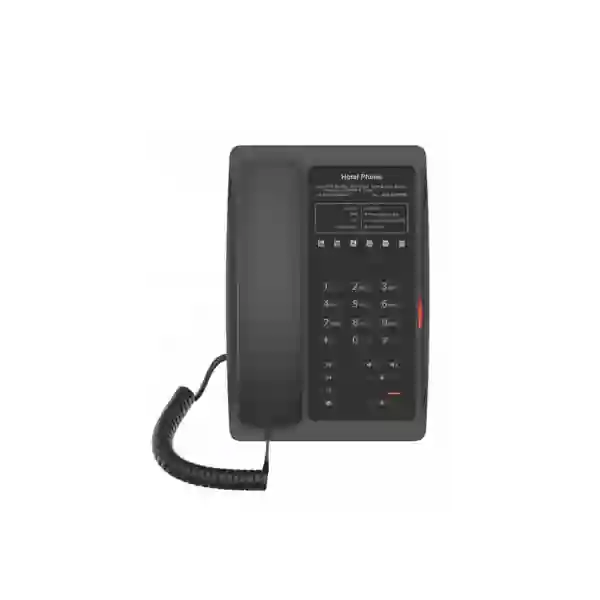
Fanvil H Series • Wi-Fi SIP Endpoint
Fanvil H3W Wi-Fi IP Phone
The Fanvil H3W Wi-Fi IP Phone is a compact SIP handset designed for environments that need reliable voice service with flexible network placement. Fanvil positions the H3W for hotels and also identifies hospitals, supermarkets and shopping malls as suitable scenarios. The phone supports two SIP lines, built-in 2.4GHz Wi-Fi using IEEE 802.11b/g/n, HD voice, G.722 and Opus wideband codecs, dual 10/100Mbps Ethernet ports, Power over Ethernet, a USB charging port and six programmable DSS keys. For organisations in Tanzania, the practical value is not simply that the phone can connect wirelessly; it is that a voice endpoint can be deployed in rooms or service points where extending a dedicated network cable may be inconvenient, while still retaining wired Ethernet and PoE as options when structured cabling is available.
2 SIP Lines
Two SIP accounts allow the H3W to fit common room, branch and service-desk calling designs without turning the endpoint into a complex executive phone.
Built-in 2.4GHz Wi-Fi
IEEE 802.11b/g/n wireless connectivity can reduce dependence on a dedicated Ethernet outlet at every phone location, subject to proper coverage and voice-ready WLAN design.
HD Voice
Wideband audio support includes G.722 and Opus, complemented by full-duplex hands-free calling, echo cancellation and voice-quality functions.
PoE + USB
The H3W supports PoE for wired deployments and includes a USB Type-A port that Fanvil specifies for phone charging, useful in hospitality and guest-facing spaces.
What the Fanvil H3W is designed to solve
Many organisations need a fixed desk phone in places where conventional cabling is awkward. Hotel guest rooms, clinic reception points, retail service counters, back-office areas, temporary desks and distributed branch spaces can all create situations where the telephony requirement is simple but the network path is not. The H3W addresses that problem by supporting both wireless and wired connectivity. A site can use Wi-Fi when mobility of placement matters, or connect through Ethernet when a structured outlet is already available. This gives infrastructure teams flexibility without changing the basic SIP calling experience.
The design remains deliberately focused. Two SIP lines cover common extension scenarios. Six programmable keys can be used for frequently dialled functions or service shortcuts. Fanvil lists call hold, transfer, redial, speed dial, auto answering, hotline, multicast and distinctive ring among supported functions. The phone also supports SIP hotspot functionality. In a hotel, that can translate into a straightforward room phone experience; in a hospital or retail environment, the same endpoint can support a service counter or shared-area extension.
Wireless deployment does not remove the need for network planning. Voice traffic still depends on stable signal strength, low interference, sensible channel allocation, predictable internet or PBX reachability and appropriate security. Buyers should therefore treat built-in Wi-Fi as a placement advantage rather than as a substitute for proper WLAN design. FourTeck Tanzania’s integrated IT and telecom overview explains how IP telephony, switching, Wi-Fi, firewalling and supporting infrastructure should be considered together rather than as isolated purchases.
Verified Fanvil H3W features and technical capabilities
| Area | Verified H3W capability | Why it matters |
|---|---|---|
| SIP | 2 SIP lines; SIP v1/v2; SIP over UDP/TCP/TLS | Supports common IP-PBX extension designs and encrypted SIP signalling where the platform is configured accordingly. |
| Wi-Fi | 2.4GHz IEEE 802.11b/g/n; WPA/WPA2-PSK and 802.1X EAP security modes | Enables wireless placement while retaining enterprise-oriented authentication options. |
| Ethernet | Dual 10/100Mbps RJ45 ports | Provides wired network and PC pass-through possibilities where cabling exists. |
| Power | PoE or 5V/2A external power | Allows a single Ethernet cable to provide network and power in wired deployments, or an adapter for Wi-Fi placements. |
| Audio | G.711A/U, G.729AB, iLBC, G.722 and Opus; full-duplex hands-free speakerphone with AEC | Gives broad codec coverage and wideband voice when the PBX, trunk and network support it. |
| Security | TLS, SRTP, 802.1X, VLAN, L2TP and OpenVPN support | Useful when voice endpoints must fit into segmented, authenticated or encrypted network designs. |
| Provisioning | FTP/TFTP/HTTP/HTTPS, DHCP Option 66, SIP PnP and TR-069 | Helps administrators standardise configuration across multiple phones. |
| USB | 1 USB Type-A port | Fanvil specifies the port for phone charging, a practical convenience in guest-facing rooms. |
PBX and platform compatibility
Fanvil lists compatibility with major communications platforms including Asterisk, BroadSoft, 3CX, Metaswitch, Elastix and Avaya. That does not mean every feature behaves identically on every PBX version or deployment. Before a bulk purchase, confirm SIP registration method, codecs, transfer behaviour, message-waiting indication, provisioning, VLAN policy and any vendor-specific feature requirements. FourTeck Tanzania’s business technology shop is useful when comparing phones together with related PBX, switching and network requirements.
Wi-Fi deployment guidance
Because H3W uses 2.4GHz Wi-Fi, a deployment should be checked for channel congestion, access-point placement, wall attenuation, roaming expectations and competing wireless devices. Hospitality buildings often have many rooms separated by dense walls, while retail and healthcare sites may have shelving, equipment or high client density. A site survey and voice-focused WLAN plan can prevent weak calls, one-way audio caused by network policy, or intermittent registration. The FourTeck Tanzania services page outlines the wider planning, configuration and support context that can accompany endpoint supply.
Who should consider the Fanvil H3W?
The H3W is most compelling when the buyer wants a simple SIP desk phone with flexible placement rather than a feature-heavy executive endpoint. Hotels can use it where guest-room aesthetics and convenient service shortcuts matter. Clinics and hospitals can use it at nurses’ stations, reception points or administrative desks where the selected PBX design permits. Retailers can place phones at counters or back-office positions. Small offices and branch locations can also use the model where a compact two-line phone is sufficient and Wi-Fi reduces cabling work.
It is less appropriate when users need a large colour display, video calling, many line appearances, Bluetooth-centric headset workflows or gigabit desktop pass-through. Those use cases should trigger comparison with other Fanvil ranges or alternative business phones. The goal is to choose an endpoint that matches the user role instead of paying for features that are never used or selecting a phone that is too limited for the actual workflow.
Fanvil H3W Wi-Fi IP Phone Tanzania
For organisations sourcing the Fanvil H3W Wi-Fi IP Phone in Tanzania, the buying decision should combine the handset specification with the environment in which it will register and operate. Tanzania includes a wide range of business settings, from hotels and serviced apartments to clinics, schools, retail groups, offices, warehouses and regional branches. A phone that supports both Wi-Fi and Ethernet can be useful when different buildings have different levels of cabling readiness. A newly fitted office may have Cat6 outlets and PoE switching at every desk, while an existing guest property may prefer to avoid pulling new cable into finished rooms. The H3W can participate in either design, but the power method and network path must be planned correctly for each room or user.
A Tanzania quotation should therefore identify quantity, intended room or desk type, PBX platform, SIP trunk arrangement, wireless network design, power method and whether central provisioning is required. For a small installation, phones may be configured individually. For a larger hotel or multi-branch rollout, automated provisioning becomes much more important because extension numbers, credentials, DSS keys, time settings and firmware policies need to remain consistent. Fanvil supports multiple provisioning methods, which gives administrators options, but those methods still need a secure operational process and a clear source of truth for configuration files.
Network quality is equally important. The H3W supports 2.4GHz Wi-Fi, a band with broad compatibility but often more interference than newer 5GHz deployments. In dense properties, access-point channels, transmit power, neighbouring networks and client load should be reviewed. Voice is sensitive to packet loss, jitter and latency. A phone can show strong signal yet still perform poorly if the WLAN is overloaded or if upstream internet connectivity is unstable. Where possible, separate voice policy, QoS and VLAN design can improve manageability, especially when phones share infrastructure with guest Wi-Fi, CCTV and business applications.
For procurement teams comparing suppliers, ask for an exact model confirmation, included accessories, power-adapter status, colour requirement, warranty terms, firmware baseline and compatibility confirmation with the intended PBX. Do not assume that Wi-Fi means no infrastructure work at all. Every wireless phone still needs power, coverage and a secure network path. FourTeck can also coordinate broader regional requirements through its Africa technology solutions network when a Tanzanian deployment is part of a wider multi-country standardisation project.
Fanvil H3W Wi-Fi IP Phone Dar es Salaam
In Dar es Salaam, the H3W can fit hospitality, office, healthcare and retail deployments where space changes frequently or cabling access differs from room to room. Hotels and serviced properties may have existing analogue or legacy phone cabling that does not align neatly with a new IP-PBX project. Rather than treating the handset as a standalone purchase, the project should map how every room will obtain network connectivity and power. Where Ethernet is available, PoE may simplify the installation. Where the room is better served over Wi-Fi, a 5V/2A power source is still required and the wireless network must provide stable 2.4GHz coverage at the phone’s exact location.
Dar es Salaam businesses often operate in buildings where wireless performance can vary considerably between open office floors, concrete hotel corridors, partitioned retail spaces and multi-storey facilities. For this reason, phone placement should be validated with actual signal and network testing rather than relying only on an access point’s nominal coverage range. Congestion from neighbouring networks can affect 2.4GHz service, particularly in dense commercial areas. A voice rollout should use sensible channel planning, secure authentication and an IP design that keeps phone traffic manageable. If the IP PBX is hosted externally, the internet path and firewall rules are also part of call quality and registration reliability.
For hotels in Dar es Salaam, the six programmable DSS keys can be planned around guest-service workflows such as reception, housekeeping, restaurant, emergency or concierge numbers where the PBX supports the intended dial plan. The USB charging port can add practical value at a bedside or desk, while the black or white finish options allow the phone to fit different room styles. Procurement teams should confirm branding or panel customisation requirements separately rather than assuming they are included by default in every supply arrangement.
A sensible Dar es Salaam request for quotation should include the property or office type, number of phones, desired colour, power method, existing PBX, whether new extensions are needed, Wi-Fi details and any service-key mapping. For a larger deployment, include a floor plan or room count so the solution can be checked against wireless coverage and switching. These details make quotations easier to compare because the buyer can distinguish handset cost from provisioning, PBX configuration, network improvement and installation work.
Fanvil H3W Wi-Fi IP Phone Mwanza
Mwanza organisations considering the Fanvil H3W may be planning a single office, a lakeside hospitality property, a clinic, a retail operation or a branch that needs to connect to a central phone system. In these cases, the H3W’s value comes from combining standard SIP functionality with both Wi-Fi and wired Ethernet options. A branch can register phones to a local or remote IP PBX, subject to the PBX design, firewall policy and WAN quality. For businesses centralising communications across several cities, this can help standardise user experience while still allowing each site to choose the most practical local connection method.
The network should be assessed before ordering a large quantity. A phone deployment may expose weaknesses that ordinary browsing does not reveal. Web applications can tolerate brief delays or retransmissions, but voice users notice dropouts, clipping, jitter and one-way audio immediately. When H3W phones connect over Wi-Fi, ensure that access points are placed for usable signal at desks and rooms, not only in corridors. Check that the WLAN is not overloaded by guest traffic, cameras or staff devices. Where voice shares a wider business network, QoS, VLAN planning and firewall rules can help protect call flows and simplify troubleshooting.
For a Mwanza hotel or lodge, the handset can be configured around concise room-service needs rather than complex office features. Two SIP lines are generally adequate for a room endpoint, while DSS keys can reduce the effort required for guests to reach frequently used services. For a clinic or retail branch, the same keys may be used for internal departments or frequently called extensions. The correct programming depends on the PBX and operational workflow, so key labels should be planned before rollout rather than after phones are placed.
Procurement teams should request confirmation of the exact H3W variant, included accessories, power arrangement, firmware, warranty terms and support scope. If the phones are intended to connect to a head-office PBX in another city or country, include that architecture in the request so NAT, VPN, SIP security and survivability can be discussed. A strong quotation separates hardware, PBX configuration, network changes, installation and support instead of combining them into an unclear single line.
Fanvil H3W Wi-Fi IP Phone Arusha
Arusha has a strong mix of hospitality, tourism, conference, education and professional-service environments, making a compact Wi-Fi-capable SIP phone relevant to several deployment types. Hotels and lodges may want room phones without disruptive recabling, while offices and service desks may value a simple endpoint that can connect through existing wireless coverage. The H3W provides two SIP lines, programmable service keys, HD audio, Ethernet, PoE and Wi-Fi, allowing the same model to be used across room types that do not all share identical cabling conditions.
Hospitality deployments should start with the guest experience. Decide which internal services need one-touch access, whether voicemail or message indication is required, how emergency calls are routed, and whether room extensions are tied to a property management workflow at the PBX level. The phone itself is only the endpoint. Call permissions, billing integration, wake-up calls or other hospitality functions depend on the wider telephony platform. It is therefore important to confirm which features are provided by the PBX or hotel system rather than assuming every hotel function originates in the handset.
Wireless coverage deserves special attention in properties with thick walls, separate cottages, long corridors or landscaped compounds. A 2.4GHz signal may travel further than higher-frequency alternatives, but interference and shared airtime can still affect voice. Access points should be positioned based on measured coverage and capacity. If buildings are linked by wireless bridges or long-distance backhaul, the complete path should be evaluated for latency and stability. Where Ethernet is available, using PoE may be preferable for fixed phones because it combines data and power and can simplify UPS protection from a central network cabinet.
An Arusha procurement brief should list room counts, building types, PBX platform, desired phone colour, service-key plan, cabling status and Wi-Fi coverage. If the property operates multiple sites, include how calls are routed between them. This gives the supplier enough context to recommend whether all H3W phones should use Wi-Fi, whether a mixed wired/wireless design is better, and what additional switching or access-point work may be needed.
Fanvil H3W Wi-Fi IP Phone Dodoma
In Dodoma, organisations may consider the Fanvil H3W for offices, hotels, institutions, clinics, branch facilities and service counters where a straightforward SIP phone is needed. The handset’s dual connectivity can be useful when a site is being upgraded in stages. Some rooms may already have structured Ethernet and PoE, while others may rely on business Wi-Fi until cabling work is completed. Standardising on one endpoint can simplify user training and spares, but the deployment design should still document which connection method is used at each location.
Government and institutional buyers often require clear technical documentation and predictable configuration. The H3W supports web management and multiple auto-provisioning methods, which can help IT teams apply consistent settings across a fleet. Before mass provisioning, define naming conventions, extension numbering, VLAN settings, time servers, codec preference, firmware policy and administrative credentials. Configuration files should be protected because they can contain sensitive SIP information. When central management is planned, verify that the chosen PBX or provisioning system supports the exact deployment workflow rather than assuming interoperability from SIP registration alone.
Voice reliability depends on the underlying network. A Dodoma office that uses H3W over Wi-Fi should confirm coverage at every desk, especially in meeting areas, partitioned rooms and spaces with dense construction. Where possible, business voice should not compete uncontrolled with guest traffic or high-volume downloads. QoS can help on managed networks, but it cannot repair an unstable internet circuit or weak radio link. If calls traverse a VPN or remote PBX, test that route under real business load.
For quotation, include the number of users, PBX type, line or trunk arrangement, network diagram if available, desired provisioning method and whether installation is required. Clarify whether power adapters are needed for Wi-Fi deployments or whether PoE will be provided from switches. A detailed request reduces last-minute accessory changes and gives decision-makers a clearer total project cost rather than only a handset price.
Fanvil H3W Wi-Fi IP Phone UAE
For UAE deployments, the Fanvil H3W can suit hotels, serviced accommodation, clinics, retail sites and offices that need a compact Wi-Fi-capable SIP endpoint. The UAE market includes many new-build properties with strong structured cabling as well as refurbishment projects where finished interiors make additional cable pulls undesirable. In a new installation, PoE and Ethernet may be the simplest choice because the phone can receive network connectivity and power through the cabling system. In an existing property, built-in 2.4GHz Wi-Fi can provide more placement flexibility when suitable coverage and a local power outlet are available.
Hotel buyers should separate handset functions from PBX and property-management requirements. The H3W offers two SIP lines, programmable keys, HD voice and guest-friendly physical design, but features such as room status, billing, wake-up services or PMS integration normally depend on the wider communications platform. Procurement should therefore include the existing PBX vendor, software version, SIP extension method and any integration expectations. If custom panels or branding are desired, confirm artwork, lead time and minimum quantities with the supplier rather than assuming every H3W order includes customisation.
Wireless voice quality in dense UAE properties can be affected by high access-point density and many neighbouring networks. Although 2.4GHz offers broad device support, channel overlap and interference need attention. Large hotels should map coverage by guest room and corridor, while malls and clinics should consider client density and physical obstructions. Wired Ethernet remains a useful fallback where consistent PoE and central UPS protection are priorities. The right design may be mixed rather than choosing one connectivity method for every phone.
Regional projects that span Tanzania and the UAE can benefit from a standard endpoint and common configuration template, provided each site’s PBX, network and regulatory environment is reviewed. FourTeck’s UAE technology solutions operation can provide regional context for projects that extend beyond Tanzania, while the Tanzania team can remain focused on the local deployment scope.
Fanvil H3W Wi-Fi IP Phone Uganda
Ugandan organisations considering the Fanvil H3W may be planning a hospitality rollout, a clinic or campus deployment, retail branches or a distributed office phone system. The key advantage is the ability to choose between Wi-Fi and Ethernet depending on the individual site. A branch with managed PoE switches may prefer wired phones for predictable power and network performance. A hotel or renovated office without convenient data outlets may use 2.4GHz Wi-Fi, provided the phone can be powered locally and the wireless network is designed for voice.
For multi-site operations, central PBX connectivity can simplify extension numbering and internal calling, but it also makes WAN design important. If an H3W in Uganda registers to a PBX in another city or country, test latency, firewall traversal, NAT behaviour and failover. SIP over TLS and SRTP support can be relevant where encrypted signalling and media are part of the architecture, but both endpoints and the PBX must be configured consistently. VPN options can also be considered where the network policy requires them, though the final design should be based on the organisation’s security standards.
Hospitality users should plan DSS keys around actual guest-service workflows. Retail and healthcare users may use programmable keys differently, perhaps for supervisors, security, pharmacy, stores or reception. This is why a deployment template should be linked to job role or room type rather than copied blindly across every phone. Auto-provisioning is especially useful when dozens or hundreds of endpoints must receive repeatable settings.
Buyers seeking coordinated regional support can review FourTeck Uganda for the wider local technology context. For a quotation, provide quantity, PBX platform, connectivity method, desired colour, provisioning plan and any network upgrade requirement. Separating hardware, configuration and installation scope makes it easier to evaluate the full solution.
Fanvil H3W Wi-Fi IP Phone Kampala
Kampala businesses can use the Fanvil H3W where a compact two-line SIP phone is more appropriate than a large executive handset. Hotels, restaurants, clinics, private hospitals, offices and retail networks may all have positions where the phone is used primarily for internal calls, reception contact or service shortcuts. The built-in Wi-Fi capability gives deployment teams flexibility in rooms that lack convenient Ethernet, but the decision should be based on tested coverage and power availability rather than convenience alone.
A dense urban wireless environment can make 2.4GHz planning important. Many neighbouring access points and consumer devices share the band, so a strong signal reading does not automatically mean good voice quality. Channel selection, interference, access-point load and backhaul capacity should be assessed. For business sites with managed Wi-Fi, a dedicated SSID or policy for voice endpoints may make operations easier, especially when paired with sensible VLAN and QoS design. Where Ethernet is available, PoE can still be the preferred method for fixed phones because it centralises power and can be protected by a UPS at the switch.
The H3W’s programmable keys can be mapped to departments or services, while its two SIP lines can support common extension scenarios. If the organisation uses hosted telephony, confirm that the provider supports standard SIP endpoint registration or has tested Fanvil devices. If an on-premises PBX is used, verify firmware, codecs and provisioning options before bulk deployment. A small pilot with representative users can reveal practical issues such as key labels, volume preferences and call-transfer behaviour before hundreds of phones are configured.
A Kampala quotation should state whether the phone is being purchased as hardware only or as part of a larger voice project. Include extension count, trunk type, PBX platform, Wi-Fi information, cabling readiness and any desired user training. This keeps the project aligned with business outcomes rather than reducing the decision to a single unit price.
Fanvil H3W Wi-Fi IP Phone Arua
Arua deployments may involve hotels, healthcare sites, NGOs, education, retail or branch offices where communications need to be dependable but infrastructure can vary by building. The Fanvil H3W can be useful in such mixed environments because it does not force every location to use the same access method. A phone can connect through 10/100 Ethernet where cabling exists, or through 2.4GHz Wi-Fi where a suitable wireless network and local power are available. This flexibility is particularly relevant when an organisation is upgrading older premises gradually.
The most important planning question is where the PBX resides. A local PBX can keep internal extension calling within the site, while a hosted or centralised PBX may depend on internet or WAN connectivity. If the link fails, phones may lose registration unless the architecture includes a survivability strategy. Buyers should therefore discuss internet reliability, secondary connectivity and emergency calling expectations before standardising on a remote-only design. The H3W supports SIP and VPN-related functions, but resilience depends on the full system rather than the endpoint alone.
Wireless deployments should also consider power stability. Wi-Fi removes the Ethernet requirement but does not eliminate the need for a power adapter. In contrast, a wired PoE design can centralise phone power at a switch that is protected by a UPS. For sites that experience frequent short interruptions, this difference may influence the preferred connection method. Mixed deployment is valid: use PoE where cabling is practical and Wi-Fi where placement flexibility creates more value.
For an Arua request for quotation, identify phone quantities by room or department, the preferred black or white finish, PBX model, connectivity method and any required provisioning support. If the project includes multiple branches, provide a simple site list and expected extension ranges. This makes it easier to design consistent dial plans, configuration templates and support procedures across the organisation.
Fanvil H3W Wi-Fi IP Phone Mbarara
Mbarara organisations looking for a practical SIP handset may find the H3W suitable for hotels, healthcare environments, retail branches, training facilities and general offices. Its feature set is intentionally focused: two SIP lines, six programmable DSS keys, HD audio, handset and hands-free modes, Ethernet, PoE and built-in 2.4GHz Wi-Fi. That combination can reduce the need to deploy different phone families for simple room or service-point use cases while still giving network teams a choice between wired and wireless access.
In a hotel, the first planning step should be to map guest communication flows. Which services require direct keys? What number reaches reception? Is there an emergency calling rule? Does voicemail need to be enabled? What happens when a room is vacant? These questions are handled by the combined phone and PBX configuration. In a clinic, equivalent questions might focus on reception, wards, pharmacy and administration. In retail, the phone may be used for supervisors, stock rooms and customer-service points. The same hardware can therefore support different workflows without identical configuration.
For Wi-Fi, confirm that access points cover the exact placement location and not merely the general floor. A handset positioned beside a bed, at a back counter or behind dense shelving may experience different signal conditions from a laptop in an open space. Voice testing should include real calls during busy periods. If quality is inconsistent, the answer may be access-point tuning, cabling the phone, adjusting QoS or improving the WAN rather than replacing the handset.
A complete Mbarara quotation should specify quantities, power adapters if required, whether PoE ports are available, PBX integration, provisioning, installation and support. For growing organisations, consider retaining a standard configuration template and documented firmware level. That reduces troubleshooting time when more phones are added later and helps ensure new extensions behave like the existing fleet.
Fanvil H3W Wi-Fi IP Phone Gulu
Gulu buyers can consider the Fanvil H3W when they need a simple VoIP endpoint for hospitality, healthcare, NGO, education, retail or branch-office environments. The phone offers the essentials needed for many shared or room-based roles without the cost and complexity of a premium executive model. Its two SIP lines and programmable keys can support everyday internal calling, while built-in Wi-Fi gives more flexibility for locations where structured cabling is incomplete or difficult to extend.
A practical design should first separate the endpoint requirement from the network requirement. The H3W can support standard SIP registration, but call quality depends on the WLAN, switch, firewall, internet link and PBX. For a remote branch, confirm how voice traffic reaches the PBX and what happens during a WAN outage. If staff must retain internal calling during connectivity problems, the wider architecture may need local survivability or another fallback approach. These are system-level decisions that should be discussed before buying phones in bulk.
Where Wi-Fi is selected, 2.4GHz coverage should be checked for interference and capacity. In buildings with several access points, avoid excessive overlap. In sites with many guest devices, consider separating business phones from general client traffic. Where Ethernet is practical, PoE can simplify device power and allow UPS-backed switching. This can be useful for front desks or operational areas where continuous availability matters more than placement flexibility.
For procurement, provide a site-by-site quantity, room or user type, connectivity method and PBX details. Ask the supplier to state what is included with each phone and what is part of professional services. A clear bill of materials should identify handsets, adapters where required, switching or Wi-Fi upgrades, PBX licences if applicable, configuration and installation. This makes the solution easier to budget, approve and maintain.
Fanvil H3W Wi-Fi IP Phone Kenya
Kenyan hotels, clinics, retail organisations and office networks can use the Fanvil H3W as a compact SIP endpoint where two lines and straightforward call functions are sufficient. The phone’s built-in 2.4GHz Wi-Fi is particularly useful for retrofits, serviced accommodation and branch environments where adding a new Ethernet outlet is not desirable. At the same time, dual 10/100 Ethernet and PoE mean the same model can also operate in conventional structured-cabling deployments. Standardising on one model across mixed sites can simplify spares and training if the feature set fits all target users.
For Nairobi or other dense commercial areas, wireless planning should consider interference and access-point load. The H3W does not use 5GHz Wi-Fi, so the health of the 2.4GHz band matters. Hotels and offices with well-managed WLANs can reserve appropriate policies for phones, while smaller locations may need a simpler but still carefully placed access point. If phones are mission-critical, Ethernet and PoE may remain preferable where cabling exists because this creates a more predictable radio-independent connection and centralises power.
Organisations with operations in both Kenya and Tanzania may wish to standardise configuration. A common dial plan, firmware baseline, DSS-key map and provisioning template can reduce administrative effort. However, SIP trunks, emergency calling rules and internet conditions can vary, so each country deployment still needs local validation. The handset may be identical while the surrounding voice design differs.
For regional coordination, buyers can review FourTeck Kenya alongside the Tanzania requirement. A useful quotation request should include phone quantity, PBX platform, intended user type, Wi-Fi or PoE method, required colour, provisioning scope and whether the project includes new switching, access points or SIP services.
Fanvil H3W Wi-Fi IP Phone Kuwait
Kuwait hospitality and business environments can consider the H3W for guest rooms, clinics, service counters and simple office extensions. The phone’s compact design, two SIP lines, six programmable keys and built-in Wi-Fi make it suited to roles where the primary requirement is dependable calling rather than a large display or advanced unified-communications interface. In refurbishment projects, Wi-Fi can reduce the need for new network cabling, while wired Ethernet and PoE remain available for new-build or structured deployments.
Hotels should evaluate the complete room-communications design. The phone can provide programmed service keys, but the PBX determines call routing, permissions, voicemail and many hospitality-specific behaviours. If the property requires integration with a PMS, billing or room-status workflow, confirm that requirement at the PBX or middleware level. A phone model should not be selected solely because it is marketed for hotels; it needs to work within the chosen hospitality communications architecture.
Wireless performance in dense multi-storey buildings should be validated carefully. 2.4GHz networks can experience congestion from many access points and client devices. A proper deployment should map channels, signal strength and expected client density. Where the phone is placed near thick structural walls or inside guest rooms, testing from the actual bedside or desk location is more useful than checking coverage in a corridor. Wired PoE may be preferable for critical operational extensions such as front desk or security even if guest rooms use Wi-Fi.
A Kuwait procurement request should include quantities by room type, PBX platform, Wi-Fi design, colour preference, adapter requirement and custom labelling expectations. For projects linked to Tanzania or other markets, use a common specification sheet but allow local network and telephony details to differ. This keeps hardware standardisation from becoming an excuse to ignore site-specific engineering.
Fanvil H3W Wi-Fi IP Phone Ghana
Ghanaian businesses and hospitality operators can consider the Fanvil H3W where a small SIP phone with flexible network connectivity is needed. Hotels and serviced apartments may value the room-friendly form factor and programmable service keys. Clinics, offices and retailers may use the same model for shared desks or service points. Because the phone supports both Ethernet and Wi-Fi, a project can adapt to the condition of each building without automatically changing handset models.
The main design decision is whether Wi-Fi is a convenience or a necessity. If structured cabling and PoE are already available, wired deployment often gives fixed phones a predictable connection and central power. If cabling is absent or expensive to add, Wi-Fi may be the more practical choice. In that case, the 2.4GHz WLAN must have sufficient capacity and coverage for voice. Congested channels, weak signals or overloaded internet links can affect calls even when the phone itself is correctly configured.
Organisations with multiple sites should make use of auto-provisioning rather than configuring every endpoint manually. Fanvil supports several provisioning mechanisms, allowing administrators to distribute settings consistently. A provisioning template can include SIP credentials, DSS keys, timezone, codec preferences and network values, but it should be managed securely. Configuration backups should also be controlled because they may expose account details or administrative settings.
For a Ghana quotation, buyers should provide the PBX platform, number of handsets, site count, preferred connection method, power availability, required colour and any service-key layout. Ask separately about installation, PBX changes and network readiness. This makes it clear whether a low handset price still requires additional wireless, switching or configuration work before the phones can be used reliably.
Fanvil H3W Wi-Fi IP Phone Nigeria
Nigeria presents many use cases for a compact Wi-Fi SIP phone, from hotels and medical facilities to retail chains, branch offices and serviced accommodation. The Fanvil H3W’s dual-network approach allows the endpoint to be used in both wired and wireless spaces. For organisations with many branches, this can help create a standard phone profile even when infrastructure varies. A new Lagos or Abuja office may use PoE switching, while an older branch may rely on business Wi-Fi for selected endpoints.
Power resilience should be discussed alongside network resilience. A Wi-Fi phone using an external adapter depends on the local outlet and any backup power protecting it. A PoE phone can receive power from a centrally protected switch. If operational teams need calls during short outages, this difference matters. Likewise, a hosted PBX depends on WAN availability. A branch with backup internet may need firewall failover rules that preserve SIP sessions or allow rapid re-registration. The handset is only one part of that resilience chain.
For hotels and large retail groups, central provisioning is valuable because it reduces configuration drift. A standard template can apply extension patterns, service keys and network settings by location. Before rollout, test the template on a small group of phones and confirm transfer, hold, voicemail, MWI and emergency calling behaviour. Different PBX platforms can expose small variations in feature operation even when basic SIP registration works correctly.
A Nigeria request for quotation should therefore describe the entire voice environment: quantity, site count, PBX, SIP trunk, internet links, Wi-Fi coverage, PoE availability and required user roles. For cross-border organisations, it may be sensible to use the H3W as a standard room or service phone while keeping more advanced models for receptionists and managers. Role-based selection usually creates a better balance of cost and usability than forcing one model onto every desk.
Fanvil H3W Wi-Fi IP Phone Seychelles
Seychelles hospitality environments can be a natural fit for the Fanvil H3W because many properties need simple guest-room telephony while also balancing aesthetic, cabling and property-layout constraints. Resorts may consist of multiple buildings, villas or dispersed room blocks where pulling Ethernet to every bedside is not always the preferred approach. Built-in 2.4GHz Wi-Fi gives the H3W an alternative path to the IP PBX, while Ethernet and PoE remain available in areas that already have structured cabling.
Resort Wi-Fi must be designed with voice in mind if phones depend on it. Guest internet usage can create high client loads, and separate buildings may use wireless backhaul or fibre links. The phone’s local signal is only one part of the path. The network should be checked from the endpoint through the access point, switching, firewall and PBX or SIP service. If voice shares a guest network without prioritisation or isolation, call quality and security may be harder to manage. A dedicated business SSID or VLAN can help, depending on the infrastructure.
For guest rooms, the six programmable keys can provide convenient access to reception, housekeeping, restaurant reservations, transport or emergency assistance. The final labels and dial actions should be coordinated with the PBX dial plan and hotel operating procedures. The USB charging port can also be a useful bedside convenience. Buyers should confirm whether custom panels are required and whether branding is part of the specific supply arrangement.
A Seychelles quotation should include room count, property layout, PBX details, network topology, Wi-Fi coverage approach, phone colour and adapter requirements. Where villas or remote buildings are involved, identify the backhaul type and whether calls must survive internet disruption. This allows the solution to be evaluated as a complete communications system rather than only as a room-phone purchase.
Deployment and configuration checklist
Before ordering
Confirm quantity, black or white finish, PBX platform, SIP account requirements, wired or Wi-Fi placement, power method, service-key layout, installation scope, warranty terms and any custom-panel requirement.
Before installation
Prepare extensions, credentials, VLAN policy, DHCP, DNS, NTP, firewall rules, wireless SSID and security, provisioning URL, firmware baseline and a tested configuration template.
Before handover
Test inbound and outbound calls, hold, transfer, redial, voicemail indication where used, DSS keys, speakerphone, audio quality, failover expectations, time settings and administrator access.
Fanvil H3W buying guidance: when to choose it and when to compare alternatives
Choose the H3W when the user primarily needs a dependable SIP phone with a handset, speakerphone, two lines, programmable shortcuts and the option to connect by 2.4GHz Wi-Fi. It is especially strong for hotel rooms, shared service areas and straightforward branch extensions. Its wired Ethernet and PoE support also make it adaptable to conventional network designs, so Wi-Fi does not have to be used everywhere.
Compare alternatives when a user needs gigabit desktop networking, a large colour screen, video, many simultaneous line appearances, Bluetooth-focused headset use or a richer executive-phone interface. Receptionists and call-handling staff may need more keys and visibility than a room phone provides. A good voice project can therefore mix models: H3W for rooms and shared points, more advanced phones for managers or reception, and dedicated conference devices for meeting rooms.
This role-based approach also simplifies budgeting. Instead of buying a premium device for every extension, the organisation assigns features according to workflow. The result is usually easier for users and more cost-effective to support. The important step is to define those roles before finalising quantities.
Frequently asked questions about the Fanvil H3W
Does the Fanvil H3W support Wi-Fi?
Yes. Fanvil specifies built-in 2.4GHz Wi-Fi supporting IEEE 802.11b/g/n. A successful voice deployment still depends on adequate signal, capacity, security and upstream network quality.
How many SIP lines does the H3W support?
The H3W supports two SIP lines. This is suitable for many hotel-room, shared-area and basic office-extension use cases.
Can the H3W use Power over Ethernet?
Yes. Fanvil lists integrated PoE. This is useful when the phone is connected by Ethernet to a PoE-capable switch. Wi-Fi deployments normally require local power because no Ethernet cable is providing PoE.
Does the H3W support HD voice?
Yes. Fanvil specifies HD voice, with wideband G.722 and Opus codecs in addition to common narrowband codecs. Actual end-to-end audio depends on the PBX, trunk, codec negotiation and network.
Is the H3W only for hotels?
No. Fanvil positions it as a hotel IP phone but also explicitly identifies hospitals, supermarkets and shopping malls as suitable scenarios. It can also be considered for other simple SIP desk-phone roles when its feature set matches the requirement.
Can the H3W be centrally provisioned?
Yes. Fanvil documents auto-provisioning through FTP, TFTP, HTTP, HTTPS, DHCP Option 66, SIP PnP and TR-069. The best method depends on the PBX, provisioning service and security policy.
What should I provide for a quotation?
Provide quantity, location, intended users or room types, PBX platform, Wi-Fi or Ethernet preference, PoE availability, colour, desired service keys, installation scope and any regional rollout information. This allows the quotation to include the correct accessories and supporting work.
Quotation checklist for Fanvil H3W projects
A strong request for quotation should identify the exact model, quantity, target site, phone colour, PBX platform, extension count, SIP trunk or service, wired or wireless connection method, PoE availability, external power-adapter requirement, desired DSS-key labels, provisioning method, installation scope and expected support. For hotel projects, add room count and any custom-panel requirement. For branch projects, add WAN and central-PBX information. For Wi-Fi projects, include the access-point platform or request a wireless readiness assessment.
This information helps separate the hardware decision from the infrastructure work. It also makes competing quotations easier to compare because buyers can see whether a proposal includes only phones or also covers PBX configuration, Wi-Fi changes, PoE switching, installation, testing and documentation.
Decision recap
The Fanvil H3W Wi-Fi IP Phone is a focused two-line SIP endpoint with a useful blend of Wi-Fi and wired connectivity. Its built-in 2.4GHz 802.11b/g/n wireless support makes it attractive for hotel rooms and other locations where cabling is inconvenient, while dual Ethernet and PoE keep it compatible with structured network deployments. HD voice, Opus and G.722, six programmable keys, a USB charging port and multiple provisioning methods round out the core feature set.
The main buying question is therefore not whether the H3W has enough features on paper; it is whether those features match the intended user and whether the surrounding PBX and network are ready. When the use case is a simple guest-room, service-point or branch extension, the H3W can be a strong fit. When the role needs more line keys, richer displays or advanced collaboration features, compare alternatives before standardising.
Talk to FourTeck about your Fanvil H3W requirement
Share the number of phones, intended rooms or users, current PBX, Wi-Fi environment, PoE availability and any regional rollout requirement. FourTeck can use that information to help define the handset quantity, connectivity approach, provisioning scope and supporting network work that should be considered before purchase.
For Tanzania projects, it is particularly useful to identify whether the site is a hotel, office, clinic, retail outlet or multi-branch environment because each has different priorities for service keys, network resilience, user training and support.



Reviews
There are no reviews yet.