
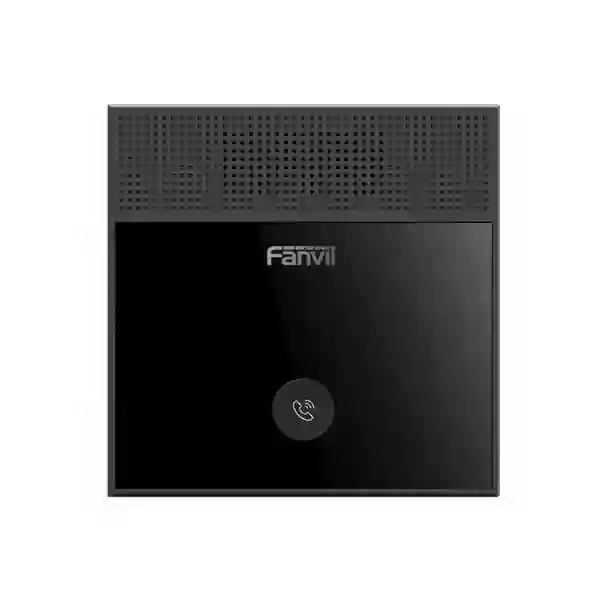
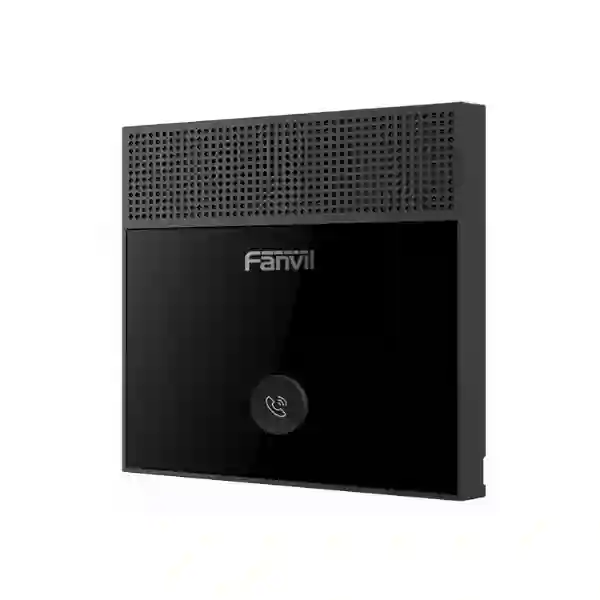
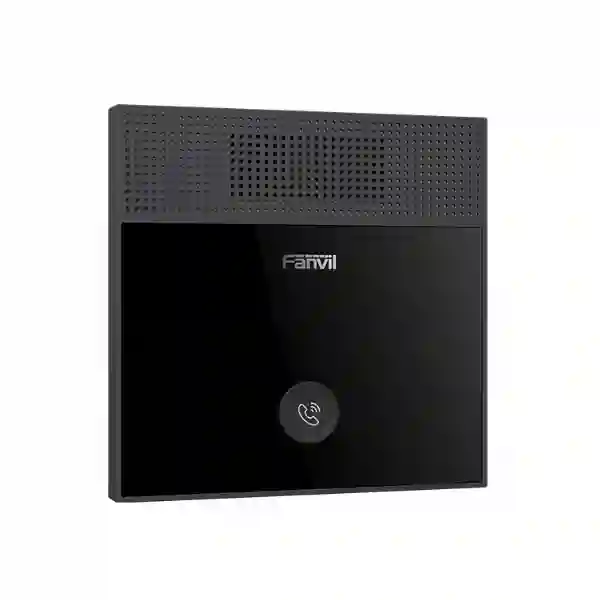
Fanvil H501W Wi-Fi Mini SIP Intercom
The Fanvil H501W is a compact embedded SIP intercom for indoor environments where users need a simple, reliable way to call reception, support staff or another SIP endpoint. Fanvil positions the H501 series for hotels, residential buildings, villas and comparable indoor spaces. The H501W adds built-in 2.4 GHz Wi-Fi 6 to the series while retaining wired Ethernet and PoE support, giving system designers more deployment flexibility when a standard network cable is available or when a suitable wireless design is preferred.
A dedicated function key can be configured for one-touch calling, useful where a guest, resident or visitor needs a direct voice path to a predefined service destination.
The H501W supports 10/100 Mbps Ethernet, PoE and 2.4 GHz Wi-Fi 6, so deployment can be planned around the cabling, power and wireless conditions of the building.
G.722 and Opus wideband codecs, full-duplex communication, acoustic echo cancellation and a published pickup range of up to 5 m support natural two-way conversations.
The unit is designed for flush mounting in a standard 86-type box with a required depth of at least 45 mm, helping it blend into indoor hospitality and residential interiors.
What the Fanvil H501W is designed to solve
Many indoor service points do not need a screen, keypad or complex user interface. They need a clear call button, intelligible two-way voice and straightforward integration with a SIP-based communication system. The H501W is suited to that narrower requirement. A guest room, apartment corridor, villa service point or controlled indoor area can use the unit as a compact calling endpoint instead of installing a conventional desk phone or a larger door-station format. The operational design remains important: the target SIP destination, call routing, network segment, power method and mounting location should all be decided before deployment.
For businesses planning a wider voice environment, the intercom should be considered as one endpoint within the complete IP telephony architecture. FourTeck Tanzania’s technology services overview explains how IP PBX, IP phones, switching, Wi-Fi and support dependencies can be coordinated. Where the H501W will register to an IP PBX, confirm the required SIP account parameters, call permissions, dial plan and any VLAN or QoS policy before mass deployment.
Verified Fanvil H501W technical specifications
| Application | Indoor intercom for hotels, buildings, villas and similar environments |
| SIP accounts | 2 SIP accounts |
| Function key | 1 function key |
| SIP protocols | SIP 2.0 over UDP, TCP and TLS |
| IP acquisition | Static IP, DHCP and PPPoE |
| Network port | 10/100 Mbps Ethernet |
| Wireless | Built-in 2.4 GHz Wi-Fi 6 on H501W |
| PoE | IEEE 802.3af Class 3 |
| Alternative power | DC 12 V / 1 A when not using PoE |
| Wideband audio | G.722 and Opus |
| Voice mode | Full-duplex HD voice with AEC, VAD, CNG, BNE and PLC |
| Published pickup range | Up to 5 m |
| Dimensions | 86 × 86 × 30.9 mm |
| Installation | 86 box flush-mounted, depth at least 45 mm |
| Operating temperature | -10 °C to +50 °C |
Deployment and integration guidance
The choice between wired Ethernet and Wi-Fi should be made from the building design rather than convenience alone. PoE can simplify power and network delivery over one cable when suitable switching and structured cabling are already available. Wi-Fi can reduce the need for a dedicated data cable at the final mounting point, but it still requires dependable 2.4 GHz coverage, suitable authentication, channel planning and a reliable power source. For business deployments, test signal quality at the exact installed location instead of assuming that coverage visible on a phone will be sufficient for a permanently mounted voice endpoint.
Voice devices are sensitive to delay, jitter and packet loss. If the site carries data, guest Wi-Fi, cameras and other services on the same infrastructure, network segmentation and prioritisation may improve operational predictability. A managed switch environment can simplify VLAN assignment for wired units, while wireless deployments should map the device to the intended SSID and security policy. FourTeck Tanzania’s business technology shop provides broader buying guidance on PoE, compatibility, capacity and infrastructure dependencies.
Before installation, confirm the depth and physical condition of the 86-type wall box, cable entry, access to power, acoustic placement and the destination that the function key should call. For a hotel or apartment project, consistent naming and configuration templates can make support easier across many rooms. Keep firmware, SIP credentials and configuration backups under controlled administrative processes and verify the current Fanvil release notes before changing production firmware.
Fanvil H501W Wi-Fi Mini SIP Intercom Tanzania
For buyers in Tanzania, the Fanvil H501W is most relevant where indoor voice communication needs to be compact, purpose-built and connected to an IP telephony environment. Hotels can use a small SIP intercom at service points where the user only needs to reach reception, housekeeping or another predefined team. Residential buildings and villas can use the same principle for internal communication points without installing a full desk handset. The H501W’s built-in 2.4 GHz Wi-Fi 6 gives project teams an alternative to a dedicated Ethernet run, while PoE remains available for sites that prefer wired network and power delivery. The right choice depends on the actual building, existing cabling, switch capacity and wireless coverage.
A Tanzania quotation should therefore describe more than the model and quantity. It should identify whether each location will use PoE or DC power, whether Wi-Fi is required, which IP PBX or SIP platform will register the device, how many intercom points are planned, and which extension or call group each button should reach. For multi-floor or hospitality deployments, a room or location schedule is valuable because it connects each physical device to a defined SIP account and support label. The H501W supports two SIP accounts, but the intended call workflow should still be planned before configuration.
Network readiness is equally important. Tanzania deployments may combine business data, CCTV, Wi-Fi, access control and IP telephony on the same switching infrastructure. Confirm PoE budget where wired units are used, and avoid placing voice endpoints on an overcrowded wireless network where possible. The 5 m published pickup range can be helpful in indoor service areas, but room acoustics, background noise, mounting height and reflective surfaces can affect the perceived result. A pilot installation is sensible when many rooms will be standardised.
FourTeck Tanzania can discuss the H501W as a product requirement or as part of a broader IP PBX, switching and Wi-Fi design. Buyers should provide quantity, site type, preferred network method, PBX details and target call flow through the FourTeck Tanzania contact page. That information helps distinguish a simple supply request from a deployment that also needs network preparation, configuration and integration planning.
Fanvil H501W Wi-Fi Mini SIP Intercom Dar es Salaam
In Dar es Salaam, the Fanvil H501W can fit hospitality, apartment, mixed-use and office projects where a small indoor wall intercom is preferable to a conventional telephone. The city’s variety of new developments and existing properties means deployment conditions can differ significantly. A newly fitted hotel may already have structured cabling and PoE switches at suitable locations, while an existing building may make cable routing difficult. In the first case, wired Ethernet and PoE can provide a simple infrastructure model. In the second, the H501W’s 2.4 GHz Wi-Fi 6 can be evaluated, provided power is available and wireless coverage is tested at the actual mounting position.
For hospitality projects, the useful design question is what the button should do. A guest may need to reach reception, a service desk or security. Rather than programming every device independently without documentation, define a repeatable call plan. Room or zone naming, SIP account allocation and target extensions should be documented before the installation team begins. This approach is especially important when tens or hundreds of endpoints are installed because small inconsistencies become expensive to troubleshoot later. The device supports one function key and two SIP accounts, so the final workflow should stay intentionally simple and clear.
Wi-Fi should not be selected merely to avoid cabling. Dar es Salaam buildings may include reinforced walls, service corridors, elevators and dense guest wireless usage, all of which can influence 2.4 GHz performance. A dedicated or carefully planned SSID, appropriate security settings and capacity checks can make the design more dependable. When PoE is available, confirm IEEE 802.3af compatibility and the aggregate PoE budget of the switch. If DC power is used, include power accessibility and cable concealment in the mounting plan.
Procurement teams in Dar es Salaam should request the exact H501W model, quantity, mounting-box status, preferred connectivity, IP PBX details and any configuration requirement. This creates a quotation that reflects deployment realities rather than only hardware count. For organisations with several technology requirements, the same project review can include voice VLANs, Wi-Fi coverage, switching and other building systems so that the intercom does not become an isolated endpoint with unclear ownership.
Fanvil H501W Wi-Fi Mini SIP Intercom Mwanza
For Mwanza organisations, the Fanvil H501W offers a focused indoor communication endpoint where space, simplicity and SIP integration matter. Hotels, residences, managed apartments, clinics or service facilities may need a wall-mounted call point that lets a user reach a known team without navigating menus. The H501W’s 86 × 86 mm face and flush-mount design are suited to that purpose, but the wall box depth and mounting conditions should be checked before equipment is ordered. Fanvil specifies installation in a standard 86-type box with at least 45 mm depth.
A Mwanza deployment should begin by defining which locations genuinely need an intercom. Placing devices in every possible area can increase administration without improving service. Identify the guest, staff or resident journey and locate the endpoint where one-touch calling can shorten response time. Then decide whether the call should go to a receptionist, a hunt group, security or another extension. If the PBX uses separate permissions for internal and external dialing, the H501W account can be restricted to the required destination set according to the organisation’s policy.
Connectivity should be assessed at each building. Wired PoE is attractive when existing structured cabling reaches the intended wall position because data and power can share one cable. Wi-Fi is useful where a data cable is impractical, but the 2.4 GHz spectrum may also be used by many other devices. A pre-installation survey should consider signal strength, interference and the effect of walls or building materials. Where the endpoint is operationally important, power resilience at the switch, access-point and PBX layers should be considered because an intercom cannot function if the supporting network loses power.
For purchasing, include the number of units, PBX platform, whether configuration is required, the preferred wired or wireless method and any existing switch or access-point information. If Mwanza is one branch in a larger Tanzanian estate, standardising account naming, firmware policy, network segmentation and documentation across locations can make remote support easier and future additions more predictable.
Fanvil H501W Wi-Fi Mini SIP Intercom Arusha
Arusha buyers considering the Fanvil H501W are likely to value its combination of compact indoor mounting and flexible connectivity, particularly in hotels, lodges, serviced residences, villas and business environments where staff response matters. One-touch calling can simplify the user experience: rather than giving a guest a conventional handset with many functions, the intercom can provide a clearly defined contact path. The business value comes from designing that path correctly and ensuring the supporting SIP and network environment remains stable.
Hospitality properties around Arusha may have a mixture of new and older buildings, detached areas or rooms where cabling conditions vary. The H501W can use PoE over Ethernet or built-in 2.4 GHz Wi-Fi 6 with a separate 12 V / 1 A supply when PoE is not used. Those options should not be mixed without documentation. A room schedule can record which unit is wired, which uses Wi-Fi, which SIP account is assigned and which support destination it calls. This provides a useful handover record for maintenance teams and reduces guesswork during troubleshooting.
Audio placement matters in guest-facing spaces. Fanvil publishes a 5 m voice pickup range and supports G.722 and Opus codecs, but practical intelligibility still depends on the environment. Avoid mounting next to loud mechanical equipment, televisions or areas with persistent background noise. The full-duplex audio design and acoustic echo cancellation support natural conversation, yet an installation test should confirm that the chosen height and room acoustics produce the desired experience.
Arusha procurement teams should also check the complete voice architecture. Confirm SIP server reachability, network addressing, DNS where required, firewall policy, VLANs and QoS expectations. If the project spans hospitality Wi-Fi and IP telephony, wireless capacity should be planned jointly rather than assuming that an existing guest network can carry operational voice endpoints without change. A well-prepared quotation request should include property type, unit count, PBX platform, deployment method and any installation constraints.
Fanvil H501W Wi-Fi Mini SIP Intercom Dodoma
In Dodoma, the Fanvil H501W can be considered for offices, residences, hospitality properties and institutional environments that want a dedicated SIP call point without the footprint or complexity of a full desk phone. The design is particularly useful when the person at the wall point has one primary task: press a button and speak with a predefined destination. Because the device supports two SIP accounts, administrators can integrate it into a controlled communication plan while keeping the physical user interaction simple.
Newer buildings may allow the cleanest approach: prepare the standard 86-type back box, provide Ethernet to the location and use 802.3af PoE from a managed switch. This gives the network team direct visibility of the physical link and simplifies power distribution. Existing buildings may favour Wi-Fi if pulling cable is disruptive, but a separate power method is still required. For that design, test 2.4 GHz coverage where the final unit will be mounted and confirm that the wireless security policy permits the endpoint to reach its SIP server without unnecessary access to other networks.
Organisations with formal IT governance should define device ownership and configuration controls from the beginning. Store the SIP extension mapping, IP assignment method, firmware version and button destination in the project documentation. If the organisation uses central monitoring or configuration tools, verify compatibility from current Fanvil documentation rather than assuming support. The H501W has a current Fanvil firmware line, so lifecycle planning should include a controlled process for evaluating and applying updates.
For a Dodoma quotation, provide the number of endpoints, whether they are in one building or several, the PBX or SIP service in use, the expected call destination, the chosen power method and any cabling requirements. If the intercom forms part of a new office or building infrastructure project, include switching, Wi-Fi and UPS planning so the supporting layers are sized with the communication requirement in mind.
Fanvil H501W Wi-Fi Mini SIP Intercom UAE
For UAE projects, the Fanvil H501W is relevant to hospitality, residential, villa and indoor service environments that require a compact SIP endpoint with one-touch calling. Properties may have strong structured cabling standards and centrally managed networks, which can make PoE an attractive deployment method. At the same time, retrofit projects can benefit from the H501W’s 2.4 GHz Wi-Fi 6 capability where a suitable wireless network and separate power source are available. The decision should follow site standards and operational support practices rather than a preference for one transport.
In large hospitality or residential projects, consistency has high value. Define an endpoint template covering SIP account naming, dial permissions, target extension, NTP, network addressing and security settings. Then apply controlled variations by room or zone. A commissioning checklist should confirm that each function key reaches the intended destination, two-way audio is clear, the device reconnects after power cycling and the PBX records the endpoint correctly. The H501W supports SIP 2.0 over UDP, TCP and TLS, so the selected transport should match the PBX design and organisational security policy.
The physical installation also deserves attention. The 86-type flush-mounted form can create a discreet finish, but back-box depth, wall material and cable management should be confirmed before installation teams arrive. In premium interiors, device placement should be coordinated with switches, thermostats and other wall controls to maintain a consistent visual layout. Audio performance should be tested in the final acoustic environment, especially in corridors or large spaces with reflective surfaces.
Multi-country customers can coordinate wider requirements through the FourTeck UAE technology site. When requesting the H501W, include model, quantity, destination environment, PBX platform, installation method and any provisioning requirement. This helps the discussion cover the complete communication path rather than treating the intercom as an isolated wall accessory.
Fanvil H501W Wi-Fi Mini SIP Intercom Uganda
Uganda deployments of the Fanvil H501W can serve hotels, residences, villas, offices and other indoor environments that need a dedicated SIP communication point. The H501W’s combination of Ethernet, PoE and 2.4 GHz Wi-Fi 6 means project teams can select a deployment method that reflects the building rather than forcing every location into the same cabling pattern. New sites can prepare PoE cabling from the outset, while retrofit sites can evaluate wireless connectivity where network coverage and power are dependable.
The operational design should begin with the call destination. A one-button intercom is most useful when the user does not need to remember extensions or navigate a directory. In a hotel, it might reach reception. In a residential property, it may connect to security or a service desk. In an office facility, it could provide an internal assistance point. The PBX administrator should define what happens if the target is busy or unavailable: ring group, queue, alternate extension or another policy. Those behaviours belong to the wider voice platform and should be agreed before commissioning.
Power continuity can also influence user expectations. If the intercom is intended for operationally important communication, consider whether the PoE switch, wireless access point, IP PBX and internet or WAN components are protected by UPS where appropriate. Resilience is a chain; backing up only the wall device does not preserve service if the network path fails. For wireless installations, maintain an SSID and access policy appropriate to fixed operational devices rather than relying on a transient guest network.
Regional customers can explore related procurement through FourTeck Uganda. A useful request includes unit count, city or site type, PBX details, wired versus Wi-Fi preference, installation scope and any need for configuration templates. This information supports more accurate planning for the endpoint, network and call-flow dependencies.
Fanvil H501W Wi-Fi Mini SIP Intercom Kampala
In Kampala, the Fanvil H501W can be a practical indoor intercom for hospitality, serviced apartments, residential complexes and commercial facilities that already use or plan to use SIP telephony. The small wall-mounted format helps where space and appearance matter, while the dedicated function key keeps the user experience straightforward. Instead of exposing PBX complexity to the person using the device, the administrator can preconfigure a simple call destination and manage routing centrally.
Kampala buildings can present varied network conditions. A modern property with structured cabling can connect H501W units to PoE access switches, potentially simplifying endpoint power. A retrofit project may prefer Wi-Fi, but the device still needs reliable DC power and a properly planned 2.4 GHz wireless network. Before choosing wireless for many units, survey representative rooms or corridors, identify congested channels and confirm that access points have enough capacity for both normal clients and fixed voice endpoints. Wireless connectivity should be engineered, not treated as a substitute for planning.
For larger properties, configuration consistency should be part of the procurement scope. Ask whether the project requires preconfiguration, extension mapping, labels, test records or documentation. Define a naming scheme that identifies building, floor and room or zone. This makes it easier to locate a failed endpoint in the PBX or switch interface. Because the unit supports SIP over UDP, TCP and TLS, transport and authentication settings should follow the existing voice-security policy.
Audio expectations should also be realistic. Fanvil specifies wideband G.722 and Opus plus up to 5 m voice pickup, but the result still depends on background noise and mounting. Test locations near lobbies, lifts or busy service areas before replicating the design. A Kampala buyer should share site drawings or a simple location list, device quantities, PBX details and connectivity plans so the quotation can include the dependencies required for a stable deployment.
Fanvil H501W Wi-Fi Mini SIP Intercom Arua
For Arua sites, the Fanvil H501W is most useful when the communication requirement is deliberately simple: a person at an indoor wall point needs to reach a known SIP extension or team quickly. That may apply in hotels, guest facilities, residences, administrative buildings or internal service areas. The H501W avoids the larger physical footprint of a desk phone and supports flush mounting in a standard 86-type box, which can suit new fit-outs as well as carefully planned renovations.
Infrastructure planning deserves particular attention where technical support access or replacement logistics are not immediate. Select a power and network approach that the local team can maintain. Wired PoE can consolidate network and power on one cable when managed switching and cabling are available. Wi-Fi can provide flexibility, but it introduces dependence on the access-point layer and radio environment. Whichever method is selected, document it clearly and keep spare configuration information so an endpoint can be replaced or reset without rebuilding the design from memory.
The voice platform should be equally well documented. Record the SIP account, button target, extension label and any fallback routing. If the H501W is intended for a guest service workflow, define who answers and what happens when the first destination is unavailable. A technically successful call that rings an unattended extension still produces a poor user experience. PBX ring groups, queues or time-based routing can be evaluated according to the organisation’s needs.
When requesting equipment for Arua, include expected quantities, whether all units are in one property, the network type, the selected PBX, installation conditions and any requirement for UPS-backed infrastructure. A staged deployment can be sensible for larger projects: install and test a small representative set, confirm audio, network and call routing, then repeat the approved standard. This reduces the risk of discovering a design issue after all devices have been mounted.
Fanvil H501W Wi-Fi Mini SIP Intercom Mbarara
Mbarara businesses and property operators can evaluate the Fanvil H501W where a compact indoor SIP call station fits better than a feature-rich handset. The device’s one function key encourages a purposeful design: identify the service or team the user must reach, program that destination and keep the interaction simple. In hospitality, this can support guest-to-reception or service communication. In a managed residence, it can connect to a security or support point. In an office, it may function as an assistance intercom in a defined internal area.
Before procurement, survey the mounting and network environment. An 86-type box with sufficient depth is required for the intended flush installation. If Ethernet is available, PoE can reduce the need for a separate adapter at the wall. If the project chooses Wi-Fi, confirm stable 2.4 GHz coverage and a power route that does not compromise the clean installation. The access point serving the device should itself have reliable backhaul and power; otherwise, the convenience of wireless at the endpoint does not improve overall availability.
The H501W uses standard SIP architecture, so the PBX remains responsible for many call behaviours. Administrators should confirm registration settings, dialing rules, codec policy and any TLS requirements with the selected platform. The wideband G.722 and Opus codecs can support clearer voice when both ends and the PBX path permit them. Test real calls to the intended receiving phones rather than validating registration alone. A green status in the PBX is not the same as a satisfactory user conversation.
For a multi-room Mbarara deployment, include commissioning and documentation requirements in the scope. Each installed unit should have a known physical location, SIP identity and call destination. This simple asset map helps maintenance teams diagnose whether a problem belongs to the device, PoE switch, Wi-Fi, PBX or receiving extension. It also makes future expansion more orderly when additional rooms or service points are added.
Fanvil H501W Wi-Fi Mini SIP Intercom Gulu
In Gulu, the Fanvil H501W can support indoor communication requirements where users need direct access to a predefined service team without the complexity of a conventional telephone. The wall-mounted format can suit hospitality rooms, residential common areas, internal help points and controlled business spaces. Its value is strongest when the project has a clear call-flow objective and the supporting network is engineered to keep the endpoint reachable.
A wired design should check switch port availability, PoE budget, cabling path and VLAN assignment. The H501W supports 10/100 Mbps Ethernet and IEEE 802.3af Class 3 PoE, which is more than sufficient from a bandwidth perspective for SIP voice, but the quality of the network path still matters. A wireless design should check 2.4 GHz signal and interference at the mounting point, SSID security, DHCP availability and access to the SIP server. The decision should consider maintainability as well as installation effort.
For organisations with a small local technical team, a standard configuration template can reduce support complexity. Record the firmware version used at commissioning, export configuration where the management workflow permits, and maintain a table mapping device location to extension. If a unit stops registering, the support team can then check physical power, network association, IP assignment, SIP credentials and PBX status in a logical order. This structured approach is more efficient than resetting devices before the root cause is understood.
Gulu buyers should request the exact H501W rather than the H501 if Wi-Fi is required, because Wi-Fi 6 is specific to the W model in this series. Include quantity, location list, expected power method, PBX platform and call destination in the procurement request. If the devices support a wider property solution, include switching, Wi-Fi and voice-platform requirements in the same project discussion so dependencies are visible before hardware is delivered.
Fanvil H501W Wi-Fi Mini SIP Intercom Kenya
Kenya organisations can deploy the Fanvil H501W as a compact indoor SIP intercom in hotels, residences, villas and other spaces where direct one-touch calling is more useful than a full telephone interface. The H501W model combines standard SIP connectivity with both Ethernet and 2.4 GHz Wi-Fi 6, allowing project designers to match the endpoint to new structured cabling or carefully planned retrofit conditions. PoE support is particularly useful when the network switch and cabling already reach the wall position.
Large hospitality and property projects should standardise deployment before scaling. A pilot room or representative zone can confirm the back-box fit, cable routing, Wi-Fi behaviour, audio pickup, receiving extension and user instructions. Once approved, the same installation standard can be repeated. This is preferable to mounting many devices first and discovering later that room acoustics, access-point placement or PBX routing needs adjustment. The H501W’s slim profile is useful aesthetically, but the supporting infrastructure remains the determinant of service quality.
For IP PBX integration, confirm the SIP account and transport, authentication, dial plan, codec policy and destination. If different rooms call different departments, maintain a deployment sheet linking each serial or asset identifier to its location and programmed target. Voice VLAN and QoS policies can be considered where the wider network carries substantial data, video or surveillance traffic. If Wi-Fi is used, fixed operational devices may benefit from a dedicated SSID or policy that avoids guest-network restrictions and changing captive-portal processes.
Customers with requirements in Kenya can use FourTeck Kenya for regional project discussions. A useful H501W enquiry specifies the exact model, quantity, use case, PBX, preferred wired or wireless connectivity, installation scope and target call flow. Those inputs help define whether the requirement is hardware supply alone or a broader voice-and-network integration project.
Fanvil H501W Wi-Fi Mini SIP Intercom Kuwait
For Kuwait hospitality, residential and indoor commercial projects, the Fanvil H501W offers a compact SIP intercom format that can be integrated into an existing or new IP telephony system. One-touch calling is useful in spaces where the user’s task should remain obvious: press the button, speak and reach the designated service team. The unit’s support for G.722 and Opus wideband codecs, full-duplex audio and a published 5 m pickup range can support clear conversations when the receiving endpoint and network path are configured appropriately.
The choice between PoE and Wi-Fi should reflect the property’s infrastructure standards. New projects can provide Ethernet and an 86-type wall box at each location, allowing the H501W to receive both network and power from an 802.3af-capable switch. Retrofit areas can consider 2.4 GHz Wi-Fi 6, but should still plan the 12 V / 1 A power supply, concealment and access for maintenance. A wireless voice endpoint should be included in radio-capacity planning, especially in properties with many guest devices.
For multi-unit deployment, administrators should build a standard configuration and a commissioning record. Test that each endpoint registers after restart, calls the correct destination, supports two-way audio and remains stable during ordinary network load. If TLS is selected, certificate and PBX requirements should be confirmed. If UDP or TCP is preferred, the firewall and segmentation policy should still limit the endpoint to the services it actually needs.
Kuwait buyers can review regional solutions through FourTeck Kuwait. Include the quantity, building type, IP PBX, expected button destination, network method and installation requirements in the enquiry. For projects spanning multiple countries, using the same endpoint configuration principles and documentation format can simplify central IT oversight even when local network details differ.
Fanvil H501W Wi-Fi Mini SIP Intercom Ghana
Ghana buyers can consider the Fanvil H501W for indoor hospitality, residential and service environments where a small wall intercom must connect to a SIP-based phone system. The H501W is not intended to replace every type of door station or desk handset; it is best viewed as a focused voice endpoint with one function key, two SIP accounts and flexible network options. That makes it particularly useful where the call destination is known in advance and simplicity improves the user experience.
The site survey should confirm mounting, power and network conditions. The product is designed for an 86-type flush box with at least 45 mm depth. For Ethernet deployment, check the cable path and PoE switch capacity. For Wi-Fi, measure signal where the device will actually sit, confirm 2.4 GHz coverage and use an operational SSID that does not require browser authentication. A fixed intercom should not depend on guest-network processes that may change or expire. If DC power is used, ensure the adapter and cable can be installed safely and maintained without damaging the interior finish.
PBX configuration should follow a documented call-flow plan. Decide whether the function key calls one extension, a group or a service queue. Define what happens when nobody answers and whether calls are allowed at all times or only during service hours. These decisions can be more important to the user experience than the endpoint specifications themselves. Test wideband audio end to end and verify that the receiving handset or softphone supports the desired codec and volume level.
Regional enquiries can be coordinated through FourTeck Ghana. Procurement teams should specify H501W quantity, site type, PBX model or service, connectivity preference and whether installation or provisioning is required. For larger estates, ask for a repeatable configuration and labeling approach so later support does not depend on individual installer knowledge.
Fanvil H501W Wi-Fi Mini SIP Intercom Nigeria
In Nigeria, the Fanvil H501W can be used in indoor hospitality, residential and commercial properties that want a compact SIP intercom with a simple one-button user experience. Its built-in Wi-Fi 6 capability on 2.4 GHz is useful for retrofit flexibility, while Ethernet and 802.3af PoE support suit projects with structured cabling. Buyers should select the transport according to reliability, maintainability and site design rather than assuming wireless is automatically faster to deploy in every room.
Power and network resilience should be discussed early where the intercom supports an important service path. If PoE is used, the availability of the device depends on the PoE switch and upstream network. If Wi-Fi is used, the endpoint also depends on its local power source and access point. A UPS strategy can be considered for supporting infrastructure according to the property’s operational requirements. The IP PBX, DNS and routing services also need stable power if internal calling is expected during interruptions.
For projects with many endpoints, configuration management becomes a procurement issue. Define how SIP credentials are created, how devices are named, how firmware is controlled and how the physical location is mapped to the extension. The H501W supports SIP over UDP, TCP and TLS; use the transport and security model approved for the organisation. Restrict the account to the permissions it needs and avoid reusing credentials across many endpoints where the PBX platform can provide unique identities.
Audio testing should include the real environment. Fanvil’s full-duplex design, acoustic echo cancellation, G.722/Opus support and 5 m pickup specification provide a strong technical base, but noisy lobbies or service areas can still affect intelligibility. Install representative units first, verify mounting height and destination volume, then scale. A Nigeria quotation request should include quantity, site count, use case, PBX, wired or wireless method, installation requirements and the desired call route so the complete solution can be scoped accurately.
Fanvil H501W Wi-Fi Mini SIP Intercom Seychelles
Seychelles hospitality and residential projects can find the Fanvil H501W attractive where interior design, compact installation and direct service communication are important. Resorts, villas and managed accommodation may prefer a discreet wall endpoint that lets a guest reach reception or another service team without presenting a full phone interface. The H501W’s 86-type flush-mount format supports that approach while SIP integration keeps call routing under the central communication system.
Property layout can influence the network method. Separate villas or spread-out buildings may have varying cabling availability and wireless coverage. Wi-Fi can be practical in selected locations, but every device should be tested against the actual 2.4 GHz radio design and powered reliably. In buildings with Ethernet, PoE provides a controlled wired option. For larger resorts, it may be appropriate to use different network methods in different zones while keeping the SIP configuration and user experience consistent. Documentation should record those differences for maintenance teams.
Because guest experience depends on fast response, the button destination should not simply ring a single unattended phone. Consider how the PBX routes calls to reception or service teams during shifts, busy periods and after hours. Ring groups or queues can be used where supported by the PBX. The H501W itself remains intentionally simple; the broader communication platform provides the operational logic. Test calls from each representative location and confirm intelligibility at both ends before room handover.
For procurement, provide property type, number of rooms or service points, device quantity, PBX information, whether Wi-Fi or PoE is expected and any installation constraints. Where imported equipment or remote support needs careful coordination, include spare-unit planning, firmware control and configuration backups in the lifecycle discussion. The goal is a repeatable endpoint standard that local staff can identify and support without unnecessary complexity.
Buying checklist for Fanvil H501W projects
Specify H501W when Wi-Fi is required. The H501 and H501W are related models but wireless capability differs.
State what the function key should call and what should happen when the primary destination does not answer.
Choose PoE Ethernet or Wi-Fi plus DC power according to the real site infrastructure and support model.
Verify the standard 86-type box and at least 45 mm depth before the installation team arrives.
Identify the SIP platform, account policy, transport preference and receiving endpoint or queue.
Record firmware, configuration, endpoint location and extension mapping for future maintenance.
Frequently asked questions
Does the Fanvil H501W support Wi-Fi?
Yes. Fanvil specifies built-in 2.4 GHz Wi-Fi 6 for the H501W. The related H501 model does not have the same wireless feature, so buyers who need Wi-Fi should specify the W model explicitly.
Can the H501W use PoE?
Yes. The H501W supports IEEE 802.3af Class 3 PoE. When PoE is not used, Fanvil specifies a DC 12 V / 1 A power option. Confirm the switch PoE budget and cabling before deployment.
How many SIP accounts does the Fanvil H501W support?
The H501W supports two SIP accounts. The practical call behaviour still depends on how the PBX account, function key and receiving destination are configured.
What audio codecs are available?
Fanvil lists G.722 and Opus wideband codecs for the H501W. It also supports full-duplex communication with acoustic echo cancellation and additional voice-processing functions. End-to-end codec use depends on the PBX and receiving endpoint.
How far can the H501W pick up speech?
Fanvil publishes a 5 m pickup range. Real-world results can vary with background noise, room acoustics, mounting height and the speaker’s position, so representative on-site testing is recommended for large deployments.
Where is the H501W intended to be installed?
Fanvil positions the H501 series as an indoor intercom for hotels, buildings, villas and similar environments. It is designed for flush mounting in a standard 86-type box with at least 45 mm depth.
What should I include in a quotation request?
Include the exact H501W model, quantity, project location, site type, PBX or SIP platform, intended call destination, wired or Wi-Fi preference, power method, mounting status and whether configuration or installation support is needed.
Decision recap
Choose the Fanvil H501W when the requirement is a compact indoor SIP intercom with one-touch calling, two SIP accounts, full-duplex HD voice, built-in 2.4 GHz Wi-Fi 6 and PoE flexibility. It is especially suited to hotels, residential buildings, villas and related indoor service environments. Do not select it only from the feature list; confirm the mounting box, PBX, call flow, network method, power, wireless conditions and support process first.
For a useful quotation, share the deployment context as well as the unit count. FourTeck can then discuss the endpoint in relation to IP PBX, switching, Wi-Fi and installation requirements rather than treating it as an isolated device.
Prepare your Fanvil H501W enquiry
Send the product name, quantity, project city or country, property type, PBX platform, intended button destination, preferred PoE or Wi-Fi deployment, number of rooms or zones and any installation constraints. If this is part of a wider voice project, include extension count, reception workflow, switching and wireless requirements so the design can be reviewed as one system.



Reviews
There are no reviews yet.