
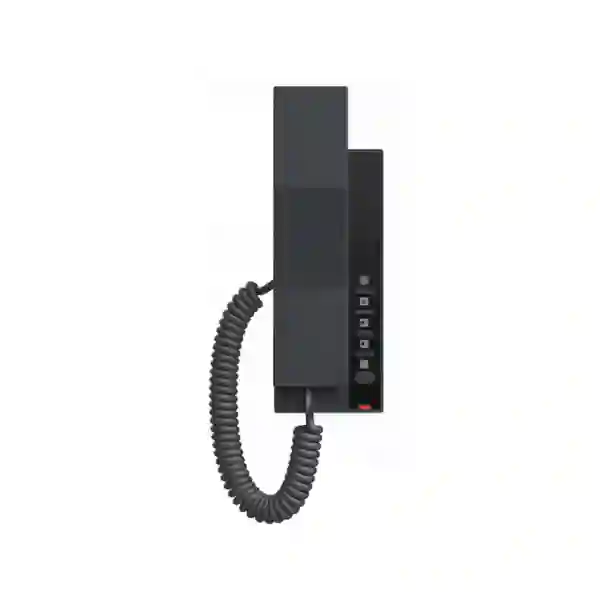
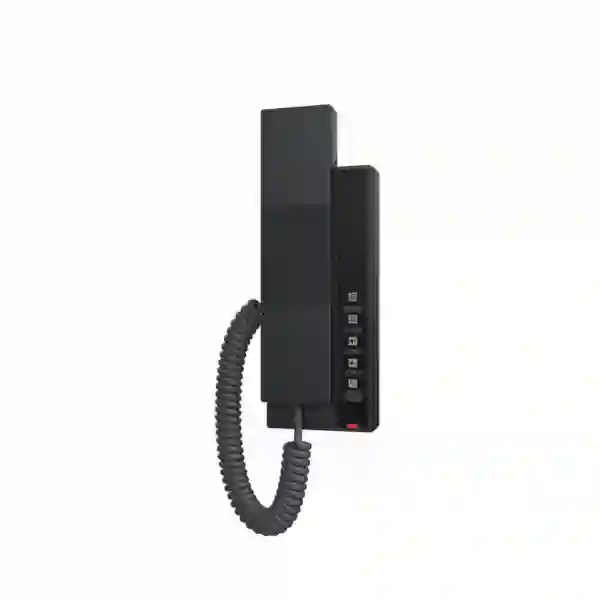
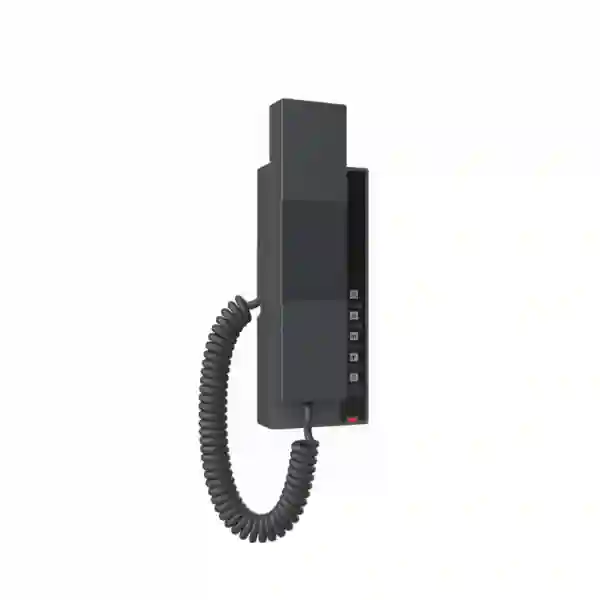
Fanvil H601W Wi-Fi IP Phone
The Fanvil H601W Wi-Fi IP Phone is a compact, screenless SIP endpoint built for hotel rooms and other commercial spaces where straightforward calling, fast access to service numbers and flexible wireless deployment matter more than a large display. Fanvil positions the H601W for hotels, shopping malls, hospitals and supermarkets. Its core design combines two SIP lines, two programmable keys, wideband G.722 and Opus audio, dual-band 2.4GHz/5GHz Wi-Fi 6, a 10/100 Mbps network interface and support for desktop or wall-mounted installation.
The H601W uses DC power rather than PoE. This difference is important during planning: a wireless network connection does not remove the need for local electrical power. A project should verify nearby power points, Wi-Fi coverage, SIP platform compatibility, VLAN and security policy, call routing requirements and the intended functions of the two programmable keys before finalizing quantities.
Built-in 2.4GHz and 5GHz Wi-Fi with Wi-Fi 6 support can reduce dependence on a dedicated data cable at each phone position.
Two programmable keys can be mapped to functions such as front desk, service desk, do-not-disturb or other SIP-side workflows supported by the deployment.
G.722 and Opus wideband codec support helps deliver clear speech when the SIP platform, network and call path also support wideband audio.
The screenless form factor is suited to bedside tables, wall positions, reception-adjacent areas and other locations where a simple calling interface is preferred.
Product overview and deployment guidance
Many hospitality phone projects are not about giving every user a feature-rich office handset. They are about providing a dependable, easy-to-understand endpoint for calling reception, requesting service, reaching security, dialing another extension or receiving a call from staff. In guest rooms, clinics, retail counters and shared facilities, too many visible controls can make the device harder to use and more difficult to standardize. The H601W takes the opposite approach: a compact handset, two programmable service keys and SIP calling over a wired or Wi-Fi-connected network environment.
The Wi-Fi capability is relevant when renovation, a leased property or a finished room makes new data cabling costly or disruptive. Wireless connectivity can simplify placement, but it should be treated as an engineered network service. A room-by-room Wi-Fi survey, access-point capacity review, power check and SIP quality-of-service plan remain important, especially in hotels with many simultaneous guest devices sharing the same WLAN infrastructure.
Verified Fanvil H601W specifications
| Item | Fanvil H601W |
|---|---|
| Product type | Compact screenless Wi-Fi SIP / hotel IP phone |
| SIP lines | 2 |
| Programmable keys | 2 |
| Wideband codecs | G.722 and Opus |
| Wi-Fi | Built-in dual-band 2.4GHz / 5GHz, Wi-Fi 6 |
| Ethernet | 10/100 Mbps |
| Power | DC power; H601W does not use PoE |
| Placement | Desktop and wall-mounted deployment supported |
Compatibility, integration and procurement
The H601W is a SIP endpoint, so purchasing should start with the call platform rather than the handset alone. Confirm that the intended IP PBX, hosted PBX or SIP service can register the required extensions and that the project’s dial plan supports the guest or service workflows. Hotels commonly want a room handset to call reception with one key, reach another extension, receive staff calls and present clear room-identifying caller information. Those functions depend on both the phone configuration and the PBX design.
Wireless planning should cover the SSID used by phones, authentication method, VLAN design where applicable, firewall policy, DNS, DHCP, NTP and access to the SIP server. Voice devices should not be added to a heavily congested guest SSID without testing. A dedicated or appropriately segmented WLAN can make troubleshooting easier and reduce the chance that consumer traffic competes with voice packets.
For broader telephony planning, buyers can explore the FourTeck IP phone resource, FourTeck Uganda, FourTeck Kenya, FourTeck UAE, and the FourTeck Tanzania website.
Fanvil H601W Wi-Fi IP Phone Tanzania
For Tanzania-based hospitality, healthcare, retail and commercial projects, the Fanvil H601W offers a practical path to SIP calling where a clean, compact phone and wireless network connectivity are desirable. A Tanzanian hotel may have renovated rooms with no spare Ethernet socket, older rooms with limited structured cabling, a central IP PBX serving administration offices, and an existing managed Wi-Fi system covering guest areas. The H601W can fit such an environment because it uses dual-band 2.4GHz and 5GHz Wi-Fi with Wi-Fi 6 support while retaining a straightforward screenless guest interface. The two programmable keys are useful when a property wants to make common actions obvious. One key can be assigned to reception or another priority service while the second supports another programmed function based on the hotel’s workflow.
Procurement in Tanzania should begin with a technical inventory rather than a simple unit count. Record how many rooms or service points need phones, whether each position has a nearby power outlet, what Wi-Fi coverage exists at bedside or wall height, which PBX or hosted SIP platform is in use, and whether the project needs room-by-room extension naming. Because H601W is DC-powered rather than PoE-powered, power availability can determine whether it is the correct model. A property with reliable PoE cabling but no convenient electrical outlet may prefer comparing the wired H601. A property with strong Wi-Fi and convenient mains power but no data cabling may find H601W better aligned with the physical environment.
Tanzanian buyers should also plan configuration, support and lifecycle tasks from the start. Decide who will maintain SIP credentials, network settings, firmware and key programming, and how replacement phones will be introduced without manual rework. For a larger hotel, standard configuration templates and a documented extension plan can reduce deployment errors. A pilot in a small number of representative rooms is useful before full rollout, particularly where walls, furniture or access-point placement may affect RF performance. FourTeck can use quantity, location type, PBX platform, Wi-Fi design and preferred service-key behavior to guide quotation planning.
Fanvil H601W Wi-Fi IP Phone Dar es Salaam
In Dar es Salaam, H601W enquiries can come from hotels, serviced apartments, hospitals, malls, supermarkets, offices and mixed-use properties that need reliable internal calling without adding visible complexity at the user end. Dense commercial buildings often have developed Wi-Fi but uneven access to spare Ethernet points at exactly the place a phone is required. That makes the wireless capability relevant, particularly during refurbishments where opening walls or running new cable through finished interiors would add disruption.
A Dar es Salaam hotel should avoid assuming that strong guest Wi-Fi automatically means voice-ready Wi-Fi. A room can show a good signal for web browsing while still experiencing contention, packet loss or roaming behavior that affects SIP audio. Before ordering a large quantity, test representative rooms on different floors, wings and building materials. Confirm that the SSID used by the phone is not dependent on a captive portal and that the PBX remains reachable under VLAN and firewall rules.
For quotation planning, provide room count, target installation style, PBX make or hosted SIP provider, number of required SIP lines, preferred programmable-key functions and whether devices will be configured centrally. If the project uses wall mounting, also check the physical location of the DC power supply and cable path. If the goal is to replace analogue hotel handsets, include information about the existing PBX and room extension numbering so migration can be planned correctly.
Fanvil H601W Wi-Fi IP Phone Mwanza
For Mwanza hospitality and commercial projects, the H601W can be considered when the deployment needs a simple SIP handset but the building is better served by Wi-Fi than by new structured cabling to every endpoint. Lodges, hotels, clinics and retail facilities can use screenless phones where staff or guests need a few predictable actions rather than a full office-phone interface. The H601W’s two programmable keys make that workflow practical.
Site conditions can differ significantly between a modern multi-storey property and a spread-out lodge or campus. The wireless survey should therefore look beyond average signal strength. Consider access-point spacing, construction materials, outdoor-to-indoor transitions, high-occupancy periods and the number of other client devices using the same radios. Since the phone supports dual-band Wi-Fi 6, administrators can design a dedicated voice SSID or segmented WLAN where appropriate.
Procurement teams should include operational needs in the buying decision. Ask who will configure SIP credentials, how spare units will be stored and provisioned, whether a custom faceplate is relevant to room branding, and how staff will verify a phone after maintenance. Because the H601W uses DC power, include availability and location of suitable power points in every room or service area.
Fanvil H601W Wi-Fi IP Phone Arusha
Arusha has a strong hospitality and tourism profile, making guest-room communications, lodge operations and front-desk accessibility natural use cases for a compact hotel-oriented SIP phone. The H601W can suit properties that want a screenless device with direct service keys and wireless network connectivity. In a room, the benefit is not a long list of desk-phone features; it is a predictable way for a guest to reach the right service point quickly.
Arusha properties range from city hotels to low-rise lodges with separate blocks. That variation makes Wi-Fi design important. A distributed lodge may need multiple access points and careful channel planning across buildings, while a city hotel may need capacity planning for dense guest-device use. H601W supports 2.4GHz and 5GHz Wi-Fi 6, but stable voice still requires consistent coverage and sensible network segmentation.
For procurement, state whether the project is a new build, refurbishment or analogue-to-IP migration. New builds may compare H601W with a wired PoE model based on total cabling and power design, while refurbishments may value wireless flexibility more heavily. The H601W uses DC power, so each location needs a practical electrical source even when network traffic is wireless.
Fanvil H601W Wi-Fi IP Phone Dodoma
In Dodoma, the Fanvil H601W may be relevant to hotels, healthcare facilities, retail properties and offices that require a simplified SIP endpoint. Its screenless design can be an advantage in shared or guest-facing areas because it reduces the number of controls an occasional user has to interpret. Two programmable keys can be mapped to frequently used destinations or functions, and the handset supports two SIP lines for integration with a compatible IP telephony platform.
A Dodoma deployment should compare wireless convenience against the site’s existing infrastructure. Where structured cabling is already present and PoE switching is available, the wired H601 may be worth evaluating. Where running additional data cabling is difficult but reliable electrical power and managed Wi-Fi are available, H601W can reduce the need for new cable drops.
For organizations planning multiple phones across rooms or departments, establish a standard naming and configuration convention before rollout. Define SIP extension ranges, programmable-key behavior, device labels, network SSID, VLAN policy and support ownership. A small pilot helps confirm coverage and call quality before ordering or installing the full quantity.
Fanvil H601W Wi-Fi IP Phone UAE
For UAE hospitality and commercial projects, the Fanvil H601W is positioned as a compact Wi-Fi SIP phone for environments that value simple guest or service calling. Hotels and serviced apartments often balance high-quality interior finishes with the need to modernize communications, and a wireless phone can be useful where an additional Ethernet outlet would require disruptive cabling.
UAE projects should be careful about network segmentation in large properties where guest Wi-Fi, staff Wi-Fi, building systems, IPTV, access control and voice may coexist. H601W should normally be connected to a controlled SSID with appropriate access to the SIP platform rather than a public guest network. The voice path should be tested under peak occupancy.
For quotation planning, specify quantity, property type, room count, deployment schedule, PBX platform, required SIP accounts and intended programmable-key actions. The H601W requires DC power, so projects should confirm suitable power near the phone location. UAE buyers can also use FourTeck UAE for Gulf-focused infrastructure and procurement discussions.
Fanvil H601W Wi-Fi IP Phone Uganda
Ugandan hotels, clinics, retail locations and service facilities evaluating IP telephony may consider the H601W when wireless network access is easier to provide than a new Ethernet outlet at every phone position. The device keeps the endpoint simple: two SIP lines, two programmable keys, HD voice codec support and dual-band Wi-Fi 6 in a compact design.
The important implementation question is whether the WLAN is engineered for voice. A hotel with busy guest Wi-Fi can experience variable latency even when signal strength looks excellent. Before a large deployment, test phones at representative locations, confirm that the SSID is not captive-portal based, and review access-point capacity during high occupancy.
Uganda procurement requests should include exact quantity, property type, whether the project is new or a replacement, the intended PBX or SIP service, desired key functions and preferred mounting style. Power must also be considered because H601W uses DC power rather than PoE. For Uganda-specific technology enquiries, visit FourTeck Uganda.
Fanvil H601W Wi-Fi IP Phone Kampala
Kampala properties often combine high user density with existing managed wireless networks, which can make a Wi-Fi SIP phone attractive for selected hotel rooms, reception-adjacent points, clinics and commercial service areas. The Fanvil H601W is designed around a compact and direct interface instead of a large screen. Two programmable keys can be configured for high-priority destinations or functions.
In a dense Kampala building, Wi-Fi planning should consider interference and client count. A 5GHz connection may offer cleaner spectrum in some locations, while 2.4GHz may provide different coverage behavior; the correct choice should come from a site survey and WLAN design. Voice endpoints should not simply be added to a consumer-style guest network.
For buyers, the quotation stage should capture room count, existing switching and access points, PBX platform, internet or private WAN dependencies, power availability and installation preference. H601W does not rely on PoE, so each phone position needs DC power even if the network path is wireless.
Fanvil H601W Wi-Fi IP Phone Arua
Arua hotels, clinics and distributed service locations may find the H601W useful when a compact SIP handset is required but new Ethernet cabling would be difficult to justify. Because the phone can use dual-band Wi-Fi 6, a project can place voice endpoints within reach of a managed wireless network while keeping the user interface intentionally simple.
For a smaller or distributed property, network reliability may be more important than headline wireless speed. SIP audio uses modest bandwidth, but it is sensitive to delay variation and packet loss. The WLAN should therefore be checked at every intended phone position rather than tested only near reception. If the property depends on an internet-hosted PBX, WAN and power resilience should also be part of the design.
Procurement planning should prioritize a clear bill of quantities and repeatable configuration method. Record extension numbers, room or department names, key assignments, SSID details and any provisioning process used by the PBX environment. Providing this information before purchase reduces the chance of discovering network or power limitations only after devices arrive.
Fanvil H601W Wi-Fi IP Phone Mbarara
In Mbarara, a Fanvil H601W deployment can suit hotels, healthcare environments and commercial properties that need a straightforward internal communication endpoint. The screenless form factor is useful where the phone should feel more like a dedicated service device than an office workstation. Two programmable keys can provide immediate access to reception, nursing, security or another defined destination.
The H601W’s Wi-Fi 6 support can simplify physical network deployment, but the site must still be prepared for voice. Hotels should consider whether each room has consistent wireless coverage after doors are closed and furniture is in place. Clinics should check whether walls or treatment spaces create RF shadows. Retail sites should account for changing customer density and neighboring wireless networks.
For purchasing, include power planning because the H601W requires DC power and does not use PoE. This can affect cable concealment and the choice between desktop and wall mounting. It is also useful to specify what each programmable key should do and to provide the existing PBX details for compatibility review.
Fanvil H601W Wi-Fi IP Phone Gulu
For Gulu-based hospitality and service organizations, the H601W can be assessed as a compact Wi-Fi SIP endpoint for rooms and shared spaces where simple calling is the primary need. A guest or occasional user does not necessarily benefit from a large screen and many function keys. The H601W instead provides two programmable keys tied to essential destinations.
Wireless deployment is most useful when it solves a real cabling constraint. If a property already has Ethernet and PoE exactly where each phone will sit, a wired alternative may be simpler. If there is strong managed Wi-Fi and convenient electrical power but no data cable, the H601W can avoid new cable runs. Its dual-band Wi-Fi 6 gives network teams flexibility.
Operational planning should cover configuration backup, spare devices, labeling and support ownership. The quotation request should include quantity, PBX platform, Wi-Fi design, room count, installation method, desired key behavior and whether pilot devices are required.
Fanvil H601W Wi-Fi IP Phone Kenya
Kenyan hotels, serviced residences, clinics and commercial spaces considering guest or service telephony can use the H601W where wireless connectivity is preferred over a new Ethernet run. The model is compact and screenless, with two programmable keys that can be configured around a property’s most common actions. It supports two SIP lines and wideband G.722 and Opus codecs.
In Kenya, the choice between wireless and wired models should be made from the building design rather than the idea that Wi-Fi is automatically easier. H601W still requires DC power, so a phone position needs a practical electrical outlet. A site with PoE data cabling already installed may find a wired model more efficient. Conversely, an existing managed WLAN and nearby power may make H601W attractive in a finished building.
Procurement teams should document phone quantity, room or location names, PBX details, required extension count, expected call routing and whether a custom faceplate is needed. Testing several devices before the main order can validate Wi-Fi behavior and operating procedures. Regional enquiries can also use FourTeck Kenya.
Fanvil H601W Wi-Fi IP Phone Kuwait
For Kuwait hospitality, healthcare and commercial projects, the Fanvil H601W offers a simple SIP phone format that can be deployed over a managed wireless network. It is relevant when the design calls for a compact guest-facing endpoint with direct service access rather than an office-class feature phone. Two programmable keys can be aligned with front desk, service, security or facility workflows.
A Kuwait project should evaluate the phone together with the WLAN and PBX. Large hotels often operate dense Wi-Fi environments with many guest devices, IPTV systems and staff applications. Voice endpoints should be given a controlled network path and tested for latency, packet loss and jitter during busy periods. Security policy, DHCP, DNS, NTP and firewall access to the SIP service should be defined before installation.
Power remains a key physical consideration. The H601W uses DC power and should not be specified on the assumption that Wi-Fi means cable-free installation. The property needs a suitable outlet and a clean power-cable route for desktop or wall positioning. Include quantity, PBX details, WLAN environment, mounting choice and programmable-key functions in the quotation brief.
Fanvil H601W Wi-Fi IP Phone Ghana
In Ghana, the Fanvil H601W can be considered for hotel rooms, clinics, retail service areas and other commercial locations that require a basic SIP handset with Wi-Fi connectivity. The model avoids a large screen and focuses on practical calling. Two programmable keys can provide direct access to predefined services, while two SIP lines allow registration with a compatible IP PBX or SIP platform.
Wireless connectivity can be an advantage during building refurbishment because it may reduce the need to install Ethernet at every endpoint. However, a Ghana project should confirm the quality of the actual WLAN in each intended location. H601W supports dual-band 2.4GHz/5GHz Wi-Fi 6, but those capabilities work best when paired with managed access points and a secure SSID.
The H601W is DC-powered, so every planned phone point should have an appropriate power source. This is one of the main design differences from a PoE phone and should be included in the cost comparison. Buyers should prepare a quotation brief listing quantity, room or service-point count, PBX platform, desired key functions and mounting preference.
Fanvil H601W Wi-Fi IP Phone Nigeria
Nigerian hospitality and commercial organizations may evaluate the H601W for projects where a compact SIP phone is needed in many rooms or service areas and managed Wi-Fi is already part of the infrastructure. The two programmable keys can simplify user interaction by exposing only the most important services, while two SIP lines provide flexibility for PBX design.
Large properties should take a capacity-based view of Wi-Fi. A hotel may have hundreds of guest devices active at the same time, so signal bars do not tell the full story. Voice needs predictable latency and low packet loss. The phone network should therefore be tested at peak load, ideally on a managed SSID separated from guest access.
Power and resilience should be included in the project model. H601W uses DC power rather than PoE, so room power availability and backup strategy can affect uptime. In facilities that already have PoE switching and cabling, comparing a wired hotel phone may be sensible. For quotation preparation, provide quantity, location type, PBX details, Wi-Fi design, mounting preference and service-key functions.
Fanvil H601W Wi-Fi IP Phone Seychelles
For Seychelles resorts, hotels and hospitality facilities, the H601W can be particularly relevant where guest-room aesthetics and flexible deployment are important. A compact, screenless phone can fit naturally into a room design without presenting guests with a complex business-phone interface. The two programmable keys allow a property to make essential services easy to reach, while SIP links the room to reception and the wider telephony system.
Island and resort environments may include spread-out buildings, outdoor walkways and rooms separated from the main reception building. That makes wireless planning a core part of the phone project. H601W should be installed only where the managed WLAN provides stable coverage and the SIP service is reachable without guest captive-portal steps. Access-point placement should be tested with doors closed and under normal occupancy.
The device requires DC power, so a Seychelles property should inspect the room layout before specifying wall mounting or bedside placement. Cable concealment, outlet position, housekeeping access and maintenance procedures affect installation quality. Procurement teams should provide room counts, villa or building groupings, PBX type, Wi-Fi topology, mounting preference and desired service-key functions.
Common use cases and buying checklist
The H601W can serve hotel guest rooms, clinics, selected healthcare areas, shopping malls, supermarkets and other commercial service points. Before ordering, confirm PBX compatibility, extension capacity, Wi-Fi coverage, SSID security, DC power, mounting method, programmable-key behavior, provisioning method, pilot quantities and spare-unit requirements. The best choice is not simply the phone with the most features; it is the endpoint that fits the network, physical room design and user workflow.
Frequently asked questions
Does Fanvil H601W support Wi-Fi 6?
Yes. Fanvil specifies built-in dual-band 2.4GHz and 5GHz Wi-Fi with Wi-Fi 6 support for the H601W.
Does the H601W support PoE?
No. H601W uses DC power. The wired H601 is the model to compare when PoE is a project requirement.
How many SIP lines does H601W support?
The H601W supports two SIP lines.
Can it be wall mounted?
Yes. Fanvil documents both desktop and wall-mounted deployment.
Is H601W only for hotels?
No. Fanvil also positions the series for shopping malls, hospitals, supermarkets and similar commercial environments.
Decision recap
Choose the H601W when the project needs a compact screenless SIP phone, two programmable service keys, two SIP lines and dual-band Wi-Fi 6, and when local DC power is available. Compare it with a wired model when PoE cabling is already present. Validate the PBX, network, mounting position and operational workflow before scaling.
Consultation panel
A useful consultation should cover device quantity, SIP platform, wireless coverage, power, programmable keys, deployment method and regional procurement needs. Share these details with FourTeck so the discussion can focus on compatibility and project fit rather than only on model availability.



Reviews
There are no reviews yet.