
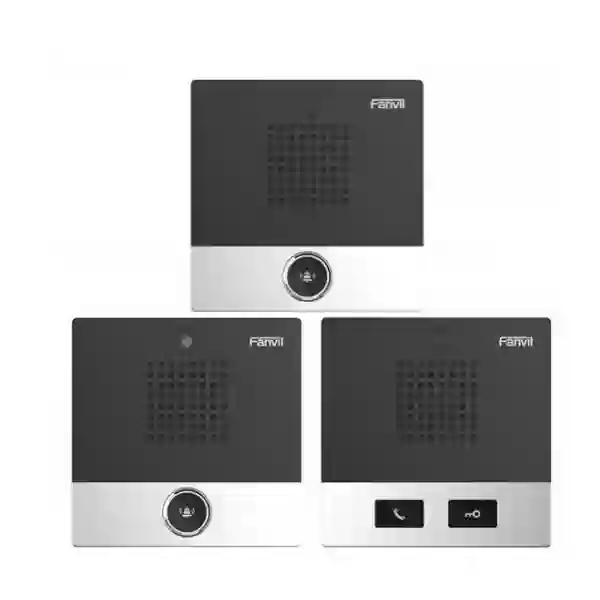
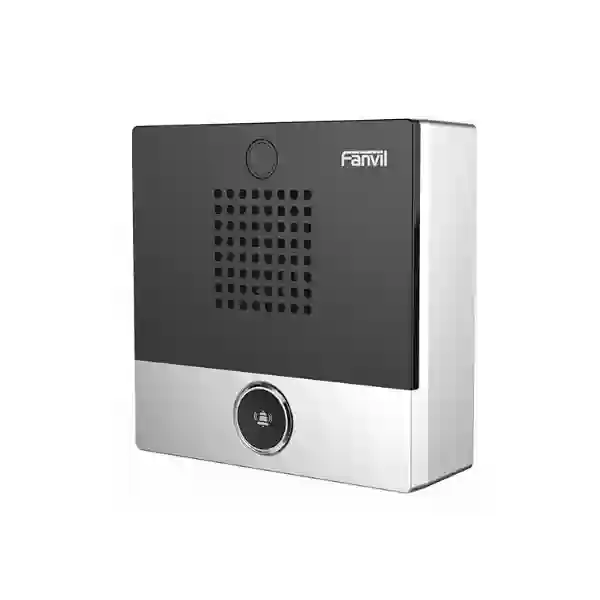
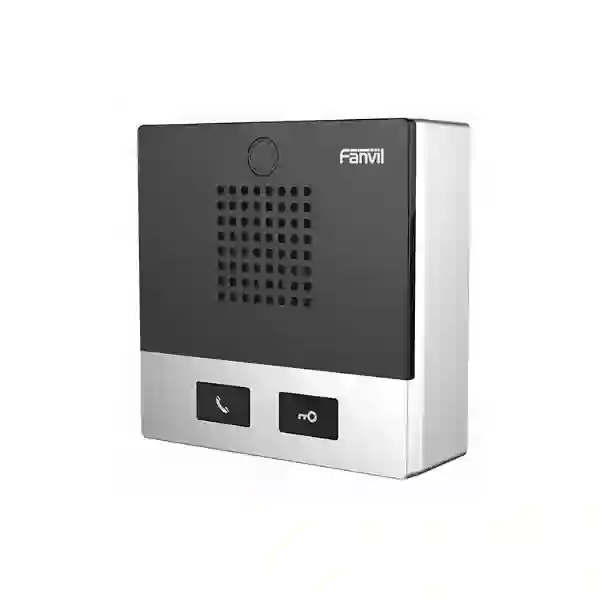
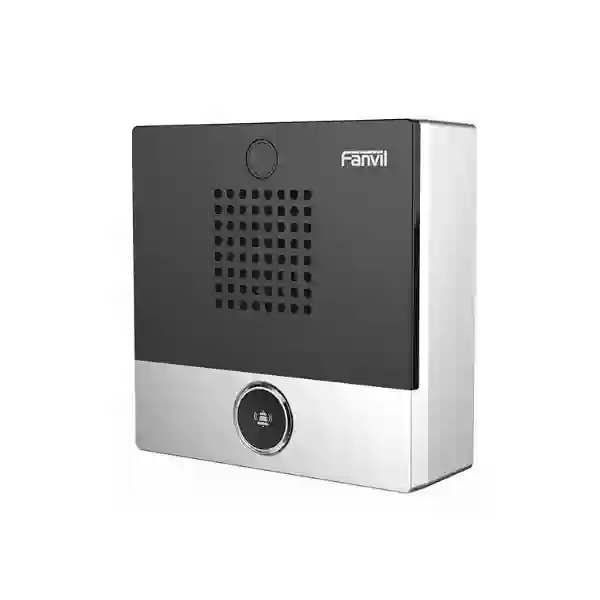
Fanvil i10SD SIP Intercom Tanzania
The Fanvil i10SD SIP Intercom is a compact network intercom for organisations that want a simple, controllable communication point connected to an IP telephony or access workflow. Within Fanvil’s i10S/i10SV/i10SD family, the i10SD is the audio model with two DSS keys rather than the single-key arrangement used on the i10S. The official Fanvil documentation identifies two SIP lines, adaptive 10/100 Mbps Ethernet, integrated Power over Ethernet, a built-in 1 W speaker, acoustic echo cancellation, a short-circuit input/output interface, wall mounting and IP54 protection. These features make the unit relevant for indoor reception, internal doorway, service-counter, warehouse, control-room and staff-assistance applications where a compact SIP endpoint is preferable to a desk phone.
For Tanzanian buyers, the practical purchasing question is not only whether the intercom can register to SIP. The site also needs appropriate switching, PoE capacity, addressing, VLAN and QoS planning, PBX compatibility, relay logic and a clear call destination. FourTeck Tanzania can help structure those requirements before quotation so the selected endpoint fits the network and the intended user workflow.
Choose the Fanvil i10SD when you need a small indoor SIP audio intercom with two programmable DSS keys, PoE, relay I/O and integration with a compatible SIP platform. Confirm PBX support, PoE budget, door-control wiring and call flow before deployment.
What the Fanvil i10SD is designed to do
The i10SD is part of Fanvil’s SIP intercom range and combines voice communication with programmable button control and external input/output connectivity. The official product data positions the family for security, intercom and broadcasting functions. For the i10SD specifically, the model matrix shows two buttons and no integrated camera. That distinction matters when choosing between models: organisations wanting a compact audio-only call point with two programmable actions can consider the i10SD, while a video requirement should be assessed against a camera-equipped alternative rather than assumed to be present on this model.
The unit supports two SIP lines and SIP 2.0 over UDP, TCP and TLS. Its audio capabilities include G.722 and Opus wideband codecs as well as common narrowband codecs, full-duplex hands-free operation and acoustic echo cancellation. Network functions documented by Fanvil include IPv4 and IPv6 operation, DHCP, static addressing, PPPoE, VLAN, LLDP, QoS, L2TP and OpenVPN. These functions give a network administrator useful options for fitting the intercom into an existing voice or security VLAN rather than treating it as an isolated device.
The built-in relay-style short-circuit input/output interface is particularly important for access workflows. It can be used as part of a wider door, alarm or control design when correctly engineered. Buyers should define the exact external device, electrical requirements and desired sequence before installation. The intercom itself is one component; locks, sensors, power supplies, exit devices and access-control policies may require separate equipment and professional planning.
Verified Fanvil i10SD features
Two programmable DSS keys
The i10SD has two DSS keys. They can support communication or programmable actions according to the deployed configuration, allowing a site to assign distinct functions such as call and unlock-related operations where appropriate.
PoE and Ethernet
An adaptive 10/100 Mbps Ethernet port with integrated PoE simplifies cabling by allowing network and power to be delivered over Ethernet when connected to a suitable PoE source. A 12 V DC input is also documented.
SIP and HD voice
Two SIP lines, G.722 and Opus wideband codecs, full-duplex hands-free audio and acoustic echo cancellation support clear intercom conversations when the network and acoustic environment are properly prepared.
IP54 protection
Fanvil specifies IP54 protection and an operating temperature range of -20°C to 50°C. The manufacturer positions the unit for indoor scenarios; environmental suitability should still be checked for the exact installation point.
Relay-style I/O
The product includes short-circuit input and output connectivity. This can support integration into a wider access or signalling workflow, provided external devices and electrical requirements are checked before connection.
Web-based management
Fanvil documentation includes web management, provisioning and firmware-management capabilities, which can make repeat deployments easier when configuration standards and access controls are defined centrally.
Technical planning and compatibility
A SIP intercom is most useful when its call flow is designed before installation. Decide which button calls which destination, whether the call should reach a reception extension, security desk, hunt group or another SIP endpoint, what should happen if the first destination is busy, and whether door release or another relay action is part of the workflow. Fanvil lists compatibility with major communications platforms including Asterisk, BroadSoft, 3CX, Metaswitch, Elastix and Avaya in its product documentation. Compatibility in a specific project should nevertheless be checked against the actual PBX version, licensing, SIP feature requirements and provisioning method.
Network preparation is equally important. The i10SD can use DHCP or static addressing, and supports VLAN and QoS capabilities. In a business network, placing voice and intercom endpoints on a defined VLAN can simplify policy and troubleshooting. QoS can help prioritise latency-sensitive voice traffic, but it must be configured consistently across switches, routers and WAN links to have practical effect. PoE switch sizing should include both port availability and total power budget. Where the intercom is part of a larger project, the switch may also power IP phones, cameras and wireless access points, so the cumulative PoE requirement matters.
Security configuration should include strong administrative credentials, restricted management access, appropriate firmware maintenance and careful firewall exposure. SIP TLS and SRTP support are documented by Fanvil, but secure operation depends on what the PBX and network support and how those features are configured. Avoid exposing device management directly to the public internet. For multi-site deployments, use controlled remote administration through approved network-security methods.
Use cases for the Fanvil i10SD SIP Intercom
The i10SD can fit environments where people need a dedicated, wall-mounted point to initiate or receive SIP communication without using a conventional desk handset. Reception vestibules, staff-only internal doors, warehouse service points, loading areas, security checkpoints, equipment rooms, help points and internal corridors are common examples of the type of workflow to evaluate. Because the model is audio only, it is especially relevant where voice communication and programmable actions are more important than integrated video.
For an office entrance, one button could be configured to call reception while the second supports another defined function depending on the access design. In a warehouse, the device could give staff a fixed point to contact a supervisor or control desk without carrying a handset. In a service environment, it can provide an assistance call point at a counter, gated internal area or controlled doorway. For emergency-oriented use cases, organisations should carefully assess whether the complete system meets the operational and regulatory requirements of that application; a general-purpose SIP intercom should not automatically be treated as a certified life-safety device.
Broadcast and multicast functions may also be useful in installations that combine point-to-point calling with announcements. This can be valuable when several endpoints need to receive a common audio message, although multicast design requires correct network configuration and should be tested across VLANs and routed segments before production use.
FourTeck Tanzania links for a complete deployment
A SIP intercom rarely works alone. Buyers can review the FourTeck Tanzania technology portfolio to understand how intercom, telephony, switching, security and access-control requirements fit together. The FourTeck Tanzania services page explains planning for IP PBX, IP phones, network switches and access control, all of which can be relevant to an i10SD project. Customers who are evaluating related hardware can browse the Tanzania technology shop, while organisations preparing a broader project can read the FourTeck Tanzania company overview for wider solution context.
For regional projects extending beyond Tanzania, the FourTeck Uganda site provides a related East African technology reference. These links are intended to help buyers connect the intercom requirement with switching, VoIP, access control and multi-site infrastructure rather than treating the endpoint as a standalone purchase.
Regional procurement and deployment guidance
Fanvil i10SD SIP Intercom Tanzania
For organisations sourcing the Fanvil i10SD SIP Intercom in Tanzania, the strongest starting point is to define the complete communication workflow rather than request the intercom as an isolated item. The i10SD uses SIP and Ethernet, so the final result depends on the PBX, switch, PoE power, IP addressing and the call destination configured behind each DSS key. A buyer should therefore identify whether the endpoint will call reception, security, a warehouse supervisor, a help desk, an internal hunt group or another destination. Where the short-circuit input/output is intended for access control, the door hardware and control logic should be documented before cabling is finalised.
Tanzanian businesses may deploy the device in offices, hospitality back-of-house areas, warehouses, campuses, medical administration areas, retail support points or controlled staff zones. Building layout matters. A wall-mount point near an entrance needs a convenient speaking height and a protected cable route. A warehouse location may need consideration of background noise, dust, heat and the distance between the user and the speaker. Fanvil specifies IP54 protection and a -20°C to 50°C working range, but its product positioning is for indoor scenarios; this should guide site selection.
For quotation preparation in Tanzania, include quantity, PBX platform, required button actions, PoE switch details, preferred VLAN, cable distance, mounting location and any relay-connected equipment. Where several intercoms are planned, describe the numbering scheme and whether each point needs a unique destination or a shared reception group. This level of detail helps separate the cost of the endpoint from the networking, switching, cabling, programming and access hardware that may also be required. It also reduces the risk of purchasing a compatible SIP intercom but discovering later that the network or door-control design needs additional components.
Fanvil i10SD SIP Intercom Dar es Salaam
In Dar es Salaam, the Fanvil i10SD can be evaluated for office complexes, logistics facilities, retail environments, service counters, hospitality back offices and controlled internal entrances that already use or plan to use IP telephony. The commercial value is strongest when the intercom becomes part of an existing SIP call flow. For example, a visitor or staff member can press a programmed key to reach a defined extension or group, while the second key can serve another communication or control action. Because the i10SD is not a video model, buyers who require visual identification should plan a separate camera or evaluate a camera-equipped intercom instead of expecting integrated video from this unit.
Dar es Salaam sites often combine many IP devices on the same network: phones, cameras, access points, computers and access-control components. The intercom should therefore be included in the switch and VLAN design. Confirm that the selected PoE switch has an available port and sufficient total PoE budget, and document whether voice/intercom traffic is separated from business data. The endpoint’s 10/100 Mbps interface is more than adequate for its audio use, but network quality, latency and configuration still determine call reliability. If calls traverse a WAN, VPN or hosted PBX, test the entire path.
Before requesting a Dar es Salaam quotation, provide the number of intercoms, floor or building locations, the SIP platform, expected call destinations, door or relay requirements, cabling status and whether configuration should be standardised across all units. For multi-floor buildings, also identify the network closet serving each device and whether PoE is available there. A structured specification makes it easier to compare proposals because buyers can distinguish hardware price from installation, network changes, PBX configuration and access-control integration.
Fanvil i10SD SIP Intercom Mwanza
For Mwanza businesses, the Fanvil i10SD offers a compact SIP endpoint for locations where a conventional telephone is inconvenient but fixed voice communication is useful. Warehouses, service entrances, internal security points, administration corridors and operational areas can benefit from a wall-mounted call station with two programmable keys. The design question should be what each key needs to accomplish. One may call a reception or guard extension, while the other can be assigned to a second destination or another supported function according to the system design.
Network readiness should be checked carefully in sites where cabling has grown over time. Verify cable quality, switch port condition, PoE availability, DHCP or static addressing policy and whether the existing PBX can register the endpoint. If the site has separate voice and data VLANs, the intercom should be placed deliberately rather than connected to whichever port is free. QoS settings can be useful if the LAN or WAN carries significant competing traffic. Where remote branches connect to a central PBX, confirm firewall and routing rules and test two-way audio before handover.
Mwanza procurement teams can improve quotation accuracy by listing the exact mounting points, distances to network closets and any requirement for external relay connections. The i10SD’s IP54 rating is useful for protection against dust and splashes, but manufacturer positioning remains indoor use, so exposed outdoor locations should be reviewed separately. If the goal includes visual verification at a gate or doorway, specify that requirement from the start because the i10SD itself has no camera. A clear functional specification avoids selecting an audio-only model for a project that later expects integrated video.
Fanvil i10SD SIP Intercom Arusha
Arusha organisations evaluating the Fanvil i10SD may be looking for a simple intercom endpoint that connects reception, security, guest-service or operational teams over the IP network. The two DSS keys are useful when the location needs more than a single call action. A hospitality property, for example, might assign one key to reception and another to a service or security desk, while a business facility might use separate destinations for visitor assistance and internal staff communication. Exact programming should reflect the PBX and site workflow.
For sites with multiple buildings or dispersed departments, the endpoint’s SIP nature can make it easier to integrate with an existing IP PBX rather than deploy an independent analogue intercom system. That advantage depends on network coverage between buildings, VLAN design and the reliability of the link to the PBX. If traffic crosses wireless bridges, fibre uplinks or VPN connections, test call quality during busy periods. Power planning should also include the PoE switch and UPS strategy if intercom service is expected to continue during short mains interruptions.
An Arusha quotation request should state whether the project is new or an upgrade, how many i10SD units are required, the PBX platform, whether PoE switching already exists, and what external device—if any—will connect to the short-circuit input/output. Include access-control hardware separately so the electrical and mechanical door requirements are not hidden inside an intercom line item. Where the environment is dusty or subject to temperature variation, compare the actual location with Fanvil’s IP54 and operating-temperature specifications before finalising the mounting point.
Fanvil i10SD SIP Intercom Dodoma
In Dodoma, the Fanvil i10SD can support organisations that need controlled voice communication at internal doors, reception points, offices, service areas or administrative facilities. Procurement should focus on operational fit. Determine who uses the device, what each of the two keys does, who answers the call and what happens if the first destination does not respond. A well-defined call flow can use PBX ring groups, forwarding or other SIP features to make the intercom useful throughout the working day instead of relying on one person being present.
The network team should verify PoE, VLAN and addressing before installation. The device supports both PoE and 12 V DC input, but a PoE design can simplify wall mounting by reducing local power requirements. In a government, education or enterprise environment with structured network segmentation, the i10SD should be documented as a managed endpoint with an IP address, switch port, PBX registration and firmware baseline. This documentation makes troubleshooting and future replacement more predictable.
For Dodoma purchasing teams, include installation scope in the request for quote rather than comparing only device price. Cabling, switch upgrades, PBX licenses or extensions, wall mounting, access-control relays, configuration, testing and user handover may all affect the full project. If the site is using the i10SD only as an audio call point, its compact form and two keys may fit well. If the requirement later expands to built-in camera identification, that should trigger a model review because the i10SD does not contain an integrated camera.
Fanvil i10SD SIP Intercom UAE
For UAE projects, the Fanvil i10SD can be considered when a business needs a compact SIP audio intercom at a reception vestibule, internal service point, office entrance, warehouse area or controlled staff location. Many UAE facilities already use managed PoE switching and IP PBX platforms, which can make integration straightforward when the endpoint is included in the voice-network design. The two DSS keys allow two programmable actions, but project teams should define those actions explicitly and confirm how they map to SIP calls or access workflows.
Large commercial sites may have centralised IT management and strict network policies. In such environments, the i10SD should receive an approved VLAN, IP addressing method and management policy. SIP TLS and SRTP capabilities may be relevant where the PBX supports them. Management access should be restricted to authorised networks, and firmware updates should follow the organisation’s change-control process. If the unit connects to door hardware, the access-control team should confirm relay ratings, lock power architecture and safe egress requirements independently of the SIP configuration.
Regional buyers can also review FourTeck UAE for broader IT and telecom solution context. When asking for a quotation, provide the exact quantity, site type, PBX vendor and version, network architecture, PoE availability, button functions and integration requirements. The i10SD is designed as an indoor IP54 intercom; projects involving exposed outdoor gates, harsh wash-down environments or a mandatory integrated camera should be assessed against other purpose-built devices rather than assuming one model covers every entrance scenario.
Fanvil i10SD SIP Intercom Uganda
Ugandan organisations can use the Fanvil i10SD as part of a SIP-based communication system where a fixed wall intercom is more practical than a desktop phone. Offices, schools, clinics, warehouses, hotels and operational facilities may have entrances or internal service points where a user needs to reach a known extension quickly. The two DSS keys can support two defined destinations or functions, giving more flexibility than a single-button call point while keeping the user interface simple.
A successful Uganda deployment depends on the network and PBX environment. The i10SD supports two SIP lines, 10/100 Ethernet, PoE, VLAN and QoS. If a site has a central PBX serving multiple branches, test the route between the intercom and PBX for latency, packet loss and firewall handling. If the endpoint sits on a local PBX, document its extension and button configuration so replacement or troubleshooting does not depend on one installer’s memory. Where power reliability is important, PoE switches and upstream network equipment can be placed on appropriate UPS protection according to the site’s continuity needs.
For a Uganda quotation, include quantity, locations, PBX details, existing switching, intended button actions and any door-control integration. Buyers can use the FourTeck Uganda technology site as a regional reference for related voice and network planning. If the requirement includes video identification, specify it explicitly because the i10SD is the two-button audio model, not the camera-equipped version in the Fanvil family.
Fanvil i10SD SIP Intercom Kampala
Kampala businesses with existing VoIP infrastructure can evaluate the Fanvil i10SD for fixed communication points at receptions, security areas, internal doors, stores, warehouses and staff service locations. Because the device registers as a SIP endpoint, the call handling can follow the organisation’s telephone-system logic rather than requiring a completely separate intercom exchange. This can simplify administration when the IT team already manages extensions, ring groups and call routing centrally.
The two DSS keys are most useful when their roles are simple and clearly labelled. A site might route one key to the main reception group and the second to security or another assistance destination. Where a relay output is used, the access function should be designed with the correct lock, power supply and safety considerations. The SIP system can provide communication, but physical access control remains an engineering task involving the door and its hardware.
Kampala procurement teams should ask vendors to separate device supply, network work, PBX configuration and door-control scope. This allows quotations to be compared more fairly. For multi-unit deployments, request a configuration standard covering naming, extensions, VLAN, credentials, firmware and button assignments. Consistency reduces support effort and helps new units be added without redesigning the system. The i10SD’s IP54 protection and wall-mount form are useful for many indoor settings, while more exposed or vandal-prone installations should be assessed against products with appropriate environmental and impact ratings.
Fanvil i10SD SIP Intercom Arua
For Arua sites, the Fanvil i10SD can provide a practical communication point in facilities where staff need a simple way to contact reception, security or another internal function. The unit’s wall-mount form avoids the need for a desk or handset, and PoE can reduce the need for a separate power outlet at the mounting point. This can be helpful in corridors, internal entrances, warehouse zones or service areas where the network cable is easier to route than local mains power.
Connectivity should be assessed before purchase, especially if the location is part of a branch linked to a PBX in another city. SIP traffic is sensitive to poor network quality, so branch links should be tested for stable latency and packet delivery. If the WAN is shared with backups, video or other high-volume services, QoS and bandwidth planning may help. The i10SD’s network features include VLAN and QoS support, but these features need matching configuration on the rest of the network to be effective.
An Arua quotation request should also specify whether the two buttons call different destinations and whether a relay connection is required. Cabling teams should know the exact mounting location and network-closet distance. Where access control is involved, identify the lock type, exit method and power arrangement separately. If the site needs visual identification of visitors, the i10SD should not be selected solely because it belongs to an audio/video intercom family; the i10SD itself is the audio two-button variant and has no built-in camera.
Fanvil i10SD SIP Intercom Mbarara
Mbarara organisations planning a SIP intercom system can consider the Fanvil i10SD where compact size, two programmable keys and PoE operation match the required workflow. Business sites often need communication at a location where installing a full desk phone would be awkward. A fixed wall intercom can provide an obvious, durable point for initiating a call, while the PBX decides where that call rings and how it is forwarded if the first destination is unavailable.
For installations across several buildings or departments, standardise the configuration. Use a consistent device-naming pattern, extension plan, VLAN, administrative policy and firmware process. This makes troubleshooting easier when users report that one intercom behaves differently from another. The i10SD supports web management and provisioning options, which can be useful where several units share common settings. The network team should also account for PoE load and switch capacity rather than assuming each wall point can be added without infrastructure changes.
Mbarara buyers should request a complete scope that identifies hardware, mounting, cabling, switch ports, PBX configuration, testing and any connected access-control components. Where the short-circuit output operates another device, confirm electrical compatibility and installation responsibility. The result should be documented with the final extension, IP address or reservation, switch port and button action so support staff know how the endpoint is meant to operate.
Fanvil i10SD SIP Intercom Gulu
In Gulu, the Fanvil i10SD can serve as a dedicated SIP call point for administration buildings, service facilities, warehouses, schools and other locations where staff or visitors need a simple way to reach a defined team. The two-button layout can support more than one destination while keeping the interface straightforward. Before installation, decide whether both keys are required for calls or whether one supports a control function, and label them according to the actual user workflow.
Network and power design are important for dependable service. PoE can simplify installation, but the upstream switch must have sufficient power budget and preferably suitable backup if continuity is important. If the intercom connects through a routed network or VPN to a central PBX, firewall rules and SIP handling need to be tested. Avoid assuming that registration alone proves the system is ready; test incoming and outgoing audio, DTMF if required, call transfer behaviour, ring groups and any relay action.
For Gulu procurement, give suppliers a site-by-site schedule showing quantity, location, cable availability, PBX destination and access-control dependencies. This is especially useful when devices are spread across multiple buildings. The i10SD’s IP54 enclosure supports many indoor conditions, but placement should avoid environments beyond the manufacturer’s stated use. If the project requires outdoor exposure or high impact resistance, compare alternative models designed for those conditions before finalising the bill of materials.
Fanvil i10SD SIP Intercom Kenya
Kenyan buyers evaluating the Fanvil i10SD often have the same core decision: whether they need an audio-only SIP intercom with two programmable buttons, or a different model with integrated video or stronger outdoor protection. The i10SD is compact, wall mounted and designed around SIP communication, PoE and programmable DSS keys. It can fit offices, warehouses, institutional buildings, hospitality operations and service environments where a fixed call point is needed.
For a Nairobi headquarters or a branch network elsewhere in Kenya, integration planning should begin with the PBX and switch. Confirm the supported SIP registration method, extension availability, call-routing behaviour, VLAN and PoE. If the organisation uses 3CX, Asterisk or another documented platform, compatibility should still be checked against the current deployed version and any specific features required. Where the intercom connects to an access-control system, document which component provides lock power, what signal the relay needs and how safe egress is maintained.
For regional project context, buyers can review FourTeck Kenya. A useful quotation request includes quantity, site list, PBX platform, network topology, PoE availability, button functions and installation scope. This lets procurement compare complete solutions rather than a single unit price that excludes configuration, cabling or access hardware.
Fanvil i10SD SIP Intercom Kuwait
For Kuwait businesses, the Fanvil i10SD is relevant where a compact indoor intercom needs to join an existing SIP telephony environment. Commercial buildings, warehouses, offices and service facilities may use it at internal doors, reception points or operational areas. The two DSS keys provide flexibility for distinct call or control functions, but the configuration should be designed around the actual staffing model and PBX call flow rather than left at generic defaults.
Environmental placement deserves attention. Fanvil specifies IP54 protection and a -20°C to 50°C working range while positioning the unit for indoor scenarios. Installers should therefore avoid assuming the device is appropriate for fully exposed exterior locations simply because it has an ingress-protection rating. For entrance projects that face outdoor heat, direct sun, wash-down or physical impact, evaluate a model designed explicitly for those conditions.
Kuwait procurement teams should confirm SIP platform compatibility, PoE switching, network segmentation and the role of the relay I/O. Where the intercom is used with a door system, the project scope should identify locks, power supplies, request-to-exit devices and any other control hardware. A complete quotation should also define configuration, testing and handover documentation so the customer receives a working endpoint rather than an unconfigured device.
Fanvil i10SD SIP Intercom Ghana
Ghanaian organisations can consider the Fanvil i10SD for indoor IP intercom points where voice communication, PoE and two programmable buttons are enough to meet the operational requirement. Typical scenarios include office reception access, internal warehouse doors, staff assistance points, security desks and service areas. The device’s SIP architecture allows it to become another managed endpoint on the voice network, which can simplify administration if the organisation already operates an IP PBX.
A project should document the relationship between the intercom and the rest of the network. The switch must provide an appropriate port and PoE capability if PoE is used. The PBX must provide the required SIP extension and call routing. Firewalls or routers must allow the necessary traffic if the PBX is remote. The security policy should control web-management access and administrative credentials. If the endpoint is part of a door-control workflow, the electrical design for the relay and lock hardware should be handled as a separate, explicit part of the solution.
For procurement in Accra or other Ghanaian locations, request a bill of materials that distinguishes the i10SD, switching, cabling, access components and professional services. This avoids comparing a bare endpoint price against a complete installed solution. Where multiple units are used, standardised provisioning can reduce setup time and simplify support. If visual identification is mandatory, choose a camera-capable intercom rather than assuming the i10SD provides video.
Fanvil i10SD SIP Intercom Nigeria
Nigerian businesses with IP telephony can use the Fanvil i10SD as a fixed communication endpoint in offices, estates, warehouses, campuses and service environments where users need a direct way to reach reception, security or another team. Its two DSS keys support a simple user interface with two configured actions. The absence of an integrated camera makes it best suited to projects where voice is sufficient or where video is provided separately by a CCTV camera.
Large sites should include the intercoms in the network design from the beginning. Count switch ports and PoE budget, assign VLANs, define IP addressing and decide how devices are monitored. Where branches connect to a central PBX, test the WAN and firewall path for reliable two-way audio. UPS planning can also matter because a PoE intercom depends on the switch and upstream network remaining powered. A resilient voice endpoint is only as resilient as the infrastructure behind it.
For Nigeria quotations, include quantity, building locations, call destinations, PBX type, access-control requirement and expected installation services. Procurement teams should ask for documentation of configuration and testing. Where a project includes many identical units, templates for provisioning and naming can make future maintenance easier. The goal is a supportable system with known configurations, not a collection of individually configured devices.
Fanvil i10SD SIP Intercom Seychelles
For Seychelles businesses, hotels, offices and operational facilities, the Fanvil i10SD can be considered where an indoor SIP audio call point is needed at a reception area, staff entrance, service corridor or controlled operational zone. The compact wall-mount design and PoE capability can reduce installation clutter, while two DSS keys can provide two clear functions for users. In hospitality environments, for example, a staff-only point could call a service desk and a security team without requiring a conventional handset.
Environmental conditions require careful thought in island locations. Although Fanvil specifies IP54 protection, the product is described for indoor scenarios. Salt-laden air, direct weather exposure or corrosive environments can be more demanding than ordinary indoor use. The installation point should therefore be protected and assessed realistically rather than selected only from the headline IP rating. For exposed gates or outdoor areas, a more rugged device may be appropriate.
For quotation purposes, specify whether the site uses a local or hosted PBX, how many intercom points are required, where PoE switches are located and whether the units must connect to door-control hardware. In multi-building hotel or resort environments, document the network path between each intercom and PBX and test voice quality across that path. Clear numbering, VLAN and configuration standards can make long-term support easier for distributed sites.
Installation and deployment checklist
Network
Confirm Ethernet cabling, switch port, PoE budget, VLAN, addressing, gateway, DNS and QoS policy. If the PBX is remote, test routing and firewall behaviour end to end.
PBX
Create the SIP extension or account, define button destinations, ring groups and fallback routing, then test calling in both directions where required.
Physical mounting
Choose an indoor wall position with practical speaking height, protected cabling and suitable access for installation and future maintenance.
Relay and access
Document the external device, voltage, current, lock power, exit requirements and expected relay behaviour. Do not treat the intercom as the complete door-control system.
Buying guidance: i10SD versus other intercom requirements
Choose the i10SD when the requirement is primarily an audio SIP intercom with two programmable keys in an indoor location. The two-button design is useful when users need two obvious actions without navigating a screen. PoE can simplify the physical installation, and the SIP interface makes the device a natural fit for organisations already using IP PBX systems. Its web management and provisioning capabilities are useful when several endpoints must be configured consistently.
Do not choose the i10SD when the requirement specifically calls for an integrated camera. Fanvil’s family includes variants with different capabilities, and the i10SD itself is the no-camera, two-button model. Similarly, do not assume that an IP54 rating makes it suitable for every outdoor or exposed installation. Environmental exposure, impact risk and local installation conditions should guide the product choice.
The correct product is the one that fits the call flow, environment, network and access-control design. A small change in the requirement—such as needing video, stronger vandal resistance, additional buttons or a different mounting method—can justify a different model. Buyers should therefore provide a functional specification rather than simply requesting “a Fanvil intercom” and expecting every product in the category to behave the same way.
Quotation checklist for Fanvil i10SD projects
A useful quotation should be based on the complete operating requirement. Provide the exact model name, quantity and installation locations; identify the PBX or SIP platform; state whether the site already has suitable PoE switching; and describe the two DSS-key functions. If a key or relay is intended to control a door or another external device, identify that device and the existing access hardware. Explain whether cabling is already installed and whether wall mounting, configuration and testing are required.
For multi-site projects, include a location schedule with the number of units at each branch, network connectivity between the branches and PBX, and the preferred numbering or naming scheme. This information allows a supplier or integrator to identify dependencies before pricing. It also helps procurement compare like with like, because one quotation may include only the intercom hardware while another includes network and configuration work.
Fanvil i10SD FAQ
Does the Fanvil i10SD have a camera?
No. Fanvil’s model matrix identifies the i10SD as the two-button model without an integrated camera. If built-in video is required, evaluate a camera-equipped intercom model.
How many SIP lines does the i10SD support?
Fanvil specifies two SIP lines for the i10S/i10SV/i10SD family. The final PBX configuration should match the project’s call-flow and account design.
Can the Fanvil i10SD use PoE?
Yes. Fanvil documents integrated PoE on its adaptive 10/100 Mbps Ethernet connection. Confirm that the switch supports the required PoE standard and has sufficient overall power budget.
Can the i10SD work with 3CX or Asterisk?
Fanvil lists compatibility with major platforms including 3CX and Asterisk. For a production project, confirm the exact PBX version, SIP settings and required features before deployment.
Is the i10SD suitable for outdoor gates?
Fanvil specifies IP54 protection but describes the product for indoor scenarios. Fully exposed outdoor gates, high-impact environments or harsh weather should be evaluated against a more rugged device designed for those conditions.
What should I provide to request a quotation?
Provide quantity, installation locations, PBX platform, PoE switch availability, button functions, cabling status, relay or door-control requirements and whether configuration, installation and testing are required.
Decision recap
The Fanvil i10SD is a strong fit when the project needs a compact indoor SIP audio intercom with two programmable DSS keys, PoE, two SIP lines, HD-audio codec support, web management, network features such as VLAN and QoS, and short-circuit input/output connectivity. Its wall-mount form can suit entrances, service points and operational areas where a traditional telephone is inconvenient.
The main reasons to choose a different product are equally clear: the i10SD has no integrated camera, and its indoor/IP54 positioning may not match highly exposed or impact-prone outdoor locations. Define the site, call flow, PBX, network and access-control requirement first, then confirm that the model matches those needs.
Consultation panel: prepare the right Fanvil i10SD solution
When contacting FourTeck Tanzania, include the business outcome rather than only the product model. State where the i10SD will be mounted, who presses each key, which extension or group answers, whether PoE is available, which PBX is in use and whether the relay interfaces with a door or another control device. For multiple sites, add a simple schedule showing quantities and network connectivity.
This information helps determine whether the i10SD alone is sufficient or whether the project also needs switching, cabling, PBX configuration, access-control hardware or another intercom model. It also creates a clearer basis for procurement and testing.




Reviews
There are no reviews yet.