
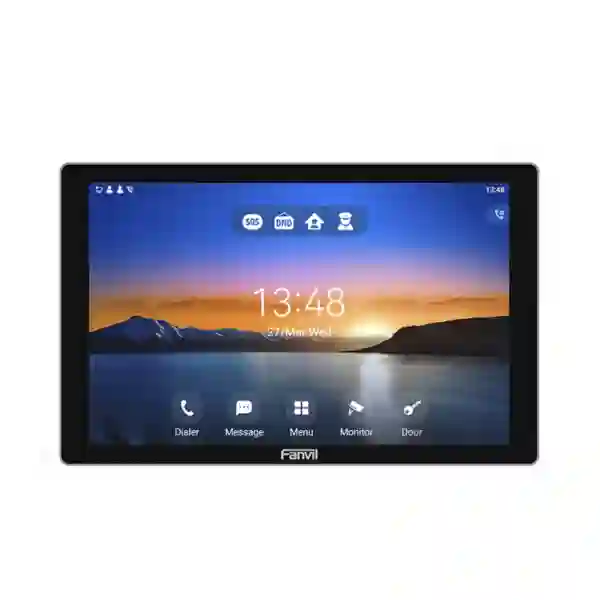
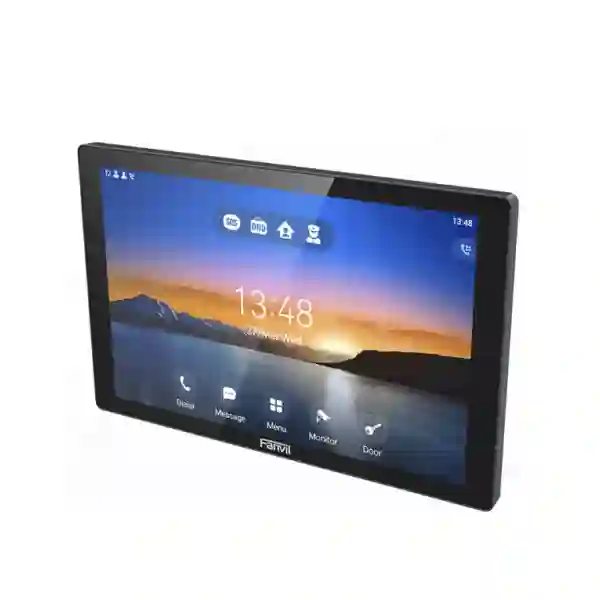
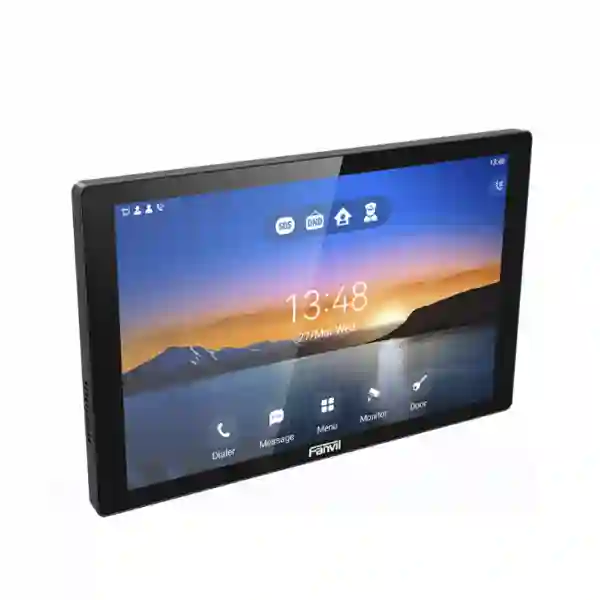
Fanvil i507W Android Indoor Station
The Fanvil i507W is a 10.1-inch Android 9.0 indoor station designed for modern SIP intercom and building-security environments. It combines a large 1280×800 capacitive IPS touchscreen, dual-band Wi-Fi, wired Ethernet, PoE or DC power, full-duplex hands-free audio, remote door control, compatible camera viewing and multiple alarm interfaces in a wall-mounted endpoint. For Tanzania projects, it can form the user-facing indoor control point in apartments, villas, residential communities, offices and mixed-use properties where visitor calls, entrance communication and security events need to be handled from one clear interface.
Quick answer
Choose the i507W when a project needs a large Android-based SIP indoor monitor with Wi-Fi flexibility, PoE support, third-party application potential, camera viewing and alarm inputs. Confirm the exact door phone, SIP server, lock interface, sensor wiring, network design and application requirements before ordering so the station is integrated as part of the complete access and intercom system.
What the Fanvil i507W is designed to do
Fanvil positions the i507W as a large-screen indoor station for users who need to receive calls from an entrance device, speak with visitors, view compatible video and remotely unlock an entrance. Its Android 9.0 platform also creates room for third-party applications and secondary development where a project requires a customized interface or integration workflow. This is important because an indoor station is often more than a video doorbell screen: it can become the touchpoint through which residents, reception teams or office users interact with an IP intercom and connected security devices.
The 10.1-inch 1280×800 IPS capacitive touchscreen provides significantly more visual space than compact indoor monitors. For projects involving camera viewing, on-screen directories, visitor identification or application controls, screen size can improve usability. The station includes a 2W speaker and acoustic echo cancellation for full-duplex hands-free communication. It can view compatible third-party IP-camera feeds and access-control cameras, while its physical interfaces provide eight alarm inputs, a short-circuit output, a doorbell input and a reserved RS485 interface. These interfaces allow the i507W to participate in a wider security design rather than operate as an isolated display.
10.1-inch IPS touch display
A 1280×800 capacitive color touchscreen provides a large interface for calls, visitor video, settings and compatible applications.
Android 9.0 platform
Android supports application customization and secondary development, subject to the requirements and compatibility of the project.
Dual-band Wi-Fi
Built-in 2.4 GHz and 5 GHz Wi-Fi gives installers a wireless connectivity option alongside 10/100 Mbps Ethernet.
PoE or 12V DC
IEEE 802.3af PoE can simplify power and data cabling, while 12V/1A DC offers an alternative power method.
SIP intercom functions
SIP 2.0 over UDP, TCP or TLS supports standards-based integration for compatible intercom and voice environments.
Security I/O
Eight alarm inputs plus doorbell and output interfaces support connected sensors, signaling and compatible entrance-control functions.
Verified Fanvil i507W technical specifications
| Item | Specification |
|---|---|
| Display | 10.1-inch IPS capacitive color touchscreen, 1280×800 |
| Operating system | Android 9.0 |
| Wi-Fi | 2.4 GHz / 5 GHz |
| Ethernet | 10/100 Mbps adaptive |
| Power | IEEE 802.3af PoE or DC 12V/1A |
| Speaker | Built-in 2W speaker with acoustic echo cancellation |
| Interfaces | 8 alarm inputs, 1 short-circuit output, 1 doorbell input, reserved RS485 |
| SIP | SIP 2.0 over UDP/TCP/TLS |
| Audio codecs | G.711A/U, G.729AB, iLBC, G.722, OPUS |
| Video | Hardware video decoding with supported resolutions up to 1080p depending on compatible stream and configuration |
| Installation | Wall-mounted |
| Dimensions | 247.96 × 156.96 × 25.6 mm |
| Operating range | -10°C to 50°C; 10%–90% working humidity |
Specifications should be checked against the current Fanvil datasheet and firmware documentation at procurement time. Features involving third-party devices depend on the exact SIP platform, camera protocol, door controller, lock circuit, application and project configuration.
Integration, deployment and buying guidance
A successful i507W deployment starts with the entrance workflow. Define which door station will call the indoor monitor, how many indoor stations are required, whether calls also route to reception or mobile users, which party is authorized to unlock the door and what should happen when nobody answers. Because the i507W is SIP based, it may be registered to a compatible SIP environment, but registration alone does not prove every intercom feature will behave identically across all platforms. Video, door-unlock signaling, directory behavior, secure SIP, camera viewing and event integration should be tested against the selected devices and software.
Network planning is equally important. The station provides 10/100 Mbps Ethernet and dual-band Wi-Fi. Wired PoE is often attractive for fixed wall-mounted endpoints because one network cable can carry both data and power when connected to an appropriate 802.3af PoE switch. Wi-Fi can be useful where cable access is difficult, but signal quality, roaming, interference, VLAN design and power availability still need attention. Security endpoints should not automatically share an unrestricted flat network with every user device. Where appropriate, administrators can place intercom, camera and access-control devices into managed segments and apply firewall policies that allow only required traffic.
For broader Tanzania infrastructure planning, FourTeck’s business technology overview explains how voice, cameras, Wi-Fi, switching and access control can be designed together, while the FourTeck Tanzania technology shop provides adjacent product categories for complete bills of materials. Projects needing configuration, cabling and lifecycle support can also review FourTeck Tanzania services. Multi-country organizations can coordinate related requirements through FourTeck Kenya and FourTeck Uganda.
Where the i507W fits best
The i507W is especially relevant for residential communities, apartment developments, villas, office buildings and managed properties where a wall-mounted indoor screen should combine visitor calling with door control and security awareness. It can also fit reception or security-desk workflows where a large touchscreen is preferred. The Android platform makes the model interesting for projects requiring selected third-party applications or custom development, but the application should be tested on the intended firmware rather than assuming that every Android application designed for a consumer tablet will operate correctly on an embedded indoor station.
Regional buying and deployment guidance
The following regional sections focus on practical procurement and deployment questions rather than claiming unverified local stock, offices, delivery times or authorization status.
Fanvil i507W Android Indoor Station Tanzania
Organizations evaluating the Fanvil i507W Android Indoor Station in Tanzania should begin by defining the complete entrance and security workflow, not only the indoor monitor. The i507W is most useful when it has a clear role: answering calls from a compatible door station, showing visitor video, enabling authorized remote unlocking, displaying compatible camera streams and receiving signals from connected alarm devices. In apartment, villa, office and mixed-use projects, procurement teams should identify how many entrances and indoor endpoints are required, whether each apartment or office receives one monitor, and whether a central reception or security position will also participate in the call flow.
Tanzania projects can benefit from the device’s two network options. Ethernet with IEEE 802.3af PoE is attractive where structured cabling and managed switching are available because power and data can travel over the same cable. This can simplify wall installations and make it easier to protect communications equipment through a UPS-backed PoE switch. Dual-band Wi-Fi can help in retrofit areas where running new data cable is difficult, but the installer should still confirm signal strength at the final wall position, channel congestion, wireless security and the location of the DC power source. A fixed security endpoint should not depend on marginal wireless coverage.
Before requesting a Tanzania quotation, provide the quantity, building type, door-station model, SIP or PBX platform, number of entrances, lock type, sensor requirements, network switch model, cabling status and preferred power method. If camera viewing is required, list the camera models and streams that need to be displayed. If Android application integration is part of the project, describe the software, login method, network dependencies and user workflow so compatibility can be validated before a rollout. This requirement-led approach produces a more accurate bill of materials and reduces installation surprises.
Fanvil i507W Android Indoor Station Dar es Salaam
Dar es Salaam deployments may range from office towers and gated residences to hospitality properties, apartment compounds and commercial buildings. In these environments, the i507W’s large 10.1-inch display can be useful where users need to identify visitors quickly and operate door controls from a clear interface. For multi-unit projects, the design should establish a consistent numbering and naming scheme for apartments, offices, entrance panels and indoor stations. This becomes especially important when security staff, reception and residents all participate in different parts of the same call-routing logic.
Dense urban buildings can also contain many shared IP services: CCTV, office data, Wi-Fi, access control, telephony and cloud applications. The indoor station should therefore be included in VLAN, PoE and IP-address planning rather than connected as an afterthought. The i507W uses 10/100 Mbps Ethernet, which is more than adequate for its intended signaling and video-intercom role when the surrounding network is correctly designed, but uplink congestion elsewhere in the building can still affect real-time traffic. Managed switching, documented ports and sensible traffic separation improve troubleshooting when a large property has many connected devices.
For procurement in Dar es Salaam, decide whether the project is new construction or retrofit. New builds can reserve wall positions, network outlets, PoE switching, lock wiring, door contacts and cable routes in advance. Retrofit projects may need more careful investigation of existing conduits, Wi-Fi coverage and power points. The quotation should separate the indoor station from dependencies such as entrance panels, electric locks, exit buttons, sensors, switches, UPS units and installation materials. This gives the buyer a transparent view of what is required for a functioning system instead of treating the i507W as a standalone screen.
Fanvil i507W Android Indoor Station Mwanza
For Mwanza organizations and property projects, the Fanvil i507W can provide a modern indoor interface where SIP intercom, visitor verification and controlled entry need to meet at one wall-mounted device. The first buying question is whether the project requires only communication with an entrance or a broader integration that includes alarms, camera feeds and third-party applications. The i507W supports both approaches, but a simple intercom installation and an integrated building-security deployment have very different design, configuration and testing requirements.
Sites with distributed buildings or several entry points should map the call path carefully. A visitor at one entrance may need to reach a specific office, apartment or security desk, while another entrance has a different access policy. SIP addressing, device naming and door-unlock permissions should reflect these real operational rules. If the station is connected to sensors through its alarm inputs, document what each input represents and what notification or response is expected. Clear labels and diagrams reduce support time months after installation when the original installer may not be present.
Power continuity deserves particular attention for any security system. The i507W can be powered by PoE or 12V DC. A PoE design can centralize power at a managed switch, making it practical to place the switch and related network equipment on a suitably sized UPS. A DC design may be appropriate where local power is readily available. Whichever method is chosen, the door lock, controller and other system elements may have separate power requirements. Buyers in Mwanza should therefore request a complete power and network diagram with the quotation, confirm cable distances and identify which devices must remain operational during short power interruptions.
Fanvil i507W Android Indoor Station Arusha
Arusha properties evaluating the Fanvil i507W may include offices, hospitality environments, villas, compounds and facilities where visitor management needs to feel professional without making reception processes complicated. The 10.1-inch capacitive touchscreen provides a familiar visual experience for users, while the Android 9.0 platform allows selected applications or customization when a project requires more than the standard indoor-station interface. Application requirements should be defined early, because the supportability of a customized Android workflow depends on the application, firmware, security permissions and maintenance process.
Hospitality or managed-property deployments should also consider user turnover. A private residence may have a small, consistent user group, whereas a serviced property or office reception may be operated by different staff across shifts. In the latter case, the interface, contact directory and door-control rules should be kept simple. User training should explain how to answer a visitor call, distinguish known cameras, unlock the correct entrance, respond to alarm indications and report faults. Good documentation can be more valuable than adding features that users do not understand.
When preparing an Arusha bill of materials, include mounting, network connectivity and security peripherals. Confirm whether the final position has Ethernet, PoE, Wi-Fi coverage or local DC power. List any sensors expected to use the eight alarm inputs and any equipment connected to the output interface. If third-party IP cameras will be viewed, provide their manufacturer and stream details for compatibility checks. The project should also define who manages firmware updates, SIP credentials and network access after handover. These operational details determine whether an indoor station remains manageable over its lifecycle rather than becoming an undocumented isolated appliance.
Fanvil i507W Android Indoor Station Dodoma
In Dodoma, the Fanvil i507W can be considered for government-related offices, professional workplaces, residential developments, institutional buildings and other controlled-entry environments where a touchscreen indoor station is preferable to a basic audio handset. Its role should be matched to the building’s actual visitor process. A facility with a staffed reception has different needs from an apartment where the resident answers the entrance directly. The SIP design can route calls accordingly, but those call flows need to be agreed and documented before devices are provisioned.
Security policy matters as much as hardware. Remote door unlocking should be available only to users who are expected to make that decision. If the station displays video from entrance cameras or third-party IP cameras, access to those views should align with the organization’s privacy and security rules. The i507W supports SIP over TLS as part of its protocol capability, but encrypted signaling is useful only when the complete SIP platform, certificates and network configuration are designed consistently. Buyers should ask how credentials, firmware and administrator access will be managed after installation.
A practical Dodoma quotation request should identify the desired number of i507W units, door phones, access points, PoE switch ports, locks, sensors and UPS-backed devices. For larger projects, a sample or pilot installation can validate screen placement, call quality, video behavior, door release and application integration before the same configuration is repeated across many rooms or buildings. Standardizing naming, IP addressing and configuration templates can make future expansion easier. The objective is to purchase an integrated visitor and entrance solution with clearly defined responsibilities, rather than simply purchasing indoor screens without the surrounding system plan.
Fanvil i507W Android Indoor Station UAE
UAE buyers evaluating the Fanvil i507W often work in environments where residential towers, villas, offices, hotels and mixed-use developments already have structured networks, access-control systems and CCTV platforms. In such projects, the i507W should be assessed for interoperability with the existing door-station and SIP environment rather than selected only because it has a large touchscreen. The model’s Android 9.0 platform, dual-band Wi-Fi, PoE and alarm interfaces create integration flexibility, but every third-party relationship should be validated against the actual system in use.
High-density projects can involve hundreds of indoor endpoints, so provisioning and documentation become major operational issues. A deployment plan should define device naming, apartment or office mapping, SIP credentials, firmware baseline, VLANs, PoE switch capacity, door-unlock permissions and support procedures. Installers should avoid creating unique undocumented settings for each endpoint. Instead, a tested template can be adapted where necessary while preserving a common baseline. This simplifies troubleshooting and replacement later.
For procurement, distinguish clearly between the monitor and the complete entrance solution. The indoor station needs compatible door endpoints, lock-control logic and network services. Alarm sensors, door contacts, electric locks and exit buttons may each require separate wiring and power. If the i507W will run a custom or third-party Android application, include that software in the acceptance test. Verify startup behavior after power loss, login persistence, permissions, screen orientation, network recovery and firmware-update impact. Organizations operating both UAE and East African sites may also benefit from using consistent design documents and product-selection principles across locations while allowing each building to retain the appropriate local network and security configuration.
Fanvil i507W Android Indoor Station Uganda
Uganda projects considering the Fanvil i507W can use it as the indoor user interface in SIP-based entrance systems for residences, office buildings and managed properties. The large screen is useful where visitor video and simple touch controls are important, while dual-band Wi-Fi and PoE create options for both retrofit and structured-cabling installations. The best connectivity method should be decided by site conditions. Wired PoE is generally easier to document and centrally protect, whereas Wi-Fi can reduce new cabling work but requires reliable coverage and local power.
If the building already has IP cameras or access-control devices, do not assume automatic compatibility because every product uses an IP network. Camera codecs, stream authentication, SIP implementations and door-control signaling differ among vendors. The i507W supports viewing compatible third-party cameras and uses SIP 2.0, yet project testing is still important when systems from several manufacturers are combined. A small proof-of-concept can validate real visitor calls, video, audio, unlock behavior and recovery after network interruption before the configuration is replicated.
Uganda procurement teams should prepare a requirement sheet covering number of doors, number of indoor monitors, door-station models, expected camera views, alarm sensors, power method, network topology and any software integrations. If the project covers several branches or properties, standardize the configuration and documentation format. This makes it easier to support the system from Kampala or another central IT function. The quotation should also identify what is included in configuration, mounting, cabling and commissioning, because those services may be separate from hardware supply. A clear scope protects both the buyer and installer from assumptions that surface only during installation.
Fanvil i507W Android Indoor Station Kampala
Kampala offices, apartment properties, gated residences and hospitality environments can use the Fanvil i507W where a modern indoor monitor must handle visitor calls and connected entrance functions. The 10.1-inch screen is particularly useful at reception or in premium residential settings where the user benefits from a larger image and touch targets. Before selecting quantities, planners should decide whether every unit needs the same functions. Some sites may use the station only for entrance calls, while others need camera monitoring, alarm inputs or Android applications.
In buildings with busy data networks, intercom traffic should be designed deliberately. The indoor station can connect by Ethernet or Wi-Fi, but real-time call performance still depends on switching, wireless coverage and congestion. Managed VLANs can help separate building-security devices from guest or general office traffic. Where PoE is used, calculate switch power budgets for all connected endpoints rather than only counting ports. The i507W is an 802.3af device, and the switch should have sufficient total budget after other phones, cameras and access points are included.
Kampala buyers should also define who owns ongoing administration. Someone needs access to SIP credentials, device configuration, firmware records and network documentation. When staff change or the building adds another door station, the system should be expandable without rediscovering every setting. A useful procurement package therefore includes a device schedule, IP plan, door mapping and commissioning checklist. For multi-site companies, these records make it easier to repeat the design at another office while adjusting quantities to the new building. Hardware selection is only one part of creating a dependable visitor-management system.
Fanvil i507W Android Indoor Station Arua
Arua buyers evaluating the Fanvil i507W should pay particular attention to maintainability and the dependencies required for a complete deployment. A wall-mounted indoor monitor can continue to be useful for many years only when the network, power, door hardware and configuration are clearly documented. The i507W provides both Wi-Fi and Ethernet connectivity, so the installer can choose a method that fits the building. If Ethernet cabling is practical, PoE can reduce the need for a local adapter and make centralized UPS protection easier.
For sites where technical support may not be permanently on location, remote diagnosability is valuable. Device names should identify their building, floor or room rather than use generic labels. SIP accounts and IP addresses should be recorded securely, and switch ports should be documented. If a sensor is connected to one of the eight alarm inputs, its purpose should be labeled at both the device and documentation level. These practices make later troubleshooting much faster when a call, alarm or door event behaves unexpectedly.
The quotation request should describe the use case in plain operational language: who approaches the door, which indoor user receives the call, what video should be seen, who can unlock the entrance, which sensors matter and what happens when the primary user does not answer. From that workflow, the installer can map the required SIP and access-control components. If an Android application is required, verify it on the actual station before standardizing the design. This is especially important for projects where internet connectivity is intermittent, because a cloud-dependent application may behave differently from the local SIP intercom functions.
Fanvil i507W Android Indoor Station Mbarara
Mbarara organizations can consider the Fanvil i507W for offices, residences, hospitality facilities and institutional properties that want an indoor station with a large color touchscreen instead of a compact intercom display. The device’s value comes from combining voice, video, door-control and alarm-related functions through one endpoint. However, the surrounding system must be designed to support those functions. A compatible entrance station, SIP configuration and lock-control method are essential for the visitor workflow, while camera and sensor integrations add their own requirements.
When a property has both new and existing buildings, the network method can differ by area. New sections may use Ethernet and PoE, while a carefully surveyed Wi-Fi connection may be more realistic in a retrofit room. The key is consistency in configuration and clear documentation of exceptions. Wireless endpoints should be tested at the exact installation height and location, not only near the access point during setup. Wired endpoints should use tested cabling and managed switch ports, especially when the same switch also powers cameras and access points.
A Mbarara purchasing checklist should include device quantity, wall locations, cable route, available PoE budget, DC power if required, door station, lock type, sensor list, camera models and any software integrations. Buyers should ask for commissioning tests that simulate a real visitor call, two-way conversation, video display, unlock request, alarm input and restart after power interruption. A successful test provides confidence that the complete workflow is functioning. It also creates a useful baseline for support if a future firmware or network change affects behavior.
Fanvil i507W Android Indoor Station Gulu
In Gulu, the i507W can support controlled-entry projects where staff, residents or security personnel need a fixed screen for visitor communication. Its 10.1-inch display and full-duplex audio are well suited to a wall-mounted interaction point, while the Android platform offers additional flexibility for selected applications. The decision to use Android features should be driven by a defined operational requirement. If standard SIP intercom functions already meet the need, adding unnecessary applications can increase administration without improving the visitor experience.
For branch and institutional deployments, consider how the system will be supported remotely. Assign consistent device names and document the firmware version, SIP server, network address and physical location. Use configuration backups where the platform allows, and maintain a record of any non-default setting needed for door control or cameras. The i507W’s Wi-Fi capability can make installation flexible, but network resilience remains critical. For fixed security endpoints, stable Ethernet may be preferred where cabling is practical; Wi-Fi is best used after a proper coverage check.
Gulu procurement should also account for accessories and infrastructure. A complete system may require PoE switching, UPS capacity, entrance hardware, locks, door contacts, sensors, structured cabling and installation materials. The indoor station is one component in that design. Ask the supplier or integrator to state which functions are included in commissioning and which third-party systems have been tested. Where a project will expand later, reserve switch ports, address space and logical naming for additional stations. This small amount of planning can make future extensions far easier than rebuilding an undocumented system.
Fanvil i507W Android Indoor Station Kenya
Kenya has an active market for SIP intercom and IP communications equipment, and the Fanvil i507W is relevant to buyers seeking a 10.1-inch Android indoor monitor for apartments, villas, offices and managed properties. Procurement teams should compare the device on its actual capabilities rather than only headline price. The IPS touchscreen, Android 9.0 platform, dual-band Wi-Fi, 10/100 Ethernet, 802.3af PoE, alarm inputs and camera-viewing functions create a broad integration profile, but the surrounding door and security ecosystem determines whether those features deliver value.
For Nairobi and other dense commercial environments, a managed network is important when intercom traffic shares infrastructure with CCTV, office data and Wi-Fi. PoE can centralize power for wall-mounted stations, and network segmentation can limit unnecessary communication between building devices and user endpoints. For residential developments, project teams should create a clear apartment-to-device database so replacement and support remain straightforward after handover. The larger the deployment, the more important repeatable configuration becomes.
A Kenya quotation request should include the number of indoor stations, compatible entrance panels, locks, sensors and switch ports. Buyers should also specify whether they expect supply only or a complete configured solution. If third-party Android applications are required, list them at the beginning of the project and perform a functional test before buying for every unit. Organizations operating in both Kenya and Tanzania can benefit from maintaining a common device naming convention and commissioning checklist across sites, while still adapting network ranges, access permissions and local building conditions. This supports regional IT teams that need consistent documentation without assuming every building is identical.
Fanvil i507W Android Indoor Station Kuwait
Kuwait buyers may consider the Fanvil i507W for villas, apartment properties, offices and commercial environments where indoor video intercom needs to combine a generous touchscreen with IP-based integration. As with any security endpoint, installation conditions matter. The published operating range is -10°C to 50°C, but the i507W is an indoor station and should be installed in a suitable interior environment. Door-side outdoor equipment should be selected separately for the exposure and environmental requirements at the entrance.
Structured buildings can make good use of PoE because the indoor station can connect to a centralized switch without a separate local power adapter. In larger properties, document PoE budgets and rack locations before ordering. The station’s dual-band Wi-Fi is useful as an alternative, but permanent wireless installations should be validated for signal quality and security. For multi-floor apartment projects, consistent VLANs, SIP addressing and apartment mapping reduce troubleshooting complexity. The entrance call should always reach the intended user and unlock only the intended door.
When asking for a Kuwait quotation, describe any existing intercom, PBX, camera and access-control platforms. A retrofit into a mixed-vendor system requires more compatibility testing than a new design using a prevalidated set of components. If camera viewing is expected, identify each stream. If a custom application will run on Android 9.0, include the application provider in testing and support planning. A project acceptance checklist should verify calling, audio, video, door release, sensor inputs, network recovery and user permissions. These tests create a clear handover standard and reduce uncertainty after installation.
Fanvil i507W Android Indoor Station Ghana
Ghana organizations looking for the Fanvil i507W can use it as an indoor SIP intercom endpoint in residential and commercial security designs. It offers a combination that is attractive for modern properties: a 10.1-inch 1280×800 touchscreen, Android 9.0, dual-band Wi-Fi, Ethernet, PoE, remote door control, compatible camera viewing and alarm inputs. The key purchasing decision is whether the wider building system can use these capabilities in a controlled and supportable way.
For office and residential networks, consider separating building-security endpoints logically from guest devices and unmanaged personal equipment. Intercom calls are real-time communications, so they should not depend on a congested or poorly maintained LAN. Where the building uses PoE, calculate total switch power across phones, cameras, wireless access points and indoor stations. UPS protection for switches may help preserve local intercom availability during brief power events, although locks and door controllers can have their own independent power needs.
A Ghana request for quotation should include the desired user experience. State whether residents or staff need only to answer and unlock, whether they must monitor multiple cameras, whether alarm sensors connect locally and whether a third-party Android app is part of the workflow. List any existing SIP server and entrance devices so the integrator can check compatibility. For larger estates, create a commissioning plan that tests a representative set of apartments or offices before mass deployment. A standardized profile makes future replacement easier and provides a clear baseline when network or firmware changes are introduced.
Fanvil i507W Android Indoor Station Nigeria
Nigeria projects can use the Fanvil i507W in villas, estates, apartment buildings, offices and managed commercial properties that require a large-screen indoor SIP station. In multi-unit developments, scalability is a central concern. The project should define how entrance stations call individual units, how directories are maintained, which doors each user may unlock and whether security or reception acts as a secondary destination. These decisions should be implemented in a repeatable configuration rather than managed ad hoc on each device.
Power planning is also important. The i507W supports IEEE 802.3af PoE and 12V DC, giving designers flexibility. Centralized PoE can simplify individual wall locations and consolidate backup power at the network rack. However, the complete access system includes more than the indoor station: electric locks, control boards, door contacts and other devices may need separate protected power. The quotation should therefore include a system power plan, not merely the wattage of the monitor.
For network security, use strong administrator credentials, controlled management access and an update process. SIP over TLS capability can be considered where the complete voice/intercom environment supports it. If third-party cameras or Android applications are integrated, treat them as separate compatibility items and verify them before mass rollout. A Nigerian buyer comparing quotations should ask each vendor to state exactly which functions have been tested, what configuration is included, what infrastructure is assumed and how future firmware updates will be handled. A cheaper hardware-only offer is not directly comparable with an integrated and commissioned system unless the scope is normalized.
Fanvil i507W Android Indoor Station Seychelles
Seychelles projects may involve villas, boutique hospitality properties, offices and managed residential environments where the indoor station needs to blend into a modern interior while providing practical security functions. The Fanvil i507W’s slim wall-mounted format and 10.1-inch touchscreen can suit these settings, while SIP and IP connectivity allow it to become part of a wider networked access design. The installer should still prioritize stable local operation over feature complexity, especially where a property relies on remote technical support.
A well-documented system is particularly valuable for island or distributed properties. Record the station’s physical location, network connection, SIP identity, door association, firmware level and any alarm-input wiring. If Wi-Fi is selected, test the final installation position and consider how access-point maintenance affects the intercom. Where Ethernet is available, PoE can provide a clean installation and centralized power strategy. Network switches, routers and UPS equipment should be sized according to the complete property infrastructure rather than the indoor station alone.
Seychelles buyers should also think about replacement and support logistics before standardizing on a model. Keeping configuration backups, documenting dependencies and using consistent naming can reduce restoration time if a unit is replaced. If the Android platform is used for a third-party app, retain the application version and credentials in the system documentation. A final acceptance test should include real entrance calls, two-way audio, video, authorized door release, camera display if used and recovery after a network restart. This creates a practical handover record for property managers and support teams.
Quotation checklist for Fanvil i507W projects
Fanvil i507W frequently asked questions
What is the Fanvil i507W?
The i507W is a 10.1-inch Android 9.0 SIP indoor station designed for entrance communication, visitor video, compatible camera monitoring, remote door unlocking and security-sensor integration in residential and commercial environments.
Does the Fanvil i507W support Wi-Fi?
Yes. Fanvil specifies built-in 2.4 GHz and 5 GHz Wi-Fi. The station also provides 10/100 Mbps Ethernet, so installers can choose wired or wireless network connectivity according to the site design.
Can the i507W be powered by PoE?
Yes. It supports IEEE 802.3af PoE as well as 12V/1A DC power. PoE can simplify a fixed installation when an appropriate PoE switch and cabling are available.
Can the i507W show third-party camera video?
Fanvil states that the i507W supports viewing video from third-party IP cameras and access-control cameras. Exact camera compatibility, authentication and stream behavior should be checked with the specific camera model and configuration.
Does Android 9.0 mean any Android app will work?
No assumption should be made that every consumer Android app will work. Fanvil supports third-party application integration and secondary development, but each required application should be tested for compatibility, permissions, screen behavior and firmware interaction.
How many alarm inputs does the i507W have?
The published specification lists eight alarm inputs, along with a short-circuit output, a doorbell input and a reserved RS485 interface. The exact sensors and control devices should be checked for electrical and system compatibility.
Is the Fanvil i507W an outdoor door phone?
No. The i507W is an indoor station. It is normally paired with a compatible entrance or door station that is selected for the conditions at the door.
What should I provide for a quotation?
Provide quantity, building type, entrance-device models, SIP platform, number of doors, network method, PoE availability, locks, sensors, camera requirements and any Android application integration. This allows the quotation to cover dependencies rather than only the indoor station.
Decision recap
The Fanvil i507W is a strong fit when a project needs a large 10.1-inch Android indoor station with SIP intercom, dual-band Wi-Fi, PoE, hands-free audio, remote door unlocking, compatible camera viewing and alarm interfaces. Its value is highest when it is selected as part of a planned access and visitor-communication architecture rather than purchased in isolation.
Before buying, verify the entrance device, SIP platform, network, lock-control method, sensors, camera streams and any Android applications. For multi-unit or multi-site deployments, pilot the configuration, document the working baseline and standardize the commissioning process.
Consultation panel
For a useful Fanvil i507W quotation, send FourTeck the number of indoor stations, building or project type, door phone model, SIP/PBX details, switch and PoE information, locks, sensors, cameras and any application-integration requirements. A requirement-led quotation makes it easier to identify the complete bill of materials and avoid missing dependencies during installation.



Reviews
There are no reviews yet.