
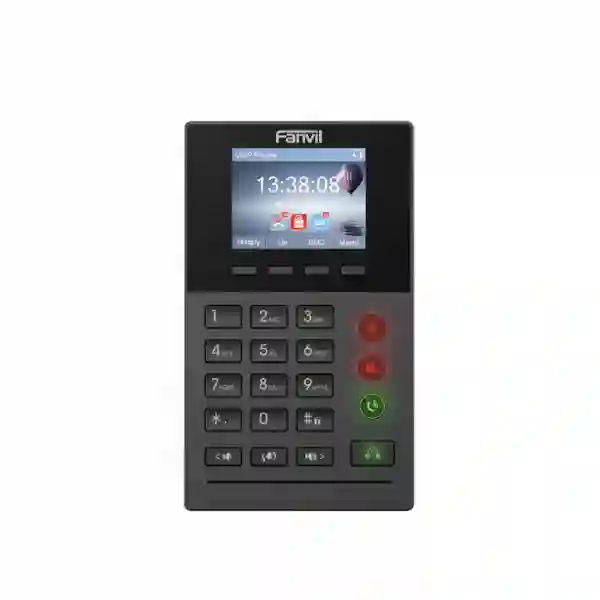
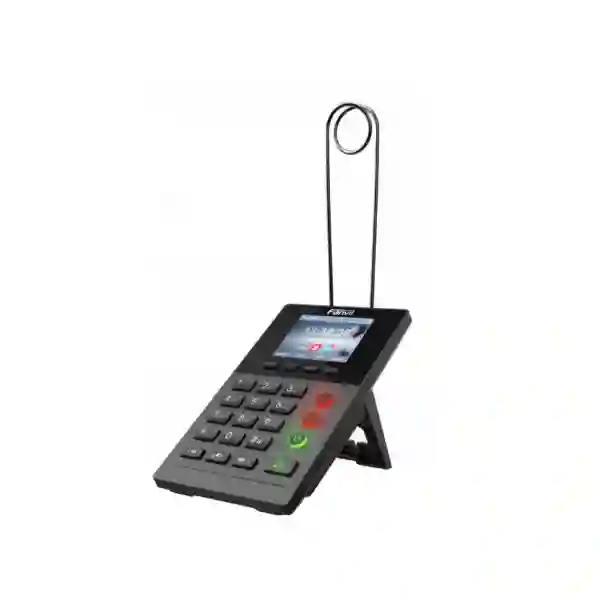
Fanvil X2P Call Center Phone
The Fanvil X2P is designed for agents and teams that spend a large part of the working day handling voice calls. It combines two SIP lines, a 2.8-inch 320×240 color LCD, HD voice, dual 10/100 Mbps Ethernet, integrated PoE, dedicated headset connectivity and EHS support in a compact call-center-oriented form factor. For organizations planning new contact-center seats or replacing basic desk phones, the X2P provides a practical endpoint when the surrounding PBX, network, power and headset environment are prepared correctly.
FourTeck Tanzania can help buyers evaluate how the phone will fit with SIP platforms, PoE switching, voice VLANs, Quality of Service, headset standards, provisioning methods and branch-office requirements before deployment. Product availability, current lifecycle status and final interoperability should be confirmed for the exact project at quotation stage.
For two registered SIP accounts/lines
320×240 display
Integrated on X2P
Wideband G.722 support
Wireless headset control support
Dual network ports
What the Fanvil X2P is designed to solve
A call-center endpoint has a different job from a general executive desk phone. Agents may answer, hold, transfer, mute, resume and redirect calls repeatedly across a shift, often while wearing a headset. That workflow puts more emphasis on clear call controls, headset usability, predictable SIP behavior and manageable deployment than on premium desktop features that may not improve agent productivity. The Fanvil X2P is positioned specifically for this kind of call-handling role. Its physical controls include illuminated functions for actions such as mute, hold, forwarding and headset use, while its headset interfaces make it practical for environments where the handset is not the primary audio device.
The phone supports two SIP lines and three-way conferencing, together with common call functions including hold, transfer, call waiting, caller ID, forwarding, do-not-disturb, auto-answer, hot line and hot desking. Many of these functions depend on PBX or service-provider support, so they should be validated against the intended call platform. This is especially important for contact centers that use queues, agent logins, reporting, recording, wallboards or CRM integrations: the endpoint can participate in the workflow, but the PBX or contact-center application usually provides the broader business logic.
For customers comparing Fanvil X2P options in Tanzania, the central buying question should therefore be whether the phone matches the call platform, headset, network and agent process. A good deployment specification should define SIP server details, VLAN strategy, PoE availability, headset type, provisioning method, call features that must work, user count, spare-unit policy and support expectations before the order is finalized.
Headset-first operation
RJ9 and 3.5 mm headset ports, plus EHS support, make the X2P suitable for agents who need consistent hands-free operation. The exact headset and EHS cable combination should be validated before bulk purchase.
PoE-ready desk deployment
Integrated PoE can simplify cabling by allowing a compatible PoE switch to carry power and network connectivity to the phone. Switch PoE capacity and UPS strategy should be checked for the total number of seats.
HD voice capability
The X2P supports wideband G.722 audio along with common narrowband codecs. End-to-end audio quality still depends on the PBX, trunk, LAN, WAN, headset and remote party.
Secure voice transport options
Fanvil lists SRTP, HTTPS and TLS support, together with VLAN and QoS functions. Security and segmentation should be configured as part of the voice design rather than treated as automatic defaults.
Fanvil X2P verified specifications
| Area | Verified X2P detail | Why it matters |
|---|---|---|
| SIP lines | 2 | Supports two SIP line registrations/accounts for business calling workflows. |
| Display | 2.8-inch, 320×240 color screen | Provides visible call and phone information at the agent position. |
| Ethernet | Dual 10/100 Mbps ports | Suitable for standard voice endpoint connectivity; LAN design should account for endpoint and downstream device requirements. |
| Power | PoE integrated; optional external power is documented | Allows centralized PoE deployment where compatible switches are available. |
| Headset | RJ9, 3.5 mm, EHS support | Supports typical contact-center headset workflows, subject to headset/cable compatibility. |
| Audio | HD voice; G.722 wideband plus common narrowband codecs | Enables wideband audio when the rest of the call path also supports it. |
| Conference | 3-way local conference | Useful for quick multi-party discussions without changing endpoint. |
| Directory | Local phonebook up to 500 entries; XML/LDAP remote phonebook support | Can support centralized or local contact access depending on deployment. |
| Network/security functions | SRTP, HTTPS, TLS, VLAN, QoS | Supports encrypted voice/signaling and voice-network segmentation when correctly configured. |
Deployment planning for call-center seats
Deploying a group of X2P phones is easier when the endpoint project is treated as part of the voice network rather than as a simple hardware purchase. Start by confirming the SIP platform and every feature agents actually need. A basic outbound team may require extension registration, caller ID, transfer, mute and headset operation. A customer-service environment may additionally depend on queue membership, hot desking, call recording, wrap-up states, supervisor monitoring or CRM screen-pop functions supplied by the PBX or contact-center platform. These application features should be tested with the intended endpoint before a large rollout.
Next, review switching. Each PoE-powered phone consumes part of a switch’s total PoE budget, and the access layer must have enough ports for the number of desks. Voice VLANs can separate phones from general user traffic, while QoS can prioritize real-time voice where congestion is possible. If a PC is daisy-chained through a phone, verify that the available 10/100 Mbps interface meets the workstation’s network needs; users handling high-volume file transfers or applications that expect Gigabit connectivity may be better served by separate network connections or a different endpoint design.
Power resilience matters in busy support teams. PoE switches protected by a correctly sized UPS can keep multiple phones powered during short interruptions, but continuity also depends on the PBX, firewall, router and internet/SIP trunk path. A redundant WAN link does not automatically protect calls unless failover behavior and SIP routing are engineered for it. For this reason, business continuity discussions should include the whole call path.
Finally, standardize provisioning and user handover. Define extension naming, firmware policy, time settings, VLAN settings, server addresses, security credentials, directory integration, headset model and spare-unit procedure. A documented build reduces seat-to-seat differences, shortens troubleshooting and makes expansion more predictable.
Related FourTeck voice and infrastructure resources
Regional procurement and deployment guidance
Fanvil X2P Call Center Phone Tanzania
Organizations searching for the Fanvil X2P Call Center Phone in Tanzania are often planning more than a single desk-phone purchase. A contact center, reservations team, collections unit, service desk, dispatch operation or internal help desk can involve tens or hundreds of endpoints connected to one PBX and dependent on consistent network behavior. The X2P’s two SIP lines, PoE support, 2.8-inch color display and headset-focused design make it relevant to these environments, but the phone should be selected as part of a complete voice architecture. Before procurement, the project team should document the number of agents, peak concurrent calls, SIP platform, call queues, call recording requirements, headset preference, supervisor functions, extension plan and expected growth.
Network readiness is particularly important for Tanzania deployments that combine voice with normal office data, cloud applications, video meetings and other IP systems. A managed switch environment can place phones on a dedicated voice VLAN and apply QoS policies so voice traffic remains predictable when other users are busy. If PoE is used, the switch must have sufficient power budget for the entire phone estate. Where business continuity is critical, UPS protection should cover the switching, routing, firewall and PBX components as well as the phones. WAN resilience also deserves attention because a hosted PBX or SIP trunk depends on connectivity beyond the local network.
Headset selection should be part of the quotation rather than an afterthought. The X2P provides RJ9 and 3.5 mm headset ports and supports EHS, but wireless-headset operation can depend on the correct vendor cable or adapter. A sample seat should therefore be tested before a broad rollout. The same pilot can validate transfer behavior, hold, mute, directory access, call recording, queue login or other PBX-specific functions. For buyers comparing Fanvil X2P pricing in Tanzania, a useful quotation should clearly separate phones, headsets, PoE switching if required, PBX licensing or SIP services, configuration, installation and post-deployment support rather than presenting one unexplained total.
FourTeck’s broader Tanzania portfolio includes IP PBX, IP phones, switching, cabling, firewalls and support services, which allows the endpoint discussion to be connected to the rest of the environment. Buyers can use the FourTeck Tanzania contact page to request a project-specific quotation and confirm current availability before ordering.
Fanvil X2P Call Center Phone Dar es Salaam
For businesses in Dar es Salaam, the Fanvil X2P can be considered for customer-care floors, travel and reservation teams, financial-service desks, logistics operators, outsourced support centers, hotel booking departments and corporate service desks. In a city environment where voice teams may rely on hosted applications, SIP trunks and multiple internet services, endpoint selection should be linked to the network and service design. The X2P itself supports VLAN and QoS features, but those capabilities provide value only when the access switches and upstream network are configured consistently.
A Dar es Salaam project should begin with seat planning. Determine whether every agent needs two SIP lines, whether users hot-desk, whether supervisors use a different phone model, and whether PCs share cabling with phones. Because the X2P’s Ethernet interfaces are 10/100 Mbps, it is worth checking how workstation traffic is connected. In some layouts the phone can sit on a dedicated voice port while the PC uses a separate Gigabit connection; in other layouts a shared path may be adequate. The correct decision depends on application bandwidth and cabling availability.
Call quality should be validated at the busiest period rather than only during installation. Packet loss, jitter, overloaded WAN circuits or poorly designed Wi-Fi backhaul can affect voice even when the handset is functioning correctly. For cloud PBX deployments, the firewall and ISP path should be reviewed for SIP behavior, NAT handling and failover. For on-premises systems, PBX capacity, trunks and server resilience should be assessed. PoE switching can simplify agent desks, while UPS-backed infrastructure can help maintain service through short utility interruptions if the wider communications path remains operational.
Procurement teams in Dar es Salaam should request a bill of materials that identifies the X2P units, compatible headsets, any EHS accessories, PoE or external power requirements, configuration scope and support assumptions. A short pilot with representative users can expose headset-comfort issues, queue-workflow differences or PBX feature gaps before hundreds of seats are committed. This structured approach turns the phone purchase into a manageable rollout rather than a collection of individually configured devices.
Fanvil X2P Call Center Phone Mwanza
Businesses in Mwanza evaluating the Fanvil X2P may include distribution companies, healthcare administration teams, education providers, hospitality operations, transport businesses and organizations coordinating customers across the Lake Zone. The operational requirement may be smaller than a large metropolitan contact center, but the same engineering principles apply. A group of ten or twenty agents can still experience serious disruption if all phones depend on one unprotected switch, an unstable internet path or inconsistent extension configuration.
The X2P provides a focused call-center feature set: two SIP lines, HD voice, a color display, dedicated call-control functions, headset interfaces and PoE. These features are useful when staff handle repeated inbound or outbound calls, but they should be mapped to the actual PBX workflow. For example, a service desk may rely on transfer and directory access, while a reservations team may need queue participation and recording controlled by the server. Some organizations may also use hot desking, which the phone supports, but server-side configuration remains important.
When WAN connectivity is a concern, buyers should distinguish between endpoint capability and service resilience. Adding a second internet link can improve availability, but voice failover may still require firewall policies, route monitoring, PBX configuration and SIP-provider support. If the PBX is local, branch connectivity requirements may differ. A project should document the expected call path and identify where redundancy is most valuable. Power design should likewise cover switches, router/firewall, PBX and any modem or optical-network equipment required for service.
For Mwanza procurement, it is useful to create a standardized seat kit containing one X2P, approved headset, patch lead and user configuration profile. Spare phones can then be preconfigured or documented for faster replacement. If teams expand gradually, using consistent extension naming, VLAN settings and firmware policy avoids configuration drift. The quotation should specify what is included and what must be supplied by the customer, so that installation does not stall because of missing PoE ports, unsuitable cabling or incompatible headset accessories.
Fanvil X2P Call Center Phone Arusha
In Arusha, the Fanvil X2P may be relevant to tour operators, hotels, reservation centers, NGOs, education organizations, customer-service teams and multi-branch businesses that rely on rapid telephone response. For these users, the quality of the agent experience can directly affect booking conversion, customer satisfaction or operational coordination. A headset-oriented endpoint can reduce repeated handset handling and keep the operator focused on the application screen, while illuminated call-control keys make common actions easier to identify.
A good Arusha deployment plan should connect the endpoint to the application’s workflow. If a tour operator uses a cloud CRM and hosted PBX, internet stability and LAN design are central. If a hotel reservation desk uses an on-premises IP PBX, trunk capacity and PBX resilience may be more important. The X2P can register two SIP lines and supports common call functions, but the underlying platform determines features such as queue reporting, recording retention, IVR routing and CRM integration. Those functions should be demonstrated before the phone estate is standardized.
Headsets deserve particular attention in long-shift environments. Compatibility is only one part of the decision; comfort, microphone noise rejection, hygiene policy and replaceable consumables can affect long-term user acceptance. The X2P’s RJ9, 3.5 mm and EHS options give procurement teams flexibility, but a known-good headset combination should be defined. Wireless EHS deployments should be tested with the exact cable or accessory needed for call answering and termination.
Network teams should confirm whether phones receive power from PoE switches and whether those switches have sufficient budget and UPS protection. VLANs can isolate voice traffic and simplify policy, while QoS can help when WAN links are shared with cloud backup, video meetings or guest traffic. For distributed tourism or hospitality operations, branch numbering, centralized directories and remote provisioning may reduce management overhead. A quotation should therefore cover both the devices and the technical work required to make them repeatable across sites.
Fanvil X2P Call Center Phone Dodoma
Organizations in Dodoma considering the Fanvil X2P may include administrative departments, education institutions, service organizations, regulated businesses, support desks and contractors operating multi-site projects. These buyers often need predictable communications, straightforward endpoint management and clear procurement documentation. The X2P’s two SIP lines, HD voice, PoE and headset-focused controls provide a practical basis for agent seats, but the procurement specification should define all associated dependencies instead of listing only the phone model.
For formal purchasing processes, technical acceptance criteria can include successful SIP registration, transfer and hold behavior, directory access, headset answer/end-call operation where EHS is used, voice VLAN assignment, NTP/time display, firmware version, provisioning method and test calls through the intended trunk. Documenting these checks helps separate product supply from a complete commissioned deployment. It also gives project stakeholders a common definition of when a seat is considered ready for use.
Dodoma sites should also plan for supportability. If an agent phone fails, can another unit be swapped without manually rebuilding every setting? Central provisioning or a documented configuration template can answer that problem. If power is interrupted, are the PoE switches and voice core on UPS? If the primary WAN fails, does the hosted PBX remain reachable over an alternate link? These questions are more valuable than choosing a phone based only on purchase price because they determine actual operational continuity.
Procurement teams can also separate mandatory from optional accessories. A wired headset may be sufficient for fixed agents, while supervisors who move around a team floor might require wireless EHS-compatible headsets. External power adapters may be useful where PoE is unavailable, but centralized PoE can create a cleaner desk layout and easier power resilience. By documenting seat types, network ports, power method and headset choice, Dodoma organizations can build a quotation that is easier to compare and a deployment that is easier to maintain.
Fanvil X2P Call Center Phone UAE
UAE buyers evaluating the Fanvil X2P typically operate in a mature VoIP environment with a wide choice of hosted PBX, SIP trunks and on-premises communication platforms. The X2P’s core value remains its call-center-focused design: two SIP lines, a compact color screen, HD voice, PoE and multiple headset interfaces. The endpoint can be attractive for large agent populations where consistency matters more than executive features, but buyers should still validate the exact PBX release, provisioning method and headset package before standardizing.
In multi-site UAE organizations, centralized provisioning and directory services can be especially useful. Fanvil documents XML/LDAP remote phonebook support and standard voice-management functions. A common configuration template can assign servers, VLANs, codecs, time settings and security parameters, while site-specific values such as extension ranges are applied separately. This approach reduces manual handling and helps support teams replace units more quickly.
Security should be incorporated into design. TLS can protect SIP signaling, SRTP can protect media, and HTTPS can protect management traffic when supported end to end, but certificates, server support and policy still need correct implementation. Voice VLANs can separate phones from normal user devices, while firewall rules can restrict management or signaling paths. These measures are more meaningful than enabling isolated settings without an architecture.
For businesses coordinating UAE and East African branches, keeping a common endpoint standard can simplify training and spare management. However, SIP providers, number plans and local connectivity differ by country, so each site should still be validated independently. Regional teams can use the FourTeck network to coordinate broader requirements while ensuring procurement documents clearly identify the exact country, quantity, accessories, PBX platform and service scope.
Fanvil X2P Call Center Phone Uganda
Uganda organizations searching for the Fanvil X2P may be planning customer-care operations, shared service desks, collections teams, reservations or help desks across Kampala and regional sites. A two-line call-center phone with PoE and strong headset support can fit these scenarios, but the endpoint should be matched to the network and PBX environment. Before ordering, buyers should list the call features agents use daily and test them against the actual platform rather than assuming every SIP feature behaves identically across systems.
For hosted PBX deployments, internet stability, firewall configuration and WAN failover deserve attention. The phone itself does not create redundancy if the PBX path is unavailable. For on-premises systems, trunk capacity, PBX licensing and server resilience become important. In both cases, voice VLANs and QoS can help manage shared LAN and WAN resources. PoE switching can simplify desk installation and, when combined with UPS-protected network equipment, can improve continuity during short power events.
Headset choice can significantly affect agent experience. The X2P supports RJ9 and 3.5 mm headsets and EHS functions, so projects can choose wired or compatible wireless approaches. Before bulk purchase, test microphone level, sidetone, answer/end-call behavior and comfort with representative users. This is particularly valuable for teams that spend most of a shift on calls.
Organizations managing both Tanzania and Uganda can benefit from consistent endpoint templates and naming conventions while keeping country-specific trunks and numbering separate. A cross-border bill of materials should distinguish hardware, local connectivity, PBX licenses, headsets, installation and support. This makes comparisons clearer and avoids assuming that the same service conditions apply in every location.
Fanvil X2P Call Center Phone Kampala
Kampala businesses with concentrated agent teams can use the Fanvil X2P as part of a structured contact-center or service-desk design. High-density offices often place many phones, PCs and applications on the same access network, so voice traffic should be planned alongside general data. The X2P supports VLAN and QoS functions, but switches must also be configured so those policies are consistent. Monitoring during busy hours can reveal whether congestion, packet loss or jitter is affecting calls.
At the desk, PoE reduces the need for separate power adapters where suitable switches are installed. A large floor should calculate the switch’s total PoE budget for all endpoints rather than counting only available ports. It is also worth checking UPS runtime for access switches and the communications core. A phone powered during an outage is useful only when the PBX and WAN path are also available.
Kampala contact-center managers should identify whether agents require hot desking, queue logins, server recording or directories. The X2P supports hot desking and remote phonebooks, while recording can be handled through server-side capabilities depending on the platform. These functions should be tested with production-equivalent settings because implementation details differ across PBX systems. A pilot desk can also confirm headset integration and user acceptance.
For procurement, separate the per-seat endpoint bundle from shared infrastructure. The endpoint bundle may contain the X2P and approved headset; shared costs may include PoE switches, PBX licenses, SIP trunk channels, configuration and support. This structure helps decision-makers understand whether the project cost is driven by handsets or by the broader communications platform and makes future expansion easier to budget.
Fanvil X2P Call Center Phone Arua
In Arua, call-center or service-desk deployments may be smaller and more distributed, which makes simplicity and supportability important. The Fanvil X2P can provide a standardized SIP endpoint for teams that spend significant time handling calls. Its two SIP lines, PoE support, HD voice and headset connectivity are relevant features, but buyers should pay equal attention to the supporting network and the availability of suitable voice services for the site.
A practical Arua deployment plan should identify the primary SIP/PBX path and what happens when connectivity is degraded. If the PBX is hosted elsewhere, the WAN link becomes part of the phone system. If an alternate link is available, routing and SIP behavior should be tested rather than assumed. If the PBX is local, local extension calling may continue during WAN disruption, but external calling still depends on the trunk design. Understanding these scenarios helps the customer choose the right resilience level.
Where on-site technical resources are limited, standardized configuration can reduce support visits. Phones can be prepared with consistent settings for firmware, time, codecs, VLANs, provisioning and directories, while an inventory record associates each unit with its extension and user. Spare units can be held with documented setup instructions. Headsets should also be standardized to one or two tested models so replacements do not require a new compatibility investigation.
For purchasing, customers should ask whether the quote includes only hardware or also configuration, PBX work, headsets and network changes. A low endpoint price can be misleading if the site later requires new PoE switches, cabling or PBX licenses. Clear scope at the beginning creates a more reliable deployment budget and allows the X2P to be evaluated as one component of an operational voice service.
Fanvil X2P Call Center Phone Mbarara
Mbarara organizations may use the Fanvil X2P for retail support, healthcare administration, education, logistics, sales teams or branch service desks. The phone is most relevant where users need a dependable SIP endpoint and spend substantial time on a headset. The two SIP lines can support multiple registrations or line use cases, while the 2.8-inch color screen presents call information without adding the cost and complexity of a large enterprise display.
For branch deployments, central IT teams should decide whether configuration is managed locally or from a head office. Remote provisioning can make it easier to standardize firmware and settings, but secure management practices remain important. Management interfaces should not be exposed unnecessarily, credentials should be controlled, and HTTPS/TLS options should be used where supported by the surrounding environment. Voice VLANs can also reduce accidental access between phones and user devices.
Power and network stability should be designed for the business impact of an outage. A few phones may be powered by adapters, but PoE often provides cleaner centralized control for a larger seat count. If PoE is selected, the switch and UPS become shared points of dependence. The PBX, firewall and router should therefore be included in resilience planning. Call quality testing should use real traffic conditions, not an empty network.
For procurement teams, a seat-by-seat schedule can identify user name, extension, headset type and location. This simple document helps installers prepare phones consistently and gives support teams a reference after handover. It also allows future expansion in Mbarara or other Ugandan cities to follow the same standard without redesigning the endpoint configuration every time.
Fanvil X2P Call Center Phone Gulu
Gulu businesses and institutions looking at the Fanvil X2P should evaluate the phone in terms of operating continuity, ease of support and compatibility with the chosen SIP service. In a call-handling role, an endpoint is valuable only when users can consistently log in, hear clearly, transfer calls and access the right numbers. The X2P supports common call functions and a call-center-focused control layout, but the PBX must deliver the application features required by the organization.
A useful pilot can include several realistic scenarios: an inbound call through the main number, transfer to another extension, hold and resume, outbound dialing, voicemail access, three-way conference, headset answer/end-call, and any queue or hot-desk workflow required by the team. Testing these scenarios helps the buyer separate confirmed functionality from assumptions. It also allows users to provide feedback before the endpoint becomes a standard.
For network preparation, check Ethernet ports, PoE capacity, VLAN configuration and WAN performance. The X2P’s 10/100 Mbps interfaces are sufficient for voice, but any shared PC topology should be reviewed for the workstation’s data needs. If the organization’s computers require higher throughput, dedicated data connections may be preferable. This is a design choice rather than a defect, and it should be decided before desks are cabled.
Gulu procurement can also benefit from defined spares and support escalation. A preconfigured spare phone can replace a failed unit quickly, while a documented configuration backup can shorten troubleshooting. Quotes should state whether configuration, user training and support are included. Clear scope helps organizations compare suppliers on the complete outcome rather than only the price of the handset.
Fanvil X2P Call Center Phone Kenya
Kenya has a broad market for BPO, customer service, finance, logistics, hospitality and technology support, all of which can generate demand for standardized call-center endpoints. The Fanvil X2P fits a cost-conscious agent-seat profile with two SIP lines, HD voice, PoE and dedicated headset interfaces. Buyers should compare that profile with their actual requirements; teams needing Gigabit pass-through, integrated Bluetooth or Wi-Fi may choose a different endpoint, while fixed call-center desks can prioritize reliable wired voice and headset operation.
Large deployments should be standardized through templates. The template can define SIP server addresses, security settings, codecs, VLAN IDs, time zone, directory sources and programmable functions. User-specific extension credentials are then applied through the provisioning system. This structure makes rollout faster and gives support teams a repeatable baseline when troubleshooting.
Because many Kenyan organizations operate multiple branches, WAN design can be as important as endpoint choice. A central PBX serving branch phones needs stable site-to-site connectivity or internet paths, while hosted PBX services depend on local ISP performance at each site. QoS can prioritize voice, but it cannot create bandwidth that is not available. Monitoring and realistic capacity planning remain important.
Organizations coordinating Kenya and Tanzania can use a common Fanvil endpoint standard where the PBX and operational requirements align, while keeping numbering, trunks and local service arrangements separate. A regional procurement document should list each country, seat count, headset type, PBX platform and implementation scope. The FourTeck Kenya regional site can support wider coordination for Kenya-based technology requirements.
Fanvil X2P Call Center Phone Kuwait
Kuwait organizations may evaluate the Fanvil X2P for customer-care teams, service desks, appointment centers, reservations, retail support and back-office telephony. The phone provides a focused agent feature set without adding wireless connectivity or premium executive controls. This can make it useful for fixed desks where a wired Ethernet and headset workflow is preferred. Procurement teams should still confirm compatibility with the specific PBX, SIP trunk and headset package.
A disciplined voice design should separate endpoint features from server functions. The X2P can perform local call actions and register SIP accounts, while IVR, queues, call recording, reporting and workforce-management integrations normally sit on the PBX or contact-center platform. If those server functions are central to the operation, they should form part of acceptance testing. A phone may register successfully yet still require platform-specific configuration for advanced workflow behavior.
Security and segmentation also matter in Kuwait enterprise environments. TLS and SRTP support can be used when the PBX and certificate configuration support them. Voice VLANs can keep phone traffic separate from user networks, while QoS can protect real-time traffic on shared links. Management access should be restricted according to IT policy. These controls are strongest when applied consistently across phones, switches, firewalls and servers.
For multi-country businesses, using the X2P in Kuwait and East Africa can simplify endpoint training and spares, but local numbering and telecom arrangements must remain country-specific. A procurement request should therefore specify destination, quantity, required accessories, deployment service and the PBX platform. Availability and regional commercial terms should be confirmed at quotation stage rather than assumed from another market.
Fanvil X2P Call Center Phone Ghana
Ghana buyers considering the Fanvil X2P may include BPO teams, financial-service operations, logistics businesses, e-commerce support, healthcare appointment desks and general customer-service departments. The X2P is a purpose-built call-center handset rather than a generic consumer VoIP device. Its headset ports, EHS capability, dedicated call controls, two SIP lines and PoE support are directly relevant to repeated call handling.
A Ghana deployment should identify whether the phones are tied to a cloud PBX, an on-premises PBX or a hybrid platform. Cloud deployments place greater emphasis on internet reliability and firewall behavior. On-premises systems place emphasis on local server resilience and trunking. In both cases, voice VLANs, PoE switching and documented QoS can improve manageability. If call recording or compliance retention is required, confirm where recordings are stored and how access is controlled because the endpoint alone does not define the retention policy.
Agent ergonomics should also be part of the purchase decision. Long periods on calls make headset comfort, microphone positioning and noise control important. A sample of the intended headset should be tested with the X2P before scaling. If wireless operation is planned, verify the required EHS accessory. If wired headsets are used, establish a replacement policy for cables and ear cushions in high-use environments.
For organizations running operations across Ghana and Tanzania, central IT can maintain common endpoint standards while regional teams manage local service providers. A shared configuration baseline improves support, but IP ranges, VLANs, time settings and SIP credentials will vary by site. Procurement documentation should capture those differences so rollout does not depend on informal knowledge.
Fanvil X2P Call Center Phone Nigeria
Nigeria’s large service economy creates many use cases for the Fanvil X2P, including fintech support, e-commerce customer care, logistics coordination, insurance, hospitality, education and outsourced contact centers. High call volumes place pressure on both people and infrastructure, so endpoint consistency can simplify training and support. The X2P offers two SIP lines, HD voice, headset connectivity, PoE and illuminated call-control functions suited to this kind of agent workflow.
At scale, the network design becomes critical. Hundreds of phones can create a large PoE requirement across access switches, and each floor or zone should be sized for port count, PoE budget, uplink bandwidth and resilience. Voice traffic itself is modest in bandwidth, but quality is sensitive to delay, packet loss and jitter. QoS policies should therefore be consistent from the access layer through WAN edges where possible. Monitoring can help identify whether user complaints originate from the phone, LAN, WAN or service provider.
Provisioning should minimize manual work. Standard firmware and configuration templates can reduce deployment time and configuration mistakes. If hot desking is used, test the agent login/logout workflow. If directories come from LDAP or XML, validate search behavior. If the organization uses recording, supervisor tools or wallboards, confirm those server-side functions separately from the handset. This layered acceptance process is especially useful in large projects because it prevents an endpoint issue from being confused with a platform issue.
Power and connectivity resilience may require multiple layers, including UPS systems, generator-backed facilities, redundant WAN links and resilient PBX hosting. The correct design depends on the required uptime rather than on a generic template. Procurement teams should request pricing for the complete seat and shared infrastructure so decision-makers understand the true deployment cost. Current hardware availability should be confirmed before finalizing rollout dates.
Fanvil X2P Call Center Phone Seychelles
Seychelles organizations may use the Fanvil X2P in hospitality reservations, travel services, financial administration, public-facing support desks and multi-property operations. A headset-focused SIP phone can be valuable where staff spend significant time coordinating bookings, customer requests or internal operations. The compact two-line design provides core call-center functions without requiring a large enterprise desk phone at every position.
Island and multi-property environments can place particular emphasis on WAN reliability and centralized management. A hosted PBX can simplify server administration but depends on each site’s internet path. A local PBX may improve local extension calling during WAN disruption but introduces on-site infrastructure responsibilities. The endpoint works in either design if SIP compatibility and network parameters are correct. Buyers should assess the operational consequences of each model before choosing only on licensing or hardware cost.
For hotels or reservation teams, headset comfort and clear audio can influence customer experience. The X2P supports HD voice, but the far-end call quality also depends on the trunk and remote network. Test calls to common destinations can provide a more realistic measure than an internal extension call. If staff need to move away from the desk, compatible wireless EHS headsets may be considered; fixed users may prefer simpler wired options.
Procurement for Seychelles should account for spares, configuration records and accessories because replacement lead times can matter in geographically distributed environments. Keeping a small number of standardized spare units and approved headsets can reduce downtime. A quotation should identify what is supplied, configured and supported, and current stock or delivery should be confirmed directly rather than assumed.
Buying checklist for a Fanvil X2P quotation
Specify total agents, supervisors, spares and anticipated growth.
List the SIP server, version and required agent functions.
Confirm wired or wireless operation and any EHS accessory.
Confirm PoE switch capacity or external adapter requirements.
State VLAN, QoS, cabling and workstation connectivity needs.
Define configuration, installation, testing, training and support scope.
Decision recap
Choose the Fanvil X2P when the requirement is a wired, headset-oriented SIP phone for call-center or high-volume voice users who need two SIP lines, PoE, HD voice and straightforward call controls. Validate a different endpoint if the user requires native Wi-Fi, Bluetooth, Gigabit Ethernet pass-through, many DSS keys or executive-style features not documented for the X2P.
Before purchase, confirm current product availability, exact PBX interoperability, headset compatibility, PoE design, VLAN/QoS settings and the service scope. A small pilot with representative agents is often the most effective way to reduce deployment risk.
Fanvil X2P FAQ
Is the Fanvil X2P designed for call centers?
Yes. Fanvil positions the X2P as a call-center IP phone. Its headset ports, EHS support, illuminated call-control keys, two SIP lines and pedal-switch support are oriented toward repeated agent call handling.
Does the Fanvil X2P support PoE?
Yes. The X2P has integrated PoE. The connected switch must support the relevant PoE standard and have enough total power budget for all deployed phones and other powered devices.
How many SIP lines does the X2P support?
The X2P supports two SIP lines. The exact way those lines are used depends on the PBX or SIP service configuration.
Can I use a wireless headset with the Fanvil X2P?
The X2P supports EHS for compatible wireless-headset workflows. Compatibility depends on the headset model and required cable or EHS accessory, so test the intended combination before bulk procurement.
Does the X2P support HD voice?
Yes. Fanvil documents HD voice and the G.722 wideband codec. End-to-end wideband quality requires compatible support throughout the PBX, trunk and remote call path.
Can the X2P work with a voice VLAN?
Yes. Fanvil lists VLAN and QoS support. The access switch and network policies must also be configured correctly for segmentation and prioritization to work as intended.
Does the Fanvil X2P have Gigabit Ethernet?
No. The documented network interfaces are 10/100 Mbps. This is adequate for voice traffic, but organizations that pass PC data through the phone should confirm whether Fast Ethernet meets workstation requirements.
Can FourTeck help with PBX, switching and deployment around the phone?
FourTeck Tanzania describes integrated IP PBX, IP phone, switching, network and support capabilities. Project scope should be confirmed for the specific site, quantities and required services.
Consultation panel
For an accurate Fanvil X2P proposal, share your seat count, PBX/SIP platform, headset preference, branch locations, PoE-switch details and whether configuration or installation is required. FourTeck can then help structure the bill of materials around the endpoint and the wider voice network.



Reviews
There are no reviews yet.