
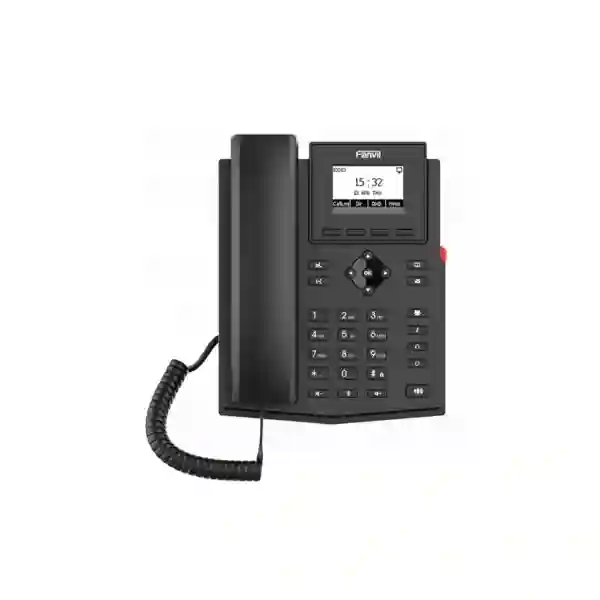
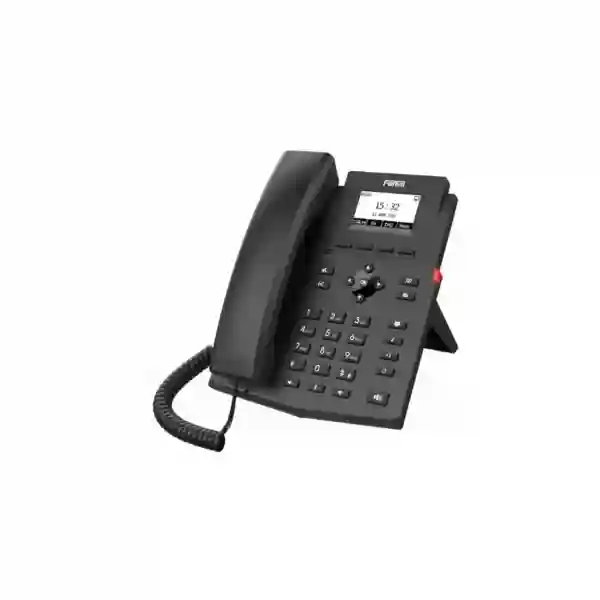
Fanvil X301 Entry Level IP Phone
Fanvil X301 is a cost-conscious two-line SIP desk phone built for everyday office communication. It combines a compact 2.3-inch 128×48 graphical LCD, HD audio, G.722 and Opus wideband codecs, full-duplex hands-free calling, six-way audio conferencing, dual 10/100 Mbps Ethernet ports, headset support and practical call-control keys in a straightforward business handset. For organisations in Tanzania planning new IP PBX extensions or replacing basic legacy endpoints, the X301 offers a sensible balance between essential VoIP functions and deployment simplicity.
The X301 should be distinguished from closely related variants. Fanvil identifies integrated PoE on the X301P, Gigabit Ethernet on the X301G and Wi‑Fi on the X301W; those functions should not be assumed for the standard X301. The X301 uses a 5V/0.6A DC input, so purchasing decisions should account for a suitable power arrangement at each desk. FourTeck can help buyers review extension quantity, SIP platform, network readiness, headset requirements and rollout plans before a quotation is prepared.
Suitable for reception support desks, administration users, sales desks, branches, clinics, schools, hospitality back offices and general office users who need reliable SIP calling rather than premium touchscreen features.
Fanvil X301 Overview and Verified Features
Supports two SIP lines for standard extension use, line separation and practical office calling.
Supports G.722 and Opus wideband codecs with HD audio on handset and speakerphone.
Local six-way audio conferencing supports quick multi-party discussions without a separate room device.
Two 10/100 Mbps Ethernet ports allow the phone to sit in a typical desk network path with PC pass-through.
RJ9 headset connectivity and EHS support can help frequent callers adopt a more comfortable workflow.
Supports desktop stand installation and optional wall mounting for space-conscious environments.
Technical Specifications That Matter During Procurement
| Area | Fanvil X301 | Buying relevance |
|---|---|---|
| Display | 2.3-inch, 128×48 graphical LCD with backlight | Clear basic call status and menu navigation without a large color screen. |
| SIP | 2 SIP lines; SIP 2.0 over UDP/TCP/TLS | Suitable for standard desk extensions and two-line workflows. |
| Audio | G.722, Opus plus narrowband codecs; full-duplex AEC | Supports modern wideband voice when the PBX, trunk and network path also support it. |
| Conference | 6-way audio conference | Useful for quick multi-party calls from a normal desk endpoint. |
| Ethernet | 2 × 10/100 Mbps RJ45 | Check whether Fast Ethernet is sufficient for the connected workstation and LAN design. |
| Power | 5V/0.6A DC input; standard X301 does not include integrated PoE | Plan power outlets/adapters; choose X301P instead if integrated PoE is a requirement. |
| Network features | IPv4/IPv6, VLAN, LLDP, QoS, 802.1x, L2TP, OpenVPN | Supports structured voice-network deployments with appropriate configuration. |
| Provisioning | FTP/TFTP/HTTP/HTTPS/DHCP Option 66/SIP PNP/TR-069 | Helpful for repeatable rollout and remote management in multi-phone projects. |
The X301 also includes local and remote phonebook capabilities, call history, voicemail indication, programmable soft keys, hold, transfer, call waiting, forwarding, DND, speed dial, intercom and other standard business calling functions. Some call features depend on the PBX or SIP server, so endpoint capability should always be checked against the actual telephony platform rather than assumed from the handset alone.
What the Fanvil X301 Solves for Business Users
Many offices do not need a large touchscreen, Bluetooth accessories or a high number of line keys at every desk. They need a phone that rings reliably, lets staff answer and transfer calls quickly, works with a SIP-based PBX and is manageable by IT. The Fanvil X301 is designed around this standard-extension requirement. It is particularly appropriate where a business wants to standardise general-user phones while reserving higher-end models for receptionists, executives or contact-center staff who need more programmable keys, Gigabit connectivity or integrated wireless features.
The handset can also support structured network practices. VLAN, LLDP, QoS, 802.1x, HTTPS, TLS and SRTP-related functions help IT teams fit the phone into an appropriately designed voice network. These capabilities do not automatically make a deployment secure or high quality; configuration, PBX settings, switching, firewall policies, cabling and internet stability still matter. A well-planned project should define the voice VLAN, IP addressing approach, provisioning method, extension naming, firmware policy, power arrangement and user roles before dozens of phones are placed on desks.
For organisations comparing the X301 with the X301P, the most practical difference is power. The X301P adds integrated PoE, while the standard X301 relies on DC power. A PoE design can reduce adapters at desks and can centralise phone power through a UPS-backed switch, but it may cost more at the endpoint or require PoE-capable switching. The right choice therefore depends on the existing network, project size and support model rather than simply the handset price.
Compatibility, PBX Integration and Deployment Planning
Fanvil X301 uses standard SIP 2.0 and supports common provisioning and network protocols, making it suitable for many SIP-based IP PBX and hosted voice environments when correctly configured. Compatibility should nevertheless be validated against the exact PBX version, required call features, provisioning templates, security policies and SIP service. A phone may register successfully while a specialised feature such as BLF behaviour, call parking, directory integration or server-side recording still requires platform-specific configuration.
Before rollout, record the number of users, extension ranges, departments, call-flow requirements, headset needs, desk cabling, power sockets, switch port availability, VLAN design and any remote-office requirements. Where a PC shares the desk network path through the phone, remember that the standard X301 provides Fast Ethernet rather than Gigabit Ethernet. That can be completely adequate for many office tasks, but it should be assessed where workstations handle high-volume local transfers, large creative files or other bandwidth-intensive traffic.
For broader IP telephony planning, buyers can review the specialist FourTeck IP phone and business telephony resource. This is useful when the X301 is only one part of a larger project involving IP PBX, SIP trunks, PoE switching, headsets, cabling or multi-site communication.
Fanvil X301 Tanzania
For buyers searching for Fanvil X301 Tanzania, the core question is whether this entry-level SIP phone matches the organisation’s calling roles and network design. The model is well suited to standard office extensions where staff need a physical handset, clear call controls, two SIP lines, HD audio and basic conferencing without the cost or complexity of a premium executive endpoint. Typical use cases include administration desks, accounts departments, sales staff, customer-service support users, clinic reception areas, school offices, hospitality back offices, warehouse administration and branch employees. It can also work as part of a mixed Fanvil estate in which more advanced phones are assigned only to users who genuinely need additional lines, larger displays, Gigabit ports or wireless connectivity.
Tanzania deployments should begin with network and power readiness. The standard X301 has dual 10/100 Mbps Ethernet and does not include integrated PoE, so every desk requires an appropriate DC power arrangement. If a project is being designed around PoE switches and central UPS backup, the X301P may be operationally cleaner. Conversely, where power outlets are already available and PoE is not required, the X301 can be a straightforward choice. Voice VLANs, QoS, stable switching and properly configured firewall rules are also important when multiple phones share the LAN with normal data traffic.
Procurement teams should request a quotation with the exact model, quantity, destination, expected PBX or hosted-voice platform, required accessories and intended deployment date. They should also state whether wall mounting, wired headsets, EHS wireless headset integration or PC pass-through will be used. This information helps avoid buying the wrong variant or overlooking power and network dependencies. FourTeck Tanzania can discuss IP phones alongside PBX, switching, cabling and network requirements through its integrated Tanzania IT and telecom portfolio.
The X301’s six-way local audio conference can be useful for short coordination calls, while G.722 and Opus support can provide improved voice quality when the end-to-end system supports wideband media. For larger conference rooms, queue-heavy contact centers or executive users, a different endpoint category may be more appropriate. The purchasing decision should therefore be based on user role, not merely on the lowest unit cost. A standardised phone chosen for the right users can simplify training, spares, configuration and long-term support across a Tanzania office estate.
Fanvil X301 Dar es Salaam
Businesses evaluating Fanvil X301 Dar es Salaam are often balancing a large number of everyday extensions against the need to keep the telephony platform manageable. Corporate offices, logistics operations, professional-services firms, retail headquarters, hospitality businesses, clinics and education facilities may have many users who simply need a dependable SIP desk phone for incoming calls, transfers, internal extensions and supplier or customer communication. The X301 fits this role because it concentrates on core functions: two SIP lines, familiar hard keys, a compact backlit display, HD voice codecs, hands-free operation, headset support and six-way conferencing.
A Dar es Salaam deployment should be planned as part of the LAN, not as a separate telephone purchase. If phones share network outlets with PCs, confirm that 10/100 Mbps pass-through is suitable for the workstation traffic at each desk. Review switch capacity, available ports, cabling condition and VLAN policy. The standard X301 requires DC power; where offices prefer to power phones centrally through the network, compare the X301P instead. For locations affected by short power interruptions, businesses may also consider how the PBX, switches, routers and internet equipment are protected, because keeping only the handset powered does not preserve calling if the rest of the voice path goes offline.
For quotation preparation, Dar es Salaam buyers should provide the extension count, department roles, PBX brand or hosted platform, expected number of simultaneous calls, SIP trunk arrangement, headset requirements and any branch links. Reception and high-call-volume roles may need a higher Fanvil model with more programmable keys, while general desks can use the X301. This mixed-role approach can improve value without forcing every employee onto the same premium hardware.
Security and administration are equally important. The X301 supports HTTPS-based management, TLS for SIP, SRTP, 802.1x, VLAN and several automated provisioning methods. Those features help only when used within a defined configuration standard. IT teams should control administrator credentials, firmware, provisioning URLs, voice VLAN settings and device naming. A disciplined rollout makes replacement and troubleshooting much easier as the number of phones grows. When a company is expanding from one office to multiple Dar es Salaam sites, it should also decide whether the PBX will be centralised, hosted or distributed and how extensions will behave during WAN outages.
Fanvil X301 Mwanza
Fanvil X301 Mwanza buyers may include regional offices, lake-zone trading businesses, healthcare providers, schools, hotels, transport operators and organisations with branches that need consistent extension calling. In these environments, the value of an entry-level IP phone is not just the handset itself; it is the ability to give ordinary users a standard interface while allowing the PBX to manage extension numbers, transfer rules, voicemail, department routing and inter-branch calling. The X301’s two SIP lines are appropriate for general users who do not need the line density of a reception console or executive phone.
Mwanza sites should check the reliability of the underlying data connection before assuming VoIP will automatically improve communication. Internal calls within the same LAN can remain stable even when the internet is poor, depending on PBX architecture, but cloud PBX and SIP trunk traffic require dependable WAN connectivity. QoS and voice VLANs can prioritise traffic inside the business network, yet they cannot repair a weak external link. Buyers should therefore map the calling path from handset to switch, PBX, firewall, SIP provider and remote destination and identify where resilience is needed.
The standard X301 uses a 5V/0.6A power input rather than integrated PoE. In a small Mwanza office with accessible power sockets, that may be perfectly workable. In a larger branch with many phones, PoE can simplify wiring and central power protection, so the X301P deserves comparison. The right variant should be determined before ordering because power design affects the switch, UPS and desk layout. Network teams should also remember that the X301’s Ethernet ports are 10/100 Mbps, which is sufficient for voice and many normal office users but may not be ideal where a high-bandwidth PC depends on the phone’s pass-through port.
A useful procurement request should include quantity, user types, location, preferred PBX, extension plan, power approach, headset requirements and whether phones will be auto-provisioned. This helps suppliers and integrators recommend the correct mix rather than quoting a handset in isolation. For multi-site organisations, device standardisation across Mwanza and other Tanzania locations can simplify support, but only if the same phone genuinely suits each user role and network environment.
Fanvil X301 Arusha
For Fanvil X301 Arusha enquiries, common business contexts can include hospitality operations, tour companies, professional offices, education providers, NGOs, retail businesses and regional administration teams. Many such organisations need a clear and predictable desk-phone experience rather than a feature-heavy endpoint. The X301 is designed for this kind of practical use, with two SIP lines, HD audio, six-way conferencing, a backlit graphical display, dual Fast Ethernet and standard call functions including hold, transfer, forwarding, DND and voicemail indication.
Hospitality and tourism businesses should consider the difference between staff phones and guest-room phones. The X301 can suit back-office departments, reservations desks, accounts and supervisors, but a hotel may prefer purpose-built hospitality phones in guest rooms where compact form, service keys and room-specific provisioning are more important. Similarly, a front desk receiving many calls may benefit from a higher model with more keys or expansion options. Matching the endpoint to the workflow avoids both under-specification and unnecessary spend.
Arusha organisations with more than one building or branch should review how the PBX connects sites and what happens when the WAN path is interrupted. SIP phones can be centrally managed, but voice resilience depends on the chosen platform. Local survivability, call forwarding, mobile fallback or secondary connectivity may be relevant for some businesses. The X301 itself supports technologies such as VLAN, LLDP, QoS, TLS, SRTP and OpenVPN, but network architecture and server configuration determine how those features are used in practice.
Power planning is particularly important because the standard X301 is not the PoE version. If the design goal is one Ethernet cable per phone with power supplied from a managed switch, compare the X301P. If adapters are acceptable, confirm suitable outlets and cable management at each desk. For larger rollouts, also decide how firmware and configuration will be controlled. Fanvil supports auto-provisioning through common methods such as HTTP, HTTPS, TFTP and DHCP options, which can reduce repetitive manual setup when the PBX or management workflow is prepared correctly. A complete Arusha quotation should therefore cover not only phone quantity but also network, PBX, accessories, power and configuration scope.
Fanvil X301 Dodoma
Fanvil X301 Dodoma can be relevant for government-support offices, professional organisations, education environments, clinics, service companies and growing businesses that need standard SIP extensions. The key strength of the model is predictability: it gives ordinary users the familiar handset and keypad experience while allowing an IP PBX to provide extension dialing, call transfer, forwarding, voicemail and other business telephony functions. The compact display and dedicated function keys keep daily calling uncomplicated, which is valuable where staff training time should remain low.
When planning a Dodoma deployment, separate endpoint requirements from PBX requirements. The phone can support two SIP lines and common SIP functions, but call queues, IVR menus, recording, detailed reporting and complex routing are normally handled by the PBX or hosted platform. Procurement teams should therefore avoid judging the whole telephone system by the handset alone. They should document incoming-number requirements, departments, extensions, after-hours routing, voicemail, call recording policy, remote users and branch connectivity before choosing quantities and endpoint tiers.
Network design also affects user experience. Voice traffic should be carried over stable switching and structured cabling, with VLAN and QoS settings where appropriate. The X301 supports 802.1x, IPv4/IPv6, LLDP and security protocols that can fit into a managed environment. However, the phone’s dual Ethernet interfaces are 10/100 Mbps, so desks with higher workstation bandwidth requirements may be better served by a Gigabit phone model or by separate switch ports. The standard X301 also lacks integrated PoE, making DC power availability another decision point.
For organisations standardising multiple Dodoma sites, provisioning is an important advantage of IP telephony. Auto-provisioning can push extension settings and policy consistently, reducing manual configuration. Teams should still maintain an inventory linking device MAC address, user, extension, department, location and firmware version. This improves replacement and troubleshooting. A buying request should state whether phones are for a new system, an expansion or replacement of an existing estate, because each scenario changes the compatibility questions that need to be answered before purchase.
Fanvil X301 UAE
For organisations comparing Fanvil X301 UAE options, the phone works best as a standard extension endpoint in offices that want essential SIP functionality with a compact footprint. Two SIP lines, HD audio, Opus and G.722 support, six-way conferencing and dual 10/100 Mbps ports cover the needs of many administration, operations, sales and service users. Businesses should not confuse the standard X301 with the X301P, X301G or X301W variants. The X301 itself is the adapter-powered Fast Ethernet model; integrated PoE belongs to the X301P, Gigabit networking to the X301G and Wi‑Fi to the X301W.
UAE deployments often involve structured office networks with PoE switches, voice VLANs and centrally managed IP PBX systems. In such an environment, buyers should consciously decide whether adapter power is acceptable. A large floor with many desk phones can be cleaner to operate with PoE, while a small office may have no problem using adapters. The choice should also account for UPS strategy, since centrally powered PoE endpoints can remain online during brief mains interruptions only if the switch, PBX, firewall and uplinks are also protected.
Companies with operations across the Gulf, Africa or multiple branches can standardise a basic phone model for general users while assigning more capable endpoints to reception and management. The procurement checklist should include SIP platform, extension count, codecs, headset compatibility, auto-provisioning method, desk network speed, wall-mount needs and security policy. Where a PC is connected through the phone, Fast Ethernet should be evaluated against the user’s actual data workload.
The UAE market also includes many hosted PBX and SIP trunk choices, so the buyer should confirm the exact platform rather than relying on generic “SIP compatible” language. Registration is only one part of compatibility; BLF, call parking, directories, remote provisioning and server-side recording can behave differently across platforms. For broader regional IT and communications planning, FourTeck’s main regional presence at FourTeck can provide context for integrated PBX, network and endpoint projects.
Fanvil X301 Uganda
Fanvil X301 Uganda searches usually point to organisations that want a cost-effective SIP endpoint for routine desk calling. Offices, schools, clinics, hospitality properties, NGOs, retail operations and distributed branch networks can use a phone like the X301 for standard extension users who do not need large displays or numerous programmable line keys. The model supports two SIP lines, HD voice, six-way audio conferencing, headset operation and common business call functions, which makes it practical for many everyday roles.
Uganda buyers should plan around connectivity and power. Where a branch uses a hosted PBX, internet stability is critical for external and inter-site calls. A local IP PBX can keep some internal functions operating independently of the WAN, but SIP trunking and remote extensions still rely on upstream connectivity. Voice VLANs and QoS can help manage local congestion, while secondary WAN links may be considered for sites where telephony is operationally important. None of these design decisions are replaced by choosing a better handset; the phone is one endpoint in the complete voice path.
The standard X301 requires DC power, so buyers designing around PoE should compare the X301P. If adapters are used, power outlets, surge protection and cable management should be considered. Headset users should also specify whether they need a simple wired RJ9 headset or EHS wireless functionality, because accessories and compatibility can affect the final quotation. The phone’s 10/100 Mbps pass-through is appropriate for many desks, but higher-bandwidth workstation roles should be reviewed individually.
Organisations operating in both Tanzania and Uganda may benefit from consistent endpoint policies, extension naming and provisioning templates. The FourTeck Uganda technology site can help regional teams align PBX, network and device requirements across sites. Before buying, provide model, quantity, destination, PBX platform, deployment type and required accessories. This keeps the quotation focused on the actual project rather than a generic product-only request.
Fanvil X301 Kampala
For Fanvil X301 Kampala deployments, city offices and branch operations often have a mixture of user types. Some employees need only a simple extension for occasional calls, while reception, customer service and managers may require more lines, programmable keys or wireless headsets. The X301 is best positioned for the first group: users who need reliable SIP calling, caller information, transfer, hold, forwarding, speakerphone and a manageable desk interface. Two SIP lines provide enough flexibility for many ordinary business users without turning the phone into a complex operator console.
Kampala businesses planning dozens of endpoints should focus on provisioning. Manual configuration can become inconsistent as extensions grow. Fanvil supports common auto-provisioning methods, enabling administrators or PBX platforms to deploy settings more systematically. Device naming, password policies, firmware control and configuration backups should be part of that process. A central inventory also makes it easier to identify which phone belongs to which extension when devices are moved between desks.
The X301’s network interfaces operate at 10/100 Mbps. If the phone shares a single wall outlet with a connected PC, check whether that speed fits the workstation role. For normal office productivity it may be sufficient, but data-heavy roles may be better connected independently or assigned a Gigabit phone variant. Power is another key distinction: the base X301 is adapter-powered and does not provide integrated PoE. A Kampala office with managed PoE switches may therefore prefer the X301P for a neater single-cable deployment.
Call quality depends on the whole network. Proper switching, voice VLANs, QoS, clean cabling, adequate internet and sensible firewall configuration matter more than advertised codec support alone. G.722 and Opus can improve audio when the PBX and network path support them, but packet loss and jitter can still degrade calls. A good procurement discussion should therefore include site network condition, WAN capacity, PBX architecture, SIP trunk arrangement, headset needs and resilience expectations. The handset should be selected as part of this system view.
Fanvil X301 Arua
Fanvil X301 Arua can suit branch offices and regional organisations that want a standardised SIP phone for day-to-day communication without a premium feature set. A branch may use the X301 for administrators, finance users, service desks and other roles that mainly answer, place and transfer calls. The phone’s two SIP lines, HD audio support, six-way conferencing and dedicated call keys help staff perform these tasks with minimal training. Because it is a network endpoint, it can also participate in a central PBX design that links Arua to other company locations.
For a remote or regional branch, WAN design deserves special attention. A centrally hosted PBX can simplify management, but branch calls may depend heavily on internet availability. Companies should define how important voice continuity is during a link outage and whether mobile fallback, secondary connectivity or a different PBX architecture is required. The X301 supports common network and security features, but it cannot by itself solve upstream connectivity failures. Local network quality should also be checked: damaged cabling, overloaded switches and incorrect VLAN settings can create one-way audio, registration problems or intermittent call quality.
Power planning should be explicit. The standard X301 uses a DC power input and is not the PoE variant. Small Arua sites may find adapter power simple and economical. Larger sites may value the operational advantages of central PoE and UPS support, in which case the X301P can be evaluated. Likewise, the 10/100 Mbps Ethernet ports should be compared with the needs of any PC connected through the phone. A dedicated data port or Gigabit phone can be more suitable for high-throughput users.
When requesting a quote, specify whether the Arua phones are part of a new installation, an expansion or a replacement project. Include the existing PBX model, extension count, SIP provider where relevant, headset requirements, wall-mount requirements and expected user growth. This provides enough context to confirm the model and avoid purchasing endpoints that later require unexpected network or power changes.
Fanvil X301 Mbarara
Fanvil X301 Mbarara is a useful search for businesses that need a basic but business-ready IP phone for normal extension users. Regional offices, schools, clinics, hotels, retailers and service organisations can use it where staff need familiar telephony controls and a dependable SIP endpoint. The model is intentionally modest: two SIP lines, a 2.3-inch graphical display, HD audio, speakerphone, headset support and six-way conferencing. That makes it easier to justify across many desks while reserving advanced phones for users with heavier call-handling requirements.
A sensible Mbarara rollout starts by mapping user roles. Reception may need more keys and line visibility; mobile staff may need Wi‑Fi or cordless devices; managers may want larger displays or Bluetooth; general desks may be ideal for X301. Using one device for every employee can either overspend or leave important users under-equipped. A tiered endpoint strategy normally creates a better balance between functionality, user experience and budget.
The X301’s standard model does not include integrated PoE, so the project must decide how each phone will be powered. Adapters are workable where outlets are available, while PoE can simplify larger projects and centralise power protection. The dual Ethernet ports are Fast Ethernet, which should be considered if the desk PC shares the phone’s network connection. Network administrators should also plan voice VLANs, QoS, addressing and provisioning before deployment. Fanvil’s support for HTTPS, TLS, SRTP, 802.1x and several provisioning methods provides useful building blocks, but they must be configured correctly.
If the Mbarara office connects to a central PBX elsewhere, test actual call behaviour across the WAN, including transfer, voicemail, caller ID, conferencing and failover. SIP registration alone does not prove that every feature required by users works as intended. A pilot of a few phones can therefore be valuable before a larger order. The final quotation should reflect phone quantity, accessories, PBX integration, provisioning, cabling and network readiness rather than listing handsets only.
Fanvil X301 Gulu
For Fanvil X301 Gulu requirements, an entry-level SIP phone can be valuable where an organisation wants consistent desk communication across general office users. The X301 supports core business functions such as answering, hold, transfer, forwarding, call waiting, speed dial, DND and voicemail indication, with two SIP lines and wideband audio codecs. This makes it appropriate for many administrative desks, service points, education offices, healthcare users and branch employees who do not need complex line monitoring or a large color screen.
Gulu buyers should distinguish the handset decision from the wider telephony architecture. The phone can connect to a compatible SIP PBX or service, but features such as IVR, queues, call recording and reporting are server-side functions. Businesses should define call flows first: who answers public numbers, how calls are transferred, what happens after hours, whether voicemail is needed and which departments require ring groups. Once those requirements are known, the X301 can be evaluated as one endpoint class within the full system.
Power and network are equally important. The standard X301 does not include integrated PoE; it uses a 5V/0.6A DC input. Where an office is already deploying PoE switching for phones, the X301P may reduce adapters and desk clutter. The phone’s network interfaces are 10/100 Mbps, so shared PC connectivity should be assessed against user data requirements. Voice traffic itself uses far less bandwidth, but the pass-through link can become the limiting factor for a connected workstation.
Regional sites should also plan remote support. Auto-provisioning can make configuration changes more consistent and reduce the need for manual device setup. Strong administrator credentials, controlled firmware updates and documented extension assignments help keep the estate manageable. For a Gulu quotation, provide exact quantities, user roles, PBX platform, branch connectivity, desired accessories and whether installation or configuration support is needed. This context allows the phone to be supplied as part of a workable communication solution rather than as an isolated hardware purchase.
Fanvil X301 Kenya
Fanvil X301 Kenya buyers can use this model as a standard business extension where two SIP lines and essential VoIP functions are enough. The handset is particularly relevant for offices that need to deploy many phones to ordinary users while keeping more advanced devices for receptionists, team leaders or executives. HD voice, Opus and G.722 support, six-way conferencing, headset readiness and familiar call controls make the X301 capable for routine customer, supplier and internal communication.
Kenya has an active market for Fanvil X300-series products, which means buyers may see X301, X301P, X301G and X301W listed side by side. Specifications should be checked carefully. The standard X301 is not the PoE model, does not provide Gigabit Ethernet and does not include Wi‑Fi. Those capabilities belong to related variants. Choosing by a shortened product name can therefore lead to mismatched expectations. A formal quote should show the exact model and power/network features required by the project.
Where phones share network connections with computers, the X301’s 10/100 Mbps ports should be evaluated against workstation usage. A data-intensive user may require a Gigabit phone or separate data connection even though the voice side works perfectly on Fast Ethernet. Businesses using PoE switches should decide whether adapters are acceptable or whether the X301P is a better operational fit. For large rollouts, provisioning templates and a controlled firmware policy help keep the phone estate consistent.
Regional organisations that operate in both Kenya and Tanzania can benefit from common PBX standards, extension numbering, endpoint tiers and support processes. The FourTeck Kenya IT and VoIP platform can support buyers reviewing cross-border communication requirements. A useful procurement brief should include the number of sites, users per site, PBX architecture, SIP trunking, WAN links, power strategy and accessories. With that information, the X301 can be assessed on its actual operational fit rather than price alone.
Fanvil X301 Kuwait
Fanvil X301 Kuwait can serve offices that need a practical SIP desk phone for standard extension users. Its two SIP lines, compact backlit display, HD voice codecs, six-way conferencing, speakerphone and headset support are well matched to administration, sales, support and back-office roles where users need dependable calling but not an executive-class interface. The model also supports several enterprise network and security capabilities, including VLAN, QoS, 802.1x, TLS, SRTP and HTTPS management.
Kuwait organisations often deploy managed switching and structured VoIP environments, so the distinction between X301 and X301P matters. The standard X301 relies on DC power, whereas X301P includes integrated PoE. If a project is designed around central PoE power and UPS-backed switches, the P variant may be cleaner. If desk adapters are acceptable, the standard model can still be a sensible choice. Buyers should also review the phone’s 10/100 Mbps Ethernet when planning PC pass-through at data-heavy desks.
Call quality requires coordination between phone, PBX, network and SIP service. Wideband codecs can improve clarity, but network jitter, packet loss or overloaded links can undermine the benefit. Voice VLAN and QoS policies should be configured in conjunction with switch and router settings, and security should include strong device credentials and controlled management access. For multi-branch organisations, provisioning and inventory management are also important because consistent configuration reduces troubleshooting effort.
A Kuwait quotation should identify the exact Fanvil variant, phone quantity, PBX or cloud platform, power approach, desired headsets, wall-mount requirements and deployment services. If an organisation is replacing older SIP phones, it should explain which functions must be preserved, including BLF, call pickup, directory access or recording workflows. This allows compatibility to be checked before procurement. Entry-level phones create the best value when they are deliberately assigned to the right user roles rather than selected as a one-size-fits-all endpoint.
Fanvil X301 Ghana
Fanvil X301 Ghana can be considered by businesses seeking an economical SIP phone for ordinary desk users in offices, schools, clinics, hospitality businesses, retail operations and branch networks. The phone offers two SIP lines, a compact graphical display, wideband audio codecs, hands-free operation, headset connectivity and six-way audio conferencing. These features are enough for many daily calling roles while avoiding the cost of higher-tier phones with large color displays, wireless connectivity or many programmable keys.
Ghana buyers should start with the PBX and network environment. A phone that supports SIP still requires compatible server settings, extension credentials, codec choices and firewall behaviour. Cloud PBX users depend on reliable internet connectivity, while on-premises PBX deployments still need stable LAN switching and proper SIP trunk configuration for external calls. Voice VLANs and QoS can help separate and prioritise traffic inside the business network, especially when phones share switches with PCs, access points and other devices.
The standard X301 is powered through a 5V/0.6A DC input and does not have integrated PoE. This is an important procurement detail because a buyer expecting a one-cable PoE rollout should select a different variant, such as the X301P. The X301 also uses Fast Ethernet ports. For normal office users that may be adequate, but organisations should assess any computer connected through the phone if that workstation requires high LAN throughput.
For branch or multi-site deployments, central provisioning can make the phone easier to manage. Configuration templates, firmware control and device inventories reduce variation between endpoints. Businesses should document which extensions are assigned to which users, how emergency or after-hours calling is handled and who is responsible for PBX administration. A good Ghana quotation should therefore include the expected quantity, user roles, deployment locations, PBX type, SIP service, accessory requirements and whether installation or remote configuration is required. This context turns a basic handset purchase into a planned communications rollout.
Fanvil X301 Nigeria
Fanvil X301 Nigeria is relevant for cost-aware organisations that want a simple SIP endpoint for a large number of standard users. Professional services, retail chains, schools, clinics, hospitality operations, logistics firms and branch offices can assign the X301 to users whose main tasks are answering, placing, transferring and conferencing calls. Two SIP lines are sufficient for many general desks, while HD audio, Opus and G.722 support can improve call clarity when the rest of the voice path supports wideband media.
In Nigeria, network and power resilience often become important design discussions for any IP-based communication system. The standard X301 itself uses DC power; it is not the PoE variant. If a business wants phones powered centrally from UPS-backed switches, the X301P may be a more appropriate endpoint. However, phone power is only one part of resilience. The PBX, switches, router, firewall, SIP trunk and internet connection must also remain available for external calling. Businesses should therefore define acceptable downtime and plan backup paths according to operational importance.
The X301’s dual Fast Ethernet interfaces should also be considered in desk design. Voice traffic is low bandwidth, but a PC connected through the phone will inherit the 10/100 Mbps limitation. Users transferring large files or working with bandwidth-intensive local applications may require a Gigabit endpoint or independent switch port. This distinction is especially useful in mixed deployments, where only some roles need higher network performance.
Security and remote management should be treated as part of the rollout from the start. Fanvil supports TLS, SRTP, HTTPS, 802.1x, VLAN and common auto-provisioning methods, giving administrators tools for managed deployment. Strong credentials, controlled firmware and restricted management access are still necessary. A Nigeria quotation should include exact model, quantity, PBX platform, user roles, power strategy, headset needs and branch topology. For cross-country projects, buyers can also explore the wider FourTeck Africa technology portfolio when coordinating telephony with switching, networking and other infrastructure.
Fanvil X301 Seychelles
Fanvil X301 Seychelles can suit offices, hotels, service companies, education providers, healthcare facilities and administrative users that need a straightforward SIP desk phone. The X301 is not a hospitality-room specialist or an executive phone; it is a general business endpoint. That positioning makes it useful for back-office departments, reservations teams, accounts staff, operational desks and other users who need dependable calling, transfer, hold, conferencing and headset capability without advanced multimedia features.
Seychelles organisations should assess the wider communications path, particularly when using hosted PBX platforms or connecting islands and remote sites. A SIP phone can be centrally managed, but call quality and availability rely on the WAN. Stable internet, sensible firewall rules and QoS policies are important. Businesses with critical call requirements should discuss resilience, backup connectivity and what happens if the primary PBX or internet link becomes unavailable. The correct answer depends on whether communication is mainly internal, public-facing or tied to operational services.
At the desk level, the standard X301 requires DC power and provides 10/100 Mbps Ethernet. If a resort or office is already designed around PoE switches, the X301P may simplify installation by combining power and data over one cable. If adapters are practical, the X301 can still work well. Buyers should also decide whether a PC will share the phone connection, because Fast Ethernet may be acceptable for normal productivity but less appropriate for high-bandwidth roles.
For hospitality businesses, endpoint selection should distinguish guest rooms from staff work areas. Guest rooms often benefit from purpose-built hotel phones with service keys and compact styling, while back-office employees may prefer the fuller business functions of the X301. Procurement teams should therefore provide room counts, staff phone counts, PBX information, user roles and network design separately. A clear quotation request should also specify headset accessories, mounting requirements and configuration scope. This avoids treating all telephony devices in a property as interchangeable when their workflows are actually quite different.
Fanvil X301 Buying and Selection Guide
Choose the X301 when users need a simple, wired SIP phone with two lines, clear audio and standard business call handling, and when adapter power plus Fast Ethernet fit the site design. Compare the X301P when PoE is required. Compare the X301G when Gigabit network pass-through is important. Compare the X301W when Wi‑Fi is a genuine deployment requirement. The correct model should be selected from the physical desk environment and network architecture, not from the model name alone.
Users need basic wired SIP calling, two lines, HD voice and adapter power is acceptable.
The desk requires integrated PoE, Gigabit pass-through, built-in Wi‑Fi, a large color display or many programmable keys.
PBX compatibility, power method, quantity, headsets, mounting, provisioning, cabling and user-role fit.
Frequently Asked Questions
Does Fanvil X301 support PoE?
No. Fanvil’s published X301/X301P information identifies integrated PoE on the X301P, not on the standard X301. The X301 uses a 5V/0.6A DC power input. If PoE is required, compare the X301P.
How many SIP lines does the Fanvil X301 support?
The X301 supports two SIP lines. This makes it suitable for standard business extensions and users who do not require a large number of line appearances.
Does the Fanvil X301 support HD voice?
Yes. Fanvil lists HD audio and wideband G.722 and Opus codecs. End-to-end call quality still depends on the PBX, codec negotiation, network and SIP provider.
Can I connect a PC through the X301?
The phone has dual 10/100 Mbps Ethernet ports and supports PC pass-through. Check whether Fast Ethernet is sufficient for the connected computer’s workload.
Does Fanvil X301 support headsets?
Yes. It provides an RJ9 headset port and Fanvil documents EHS support for selected wireless headset integrations. Confirm the exact headset and required EHS cable before ordering.
Can Fanvil X301 be wall mounted?
Yes. Fanvil lists desktop stand and optional wall-mount installation. The wall-mount accessory should be confirmed as part of the quotation where required.
Is the X301 suitable for a receptionist?
It can handle normal calls, but a busy receptionist may need more line keys, BLF visibility or expansion support. In that case a higher-tier Fanvil model may be a better operational fit.
Quotation Checklist
To receive a useful Fanvil X301 quotation, provide the information that affects compatibility and deployment rather than only requesting a unit price.
Decision Recap
Fanvil X301 is a sensible entry-level IP phone when the requirement is simple: two SIP lines, clear business audio, familiar call controls, six-way conferencing, wired Ethernet and manageable provisioning. It is strongest as a standard-user endpoint rather than a reception console, executive touchscreen phone or wireless handset. The most important purchasing checks are power method, Fast Ethernet suitability, PBX compatibility, headset needs and user role. Getting these points right is more valuable than buying purely on advertised price.
For Tanzania customers, FourTeck can discuss the phone in the context of IP PBX, network switching, cabling, VLAN design and broader business infrastructure. This helps ensure the selected endpoint fits the complete environment and reduces the risk of discovering power, connectivity or integration gaps after the order.
Talk Through Your Fanvil X301 Requirement
Share the number of users, existing PBX or cloud platform, network switch type, preferred power method and headset requirements. FourTeck can use that information to help confirm whether the X301 is the right entry-level model or whether another Fanvil variant better matches the deployment.



Reviews
There are no reviews yet.