
Business VoIP Endpoint • Tanzania
Fanvil X303P Enterprise IP Phone
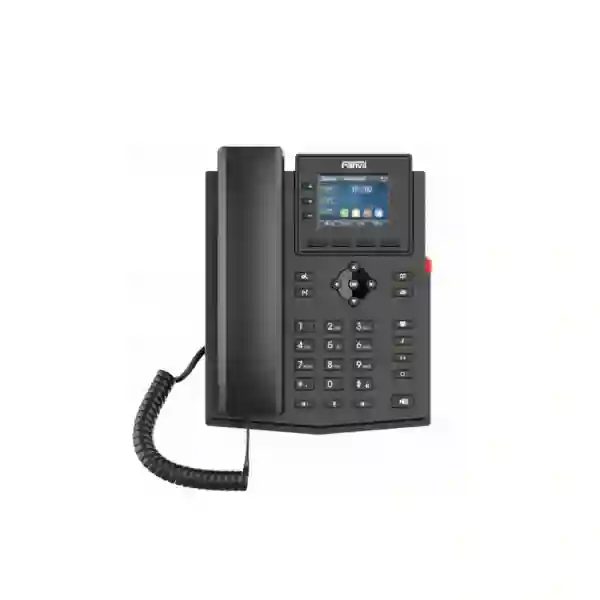
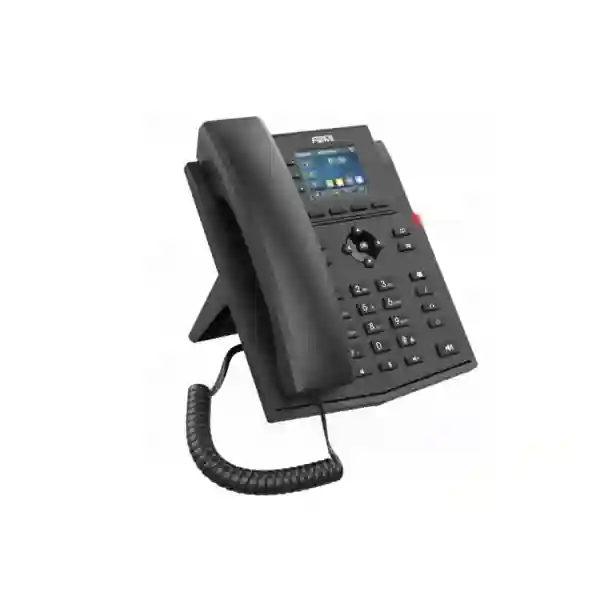
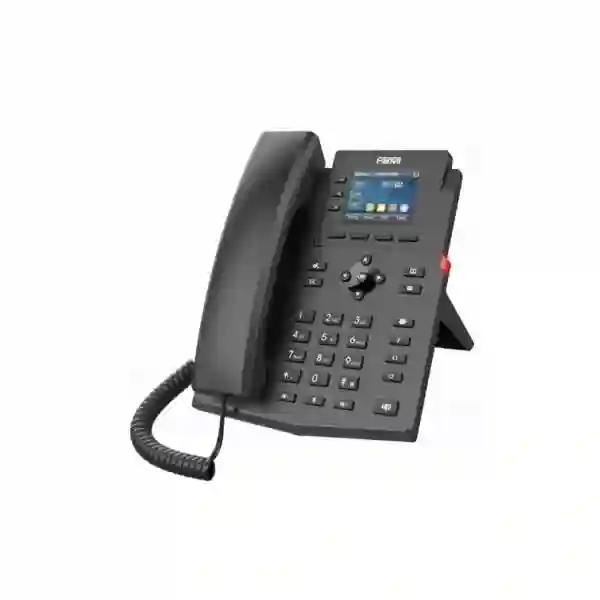
The Fanvil X303P is designed for organizations that need an affordable, manageable SIP desk phone without giving up practical enterprise features. It combines a 2.4-inch 320×240 color display, four SIP lines, HD voice, six-way local audio conferencing, EHS headset support, two 10/100 Mbps network ports and integrated PoE. For offices standardizing extensions across departments, branches, front desks and general users, the X303P provides a sensible balance of clear call handling, wired network simplicity and centralized deployment potential.
Fanvil X303P overview
The Fanvil X303P belongs to Fanvil’s X300 series of business IP phones and is positioned as a cost-effective color-screen SIP endpoint for enterprise use. The official Fanvil material specifies a 2.4-inch 320×240 display, four SIP lines, HD audio on handset and speakerphone, G.722 and Opus wideband codecs, six-way audio conferencing, EHS wireless-headset support and dual 10/100 Mbps Ethernet. The X303P variant includes Power over Ethernet, which is especially useful when an organization wants a cleaner desk deployment and centralized power through a suitable PoE switch.
For a business buyer, those specifications translate into a straightforward endpoint for day-to-day calling. Four SIP registrations can support several line identities or service roles, while the color display provides clearer navigation than a basic monochrome screen. Six-way conferencing can reduce the need to create a separate bridge for small internal discussions. EHS support is relevant to users who spend long periods on calls and want compatible wireless headset control. Dual network ports allow the phone to sit between the LAN and a nearby workstation in environments where the network design supports that topology.
The X303P is not a Wi-Fi model and its network interfaces are 10/100 Mbps rather than Gigabit Ethernet. That distinction should be considered during procurement. If a desk requires wireless connectivity or if a chained workstation specifically needs Gigabit throughput, another Fanvil model may be more appropriate. For conventional wired voice endpoints, however, the X303P offers the core business telephony functions many organizations actually use.
Verified Fanvil X303P features
2.4-inch color display
A 320×240 pixel color screen gives users a clearer interface for line status, caller information, menus and day-to-day navigation.
Four SIP lines
Four SIP registrations give administrators flexibility when mapping extensions, service identities or multiple call appearances to a single desk endpoint.
HD audio
Fanvil lists G.722 and Opus wideband codecs and HD audio support on handset and speakerphone for clearer voice reproduction when the PBX and network path support compatible codecs.
Integrated PoE
The X303P can receive power from a compatible PoE network switch, reducing dependence on a separate local power adapter at each desk.
Six-way conferencing
Local six-way audio conference support can help teams bring several parties together for short operational discussions directly from the phone.
EHS headset support
EHS compatibility supports suitable wireless-headset workflows for reception, sales and other users who need hands-free mobility around the desk.
Technical specification guide
| Area | Fanvil X303P | Procurement meaning |
|---|---|---|
| Display | 2.4-inch, 320×240 color screen | Clearer user interface for a mainstream desk-phone role. |
| SIP lines | 4 | Suitable for multi-line extension or service identities. |
| Conference | 6-way audio conference | Useful for small multi-party voice discussions. |
| Wideband codecs | G.722, Opus | Supports HD voice where the end-to-end platform allows it. |
| Ethernet | 2 × 10/100 Mbps | Appropriate for conventional voice deployment; verify chained-PC bandwidth needs. |
| Power | PoE on X303P | Can simplify power distribution with suitable PoE switching. |
| Headset | EHS supported | Consider headset model and required EHS cable/accessory compatibility. |
| Mounting | Desktop stand; wall mounting via separate accessory | Plan mounting hardware separately for wall installations. |
Where the X303P fits in a business voice system
An IP phone is only one part of a working VoIP environment. The X303P needs a compatible SIP platform, appropriate network addressing, reliable switching, and where required, VLAN and Quality of Service policies. A business deploying dozens of endpoints should also consider provisioning, naming conventions, extension numbering, firmware management, user permissions and support documentation. These details have a larger impact on maintainability than the physical installation of the handset itself.
The X303P is particularly sensible for standardized desk positions such as administration, finance, operations, sales support and branch staff. It can also be used for users who need more than one SIP identity or regular access to call transfer, hold, conferencing and headset workflows. Reception deployments should be evaluated according to call volume; a busy operator may require more programmable keys, a larger screen or expansion capability than an entry-level enterprise phone is designed to provide.
FourTeck Tanzania publishes broader guidance around IT, telecom and infrastructure services in Tanzania. That wider view is useful when the phone purchase also involves an IP PBX, PoE switches, structured cabling, firewall rules, SIP connectivity, UPS-backed network power or a branch rollout.
Fanvil X303P Tanzania
For businesses evaluating the Fanvil X303P in Tanzania, the most useful starting point is not simply the unit price. A productive procurement process looks at the complete voice environment: how many users need desk phones, which users need multiple line identities, whether a SIP PBX already exists, how phones will receive power, and whether the LAN is already segmented for voice. The X303P’s integrated PoE can simplify desks when compatible PoE switching is available, while its four SIP lines make it flexible enough for many normal office roles. Organizations with existing non-PoE switches should include either suitable power arrangements or a switching upgrade in the project calculation rather than discovering the requirement during installation.
Tanzania deployments can include head offices, branches, clinics, hotels, education sites, professional services firms, retail offices and logistics operations. In each case, the X303P should be mapped to the user role. General staff may need a straightforward extension with transfer, hold and voicemail access. Supervisors may use several registrations or line appearances. Customer-facing teams may benefit from EHS headset support when paired with compatible equipment. Small internal meetings can use the phone’s six-way audio conference capability, although larger or scheduled conferences may still be better handled through the PBX or a collaboration platform.
Network readiness is important because voice quality depends on more than the handset. Packet loss, unstable WAN links, overloaded switches, poor VLAN configuration and incorrect QoS policies can affect calls even when the phone itself is operating normally. For multi-site organizations, administrators should document extension ranges, SIP server details, VLAN IDs, switch ports, firmware versions and device naming. Standardization makes replacement and troubleshooting much easier. The X303P’s 10/100 Mbps ports are adequate for many voice scenarios, but any workstation chained through the phone should be assessed if the business expects Gigabit desktop throughput.
When requesting a Fanvil X303P quotation for Tanzania, include quantity, branch locations, PBX brand or hosted SIP service, PoE requirements, headset requirements and whether configuration is needed. This allows the commercial offer to reflect the actual project instead of treating the endpoint as an isolated device.
Fanvil X303P Dar es Salaam
Organizations sourcing the Fanvil X303P in Dar es Salaam often have a mixture of headquarters users, customer-facing teams, branch coordination and shared services. That makes user profiling important. A finance or administration desk may need one primary extension and straightforward call transfer. A service desk may need multiple SIP identities, headset use and frequent conferencing. A manager may require a more advanced phone if Bluetooth, Wi-Fi or a larger number of programmable keys is important. The X303P works best when it is selected for the users whose needs match its four SIP lines, color display, PoE and wired Ethernet design rather than being forced into every role.
For office towers and multi-floor sites, the network layer should be checked before rollout. PoE budget must cover the intended quantity of phones together with any access points, cameras or other powered devices sharing the same switches. Voice VLANs can separate phone traffic from general user traffic, and QoS can prioritize latency-sensitive flows when designed correctly. If the office has redundant internet links or a hosted PBX, failover behavior should be tested rather than assumed. A phone that remains powered during a local electrical interruption still depends on the PoE switch, router, firewall and WAN path, so UPS coverage should be planned across the communication chain.
Dar es Salaam buyers should also define how devices will be provisioned. Manual configuration may be acceptable for a few phones, but larger quantities benefit from consistent templates, naming, credentials, firmware control and extension records. A rollout sheet that maps each device to user, desk, MAC address, extension and switch port reduces later support effort. Headsets should be tested with the required EHS interface and cabling before purchasing at scale.
For a quotation, provide the number of Dar es Salaam users, whether phones are new or replacements, PBX details, number of sites, existing switch models and any cabling or configuration requirement. That information helps separate endpoint cost from the network work needed to deliver reliable voice service.
Fanvil X303P Mwanza
For Mwanza businesses, the Fanvil X303P can be a practical option when a wired SIP phone is needed for branch offices, administration desks, sales teams, education environments, healthcare facilities or logistics operations. The four SIP lines provide room for more than a single basic extension, while the color display and physical call-control keys are familiar for users transitioning from conventional office telephony. Integrated PoE can simplify installation where the network switch is already capable of powering endpoints, which is useful for keeping desk cabling tidy and centralizing power protection at the network cabinet.
A Mwanza rollout should begin with connectivity and branch architecture. If the PBX is hosted elsewhere, call quality depends on the WAN path between the user and the SIP service. If the PBX is on-site, local switching and server availability become central. In either case, extension registration, DNS, time synchronization, firewall policy and voice traffic prioritization should be checked systematically. Businesses connecting Mwanza to Dar es Salaam or other branches should also test how calls behave during internet failover and how extension dialing works across sites.
The X303P’s dual 10/100 Mbps ports can support common desk layouts where a phone and PC share one data outlet, but this topology should only be used when 100 Mbps is sufficient for the connected workstation and when VLAN settings are configured correctly. A user handling large files, high-bandwidth applications or fast local storage may be better served by a network layout that does not place the workstation behind a Fast Ethernet phone port.
Procurement teams in Mwanza should include accessories and implementation details in the request: wall-mount hardware if required, compatible headsets and EHS cables, PoE switching, patch cords, PBX licenses where applicable, configuration and user handover. This produces a more realistic deployment plan than comparing handset prices alone.
Fanvil X303P Arusha
The Fanvil X303P can suit Arusha organizations that want a consistent business desk phone for offices, tourism operations, hospitality administration, professional services, schools and branch environments. Its strongest value is in predictable wired SIP calling: a compact color screen, four registrations, PoE, HD voice capability, conferencing and headset support. Buyers should decide whether those functions match the intended user group. Front-office teams handling heavy call queues may need an operator-oriented model with more programmable controls, while standard administrative and departmental users may find the X303P well aligned with daily calling needs.
Hospitality and tourism organizations around Arusha may have multiple operational areas such as reservations, finance, management, reception back offices and support departments. SIP phones can be standardized across those teams while call routing is controlled centrally by the PBX. The exact functions available to users still depend on the PBX configuration, SIP service and policies. Features such as voicemail, call pickup, queues and recording are not simply properties of the phone; they are part of the broader telephony platform and should be validated before procurement.
Infrastructure planning is equally important. PoE simplifies endpoint power, but the switch’s power budget, UPS coverage and port capacity must support the entire site. Structured cabling should be tested where call problems are suspected. For offices using separate voice and data VLANs, the access switch and phone configuration must agree on tagging. For cloud PBX deployments, internet stability and firewall policy should be reviewed with the SIP provider.
An Arusha quote request should identify the number of phones, user types, PBX or hosted provider, whether a voice VLAN exists, and whether there are several buildings or branches. If the site needs a mixture of desk phones, cordless phones, conference endpoints and reception devices, specifying those roles allows a more suitable overall design than buying one model for every position.
Fanvil X303P Dodoma
In Dodoma, the Fanvil X303P is relevant to organizations modernizing office communications with SIP-based telephony. The phone combines practical enterprise functions without introducing Wi-Fi or Gigabit features that some projects do not need. For departments using fixed desks and wired network outlets, integrated PoE can make the physical rollout straightforward. Four SIP lines provide flexibility for users who need more than one identity, while HD audio support, six-way conferencing and EHS compatibility can improve day-to-day call handling when the rest of the platform is properly configured.
Public-sector offices, service organizations, education institutions, NGOs and private businesses may have different procurement processes, but they share a need for accurate scope. A tender or quotation should state whether the requirement is supply only, pre-configuration, full deployment, cabling, switching or PBX integration. It should also state whether power adapters are required or whether phones will be powered from managed PoE switches. This prevents ambiguous pricing and makes technical evaluation easier.
For larger Dodoma deployments, centralized provisioning and documentation are important. Each phone should have a clear extension assignment, device identity, configuration profile and support owner. Password policies and firmware management should be included in the operational plan. If phones are used across several buildings, switch uplinks and VLAN consistency should be verified so that extensions register correctly and voice traffic remains predictable. Where internet-based SIP trunks or hosted PBX services are involved, bandwidth and failover planning should account for simultaneous calls rather than raw user count alone.
The X303P can be a sensible standardized endpoint where the requirements are wired Ethernet, PoE, four SIP lines and normal office calling. When a project also requires wireless networking, Gigabit pass-through or many programmable keys, those needs should be stated clearly so the endpoint mix can include models better suited to those roles.
Fanvil X303P UAE
UAE buyers comparing the Fanvil X303P typically encounter a broad range of reseller offers, so technical matching matters more than headline price. The official specification is consistent: 2.4-inch color display, four SIP lines, six-way audio conferencing, HD voice with G.722 and Opus, EHS support, dual 10/100 Mbps ports and integrated PoE. Commercial listings may bundle accessories, warranty terms or delivery claims differently, so project buyers should separate manufacturer specifications from seller-specific conditions and request a written quotation that clearly identifies what is included.
The X303P is suitable for many wired office extension roles in Dubai, Abu Dhabi and other UAE business environments, particularly when the customer already operates a SIP PBX or hosted voice service. Before standardizing, confirm PBX compatibility, provisioning method, codec policy, VLAN approach and headset requirements. Where a PC shares the phone’s second network port, remember that the X303P uses 10/100 Mbps Ethernet. Users who depend on Gigabit desktop performance may require a different topology or another phone model.
For regional organizations managing both UAE and East African offices, it is useful to define one extension architecture and endpoint policy across sites while allowing local telecom connectivity to differ. Centralized naming, firmware baselines and configuration templates reduce support complexity. Users can receive similar call handling at each branch even if the SIP trunks, internet providers and local numbering arrangements are different. Procurement should also account for compatible headsets, PoE switching, UPS protection and any wall-mount accessories.
For UAE-wide infrastructure planning, customers can also review FourTeck UAE integrated IT and telecom solutions. The most efficient quotation includes quantity, office locations, PBX platform, PoE availability and whether configuration or deployment support is required.
Fanvil X303P Uganda
Uganda organizations considering the Fanvil X303P can use it as a standardized wired endpoint for branches, administration offices, customer service teams and general staff. Four SIP lines allow more flexibility than a basic single-account phone, and the combination of PoE, HD voice and EHS support addresses common enterprise deployment needs. The device is best evaluated as part of the voice architecture rather than in isolation because PBX features, SIP registration, codecs, firewall rules and LAN design all influence the final user experience.
For multi-branch deployments, a practical design question is where the PBX is located. A cloud-hosted PBX makes internet availability central to every extension. An on-premises PBX can keep internal calls local but may require more local infrastructure and maintenance. A centralized PBX serving several branches can simplify administration, although WAN reliability and failover must be planned. The X303P can operate in any of these architectures when the SIP platform is compatible and the network settings are correct.
PoE deployment should be checked against switch capacity. A 24-port PoE switch does not automatically mean every port can power any endpoint combination indefinitely; the overall power budget still matters. Voice VLANs, DHCP options or provisioning URLs may also need switch and server configuration. For larger quantities, organizations should create a repeatable onboarding process so that replacement phones can be brought into service without rebuilding every setting manually.
Customers coordinating Ugandan sites can review FourTeck Uganda IT, PBX and networking solutions alongside the Tanzania project. A useful X303P request includes quantity, PBX type, branch count, PoE status, headset needs and expected configuration scope.
Fanvil X303P Kampala
For Kampala offices, the Fanvil X303P can support a wide range of everyday desk roles when the organization is building or refreshing a SIP telephone system. The four-line capacity is useful for employees who need multiple registrations, while the 2.4-inch color display offers a clearer interface than entry-level monochrome units. Integrated PoE is helpful in managed office networks because it allows the phone to draw power through Ethernet, simplifying desks and enabling centralized UPS protection when the switching infrastructure is also protected.
Call-heavy teams should pay particular attention to headset workflow. Fanvil lists EHS wireless-headset support, but procurement should verify the exact headset and cable combination intended for use. This is especially important when equipping reception, customer support or sales users in quantity. A pilot deployment with the actual PBX and headset model can confirm answer/end-call behavior, caller identification, transfer workflow and audio levels before a larger rollout.
Kampala organizations with several floors or buildings should treat the voice network as a managed service. Switch port configuration, voice VLAN membership, DHCP, NTP, DNS and firewall policy should be documented. If the office uses hosted SIP, the internet link should be monitored for latency, jitter and packet loss. If the office has two WAN links, administrators should test how registrations recover after failover rather than assuming calls will automatically resume in the desired way.
For budgeting, separate phones, accessories, switching, PBX licenses or subscriptions, installation and ongoing support. The X303P itself is a straightforward endpoint, but the business value comes from making it part of a coherent system with predictable calling, easy replacement and consistent user settings.
Fanvil X303P Arua
Businesses and institutions in Arua may choose the Fanvil X303P when they need a dependable wired SIP endpoint for branch operations without the cost or complexity of features that are unnecessary at every desk. Its four SIP lines, color display, HD audio capability, PoE and conferencing make it suitable for administrative users, managers, service desks and shared offices. Because the phone is designed around Ethernet rather than Wi-Fi, the quality of the local cabling and switch configuration becomes an important part of the deployment.
Branch locations should plan for resilience according to their communication priorities. If voice is business-critical, protecting only the phone with power is not enough. The PoE switch, router, firewall and internet equipment may also need UPS support. Hosted PBX services depend on internet availability, so a second link may be considered where operationally justified. If the branch connects to a central PBX over VPN, the firewall and VPN design should account for SIP and RTP traffic and avoid unnecessary complexity.
Arua deployments can also benefit from a clear support model. Administrators should know which team manages extensions, who controls PBX credentials, how firmware updates are handled and what information must be recorded when a phone is replaced. Small sites often become difficult to support when devices are configured individually without documentation. A standard template for extension number, user name, device MAC address, switch port, VLAN and location saves time during future troubleshooting.
When ordering the X303P for Arua, specify whether the requirement is supply only or includes pre-configuration, remote support or on-site integration. Include any headset, wall-mount or power-accessory needs so the quote reflects a complete usable endpoint rather than only the handset.
Fanvil X303P Mbarara
The Fanvil X303P is a practical candidate for Mbarara organizations moving from analog extensions to SIP, expanding a branch, or standardizing an existing VoIP deployment. The phone’s combination of four SIP lines, HD audio, six-way conferencing, EHS compatibility and PoE is well suited to normal office communication. It is particularly useful where desks already have managed Ethernet and the organization prefers wired endpoints for predictable network behavior.
Migration projects should include a clear call-flow plan. Simply replacing handsets does not define how incoming numbers reach departments, how unanswered calls are handled, when voicemail activates or who can pick up a colleague’s ringing extension. Those functions depend on the PBX and its configuration. Before deployment, map departments, extension ranges, ring groups, queues, after-hours rules and any recording requirements. The X303P then becomes the user-facing device through which those policies are accessed.
Mbarara sites that share data and voice on the same switching infrastructure should review VLAN and QoS design. Voice packets are small but delay-sensitive, so congestion can degrade call quality before ordinary web browsing appears badly affected. Managed switches provide better visibility and control than unmanaged desktop switches. The phone’s integrated PoE is useful, but the switch should have sufficient power budget and UPS protection to keep the voice system available during short utility interruptions where that continuity is required.
For procurement, identify whether existing cabling is reusable, whether users need headsets, whether any desks require Gigabit pass-through and whether the PBX supports the desired provisioning method. These details help decide where the X303P is the right fit and where a different endpoint should be selected.
Fanvil X303P Gulu
For Gulu offices and institutions, the Fanvil X303P provides a sensible feature set for everyday enterprise calling over SIP. The color screen, four registrations, PoE, HD audio and conferencing give administrators more flexibility than a very basic entry-level phone, while the lack of Wi-Fi and Gigabit Ethernet keeps the product focused on wired desk deployments. The right buying decision therefore depends on how the phone will connect and what the user actually needs.
In new deployments, network preparation should happen before phones are placed on desks. Confirm data outlets, switch ports, PoE capacity, DHCP and DNS services, and any voice VLAN settings. If the PBX is hosted outside the site, verify firewall behavior and internet performance. A short pilot with a few phones can reveal issues with codec negotiation, caller ID, transfer methods, voicemail keys or provisioning before the organization commits to a larger rollout.
For organizations with limited local IT staff, documentation is especially valuable. Each phone can be tagged with extension and location, while a central record tracks user, device MAC address, profile and date of deployment. Configuration backups or provisioning templates should be stored securely. This enables remote teams to troubleshoot or replace an endpoint more efficiently without relying on undocumented settings remembered by one person.
A Gulu quote should mention the number of extensions, whether there is an existing PBX, whether phones are replacing analog sets, the switch model, and any requirement for headsets or wall mounting. Where voice is critical, also include UPS and internet-resilience requirements so that the endpoint investment is supported by an infrastructure plan rather than deployed on an unreliable foundation.
Fanvil X303P Kenya
Kenyan businesses evaluating the Fanvil X303P will find a product aimed at cost-conscious enterprise SIP deployments. The core manufacturer specifications remain the same regardless of reseller: a 2.4-inch 320×240 color screen, four SIP lines, six-way conferencing, HD audio with G.722 and Opus, EHS headset support, dual Fast Ethernet ports and PoE on the X303P. Buyers should compare offers based on complete scope, not only the advertised unit price, because power accessories, configuration, warranty handling and installation support can vary between suppliers.
The X303P can serve general office users, branch employees and teams that need basic multi-line capability. For larger deployments in Nairobi, Mombasa or other locations, standardization can simplify support: one firmware baseline, one provisioning method, consistent extension templates and a documented approach to VLANs and QoS. If different user groups have different needs, the X303P can form the mainstream tier while receptionists, executives or wireless users receive models with additional keys, Gigabit networking, Bluetooth or Wi-Fi.
Organizations linking Kenya and Tanzania offices should also consider numbering plans and inter-branch routing. A central PBX or cloud platform can make internal dialing consistent, but the design should consider WAN latency, failover and emergency calling requirements where applicable. Endpoint configuration should avoid embedding site-specific assumptions that make future moves difficult.
Customers planning cross-border or Kenyan projects can review FourTeck Kenya VoIP PBX and network solutions. For an accurate X303P quote, provide quantities, locations, PBX brand, SIP provider, PoE availability, headset requirements and desired installation scope.
Fanvil X303P Kuwait
For Kuwait businesses, the Fanvil X303P fits projects that need a straightforward SIP desk phone with enterprise essentials and PoE. Its four SIP lines, 2.4-inch color screen, HD audio capability, EHS support and six-way conferencing make it suitable for general office extensions, departmental users and branch staff. The device uses wired 10/100 Mbps Ethernet and does not include Wi-Fi, so the target desk should have suitable network cabling and should not require wireless endpoint placement.
Procurement teams should distinguish between hardware capabilities and PBX-dependent functions. Transfer, voicemail, call pickup, hunt groups, queues, recording and reporting are shaped by the telephony platform. Before ordering in volume, confirm that the X303P is supported by the intended PBX or hosted SIP service and that auto-provisioning can be managed at the desired scale. A pilot can verify local dialing patterns, caller-ID behavior, codec negotiation and headset interoperability.
PoE is valuable in offices because power can be centralized at the network cabinet, but the switch must have enough available power for all phones and other PoE devices. UPS protection can improve continuity during short power interruptions, although the full communication chain—including switch, router, firewall and upstream connectivity—must remain available. For desk sharing or hot-desking, check how the PBX handles user login and profile assignment rather than assuming the endpoint alone provides the required workflow.
A well-prepared Kuwait quotation request includes quantity, office count, PBX model, switch details, headset needs and whether configuration, cabling or installation is required. This makes it easier to compare suppliers on the same technical scope and avoids hidden project costs.
Fanvil X303P Ghana
In Ghana, the Fanvil X303P can serve as a standard business endpoint for organizations deploying SIP across offices, branches, schools, clinics, hotels and service environments. Four SIP lines give the device enough flexibility for users who need several identities or line appearances, while PoE simplifies desks in managed network environments. HD audio using G.722 and Opus is available when the rest of the call path supports compatible wideband codecs.
A good Ghana deployment starts with the PBX and network design. If the organization already has a supported SIP platform, the next questions are provisioning, voice VLANs, PoE capacity and extension mapping. If the project is a new telephony system, define call flows, public numbers, queues, auto attendants, voicemail, recording and branch dialing before selecting every endpoint. The X303P may be a good standard phone, but specialized roles may require different devices.
For Accra head offices with regional branches, centralized configuration can reduce operational overhead. Templates can include SIP server settings, language, time zone, codec preference and key assignments. Each endpoint should then be associated with a clear user and location record. This approach makes moves, additions and changes easier and reduces the risk of inconsistent manual settings. Organizations should also monitor call quality and network conditions rather than treating all voice problems as handset faults.
Customers managing projects in Ghana can review FourTeck Ghana business IT and telecom solutions. Include quantity, locations, PBX details, PoE environment, headset requirements and desired configuration scope when requesting an X303P quotation.
Fanvil X303P Nigeria
Nigerian enterprises evaluating the Fanvil X303P can use it as a cost-effective wired SIP endpoint for general business calling. It offers four SIP lines, a 2.4-inch color display, six-way local conferencing, HD voice support, EHS headset compatibility, dual 10/100 Mbps Ethernet and PoE. These characteristics make it suitable for organizations that value practical desk-phone functionality and centralized network power more than wireless connectivity or Gigabit pass-through.
For larger offices in Lagos, Abuja or other commercial centers, endpoint selection should be role-based. Standard staff can use the X303P where four lines and normal call-control functions are sufficient. Contact-center agents may need headsets and queue integration. Reception users may require more keys or an operator console. Executives may need Bluetooth, Wi-Fi or a larger screen. Mixing models according to role can be more efficient than over-specifying every desk or under-specifying key positions.
Network and power design are especially important in voice systems. A PoE phone remains dependent on the switch, router, firewall and PBX path, so UPS and backup connectivity should be evaluated according to business continuity requirements. Hosted PBX customers should monitor internet quality, while multi-branch companies should test failover and inter-site routing. Security policies should use strong administrator credentials, controlled provisioning and appropriate network segmentation.
For Nigerian deployments and regional coordination, see FourTeck Nigeria IT service and communications solutions. An effective request for quotation identifies quantities, sites, PBX platform, SIP trunks, PoE readiness, headset requirements and whether configuration or installation is part of the scope.
Fanvil X303P Seychelles
For businesses in Seychelles, the Fanvil X303P can be considered for offices, hospitality administration, service desks and branch communications where a wired SIP endpoint is preferred. The phone provides four SIP lines, PoE, HD audio capability, six-way conferencing and EHS wireless-headset support in a compact color-screen format. It is best suited to fixed workstations with Ethernet access rather than locations that depend on Wi-Fi connectivity.
Hospitality and multi-property organizations should think beyond individual phones. A central or hosted PBX can connect reservations, finance, management and back-office departments across sites, but the design should address WAN dependency, numbering plans, call routing and failover. Guest-room telephony may have different requirements from administrative desk phones, so the X303P should be assigned to roles that actually benefit from its enterprise features. Public-area or room phones may need a different form factor or simplified interface.
Because island deployments can make replacement logistics more important, configuration standardization and spare planning are useful. Keep records of firmware, device settings, MAC addresses and extension assignments. A spare phone can be pre-staged with a standard profile so a failed endpoint can be replaced quickly. If a compatible EHS headset is used, keep the required interface cable in the bill of materials rather than ordering headsets and phones independently.
A Seychelles quotation should state quantity, property or office locations, PBX architecture, internet or inter-site connectivity, PoE switch availability and accessories. For projects involving several endpoint types, identify user roles so the X303P can be combined with other phones where wireless, Gigabit, conference-room or operator capabilities are required.
Compatibility, deployment and buying guidance
The X303P is a SIP phone, but “SIP compatible” should not be treated as a guarantee that every PBX feature will behave identically on every platform. Before volume deployment, verify registration, transfer methods, hold, conference, voicemail indication, caller ID, directory behavior, provisioning and any queue or BLF functions that matter to the business. If the phone will be integrated with a specific hosted provider, confirm that provider’s supported-device policy and recommended firmware.
Plan PoE carefully. The advantage is not merely removing a power adapter from the desk; it also gives IT teams a central place to control and protect endpoint power. However, switch power budget, UPS runtime and network resilience remain design considerations. The X303P’s two 10/100 Mbps ports are an important buying detail. They are suitable for many offices, but organizations that chain high-performance PCs behind the phone should confirm whether Fast Ethernet meets user requirements. If not, use a separate data outlet or choose a model with Gigabit interfaces.
For wall installations, Fanvil indicates wall mounting is available using separate accessories. For headset users, confirm the exact EHS cable and headset model. For large rollouts, ask how devices will be provisioned and documented. These practical questions usually determine whether an endpoint project is smooth to support after installation.
Quotation checklist for Fanvil X303P
Quantity: total number of X303P phones and any planned spare units.
Locations: Tanzania site or cities, plus any regional offices that should share the same design.
PBX platform: existing IP PBX, hosted PBX or new system requirement.
Power: existing PoE switch model and capacity, or need for new switching/power adapters.
Network: voice VLAN, QoS, DHCP/provisioning and internet/WAN environment.
Accessories: EHS headsets, required interface cables, wall-mount accessories and patch leads.
Services: supply only, pre-configuration, PBX integration, installation, testing, training or ongoing support.
Frequently asked questions
Does the Fanvil X303P support PoE?
Yes. Fanvil specifies integrated PoE for the X303P. The related X303 model does not include PoE, so the exact model should be confirmed when ordering.
How many SIP lines does the X303P support?
The X303P supports four SIP lines. How those lines are used depends on the PBX or SIP service configuration.
Does the X303P have Wi-Fi?
No. The X303P is a wired Ethernet phone. Buyers who require Wi-Fi should evaluate a Fanvil model designed with wireless connectivity.
Is the network port Gigabit?
No. Fanvil specifies two 10/100 Mbps Ethernet ports on the X303P. This is adequate for many voice deployments, but it should be considered when a workstation is chained through the phone.
Can the X303P use a wireless headset?
Fanvil lists EHS wireless-headset support. The exact headset and required EHS cable or accessory should be verified before procurement.
Can the Fanvil X303P be wall mounted?
Fanvil indicates wall mounting is supported using a separate accessory. Include the required wall-mount hardware in the bill of materials if desk mounting is not intended.
What should be provided for a quotation?
Provide quantity, deployment location, PBX or hosted SIP platform, PoE status, headset requirements and whether configuration, installation or network work is required.
Decision recap
Choose the X303P when
You need a wired enterprise SIP phone with four lines, color display, HD audio, PoE, EHS headset support and conventional 10/100 Mbps networking for general office roles.
Consider another model when
The role requires Wi-Fi, Gigabit Ethernet pass-through, extensive programmable keys, Bluetooth or a larger executive/operator display. Matching the endpoint to the role prevents both overspending and under-specification.
Plan your Fanvil X303P deployment with FourTeck
A useful IP phone quotation should cover the complete deployment context. Share your required quantity, users, PBX platform, PoE environment, locations and accessories. FourTeck can then align the endpoint requirement with switching, voice network design and broader telecom infrastructure instead of treating the phones as isolated hardware.
For Tanzania projects, this approach is especially useful when a rollout involves several offices or a mixture of desk users, reception positions, headsets and branch connectivity. The result is a clearer bill of materials and fewer surprises during configuration.



Reviews
There are no reviews yet.