
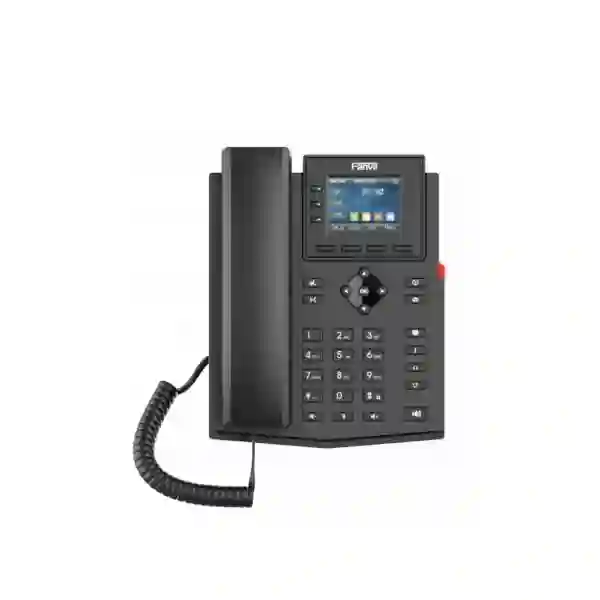
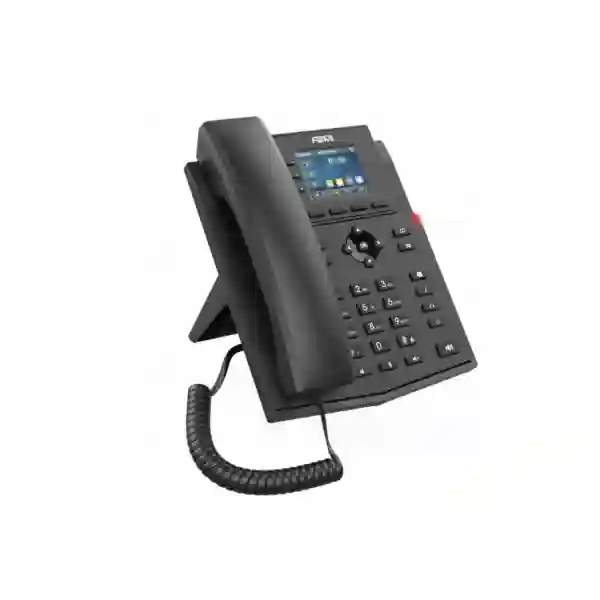
Fanvil X303W Wi-Fi Enterprise IP Phone
The Fanvil X303W Wi-Fi Enterprise IP Phone is an entry-level business SIP desk phone designed for organizations that want the convenience of wireless network connectivity without giving up the familiar experience of a dedicated office handset. Fanvil equips the X303W with a 2.4-inch 320×240 color display, support for four SIP lines, HD voice, local six-party audio conferencing, EHS wireless-headset support and built-in dual-band 2.4GHz/5GHz Wi-Fi. The result is a practical endpoint for offices, reception points, shared work areas and branch locations where a wired Ethernet drop may not always be convenient.
A flexible Wi-Fi SIP phone for everyday business communication
For a modern office, an IP phone is not only a handset. It is an endpoint that must fit the organization’s call flow, voice platform, network design and user habits. The Fanvil X303W addresses common desk-phone requirements while adding built-in dual-band Wi-Fi, which can simplify deployment in locations where running a new data cable is inconvenient. It can still be used in a wired network environment, giving IT teams flexibility when desk layouts or branch-office conditions vary.
Its four SIP lines provide room for multiple accounts or line appearances, while HD voice support with G.722 and Opus helps deliver clearer speech when the PBX, network and far-end endpoints support wideband audio. Local six-party audio conferencing can help small teams combine multiple participants without immediately moving to a separate conferencing device. EHS headset compatibility is useful for users who spend significant time on calls and want hands-free operation.

Fanvil X303W key verified features
Dual-band Wi-Fi
Built-in 2.4GHz and 5GHz Wi-Fi provides a wireless network option for flexible desk placement. The official Fanvil datasheet identifies 2.4GHz 802.11 b/g/n and 5GHz 802.11 a/n/ac support.
Four SIP lines
Four SIP lines make the phone suitable for typical office extension roles that need multiple registrations, line appearances or account options, subject to the capabilities of the selected PBX or SIP service.
HD audio
Fanvil lists G.722 and Opus among the wideband codecs and specifies HD voice on handset and hands-free operation, supported by echo-cancellation and audio-processing functions.
Six-party local conference
The X303W can support a local six-party audio conference, allowing the organizer to bring additional participants into the same call without relying exclusively on an external conference bridge.
Color display
A 2.4-inch 320×240-pixel color display gives users a clearer interface for line status, contacts, call information and phone menus than a basic monochrome desk phone.
Headset and installation choices
The phone supports EHS wireless headset workflows and can be used on a desktop stand or wall mounted with the appropriate installation arrangement, helping it fit different user and space requirements.
What the X303W solves for business users
The strongest reason to consider the Fanvil X303W is deployment flexibility. Traditional desk phones are usually installed wherever the structured cabling reaches. In a new office that is easy to plan, but existing buildings, temporary work areas, renovated rooms, leased spaces and changing desk layouts can make cable work disruptive. Built-in Wi-Fi gives the X303W another way to reach the voice network, provided the business wireless environment is designed for reliable coverage, capacity and security.
The phone also helps businesses standardize a familiar physical calling interface. Users still have a handset, keypad, navigation controls, speakerphone, call keys and a color display, which can be easier for reception, administration, finance, operations and customer-service staff than relying only on a softphone. A dedicated SIP phone can also keep business calling separate from the employee’s personal mobile device.
For IT teams, the practical question is not simply whether Wi-Fi works, but whether the phone can be integrated cleanly with the selected IP PBX, SIP trunk, numbering plan, VLAN strategy, authentication method and provisioning workflow. FourTeck can help customers review the endpoint as part of a complete voice design rather than treating the handset as an isolated purchase.
Technical overview
| Model | Fanvil X303W Enterprise IP Phone |
| Display | 2.4-inch 320×240 color screen |
| SIP lines | 4 SIP lines |
| Wi-Fi | 2.4GHz 802.11 b/g/n and 5GHz 802.11 a/n/ac |
| Wideband codecs | G.722 and Opus |
| Conference | Local 6-party audio conference |
| Network | 100 Mbps Ethernet class; Wi-Fi built in |
| Power | PoE enabled; external power option |
| Headset | EHS wireless-headset support with compatible accessories |
| Installation | Desktop stand or wall-mount arrangement |
Exact compatibility, provisioning behavior and supported features can depend on firmware, PBX platform and network design. Confirm requirements before large deployments.
PBX, SIP and network integration guidance
A SIP phone becomes useful only after it is connected to a voice platform. Before ordering a batch of Fanvil X303W phones, identify the PBX or hosted voice service, the extension count, required calling features and the provisioning method. Basic registration normally requires SIP server information, credentials and network access, while business deployments often add feature codes, BLF behavior, call pickup, voicemail indication, transfer rules, time synchronization, directory integration and security policies.
Wi-Fi deserves particular attention. A desktop handset may remain in one place for years, so signal strength at that exact position matters more than whether a laptop occasionally shows a wireless signal. Check coverage on both 2.4GHz and 5GHz bands, channel utilization, authentication settings and whether the phone traffic will be separated from guest or general-user wireless traffic. Voice is sensitive to packet loss, jitter and delay, which means a stable access point and a well-designed LAN matter as much as the handset.
For broader planning, FourTeck Tanzania describes integrated IT, telecom and network solutions in Tanzania, which is useful when an IP-phone project also involves switching, Wi-Fi, firewall policy, structured cabling or branch connectivity. Customers that need design and implementation support can also review the FourTeck Tanzania services portfolio for related deployment and support planning.
Who should consider the Fanvil X303W?
Small and medium offices
Teams that need standard desk phones but want to avoid adding Ethernet cabling to every desk can use built-in Wi-Fi where the wireless network is suitably designed for voice.
Branches and temporary workspaces
A branch, project office or rapidly changing workspace may benefit from a phone that can operate with either wired networking or Wi-Fi, subject to PBX and security policies.
Customer-facing teams
Reception, administration, service desks and sales users can benefit from a dedicated SIP endpoint with a color screen, multiple line support, headset options and conference calling.
Buying checklist before requesting a quotation
A useful quotation should describe the deployment, not only the handset model. State the number of X303W phones required, the PBX or hosted voice platform, whether the phones will primarily use Wi-Fi or Ethernet, whether PoE is expected, and whether users require EHS headsets. For Wi-Fi deployments, include the office location, access-point environment and any enterprise wireless authentication requirements that may affect configuration.
Also confirm the intended call features: extension dialing, external SIP trunk calls, transfer, hold, pickup, voicemail, BLF, conference behavior and phonebook requirements. If the project is replacing older phones, identify the existing PBX and any provisioning templates. If it is a new deployment, include expected extension count, reception requirements, branch connectivity and internet redundancy. These details allow the supplier or integrator to recommend a complete and technically coherent solution.
Fanvil X303W Wi-Fi Enterprise IP Phone Tanzania
Businesses searching for the Fanvil X303W Wi-Fi Enterprise IP Phone in Tanzania are often trying to solve two requirements at the same time: modernize voice communication and make endpoint deployment easier in buildings where structured cabling is not available at every desk. The X303W is relevant to that need because it combines a familiar SIP desk-phone format with integrated 2.4GHz and 5GHz Wi-Fi. In a properly planned wireless network, the phone can be positioned in an office, reception area, meeting point or branch workspace without relying exclusively on a nearby Ethernet outlet.
For a Tanzania deployment, the purchasing decision should include more than the phone quantity. Confirm the PBX platform, SIP trunk or hosted voice environment, the number of user extensions, the calling features required and whether Wi-Fi coverage is strong at each planned desk location. Voice traffic is sensitive to jitter and packet loss, so an office that already experiences unstable Wi-Fi for laptops should address the wireless network before relying on it for desk phones. Where Ethernet is available, the X303W can still participate in a structured network design, giving IT teams flexibility across different rooms and branches.
The X303W’s four SIP lines, color display, HD audio, wideband G.722 and Opus codecs, local six-party conferencing and EHS headset support make it a practical fit for administrative users, reception teams, managers and general office staff. Organizations rolling out multiple phones should standardize extension naming, provisioning, time settings, directory configuration and user instructions. That approach reduces support effort and makes future moves or replacements easier.
FourTeck can discuss the handset alongside related voice, network and Wi-Fi requirements rather than treating it as a standalone box. The FourTeck Tanzania shop is a useful starting point for related business technology products, while project quotations can be prepared around actual quantities, integration needs and site conditions.
Fanvil X303W Wi-Fi Enterprise IP Phone Dar es Salaam
In Dar es Salaam, the Fanvil X303W can suit commercial offices that want a straightforward SIP handset but need more freedom in where phones are placed. Growing companies frequently rearrange departments, add temporary desks, open customer-service counters or move teams between rooms. A Wi-Fi-capable desk phone can reduce the dependence on adding a dedicated Ethernet cable every time the seating plan changes, provided the existing business wireless network has appropriate signal strength, capacity and security.
For offices in multi-tenant buildings or renovated premises, a practical assessment should begin with the voice system. Confirm whether the business uses an on-premises IP PBX, a hosted PBX or a SIP service supplied by another provider. The X303W supports four SIP lines, but the actual calling features that users see depend on the PBX configuration. Call transfer, pickup, voicemail, line keys, directory access and presence-style indications should be tested against the selected platform before a large rollout.
Wi-Fi planning in dense office environments also matters. Dar es Salaam businesses may operate near many neighboring wireless networks, so channel congestion can affect voice quality even when signal strength appears adequate. Using 5GHz where suitable can provide additional channel options, while 2.4GHz remains useful in areas where range is more important. Access-point placement, VLAN design, QoS, firewall rules and internet stability can all influence the user experience. If the office already has structured cabling, Ethernet can still be used for selected desks while Wi-Fi is reserved for locations where cabling is inconvenient.
When asking for a quotation in Dar es Salaam, specify the number of handsets, current PBX, headset needs, expected Wi-Fi usage and any requirement for configuration support. A complete bill of materials may also include switches, access points, firewall changes, UPS protection or cabling depending on the site. This produces a more useful comparison than evaluating handset price alone.
Fanvil X303W Wi-Fi Enterprise IP Phone Mwanza
For organizations in Mwanza, the Fanvil X303W provides a practical option for extending SIP telephony into offices, service counters and branch workspaces where a conventional wired phone installation may be inconvenient. Its built-in dual-band Wi-Fi can be useful in leased premises, mixed-use buildings or layouts where desks change more frequently than the cabling. The phone still operates as a dedicated business endpoint, giving staff a physical handset, speakerphone, color display and familiar call-control keys rather than requiring every user to rely on a computer or personal mobile device.
A Mwanza deployment should start with the quality of the local network. If phones are expected to use Wi-Fi, test the exact desks where they will be installed and verify stable signal, not simply general building coverage. Voice packets are continuous and time-sensitive, so intermittent wireless interference that is tolerable during web browsing can become noticeable during a conversation. Where the building has multiple floors, thick walls or metal shelving, the wireless design may need additional access points or changed placement before phone rollout.
The X303W supports four SIP lines and local six-party conferencing, which can cover ordinary branch-office calling needs when paired with a suitable PBX. HD audio with G.722 and Opus can improve speech clarity where the entire call path supports wideband voice. Headset users should confirm the specific EHS accessory combination required for their chosen headset brand and workflow. Administrators should also establish a repeatable configuration template so extensions, feature keys, directories and time settings are consistent across all phones.
For procurement, share the intended phone quantity, the existing PBX or SIP provider, whether the project is a new installation or replacement, and whether branch-to-branch dialing is required. These details help identify whether the handset can be integrated directly or whether additional voice, network or internet changes are needed.
Fanvil X303W Wi-Fi Enterprise IP Phone Arusha
Arusha businesses in hospitality, professional services, administration, travel, education and general commerce may need desk phones that are simple for users but flexible for IT teams. The Fanvil X303W is designed around that balance. It combines a color interface and four SIP lines with built-in 2.4GHz/5GHz Wi-Fi, allowing a business to deploy voice endpoints in locations where structured cabling is limited or where a room layout changes over time.
In hospitality or customer-facing environments, a desk phone is often part of a broader call-flow design. Reception may need transfer and directory access, back-office staff may require several line appearances, and managers may value a wireless headset. The X303W’s local six-party conference feature can help with small internal or partner calls, while wideband codecs such as G.722 and Opus support HD voice where the PBX and network path permit it. These benefits should be tested in the actual voice environment rather than assumed from the handset specification alone.
Wi-Fi implementation should be deliberate. In hotels, offices or multi-building sites, guest Wi-Fi and business voice should not simply share an unmanaged network. Separate SSIDs or VLANs, controlled firewall policies and appropriate QoS can help protect voice traffic and reduce unnecessary exposure. The exact design depends on the wireless platform and security requirements. Where a stable Ethernet drop exists, a wired connection remains a straightforward choice; Wi-Fi is valuable because it adds another deployment option rather than because every desk must be wireless.
When requesting the Fanvil X303W in Arusha, identify how many extensions are needed, whether the phones will connect to a local or cloud PBX, and whether existing Wi-Fi has been designed for business voice. Include headset, wall-mount and power requirements in the quotation so the complete deployment can be evaluated before purchase.
Fanvil X303W Wi-Fi Enterprise IP Phone Dodoma
In Dodoma, organizations evaluating the Fanvil X303W are likely to value a compact business phone that can fit both established offices and expanding workspaces. Government-related contractors, professional firms, education providers, service organizations and private businesses may have branch or project offices where network layouts evolve. The X303W’s integrated dual-band Wi-Fi can help reduce dependence on new cable runs when the wireless network is already suitable for real-time voice.
The device is most effective when deployment is planned around the voice system. Four SIP lines provide flexibility for users who need more than a single account, and the color display supports a more informative user interface. Local six-party conferencing can simplify short coordination calls, while HD audio through G.722 and Opus can improve clarity on compatible calls. EHS headset support is useful for users who need to answer calls away from the handset or work hands-free, but the correct adapter and headset combination should be confirmed during procurement.
Network readiness remains central. A phone connected over Wi-Fi depends on stable access-point coverage, low interference and a reliable path to the PBX or SIP provider. If the voice platform is hosted outside the site, internet quality and firewall behavior become important parts of the call path. If the PBX is on premises, internal switching, VLANs and power protection may matter more. A well-planned deployment documents extension numbers, credentials, device labels and configuration standards so future troubleshooting is predictable.
Buyers in Dodoma should request a quotation that distinguishes handset supply from optional configuration, network preparation, PBX work and accessories. That makes it easier to compare proposals and avoids discovering after delivery that a required power adapter, headset interface or network change was not included.
Fanvil X303W Wi-Fi Enterprise IP Phone UAE
For UAE offices and regional operations, the Fanvil X303W can be a useful endpoint where businesses want a standard SIP desk phone with the added flexibility of built-in Wi-Fi. The combination of four SIP lines, a 2.4-inch color display, HD voice and local six-party conferencing fits typical administrative and office calling roles. Dual-band 2.4GHz and 5GHz wireless connectivity can be valuable in fitted offices where adding another cable outlet is disruptive or in temporary project spaces where desks move frequently.
Enterprise environments in the UAE often have managed wireless infrastructure, structured VLANs and centralized security controls. Before choosing Wi-Fi as the primary transport for desk phones, check the wireless authentication method and the way voice traffic will be segmented. Not every enterprise security configuration is identical, and the phone’s supported wireless capabilities should be matched to the actual network policy. For high-density offices, 5GHz can provide more channel options, but coverage should be validated at each phone location.
The X303W can also be considered in regional deployments where the same PBX serves several countries. Standardizing on a phone model can simplify user training, configuration templates and spare management, but SIP-trunk arrangements, emergency-calling requirements and telecom regulations can differ by country. Those elements should be reviewed separately rather than assuming one configuration works everywhere.
Organizations comparing endpoints across East Africa and the Gulf can use the X303W as part of a common SIP strategy while adapting network and carrier settings per site. The goal is consistent user experience with locally appropriate connectivity and support arrangements.
Fanvil X303W Wi-Fi Enterprise IP Phone Uganda
Businesses in Uganda can use the Fanvil X303W as a flexible office SIP endpoint for headquarters, branches and customer-facing locations. Built-in 2.4GHz/5GHz Wi-Fi is especially useful where a desk or reception point has reliable wireless coverage but no convenient Ethernet outlet. The phone keeps the familiar experience of a physical handset while connecting to an IP PBX or SIP service through the business network.
A national or multi-branch rollout should begin with PBX architecture. Decide whether all sites connect to a centralized platform, whether each branch has local voice equipment, or whether the company uses a hosted service. The X303W’s four SIP lines can support several account or line roles, while six-party conferencing and HD audio provide useful everyday features. The exact behavior of transfer, pickup, voicemail, BLF and directory functions depends on the PBX and should be validated with the target configuration.
Wireless voice is only as good as the wireless network beneath it. Branches should be checked for signal strength, congestion and internet stability where the PBX is cloud based. If a site experiences frequent WAN interruptions, consider how voice continuity is expected to work and whether a backup internet link is needed. Power protection for switches, routers and access points can also be important because a Wi-Fi phone cannot reach the PBX if the supporting network goes offline.
For customers coordinating Tanzania and Uganda requirements, FourTeck Uganda provides a regional reference for IT, PBX, CCTV and networking solutions. A cross-border procurement plan should still document quantities and site requirements separately so each location receives the correct configuration and accessories.
Fanvil X303W Wi-Fi Enterprise IP Phone Kampala
Kampala offices that are expanding, relocating or introducing hosted telephony can consider the Fanvil X303W when they need a straightforward business handset with wireless flexibility. A typical deployment might include reception desks, sales teams, administration, finance or branch management. The 2.4-inch color display makes day-to-day call information easy to view, while four SIP lines give the phone more flexibility than a basic single-account endpoint.
In a busy urban office environment, Wi-Fi planning matters because many neighboring networks can compete for radio channels. A strong signal does not automatically mean low interference. Businesses should evaluate channel utilization and the quality of the access-point infrastructure at each desk. The X303W supports both 2.4GHz and 5GHz bands, so administrators can choose the band that best fits coverage and capacity requirements. Managed voice networks may also use separate VLANs or SSIDs, QoS and firewall rules to keep calling predictable.
For users who spend much of the day on calls, EHS wireless-headset support can improve comfort and mobility around the desk. For small team calls, local six-party conferencing may reduce the need to create an external bridge for every discussion. HD audio support is most valuable when codecs, PBX and the other endpoint all support wideband voice; otherwise the call will use the capabilities available across the whole path.
A Kampala quotation should therefore include more than the model number. List phone count, PBX type, Wi-Fi design, headset needs, installation method and configuration expectations. If the project includes new access points, switches or internet changes, include those items in the design so the voice service is supported by the network from the beginning.
Fanvil X303W Wi-Fi Enterprise IP Phone Arua
In Arua, the Fanvil X303W can fit branch-office environments where businesses want dependable SIP extensions without assuming that every workstation has structured Ethernet cabling. Its built-in wireless capability can be useful for administrative offices, service counters, small branch teams and project locations where a stable business Wi-Fi network already exists. Because the handset can also work within a conventional IP network design, the same model can be standardized across different site conditions.
For branch deployments, connectivity to the main PBX is a key design question. If the phone registers to a cloud or remote PBX, the WAN connection becomes part of every call. Bandwidth demand for voice is modest compared with video, but call quality is sensitive to packet loss, delay and jitter. Businesses should therefore review internet reliability, firewall settings and any VPN or security architecture used between the branch and central systems. A backup connection may be valuable where voice availability is operationally important.
The X303W’s four SIP lines can support multiple registrations or line appearances, while the color screen improves usability for contacts and call status. Six-party local conferencing can support internal coordination, and EHS headset compatibility may suit staff who need hands-free calling. Wi-Fi coverage should be measured at the planned phone location, particularly in buildings with thick walls or long corridors that can weaken signal.
When requesting equipment for Arua, describe whether phones are for a new site, a replacement project or an extension of an existing PBX. Include expected extension numbering, central-office connectivity and any requirement for remote provisioning. That information helps the deployment team prepare consistent settings before the phones reach users.
Fanvil X303W Wi-Fi Enterprise IP Phone Mbarara
For businesses in Mbarara, a Wi-Fi desk phone can be attractive when the office needs a dedicated voice endpoint but the cabling layout is limited. The Fanvil X303W brings together four SIP lines, a compact color display, HD voice, local six-party conferencing and dual-band Wi-Fi. This combination can serve general office staff, branch managers, reception points and customer-service roles where a physical phone remains the preferred way to handle calls.
Before deployment, define the call flow. Determine which incoming numbers ring each extension, whether calls need an IVR or queue, how transfers are handled, and what happens after hours. Those requirements belong to the PBX rather than the phone itself, but the endpoint must be configured to make those functions easy for users. Feature keys, phonebooks and voicemail indicators should be tested against the selected platform.
Wireless readiness is equally important. The X303W supports 2.4GHz and 5GHz Wi-Fi, but the best band depends on building layout, access-point placement and interference. A reliable business SSID should have adequate signal at each desk and should not be overloaded by guest traffic or high-volume applications. If the PBX is off site, internet stability and firewall policy also affect call quality. For critical branches, network and power resilience should be considered alongside the phone purchase.
A procurement request for Mbarara should include handset count, PBX details, whether phones use Wi-Fi or Ethernet, headset requirements and any need for preconfiguration. If there are several branches, consistent labeling and configuration templates can save support time and help staff move between locations without learning a different phone workflow.
Fanvil X303W Wi-Fi Enterprise IP Phone Gulu
Gulu organizations looking for a practical SIP handset can consider the Fanvil X303W where wireless deployment is useful. The phone’s built-in 2.4GHz and 5GHz Wi-Fi can reduce cabling dependence in branch offices, training facilities, service organizations and other environments where desk locations may change. At the same time, users receive the dedicated handset, speakerphone and hardware keys expected from a traditional office telephone.
The X303W supports four SIP lines and a 2.4-inch color display, providing enough flexibility for common office roles. Local six-party conferencing can support quick team discussions, while HD audio with G.722 and Opus can provide clearer speech where the whole voice path supports those codecs. EHS wireless-headset compatibility is useful for staff who need to move around a work area while remaining available on calls, though the accessory combination should be confirmed before order.
For remote or branch sites, network stability deserves as much attention as handset selection. If a phone connects over Wi-Fi and reaches a cloud PBX over the internet, both the local wireless link and WAN link must perform consistently. IT teams should check signal, access-point capacity, DHCP, DNS, firewall rules and any QoS policies. Power backup for the router and access point may also matter if continued calling during short power interruptions is an operational goal.
When preparing a quotation for Gulu, identify the exact deployment scenario and include any configuration, installation or network work separately. Clear scope helps avoid hidden dependencies and gives decision makers a realistic view of what is needed to put the phones into service rather than simply delivering unopened hardware.
Fanvil X303W Wi-Fi Enterprise IP Phone Kenya
The Fanvil X303W is relevant to Kenyan businesses that want an affordable business SIP endpoint with the added convenience of dual-band Wi-Fi. A phone with integrated wireless can be useful in offices, retail back offices, hospitality operations, schools, clinics and branch environments where adding a network cable to every desk is not practical. The core functions remain those of a business desk phone: four SIP lines, a color screen, HD voice, conference calling and headset support.
For multi-site organizations, standardization can be more valuable than selecting a different handset for every branch. Using a consistent model simplifies training, provisioning templates, spare management and troubleshooting. However, each site still needs its own connectivity assessment. Nairobi offices may have dense wireless conditions, while regional branches may have different internet and power characteristics. The X303W supports both 2.4GHz and 5GHz Wi-Fi, allowing administrators to choose the most appropriate band for each location.
A Kenya deployment should confirm PBX compatibility and required SIP functions before volume purchase. Test call hold, transfer, pickup, voicemail, BLF behavior, directory use and any remote provisioning process used by the organization. Headset users should confirm the appropriate EHS integration. Where the PBX is cloud hosted, WAN latency and reliability can influence the user experience more than the handset itself.
Organizations coordinating procurement between Tanzania and Kenya can refer to FourTeck Kenya for regional IT, VoIP PBX and network-security context. Quotations should still list each site separately so quantities, accessories and configuration requirements are not mixed between countries.
Fanvil X303W Wi-Fi Enterprise IP Phone Kuwait
Kuwait businesses evaluating the Fanvil X303W may be looking for a practical SIP desk phone that can be deployed without depending entirely on Ethernet at every workstation. The integrated 2.4GHz/5GHz Wi-Fi capability is useful for fitted offices, temporary project rooms and areas where adding new structured cabling would be inconvenient. A dedicated handset also keeps business calling separate from users’ personal mobile devices and provides consistent call controls.
The phone’s four SIP lines provide flexibility for common office roles, while the 2.4-inch color screen makes call information and menus easier to navigate. HD voice support, including G.722 and Opus, can improve clarity when supported by the PBX, SIP trunk and far-end device. Local six-party conferencing can be useful for small coordination calls, and EHS headset support gives frequent callers a hands-free option.
In enterprise office networks, Wi-Fi security and segmentation must be considered before deployment. A voice endpoint may need access only to the PBX, DNS, NTP and provisioning services, not the same resources as user laptops. The exact policy will depend on the organization’s firewall and wireless platform. If 5GHz coverage is strong, it can help reduce congestion; if range is more important, 2.4GHz may be practical. The decision should be based on site testing rather than a universal rule.
For procurement, specify the number of phones, PBX platform, required user features, headset type and intended network method. If the X303W is part of a larger regional standard, document configuration differences for each country and branch so that provisioning remains controlled and support teams know which settings apply to which site.
Fanvil X303W Wi-Fi Enterprise IP Phone Ghana
Ghanaian businesses can consider the Fanvil X303W when they need a business SIP endpoint that is simple to use yet flexible to deploy. Built-in 2.4GHz and 5GHz Wi-Fi can help offices extend voice service to desks or counters without installing additional data cabling, assuming the existing wireless network is stable. The phone retains a conventional handset and keypad, making it suitable for users who prefer a dedicated office phone over a softphone application.
The four SIP lines can support typical multi-line office workflows, and the 2.4-inch color screen provides a clear interface for calls and settings. Local six-party conferencing is useful for small business discussions, while HD audio with G.722 and Opus can provide more natural speech when the end-to-end voice path supports wideband codecs. EHS headset support is also relevant to customer-service and administrative users who need hands-free mobility.
For Ghana deployments, network planning should include both the local wireless environment and the connection to the PBX. If the organization uses a cloud voice service, internet stability, firewall rules and DNS become critical. If the PBX is on premises, internal switching, VLANs and local power protection may be more important. In either case, a voice-specific network assessment helps prevent the common mistake of blaming the phone for issues caused by unstable connectivity.
When asking for a quotation, identify whether the project is for one office or multiple branches, how many extensions are required, and whether phones need preconfiguration. Include accessory, mounting and headset requirements so the quote reflects the complete deployment. Large projects should validate a sample configuration before mass rollout and keep a documented template for consistent setup.
Fanvil X303W Wi-Fi Enterprise IP Phone Nigeria
In Nigeria, the Fanvil X303W can suit businesses that want a dedicated SIP desk phone without limiting every extension to a fixed Ethernet point. Built-in dual-band Wi-Fi makes it possible to deploy phones in offices, project rooms, service counters and branch locations where business wireless coverage is already available. The same handset provides four SIP lines, a color display, HD voice, local six-party conferencing and EHS headset support for everyday business use.
Large Nigerian offices and multi-floor buildings should assess wireless density carefully. Voice quality depends on consistent packet delivery, so overloaded access points or weak coverage can cause audible problems even when normal browsing appears acceptable. A planned WLAN should use suitable channel allocation, controlled client density and security settings. Businesses may choose 5GHz in dense areas and 2.4GHz where additional range is needed, but the actual selection should follow site testing.
The phone’s SIP features should also be tested against the company’s PBX. A corporate rollout may require centralized provisioning, extension templates, directories, BLF, call pickup, voicemail, transfer and specific security settings. The X303W supports a broad business calling feature set, but platform-specific behavior can vary. A pilot deployment with representative user roles can uncover issues before a large order is configured.
For quotations in Nigeria, provide expected quantities per site, PBX details, network method, headset requirements and whether the supplier is expected to perform configuration. Consider internet and power resilience where phones depend on a cloud PBX or centralized regional platform. The handset should be treated as one component in a complete voice path that includes LAN, Wi-Fi, firewall, WAN and SIP services.
Fanvil X303W Wi-Fi Enterprise IP Phone Seychelles
Seychelles organizations in hospitality, professional services, administration and other sectors may find the Fanvil X303W useful where a compact SIP phone and flexible wireless placement are important. Hotels, guest-service offices and multi-building properties often have areas where network cabling and desk layouts vary. Integrated 2.4GHz/5GHz Wi-Fi can provide another deployment path when there is stable managed wireless coverage at the intended phone location.
The four SIP lines can support common office and service workflows, and the 2.4-inch color screen gives staff an approachable interface for everyday calling. Local six-party conferencing can support small team discussions, while G.722 and Opus wideband codecs can improve clarity on compatible calls. EHS headset support may be relevant at reception or reservation desks where users need to work hands-free while remaining on calls.
For island and hospitality environments, network architecture should be reviewed carefully. Some properties have separate guest, staff and operational wireless networks, and voice devices should be placed on the appropriate secured network rather than on a public guest SSID. If the PBX is hosted overseas or in another region, internet path quality becomes a major factor in call performance. A local or regional PBX design may have different resilience considerations. Power protection for networking equipment can also help keep phones reachable during short interruptions.
A Seychelles quotation should identify whether phones are for guest-service areas, offices or general administration, because accessory and call-flow requirements may differ. Include the PBX platform, desired extension count, Wi-Fi design and configuration scope. A small pilot can be useful before standardizing the handset across multiple departments or properties.
Fanvil X303W selection and deployment guidance
Choose the X303W when wireless connectivity is a real deployment advantage and the user role fits a four-line business phone. If a location already has reliable PoE Ethernet at every desk, compare whether a wired-only or Gigabit model better matches the broader network standard. If the user needs a larger display, Bluetooth, many programmable keys or advanced executive features, another Fanvil model may be more appropriate. Selecting the right endpoint by role can reduce cost without forcing every user onto the same feature level.
For a multi-phone deployment, create a standard template before installation day. Define extension naming, SIP server settings, time zone, NTP, directory sources, DSS keys, voicemail access and firmware policy. Label phones and record MAC addresses where required for provisioning. Test emergency dialing, external calls, transfers and voicemail before users are trained. These steps are routine but have a large effect on deployment quality.
If the organization is still comparing IP-phone options, the specialist FourTeck IP phone resource provides broader context around business IP telephony. The best choice is the model that fits the user, PBX and network together rather than the handset with the longest feature list.
Frequently asked questions
Does the Fanvil X303W have built-in Wi-Fi?
Yes. Fanvil specifies built-in dual-band Wi-Fi supporting 2.4GHz 802.11 b/g/n and 5GHz 802.11 a/n/ac. This allows the phone to connect to a suitable wireless network without relying only on a desk-side Ethernet connection.
How many SIP lines does the X303W support?
The X303W supports four SIP lines. The way those lines are used depends on the PBX or SIP service, including whether they represent separate registrations, line appearances or other configured roles.
Does the Fanvil X303W support HD voice?
Yes. Fanvil lists HD voice and wideband codecs including G.722 and Opus. Actual call quality still depends on the PBX, network conditions, codec negotiation and the endpoint on the other side of the call.
Can the X303W handle conference calls?
Yes. The official specification lists local six-party audio conferencing. PBX-hosted conference services may also be available separately depending on the telephone system.
Can I use a wireless headset with the X303W?
The phone supports EHS wireless-headset workflows with compatible accessories. Confirm the headset brand, model and required EHS cable or adapter before purchase so the complete solution is included.
Is Wi-Fi always better than Ethernet for this phone?
No. Wi-Fi adds flexibility, but Ethernet can remain preferable where structured cabling is already available and predictable wired connectivity is desired. The X303W is attractive because it gives deployment choices. Use the connection method that best fits the site.
What should I provide when requesting a quote?
Provide the number of phones, country and city, PBX or hosted voice platform, whether phones will use Wi-Fi or Ethernet, headset requirements, wall-mount needs, configuration scope and any network or installation support required.
Decision recap
The Fanvil X303W is best understood as a business SIP phone that adds dual-band Wi-Fi to a practical four-line desktop design. It offers a 2.4-inch color display, HD voice, G.722 and Opus, local six-party conferencing, EHS headset support and flexible installation options. Those features make it suitable for standard office roles where wireless deployment can solve a real cabling or desk-placement problem.
Before buying, verify the PBX, user requirements and network environment. A successful IP-phone project depends on reliable SIP registration, clean call flows and a network that can carry voice consistently. For larger deployments, test one or more sample phones with the real PBX and Wi-Fi configuration, document the template, and then scale the rollout.
Consultation and quotation panel
For a useful quotation, send the required quantity, deployment city, PBX platform, planned network method and accessory requirements. If you are building a new phone system, include the number of users, reception and queue requirements, SIP-trunk status, branch locations and whether you need configuration or installation. This gives the sales and technical team enough context to separate the handset cost from any PBX, network, Wi-Fi, cabling or support work.
Avoid ordering only by model name when the project includes several offices. A short technical scope can prevent mismatched accessories and incomplete deployment assumptions. FourTeck can use that scope to discuss the Fanvil X303W in the context of the wider voice environment.



Reviews
There are no reviews yet.