
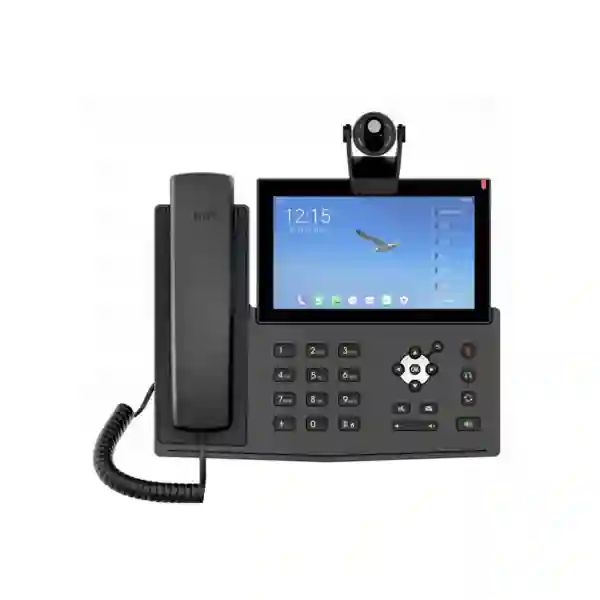
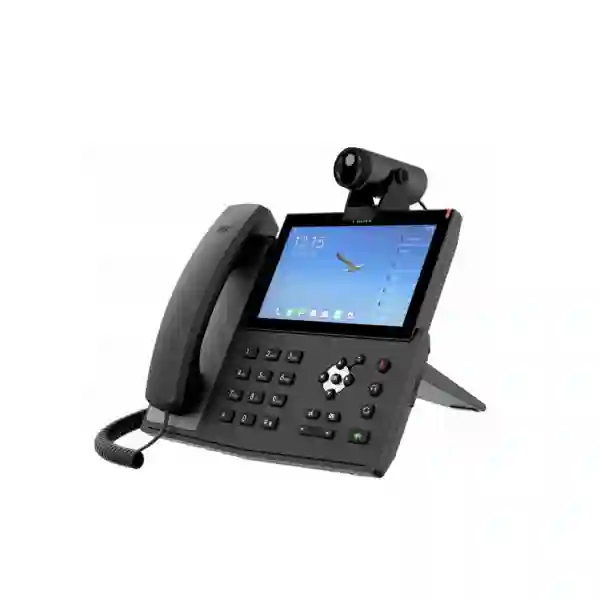
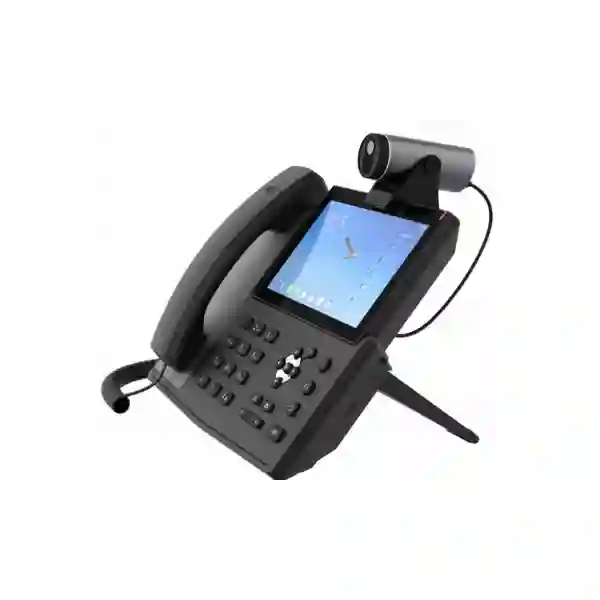
Fanvil X7A Android IP Phone with Camera
The Fanvil X7A is a high-end Android 9.0 business IP phone designed for users who need a large touch interface, extensive SIP capacity, programmable call controls and optional desktop video. Fanvil specifies 20 SIP lines, a 7-inch 1024×600 color touchscreen, built-in 2.4 GHz and 5 GHz Wi-Fi, Bluetooth 4.2, dual Gigabit Ethernet, integrated PoE, HD audio, H.264 video and support for the optional Fanvil CM60 USB camera. For organisations in Tanzania, the strongest buying case is not simply the feature list; it is the ability to combine a capable endpoint with a properly designed SIP platform, managed LAN, voice VLAN, PoE switching, secure provisioning and a practical user-role plan.
SIP lines
touchscreen
dual Ethernet
integrated
What the Fanvil X7A is designed to do
The X7A is positioned above basic SIP handsets for users who handle several lines, rely on rapid call control or want a touchscreen workflow. The Android 9.0 operating environment gives the phone a familiar app-style interface and Fanvil documents support for third-party applications, although any application planned for production use should be validated for the exact firmware, security policy and business workflow. The 7-inch capacitive color touchscreen provides room for contacts, call logs, menus and large sets of virtual DSS keys. Fanvil literature for the X7A family describes 112 one-touch DSS keys on the touchscreen, while some current product tables list 116 DSS keys; buyers should therefore confirm the exact current firmware presentation and configuration required rather than purchasing on the basis of one isolated DSS-count reference.
The core telephony capacity is substantial for a desk endpoint. Fanvil specifies 20 SIP lines and common business call functions including hold, transfer, call waiting, forwarding, redial, do-not-disturb, auto answer, hotline, hot desking, BLF, call pickup when supported by the server, and ten-way audio conferencing. That makes the X7A relevant for executive assistants, receptionists, managers, service coordinators and other users who may monitor several extensions or participate in frequent internal and external calls. A feature-rich phone still depends on PBX behaviour. Presence, BLF, shared-line appearance, voicemail indication, directory integration and secure signalling can behave differently across platforms, so pilot testing is sensible before a large rollout.
Audio capability includes HD handset and speaker audio, wideband G.722 and Opus codecs, full-duplex acoustic echo cancellation, noise reduction and jitter-handling features. Fanvil also documents narrowband codecs including G.711 and G.729 family support. The endpoint can therefore participate in modern wideband calls when the PBX, trunk and remote endpoint support compatible codecs. For daily quality, the network is just as important as the codec list. Packet delay, jitter, loss, overloaded uplinks and poorly configured firewalls can undermine an otherwise capable phone, which is why voice VLANs, QoS policy and stable switching should be considered part of the X7A project.
Touch interface
A 7-inch 1024×600 color touchscreen gives high-activity users more visual room for directories, call handling, settings and virtual DSS functions than conventional monochrome desk phones.
Wireless flexibility
Built-in 2.4/5 GHz Wi-Fi and Bluetooth 4.2 support flexible placement and compatible wireless accessories, while wired Gigabit Ethernet remains preferable where predictable voice performance is the priority.
Video-ready design
H.264 video support and compatibility with the optional Fanvil CM60 USB camera allow the X7A to support desktop video calling and three-way video conferencing in compatible deployments.
Power and LAN
Dual 10/100/1000 Mbps Ethernet ports and IEEE 802.3af PoE support can simplify desks by carrying network and power over structured cabling when the access switch has sufficient PoE budget.
Verified technical highlights
| Operating system | Android 9.0 | SIP lines | 20 |
| Display | 7-inch 1024×600 color touchscreen | Network | Dual Gigabit Ethernet |
| Wi-Fi | 2.4 GHz 802.11 b/g/n and 5 GHz 802.11 a/n/ac | Bluetooth | Built-in Bluetooth 4.2 |
| Power | PoE or 5V/2A adapter | Video | H.264, up to 1080p decoding profile in supported use |
| Camera | Optional Fanvil CM60 USB camera | Conference | 10-way audio, 3-way video |
Specifications should be checked against the current Fanvil datasheet and firmware at the time of quotation, especially where a deployment depends on a particular third-party application, PBX feature, accessory, security mode or camera workflow.
PBX compatibility, network design and deployment planning
Fanvil lists compatibility with major SIP ecosystems including Asterisk, BroadSoft, 3CX, Metaswitch, Elastix and Avaya in product literature. That is a useful starting point, but enterprise buyers should define what “compatible” means for their own workflow. Basic SIP registration and calling may work while advanced functions such as remote phonebooks, BLF, secure provisioning, directory search, multicast, recording, video, XML services or platform-specific soft keys require additional configuration. The practical method is to test one endpoint against the production PBX profile and confirm inbound calling, outbound calling, transfer, hold, conferencing, voicemail indication, caller ID, time synchronisation, directory access, headset operation and any receptionist functions.
The X7A supports dual Gigabit Ethernet, so a user computer can share the desk network drop without forcing the workstation through a 100 Mbps bottleneck. Where Power over Ethernet is used, verify both the per-port power standard and the aggregate switch PoE budget. A rack UPS supporting the PoE switch can improve resilience during brief power interruptions because phone power and network switching remain centralised. Sites using the optional external 5V/2A adapter should include local socket availability and desktop power continuity in the deployment plan.
Wireless connectivity is useful when desk cabling is unavailable or flexible placement matters, but business voice should still be engineered for radio conditions. The X7A supports 2.4 GHz and 5 GHz Wi-Fi. A crowded 2.4 GHz environment, weak signal, roaming edge or oversubscribed access point can produce audio problems that look like phone faults. Where wired Ethernet is available, it usually provides the more deterministic path. Where Wi-Fi is necessary, verify coverage, channel design, authentication method, VLAN mapping and QoS from the wireless layer through to the PBX.
Security should be planned end to end. Fanvil documents SIP over TLS, SRTP, 802.1X, HTTPS management and encrypted configuration support among its networking and management capabilities. These features are valuable when they match the organisation’s certificate, switch, PBX and provisioning design. Administrators should avoid leaving default credentials, unnecessary services or unmanaged application installations in place. Firmware should be governed as part of the endpoint lifecycle, and configuration backups or provisioning templates should be controlled so that replacement phones can be introduced predictably.
Who should consider the Fanvil X7A?
Executives and managers
The large screen, Bluetooth, Wi-Fi, multiple SIP registrations and programmable controls suit users who manage several call paths and value rapid access to contacts and status information.
Reception and coordination desks
A high DSS-key capacity and multi-line operation can support reception, dispatch, reservations and departmental coordination when BLF and transfer behaviour are correctly configured on the PBX.
Collaboration-heavy users
HD audio, ten-way audio conferencing and optional CM60 camera support can help users who frequently switch between voice calls, ad-hoc conferences and compatible desktop video sessions.
Related FourTeck Tanzania telephony options
The X7A is a premium Android endpoint and may be more capable than many ordinary desks require. For mixed-role deployments, compare simpler SIP handsets before standardising every user on the same model. FourTeck Tanzania currently lists the Dinstar C60S Business IP Phone for basic two-account users, the Dinstar C60SP PoE Business IP Phone when centralised PoE is required, the Dinstar C60U-W Wi-Fi IP Phone for wireless desk connectivity, and the Dinstar C62U Business IP Phone for users needing additional SIP capacity. Buyers can also review the Dinstar C62UP PoE Business IP Phone and Dinstar C63G Business IP Phone for alternative office profiles.
For broader planning, the FourTeck Tanzania technology shop explains product-selection dependencies across IP phones, PBX, switching and infrastructure, while the FourTeck Tanzania solutions overview places telephony in the wider network and collaboration architecture. When quantities, PBX platform, current switches and user roles are known, use the FourTeck Tanzania contact page to request a quotation or compatibility discussion.
Regional procurement and deployment guidance
Fanvil X7A Android IP Phone with Camera Tanzania
For organisations evaluating the Fanvil X7A Android IP Phone with Camera in Tanzania, the most useful purchasing approach is to map the phone to a specific user role and voice architecture. The X7A is not a basic extension handset. Its 20 SIP lines, large touchscreen, Android platform, integrated wireless connectivity, Gigabit switching and optional camera make it better suited to executives, reception points, managers, customer-service supervisors, dispatch coordinators and other staff who benefit from rich call control. A Tanzania quotation should therefore separate premium users from ordinary desk users rather than assuming every extension needs the same endpoint. This role-based approach can reduce unnecessary cost while still giving high-activity positions the capabilities they need.
Network readiness should be checked before quantity is finalised. The X7A can be powered through PoE, which is attractive for centrally managed offices because a suitable PoE switch and UPS can keep both network and phones supported during short utility interruptions. Confirm the switch model, available PoE budget, VLAN capability and uplink design. If phones share ports with computers, the X7A’s Gigabit pass-through supports modern desktop data rates, but voice traffic should still be protected with appropriate QoS and segmentation. Businesses using Wi-Fi should test signal quality and airtime at the actual desk locations instead of assuming the presence of dual-band Wi-Fi removes the need for network planning.
PBX compatibility is the other major procurement question. Share the PBX brand, software version, SIP trunk arrangement, extension count, directory requirements and any need for BLF, call pickup, call recording, secure SIP, remote provisioning or third-party Android applications. The optional CM60 USB camera should be included only where desktop video has a defined use case and the target platform supports the expected workflow. For procurement teams, the best request includes phone quantity by role, PBX details, PoE availability, headset requirements, camera quantity, current network design and rollout locations. That gives FourTeck enough context to treat the X7A as part of a working telephony system rather than an isolated handset purchase.
Fanvil X7A Android IP Phone with Camera Dar es Salaam
Dar es Salaam businesses often combine dense office staffing, customer-facing reception, logistics coordination and multi-department calling on the same network. In that environment, the Fanvil X7A can be a strong endpoint for positions that need visibility and speed. Reception staff can benefit from programmable DSS functions and multiple SIP registrations; managers can use Bluetooth headsets and the larger touchscreen; coordinators can keep several extensions or service identities visible without moving to a separate attendant console. The key is to configure the interface around the job. A phone with many programmable keys only improves productivity when extension labels, BLF states, transfer behaviour and contact directories are organised logically.
A Dar es Salaam deployment should also examine LAN contention. Voice may share switches and uplinks with CCTV, wireless access points, cloud applications, file transfers and internet traffic. The X7A’s Gigabit ports prevent the handset itself from becoming a Fast Ethernet bottleneck, but the rest of the path still needs sufficient capacity. Managed switches should provide voice VLAN and QoS options, and the firewall should allow required SIP and media flows without exposing management services unnecessarily. Where the phone is connected over Wi-Fi, assess the actual 5 GHz coverage at desks and avoid relying on a heavily congested 2.4 GHz network for high-priority voice.
Power and continuity should be part of the bill of materials. PoE can simplify desks and centralise power, provided the switch has enough aggregate budget and is itself protected appropriately. If external adapters are used, identify socket availability and whether local UPS coverage is needed. Organisations planning the CM60 camera should confirm USB-port use, platform support, user privacy expectations and whether desktop video is genuinely more useful than a separate meeting-room system. A well-scoped Dar es Salaam quotation should list departments, premium-user quantity, standard-user quantity, PBX platform, trunk provider, switch model, network topology, headsets and camera needs. For integrated voice and network design, the broader FourTeck Tanzania shop and contact resources can help turn those inputs into a more complete project discussion.
Fanvil X7A Android IP Phone with Camera Mwanza
Mwanza organisations considering the Fanvil X7A may be upgrading from analog telephony, expanding an existing SIP environment or standardising executive endpoints across a branch network. In each case, the phone should be evaluated as part of the full communications path. If the existing PBX already supports SIP extensions, begin with a pilot registration and verify transfer, hold, voicemail indication, directory search, BLF and conference behaviour. If the organisation is moving from analog lines to an IP PBX, define the new extension plan and call flow first, because handset selection should follow the way incoming and internal calls will be handled.
The X7A’s management capabilities can be particularly useful where IT teams support several sites. Fanvil documents auto-provisioning methods including FTP, TFTP, HTTP, HTTPS, DHCP option 66, SIP PnP and TR-069, as well as web management and firmware upgrade. In practice, this means a Mwanza rollout can be built around repeatable templates instead of configuring each phone manually. Administrators should still test templates carefully, secure provisioning credentials and document firmware versions. Replacement endpoints become easier to introduce when extension settings, VLAN assignments, phonebooks, time parameters and user-key layouts are standardised.
Infrastructure planning should cover both power and connectivity. PoE is often preferable for business phones because it can reduce desktop adapters and place power resilience in the network rack. Where the office has only one network drop per desk, the X7A’s Gigabit PC pass-through is useful. If Wi-Fi is used for selected desks, conduct coverage checks and ensure the wireless network can prioritise latency-sensitive traffic. The optional camera should be treated as a separate decision because not every user who needs a premium voice endpoint also needs desktop video. Before requesting a Mwanza quotation, provide quantities by user profile, PBX model, network switch details, PoE availability, headset models, camera requirement and any remote management expectations. These inputs make it easier to choose the X7A where its capabilities create real operational value.
Fanvil X7A Android IP Phone with Camera Arusha
Arusha businesses in hospitality, tourism administration, professional services, education and general commercial operations may need telephony that supports both customer-facing calls and internal coordination. The Fanvil X7A is best suited to users who handle more than a basic extension workload. A reservations supervisor, front-office manager or executive assistant can use the touchscreen and DSS functions to reach colleagues quickly, monitor extension states and manage transfer-heavy call flows. Managers who work between handset, speakerphone and headset modes can benefit from Bluetooth support, while optional camera capability may suit selected users who regularly participate in compatible video sessions from the desk.
Hospitality and service environments should define call behaviour carefully. Incoming numbers may need IVR routing, ring groups, queues, overflow rules and after-hours treatment at the PBX. The X7A endpoint presents the user interface, but those workflows depend on server configuration. Before procurement, confirm how reservations, reception, finance and management calls are routed, which users require BLF keys, and whether departmental identities need separate SIP registrations. A test handset can verify behaviour with the actual PBX and trunk before a broader rollout.
Arusha deployments should also review network and power resilience. If phones remain important during brief mains interruptions, PoE switches backed by UPS can create a more coordinated continuity design than individual adapters. Voice VLANs and QoS help protect calls when the same LAN carries guest Wi-Fi, office data and other business traffic. For wireless desks, the X7A’s 2.4/5 GHz capability is useful, but a site survey or at least targeted signal testing is preferable to assuming reliable coverage. Quotation requests should include phone count, user roles, PBX platform, switch and PoE details, headsets, directory needs and any camera requirement. That lets the project distinguish premium X7A users from standard extensions and ensures the supporting network is not overlooked.
Fanvil X7A Android IP Phone with Camera Dodoma
Dodoma organisations, institutions and administrative offices may evaluate the Fanvil X7A when they need a feature-rich SIP endpoint for managers, reception staff and coordination roles. The phone’s 20 SIP lines and large touchscreen are particularly relevant where a user handles multiple identities or needs a high number of programmable functions. Procurement should begin by confirming which positions genuinely need those capabilities. General staff may be better served by simpler phones, while high-activity desks receive X7A units. This mixed-endpoint model can keep the system easier to budget and support.
Formal IT environments often place greater importance on security and change control. The X7A supports secure communication and management options including SIP over TLS, SRTP, HTTPS and 802.1X, but these functions require matching infrastructure. Certificates, PBX settings, switch authentication and firewall policies should be designed consistently. Administrators should control firmware, disable unnecessary access and manage configuration backups or provisioning templates. Android application support should also be governed rather than treated as permission to install arbitrary apps on a business phone.
For Dodoma deployments, include continuity requirements in the architecture. PoE allows power to be delivered from the access switch, which can simplify desks and make UPS-backed voice easier to plan. Gigabit pass-through can preserve workstation connectivity where one cable serves both phone and PC. Voice VLANs and QoS should be configured according to the existing network design, and any Wi-Fi-connected phones should be tested for signal quality and authentication. A procurement brief should state the number of premium users, total extension count, PBX platform, SIP trunk arrangement, switch capability, PoE budget, headset needs, CM60 camera quantity and any central provisioning requirement. These details help turn the X7A purchase into a controlled deployment rather than a set of standalone devices.
Fanvil X7A Android IP Phone with Camera UAE
For UAE offices, the Fanvil X7A can serve as a premium SIP endpoint for executives, reception positions, operations teams and organisations standardising communications across several countries. Its 20 SIP lines, Android 9.0 interface, Gigabit Ethernet, PoE, Wi-Fi, Bluetooth and optional USB camera offer a flexible platform for advanced users. Multi-country organisations may benefit from creating one tested X7A profile for common PBX settings, security policy, phonebook access and key layout, then adapting only what is necessary for each site. That creates a more supportable model than allowing every branch to configure premium handsets independently.
UAE deployments often sit on structured managed networks, so the phone should be integrated with voice VLANs, QoS, PoE capacity and security controls from the start. If the X7A is deployed alongside PCs, its Gigabit pass-through helps preserve workstation throughput. Bluetooth can support compatible headsets for executives and reception staff, while Wi-Fi offers placement flexibility when cabling is unavailable. The CM60 camera should be specified only for users who need video at the desk and after confirming the intended collaboration or SIP-video workflow.
FourTeck’s regional network can support broader planning: FourTeck UAE covers IT and telecom requirements, while the FourTeck IP phone specialist site provides additional telephony context. For organisations coordinating Tanzania and UAE sites, provide the PBX architecture, extension ranges, site count, network standards, preferred headsets, camera requirement and provisioning method. A shared endpoint strategy can simplify user training and support while still allowing local SIP trunks, numbering and network policies to differ.
Fanvil X7A Android IP Phone with Camera Uganda
Ugandan businesses evaluating the Fanvil X7A may be building a new IP PBX environment, extending a branch network or replacing older executive phones. The model is appropriate where users need more than basic calling: multiple SIP registrations, high-capacity programmable keys, a large touchscreen, Bluetooth, Wi-Fi and optional video. Before standardising, segment staff into user profiles. Receptionists and managers may justify X7A units, while routine extensions can use simpler devices. This reduces cost and makes support easier because the most complex endpoint is reserved for people who will actually use it.
Branch operations should prioritise repeatable provisioning. Fanvil’s provisioning and management options can support template-based deployment, but IT teams should define firmware, extension parameters, VLAN settings, server addresses and security controls centrally. A pilot endpoint should confirm registration, transfer, voicemail, BLF, directory and conference functions against the exact PBX. For organisations with multiple branches, remote diagnostics and consistent naming become important because support teams may not be physically present at each desk.
The network path should be evaluated alongside the phone. PoE can centralise power, while Gigabit pass-through allows a workstation to share the desk cable. Voice VLANs and QoS are especially useful when office traffic, internet access and cloud applications share uplinks. Wi-Fi should be used only where coverage and capacity are suitable for voice. Organisations with Uganda operations can review FourTeck Uganda for regional IT and VoIP context. A good quotation request includes location count, user roles, PBX platform, SIP trunk details, switch and PoE information, headset requirements and whether the optional camera is needed.
Fanvil X7A Android IP Phone with Camera Kampala
Kampala offices with customer-facing teams, professional services, management departments and distributed branches can use the Fanvil X7A as a high-function endpoint where rapid call handling matters. A receptionist may assign DSS keys to frequent destinations and monitor BLF states, while a manager may prefer the touchscreen, Bluetooth headset support and multiple SIP identities. The phone’s feature density should be reflected in the configuration. Organised labels, consistent extension naming and a sensible key map are more important than simply enabling every available function.
In busy Kampala networks, voice quality can be affected by congestion long before the handset reaches its limits. The X7A’s Gigabit ports are well suited to modern office LANs, but switching and uplinks still need appropriate capacity. Voice VLANs, QoS and correct firewall handling can make delay-sensitive traffic more predictable. Where the phone is connected wirelessly, 5 GHz coverage and access-point load should be tested at each desk. If the organisation already operates PoE switches, central power can simplify deployment; confirm aggregate PoE budget and UPS design rather than assuming every port can support every connected device simultaneously.
Kampala buyers should also decide whether desktop video is actually part of the workflow. The optional CM60 camera can support compatible video calling, but conference rooms may still need dedicated room systems for group meetings. Use the X7A camera where an individual user needs a personal video endpoint. Before ordering, provide extension count, premium-user quantity, PBX and firmware details, trunk configuration, switch model, VLAN design, headset choice, camera quantity and provisioning method. Those inputs allow the system to be designed around daily call behaviour instead of buying a premium phone and working out the architecture afterwards.
Fanvil X7A Android IP Phone with Camera Arua
Arua businesses and branch offices considering the Fanvil X7A should focus on manageability and resilience as much as endpoint features. If the site is remote from the main IT team, a premium phone is most useful when it can be configured and supported consistently. Fanvil’s documented provisioning methods allow administrators to prepare repeatable settings, while web management, diagnostics and firmware control can reduce the need for desk-by-desk manual work. Before a rollout, validate a template on one phone and confirm that it performs correctly with the production PBX.
The user-role decision remains important. A branch manager or reception desk may benefit from the 7-inch touchscreen, 20 SIP lines, programmable DSS functions and Bluetooth. Many ordinary branch users may not need that level of capability, so a mixed handset strategy can be more practical. If a user PC shares the same network drop, the X7A’s Gigabit pass-through supports the data connection without restricting it to Fast Ethernet. Where PoE is available, centralised power can simplify desk cabling and place continuity planning in the switch rack.
Connectivity conditions should be assessed carefully. Voice quality depends on stable LAN and WAN performance, not only on the handset. Apply QoS where appropriate and avoid running critical voice over weak or oversubscribed Wi-Fi. For branches using VPN or central PBX connectivity, firewall and routing policies should be tested for SIP signalling and media. A useful Arua procurement request includes phone count, whether users are local or centrally registered, PBX platform, WAN design, switch model, PoE availability, headset requirements and any optional camera need. That information helps determine whether the X7A is a good fit for selected users and how it should be integrated into the branch architecture.
Fanvil X7A Android IP Phone with Camera Mbarara
Mbarara organisations can consider the Fanvil X7A for management, reception, coordination and service roles where a richer interface improves daily calling. The 7-inch screen provides more visual space for contacts and programmable functions, while 20 SIP registrations can support users who handle several identities or services. The phone is likely to be excessive for straightforward one-extension desks, so procurement teams should identify premium roles first. This makes the business case clearer and helps avoid paying for advanced functions that are never used.
For the selected users, headset and call-flow design deserve attention. Bluetooth 4.2 can support compatible wireless accessories, and the phone also provides a headset interface. Reception or customer-service users should test the exact headset and call-control workflow. PBX features such as queues, ring groups, transfer methods, voicemail and BLF need to be configured together with the phone layout. If the organisation expects desktop video, confirm the CM60 camera quantity and the platform with which it will be used rather than assuming every SIP environment will offer an identical video experience.
Network design is equally important. PoE simplifies power where suitable switches are installed, while Gigabit Ethernet supports phone-plus-PC desks. Voice VLAN and QoS policies can protect calls when the network carries cloud applications, backups and general data. Wi-Fi connectivity is useful for selected locations but should be validated for signal and client capacity. Before quotation, a Mbarara buyer should list premium-user roles, total extensions, PBX platform, SIP trunk design, switching hardware, PoE budget, cabling, headsets, camera needs and any remote-management requirements. This turns a model request into a deployment plan that considers the phone, PBX, network and user workflow together.
Fanvil X7A Android IP Phone with Camera Gulu
Gulu offices and organisations evaluating the X7A may value a premium endpoint for supervisors, administrators, reception teams and branch managers. The phone’s large touchscreen and high SIP-line capacity can provide fast access to frequently used contacts and several service identities, but configuration should remain simple enough for daily use. A thoughtful key layout, consistent extension naming and clear user training will often deliver more productivity than enabling every function. For branch managers, Bluetooth and optional Wi-Fi can add flexibility, while the wired Gigabit connection remains the most predictable choice where structured cabling exists.
If the Gulu site connects to a central PBX elsewhere, WAN reliability and security become central design concerns. SIP signalling and RTP media need appropriate routing and firewall treatment, and a site-to-site VPN or other secure architecture may be used depending on the PBX design. Administrators should test how the phone behaves during WAN interruption and what local fallback, if any, the PBX provides. Central provisioning can make replacement easier, but configuration servers and credentials should be protected.
Power planning should include the access switch and UPS, not only the handset. PoE can reduce local adapters and centralise resilience. If Wi-Fi is chosen because cabling is difficult, verify signal quality, access-point loading and backhaul. The CM60 camera can be useful for selected personal video users but does not replace a room collaboration system for larger meetings. A Gulu quotation request should state user roles, phone quantity, PBX location, SIP trunk details, network and WAN design, PoE availability, headsets, camera requirement and expected support model. This provides enough information to evaluate the X7A in the context of the actual branch environment.
Fanvil X7A Android IP Phone with Camera Kenya
Kenyan businesses can use the Fanvil X7A as a premium SIP endpoint in executive offices, reception areas, operations teams and customer-facing departments that benefit from a large touchscreen and extensive call controls. Its Android platform, 20 SIP lines, Gigabit Ethernet, PoE, Wi-Fi, Bluetooth and optional camera give IT teams several deployment options. The main design question is whether those options match the user profile. Premium handsets should be assigned where multiple identities, BLF monitoring, frequent conferencing or headset use justify them, while standard employees can use simpler models.
For organisations operating both Kenya and Tanzania, a consistent endpoint standard can simplify training and support. Define a baseline configuration for SIP servers, codecs, security, time settings, firmware and key layout, then document any country-specific differences. Central provisioning can help repeat that standard across sites. The PBX may be centralised or local depending on the architecture, but users should receive consistent basic call behaviour. Test transfer, voicemail, directory and conference functions before rollout because platform-specific details can vary.
Kenyan buyers can refer to FourTeck Kenya for regional VoIP and IT context. For the X7A itself, provide phone quantity by role, PBX platform, SIP trunks, switch models, PoE capacity, headsets, camera requirements and whether users will connect over wired Ethernet or Wi-Fi. The network should be prepared with VLAN and QoS policies where appropriate. If the phone shares a port with a PC, Gigabit pass-through supports modern office data requirements. This combined endpoint-and-network review produces a more reliable result than comparing handset prices alone.
Fanvil X7A Android IP Phone with Camera Kuwait
For Kuwait organisations, the Fanvil X7A can fit enterprise offices, reception desks and management users who need a feature-rich SIP endpoint. The large touchscreen and 20 SIP registrations suit high-activity calling positions, while PoE and Gigabit Ethernet align with structured office networks. Bluetooth and Wi-Fi offer additional flexibility for headsets and placement, and the optional CM60 camera can support selected video workflows. The purchasing decision should still begin with roles: identify who needs premium control and who can use a simpler phone.
A Kuwait deployment should validate interoperability with the exact PBX and SIP service. Registration is only the first test. Confirm transfer methods, caller ID, voicemail indication, BLF, directory integration, conferencing and secure signalling. If the Android platform will run third-party applications, validate application compatibility and security before production use. Enterprise endpoint policies should control firmware, credentials and unnecessary services. Provisioning templates can reduce manual effort, but they should be tested and protected.
Network infrastructure should be designed around predictable voice performance. Gigabit connectivity supports shared phone-and-PC desks, while PoE can centralise power. Check aggregate PoE budgets and UPS capacity. Voice VLANs and QoS should match the wider switching and firewall design, and Wi-Fi use should be based on verified coverage rather than convenience alone. For a Kuwait quotation, include user profile counts, PBX brand and version, SIP trunks, switch and PoE details, headset models, camera quantities and any branch-standardisation requirements. These inputs help determine whether the X7A should be a strategic premium endpoint within a mixed telephony estate.
Fanvil X7A Android IP Phone with Camera Ghana
Ghanaian organisations considering the Fanvil X7A can use it for executives, reception teams, operations supervisors and users who need a richer interface than a standard SIP handset. The 20 SIP lines and programmable DSS environment can be useful for people handling several extensions or service identities. Managers can benefit from Bluetooth headsets and the large touch display, while optional CM60 camera support can provide personal video capability where the platform and workflow justify it. As with other markets, the strongest deployment model is usually mixed: premium phones for high-activity roles and simpler handsets for routine extensions.
IT teams should first validate the production PBX. Create a test profile and verify calling, transfer, hold, voicemail, directories, BLF and conferencing. Secure communication features should be aligned with certificates, PBX configuration and firewall policy. If central provisioning is used, store credentials securely and control firmware. The Android operating environment should also be managed deliberately; third-party application support is useful only when applications are approved, compatible and operationally necessary.
Infrastructure planning includes PoE, switching, VLANs, QoS and internet or WAN connectivity. The X7A’s Gigabit ports support shared desks without a Fast Ethernet limitation, and PoE can simplify power. Businesses operating in Ghana can review FourTeck Ghana for regional technology context. When requesting an X7A quotation, specify phone count by role, PBX and SIP service, switch and PoE capacity, headset requirement, camera quantity and whether configuration must be replicated across several sites. This helps ensure that the phone’s advanced capabilities are supported by the surrounding system.
Fanvil X7A Android IP Phone with Camera Nigeria
Nigerian businesses can consider the Fanvil X7A for enterprise telephony positions where high call volume, multiple line identities or rapid call control justify a premium endpoint. Reception, executive, coordination and supervisory roles are the clearest candidates. The phone combines 20 SIP lines, a 7-inch touchscreen, HD audio, Gigabit networking, PoE, Wi-Fi and Bluetooth, plus support for an optional USB camera. A role-based procurement plan prevents overspecification by reserving the X7A for users who will take advantage of those features.
Network and power continuity deserve early attention. PoE simplifies desk power and can support central UPS strategies, but the access switch must have sufficient aggregate budget. Gigabit Ethernet allows PC sharing without imposing a 100 Mbps endpoint bottleneck. Voice VLANs and QoS can improve predictability on busy office networks, and Wi-Fi should be selected only where coverage and capacity support business voice. Where sites connect to a central PBX over WAN links, test media quality and firewall behaviour under expected load.
For regional planning, FourTeck Nigeria provides broader IT service context. X7A buyers should include PBX brand and version, extension count, premium-user roles, SIP trunk design, switch models, PoE availability, headsets, CM60 cameras and provisioning expectations in the request. A pilot handset should be tested before a large order to confirm transfer, BLF, voicemail, directory and conference behaviour. This evidence-based approach is more reliable than assuming every standards-based SIP feature behaves identically across platforms.
Fanvil X7A Android IP Phone with Camera Seychelles
Seychelles organisations in hospitality, professional services, administration and multi-site operations may find the Fanvil X7A useful for reception, reservations, managers and other users who need extensive SIP control. Hospitality environments in particular can involve frequent transfers between reception, reservations, offices and service departments. The X7A’s touchscreen and programmable DSS environment can make those workflows faster when the PBX is configured with clear extension names and BLF states. Executives may also value Bluetooth headset support and the ability to run selected compatible applications.
For island or distributed operations, supportability is important. Central provisioning and documented firmware can simplify replacement and reduce configuration variation between sites. If a central PBX serves several properties or branches, WAN and VPN design should be tested for latency and resilience. A premium endpoint cannot compensate for unstable connectivity, so monitor packet loss, jitter and bandwidth. Where local PBX services are used, ensure trunk routing and failover expectations are documented.
Power and switching should be planned together. PoE can centralise endpoint power and reduce adapters, while Gigabit pass-through supports shared desks. For Wi-Fi-connected X7A phones, confirm 5 GHz coverage and access-point capacity in guest-heavy environments where wireless airtime may already be busy. The optional CM60 camera is best used for selected personal video users; group meeting spaces usually need dedicated conferencing systems. A Seychelles quotation should state property or office count, user roles, phone quantities, PBX architecture, WAN design, switching and PoE, headset requirements and camera quantities so the endpoint can be integrated into a complete communications plan.
Quotation checklist
For the most useful Fanvil X7A quotation, provide the exact quantity, number of premium versus standard users, PBX platform and software version, SIP trunk or hosted service, expected SIP identities per user, BLF and receptionist requirements, current network-switch models, available PoE budget, VLAN and QoS design, cabling condition, headset models, CM60 camera quantity, Wi-Fi use, third-party Android application requirements, remote directory needs, provisioning method, branch locations and any UPS or continuity requirements. These details reduce the risk of missing accessories, selecting the wrong endpoint mix or discovering network constraints after equipment arrives.
Fanvil X7A FAQs
Does the Fanvil X7A have a built-in camera?
The X7A supports the optional Fanvil CM60 USB camera. Product material describes the camera as an external USB accessory rather than an integrated camera built permanently into the handset.
How many SIP lines does the Fanvil X7A support?
Fanvil specifies 20 SIP lines for the X7A, making it suitable for users who need several registered identities or advanced line handling.
Does the Fanvil X7A support PoE?
Yes. Fanvil lists integrated Power over Ethernet and dual Gigabit Ethernet. The network switch must still provide compatible PoE and sufficient power budget.
Can the X7A connect over Wi-Fi?
Yes. The X7A includes built-in 2.4 GHz and 5 GHz Wi-Fi. For business voice, use a properly planned wireless network and test coverage at the desk location.
Does the X7A support Bluetooth headsets?
The phone includes Bluetooth 4.2. Exact headset compatibility and call-control behaviour should be checked for the headset model and phone firmware being deployed.
Can the Fanvil X7A work with 3CX or Asterisk?
Fanvil product literature lists major SIP platforms including 3CX and Asterisk among compatible environments. Buyers should still test the exact PBX version and required advanced features before a large deployment.
Is the Fanvil X7A suitable for reception?
It can be a strong reception endpoint because of its touchscreen, multiple SIP lines and programmable DSS functions. The exact suitability depends on the number of monitored extensions, call flow and whether a dedicated attendant console is required.
Decision recap
Choose the Fanvil X7A when the user needs a premium Android SIP phone with a large touchscreen, 20 SIP lines, Gigabit connectivity, PoE, Wi-Fi, Bluetooth and optional USB video. Do not select it only because it has more features than a basic phone. Match it to roles that benefit from high call-control density, confirm PBX interoperability, verify PoE and network readiness, and decide whether the CM60 camera is needed for a defined workflow. In mixed offices, combining X7A units for premium positions with simpler phones for ordinary extensions can produce a more efficient and supportable telephony standard.
Talk to FourTeck about your Fanvil X7A requirement
FourTeck Tanzania can review your required quantity, PBX platform, SIP lines, PoE switching, voice VLAN, headsets, camera requirement and rollout locations before quotation. For wider regional projects, the FourTeck network also includes UAE IT and telecom solutions, Uganda business communications, Kenya VoIP and IT solutions, Ghana technology solutions and Nigeria IT services. The objective is to select a phone and network design that work together rather than treating the handset as a disconnected purchase.



Reviews
There are no reviews yet.