
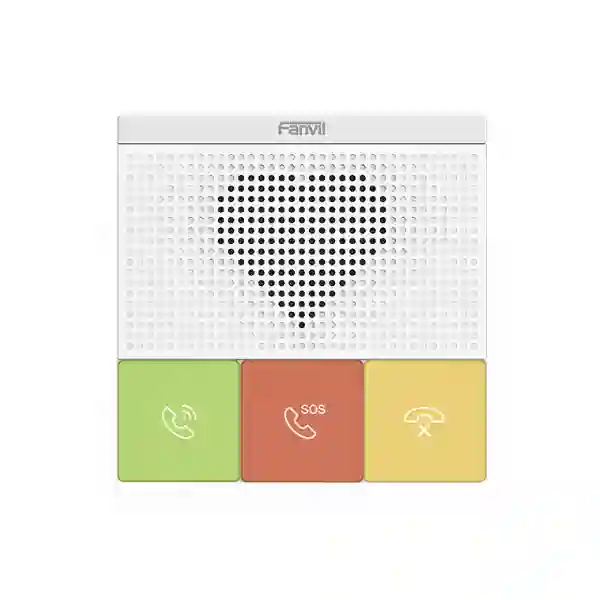
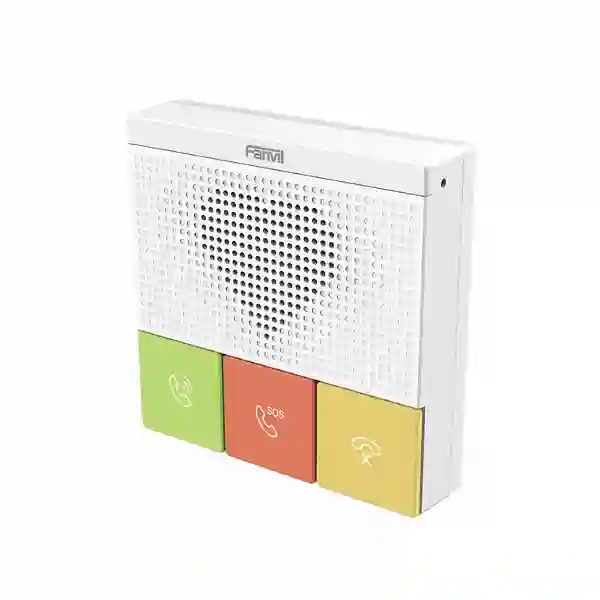
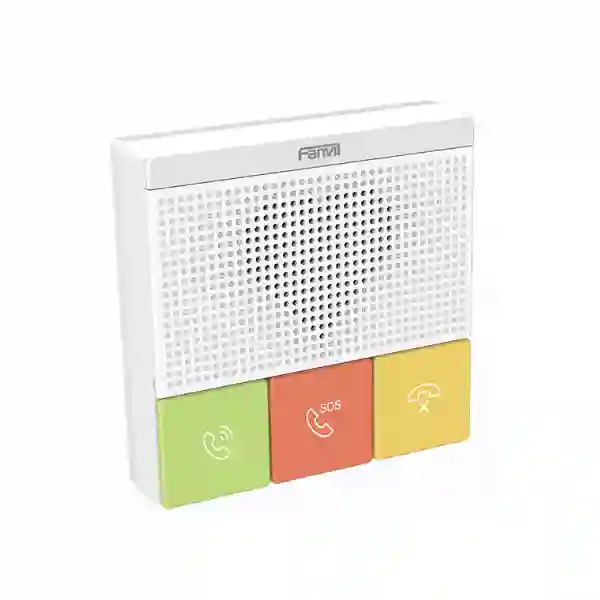
Fanvil Y501 SIP Healthcare Intercom
The Fanvil Y501 SIP Healthcare Intercom is built for indoor care communication where patients, residents, caregivers and staff need a simple way to initiate calls, receive assistance and connect into a SIP-based communication environment. The Y501 family combines voice intercom, emergency communication and broadcasting-oriented functions in a compact bedside or wall-mounted format. For buyers in Tanzania, the most important procurement decision is not only the unit itself, but also the exact model variant, network method, mounting format, PoE availability, SIP platform compatibility and the wider nurse-call workflow the device is expected to support.
FourTeck can help organizations evaluate the Fanvil Y501 as part of a broader IP telephony and healthcare communication design, including managed switching, PoE, SIP registration, VLAN planning, wireless considerations for Wi-Fi variants, emergency button integration, and related Fanvil nurse-call components. Because the Y501 family includes wired, Wi-Fi and embedded-installation variants, quotation requests should identify room count, required installation style, existing PBX or SIP server, cable availability, and any corridor lights, wireless buttons or nurse-station requirements before final model selection.
Verified Y501 Family Highlights
- 2 SIP accounts
- HD audio with G.722 and Opus support
- 3 detachable antibacterial function buttons on Y501 series
- PoE support
- IP54 protection rating
- 10/100 Mbps Ethernet
- 2.4 GHz and 5 GHz Wi-Fi on Y501W/Y501W-E
- Wall-mount and 86-box embedded options depending on model
What the Fanvil Y501 is designed to solve
Healthcare and assisted-care communication is different from ordinary desk telephony. A bedside or room intercom must be straightforward to understand, easy to reach, predictable in operation and capable of fitting into an escalation process that staff can manage. Fanvil positions the Y501 family for home-based care, nursing homes and other indoor care environments where emergency communication, voice intercom and broadcasting can be part of the same IP-based system. Rather than requiring a conventional desk-phone workflow, the unit provides dedicated function buttons and can be connected to compatible accessories that support care-oriented call scenarios.
For procurement teams, that means the Y501 should be evaluated as an endpoint inside a complete communication design. The SIP accounts must register to the intended platform, the network should provide stable power and connectivity, the installation method should match the room, and the call destination should be clearly defined. If a facility intends to use Fanvil nurse-call components such as the A320i nurse console, CL-01 corridor light or compatible wired and wireless emergency buttons, those dependencies should be mapped before devices are ordered. A small pilot room can be useful for confirming call flows, button labels, priority handling, audio levels and network behavior before a wider deployment.
Key features and buyer benefits
SIP-based communication
Two SIP accounts allow the Y501 family to participate in an IP voice environment and support structured call routing. Buyers should confirm the target SIP server or PBX, registration method, extension plan and any firewall or VLAN policies before deployment.
HD audio
Support for wideband codecs including G.722 and Opus can provide clearer speech where the wider system also supports them. Acoustic conditions, speaker placement, network quality and codec negotiation still influence the final user experience.
PoE-ready deployment
Power over Ethernet can simplify installation by carrying network connectivity and power over the same cable. The switch must have sufficient PoE budget, suitable UPS protection where required, and correctly configured access ports.
Care-focused controls
The Y501 series uses detachable antibacterial-material function buttons. Button purpose should be aligned with the facility workflow, labels and staff response procedures so the endpoint is intuitive for the intended users.
IP54 protection
The published IP54 rating supports use in suitable indoor healthcare settings where dust and incidental splashes are considerations. It should not be interpreted as permission for outdoor exposure, immersion or cleaning methods beyond the manufacturer’s instructions.
Model flexibility
Y501, Y501W, Y501-E and Y501W-E variants differ in Wi-Fi and mounting approach. Confirm the exact model code on the quotation so the purchased unit matches the cable, wall-box and wireless requirements of each room.
Technical planning snapshot
| Item | Y501 family planning note |
|---|---|
| SIP | 2 SIP accounts; confirm registrar, credentials, codecs, routing and emergency-call logic. |
| Network | 10/100 Mbps Ethernet; Wi-Fi is model-dependent on Y501W variants. |
| Power | PoE supported; optional external power arrangements should follow official documentation. |
| Audio | HD audio with G.722 and Opus, plus standard narrowband codecs. |
| Protection | IP54 for appropriate indoor deployments. |
| Buttons | 3 detachable antibacterial function buttons on Y501-series units. |
| I/O | Published support includes one short-circuit input and one short-circuit output. |
| Installation | Wall-mounted and 86-box embedded options depend on the exact model suffix. |
Compatibility, network and deployment considerations
A reliable healthcare intercom project begins with the call workflow. Identify who receives a normal call, what happens when a call is not answered, how an emergency call differs from a routine request, and whether the Y501 will work with a Fanvil nurse console, an existing SIP PBX or another supported SIP platform. The network team should define the voice VLAN, IP addressing, DHCP behavior, DNS and NTP availability, SIP signaling path, RTP media path and any firewall rules. If the device is powered from a PoE switch, calculate total switch power rather than assuming every port can simultaneously provide maximum power.
Wireless Y501W variants can be useful where Ethernet is difficult to reach, but Wi-Fi should not be treated as a shortcut around network design. Healthcare rooms may contain walls, medical equipment, elevators or other sources of attenuation and interference. Coverage should be validated at the exact mounting position, with roaming and channel planning considered if the broader system includes mobile endpoints. Wired Ethernet is often easier to troubleshoot and can provide both data and PoE, while Wi-Fi variants may fit selected retrofit situations when wireless design is robust.
For related infrastructure, FourTeck Tanzania publishes guidance on integrated IT and telecom solutions, while its services page describes planning, deployment and support capabilities. The FourTeck Tanzania shop can be used to review additional business technology categories that may be required around a Y501 rollout, including PoE switching, IP telephony and supporting infrastructure.
Fanvil Y501 SIP Healthcare Intercom Tanzania
In Tanzania, the Fanvil Y501 SIP Healthcare Intercom is most relevant to organizations planning IP-based care communication for nursing facilities, clinics, assisted-living environments, rehabilitation centers and other indoor care settings. A Tanzania procurement should begin with an accurate room schedule: how many bedside or room intercoms are needed, which rooms require wired Ethernet, which locations may need Wi-Fi variants, and whether the installation will use wall mounting or an 86-box embedded format. This avoids a common purchasing problem where devices are ordered by product family name without confirming the exact suffix required for the building. Because the Y501 range includes Y501, Y501W, Y501-E and Y501W-E options, the quotation should identify each requested model and quantity rather than treating the family as one interchangeable product.
The network should be assessed at the same time. Facilities using PoE can simplify endpoint power, but the switching layer must have sufficient PoE capacity for all planned endpoints and preferably be protected by a suitable UPS where communication continuity matters. Voice traffic should be kept organized through a well-documented LAN, and the SIP platform should be tested for registration, audio codec negotiation, call routing and response procedures. If existing IP phones or a PBX are already in place, the Y501 can be evaluated as another SIP endpoint, while care-specific workflows may justify using Fanvil’s A320i nurse-console ecosystem and related accessories. The choice depends on the operational process, not only on protocol compatibility.
For Tanzania buyers, a useful quotation request should include site city, number of rooms, floor count, existing PBX or SIP server, PoE switch availability, desired call destination, accessory requirements and whether installation/configuration assistance is needed. FourTeck can then help structure the bill of materials and identify networking dependencies before supply. This is particularly important where healthcare communication must coexist with CCTV, Wi-Fi, data systems and other IP services. Organizations can review FourTeck Tanzania’s broader technology services and use the verified Tanzania contact page to request a project-based quotation. The goal should be a deployment that is technically documented, easy for staff to use and scalable if the facility later adds rooms, nurse stations, corridor indicators or additional emergency-call accessories.
Fanvil Y501 SIP Healthcare Intercom Dar es Salaam
Dar es Salaam healthcare buyers often need to fit new communication systems into active facilities where downtime, cabling disruption and user retraining must be controlled. For a Fanvil Y501 deployment, begin by mapping the rooms and identifying whether each endpoint can receive Ethernet and PoE. Newer sites may already have structured cabling and managed switches, which can make a wired Y501 deployment straightforward. Retrofit environments may require cable-path surveys or selective use of Y501W wireless models, but Wi-Fi should only be selected after checking signal strength and interference at the proposed mounting positions. A room-by-room list is more useful than a single total quantity because it links each device to a specific network and mounting requirement.
Dar es Salaam facilities with a central reception, nursing station or help desk should also define exactly where Y501 calls terminate. If the site uses an IP PBX, normal intercom calls may register and route through the existing voice platform. Where a more care-specific workflow is required, Fanvil’s healthcare solution can pair bedside stations with a dedicated nurse console and accessories. Procurement teams should document which calls are routine, which require higher priority, whether corridor lights are needed, and what staff should do if the first destination does not answer. This operational definition is just as important as the technical configuration because an emergency button is useful only when the receiving workflow is clear.
Businesses and care organizations in Dar es Salaam may also need switching, UPS support, firewall rules, wireless coverage or SIP integration around the intercom itself. FourTeck’s Tanzania portfolio covers IP telephony and LAN infrastructure as part of an integrated technology approach, which can help avoid isolated purchases that later require rework. When requesting a quote, provide the current network topology if available, switch models, VLAN information, PBX details, number of endpoints, cable distances and any desired accessory integration. The quotation can then distinguish hardware supply from configuration, testing and deployment services. That preparation also makes it easier to compare alternatives on a like-for-like basis rather than comparing only the unit price of the Y501.
Fanvil Y501 SIP Healthcare Intercom Mwanza
For Mwanza deployments, resilience and maintainability should be built into the project from the beginning. A Fanvil Y501 system can serve as a SIP-based communication endpoint across patient rooms, assisted-care spaces or internal help points, but the reliability of the experience depends on the LAN, power and call-routing design around it. A managed PoE switch with sufficient budget can simplify endpoint installation and centralize power, while UPS protection for critical network equipment can reduce disruption during short electrical interruptions. Buyers should confirm how long they expect communication systems to remain available during an outage and size backup power accordingly rather than assuming PoE alone provides continuity.
Mwanza organizations should also decide how they want to support and troubleshoot the system after commissioning. Good documentation should record each Y501 extension number, MAC address, switch port, room name, device model, IP assignment method and call destination. If wireless Y501W units are used, record SSID, radio band policy and the access points serving each area. This information is valuable when a room is renovated, an endpoint is replaced or the PBX configuration changes. It also reduces the risk that future network changes accidentally isolate voice endpoints or remove necessary QoS and firewall policies.
Procurement teams can strengthen a Mwanza quotation by separating the endpoint requirement from the infrastructure requirement. The Y501 may be one line item, while PoE switches, patching, UPS, configuration, labeling, training and testing can be scoped separately. If a full Fanvil nurse-call workflow is under consideration, the A320i console, compatible wireless or wired emergency buttons and corridor indicators should be identified during design rather than added informally later. FourTeck can assist with this solution-level review and can coordinate related IP voice and networking requirements. A well-prepared project brief should state the number of rooms, expected users, escalation process, current SIP platform and any planned future expansion so the first deployment does not become a dead end.
Fanvil Y501 SIP Healthcare Intercom Arusha
Arusha facilities considering the Fanvil Y501 should pay close attention to user experience as well as technical compatibility. In care environments, an endpoint may be used by residents, patients or staff who do not interact with technology in the same way as office workers. The Y501’s dedicated detachable function buttons can be configured and labeled for clear actions, but the final button purpose should match the site’s actual response process. Before rollout, administrators should decide which button initiates a normal call, how staff recognize an emergency condition, whether different call types need different destinations, and what happens after a call is resolved. A small pilot can expose confusing labels or routing assumptions before dozens of rooms are configured.
Arusha deployments may also span hotels with wellness or assisted-care services, private clinics, residential care settings or specialized medical facilities. Each environment creates different mounting and network considerations. Embedded 86-box variants may suit projects that are already being built or renovated, while wall-mount units can be easier for existing buildings where suitable surfaces and cabling are available. Wi-Fi variants can reduce cabling in selected locations, but they still need reliable power and should be validated for coverage, interference and security. Wired PoE remains attractive when the LAN can support it because a single network cable can provide both connectivity and power.
A complete Arusha quotation should therefore include device variants, mounting accessories where applicable, SIP configuration scope, PoE switching capacity and any nurse-call accessories. Buyers should also ask who will own changes after commissioning: for example, extension updates, button remapping, firmware maintenance or adding rooms. FourTeck can help document these requirements before product supply so the Y501 is treated as part of a maintainable communications system. Where branch connectivity or remote administration is required, the firewall and VPN design should be reviewed separately rather than exposing management interfaces directly to the public internet.
Fanvil Y501 SIP Healthcare Intercom Dodoma
In Dodoma, organizations planning government, institutional, clinic or residential-care deployments can use the Fanvil Y501 as part of a standards-based SIP communication architecture. The procurement process should distinguish between basic SIP intercom use and a more specialized nurse-call implementation. For basic use, the critical questions are SIP registration, dialing behavior, audio quality, PoE availability and mounting. For care-focused use, buyers may need additional components for centralized call handling, visual status, emergency buttons and room identification. Defining the required workflow at tender or quotation stage reduces ambiguity and helps ensure that all bidders are pricing the same functional outcome.
Network segmentation is another important consideration. The Y501 does not need to share the same unrestricted network as office computers or guest Wi-Fi. A managed switch can place voice and intercom endpoints in an appropriate VLAN, while firewall rules can allow only the services needed for SIP, provisioning, time synchronization and management. This can improve troubleshooting and reduce unnecessary exposure. If a centralized PBX serves multiple buildings, WAN quality and routing should be checked so audio is not affected by congestion or unstable links. Local call handling options may also be considered where a site requires continued internal operation during upstream connectivity problems.
For Dodoma projects, buyers should request a documented bill of materials that includes exact Fanvil model numbers, quantity, network accessories, installation assumptions and any configuration services. If the building is under construction, coordinate wall boxes, cable routes and switch locations before finishes are completed. If the site is already operational, survey cable pathways and available rack capacity before selecting embedded or wall-mounted versions. FourTeck can support the technology-planning side of that process and align the intercom requirement with broader IP telephony and network infrastructure. This makes the final solution easier to expand, audit and support over time.
Fanvil Y501 SIP Healthcare Intercom UAE
For UAE buyers, the Fanvil Y501 can fit projects that require SIP-based room communication in nursing homes, clinics, assisted-living facilities or other indoor healthcare environments. Procurement teams should treat the Y501 as a family rather than a single fixed configuration. The wired Y501 and Wi-Fi-enabled Y501W, along with embedded-installation variants, allow the design to match the physical site. In new-build projects, the embedded option can be coordinated with wall-box and cable planning. In retrofit projects, wall mounting may reduce disruption, while Wi-Fi variants can be evaluated where cable installation is difficult. The choice should follow a site survey and not be made solely from catalog descriptions.
UAE deployments commonly involve integration with broader enterprise networks, centralized PBX platforms and structured low-current systems. The Y501 should therefore be included in network documentation alongside switching, addressing, VLANs, QoS and security policies. If the facility operates multiple locations, extension plans and naming conventions should identify building, floor, room and bed where relevant. This makes nurse-console displays and call logs easier to interpret. For Wi-Fi models, enterprise WLAN policies may need to accommodate the endpoint’s supported bands and authentication methods, and coverage should be confirmed at the actual installation height.
FourTeck’s UAE presence can help regional buyers coordinate related voice and infrastructure requirements through FourTeck UAE. A useful request for quotation should include number of rooms, desired Y501 variant, SIP platform, PoE availability, mounting method and any Fanvil healthcare accessories. Buyers should also identify commissioning expectations such as device labeling, extension creation, call-flow testing, handover documentation and staff orientation. This project-based approach is more reliable than treating healthcare intercoms as isolated hardware purchases, particularly where the system is expected to remain understandable and supportable for several years.
Fanvil Y501 SIP Healthcare Intercom Uganda
Uganda buyers evaluating the Fanvil Y501 should start with the type of care environment and expected communication path. A small assisted-care residence may only need room-to-desk SIP calling, while a larger nursing or clinical facility may require a dedicated nurse station, corridor indicators and multiple emergency-call options. Because the Y501 family supports SIP, it can participate in a wider IP communication system, but the overall workflow must be designed intentionally. List the rooms, identify normal and emergency destinations, decide whether calls need escalation and confirm how staff will acknowledge or clear events.
Infrastructure quality can have a greater effect on the user experience than many buyers expect. A PoE-capable managed switch can power wired endpoints, but the total budget, uplinks, VLAN design and UPS protection should be checked. Where a Y501W wireless model is considered, perform a Wi-Fi survey in the intended rooms and verify that coverage remains reliable after doors are closed and the facility is occupied. Avoid assuming that general guest or office Wi-Fi is automatically suitable for a care-communication endpoint. Separate SSIDs or VLANs, controlled credentials and documented management can make support easier.
FourTeck’s regional network includes FourTeck Uganda, which can be relevant for organizations coordinating technology across Uganda and Tanzania. For a Y501 quotation, include exact model preference, installation location, existing PBX, switch and Wi-Fi details, and accessory requirements. If the project may later expand to more rooms or branches, mention the expected growth so extension numbering, switch capacity and call routing are not designed only for the first phase. Documentation and staff handover should be included in project planning, especially where local IT teams will manage moves, additions and changes after commissioning.
Fanvil Y501 SIP Healthcare Intercom Kampala
Kampala healthcare and assisted-care facilities can use the Fanvil Y501 to introduce a dedicated room communication endpoint without requiring residents or patients to operate a full office telephone. The three detachable function buttons on the Y501 series support a simple interface, while SIP connectivity allows the device to register to compatible communication platforms. For practical deployment, the first task is to decide what each button will do. A normal assistance request, urgent call and general communication button may need different destinations or priorities. Those decisions should be made with clinical or care staff, not only by the network team.
The second task is installation planning. Kampala sites with structured cabling can take advantage of PoE and central switching. Where cabling is incomplete, a Y501W variant may be evaluated, but only after the WLAN is checked for capacity and reliability. The choice between wall-mount and 86-box embedded models should be based on the room construction and maintenance requirements. In high-turnover rooms, serviceability matters: technicians should be able to identify the endpoint, cable path and switch port without disturbing unrelated systems. Clear labels and a room-to-extension inventory are therefore useful operational tools.
A Kampala quotation should also state whether the Y501 will operate independently with an existing SIP PBX or as part of Fanvil’s nurse-call ecosystem. If the latter, ask for all dependent components to be listed with quantities and purpose so the budget covers the complete workflow. FourTeck can help review SIP, PoE, LAN and accessory dependencies through its Uganda and Tanzania operations. Buyers comparing proposals should check whether configuration, testing, documentation and user orientation are included, because a lower hardware-only quote may not represent the full deployment cost.
Fanvil Y501 SIP Healthcare Intercom Arua
For Arua, a Fanvil Y501 project may benefit from a design that emphasizes simplicity, remote support readiness and clear documentation. The endpoint itself is compact, but the supporting system should be straightforward enough for on-site staff to identify faults without specialist tools. Wired PoE units can be labeled by room and switch port, and the PBX can use a logical extension-numbering plan. If a site later needs remote technical support, this documentation allows a technician to distinguish an endpoint issue from a switch, cabling, SIP or WAN problem more quickly.
Where connectivity between Arua and a centralized PBX is required, consider what should happen if the WAN link is unavailable. Some facilities may accept temporary loss of centralized calling, while others may require local operation or alternative escalation methods. This is an architectural question rather than a feature that should be assumed from the Y501. Buyers should discuss it during system design and, where necessary, test failover behavior. Similarly, Wi-Fi models can be useful in selected rooms, but wireless dependence should be assessed against power, interference and coverage conditions at the site.
Procurement should therefore include more than a device count. Provide floor plans if available, mark rooms, identify switch locations, list existing voice systems and state the expected response procedure for calls. If emergency buttons or corridor lights are part of the requirement, include them from the outset. FourTeck can help translate this information into a structured bill of materials and implementation scope. For buyers in Arua, that planning can reduce unnecessary repeat visits and make future expansion easier because room, network and communication records are already organized.
Fanvil Y501 SIP Healthcare Intercom Mbarara
Mbarara organizations considering the Fanvil Y501 should examine the balance between endpoint convenience and centralized administration. A SIP intercom becomes much easier to maintain when devices use consistent naming, extension allocation, provisioning and network policies. Before deployment, create a table that lists each room, intended Y501 variant, extension, call destination, button behavior, switch port and installation type. This simple record can support commissioning, troubleshooting and later changes. It also allows procurement teams to validate whether the delivered models match the original design.
Power and network continuity should also be considered. PoE can remove the need for individual adapters, but it shifts power dependence to the switching infrastructure. If communication during short outages is important, the PoE switches, PBX and key network equipment should be placed on appropriately sized UPS systems. For facilities using Wi-Fi variants, the wireless access points also become part of the critical path. Those APs should have stable power and sufficient coverage, and network security should prevent care endpoints from being mixed casually with public wireless traffic.
If Mbarara buyers are planning a phased project, ask for a design that can grow. Switches should have spare ports and PoE headroom, extension numbering should leave room for additional beds or rooms, and the SIP platform should be sized for future endpoints. Fanvil’s compatible healthcare accessories can then be added where the workflow requires them rather than forcing a full redesign. FourTeck can assist with model selection, network review and quotation planning across regional projects. A complete scope should clarify supply, installation, configuration, acceptance testing, documentation and post-installation support responsibilities.
Fanvil Y501 SIP Healthcare Intercom Gulu
In Gulu, the Fanvil Y501 can support care environments that need a clear, dedicated means of contacting staff without relying on mobile phones or ordinary desk handsets. The product’s SIP architecture means it can be tied into a structured extension plan, while its dedicated function buttons can be mapped to site-specific actions. The key design task is to ensure that the technology mirrors the facility’s response process. If a patient presses a button, staff should know who receives the call, what information is displayed, whether unanswered calls escalate and how the event is closed.
A practical Gulu deployment should also minimize hidden dependencies. Wired endpoints need Ethernet cabling, PoE ports and network configuration. Wireless models need suitable Wi-Fi coverage and power. Embedded units require compatible wall boxes and construction coordination. Any optional emergency buttons or corridor indicators require their own placement and integration plan. Listing these dependencies in the bill of materials prevents a situation where devices arrive but cannot be installed because cabling, mounting or network preparation was omitted.
For organizations with limited on-site IT resources, commissioning documentation is particularly valuable. Ask for a room-to-extension list, IP or DHCP reservation details where appropriate, administrator access procedures, configuration backups and a basic troubleshooting guide. These records make future support more efficient and reduce reliance on memory. FourTeck can help scope Y501 supply together with SIP and network requirements. Buyers should use a project quotation that clearly separates confirmed hardware from optional accessories and services so budget decisions can be made without losing sight of the complete communication workflow.
Fanvil Y501 SIP Healthcare Intercom Kenya
Kenya buyers can position the Fanvil Y501 within a wider IP communication and nurse-call strategy. The endpoint supports two SIP accounts, PoE and HD audio, while Wi-Fi capability is available on designated Y501W variants. For multi-site organizations, standardizing on a small set of approved variants can simplify purchasing and support. For example, wired wall-mount units may be the default for rooms with Ethernet, while Wi-Fi units are reserved for locations where cabling is impractical. Embedded variants can be specified for new construction. Such standardization reduces model confusion and makes spares planning easier.
Integration with an existing PBX should be tested before a large order. Confirm SIP registration, codec negotiation, DTMF behavior, auto-answer requirements and any special call routing. If the device will interact with a dedicated nurse console rather than a general PBX, confirm the complete Fanvil architecture and accessory list. A pilot can be used to verify button labels, audio level, call priority, user acceptance and cleaning procedures. The goal is to identify operational issues before rolling out to dozens of rooms.
FourTeck’s regional resources include FourTeck Kenya, useful for customers coordinating deployments across East Africa. Kenya quotation requests should include site count, room count, preferred model variants, SIP system, PoE switching, accessory needs and implementation responsibilities. Buyers should also ask whether the proposal includes labeling, testing and documentation. These elements add relatively little compared with the value they provide during maintenance. A structured regional design can make it easier to replicate the solution in Tanzania, Uganda or other sites while still adapting to local network and facility conditions.
Fanvil Y501 SIP Healthcare Intercom Kuwait
Kuwait projects involving the Fanvil Y501 should align the intercom with the facility’s low-voltage and IP network design from the beginning. In new healthcare or assisted-living buildings, this means coordinating cable drops, PoE switch locations, wall boxes and rack capacity before final finishes. Embedded Y501-E or Y501W-E variants may be considered where an 86-box installation is appropriate, while wall-mounted versions may be preferable in retrofit settings. The exact variant should be written into the procurement schedule because Wi-Fi and installation method are not universal across the family.
The communication design should also define how a call reaches staff. An ordinary SIP PBX can provide extension-based routing, but specialized care environments may benefit from the Fanvil nurse-call workflow and compatible accessories. Buyers should avoid assuming that every desired clinical workflow is automatically enabled by the endpoint alone. Instead, define call types, priority, acknowledgment, escalation and visual indications, then map those requirements to the appropriate system components. This approach reduces the risk of purchasing endpoints without the console or accessory layer required for the intended workflow.
Kuwait procurement teams should request technical submittals that clearly show product model, network requirements, power method, mounting and integration assumptions. If the facility uses centralized IT management, the Y501 endpoints should be included in the same asset and VLAN documentation as other voice devices. Remote management access should be secured rather than exposed directly to the internet. FourTeck’s regional network can help organizations align product supply with broader networking and telephony needs across the Middle East and Africa, while final compliance and site-specific requirements should always be reviewed against the project’s own specifications.
Fanvil Y501 SIP Healthcare Intercom Ghana
Ghana buyers evaluating the Fanvil Y501 can use the product in indoor care communication projects where dedicated call buttons and SIP connectivity are more appropriate than a conventional desk phone. The purchasing process should start with room count and workflow, then move into technical requirements. Ask which rooms need Y501 endpoints, which staff positions will receive calls, whether the system will use an existing PBX or a Fanvil nurse console, and whether emergency buttons or corridor lights are required. This information makes the bill of materials more accurate and reduces changes after equipment arrives.
Network planning should cover Ethernet, PoE, VLANs and wireless design. If PoE is used, check total switch power, spare capacity and UPS protection. If Y501W models are selected, validate Wi-Fi coverage in the actual care rooms rather than relying on a survey performed only in corridors or open office spaces. Building materials can significantly change wireless performance. The SIP platform should also be tested for audio, call routing and registration stability, especially if it is hosted remotely or shared across sites.
FourTeck’s Ghana technology site can support customers with broader regional requirements. A Ghana quotation for the Y501 should identify exact model codes, quantities, required accessories, installation assumptions and whether configuration services are included. For organizations that expect expansion, include future room count and branch plans so switching and SIP capacity can be sized with headroom. Proper labeling and handover documentation should be part of the deployment because long-term maintainability matters as much as successful installation on day one.
Fanvil Y501 SIP Healthcare Intercom Nigeria
Nigeria healthcare, residential-care and institutional buyers can use the Fanvil Y501 family as an IP-based endpoint for room communication and assistance calling. Larger deployments should be treated as networked systems rather than isolated devices. A hundred endpoints, for example, have implications for switching, PoE, addressing, PBX licensing or capacity, provisioning, monitoring and fault management. Even smaller sites benefit from the same disciplined approach because each device still depends on reliable power, network access and a defined call destination.
Where a site spans multiple floors or buildings, design the switching topology and uplinks with growth in mind. Voice traffic is not usually bandwidth-heavy, but oversubscribed or unstable links can still cause poor audio. Managed VLANs and QoS policies can separate care communication from guest traffic, cameras or large data transfers. If Wi-Fi Y501W models are used, enterprise WLAN coverage should be checked in each room and power arrangements should remain reliable. Wired PoE may be preferred where cable infrastructure is available because it centralizes both connectivity and power.
FourTeck’s Nigeria technology site is relevant for organizations working across West and East Africa. Nigerian buyers should request a quotation that includes exact Y501 variants, network infrastructure, accessories and commissioning scope. If the facility requires specialized nurse-call functions, ask the supplier to show the complete architecture and event flow rather than presenting the Y501 as a stand-alone answer to every care requirement. A properly documented solution should show how users initiate calls, how staff receive them, how events are prioritized and how the system can be tested during acceptance.
Fanvil Y501 SIP Healthcare Intercom Seychelles
Seychelles deployments can benefit from careful spares and support planning because replacement logistics may differ from large mainland markets. When standardizing on the Fanvil Y501, buyers should keep model selection consistent and document which rooms use wired, Wi-Fi, wall-mounted or embedded variants. A small quantity of strategically chosen spare units may be considered according to the organization’s own maintenance policy, but stock levels should be based on operational requirements rather than assumptions about supplier availability. Configuration backups and an asset list can make replacement faster when needed.
For island facilities, reliable network and power architecture is especially important. PoE can simplify endpoint deployment, while UPS-backed switches can maintain communication during brief power interruptions. If the SIP server is hosted off-site, the project team should decide whether local calling needs to continue during internet or WAN outages and design the system accordingly. That continuity behavior is a solution-level property and should not be assumed from the endpoint itself. Wi-Fi variants can be useful in buildings where new cabling is difficult, but they still require careful coverage validation and secure WLAN configuration.
A Seychelles quotation should include device counts, exact variants, installation accessories, SIP configuration, network equipment and any care-specific accessories. Remote commissioning or support requirements should be discussed early so credentials, secure access and documentation are prepared in advance. For organizations operating across multiple countries, a consistent extension plan and device-naming standard can make central support easier while allowing each site to retain local call routing. FourTeck can help coordinate such regional technology planning through its broader network, with Tanzania serving as a primary focus for this product page.
Related products and infrastructure to consider
A Y501 project may require more than the bedside or room endpoint. Depending on the intended workflow, Fanvil identifies healthcare-system components such as the A320i nurse console, CL-01 corridor light, CMD-01 corridor display, KT10/KT20 wireless buttons, KT30 wireless pull-cord button, KT31 wired emergency button and IP speakers. Not every project needs all of these items. They should be selected according to the call types, visual indication, room layout and escalation process required by the facility.
At the network layer, consider managed PoE switches, structured cabling, UPS systems, a supported SIP PBX or nurse-console architecture, firewall rules and Wi-Fi access points where wireless variants are used. FourTeck Tanzania’s business technology shop can be used to review complementary categories, while the FourTeck Tanzania home page summarizes broader IP telephony, switching, Wi-Fi, firewall and infrastructure capabilities. These related components are relevant because a dependable healthcare intercom depends on the environment in which it operates.
Quotation checklist for Fanvil Y501 projects
Provide country, city, site name, number of buildings, floors, rooms and total endpoints.
State whether you need Y501, Y501W, Y501-E or Y501W-E, or ask for a model recommendation based on installation conditions.
Identify the existing PBX, SIP server or intended Fanvil nurse-call console and the number of extensions required.
Share PoE switch models, port availability, cabling condition, VLAN requirements and UPS expectations.
List nurse console, corridor lights, emergency buttons, displays, speakers or other required integration points.
Clarify whether you need supply only, installation, configuration, testing, documentation, training or ongoing support.
Frequently asked questions
Does the Fanvil Y501 support PoE?
Yes. Fanvil’s published specifications list PoE support for the Y501 series. Confirm your switch’s available PoE budget and whether the switch and upstream network require UPS protection for your continuity objectives.
Does every Y501 model have Wi-Fi?
No. Wi-Fi is model-dependent. Fanvil lists 2.4 GHz and 5 GHz Wi-Fi on Y501W and Y501W-E variants, while the standard Y501 and Y501-E are wired models.
Can the Y501 work with a SIP PBX?
The Y501 is a SIP endpoint with two SIP accounts, so it is designed to register into compatible SIP environments. Compatibility should still be validated with the specific PBX or platform, including registration, codecs, call routing and any provisioning requirements.
What is the difference between Y501 and Y501-E?
The family includes different installation modes. Fanvil documentation identifies wall-mount and 86-box embedded options depending on model. Confirm the exact product code and installation method before ordering.
Is IP54 suitable for outdoor use?
The Y501 is positioned for indoor healthcare and care environments. IP54 provides a defined level of dust and splash protection but should not be interpreted as an outdoor weatherproof rating. Follow Fanvil’s installation guidance for the intended environment.
Can the Y501 be part of a nurse-call system?
Yes. Fanvil documents the Y501/Y501-Y family as part of its healthcare solution alongside the A320i nurse console, corridor indicators and compatible emergency buttons. The complete component list should be selected according to the required care workflow.
What information should I provide for a quotation?
Provide site location, number of rooms, exact model or mounting preference, existing SIP/PBX platform, PoE and Wi-Fi availability, accessory requirements and whether installation or configuration services are required.
Decision recap
Choose the Fanvil Y501 when you need a dedicated indoor SIP healthcare intercom with simple function buttons, HD audio, PoE and model options that can suit wired, Wi-Fi, wall-mounted or embedded deployments. Do not select the exact variant until you have confirmed the building’s cabling, mounting and wireless conditions. For larger care workflows, review the nurse-console and accessory architecture at the same time so the endpoint is purchased as part of a complete operational design.
FourTeck can assist with product selection, network readiness, SIP integration and quotation planning for Tanzania and multi-region projects. Use the FourTeck Tanzania contact page to share your room count, site details and existing communication platform.
Consult FourTeck on your Y501 deployment
A useful consultation starts with facts about the site rather than a request for a generic unit price. Share the number of rooms, exact installation locations, whether Ethernet and PoE are present, the existing PBX or SIP server, the staff response workflow and any Fanvil nurse-call accessories you are considering. FourTeck can then help separate mandatory components from optional items, identify network dependencies and prepare a clearer quotation. This approach is especially useful for healthcare projects where a communication endpoint must remain understandable for users and maintainable for technical teams after handover.

Reviews
There are no reviews yet.