
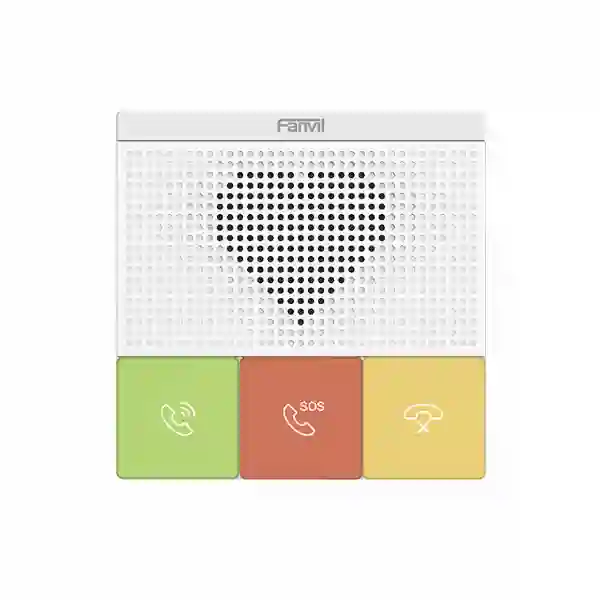
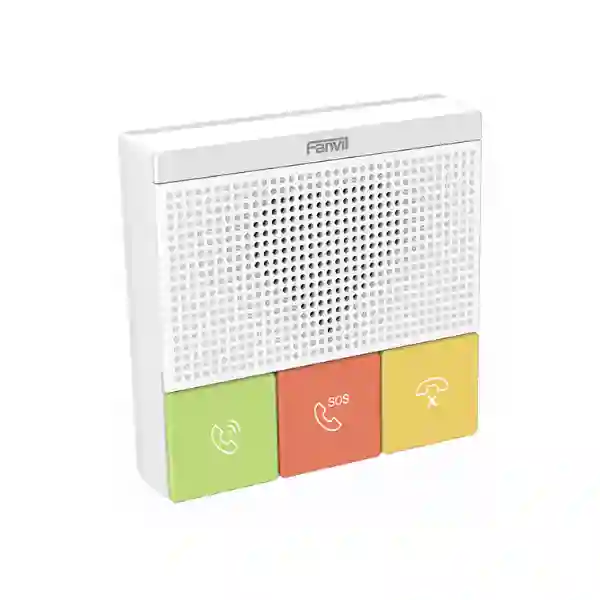
Fanvil Y501W-E Wi-Fi Healthcare Intercom
The Fanvil Y501W-E Wi-Fi Healthcare Intercom is a purpose-built SIP communication endpoint for indoor healthcare, assisted-living, nursing-home and care-related environments where users need a clear, simple way to reach staff. It belongs to Fanvil’s Y501 healthcare intercom family and combines network voice communication with dedicated call controls, integration interfaces and flexible installation. The Y501W-E model is the embedded-installation Wi-Fi version, giving project designers both 10/100 Mbps Ethernet and built-in dual-band 2.4 GHz and 5 GHz Wi-Fi connectivity while retaining Power over Ethernet support.
For Tanzania projects, the most important buying question is not merely whether the device can make a SIP call. Healthcare communication endpoints must fit the wider operational workflow: where they are mounted, who presses the call buttons, which nurse station or PBX answers, how calls are prioritized, whether wireless emergency buttons are required, how the network is segmented, and what happens during maintenance or expansion. FourTeck helps buyers review those practical requirements before quotation so the selected intercom, SIP platform, PoE infrastructure and wireless design can be evaluated as one working environment.
Dual-band Wi-Fi
Built-in 2.4 GHz and 5 GHz Wi-Fi gives the Y501W-E a wireless network option for indoor deployments where running a data cable to every intercom position is difficult. Wireless design should still be planned around signal strength, roaming expectations, VLAN policy and reliable power.
HD SIP audio
The device supports two SIP lines and wideband codecs including G.722 and Opus, together with echo cancellation, packet-loss concealment and adaptive jitter buffering. These capabilities support clear two-way communication when the underlying network is designed correctly.
Healthcare-oriented controls
Three detachable function buttons can be customized for care workflows. Fanvil also documents support for a specific 433 MHz wireless button, providing another way to build emergency or assistance-call workflows where an optional wireless trigger is appropriate.
Embedded installation
The “E” version is designed for standard 86-box embedded installation. This makes it useful for projects that want a more integrated wall finish, but installers should confirm back-box dimensions, cable routes, power method and service access before final installation.
What the Fanvil Y501W-E is designed to solve
In a care environment, communication points need to be easy to understand and quick to use. A patient, resident or staff member may need to request nursing support, call for assistance or trigger a predefined communication action without navigating a complex handset. The Y501W-E addresses this requirement with large, identifiable function buttons and hands-free intercom communication. Fanvil positions the Y501 family for home-based care, nursing homes and other indoor healthcare-related environments, with emergency communication, security protection and broadcasting among the intended scenarios.
The model also provides a short-circuit input and relay output. This enables project designers to consider integrations with compatible external devices such as emergency buttons, sensors or alarm indicators. Any such integration should be engineered around the specific third-party device ratings and the actual workflow required by the facility. The intercom itself should not be treated as a substitute for certified life-safety equipment where local regulations require dedicated systems.
For larger installations, the Y501W-E can also sit inside a broader SIP communication architecture. SIP 2.0 over UDP, TCP or TLS, RTP/RTCP and SRTP support allow the endpoint to be planned with compatible SIP platforms. Provisioning methods documented by Fanvil include FTP, TFTP, HTTP, HTTPS, DHCP Option 66, SIP PnP and TR-069, which can help administrators standardize configuration across multiple rooms or sites.
Verified technical highlights
| Area | Fanvil Y501W-E capability |
|---|---|
| SIP | 2 SIP lines; SIP 2.0 over UDP/TCP/TLS |
| Audio | HD voice with wideband G.722 and Opus; narrowband codecs also supported |
| Ethernet | 10/100 Mbps RJ45 |
| Wi-Fi | 2.4 GHz 802.11 b/g/n and 5 GHz 802.11 a/n |
| Power | PoE or optional external DC power |
| Protection | IP54 waterproof and dustproof rating for the intended indoor product design |
| Buttons | 3 detachable customizable function/DSS buttons |
| I/O | 1 short-circuit input and 1 relay/short-circuit output interface |
| Network functions | IPv4/IPv6, DHCP, static addressing, PPPoE, VLAN, LLDP, QoS, L2TP and OpenVPN |
| Installation | Standard 86-box embedded installation for Y501W-E |
Buying and deployment guidance
A healthcare intercom project should begin with a room-by-room communication workflow rather than a product count. Identify where an assistance call originates, who should answer it, whether the call needs to ring a nurse console, desk phone, mobile client or SIP group, and what should happen when the primary destination does not answer. This determines PBX programming, call routing, button behavior and escalation logic.
For wired deployment, confirm PoE switch capacity, VLAN configuration and cabling. For Wi-Fi deployment, perform a coverage assessment at the actual wall positions rather than relying on general room coverage. Building materials, corridor geometry, doors, medical equipment and access-point placement can all affect signal quality. Where wireless connectivity is chosen, power still needs to be planned independently unless a wired PoE connection is used.
Procurement teams should also document whether optional 433 MHz wireless buttons are required, whether relay or input integration is needed, how many SIP accounts will be configured, and which provisioning method will be used. A clear requirement makes it easier to quote the correct combination of intercoms, network equipment and configuration services.
Useful FourTeck resources for connected projects
Healthcare intercoms depend on reliable network and voice infrastructure. For broader Tanzania technology planning, visit FourTeck Tanzania to review integrated IT, telecom, networking and security solution coverage. Multi-country organisations can also explore FourTeck Uganda and FourTeck Kenya when coordinating East African branches. For wider African project discussions, FourTeck Africa provides a regional route, while FourTeck global solutions can support broader telecom and collaboration planning.
Fanvil Y501W-E Wi-Fi Healthcare Intercom Tanzania
For Tanzania healthcare organisations, the Fanvil Y501W-E is relevant where facilities are modernising room-to-staff communications using SIP networks. Hospitals, private clinics, assisted-living facilities, rehabilitation centres and residential care environments may need a compact endpoint that can be mounted near a bed, treatment space, accessible room or other indoor assistance point. The embedded form factor is especially useful in planned construction or refurbishment where standard 86-box mounting can be incorporated neatly into wall finishes. Buyers should confirm the physical installation depth and serviceability during the design stage rather than waiting until fit-out is complete.
Tanzania projects often combine new equipment with existing network infrastructure, so a compatibility review is valuable. If the facility already has an IP PBX, confirm SIP registration, codec support, extension numbering, call groups, VLAN design and firewall rules. If the intercom is part of a new nurse-call architecture, document nurse stations, escalation paths, wireless buttons, corridor indicators and any relay-driven equipment before quantities are finalized. The Y501W-E supports both Ethernet and dual-band Wi-Fi, but the choice between them should be based on site conditions. Wired PoE can simplify power and provide predictable connectivity, while Wi-Fi may help where retrofitting data cable is difficult.
Procurement teams in Tanzania should request quotations with exact model numbers because Y501 family variants differ by mounting and Wi-Fi capability. The requested Y501W-E is specifically the Wi-Fi-enabled embedded model. Include quantity, room count, proposed PBX or SIP platform, preferred power method, optional wireless button requirement and any external input/output integration. This information helps avoid buying the right family but the wrong variant.
FourTeck Tanzania can support the commercial and technical discussion around endpoint selection, network readiness, PoE switching, Wi-Fi coverage, SIP integration and related infrastructure. Final project design should reflect the facility’s operational procedures and any local healthcare or safety requirements that apply to the site.
Fanvil Y501W-E Wi-Fi Healthcare Intercom Dar es Salaam
Dar es Salaam buyers frequently need communications equipment that can fit busy private hospitals, clinics, specialist centres, elder-care facilities and mixed-use medical buildings. In these settings, room communication must remain simple for the user while integrating cleanly with the facility’s IP network. The Y501W-E provides a compact SIP intercom with three customizable buttons, two SIP accounts, HD voice and dual-band Wi-Fi, making it suitable for projects where a straightforward assistance-call interface is more useful than a conventional multi-key desk phone.
Dense buildings in Dar es Salaam can create practical wireless design challenges. Concrete walls, service shafts, elevators, equipment rooms and crowded 2.4 GHz environments may reduce Wi-Fi quality. If the Y501W-E is deployed wirelessly, a site survey should verify 5 GHz and 2.4 GHz coverage at each intended mounting point. A design that looks good in an office corridor may perform differently inside patient rooms. Where structured cabling is available, Ethernet with PoE can provide a cleaner power-and-data path and can be placed on a dedicated voice or healthcare-device VLAN.
For retrofit projects, the embedded Y501W-E requires attention to wall boxes and cable routes. Facilities should confirm whether existing back boxes match the intended mounting method and whether access for maintenance can be retained. If external alarm lights, sensors or buttons are part of the workflow, document the electrical characteristics and integration logic before installation. The device’s short-circuit input and relay interface create integration possibilities, but those interfaces still require project-specific engineering.
When requesting a Dar es Salaam quotation, include the number of rooms, expected call destinations, SIP platform, network-switch details, wireless coverage information, mounting status and desired accessories. This turns a simple device enquiry into a deployment-ready requirement and helps the supplier assess the infrastructure surrounding the intercom.
Fanvil Y501W-E Wi-Fi Healthcare Intercom Mwanza
For healthcare facilities in Mwanza, the Fanvil Y501W-E can be considered when a project needs SIP-based room communication with flexible network options and a simple user interface. Clinics, hospitals, rehabilitation centres and long-term-care environments can benefit from a dedicated endpoint that makes assistance calls easier than asking users to operate a full desk phone. The three customizable function buttons allow the project team to map commonly required actions according to the facility’s workflow, while hands-free communication supports quick response once the call is answered.
Infrastructure planning is especially important when sites are expanding building-by-building or ward-by-ward. Instead of purchasing intercoms as isolated devices, Mwanza project teams should map each unit to switching, Wi-Fi, IP addressing, SIP registration and call-routing requirements. If the site uses PoE, calculate switch power budgets and UPS runtime for the communication network. If Wi-Fi is preferred, assess channel utilization and signal levels in every intended location. Dual-band support gives useful flexibility but does not eliminate the need for sound RF planning.
The Y501W-E also supports secure signaling options including SIP over TLS and SRTP for media, subject to compatible platform configuration. Facilities with centralized IT management can evaluate VLANs, QoS and provisioning methods such as HTTPS, DHCP Option 66 or TR-069. A standardized template is valuable when many endpoints must share the same settings while retaining room-specific extension numbers or button assignments.
A Mwanza quotation request should state whether the site is new-build or retrofit, total endpoint count, planned nurse or reception destinations, existing PBX brand, PoE availability, wireless requirements and any optional 433 MHz button requirement. This detail helps identify dependencies early and supports cleaner budgeting for the total system rather than only the intercom hardware.
Fanvil Y501W-E Wi-Fi Healthcare Intercom Arusha
Arusha healthcare and care-related facilities may evaluate the Y501W-E when they need a compact SIP intercom for indoor assistance communication with both wired and wireless network options. The device is particularly useful where staff want clearly assigned call buttons and hands-free audio rather than a general-purpose telephone. In a guest-oriented clinic, rehabilitation property or residential care setting, that simpler interface can reduce confusion for people who only need to request assistance quickly.
Project teams should decide early whether the intercom will register directly to an existing IP PBX, a dedicated healthcare communication platform or a broader Fanvil nurse-call architecture. The answer affects extension plans, call groups, fallback destinations and management procedures. Two SIP accounts can provide flexibility, but routing should be intentionally designed rather than left at default settings. Calls may need to reach a nurse console during normal hours and an alternate destination after hours, for example, depending on the facility’s operating procedure.
Arusha installations that rely on Wi-Fi should verify coverage through finished walls and occupied rooms. Access points should be positioned for predictable voice performance, with appropriate QoS and VLAN segmentation. If network cabling is already being installed, PoE Ethernet may still be preferred for endpoints where maximum predictability and centralized power backup are priorities. The embedded 86-box format also makes coordination with electrical contractors important during construction.
For procurement, specify the exact Y501W-E model, not only “Fanvil healthcare intercom.” Include quantities, installation areas, network method, PBX details, button labeling needs and external device integration. FourTeck can then help frame the requirement around endpoint supply and the supporting voice, LAN and Wi-Fi environment.
Fanvil Y501W-E Wi-Fi Healthcare Intercom Dodoma
Dodoma organisations planning clinics, healthcare offices, treatment facilities or residential care spaces can use the Fanvil Y501W-E as a SIP-based assistance communication point where simple controls and central call routing are required. The model’s HD audio, configurable buttons and embedded mounting format suit projects that want a fixed indoor intercom integrated into the wall rather than a portable handset that can be misplaced.
A strong Dodoma deployment plan should include resilience. Communication endpoints may be simple at the wall, but their availability depends on switching, wireless access points, IP PBX services and power. If the project uses PoE, place relevant network switches on appropriate UPS protection where continuity matters. If endpoints use Wi-Fi with external power, consider the continuity of both the intercom’s power source and the wireless network. The device supports networking features such as DHCP or static addressing, VLAN, LLDP and QoS, which can be used as part of an organized LAN design.
Facilities should also establish an administration process. Someone should own extension naming, firmware updates, configuration backups, password policy and room records. Fanvil supports web management and multiple auto-provisioning approaches, which can reduce manual effort in multi-endpoint projects. Documentation is particularly valuable when rooms change purpose or the system grows into additional wings.
When seeking a Dodoma quote, buyers should include room quantities, installation phase, chosen SIP/PBX platform, PoE or DC power preference, Wi-Fi expectations and any desired emergency-button integration. This allows pricing to reflect a complete, supportable design rather than only a unit price.
Fanvil Y501W-E Wi-Fi Healthcare Intercom UAE
UAE healthcare, home-care and assisted-living projects can consider the Fanvil Y501W-E where SIP communication, wall-integrated installation and Wi-Fi flexibility are required. The model can suit projects in clinics, care homes, rehabilitation environments and indoor patient-support areas that need a dedicated assistance endpoint. Its three detachable, customizable buttons can be aligned with local operating procedures, while two SIP accounts and standard SIP protocols allow integration planning with compatible communication platforms.
Because many UAE projects involve structured fit-out processes, the embedded Y501W-E should be coordinated with consultants and contractors before walls are finalized. Confirm the 86-box requirement, cable entry, power arrangement, network port availability and service clearance. Where PoE is used, switching should be sized for endpoint count and redundancy expectations. Where dual-band Wi-Fi is used, coverage should be validated in completed rooms, particularly in buildings with dense walls, glass partitions or high RF utilization.
Integration teams should also define cybersecurity settings. SIP over TLS and SRTP are supported, as are VLAN, QoS and 802.1X EAP for Wi-Fi authentication. The exact security configuration must match the organisation’s network and PBX capabilities. Auto-provisioning can be valuable in multi-floor or multi-building rollouts, helping administrators apply consistent settings and reduce configuration drift.
For UAE procurement, request the exact Y501W-E model and specify whether accessories such as 433 MHz wireless buttons are required. Include endpoint count, PBX platform, mounting status, network architecture and required integrations so quotation and project planning can be aligned.
Fanvil Y501W-E Wi-Fi Healthcare Intercom Uganda
Uganda healthcare and residential-care projects can use the Fanvil Y501W-E as a SIP intercom endpoint when simple room communication and flexible connectivity are key requirements. The model supports wired Ethernet, PoE and dual-band Wi-Fi, allowing designers to choose a network method that fits both new-build and retrofit environments. In facilities where cabling is still being planned, PoE can provide centralized data and power. In completed interiors where new cable routes are difficult, Wi-Fi can be evaluated provided signal quality and local power are dependable.
Before procurement, teams should map the intended call workflow. A bedside or room assistance button only becomes useful when its call destination, escalation path and staff response are clearly defined. The Y501W-E supports two SIP lines, auto-answer and customizable DSS functions, so it can participate in an organized SIP communication plan. The device also provides a short-circuit input and relay output that may support compatible external buttons, sensors or indicator workflows.
For multi-site organisations in Uganda, centralized provisioning and documentation can be important. Standard templates for network settings, codecs, SIP servers and security can simplify rollout while room-specific details remain unique. Web management, configuration export/import and supported auto-provisioning methods help administrators maintain a consistent fleet.
Uganda buyers should provide exact quantities, facility type, installation locations, PBX information, network availability and accessory needs when requesting a quote. This helps determine whether the intercom can be integrated directly or whether supporting switches, access points, PBX configuration or nurse-call components must also be included.
Fanvil Y501W-E Wi-Fi Healthcare Intercom Kampala
In Kampala, the Y501W-E can fit private hospitals, outpatient centres, specialist clinics, long-term-care residences and health-related accommodation that need an indoor SIP assistance point. Its compact embedded format can support clean room design, while large configurable buttons can be easier for patients or residents to understand than a standard office telephone. The unit’s HD audio capabilities support clear hands-free communication when deployed over a voice-ready network.
Kampala facilities often operate within buildings that have evolved over time. A retrofit may have mixed switching, older cabling and uneven Wi-Fi coverage. Before using the wireless capability, survey the exact rooms and corridors for usable 2.4 GHz and 5 GHz coverage. For wired deployment, verify cable condition, PoE availability and switch capacity. A dedicated VLAN and QoS policy can help separate healthcare voice traffic from general office or guest usage.
The project should also define how each button is labeled and programmed. Depending on the workflow, different keys may call different destinations or trigger specific SIP actions. Optional wireless 433 MHz buttons can be considered where a user needs a portable call trigger, but accessory quantities and compatibility should be confirmed during the bill-of-materials stage.
For a Kampala quotation, include floor plans or room counts where possible, endpoint quantity, existing PBX brand and version, network topology, Wi-Fi access-point information and desired integrations. These inputs make it easier to identify potential infrastructure work before installation begins.
Fanvil Y501W-E Wi-Fi Healthcare Intercom Arua
Arua healthcare providers evaluating SIP-based assistance communication can consider the Fanvil Y501W-E where a compact indoor endpoint and straightforward call controls are needed. Smaller facilities may value the ability to connect room intercoms to an existing SIP PBX rather than operate a completely separate voice network, while larger projects can integrate the device into a more structured healthcare communication architecture.
Network reliability should be part of the buying decision from the beginning. If a facility has limited switching capacity, PoE port count and power budget should be checked before devices are ordered. If the deployment will depend on Wi-Fi, coverage should be measured and access-point capacity reviewed. Dual-band capability gives options, but placement and interference remain important for two-way audio quality. The intercom’s support for QoS can help prioritize traffic where the network is properly configured.
Arua buyers should also plan maintenance. Assign clear device names, extension numbers and room references, record configuration parameters, and use supported provisioning methods where practical. This makes troubleshooting easier when staff change or when endpoints are relocated. The Y501W-E’s embedded installation also means physical access needs consideration so that servicing does not require unnecessary wall work.
When requesting pricing, provide the exact quantity and describe whether the project is a new facility, an expansion or a retrofit. Mention the SIP platform, required call destinations, available PoE, Wi-Fi environment, desired button functions and any relay/input use. These details help create a realistic bill of materials and deployment plan.
Fanvil Y501W-E Wi-Fi Healthcare Intercom Mbarara
Mbarara hospitals, clinics and care facilities can evaluate the Fanvil Y501W-E when they need an indoor SIP intercom that combines simple patient-facing controls with standards-based networking. The device’s three customizable buttons can help staff create a consistent room interface, while two SIP lines provide flexibility in how calls are registered and routed. HD voice, acoustic echo cancellation and packet-loss mitigation features support intelligible two-way audio, although network quality remains a key part of the final experience.
For campuses or multi-building facilities, consider whether intercom traffic will remain on a local PBX or traverse routed links between sites. VLANs, QoS, firewall rules and VPN design may all affect communication. The Y501W-E supports L2TP and OpenVPN capabilities, but any VPN architecture should be evaluated within the facility’s broader security policy rather than configured independently on each endpoint without a management plan.
The model can also participate in installations using external call or indicator devices through its I/O interface. Project teams should document what the external device does, required contact behavior and power characteristics. Healthcare workflows should be tested with staff before handover so the button labels and call routing match real operating procedures.
For Mbarara procurement, a useful enquiry includes endpoint count, building type, planned room locations, PBX or SIP server, network diagram if available, power approach and optional accessory list. This enables a supplier to discuss both the intercom hardware and the network or telephony elements needed to make it operational.
Fanvil Y501W-E Wi-Fi Healthcare Intercom Gulu
Gulu care environments that need a wall-integrated communication point can consider the Fanvil Y501W-E for indoor SIP deployments. Its combination of Wi-Fi, Ethernet, PoE and customizable buttons allows designers to adapt the endpoint to different room conditions. A clinic undergoing refurbishment may use wireless connectivity in hard-to-cable spaces while selecting PoE Ethernet for newly wired areas, provided the operating and management model remains consistent.
The most important system design step is to define who receives each call and how unanswered calls are handled. A call from a patient room may need to ring a nurse station first and then a secondary group. Another button may contact security or reception. These behaviors depend on PBX and SIP configuration, so call-flow documentation should accompany endpoint installation. Button labels should be clear, durable and aligned with the facility’s actual procedures.
For IT administrators, features such as HTTPS provisioning, configuration export/import, syslog and web management can support ongoing maintenance. Firmware management and password policy should be included in the operational handover. Where many endpoints are deployed, standardized naming and templates help avoid room-to-room configuration errors.
A Gulu quotation request should therefore include more than model and quantity. List the PBX platform, call groups, room count, intended mounting method, Wi-Fi or PoE approach, optional wireless buttons and any external alarm integration. That information supports more accurate project planning and reduces changes during installation.
Fanvil Y501W-E Wi-Fi Healthcare Intercom Kenya
Kenya healthcare organisations and care providers can use the Fanvil Y501W-E as part of an IP-based communication strategy where room assistance calling needs to integrate with SIP infrastructure. The device is suitable for indoor use and combines an embedded wall format with dual-band Wi-Fi and Ethernet. This gives project teams options during new construction, phased refurbishment and retrofit work.
In a modern hospital or clinic network, voice endpoints should be segmented and managed like other critical IP devices. Assign appropriate VLANs, IP addressing, QoS and access rules, and confirm that the PBX supports the required SIP signaling and media security. If the deployment spans branches, verify WAN latency and failover behavior before relying on a centralized call server. Local fallback or alternate routing may be appropriate depending on operational requirements.
Kenyan buyers comparing nurse-call and intercom options should distinguish between a basic SIP endpoint and a complete healthcare workflow. The Y501W-E provides communication, buttons and I/O integration, but the broader solution may also require nurse consoles, corridor indicators, wireless call buttons, switching, Wi-Fi, UPS power and configuration services. Procurement should evaluate the whole operational chain rather than comparing only the unit price of the wall device.
For quotation, share exact quantities, site locations, room functions, PBX details, cabling status, wireless coverage, PoE availability and required accessories. This makes model selection and project scoping more reliable, particularly for multi-floor or multi-site healthcare projects.
Fanvil Y501W-E Wi-Fi Healthcare Intercom Kuwait
Kuwait healthcare and care-home projects can consider the Fanvil Y501W-E when they need a compact SIP assistance endpoint with an embedded wall installation and wireless connectivity. The product supports two SIP accounts, HD audio, PoE and built-in 2.4 GHz/5 GHz Wi-Fi, giving integrators flexibility in structured new builds as well as refurbishment projects.
For fit-out projects, coordinate device placement with patient-room layouts, wall-box preparation and low-voltage cabling. The intercom should be positioned so users can reach the buttons comfortably, staff can hear communication clearly and maintenance access remains practical. Where wireless connectivity is used, access-point design should account for room density and construction materials. In high-density environments, 5 GHz may offer cleaner channel reuse, but the final band strategy should follow the site’s RF assessment.
IT teams can use supported SIP security, VLAN and provisioning functions to fit the device into a managed enterprise network. The relay and input interface can also be evaluated for compatible external call or indication devices. Such integrations should be tested carefully because healthcare workflows depend on predictable behavior, and local compliance requirements may apply to emergency or life-safety functions.
Kuwait procurement teams should request an itemized quotation identifying the exact Y501W-E model, quantities, optional wireless buttons, PBX or nurse-call integration, network requirements and installation scope. This gives decision makers a clearer view of the total solution and avoids ambiguity between closely related Y501 variants.
Fanvil Y501W-E Wi-Fi Healthcare Intercom Ghana
Ghana hospitals, clinics, assisted-living facilities and rehabilitation centres can evaluate the Fanvil Y501W-E where a SIP-based assistance point is needed inside rooms or care areas. The endpoint is designed for indoor healthcare-related scenarios and supports a combination of wired and wireless networking, allowing it to fit different building conditions without changing the core SIP communication model.
For facilities with centralized IT teams, the device can be managed as part of a structured voice network. Separate VLANs, QoS, secure provisioning and standard extension naming can help keep the deployment organized. Two SIP accounts allow flexibility, but administrators should document exactly how each account is used. If the facility uses Wi-Fi, access-point health and RF coverage become part of the intercom service chain and should therefore be monitored with the same care as the PBX.
Facilities considering external call buttons, sensors or indicator lights can evaluate the Y501W-E’s short-circuit input and relay output, but wiring and electrical characteristics must be checked against the third-party equipment. Optional 433 MHz wireless buttons can support portable call initiation where appropriate. These accessories should be included in testing and staff training rather than treated as an afterthought.
A Ghana buying enquiry should include room quantities, user scenarios, PBX platform, available LAN/PoE infrastructure, Wi-Fi information and accessory requirements. With those details, the project can be scoped around actual operating needs, helping avoid mismatched endpoints or incomplete infrastructure.
Fanvil Y501W-E Wi-Fi Healthcare Intercom Nigeria
Nigeria healthcare organisations looking for IP-based patient or resident communication can consider the Fanvil Y501W-E for indoor SIP intercom use. The unit’s embedded form factor is suitable for planned wall installation, while dual-band Wi-Fi offers a practical option where wired Ethernet cannot be placed at every endpoint. For high-availability environments, network architecture should still be designed around the required service level rather than assuming wireless alone will meet continuity needs.
Large Nigerian facilities may deploy many endpoints across wards, floors or buildings. In that case, configuration consistency matters. Auto-provisioning, web administration, syslog and configuration export/import can help IT teams maintain devices at scale. Naming conventions should include building, floor, room and bed or function identifiers so an incoming call can be interpreted quickly by staff and troubleshooting records remain clear.
Power planning is equally important. PoE can centralize endpoint power and may simplify UPS-backed operation when supported by the switching design. If DC power is used with Wi-Fi, the intercom and access points should both be considered in backup planning. The product’s IP54 rating adds protection against dust and water exposure within its intended indoor use, but it should not be treated as an outdoor weatherproof device.
Nigeria procurement teams should provide quantities, site count, PBX or nurse-call platform, installation method, power choice, Wi-Fi or Ethernet preference and required integrations. This supports a complete quotation and helps determine whether related network, telephony or configuration services are required.
Fanvil Y501W-E Wi-Fi Healthcare Intercom Seychelles
Seychelles clinics, private healthcare centres, wellness facilities, senior-care environments and hospitality-linked medical spaces may consider the Fanvil Y501W-E where a compact SIP assistance endpoint is required. Smaller island deployments can benefit from standards-based SIP because the intercom can potentially integrate with an existing IP voice environment instead of creating a completely separate telephone platform.
When facilities are distributed across separate buildings, network connectivity becomes a major design consideration. Local switching, wireless coverage and PBX reachability should be checked for every area. If internet or inter-building links are part of the path, designers should understand what happens during link disruption and whether local call handling is required. A healthcare communication workflow should be designed around operational continuity rather than only normal conditions.
The Y501W-E’s embedded installation can support clean interiors, but early coordination is important because wall boxes, power and cable entry must be prepared. Optional wireless buttons may be useful for residents or patients who need a portable trigger, while the built-in relay and input create additional integration possibilities. Any external signaling device should be tested in the real environment before handover.
Seychelles buyers should request the exact model and state quantities, room purpose, PBX platform, installation status, Wi-Fi or PoE availability and required accessories. This enables a realistic scope for supply and configuration and reduces the risk of discovering missing infrastructure after equipment arrives.
Frequently asked questions
Does the Fanvil Y501W-E support Wi-Fi?
Yes. Fanvil documents built-in dual-band Wi-Fi for the Y501W-E, supporting 2.4 GHz 802.11 b/g/n and 5 GHz 802.11 a/n. The actual deployment should still be verified through a site-specific wireless coverage assessment.
Can it use PoE?
Yes. The Y501W-E supports PoE. This can simplify installations where Ethernet cabling is available and centralized switch power is preferred.
How is the Y501W-E mounted?
The Y501W-E is the standard 86-box embedded variant in the Y501 family. Wall preparation should therefore be coordinated with the installer before fit-out is finalized.
Does it support SIP PBX integration?
The device supports SIP 2.0 over UDP, TCP or TLS and provides two SIP lines. Compatibility and provisioning should be verified against the exact PBX or SIP platform used in the project.
Can external call buttons or alarms be connected?
Fanvil documents one short-circuit input and one relay/short-circuit output. These interfaces can support project-specific integration with compatible external devices, subject to electrical ratings and workflow testing.
Is there an optional wireless emergency button?
Fanvil states that the Y501 series supports a specific optional 433 MHz wireless button. Confirm the exact accessory model and required quantity when preparing the bill of materials.
Is the Y501W-E suitable outdoors?
Fanvil positions the Y501 series for indoor installation and specifies IP54 protection. It should therefore be treated as an indoor healthcare intercom rather than an outdoor weather-exposed intercom.
Quotation checklist
For a useful quotation, provide the exact model Y501W-E and the required quantity. Add room count and facility type, the existing or planned SIP/PBX platform, whether Ethernet and PoE are available, whether Wi-Fi will be used, and whether standard 86-box mounting is already prepared.
Also include required wireless buttons, external relay/input integration, preferred button functions, any nurse-console requirement, deployment timeline and whether installation or configuration support should be considered.
Decision recap
Choose the Y501W-E when the project specifically needs the Wi-Fi-enabled embedded version of Fanvil’s Y501 healthcare intercom. It offers two SIP lines, HD audio, PoE, dual-band Wi-Fi, customizable buttons, IP54 protection and external I/O in a compact indoor endpoint.
Before ordering, confirm mounting, PBX compatibility, call routing, network coverage, power strategy, accessories and integration requirements. These project details matter more than selecting the model from a feature list alone.
Plan your Fanvil Y501W-E deployment with FourTeck
Share your facility type, room quantity, SIP platform, network design and desired healthcare call workflow. FourTeck can help turn those requirements into a practical product and infrastructure discussion covering intercoms, PoE switching, Wi-Fi, SIP integration and related communication components. Pricing, stock, delivery and implementation scope should be confirmed for the specific quotation rather than assumed from generic product information.




Reviews
There are no reviews yet.