
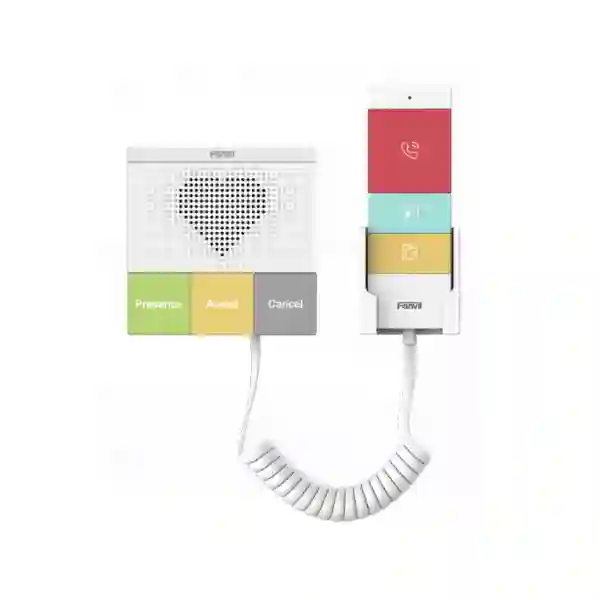
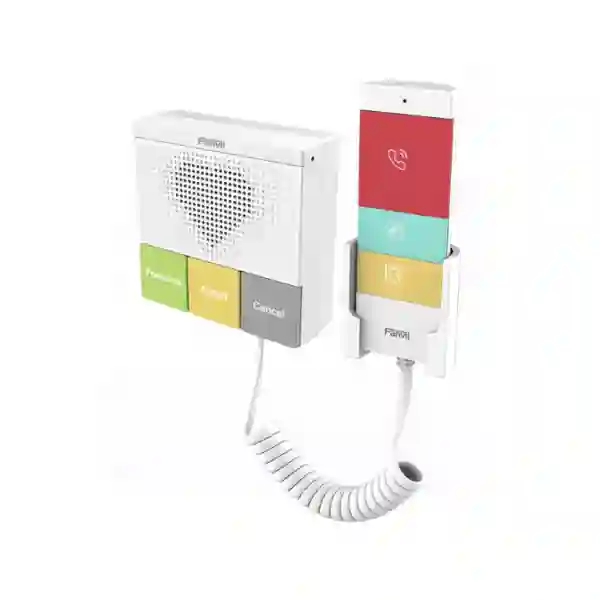
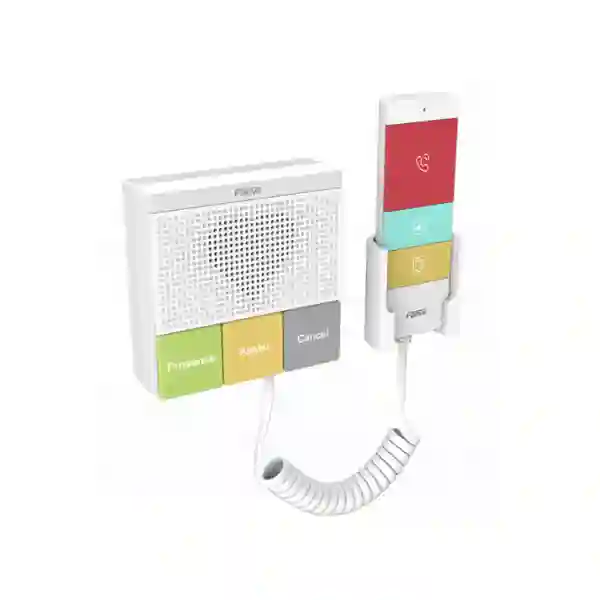
Fanvil Y501W-Y Wi-Fi Healthcare Intercom
The Fanvil Y501W-Y is a purpose-built bedside SIP healthcare intercom for hospitals, clinics, nursing facilities, assisted-care environments and other indoor care settings that need immediate, intelligible communication between patients and staff. It combines a handset, six detachable antibacterial function buttons, two SIP accounts, HD audio, dual-band 2.4 GHz and 5 GHz Wi-Fi, 10/100 Mbps Ethernet, PoE and 12V DC power options, IP54 protection, and integration capabilities for call buttons and healthcare workflows. For organizations in Tanzania planning new wards, modernizing nurse-call communications or extending an IP voice platform into patient-care areas, the Y501W-Y provides a flexible endpoint that can be assessed as part of the wider network, SIP, power and response-process design.
Built-in 2.4 GHz and 5 GHz Wi-Fi helps healthcare projects place the endpoint where wireless access is appropriate, while Ethernet remains available for structured deployments.
Support for HD audio including G.722 and Opus is designed to improve voice intelligibility for bedside calling and staff communication.
Six detachable antibacterial function buttons allow care workflows to be mapped to clear call actions based on project configuration.
Power over Ethernet can simplify bedside cabling, while 12V DC provides another supported powering approach where the project requires it.
What the Fanvil Y501W-Y is designed to solve
Healthcare communication has different priorities from ordinary office telephony. The person initiating a call may be a patient with limited mobility, a nurse requesting assistance, or a member of staff escalating an urgent event. The endpoint therefore needs obvious controls, dependable audio, straightforward installation and a configuration model that fits the facility’s response workflow. Fanvil positions the Y501-Y family for home-based care, nursing facilities and other indoor healthcare applications, and identifies the Y501W-Y specifically as the bedside station with a handset and Wi-Fi support within its nurse-call ecosystem.
For procurement teams, the most useful way to evaluate the Y501W-Y is as part of a complete communication path rather than as a standalone wall device. Confirm the SIP platform or nurse-console architecture, the wired or wireless network method, power source, required call-button labels, corridor-light or emergency-button interfaces, VLAN and QoS design, and the way clinical staff will acknowledge, return and escalate calls. A good deployment connects these decisions before hardware is ordered.
FourTeck Tanzania can align the endpoint requirement with related IP telephony, switching, Wi-Fi and infrastructure planning. Where a project also spans regional offices or procurement teams, the wider FourTeck network can support linked technology discussions through FourTeck Uganda, FourTeck Kenya, FourTeck UAE, FourTeck Ghana and FourTeck Nigeria.
Verified Fanvil Y501W-Y features and technical profile
| Product role | SIP healthcare bedside intercom/station with built-in handset and Wi-Fi |
| SIP accounts | 2 |
| Audio | HD audio with support for G.722 and Opus; full-duplex communication technologies are documented for the platform |
| Function buttons | 6 detachable antibacterial material function buttons |
| Wireless LAN | Built-in 2.4 GHz and 5 GHz Wi-Fi |
| Ethernet | 10/100 Mbps |
| Power | PoE or 12V DC |
| Protection | IP54 dust and splash protection for suitable indoor environments |
| I/O | 1 short-circuit input and 1 short-circuit output |
| Wireless emergency accessories | Supports specified 433 MHz Fanvil wireless buttons |
| Installation | Wall mounting and standard 86-box embedded installation options are documented for the series |
Healthcare deployment and integration guidance
A Y501W-Y project should begin with the clinical response process. Decide which calls need ordinary assistance, which represent emergencies, how staff assistance is requested, and whether workflows such as Code Blue or staff presence are part of the intended configuration. Fanvil documentation identifies multiple healthcare call types for the Y501-Y series, but the final behavior depends on how the system is configured and integrated. Button caps and labels should match the facility’s approved terminology, and staff training should reflect exactly what each action does.
Network planning is equally important. Wi-Fi can reduce dependence on a bedside Ethernet drop, but healthcare wireless coverage should be verified where devices are actually installed. Signal strength alone is not enough: channel utilization, roaming design, interference, VLAN separation, security policy and the path to the SIP service all affect reliability. Where Ethernet is available, PoE can simplify powering and centralize resilience through UPS-backed switching. FourTeck’s Tanzania technology portfolio includes managed switching, Wi-Fi access points, IP PBX, IP phones and structured cabling, which are directly related to the infrastructure around a SIP healthcare endpoint.
The Y501W-Y can also participate in Fanvil’s healthcare ecosystem with nurse-console and accessory components. The current Fanvil nurse-call documentation identifies the A320i as a nurse station host, Y501W-Y as a Wi-Fi bedside station, CL-01 as a corridor light, KT10/KT20/KT30 as wireless call-button options and KT31 as a wired pull-cord button. These components should be specified only after the use case, quantity, compatibility, firmware and topology have been checked for the proposed deployment.
Who should consider the Fanvil Y501W-Y?
Hospitals and clinics
Suitable for bedside communications where patients need simple, visible call controls and staff need SIP-based voice communication integrated with the facility network. Projects should verify ward workflow, nurse-console design, redundancy expectations and device cleaning procedures.
Nursing and assisted-care facilities
The handset, large colored function controls and optional wireless emergency accessories can support environments where residents require straightforward ways to request help. The actual call-routing and escalation logic should be documented before deployment.
Healthcare modernization projects
Organizations replacing legacy analog call points can evaluate SIP endpoints as part of a broader migration toward managed Ethernet, PoE, Wi-Fi and IP communications, while carefully validating integration with existing life-safety and clinical procedures.
Buying checklist before requesting a quotation
For an accurate Fanvil Y501W-Y quotation, provide the number of beds or rooms, desired number of bedside stations, whether Wi-Fi or wired Ethernet will be used, PoE availability, SIP platform details, nurse-station requirement, desired function-key workflow, corridor-light requirement, emergency-button or pull-cord requirement, installation method, and whether the project is a new build or retrofit. Include floor plans where practical, especially for larger hospitals or facilities where wireless coverage and cable routes need assessment.
Do not base the final bill of materials only on endpoint quantity. Consider PoE switch capacity, UPS-backed power, wireless access-point density, VLANs, SIP registration, nurse-console quantities, accessories, mounting materials, commissioning, user training and future expansion. A clear design brief reduces the risk of purchasing compatible products in incompatible quantities.
Fanvil Y501W-Y Wi-Fi Healthcare Intercom Tanzania
For healthcare providers in Tanzania, the Fanvil Y501W-Y offers a practical route to SIP-based bedside communication where both wired infrastructure and wireless flexibility may be required. A hospital may use Ethernet and PoE in newly constructed wards while relying on carefully engineered Wi-Fi in retrofit areas where pulling additional cable is disruptive. Because the Y501W-Y supports both approaches, procurement teams can evaluate one endpoint family across different building conditions rather than assuming every room has identical infrastructure. The built-in handset is particularly relevant when a patient or resident benefits from private, close-range voice communication rather than hands-free audio alone.
Tanzania projects should start with a survey of network, power and workflow conditions. Healthcare facilities can contain reinforced walls, multiple floors, busy wireless environments and areas where downtime has operational consequences. If Wi-Fi is selected, confirm stable coverage at the mounting position and separate healthcare endpoints from unmanaged guest traffic where appropriate. If PoE is selected, confirm switch port counts, PoE budget and UPS strategy. SIP server reachability, DNS, addressing, VLANs and firewall policy should be documented so a bedside unit can be replaced or relocated without lengthy troubleshooting.
The clinical process is just as important. Define what each function button means, which destination it calls, how priorities are handled and what staff do if the first destination is unavailable. Where Fanvil nurse-call components such as the A320i console, CL-01 corridor light or KT-series buttons are planned, verify quantities and compatibility against the current Fanvil documentation. The Y501W-Y’s support for multiple healthcare call types can be valuable, but those call types only become useful when they map clearly to a facility’s operational procedures.
FourTeck Tanzania can discuss the Y501W-Y alongside the surrounding IP infrastructure rather than treating it as an isolated purchase. That may include SIP telephony, managed switches, Wi-Fi access points, structured cabling, network segmentation and power continuity. This systems approach is useful for hospitals, private clinics, nursing facilities, rehabilitation centers and care environments planning phased expansion. Requesting a quotation with room counts, site drawings and current PBX details will help determine the right starting bill of materials without making assumptions about stock, lead time or final compatibility.
Fanvil Y501W-Y Wi-Fi Healthcare Intercom Dar es Salaam
Dar es Salaam healthcare facilities often combine established buildings with new clinical spaces, creating mixed infrastructure conditions. The Y501W-Y can suit this type of environment because it offers both 10/100 Mbps Ethernet and dual-band Wi-Fi. In a new ward, PoE cabling can provide predictable connectivity and centralized power. In an existing room where new cable routes are difficult, Wi-Fi may reduce physical disruption, provided that a proper wireless survey demonstrates reliable coverage and capacity. The important decision is not wired versus wireless in isolation; it is which method provides the most maintainable connection for each area.
For a Dar es Salaam hospital or clinic, procurement should map bedside stations to room and bed identifiers before installation. Consistent naming helps nurses, IT teams and integrators understand where every endpoint belongs, especially when the deployment expands. The SIP account plan should match the nurse-console or PBX call-routing design. Emergency call destinations, staff-assistance routes and after-hours behavior should be tested with real workflows rather than only confirming that a test call rings. Where multiple buildings or floors are involved, network segmentation and QoS can help keep voice traffic predictable.
The Y501W-Y’s six detachable antibacterial function buttons are useful because care facilities can configure recognizable functions rather than forcing users to remember extension numbers. The built-in handset can support users who prefer a familiar telephone-style experience. Optional Fanvil 433 MHz wireless buttons may also extend emergency calling where mobility or bathroom access is part of the requirement, but accessory selection should be made from the official supported list and incorporated into the room-by-room design.
Organizations requesting a Dar es Salaam quote should provide the facility type, approximate number of beds, number of nurse stations, existing SIP/PBX platform, available PoE switching, wireless network brand and coverage information, desired accessories and installation constraints. FourTeck can then frame the intercom requirement within the broader communication and network architecture. For related infrastructure planning, the Tanzania site’s coverage of IP phones, VoIP, switching, Wi-Fi and structured cabling provides useful context for turning a bedside device purchase into a manageable deployment.
Fanvil Y501W-Y Wi-Fi Healthcare Intercom Mwanza
In Mwanza, healthcare buyers evaluating the Fanvil Y501W-Y should consider how the communication system will remain understandable and serviceable over time. A compact clinic may begin with a small number of bedside stations, while a larger hospital can require multiple wards, nurse consoles, corridor indicators and emergency accessories. The same Y501W-Y endpoint can fit both scenarios, but the network design, call routing and operational documentation will differ significantly. Planning a repeatable configuration template from the first room makes later expansion easier.
The Y501W-Y is especially relevant where healthcare organizations want to use existing IP infrastructure. SIP allows the endpoint to participate in a standards-based communication environment, while built-in dual-band Wi-Fi offers another connectivity option. Wireless should be engineered carefully in wards because roaming clients, staff devices, visitors and medical systems may all compete for airtime. A dedicated or appropriately segmented SSID, managed authentication, channel planning and stable backhaul are more important than simply seeing a strong signal icon during installation.
Power resilience also deserves attention. PoE can centralize power delivery to the bedside station, allowing the switching layer to be protected by UPS where the facility design requires continuity during short interruptions. If 12V DC is used instead, the power path and outlet location should be documented. Neither method should be assumed to guarantee uninterrupted service without a wider power-resilience plan. The facility should identify which communication functions are operationally critical and design the supporting infrastructure accordingly.
For quotation preparation in Mwanza, list each room, bed position, required call functions, desired wireless or wired method, handset requirement, accessories and nurse-console relationship. Existing PBX and network information can prevent unnecessary duplication. FourTeck can help align these requirements with switching, Wi-Fi, IP telephony and cabling considerations so the project can be assessed as a coherent system. This is particularly useful for phased upgrades where the first deployment needs to create standards that later wards can follow.
Fanvil Y501W-Y Wi-Fi Healthcare Intercom Arusha
Arusha healthcare and care-facility projects may include private hospitals, clinics, rehabilitation spaces, specialist centers, senior-care settings and hospitality-linked medical services. For these environments, the Y501W-Y can provide a clearly identifiable bedside SIP communication point with a handset and configurable function controls. The key advantage is not simply that the device has Wi-Fi; it is that the project can choose between Wi-Fi and Ethernet based on the room, cable availability and operational requirements.
A practical Arusha deployment begins with a room schedule. Assign every bedside location a device name, SIP identity and intended call behavior. Document which buttons trigger normal nurse calls, urgent calls or other staff workflows. If corridor lights or pull-cord buttons are included, map those accessories to the correct bedside station and test each one from the patient location through to the receiving console. This end-to-end testing matters more than checking each component separately because failures often occur in the interfaces between systems.
The IP54 rating provides dust and splash protection appropriate to the manufacturer’s stated indoor healthcare positioning, but it should not be interpreted as permission to install the endpoint in arbitrary wet or exposed areas. Mounting height, cleaning practices, cable protection and access to the handset should be agreed with the clinical team. Facilities should also check whether their infection-control procedures are compatible with the device materials and approved cleaning methods.
When requesting pricing for Arusha, include the expected number of Y501W-Y units, nurse-console needs, accessory quantities, network readiness, preferred mounting method and project timeline. Rather than assuming delivery, availability or installation coverage, obtain a current quotation and deployment scope. FourTeck’s broader Tanzania services for network switching, Wi-Fi, IP telephony and infrastructure can be considered alongside the intercom so the final design addresses both clinical usability and technical maintainability.
Fanvil Y501W-Y Wi-Fi Healthcare Intercom Dodoma
Healthcare institutions in Dodoma assessing digital communication upgrades can use the Fanvil Y501W-Y as a bedside SIP endpoint within a structured nurse-call or IP voice plan. The model’s built-in handset, six function buttons and HD audio make it suitable for direct patient-to-staff communication, while Wi-Fi and Ethernet give designers choices for different room conditions. The most successful deployments treat the endpoint, the receiving console, the LAN, power and staff procedures as one system.
For a new facility or refurbishment, incorporate bedside communication into the network design early. Reserve VLANs and addressing, identify PoE ports, define Wi-Fi coverage targets, document switch uplinks and ensure the SIP platform is reachable through the required firewall policies. If the facility uses a centralized server room, consider how switch or UPS failure affects multiple wards. If distributed network closets are used, ensure documentation and labeling make troubleshooting straightforward for onsite IT staff.
User experience should be reviewed with nurses and administrators before finalizing button functions. The Y501W-Y supports detachable function buttons, giving the project flexibility, but labels and call types should match the facility’s real terminology. An overly complex configuration can make a capable device harder to use. A small set of clearly understood actions, backed by defined response procedures, is generally more useful than assigning every possible function without an operational need.
Dodoma procurement teams should request a quote based on an actual room and bed schedule rather than a rough device count. Include quantities for consoles, corridor lights, pull cords or wireless buttons where needed, as well as installation and configuration requirements. FourTeck can then assess the related LAN, Wi-Fi, PoE and SIP considerations. The objective is to create a maintainable healthcare communication environment that can be expanded without redesigning each ward from the beginning.
Fanvil Y501W-Y Wi-Fi Healthcare Intercom UAE
Organizations with healthcare operations or procurement teams in the UAE can evaluate the Y501W-Y for SIP-based bedside communication projects that require a handset, configurable healthcare function keys and dual-band Wi-Fi. The UAE market often includes sophisticated structured cabling and managed wireless environments, which makes it especially important to integrate the device with established network standards, security policy and change-management procedures rather than installing it as an unmanaged endpoint.
Large hospitals may need standardized device naming, automated provisioning, VLAN design, controlled firmware management and formal acceptance testing. Smaller clinics can use the same principles at a simpler scale. Each endpoint should have a known location, configuration baseline and support path. If Fanvil’s nurse-call ecosystem is being used, test nurse console behavior, priority calls, corridor indicators and accessories against the facility’s approved workflow before production rollout.
Wireless deployment should follow the building’s enterprise Wi-Fi design. Dual-band capability offers flexibility, but clinical endpoints should not be placed on a congested general-purpose network without assessing reliability. Ethernet with PoE may be preferred for fixed bedside positions where cabling exists, while Wi-Fi may be appropriate in retrofits or selected spaces. The right choice depends on coverage, redundancy, maintenance access and local technical standards.
For UAE requirements connected to a Tanzania project, procurement teams can use FourTeck UAE for broader regional technology discussions while maintaining Tanzania-specific planning through FourTeck Tanzania. This can help multi-country groups align endpoint standards, SIP architecture and documentation without claiming that every site should use an identical physical design. Request model-specific availability, compliance information and current commercial terms before purchase.
Fanvil Y501W-Y Wi-Fi Healthcare Intercom Uganda
Uganda healthcare organizations considering the Y501W-Y can use its SIP design to connect bedside communication with a broader IP network strategy. The endpoint’s Wi-Fi capability is useful when cable access is constrained, while PoE Ethernet can provide a straightforward fixed connection where managed switching is available. Rather than standardizing on one transport method everywhere, project teams can select the method that provides the most predictable operation for each building or ward.
For facilities with multiple locations, standardization should focus on configuration and documentation. Use consistent room naming, SIP numbering, button functions, firmware policy and installation records. A common template reduces training effort and makes support easier, even if one facility uses Ethernet and another uses Wi-Fi. When optional call buttons or corridor lights are part of the design, maintain a clear record of which accessory is paired or wired to each bedside station.
The Y501W-Y’s healthcare-oriented call types can support structured response processes, but those features should be aligned with staffing and escalation procedures. A technology configuration cannot replace clinical policy. Before rollout, simulate normal calls, urgent events, unavailable staff and recovery after network or power interruption. Acceptance criteria should include understandable audio, correct destination, visible status where configured and straightforward cancellation or closure of calls.
For Uganda-specific commercial discussions, FourTeck Uganda can be referenced alongside the Tanzania project. Cross-border organizations can use a common technical checklist while requesting current local quotations separately. Avoid assumptions about stock, delivery times or service reach until confirmed for the actual project location and quantity.
Fanvil Y501W-Y Wi-Fi Healthcare Intercom Kampala
Kampala hospitals and clinics can evaluate the Y501W-Y where a SIP bedside endpoint needs to combine straightforward user controls with flexible network connectivity. Dense buildings and busy wireless networks make site validation particularly important. Even when 5 GHz coverage appears strong in corridors, the bedside mounting position can experience different signal conditions because of walls, doors, equipment and room layout. A pre-installation wireless check can identify whether Wi-Fi is appropriate or whether Ethernet should be preferred.
For wired deployments, PoE simplifies bedside power by carrying data and power on one cable, but switch capacity must be planned. Count ports, calculate power budget, confirm uplink bandwidth and decide which network closets require UPS protection. Voice QoS, VLAN design and device management should be included in the commissioning plan. For a large hospital, these network details have a direct impact on supportability because hundreds of endpoints can be affected by a single infrastructure decision.
Clinical teams should review the function-button labeling and response destinations before installation. The Y501W-Y provides six detachable antibacterial function buttons, and Fanvil documents call types including normal nurse calls, emergency calls, staff assistance, staff emergency, Code Blue and staff presence. Not every deployment needs every function. Configure only the workflows that are clearly understood, approved and supported by staffing processes.
A Kampala quotation request should include bed count, ward count, nurse-station locations, existing IP PBX or SIP infrastructure, switch and Wi-Fi details, accessory requirements and installation expectations. Where the same organization has operations in Tanzania, Kenya or other regions, maintain a shared technical specification but validate each site separately. Regional FourTeck sites can support country-specific commercial discussions while preserving a consistent project framework.
Fanvil Y501W-Y Wi-Fi Healthcare Intercom Arua
For healthcare facilities in Arua, maintainability and infrastructure readiness may be just as important as endpoint features. The Fanvil Y501W-Y supports both Wi-Fi and Ethernet, giving a project flexibility when existing cabling varies between rooms. Before selecting wireless as the default, assess access-point coverage, backhaul stability and power to the wireless infrastructure. A bedside intercom depends on the whole communication path, so resilient access points and switches matter as much as the endpoint itself.
The device’s PoE support can reduce local power-adapter requirements in wired rooms. Where a central UPS supports the PoE switch, short power interruptions may be easier to manage, although actual resilience depends on the full network and SIP system. For sites using DC power, label power supplies and cable paths so maintenance staff can identify them without disconnecting other clinical equipment.
The handset and clear function keys can be useful for patient-centered communication, particularly where users benefit from a familiar calling interface. Optional 433 MHz Fanvil buttons can extend the design to specific emergency-call scenarios. These accessories should be specified from current official documentation and tested in the actual building, because wireless range and workflow requirements are site dependent.
Arua buyers should define what they expect from the system before comparing price. Identify required call types, staff response points, room quantities, network method, power method, installation method and expansion plans. A well-prepared requirement enables a supplier to quote the endpoint together with any necessary switching, wireless, PBX or accessories. For regional support discussions, the Uganda FourTeck site provides an appropriate country-specific reference while the Tanzania site can remain the basis for Tanzania projects.
Fanvil Y501W-Y Wi-Fi Healthcare Intercom Mbarara
Mbarara healthcare projects can use the Y501W-Y when a facility wants a SIP-based bedside communication device with both a handset and healthcare-oriented function buttons. The device should be selected in conjunction with the nurse station, PBX or SIP server rather than purchased solely on feature count. Confirm how calls are received, displayed, prioritized and closed, and ensure staff can identify the origin of a call quickly enough for the intended workflow.
Infrastructure assessment should include Ethernet availability, Wi-Fi coverage, PoE capacity, UPS support and network segmentation. If wireless is chosen, reserve adequate capacity and avoid treating the endpoint like an ordinary guest client. If Ethernet is chosen, label switch ports and patch panels by room and bed. These simple documentation steps reduce troubleshooting time when staff report that a specific bedside station is unreachable.
The Y501W-Y supports two SIP accounts, which can provide design flexibility, but the final account strategy should follow the chosen communication architecture. Avoid adding unused registrations simply because the device supports them. Similarly, function keys should represent meaningful actions for the facility. A smaller set of well-defined workflows can be safer and easier to train than a feature-heavy configuration that users do not understand.
For Mbarara procurement, request a detailed bill of materials that separates bedside stations, consoles, lights, emergency accessories, network components and professional services. This makes comparison clearer and avoids mistaking a device-only quotation for a complete nurse-call solution. Current availability, warranty conditions and delivery arrangements should be confirmed in the formal quotation rather than assumed from online listings.
Fanvil Y501W-Y Wi-Fi Healthcare Intercom Gulu
Gulu clinics, hospitals and care facilities evaluating the Y501W-Y should begin by defining communication priorities. Some sites need a simple bedside call to a central nurse point; others need multiple call categories, corridor indication and emergency buttons. The Y501W-Y can participate in these broader Fanvil healthcare designs, but the exact combination should follow the facility’s staffing model and physical layout.
Dual-band Wi-Fi can be attractive in retrofit projects where additional cabling is difficult, yet a dedicated healthcare communication endpoint still requires dependable coverage. Survey each installation area, especially patient rooms at the edge of access-point cells. Check interference and channel use during representative operating hours. Where coverage is uncertain, additional access points or Ethernet may provide a more robust result than trying to compensate through endpoint settings.
The IP54 protection rating and antibacterial function-button material support the product’s healthcare positioning, but facility cleaning procedures and mounting locations should still be reviewed. Keep the endpoint accessible to the patient and staff while protecting cables from accidental pulling. If a handset cord or accessory is within reach, consider how it interacts with beds, trolleys and routine room cleaning.
For a Gulu quote, submit the project as a room schedule where possible. Note each bed, connectivity method, power source, function-button set and required accessory. This enables clearer commissioning and future maintenance. Regional procurement can be coordinated with the appropriate FourTeck country resources, while all final claims about availability, service and commercial terms should come from the current project quotation.
Fanvil Y501W-Y Wi-Fi Healthcare Intercom Kenya
Kenya healthcare providers and regional groups can evaluate the Fanvil Y501W-Y as a bedside SIP endpoint for facilities that want a unified IP communication foundation. Its combination of Ethernet, PoE, dual-band Wi-Fi, two SIP accounts and a built-in handset supports several deployment models. The best model is the one that fits the existing network and clinical response design, not necessarily the one with the least cabling.
For multi-site hospital groups, create a common design standard covering device naming, SIP numbering, firmware, button functions and acceptance tests. Then adapt the physical network to each site. A modern hospital with structured Cat6 and PoE switching may favor wired endpoints, while an older clinic may selectively use Wi-Fi. Standardization at the configuration level allows support staff to recognize devices even when connectivity methods differ.
The Fanvil nurse-call ecosystem gives buyers options beyond the bedside station, including the A320i console and compatible corridor-light and call-button accessories. Determine whether the project needs these healthcare-specific components or only SIP calling to an existing platform. Integration requirements should be validated with current firmware and documentation, especially when third-party PBX systems or healthcare applications are involved.
For Kenya-specific commercial engagement, FourTeck Kenya provides a regional reference. Organizations operating in both Kenya and Tanzania can align their technical requirements while requesting country-specific quotations. This makes it easier to compare system architecture and management standards without assuming identical pricing, logistics or local project scope.
Fanvil Y501W-Y Wi-Fi Healthcare Intercom Kuwait
Kuwait healthcare deployments of the Y501W-Y should focus on integration with the facility’s established communications and network standards. Hospitals may already operate segmented networks, centralized monitoring and formal change controls. The bedside intercom should therefore be assigned to an appropriate VLAN, registered to an approved SIP platform and included in configuration backup and firmware-management practices.
The model’s Wi-Fi capability is useful in selected retrofit areas, but fixed bedside positions often benefit from the predictability of structured Ethernet and PoE where available. Wireless can still be valuable when construction constraints make cabling difficult. In either case, test voice quality, registration stability, call setup time and recovery after network interruption as part of acceptance rather than relying only on basic connectivity.
User-interface planning matters in multilingual healthcare environments. The physical button labels and icons should be chosen for the facility’s approved workflow and patient population, and staff should receive clear instruction on what each call type triggers. Because the Y501W-Y supports detachable function buttons, the interface can be configured around relevant actions rather than exposing unnecessary functions.
For Kuwait procurement, ask for current model availability, accessories, compatible console components, warranty terms and implementation scope as part of a formal quotation. Regional technology needs can also be explored through FourTeck Kuwait. Multi-country organizations should keep a shared technical specification but validate regulatory, commercial and infrastructure details separately in each market.
Fanvil Y501W-Y Wi-Fi Healthcare Intercom Ghana
Ghana healthcare projects can consider the Y501W-Y where hospitals, clinics or assisted-care facilities want IP-based bedside communication that can work over Ethernet or dual-band Wi-Fi. A project should define whether the device will operate primarily as part of Fanvil’s nurse-call architecture or as a SIP endpoint connected to another compatible communication platform. That decision affects console requirements, call routing and the accessory list.
For facilities modernizing incrementally, the Y501W-Y can be introduced ward by ward if the underlying SIP and network design is scalable. Build a repeatable template for VLAN, addressing, SIP credentials, button functions, device naming and test procedures. This reduces variation between phases and makes it easier for support teams to understand older and newer wards.
Connectivity should be chosen after a site survey. Wi-Fi offers flexibility, but access-point placement and network congestion can affect voice performance. Wired PoE provides data and power over one connection but requires suitable cabling and switching. Both methods depend on resilient core infrastructure and a reachable SIP service. A UPS strategy for network components can be important where communication continuity during short power disturbances is part of the facility requirement.
Ghana buyers can use FourTeck Ghana for country-focused enquiries while using the same technical checklist as Tanzania projects. Provide room quantities, nurse-station design, accessory needs and network details when seeking a quotation. Current stock, commercial terms and deployment scope should always be confirmed specifically for the project.
Fanvil Y501W-Y Wi-Fi Healthcare Intercom Nigeria
Nigeria healthcare organizations looking for a SIP bedside communication endpoint can evaluate the Y501W-Y for hospitals, specialist clinics, nursing facilities and care environments. The product’s six healthcare-oriented function buttons, handset, HD audio and flexible network options make it relevant where patients need an intuitive communication point and IT teams want an IP-based platform that can be documented and managed.
Larger facilities should pay particular attention to scale. Hundreds of endpoints can magnify small configuration inconsistencies, so standardized provisioning, IP addressing, VLANs, SIP naming and firmware policy become essential. Nurse-console capacity and call-flow design should be assessed against expected simultaneous use rather than merely total bed count. During commissioning, test representative peak scenarios and ensure urgent calls receive the correct handling.
Where power conditions are a design concern, consider the complete path from bedside endpoint through the PoE switch, access layer, core network and SIP platform. A UPS protecting only the endpoint or only the server is not enough if an intermediate switch loses power. Facilities should identify their continuity objectives and design appropriately. The Y501W-Y’s choice of PoE or 12V DC supports different architectures but does not remove the need for system-level resilience planning.
For Nigeria-specific procurement, FourTeck Nigeria can be used for regional enquiries. Groups with operations in Tanzania can maintain common technical standards across locations while confirming local availability and project scope independently. A well-defined request for quotation should separate endpoint quantities, nurse-call accessories, network components and professional services for transparent evaluation.
Fanvil Y501W-Y Wi-Fi Healthcare Intercom Seychelles
Healthcare facilities in Seychelles may place particular value on a deployment that is simple to support and well documented. The Fanvil Y501W-Y can fit that objective when deployed with clear configuration standards, because it combines bedside calling, a handset, Wi-Fi and Ethernet options in one SIP endpoint. The project should still minimize unnecessary variation: define one approved firmware baseline, a consistent button layout and a repeatable network profile wherever possible.
For smaller island facilities, spare-unit planning and documentation can be important. Record each endpoint’s location, configuration and accessory relationships so a replacement can be prepared efficiently. Where remote technical support is part of the operational model, secure management access and configuration backups can reduce dependence on ad hoc onsite troubleshooting. These are project-design considerations rather than product features, but they strongly affect long-term serviceability.
Wi-Fi can simplify retrofits where cable routes are difficult, although the hospital or clinic should validate coverage at each bedside and protect healthcare traffic through appropriate network controls. Ethernet with PoE can be preferred for fixed locations where structured cabling is practical. Mixed designs can also work if installation records clearly show which rooms use which method and support staff understand both.
When requesting a Seychelles quotation, include total beds, room layout, desired call workflows, SIP platform, wireless and switching information, and any requirement for consoles, corridor lights or emergency buttons. Regional supply and logistics should be confirmed through the quotation rather than assumed. If the organization also operates in Tanzania or other African markets, a shared design standard can simplify training and support while each site retains an infrastructure plan suited to its own building.
Related infrastructure for a complete Y501W-Y deployment
A healthcare intercom endpoint is only one layer of the solution. The Tanzania FourTeck site describes business IP PBX and VoIP, IP phones, managed network switching, Wi-Fi access points, structured cabling, UPS-supported infrastructure and integrated IT services. These categories are directly relevant to a Y501W-Y project because the endpoint relies on the network and SIP path around it. Explore the FourTeck Tanzania solution portfolio to review these related technologies, and use the FourTeck Tanzania services page when the requirement includes assessment, installation, configuration or broader infrastructure work.
For a healthcare deployment, related requirements commonly include PoE access switches, Wi-Fi coverage, VLAN design, UPS capacity, structured cabling, SIP platform configuration and documented commissioning. These should be selected based on the number of endpoints, building layout and operational requirements rather than bundled automatically. A site with ten beds and a stable existing PBX has a very different design from a multi-floor facility with several hundred endpoints.
Fanvil Y501W-Y FAQ
Does the Fanvil Y501W-Y support Wi-Fi?
Yes. The Y501W-Y includes built-in 2.4 GHz and 5 GHz Wi-Fi. A healthcare deployment should still validate signal coverage, interference, network segmentation and SIP reachability at the actual installation location.
Can the Y501W-Y use PoE?
Yes. Fanvil documentation lists PoE support, and the series also supports 12V DC power. The project should confirm switch PoE capacity, UPS strategy and cabling before deployment.
How many SIP accounts does the Y501W-Y support?
The model supports two SIP accounts. The account plan should be designed around the intended PBX or nurse-call architecture rather than registering additional accounts without a defined purpose.
Is the Y501W-Y a video intercom?
No. The Y501W-Y is an audio-focused SIP healthcare bedside intercom. If video is required, the project should evaluate a different Fanvil model or solution designed for video rather than assuming camera capability.
What is the difference between Y501W-Y and Y501W?
Within Fanvil’s healthcare lineup, the Y501W-Y is the Wi-Fi bedside station with a built-in handset, while the Y501W is the Wi-Fi intercom variant without that handset form factor. Confirm exact accessories and installation requirements for the selected model.
Can it connect to emergency buttons?
Fanvil documents support for specified 433 MHz wireless buttons and short-circuit input/output interfaces in the Y501-Y family. Current compatibility and the intended emergency workflow should be verified for the exact accessory and firmware used.
Is it suitable for outdoor installation?
The Y501W-Y is positioned by Fanvil for indoor healthcare environments and carries an IP54 protection rating. Do not treat that rating as an outdoor deployment guarantee; select the mounting location according to the manufacturer’s intended use and environmental guidance.
What information is needed for a quote?
Provide quantity, bed and room count, nurse-station requirement, wired or Wi-Fi preference, PoE availability, SIP/PBX details, function-button workflow, accessory needs, installation method, site location and whether installation or configuration services are required.
Decision recap
Choose the Fanvil Y501W-Y when the requirement is for a healthcare-focused SIP bedside intercom with a handset, dual-band Wi-Fi, Ethernet, PoE, HD audio and configurable function buttons. It is particularly relevant when the organization wants to connect bedside communications to a structured IP network or Fanvil nurse-call environment. The strongest buying decision comes from validating the complete workflow: who places the call, how it reaches staff, what happens when the first responder is unavailable, and how network and power infrastructure support the service.
Before ordering, confirm quantities, SIP compatibility, firmware, accessories, Wi-Fi or Ethernet design, PoE budget, mounting approach and current commercial availability. Avoid assuming that a product specification alone defines a complete nurse-call solution. FourTeck can help frame the Y501W-Y within the broader network and communication requirements for a Tanzania healthcare deployment.
Plan your Fanvil Y501W-Y healthcare communication project
Share your facility type, location, number of beds, existing PBX or SIP platform, network details and required healthcare accessories. FourTeck can use that information to discuss a practical product and infrastructure scope without making unsupported assumptions about stock, delivery times or site conditions.



Reviews
There are no reviews yet.