
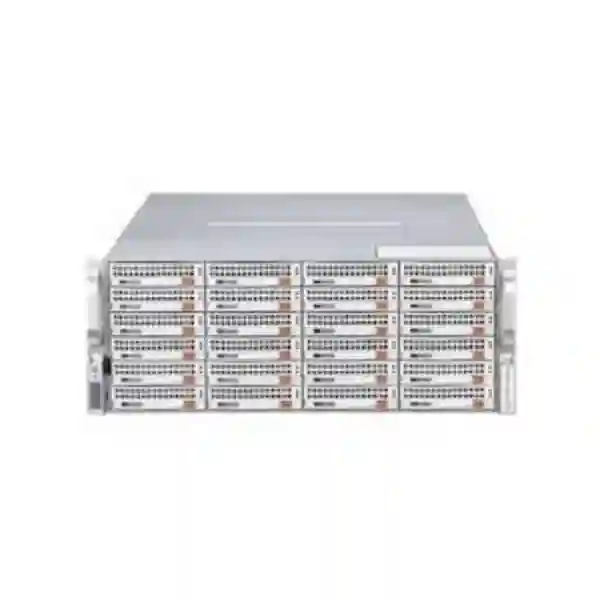
FortiAnalyzer FAZ-3750G Tanzania
The FortiAnalyzer FAZ-3750G is built for organizations that need centralized Fortinet log management, security analytics, reporting and investigation at substantial scale. Fortinet’s published specifications list up to 8,300 GB/day of logs, 100,000 analytic logs per second, 150,000 collector logs per second, 2 × 10GE RJ-45 ports, 2 × 25GE SFP28 ports, 24 × 16 TB HDD storage and 4 × 15 TB SSD storage. These characteristics make the platform relevant to large enterprises, managed security operations and distributed environments where security telemetry must be consolidated for operational visibility.
Designed to receive and analyze large volumes of Fortinet security logs while supporting centralized investigation and reporting workflows.
A combination of HDD and SSD capacity supports demanding retention and analytics requirements. Retention planning should still be based on measured daily log volume and organizational policy.
10GE RJ-45 and 25GE SFP28 connectivity gives architects options for integrating the appliance into high-throughput data-center and security operations networks.
FortiAnalyzer FAZ-3750G overview
FortiAnalyzer centralizes security event information from compatible Fortinet environments so operations teams can work from a consolidated view rather than treating each security appliance as an isolated source. For a large deployment, the important design questions are not limited to appliance capacity. Buyers should quantify average and peak log rates, retention periods, the number and types of managed devices, reporting requirements, administrative domains, redundancy expectations, backup strategy and growth. The FAZ-3750G belongs in designs where these requirements justify a high-capacity hardware platform.
A procurement exercise should therefore begin with a log-volume assessment. Teams can estimate current daily ingestion, add growth assumptions, identify regulatory or internal retention targets, and distinguish searchable analytics retention from archive requirements. This produces a more defensible sizing decision and helps determine whether the FAZ-3750G, another FortiAnalyzer appliance, or a different deployment architecture is appropriate.
Verified platform highlights
| Item | Published capability |
|---|---|
| Logs per day | Up to 8,300 GB/day |
| Analytics rate | 100,000 logs/second |
| Collector rate | 150,000 logs/second |
| Copper high-speed interfaces | 2 × 10GE RJ-45 |
| Optical high-speed interfaces | 2 × 25GE SFP28 |
| HDD storage | 24 × 16 TB HDD |
| SSD storage | 4 × 15 TB SSD |
Security operations and deployment planning
Centralized logging becomes more valuable as a Fortinet estate grows. Security teams can use FortiAnalyzer to bring together event data for investigation, reporting and operational review. The deployment should be designed around reliable log transport, accurate time synchronization, appropriate administrative access, backup processes and documented retention policy. Network segmentation and management-plane controls should be considered before production onboarding.
Organizations using FortiGate can also review FourTeck resources for FortiGate firewall solutions in Tanzania, while broader vendor requirements can be discussed through Fortinet solutions for Tanzania. For multi-site connectivity projects, FortiGate site-to-site VPN guidance helps frame how distributed branches may connect securely. Organizations planning remote access can review FortiGate remote-access VPN, and resilient internet designs can use the FortiGate dual-WAN configuration overview. Security subscription planning can be considered alongside FortiGuard subscription renewal, while broader enterprise projects can start from the FourTeck Tanzania contact page.
FortiAnalyzer FAZ-3750G Tanzania
For Tanzanian enterprises, the FAZ-3750G is most relevant when security infrastructure has reached a scale where local device-by-device log review is inefficient. Financial institutions, telecom environments, large industrial groups, universities, government-scale networks and managed service operations may generate substantial telemetry across firewalls and other security controls. Centralizing that data can make investigation and reporting more consistent, but procurement should begin with measured requirements rather than model name alone.
A Tanzania sizing workshop should document the number of log-producing devices, daily ingestion, expected annual growth, required searchable retention, archive policy, reporting frequency and recovery objectives. Connectivity between sites and the central analytics environment also matters. If branch locations send logs over WAN or VPN connections, architects should account for link stability, routing, latency and security. Time synchronization across devices is equally important because incident timelines depend on accurate timestamps.
Buyers requesting a quotation should specify the intended FortiAnalyzer role, current Fortinet estate, software requirements, support expectations and any high-availability objectives. A complete bill of materials should be checked against current Fortinet ordering information at quotation time rather than assuming that every service or accessory is bundled with the hardware. FourTeck can use these details to frame a more relevant proposal for the Tanzanian environment.
FortiAnalyzer FAZ-3750G Dar es Salaam
Dar es Salaam organizations often operate headquarters, data-center, campus and branch networks that aggregate substantial security telemetry. For an enterprise considering FAZ-3750G, the design should map the appliance to the real operational workflow: which teams investigate events, which devices generate the largest log volume, how long analysts need searchable data, and which reports are required for management, audit or internal governance.
The appliance’s high-speed interfaces make network placement an important architecture decision. Teams should identify appropriate switching capacity, management VLANs, upstream routes and secure administration paths. They should also plan power, rack space, cooling and physical access controls as part of data-center readiness. These practical requirements are separate from the security analytics features but can determine whether deployment proceeds smoothly.
For procurement in Dar es Salaam, a useful request for quotation includes device counts, FortiOS or related platform versions where relevant, current log volume, retention targets and expected expansion. This lets the proposed architecture be evaluated against measurable needs. Organizations should also identify whether the system will operate primarily as an analyzer, collector, or within a larger distributed FortiAnalyzer architecture, and confirm current compatibility and licensing with Fortinet documentation before implementation.
FortiAnalyzer FAZ-3750G Mwanza
Organizations in Mwanza evaluating FAZ-3750G may be connecting a regional hub to branches, production locations, campuses or remote facilities. In that pattern, centralized visibility is useful only when log transport is dependable. Project teams should document WAN paths, VPN architecture, bandwidth constraints and failover behavior before deciding how remote devices will forward security data to the central FortiAnalyzer environment.
Retention planning deserves particular attention. The published maximum daily log capacity is a platform figure, not a substitute for an organization’s own sizing. Actual retention depends on ingestion, analytics requirements, storage allocation, configuration and growth. Teams should measure typical and peak periods rather than relying on a single average. Seasonal activity, major application changes or additional protected sites can materially change logging demand.
Mwanza procurement teams can improve quotation accuracy by listing existing Fortinet appliances, anticipated additions, desired retention, reporting needs and support expectations. The result is a clearer conversation about capacity and lifecycle planning. Where the security estate is still small, that assessment may also show that another FortiAnalyzer model is a better fit; where logging is already substantial, FAZ-3750G provides a high-capacity option for consideration.
FortiAnalyzer FAZ-3750G Arusha
Arusha businesses with hospitality, institutional, regional-office or multi-site networks can approach FortiAnalyzer design from an operational perspective. The first question is how centralized analytics will improve the security team’s daily work. Common objectives include faster event review, consistent reporting, consolidated visibility and retaining security telemetry for an appropriate period. These goals should be converted into measurable technical requirements before hardware selection.
A deployment plan should identify the devices that will send logs, authentication and administrator roles, network routes, time sources, backup arrangements and monitoring responsibilities. For sites linked across variable WAN connections, engineers should also consider what happens during link interruption and how log forwarding behaves after connectivity returns. This avoids treating the analytics appliance as an isolated server and instead places it within the wider security operations architecture.
When requesting FAZ-3750G pricing for Arusha, buyers should avoid a hardware-only specification if subscriptions, support, installation, migration or configuration assistance are also expected. Clearly separating these items makes proposals easier to compare. Current software compatibility and service entitlements should be verified for the intended deployment date, because platform support information can change over a product lifecycle.
FortiAnalyzer FAZ-3750G Dodoma
Dodoma deployments may involve public-sector, institutional, education and enterprise networks where centralized reporting and controlled access to security records are important design considerations. FAZ-3750G can be evaluated as the analytics layer for a sizeable Fortinet environment, with sizing driven by actual ingestion and retention rather than assumptions based only on the number of firewalls.
Governance requirements should be documented early. Teams should determine who can view logs, who can administer the platform, how administrative activity is controlled, what reports are required and how long different categories of data must be retained. These are organizational decisions that influence the technical configuration. Procurement stakeholders should coordinate with security and infrastructure teams so the selected capacity reflects both operational and governance needs.
For a Dodoma quotation, provide a network summary, device inventory, expected daily log rate, retention policy, desired deployment role and growth assumptions. If high availability or disaster recovery is required, include that requirement explicitly so the architecture can be assessed as a system rather than a single appliance purchase. This approach reduces ambiguity during procurement and supports a more predictable implementation plan.
FortiAnalyzer FAZ-3750G UAE
UAE enterprises and service providers can evaluate FAZ-3750G for high-volume Fortinet security analytics in data-center and distributed environments. Large estates may span headquarters, branches, cloud-connected networks and multiple security zones, so the design should define whether logs are collected centrally or through a distributed collector architecture. Network bandwidth, redundancy and retention requirements should be calculated for that topology.
The appliance’s 25GE SFP28 and 10GE RJ-45 interfaces provide high-speed connectivity options, but transceiver, cabling and switch compatibility must be checked for the actual data-center design. Rack power, cooling and resilient connectivity should also be included in readiness planning. For regional Fortinet projects, buyers can review FourTeck Fortinet UAE resources and FourTeck UAE technology solutions as complementary regional references.
A UAE procurement brief should distinguish appliance hardware, applicable support and services, deployment assistance, migration scope and any required accessories. Buyers should confirm current Fortinet ordering and compatibility details at the time of quotation. For organizations consolidating multiple sites, a measured log baseline and realistic growth forecast are more useful than a simple count of network devices.
FortiAnalyzer FAZ-3750G Uganda
Ugandan organizations with distributed Fortinet networks can use centralized analytics to reduce fragmented security monitoring across branches and facilities. FAZ-3750G is positioned for substantial environments, so a project should start by establishing whether the current and projected telemetry justifies its capacity. Daily log measurements, retention objectives and reporting workloads form the core of that assessment.
Connectivity is a major design factor for multi-site deployments. If logs travel from branches to a central site, teams should review WAN resilience, VPN routing, available bandwidth and recovery after outages. A distributed collector design may be considered where appropriate, but the exact architecture should follow current Fortinet guidance and the organization’s operational needs. Administrator access and management networks should be protected separately from ordinary user traffic.
For Uganda-specific project discussions, FourTeck Uganda provides a regional FourTeck reference. A quotation request should include the Fortinet device estate, expected log volume, software versions where relevant, support expectations and planned growth. That information enables a capacity discussion grounded in the actual network rather than generic sizing assumptions.
FortiAnalyzer FAZ-3750G Kampala
Kampala is a natural aggregation point for organizations operating branch networks across Uganda. A central FortiAnalyzer platform can support a security operations workflow in which analysts review consolidated events and reports from a shared environment. For FAZ-3750G, the main buying question is whether its scale aligns with measured telemetry and expected expansion.
Infrastructure teams should assess where the appliance will sit relative to firewalls, core switching, management networks and backup systems. High-speed interfaces can support demanding deployments, but connectivity should be engineered end to end. A fast appliance interface cannot compensate for constrained branch links or an undersized aggregation network. Time synchronization and DNS dependencies should also be documented as part of deployment readiness.
Kampala buyers can prepare a stronger RFQ by including a device inventory, log-rate samples, retention requirements, reporting needs and any planned expansion. If the organization expects onboarding in phases, describe those phases so storage and throughput can be evaluated over the intended lifecycle. Support and implementation services should be listed separately from hardware requirements for clear commercial comparison.
FortiAnalyzer FAZ-3750G Arua
Arua deployments may involve remote branches or regional facilities where WAN reliability is a central consideration. In these environments, security analytics architecture should account for how logs reach the central platform, what happens during connectivity interruptions and how operations teams maintain visibility when a site is temporarily isolated. These questions should be resolved before production onboarding.
FAZ-3750G provides substantial processing and storage capacity, but capacity at the central site is only one part of a distributed design. Teams should evaluate remote device logging settings, transport security, routing, bandwidth and time synchronization. They should also document which event categories are operationally important and align retention with business and governance requirements.
For procurement serving Arua, buyers should provide the number and type of Fortinet devices, site topology, connectivity constraints, daily log estimates and growth expectations. This allows the central platform to be assessed in the context of the whole network. A clear implementation scope should also state whether configuration, migration, training or ongoing support is required in addition to the appliance and applicable Fortinet services.
FortiAnalyzer FAZ-3750G Mbarara
Mbarara organizations with branch, campus or operational networks can evaluate FortiAnalyzer as a way to centralize security records and reporting. The value comes from building repeatable security operations around the collected data, not merely storing logs. Teams should define investigation workflows, reporting responsibilities and retention requirements before finalizing the platform design.
A technical assessment should establish normal and peak log volumes and then model expected growth. New firewalls, increased traffic, additional security profiles and longer retention can all raise storage and processing demand. The FAZ-3750G’s published capacity provides a high ceiling, but practical sizing must use the organization’s real workload and current Fortinet guidance.
Mbarara procurement teams should also document network and facilities requirements, including rack environment, resilient power, management connectivity and backup strategy. If the appliance will serve multiple organizational units, administrative separation and reporting needs should be included in the design discussion. A structured RFQ helps ensure that hardware, services and implementation expectations are not mixed together ambiguously.
FortiAnalyzer FAZ-3750G Gulu
Gulu enterprises and institutions can consider FAZ-3750G when a centralized Fortinet security analytics platform is needed for a sizeable or growing estate. The first stage is discovery: identify log sources, estimate daily volume, define retention and establish which operational reports and investigations the security team needs to perform.
For geographically distributed sites, network behavior during outages should be part of the design. Engineers should understand how branch devices handle logging when the path to the analyzer is unavailable and how traffic is restored afterward. They should also ensure consistent time configuration across security devices, because accurate event chronology is essential during investigations.
A Gulu-focused quotation request can include current equipment, future expansion, preferred deployment role, support requirements and any installation or migration assistance. This creates a clear baseline for comparing proposals. Where an organization has not yet measured log volume, a discovery exercise should precede final sizing rather than selecting the largest appliance by default.
FortiAnalyzer FAZ-3750G Kenya
Kenyan enterprises with large Fortinet deployments can evaluate FAZ-3750G for centralized analytics across headquarters, branches, data centers and other protected environments. High-capacity log processing is particularly relevant where many security controls feed a shared operations team. The architecture should nevertheless be based on observed ingestion, reporting workloads and retention objectives.
Network teams should consider whether logs will flow directly to the appliance or through a distributed collection design. Data-center switching, high-speed interface compatibility, management segmentation, backup and resilient power should all be planned. If sites connect over WAN or VPN links, bandwidth and failure behavior should be modeled so centralized visibility does not depend on unrealistic connectivity assumptions.
For Kenya-focused FourTeck resources, visit FourTeck Kenya. Buyers requesting FAZ-3750G should include their Fortinet inventory, current log rates, retention policy, projected growth and service requirements. Current compatibility and ordering information should be reconfirmed at quotation time, especially where the project includes software upgrades or integration with an existing Fortinet management environment.
FortiAnalyzer FAZ-3750G Kuwait
Kuwait organizations operating high-throughput data-center and enterprise security networks can assess FAZ-3750G as a centralized Fortinet analytics platform. Its published high-speed interfaces and large storage configuration are suited to demanding environments, but design teams should map those resources to their own log sources, retention objectives and operational workflows.
Facilities readiness is especially important for a large hardware appliance. Rack allocation, power resilience, cooling, cabling and switch-port availability should be confirmed before delivery. Security teams should separately define management access, authentication, reporting and backup procedures. Combining these infrastructure and operational workstreams produces a more complete implementation plan.
Regional buyers can reference FourTeck Kuwait for related technology discussions. A useful FAZ-3750G RFQ includes log-volume estimates, device counts, retention, deployment role, high-availability expectations and implementation scope. Any required support or subscriptions should be verified against current Fortinet commercial documentation rather than inferred from the appliance model alone.
FortiAnalyzer FAZ-3750G Ghana
Ghanaian organizations with expanding Fortinet environments may need centralized security analytics as branch and data-center footprints grow. FAZ-3750G can be considered where log volumes and retention requirements are substantial. A disciplined sizing process starts with current telemetry and projects realistic growth rather than treating appliance capacity as a target that must be filled.
Security teams should document who will use the platform and for what purpose. Incident investigators, network security administrators, auditors and management may require different reports and access levels. Those requirements influence configuration and operational procedures. Network teams should simultaneously confirm log transport, management segmentation and time synchronization across the environment.
For regional context, FourTeck Ghana provides a related FourTeck market resource. Ghana procurement requests should identify the Fortinet estate, expected ingestion, retention targets, implementation timeline and support needs. Where a migration from an existing logging platform is planned, the scope should explicitly cover configuration and data-handling expectations so the transition can be assessed before purchase.
FortiAnalyzer FAZ-3750G Nigeria
Nigeria’s large enterprise and service-provider networks can generate significant security telemetry across multiple locations. FAZ-3750G is relevant to projects where centralized Fortinet analytics must accommodate high daily ingestion and substantial storage. Organizations should validate the requirement with measured data and determine whether a single appliance or distributed architecture best fits their topology.
A multi-site design should consider bandwidth, resilient paths, collector placement where applicable, management security and recovery after link failure. Security operations requirements are equally important: teams need defined workflows for investigations, reporting, access control, backup and retention. These operational choices determine how the platform will be used after installation and should therefore be part of procurement planning.
For Nigerian projects, FourTeck Nigeria offers a regional reference. A detailed quotation request should list current devices, expected additions, log rates, retention, data-center connectivity and required services. This allows technical and commercial discussions to focus on a documented requirement rather than a generic request for a high-end analyzer.
FortiAnalyzer FAZ-3750G Seychelles
Seychelles organizations may operate distributed hospitality, government, financial or commercial networks where island connectivity and centralized security visibility must be considered together. A FortiAnalyzer design should establish where logs are generated, where the appliance will be hosted and how remote locations maintain secure, reliable paths to the analytics environment.
For FAZ-3750G, the scale of the appliance means sizing should be evidence-led. Measure daily log generation, define searchable retention and account for growth. Where WAN links are constrained, evaluate transport behavior and architecture carefully rather than assuming every site can continuously send unrestricted telemetry. Infrastructure planning should also cover rack, power, cooling, switching and secure management access.
Seychelles buyers can prepare an RFQ that includes topology, device inventory, log estimates, retention requirements and support expectations. If installation or remote configuration assistance is required, state that separately. Current Fortinet compatibility, software and service information should be confirmed for the project date so the final design reflects the supported platform state rather than outdated assumptions.
Buying and sizing checklist
Before requesting a final FAZ-3750G proposal, document the current Fortinet device inventory; average and peak log rates; daily ingestion; required analytics and archive retention; expected three-year growth; data-center interface requirements; administrative domains; reporting needs; backup strategy; high-availability or disaster-recovery objectives; rack and power readiness; implementation services; migration requirements; and desired support. This information helps turn a product inquiry into a deployable architecture.
Frequently asked questions
How much logging can FAZ-3750G handle?
Fortinet publishes up to 8,300 GB of logs per day, 100,000 analytic logs per second and 150,000 collector logs per second for FAZ-3750G. Actual deployment sizing should still use measured workload, retention and architecture requirements.
What storage is included?
Published specifications list 24 × 16 TB HDD and 4 × 15 TB SSD. Retention duration depends on actual ingestion and configuration, so raw capacity should not be converted into a retention promise without workload analysis.
Does FAZ-3750G have high-speed interfaces?
Yes. Fortinet lists 2 × 10GE RJ-45 and 2 × 25GE SFP28 interfaces. Cabling, optics and upstream switch compatibility should be checked for the intended deployment.
What should be included in a quotation request?
Include device inventory, log volume, retention, growth, topology, software context, support requirements, implementation scope and any high-availability objectives. This gives the supplier enough context to validate the proposed configuration.
Decision recap and consultation
FAZ-3750G is a high-capacity FortiAnalyzer platform for organizations that need substantial centralized log collection, analytics, storage and reporting. Its published capacity is significant, but the correct purchasing decision depends on real log volume, retention, network topology and operational requirements. FourTeck can review these inputs and prepare a project-specific quotation rather than relying on generic sizing.



Reviews
There are no reviews yet.