
FORTINET WI-FI 7 FOR BUSINESS
FortiAP FAP-23JK Tanzania
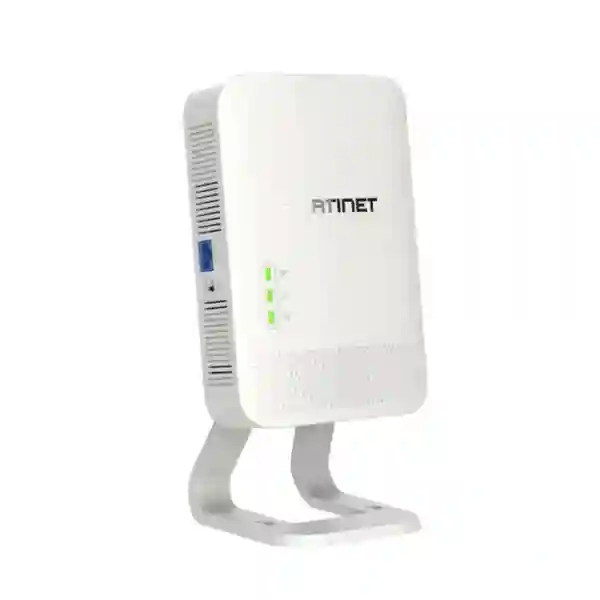
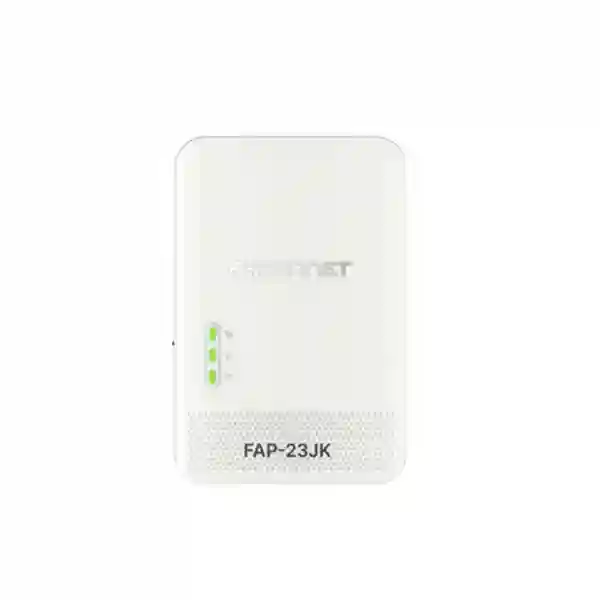
The Fortinet FortiAP FAP-23JK is a Wi-Fi 7 indoor access point in a wall-jack / desk-mount form factor. It is designed for organizations that want modern wireless connectivity, wired edge ports and Fortinet-centered management in a compact device. For Tanzanian offices, hotels, branches and distributed workplaces, the practical value is the ability to combine tri-band Wi-Fi 7 service with Ethernet connectivity at the room or workspace edge while keeping wireless policy aligned with the wider network.
Three Wi-Fi service radios cover 2.4 GHz, 5 GHz and 6 GHz operation with 2×2 MIMO.
One multigigabit Ethernet interface plus additional Gigabit Ethernet, pass-through and serial connectivity support room-edge designs.
Fortinet lists management through FortiGate, FortiEdge Cloud or FortiSASE, allowing deployment choices to follow the organization’s architecture.
What is the FortiAP FAP-23JK?
FAP-23JK is part of Fortinet’s Wi-Fi 7 FortiAP portfolio. Fortinet identifies it as an indoor 2×2 access point with internal antennas and a wall-jack / desk-mount form factor. That positioning matters because the product is not simply a ceiling access point in another enclosure. It can be considered for rooms, offices, accommodation spaces and branch locations where users need wireless coverage close to the point of use and where wired endpoints may also need convenient network access.
The hardware uses three Wi-Fi radios plus a BLE radio. The 2.4 GHz radio supports 20/40 MHz channels, the 5 GHz radio supports widths through 160 MHz, and the 6 GHz radio supports widths through 320 MHz where local regulatory conditions and configuration permit. Fortinet publishes maximum data rates of up to 688 Mbps on 2.4 GHz, 2.882 Gbps on 5 GHz and 5.765 Gbps on 6 GHz. These are radio maximums rather than a promise of application throughput; real performance depends on client capabilities, channel availability, interference, signal conditions, uplink design and network policy.
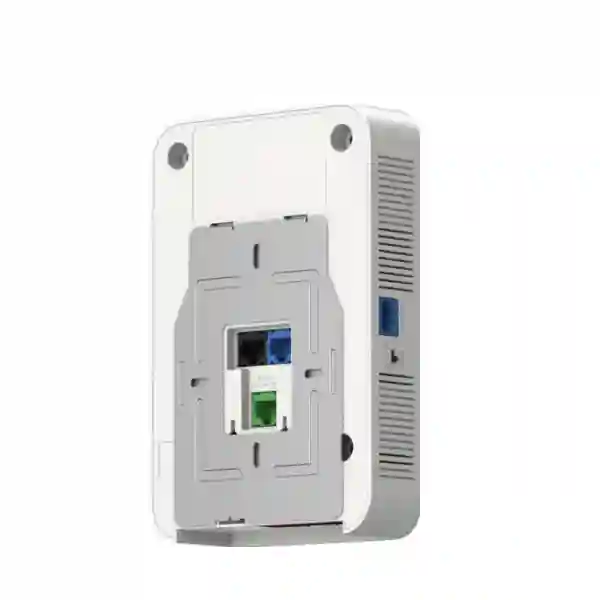
The access point provides one 100M/1G/2.5G/5G/10G multigigabit Ethernet interface, three Gigabit Ethernet interfaces, Gigabit pass-through input/output and an RS-232 RJ45 serial interface. Power over Ethernet is supported. Fortinet documentation for FortiAP 7.6.5 also notes that the LAN3/PSE port can provide 802.3af output when the unit is in High power mode with 802.3at PoE input. Confirm firmware, power mode, switch PoE budget and intended downstream device before designing around this capability.
Verified FAP-23JK technical highlights
| Form factor | Indoor wall-jack / desk-mount access point |
| Wireless generation | Wi-Fi 7 (802.11be family) |
| Radios | 3 Wi-Fi + 1 BLE |
| Wi-Fi service | 2.4 GHz 2×2, 5 GHz 2×2, 6 GHz 2×2 |
| Maximum published radio data rates | Up to 688 Mbps (2.4 GHz), 2.882 Gbps (5 GHz), 5.765 Gbps (6 GHz) |
| Primary wired interface | 1 x 100M/1G/2.5G/5G/10G multigigabit Ethernet |
| Additional interfaces | 3 x Gigabit Ethernet, Gigabit pass-through in/out, RS-232 RJ45 serial |
| Simultaneous SSIDs | Up to 24 |
| Management options | FortiGate, FortiEdge Cloud or FortiSASE, subject to design and supported versions |
Planning the FAP-23JK into a business network
A Wi-Fi 7 access point should be selected as part of a network design rather than by wireless generation alone. Start with the client mix. Newer laptops and phones may use Wi-Fi 7 features, while older devices continue to connect on earlier standards. The design should therefore consider both forward-looking capacity and the actual endpoints in use today. The 6 GHz band can create additional clean spectrum opportunities, but regulatory availability, client support and propagation characteristics need to be considered before assuming that every device will use it.
The wired network is equally important. A multigigabit uplink is useful only when the upstream switch port, cabling and switching architecture can support the intended rate. PoE planning should include the access point’s required input power and any intended PSE output. For projects that also include firewalls, VLANs, guest access or branch connectivity, review FourTeck Tanzania’s integrated IT and networking overview, which explains how wireless, switching and security dependencies should be planned together. The Tanzania technology services page is useful when the requirement includes assessment, configuration, installation or lifecycle support rather than equipment supply alone.
For a quotation, identify the number of rooms or work areas, approximate concurrent users, floor plan, wall materials, existing switch model, available PoE, internet capacity, required SSIDs, guest-network needs and any FortiGate already in service. FourTeck Tanzania’s contact and quotation page specifically recommends providing user/device counts, floor or room information and existing network details for Wi-Fi enquiries.
FortiAP FAP-23JK Tanzania
For organizations evaluating FortiAP FAP-23JK in Tanzania, the most useful starting point is the deployment pattern. A compact wall-jack access point can suit environments where connectivity is required room by room or work area by work area, particularly when wired edge ports are also useful. Corporate offices can use the design to serve staff and meeting spaces; hospitality properties can evaluate it for guest-room or suite connectivity; distributed businesses can standardize a repeatable branch wireless design. The right quantity should not be estimated only from floor area. Building materials, client density, expected applications, neighboring radio activity and placement all affect the final design.
Tanzania deployments should also consider the upstream LAN. Wi-Fi 7 can move substantial traffic, so access switches, uplinks, VLANs and internet capacity should be sized as a system. If an existing FortiGate will manage the access points, firmware compatibility should be checked before purchase and upgrade planning should be included where required. Fortinet’s compatibility documentation shows that FAP-23JK support depends on FortiAP/FortiOS versions; matching supported versions is preferable to assuming that an older installed firewall will automatically manage a new Wi-Fi 7 AP.
Procurement teams should request the exact model, required quantity, mounting context, PoE source, management approach and any related switching or firewall requirement. They should also confirm country-specific radio operation and the intended 6 GHz use rather than assuming identical channel availability in every market. A good quotation can therefore cover not only the AP but also compatible switching, cabling, power budget, configuration and testing where needed.
For organizations building a wider secure network, the regional FourTeck ecosystem can support related discussions through FourTeck Africa infrastructure resources and the Tanzania project channel. The objective is to make the access point part of a documented wireless architecture with defined SSIDs, VLANs, security policies and handover information.
FortiAP FAP-23JK Dar es Salaam
Dar es Salaam businesses often combine dense office usage, customer-facing areas, meeting rooms and branch connectivity within the same network. FAP-23JK can be evaluated where room-level Wi-Fi 7 and local Ethernet access fit the layout. A professional-services office may prioritize secure staff wireless and reliable conferencing, while a hotel or serviced apartment may focus on consistent room coverage and convenient wired connectivity. A retail or branch environment may need guest access separated from operational devices. These use cases should be mapped to SSIDs, VLANs and security policies before hardware quantities are finalized.
The physical site is important. Concrete walls, lifts, service shafts, neighboring networks and furniture can alter RF behavior. A floor plan and, for larger sites, a wireless survey are more useful than a simple square-metre rule. Wi-Fi 7’s 6 GHz capabilities should be treated as an additional design resource, not as a replacement for correct placement. Client devices must support the band, and higher frequencies generally require careful coverage planning.
The FAP-23JK’s multigigabit uplink can also expose weaknesses in older LAN infrastructure. Check whether the switch offers a compatible multigigabit port, adequate PoE, suitable uplink capacity and the VLAN features required by the wireless design. Cabling condition and category should be validated before blaming wireless equipment for a wired bottleneck. Where a FortiGate is present, confirm supported software combinations and define how AP configuration, logging and security policy will be administered.
Dar es Salaam buyers can use the verified FourTeck Tanzania enquiry page to provide the exact FAP-23JK quantity, building type, user count and existing network. This produces a more meaningful quotation than requesting an access point without the PoE, switching and management context.
FortiAP FAP-23JK Mwanza
In Mwanza, organizations considering FAP-23JK may include branch offices, hospitality sites, education facilities, professional workplaces and multi-room commercial properties. The wall-jack / desk-mount format is particularly relevant when wireless service and wired endpoint access need to be delivered near users rather than from a conventional ceiling-only design. Before selecting quantities, map the rooms, corridors, shared spaces and high-demand zones, then identify where Ethernet cabling and PoE are already available.
Capacity planning should distinguish coverage from performance. An access point can provide a visible signal while still becoming congested if too many active clients share the same radio or if the wired uplink is constrained. Consider expected video meetings, cloud applications, voice traffic, guest devices and large downloads. The FAP-23JK provides modern radio capabilities, but overall experience remains dependent on switching, internet connectivity, DNS, firewall inspection and the quality of the client devices.
For existing Fortinet environments, management integration is an important procurement question. Confirm the FortiGate model and FortiOS version before ordering. For new sites, compare whether FortiGate-integrated management, FortiEdge Cloud or FortiSASE aligns with the operating model. Multi-site businesses may value a standardized configuration template for SSIDs, authentication, VLAN mapping and naming so that Mwanza is managed consistently with other branches.
A useful request for quotation should include the FAP-23JK model, quantity estimate, number of users, floor plan, switch and PoE information, desired management platform and any requirement for installation or testing. That information allows the wireless purchase to be evaluated as part of the LAN rather than as an isolated device.
FortiAP FAP-23JK Arusha
Arusha has a mix of corporate, hospitality, tourism, institutional and service environments where dependable room-level wireless can be operationally important. FAP-23JK can be considered for indoor deployments that benefit from Wi-Fi 7, internal antennas and a wall-jack / desk-mount format. Hospitality projects should pay particular attention to room construction, corridor placement, guest density and the separation of guest traffic from staff and operational systems. Office deployments should map meeting spaces, concentrated work areas and roaming paths rather than placing APs solely where cabling is convenient.
The three service radios allow the design to use 2.4, 5 and 6 GHz resources, but the final channel plan must follow local regulatory availability and actual client capabilities. Legacy or IoT devices may remain on 2.4 GHz while modern endpoints use 5 or 6 GHz. A mixed environment therefore benefits from deliberate SSID and band planning instead of forcing every endpoint into the same assumptions.
Power and switching are part of the design. Confirm PoE input, switch power budget, multigigabit capability and cabling. If LAN3/PSE output is intended, verify the required FortiAP firmware and high-power mode conditions documented by Fortinet. This is especially important when a downstream device is expected to receive power from the AP, because the complete power chain needs to be engineered rather than inferred.
Arusha organizations can combine the access-point discussion with switching, firewall and cabling planning through FourTeck Tanzania’s verified services and contact pages. Include room counts, users, floor plans and existing Fortinet equipment to support accurate model and quantity validation.
FortiAP FAP-23JK Dodoma
Dodoma deployments can include offices, institutions, training facilities, professional services and branch networks where secure wireless must be documented and manageable. FAP-23JK offers a compact Wi-Fi 7 option for indoor wall-jack or desk-mount use, with additional Ethernet interfaces that can be useful where wired devices share the same room-edge network point. Procurement should begin with a clear statement of the intended environment and management model.
For formal projects, prepare a bill of requirements covering AP quantity, radio standard, uplink requirements, PoE, switch compatibility, SSIDs, authentication, guest access, VLANs, management and acceptance testing. Avoid specifying only “Wi-Fi 7” because that leaves important operational questions unanswered. If the organization already uses FortiGate, record the appliance model and software version so compatibility can be validated against Fortinet’s current matrix.
Site readiness also deserves attention. Cabling should be tested and labeled; switch ports should be configured intentionally; PoE capacity should include headroom; and UPS strategy should reflect how important wireless availability is during short power interruptions. After installation, testing should include real client roaming, application performance, guest isolation and access to permitted internal services rather than merely checking that the SSID appears.
A documented Dodoma rollout can become a template for other branches. Standard AP names, SSIDs, VLAN IDs, authentication policies and switch-port configurations make troubleshooting easier. FourTeck Tanzania’s broader network and infrastructure planning guidance emphasizes this integrated approach to wireless, switching and security.
FortiAP FAP-23JK UAE
Organizations procuring FAP-23JK for the UAE may be standardizing wireless across offices, hospitality spaces, retail branches or distributed enterprise sites. The product’s wall-jack / desk-mount form factor can suit environments where each room or work zone benefits from local Wi-Fi and Ethernet connectivity. The same core planning principles apply: verify client density, radio conditions, switch uplinks, PoE and management architecture before defining quantities.
Regional regulatory settings must be respected, especially for 6 GHz operation. Do not copy a radio plan from another country without validating the correct country code and permitted channels. Wi-Fi 7 client adoption may also vary by device fleet, so design for the actual endpoints rather than assuming all users can immediately use the newest features.
For Fortinet-centered networks, management may be integrated with FortiGate or use FortiEdge Cloud or FortiSASE depending on architecture. Version compatibility should be validated during design. Organizations with security and firewall requirements in the UAE can also consult FourTeck’s Fortinet-focused UAE resource and FourTeck UAE for related regional infrastructure discussions.
For multinational buyers, keep the bill of materials and configuration standard consistent where practical while allowing country-specific radio settings, power arrangements and logistics. Record AP model, firmware baseline, switch requirements, SSIDs, VLANs and acceptance criteria so deployments can be compared and supported across locations.
FortiAP FAP-23JK Uganda
Ugandan organizations can evaluate FAP-23JK for offices, hospitality properties, branch networks and commercial spaces requiring modern indoor Wi-Fi. Its compact wall-jack / desk-mount design differs from a conventional ceiling AP and should be selected where that placement model fits the building. Wireless quantity and placement should follow user density, wall construction, room layout and application demand.
A complete design includes switching and power. The multigigabit uplink can support high aggregate traffic, but only when the upstream LAN is ready. Check PoE capacity, switch port speed, cable condition and uplinks. Separate guest, staff and infrastructure traffic with appropriate VLAN and security policy where required. For FortiGate-managed deployments, validate current compatibility before procurement.
Organizations operating across Tanzania and Uganda may benefit from a common wireless standard with local configuration adjustments. Use consistent naming, authentication methods, monitoring expectations and documentation while respecting local radio rules. This approach reduces support complexity for regional IT teams.
For Uganda-specific project channels, see FourTeck Uganda. A useful quotation request should identify FAP-23JK quantity, locations, room counts, existing switches, FortiGate details and whether configuration, installation or survey work is required.
FortiAP FAP-23JK Kampala
Kampala office and hospitality networks can place heavy demands on wireless because cloud applications, video meetings, mobile devices and guest access often share the same infrastructure. FAP-23JK provides Wi-Fi 7 capability in a room-edge form factor, but successful deployment depends on RF planning and LAN readiness. Identify high-density areas, meeting rooms and spaces where users need wired ports as well as wireless access.
The 2.4, 5 and 6 GHz radios provide options for different device classes. In practice, many networks remain mixed-generation, so administrators should test critical devices and avoid assuming that all endpoints use 6 GHz. Channel width decisions also involve tradeoffs between peak rate and channel reuse, especially in dense buildings.
For larger Kampala sites, central management and monitoring become important. Define how AP health, client experience, firmware and configuration changes will be handled. If FortiGate is the controller, align FortiAP and FortiOS versions with the published compatibility guidance. If a cloud-managed architecture is preferred, confirm subscriptions and operational ownership before purchase.
A procurement package should also include PoE switches, multigigabit requirements, UPS strategy and cabling validation where necessary. This avoids buying high-capability APs that are constrained by 1 Gbps switching, insufficient power or poor cabling.
FortiAP FAP-23JK Arua
For Arua branches, institutions and commercial sites, FAP-23JK can be evaluated when a compact indoor Wi-Fi 7 AP aligns with the room layout and wired edge requirements. Smaller sites should still be designed deliberately: one poorly positioned access point can create weak coverage, while unnecessary AP density can create channel contention. Start with the building layout, users and applications.
Where remote IT teams manage the site, standardization is valuable. Define AP naming, SSIDs, VLANs, authentication and switch-port templates centrally. Remote monitoring can then focus on consistent indicators rather than treating the branch as a unique configuration. Fortinet management options allow the architecture to be chosen around the organization’s existing security and operations model.
Connectivity beyond the LAN should also be considered. Cloud applications and remote management depend on the WAN, so internet reliability and firewall policy can affect perceived Wi-Fi quality. Keep local troubleshooting procedures for power, cabling and switch ports so simple faults can be isolated without unnecessary equipment replacement.
When requesting FAP-23JK for Arua, provide the number of rooms, users, expected devices, existing network equipment and intended management method. This helps determine whether the model and quantity fit the actual branch requirement.
FortiAP FAP-23JK Mbarara
Mbarara businesses planning wireless upgrades can consider FAP-23JK where Wi-Fi 7, internal antennas and wall-jack / desk-mount installation are appropriate. The product can support modern endpoint connectivity while providing additional wired interfaces, which can be useful in offices, rooms and branch environments with mixed wired and wireless devices.
Before deployment, determine whether the main problem is coverage, capacity, aging Wi-Fi standards or network management. A new access point cannot correct every underlying issue. Congested internet, damaged cabling, overloaded switches or incorrect VLAN configuration can still reduce user experience. Validate each layer so the upgrade addresses the actual constraint.
If the network includes FortiGate security, the wireless design can be coordinated with segmentation and access policy. Staff, guests and operational devices may require different permissions. Authentication requirements should be defined early, particularly where enterprise identity systems are used. Fortinet lists several EAP methods for the FAP-23JK, but the complete authentication solution depends on the surrounding infrastructure.
For procurement, document quantities, switch ports, PoE, cable runs, expected client mix and management. Include testing and handover requirements if the project is more than equipment supply.
FortiAP FAP-23JK Gulu
Gulu organizations can use a structured approach to FAP-23JK selection by starting with site function. Offices may prioritize secure cloud access and video meetings; hospitality environments may prioritize room coverage and guest isolation; education or training spaces may require higher concurrent client capacity. These differences affect placement, SSID design and the number of APs required.
Wi-Fi 7 provides a modern radio platform, but client compatibility should be audited. Older endpoints continue to operate on earlier standards and bands, while newer devices may take advantage of 6 GHz and advanced features. A phased device lifecycle means the network should accommodate both groups without making the newest specification the only design criterion.
Power resilience may also be relevant. If wireless access is operationally important, consider whether the PoE switch and upstream firewall need UPS support. The AP cannot remain available if the switch loses power. Documentation should record the switch port, cable outlet, AP name, management platform and configuration baseline for easier remote support.
A Gulu quotation request is stronger when it includes this site context. It allows the discussion to cover compatible switching and security instead of treating FAP-23JK as a standalone purchase.
FortiAP FAP-23JK Kenya
Kenyan organizations with offices, hospitality properties and distributed branches can evaluate FAP-23JK as part of a Wi-Fi 7 refresh. Its wall-jack / desk-mount design is especially relevant where the AP is intended to serve a room or local work zone and provide wired edge connectivity. Larger open offices may require a different placement strategy or complementary AP models, so model selection should follow the environment rather than a single standard across every space.
For regional businesses operating in Kenya and Tanzania, standardization can reduce configuration drift. Define common SSID names where appropriate, authentication policies, VLAN structures, monitoring procedures and firmware baselines, while keeping country-specific radio settings correct. Central IT teams can then troubleshoot similar architectures across branches.
Switch readiness is a key part of a Wi-Fi 7 project. Confirm multigigabit access ports, PoE capacity and uplink bandwidth. Cabling should be tested where higher Ethernet rates are expected. The firewall and internet service must also be sized for the applications that users will run over the wireless network.
For Kenya project discussions, visit FourTeck Kenya. Provide FAP-23JK quantities, site type, existing Fortinet equipment and implementation scope for a focused quotation.
FortiAP FAP-23JK Kuwait
Kuwait deployments can consider FAP-23JK for indoor office, hospitality and branch environments that need Wi-Fi 7 and room-edge Ethernet connectivity. Dense buildings require careful channel planning because neighboring wireless networks and multiple APs can compete for spectrum. A survey or measured design is preferable to choosing AP quantity only from floor area.
The 6 GHz radio offers additional spectrum opportunities for compatible clients, but local regulatory settings must be applied correctly. Device fleets should be reviewed to understand how many endpoints can use Wi-Fi 7 or 6 GHz today. This prevents unrealistic expectations and supports a migration plan for older devices.
Upstream switching should match the access point’s capabilities where performance requirements justify it. Check multigigabit ports, PoE, cabling and uplinks. If the AP will be FortiGate-managed, confirm firmware compatibility. If FortiEdge Cloud or FortiSASE is planned, define licensing and operational responsibility as part of procurement.
For Kuwait-related infrastructure enquiries, FourTeck Kuwait provides a regional channel. Multinational organizations can keep the technical standard aligned with Tanzania deployments while adapting radio and logistics details locally.
FortiAP FAP-23JK Ghana
Ghanaian offices and branch networks can evaluate FAP-23JK when they need a modern Fortinet wireless platform with a compact room-edge form factor. The product is suitable for indoor use and combines tri-band Wi-Fi with several wired interfaces. Site planning should determine whether this form factor is preferable to ceiling-mounted APs for the specific building.
Wireless design should include user density, application mix and client capabilities. Video collaboration and cloud systems can create sustained traffic that exposes weak uplinks or internet bottlenecks. Guest Wi-Fi can add many unmanaged devices, so segmentation and bandwidth policy may be required. The AP is one component of this end-to-end experience.
Fortinet environments should validate FortiOS/FortiAP compatibility and define management before ordering. New installations should also document PoE source, switch model, cabling and UPS needs. Acceptance testing can check real applications, roaming and guest isolation rather than relying only on signal strength.
For Ghana project coordination, use FourTeck Ghana. Regional IT teams can align their Ghana and Tanzania configurations while preserving local regulatory settings and site-specific RF design.
FortiAP FAP-23JK Nigeria
Nigeria deployments may range from compact branches to multi-floor offices and hospitality sites. FAP-23JK is best assessed where its wall-jack / desk-mount format and combination of Wi-Fi 7 plus wired interfaces match the room design. High-density open spaces may require different placement or additional models, so a single AP type should not be forced into every area without RF planning.
Power and network resilience deserve attention. Wireless depends on the PoE switch, upstream routing/firewall and internet connection. If availability is important, UPS-backed switching and documented failover procedures can be as relevant as the AP specification. Multigigabit switching and good cabling help prevent the LAN from constraining a high-capability access point.
Security architecture should define staff, guest and device access. FortiGate integration can align wireless policy with the broader Fortinet environment, while FortiEdge Cloud or FortiSASE may suit other operating models. Check supported versions and subscriptions before finalizing the bill of materials.
Nigeria project enquiries can be coordinated through FourTeck Nigeria. Include the FAP-23JK quantity, floor plans, user density, switch and firewall information and expected implementation scope.
FortiAP FAP-23JK Seychelles
Seychelles hospitality, office and commercial environments may find the FAP-23JK form factor useful where indoor rooms need both wireless and local Ethernet connectivity. Hospitality design should distinguish guest rooms, corridors, lobbies, restaurants, meeting spaces and back-office areas because each can have different capacity and placement needs. A room-edge AP may be appropriate in some zones while other AP types are better elsewhere.
The network should be planned for guest isolation, staff access and operational devices. Where voice, IPTV, building systems or other room devices share the infrastructure, VLAN and switch-port design becomes important. The FAP-23JK’s additional Ethernet connectivity can be useful, but every downstream requirement should be validated for speed, power and policy.
Wi-Fi 7 and 6 GHz operation should be configured according to local rules and client capability. Do not assume the same country code or channel plan used in Tanzania, UAE or another market. For managed Fortinet environments, verify software compatibility and decide who owns firmware, monitoring and configuration changes.
For procurement, provide room counts, property layout, expected occupancy, existing switching and firewall details, and any requirement for survey, installation or remote management. This helps create a design that reflects the property rather than simply multiplying one AP per room.
Compatibility, firmware and management guidance
Fortinet’s compatibility documentation should be checked during every FAP-23JK project because support evolves with FortiAP and FortiOS releases. Fortinet introduced FAP-23JK support in FortiAP 7.4.5 release notes, and current compatibility tables list the model across newer software branches. Fortinet recommends matching FortiAP firmware with the respective FortiOS version when available. This is particularly important when an organization is adding Wi-Fi 7 access points to an older FortiGate environment.
Management architecture also affects procurement. Fortinet positions FortiAP management through FortiGate, FortiEdge Cloud or FortiSASE. The correct option depends on whether the organization wants integrated firewall/WLAN control, cloud-oriented network management or a SASE-led branch approach. Licensing and subscription requirements should be confirmed for the selected architecture rather than assumed from the access-point hardware alone.
Related infrastructure for FAP-23JK deployments
PoE and multigigabit switching
Use managed switching with the port speed, PoE budget, VLAN features and uplinks required by the design. The Tanzania homepage’s network-switch guidance explains why PoE demand and uplink capacity should be planned together.
Firewall and segmentation
Coordinate wireless SSIDs with VLANs, guest isolation and firewall policy. Fortinet deployments can benefit from treating security and wireless as one architecture rather than separate purchases.
Structured cabling and UPS
Validate cable performance for intended Ethernet rates and consider UPS protection for PoE switching where wireless availability matters during short interruptions.
FortiAP FAP-23JK FAQ
Is the FAP-23JK a Wi-Fi 7 access point?
Yes. Fortinet lists FAP-23JK in its Wi-Fi 7 FortiAP portfolio. It uses 2×2 service radios for 2.4 GHz, 5 GHz and 6 GHz.
Is FAP-23JK ceiling mounted?
Fortinet identifies the model’s form factor as wall jack / desk mount. Deployment should follow the official installation guidance and the physical requirements of the site.
Can FAP-23JK be managed by FortiGate?
Fortinet lists FortiGate as a management option. Check the FortiAP/FortiOS compatibility matrix for the exact software combination before deployment, especially with older FortiGate models.
Does it have multigigabit Ethernet?
Yes. Fortinet specifies one Ethernet interface supporting 100M, 1G, 2.5G, 5G and 10G rates, plus additional Gigabit Ethernet interfaces.
What information is useful for a Tanzania quotation?
Provide the exact model, quantity, city/site, building or room layout, approximate users and devices, existing switch and FortiGate details, PoE availability, desired management method and whether installation or configuration is required.
Quotation checklist
To prepare a practical FAP-23JK request, include: exact model and quantity; country and city; floor plan or room count; expected concurrent clients; important applications; existing APs; FortiGate model and FortiOS version if present; switch model and available multigigabit ports; PoE budget; cable type and condition; SSID and guest-access requirements; authentication method; VLAN requirements; installation expectations; and any target project timeline. Where several branches are involved, provide the same information per site so differences are visible.
Avoid assuming stock, price, delivery time, warranty or country radio configuration. These items should be confirmed in the quotation for the exact destination and project date.
Decision recap
Choose FortiAP FAP-23JK when its Wi-Fi 7 capabilities, 2×2 tri-band radios, wall-jack / desk-mount form factor, multigigabit uplink and additional Ethernet connectivity match the site. Validate the complete design around RF coverage, client mix, switch speed, PoE, cabling, Fortinet software compatibility and management. For Tanzania, the strongest procurement request combines the exact AP requirement with building and network context so that switching, security and deployment dependencies can be checked before purchase.
Consult FourTeck Tanzania about FAP-23JK
Share your site, user count, room layout, current switch/firewall environment and target quantity. FourTeck Tanzania’s verified contact page is designed for product selection, quotation and network project discussions, including wireless access points. For cross-border projects, related FourTeck regional resources include FourTeck global solutions, FourTeck Kenya, FourTeck Uganda, FourTeck Ghana and FourTeck Nigeria.



Reviews
There are no reviews yet.