
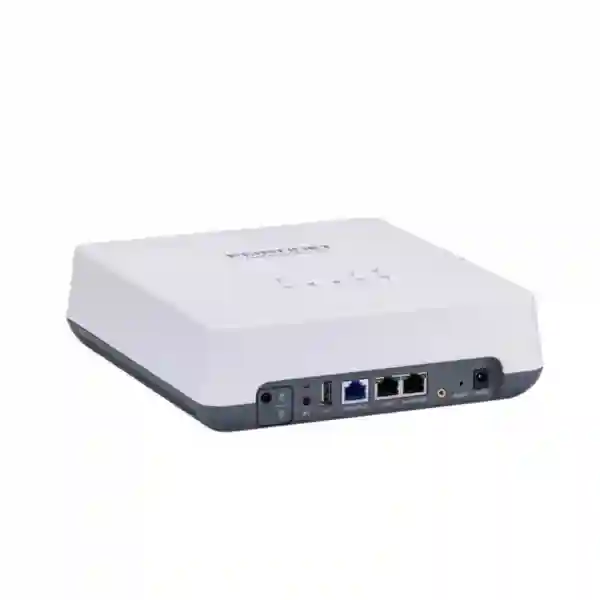
FortiExtender WAN 50G (FEW-50G) Tanzania
FortiExtender WAN 50G (FEW-50G) is an ultra-fast indoor 5G gateway built to extend WAN connectivity for FortiGate next-generation firewall deployments. For businesses planning resilient branch internet, rapid cellular WAN activation, high-throughput wireless links or an out-of-band path for remote administration, FEW-50G provides a focused way to add 5G/LTE connectivity without treating cellular access as an isolated networking silo. FourTeck helps buyers evaluate the gateway in the context of the FortiGate platform, carrier availability, branch design, redundancy objectives and operational requirements before quotation.
Purpose-built for high-speed cellular WAN extension with FortiGate at distributed sites.
Fortinet positions FEW-50G for 5G/LTE WAN connectivity at high-throughput, low-latency distributed edges.
Two 5 Gigabit Ethernet interfaces help avoid constraining a fast cellular WAN path between the gateway and FortiGate.
Out-of-band access and VRRP support address continuity and recovery scenarios around the FortiGate-driven edge.
What FEW-50G is designed to solve
Modern branches increasingly depend on cloud applications, voice and video, SaaS, centralized business systems, remote support and continuously connected security services. A single fixed WAN can become an operational dependency, while conventional cellular backup may not provide enough throughput for demanding sites. FEW-50G addresses this design problem by providing a dedicated cellular WAN extension for FortiGate. Fortinet describes the model as a 5G gateway rather than a general-purpose LAN router, so the strongest buying case is an organization that already uses, or plans to use, FortiGate as the security and policy enforcement point.
The hardware uses internal omnidirectional cellular antennas and is intended for desk or wall placement where usable 5G/LTE signal can be obtained. Fortinet documentation identifies two physical SIM positions plus eSIM capability and describes high cellular downlink capability, while actual carrier performance remains dependent on network coverage, spectrum, congestion, subscription, radio conditions and deployment location. Buyers should therefore evaluate the gateway together with a site signal survey, compatible mobile service and realistic application traffic rather than treating a theoretical radio maximum as guaranteed internet speed.
Verified FEW-50G capability highlights
| Device role | Indoor 5G/LTE gateway for FortiGate WAN extension |
| Ethernet | Two 5GE interfaces for high-speed wired handoff |
| Cellular antennas | Eight internal omnidirectional 5G/LTE antennas, plus GNSS antenna |
| SIM approach | Dual physical SIM positions and eSIM capability documented by Fortinet |
| Operations | FortiGate/FortiOS integration, cloud-management options, telemetry and centralized operations |
| Resilience | Out-of-band management through console/USB use cases and VRRP support |
FortiGate integration and deployment planning
FEW-50G should be planned as part of the wider Fortinet edge architecture. In a WAN-extension design, FortiGate remains the central security platform while the FortiExtender supplies the cellular path. This separation is useful because administrators can maintain firewall policy, SD-WAN logic and security controls at the FortiGate while positioning the cellular gateway where radio reception is more favorable. A practical deployment assessment should document the FortiGate model and FortiOS release, available interfaces, primary WAN design, intended cellular carrier, expected failover behavior, routing and NAT requirements, application priorities, remote-management requirements and physical mounting location.
Organizations should also determine whether 5G is intended as a primary WAN, secondary WAN, rapid-deployment connection or recovery path. Those roles create different sizing and subscription requirements. A primary link needs careful attention to monthly data use, sustained performance and carrier service terms. A failover link requires testing of routing, session behavior and application recovery. Out-of-band management needs a documented administrative workflow so the cellular path remains useful when the normal production WAN is unavailable. For larger fleets, centralized visibility, consistent configuration and operational telemetry become as important as raw radio speed.
FortiExtender WAN 50G (FEW-50G) Tanzania
Tanzanian organizations evaluating FEW-50G typically have a practical connectivity problem rather than a simple requirement for another router. A headquarters may need an independent cellular path to protect access to cloud systems; a branch rollout may need connectivity before a fixed circuit is installed; a retail, finance, healthcare, logistics or service site may need an alternative WAN path for business continuity; or an IT team may want remote recovery access when the primary internet connection becomes unavailable. FEW-50G is relevant to these cases because it is designed to work as a FortiGate WAN extension, allowing the FortiGate to remain the main security and policy platform while cellular connectivity is added as an integrated edge resource.
Procurement in Tanzania should begin with the exact deployment environment. Confirm the FortiGate model, firmware compatibility, number of sites, primary internet type, desired cellular role, expected traffic, available 5G/LTE service and the physical location where the gateway can obtain a reliable radio signal. Mobile coverage varies by operator and site, so a buyer should not assume that a 5G-capable gateway automatically delivers the same performance everywhere. Buildings with reinforced walls, equipment rooms located deep inside a property and sites with marginal coverage can change the result. Because FEW-50G uses internal antennas, thoughtful device placement is especially important.
For a Tanzania quotation, it is useful to provide the intended FortiGate platform, whether the cellular service is primary or backup, carrier/SIM plans under consideration, branch count, target application types and whether centralized management is required. This gives the solution team enough information to distinguish a straightforward single-site WAN extension from a multi-branch resilience project. Buyers can also review FourTeck Tanzania technology solutions when planning related firewall, networking and business infrastructure requirements. The goal is to procure FEW-50G as a designed part of the WAN architecture rather than as an isolated cellular appliance.
FortiExtender WAN 50G (FEW-50G) Dar es Salaam
Dar es Salaam businesses often operate in environments where internet availability directly affects transactions, customer service, cloud access, collaboration and branch communication. FEW-50G can be evaluated for offices, retail operations, hospitality environments, logistics companies, financial service locations and other distributed sites that already use FortiGate or are standardizing on the Fortinet platform. The value of the gateway is not simply that it connects to 5G/LTE; it gives the FortiGate-driven edge a dedicated high-speed cellular WAN path that can be incorporated into a wider resilience and SD-WAN strategy.
A Dar es Salaam deployment should account for building conditions and radio placement. A central server room may be convenient for Ethernet cabling but not always ideal for cellular signal. Because the FEW-50G can be desk or wall mounted, network teams can plan placement closer to a location with better reception while retaining the wired handoff to the firewall. Before purchasing, measure signal conditions where practical, confirm the chosen operator’s service at the exact premises and decide whether the connection will carry ordinary failover traffic or high-volume production workloads. If the site depends on video meetings, cloud backups, ERP, hosted voice or large data transfers, traffic expectations should be discussed during design.
Resilience testing matters as much as installation. IT teams should define what happens when the fixed WAN fails, how quickly routes change, which applications remain prioritized, how users experience the transition and how administrators reach the firewall during an outage. FEW-50G’s OOB and VRRP-related capabilities can support continuity designs, but they should be configured and tested against the actual network. For procurement, share the FortiGate model, WAN bandwidth, business-critical applications, required failover objective and site count. This produces a more useful quotation and implementation scope than requesting hardware by model alone.
FortiExtender WAN 50G (FEW-50G) Mwanza
For Mwanza organizations, FEW-50G can support branch connectivity strategies where rapid deployment and WAN diversity are important. A business opening a new office may need a working connection while waiting for a permanent circuit. A warehouse, service center, professional office or regional branch may want a second access technology that does not share the same physical last-mile path as the primary service. Cellular WAN can provide that diversity when local coverage and service quality are suitable. FEW-50G is particularly relevant when the site uses FortiGate, because the gateway is built to extend the FortiGate WAN rather than create a separate management environment.
Planning should start with coverage and workload. 5G availability is not uniform, and LTE may be the practical service in some locations. Network teams should verify the operator, SIM arrangements, data allowance, expected signal and the physical mounting position. The two 5GE interfaces give the gateway a high-speed wired connection capability, but actual end-to-end performance still depends on the mobile network and FortiGate design. Buyers should distinguish between theoretical cellular capability and the service that can be delivered at a specific Mwanza site.
A well-scoped project also defines operational ownership. Decide who monitors the cellular link, how data consumption is reviewed, how alerts are handled and how the branch is supported if the primary circuit is unavailable. For multi-site organizations, centralized management can reduce the burden of treating each cellular gateway as a standalone device. When requesting a quotation, provide the number of Mwanza sites, current firewall models, ISP arrangement, carrier preference if known, expected monthly traffic and whether the link is primary, backup or temporary. This helps align the FEW-50G deployment with real continuity requirements rather than simply adding unused redundancy.
FortiExtender WAN 50G (FEW-50G) Arusha
Arusha businesses in tourism, hospitality, professional services, education, logistics and distributed commercial operations can evaluate FEW-50G when dependable connectivity is needed alongside FortiGate security. Guest services, reservation systems, payment workflows, cloud applications, VPN connectivity and communications can all make a branch sensitive to WAN interruption. A cellular extension can provide an alternate path, but the design should be based on business priorities: which services must remain reachable, how much bandwidth they need, and how the FortiGate should steer or fail over traffic when a primary circuit degrades.
The gateway’s indoor form factor and internal antennas make physical placement a key design task. IT teams should avoid assuming that the same rack location used for the firewall is automatically the best RF location. Evaluate reception at practical wall or desk positions, then plan the Ethernet path back to FortiGate. For sites with multiple floors or complex construction, this simple placement exercise can materially affect reliability. The selected carrier and subscription should also be checked for data policy, 5G/LTE availability and suitability for business use.
For an Arusha procurement request, document the current network topology, FortiGate model, critical applications, normal and peak internet demand, expected outage behavior and remote-support requirements. If the gateway is intended for temporary deployments or rapid branch activation, include how quickly sites need to become operational and whether configurations will be standardized across locations. If it is intended for permanent resilience, include failover testing and monitoring in the implementation plan. FEW-50G is most valuable when its high-speed cellular capability is matched with clear FortiGate policies and a support process that treats connectivity as a managed business service.
FortiExtender WAN 50G (FEW-50G) Dodoma
Organizations in Dodoma may consider FEW-50G for administrative offices, professional services, education, healthcare, NGOs, branch operations and other sites where a wired internet interruption can affect access to centralized systems. The product is designed to extend FortiGate with a cellular WAN path, making it suitable for network teams that want security policy and WAN connectivity to remain part of the same Fortinet operating model. It can be considered for backup connectivity, rapid site activation or a primary cellular path where service conditions and data plans support the requirement.
Before ordering, confirm the actual cellular environment. A procurement specification should identify the intended mobile operator, whether physical SIM or eSIM processes are preferred, signal conditions at the premises and the traffic profile expected during normal or failover operation. Where a site has critical video, VPN, cloud or transactional applications, the design should prioritize those flows rather than assuming every service must receive identical treatment. FortiGate SD-WAN and policy design can then be planned around the available WAN paths.
Operational continuity also needs an administration plan. FEW-50G supports use cases around out-of-band management, which can help an administrator reach equipment when the primary path has failed. That capability should be protected with appropriate access controls and tested before an incident. For a Dodoma quotation, buyers should provide the firewall model, number of locations, existing ISP links, cellular carrier options, expected bandwidth, key applications and any centralized-management requirements. This information allows the hardware request to be connected to the real deployment outcome: maintaining usable, manageable connectivity when the fixed WAN is unavailable or when a new site needs an agile connection.
FortiExtender WAN 50G (FEW-50G) UAE
UAE organizations can evaluate FEW-50G for high-speed wireless WAN at branches, temporary offices, retail sites, project locations and distributed enterprise edges where FortiGate is the security platform. The product’s dedicated WAN-extension role makes it useful for businesses that want 5G connectivity without separating cellular operations from the firewall architecture. It can support designs where 5G is a secondary circuit, a rapidly deployable primary connection or an additional path used by SD-WAN policies according to application requirements.
Because the UAE has diverse indoor environments ranging from office towers to warehouses and retail properties, placement should be validated at each site. Internal antennas simplify the physical form factor, but radio performance remains dependent on the operator, building materials, location and spectrum conditions. A project should therefore include carrier verification and practical signal assessment. Network teams should also review data-plan terms, expected usage and whether business applications require consistent latency or sustained throughput rather than short bursts of speed.
For regional procurement and Fortinet-related planning, buyers can reference FourTeck’s Fortinet UAE resource. A useful FEW-50G request should specify the FortiGate model, branch count, current WAN circuits, failover objective, application priorities and preferred carrier. Where multiple sites are involved, centralized configuration and monitoring should be considered from the start. This creates a repeatable deployment standard and makes it easier to track cellular health, data use and site status instead of troubleshooting each branch independently.
FortiExtender WAN 50G (FEW-50G) Uganda
Uganda enterprises and growing multi-site organizations can use FEW-50G as part of a FortiGate-centered branch resilience strategy. The gateway is particularly relevant where a site needs an alternative to a single fixed internet path, where new branches must become operational quickly, or where remote administrators need a cellular route for recovery. Instead of deploying a consumer hotspot beside an enterprise firewall, FEW-50G provides a purpose-built WAN-extension model designed for the Fortinet environment.
Procurement should still be driven by the actual site. Confirm 5G/LTE service, operator performance, SIM strategy and the intended installation point. A branch that needs only emergency failover has different data and traffic requirements from a site using cellular connectivity throughout the day. The FortiGate model and software release should also be reviewed for the planned integration, and the team should decide how WAN health, route changes and application steering will be monitored. For larger deployments, standard configuration and central visibility can reduce support complexity.
FourTeck maintains an Uganda technology and Fortinet resource for buyers planning related firewall and network requirements. When requesting FEW-50G, include branch locations, firewall models, WAN service details, expected cellular role, critical applications and support expectations. The result should be a solution that can be tested under real failover conditions and documented for the IT team, rather than a gateway that is installed but never validated until an outage occurs.
FortiExtender WAN 50G (FEW-50G) Kampala
Kampala has many businesses that depend on continuous access to SaaS platforms, payment services, hosted applications, VPNs and communications. For FortiGate environments, FEW-50G can add a high-speed cellular WAN option that supports business-continuity planning without requiring the cellular gateway to become the primary security device. This can simplify policy ownership: FortiGate continues to handle the security architecture while FEW-50G supplies the mobile-network path.
The first design question is whether the cellular connection is for resilience or production. Backup use may prioritize availability, rapid failover and sufficient capacity for critical applications. Primary or active use requires deeper review of carrier performance, monthly data consumption, application behavior and traffic management. A Kampala site should also be checked for signal quality at the intended mounting location. Dense construction and equipment-room placement can affect radio conditions, so desk or wall positioning should be chosen with connectivity rather than convenience alone in mind.
For multi-branch organizations, define a standard that covers SIM activation, naming, firmware management, FortiGate integration, monitoring, alerting and recovery testing. This reduces configuration drift and makes support easier as the fleet grows. A quotation request should state the FortiGate platform, number of Kampala sites, ISP arrangement, carrier options, desired failover behavior and key applications. If the business already uses FortiManager or other centralized Fortinet tools, include that context so the FEW-50G design can align with existing operations and reporting.
FortiExtender WAN 50G (FEW-50G) Arua
For an Arua branch or regional operation, FEW-50G can be evaluated where cellular WAN offers a practical way to diversify connectivity or bring a site online without relying solely on a fixed circuit. The product is designed around FortiGate WAN extension, so it is best suited to organizations that want cellular access integrated with enterprise firewall policy rather than managed as a separate consumer connection. Typical design goals include branch continuity, remote recovery and rapid activation of new premises.
Local carrier conditions should drive the decision. Confirm whether 5G or LTE is available at the exact site and test the expected operator where practical. The gateway’s internal antenna design means the physical installation location matters. If a server cabinet is in a low-signal area, plan a suitable wall or desk position and cable route to FortiGate. Buyers should also review SIM and data-plan arrangements so the link remains commercially practical if it is used for extended failover rather than occasional emergencies.
Arua deployments benefit from clear remote-support procedures because travel to a branch can add time and cost during an outage. Out-of-band management can be valuable when it is securely configured and tested, giving administrators another path for diagnosis. For procurement, share the FortiGate model, site address or general environment, current internet service, preferred carrier, expected traffic and critical applications. If several regional sites are planned, ask for a standardized architecture and configuration approach so monitoring, troubleshooting and change control remain consistent across the deployment.
FortiExtender WAN 50G (FEW-50G) Mbarara
Mbarara businesses planning resilient branch networks can consider FEW-50G as a dedicated cellular extension for FortiGate. A second WAN technology can be useful for offices, healthcare facilities, education, retail, logistics and service locations that need access to cloud applications and central systems even when a fixed connection is interrupted. The FEW-50G architecture keeps FortiGate at the center of security policy, which is useful for IT teams already familiar with FortiOS and Fortinet branch networking.
A deployment assessment should record current ISP bandwidth, normal utilization, critical applications, outage tolerance and available mobile networks. If cellular is only a backup, FortiGate policies can be designed to prioritize essential business traffic during failover and limit nonessential high-volume activity. If the cellular path is intended for active use, data consumption and performance expectations become more important. In both cases, site placement and radio signal should be validated rather than assumed from general coverage maps.
For a useful Mbarara quotation, specify the number of sites, FortiGate model, existing WAN circuits, mobile operator options and whether installation, configuration or ongoing support is required. Organizations with multiple branches should consider common templates for WAN health checks, failover testing, administrative access and documentation. The goal is a repeatable design in which FEW-50G contributes measurable resilience and operational visibility. Regular testing should be part of the support plan so a backup link is known to work before it is needed during a real outage.
FortiExtender WAN 50G (FEW-50G) Gulu
Gulu organizations can evaluate FEW-50G for sites that need an agile cellular WAN option alongside FortiGate. This may include branch offices, institutions, commercial locations and distributed operations where fixed internet is important but an independent secondary path can reduce the operational impact of a last-mile failure. The gateway’s role as a WAN extension makes it a better architectural fit for FortiGate environments than adding an unrelated router that requires separate policy and management.
Successful deployment depends on local radio conditions. Buyers should identify the intended carrier, confirm 5G/LTE availability and consider the building layout before finalizing the installation point. Since the gateway uses internal antennas, the location should balance signal reception with practical Ethernet connectivity to the firewall. IT teams should also decide how the cellular path is used during an outage. Critical applications may need priority while software updates, large backups or guest traffic can be restricted until the primary service returns.
Remote administration is another consideration for Gulu branches. A properly planned out-of-band path can help support teams diagnose equipment without immediately dispatching staff. That access should be secured, documented and periodically tested. When requesting FEW-50G, provide the FortiGate model, branch count, network diagram if available, primary ISP, carrier preference, application priorities and support requirements. This information helps turn a product purchase into a continuity design with defined behavior, monitoring and recovery procedures.
FortiExtender WAN 50G (FEW-50G) Kenya
Kenyan businesses with FortiGate at branch or enterprise edges can evaluate FEW-50G for high-speed cellular WAN, failover and rapid-deployment connectivity. The product is particularly relevant to multi-site operations that want an additional access technology without creating a separate security architecture. Retail, logistics, finance, healthcare, education, professional services and other distributed organizations can use cellular connectivity as part of a broader WAN strategy where fixed links and mobile networks are managed according to application requirements.
The right design starts with the branch profile. A Nairobi office with high cloud usage may have different needs from a regional branch that requires only continuity for core systems. Confirm mobile-network service, expected signal, data-plan terms and actual application demand at each location. FEW-50G’s high-speed Ethernet handoff is designed not to bottleneck the cellular side, but real throughput is still determined by carrier and radio conditions. Buyers should therefore size around tested or realistic service rather than headline radio capability.
For related regional planning, visit FourTeck Kenya. A strong quotation request includes FortiGate models, branch count, existing circuits, carrier preference, failover or active-active objectives, critical applications and centralized-management requirements. Larger rollouts should include configuration standards, monitoring and periodic failover tests. This helps ensure that cellular connectivity remains operationally useful across the fleet and that the IT team can identify degraded signal, unusual data consumption or link failure before users report a problem.
FortiExtender WAN 50G (FEW-50G) Kuwait
Kuwait enterprises can consider FEW-50G where FortiGate sites need a flexible 5G/LTE WAN extension for resilience, rapid activation or additional bandwidth paths. The gateway’s indoor design and integrated Fortinet management approach suit branches and distributed environments where IT teams want to keep firewall policy centralized while adding cellular access. Use cases can range from a backup path for cloud and VPN access to a temporary connection during circuit provisioning or site relocation.
Indoor radio planning remains important even in areas with strong general mobile coverage. Building construction, equipment rooms and the exact placement of the gateway can affect signal quality. A deployment should therefore confirm operator service at the premises, select a practical wall or desk position and validate performance before relying on the link for business continuity. Data-plan limits and traffic patterns should also be reviewed, particularly if the cellular connection may carry sustained production traffic during a long fixed-line outage.
Procurement teams should provide the FortiGate model, number of Kuwait sites, existing WAN services, preferred mobile carrier, critical applications and desired recovery behavior. IT teams can then plan FortiGate policies that determine how traffic uses the cellular path and how administrators maintain access during failures. Multi-site projects should include common configuration, monitoring and documentation standards. This ensures FEW-50G is deployed as a controlled enterprise WAN component rather than an unmanaged emergency modem.
FortiExtender WAN 50G (FEW-50G) Ghana
Ghana businesses using FortiGate can evaluate FEW-50G for branch resilience and cellular WAN diversity. Distributed companies often need reliable access to cloud applications, payment platforms, centralized databases, collaboration tools and VPN services. When a single fixed circuit becomes unavailable, an integrated cellular path can help preserve access to priority services. FEW-50G is designed specifically for the FortiGate WAN-extension role, making it relevant to organizations that want to keep security and routing decisions within the Fortinet environment.
A Ghana deployment should begin with carrier and site assessment. Confirm 5G/LTE availability, signal conditions, SIM arrangements and data policy at each premises. Decide whether the connection will be standby-only, actively used or deployed temporarily. Each scenario changes the expected traffic and commercial requirements. Physical placement should also be tested because internal antennas perform according to the radio environment around the gateway. The best location may not be the same rack or room as the firewall.
For a quotation, share the number of branches, FortiGate models, current ISP links, preferred carriers, application priorities and support requirements. If the organization manages many sites, include centralized monitoring and configuration in the discussion so cellular health and data use can be viewed consistently. Periodic failover testing should be included in operational procedures. This verifies that routing, DNS, VPNs and critical cloud services behave as intended when traffic moves from the normal WAN to FEW-50G.
FortiExtender WAN 50G (FEW-50G) Nigeria
Nigerian enterprises with distributed branches can consider FEW-50G where cellular WAN is an important part of availability planning. Retail networks, finance, logistics, professional services, healthcare, education and other organizations may need a second connectivity path to maintain access to cloud and central applications. FEW-50G is designed to extend FortiGate WAN connectivity, which can reduce the operational fragmentation created by deploying unrelated cellular routers at every branch.
Network teams should classify each site before procurement. A high-traffic Lagos office, a regional branch and a temporary project location may all need different cellular plans and failover policies. Confirm carrier service and signal at the exact premises, review expected monthly consumption and determine which applications must remain available during a fixed-line outage. Where cellular is used as a primary or active WAN, sustained performance and service terms deserve deeper testing. Where it is standby, routine health checks are essential so the backup is not silently unavailable when needed.
A strong deployment standard includes FortiGate integration, routing behavior, administrative access, monitoring, alerting, SIM ownership and documentation. For larger fleets, centralized management can make this easier to maintain. Procurement requests should state FortiGate models, site count, existing WAN circuits, mobile carrier preferences, critical applications and required support scope. This lets the solution be designed around business continuity and operational control rather than just supplying a 5G gateway.
FortiExtender WAN 50G (FEW-50G) Seychelles
Seychelles organizations can evaluate FEW-50G for FortiGate sites that benefit from a cellular WAN alternative, especially where continuous access to reservations, payments, cloud applications, communications or remote administration is important. Hospitality, professional services, retail and distributed business environments may use a cellular path as a backup to fixed connectivity or as an agile connection during site changes. The FEW-50G approach keeps FortiGate as the security and policy platform while extending the WAN through 5G/LTE.
Because island and property-level coverage conditions can vary, procurement should include site-specific carrier validation. Confirm the mobile service available at the premises and test practical mounting positions. Internal antennas make the unit compact, but they also make correct placement important. A technical plan should document how the gateway connects to FortiGate, which traffic is permitted during failover, how bandwidth is prioritized and how administrators reach the network if the normal WAN is unavailable.
For multi-property or multi-branch organizations, standardization can reduce support effort. Use consistent naming, configuration, monitoring and test procedures so each FEW-50G installation behaves predictably. When requesting a quotation, provide the FortiGate model, number of sites, current WAN services, cellular operator options, critical applications and whether the gateway will be used as primary, backup or temporary connectivity. This allows the commercial and technical scope to reflect the real deployment rather than assuming all sites have identical requirements.
Buying and sizing guidance
FEW-50G selection should be based on the complete edge design. First verify that the intended FortiGate platform and FortiOS release support the planned WAN-extension workflow. Next confirm carrier compatibility and service at the installation site. Define whether cellular is primary, secondary, active alongside another WAN or reserved for out-of-band administration. Estimate normal and emergency traffic, identify applications that must survive an outage and decide whether the data plan can support that demand. Finally, document management and support ownership.
Do not size the project only around the gateway’s maximum radio specification. Mobile-network performance is variable by nature. A better approach is to define a minimum usable service level for the applications, validate carrier conditions and build FortiGate policies around the actual business priority. This also helps procurement teams compare the cost of cellular service with the cost of downtime or a second fixed circuit.
Related Fortinet and FourTeck resources
FortiExtender WAN 50G FAQs
Is FEW-50G a standalone branch firewall?
It is primarily positioned by Fortinet as a 5G gateway for FortiGate WAN extension. FortiGate remains the main security and policy platform in the intended architecture.
Can FEW-50G be used for WAN failover?
Yes, cellular WAN can be incorporated into resilience and failover designs. The exact behavior should be configured and tested on the FortiGate according to the business applications and network topology.
Does FEW-50G support out-of-band management?
Fortinet documents OOB use cases through console and USB connectivity, helping administrators plan a recovery path when normal WAN connectivity is unavailable.
Does 5G speed stay the same at every site?
No. Actual performance depends on carrier service, spectrum, signal strength, congestion, building conditions, subscription terms and device placement. Site validation is recommended.
What information should I provide for a quotation?
Provide the FortiGate model, deployment country and site count, current WAN links, intended mobile carrier, whether 5G is primary or backup, critical applications, expected traffic and required installation or support scope.
Quotation checklist
To prepare a useful FEW-50G quotation, share: FortiGate model and FortiOS version; number of gateways and sites; target country/city; current ISP links; mobile carrier or SIM preference; primary versus backup role; critical applications; expected bandwidth and data use; mounting environment; centralized-management requirements; desired configuration, testing and support scope. Exact regional part number and commercial availability should be confirmed during quotation.
Decision recap
FortiExtender WAN 50G (FEW-50G) is designed for organizations that need high-speed 5G/LTE connectivity integrated with a FortiGate-driven edge. Its two 5GE interfaces, internal cellular antenna design, SIM flexibility, OOB capabilities, VRRP support and Fortinet management integration make it a focused option for wireless WAN extension. The buying decision should still be grounded in FortiGate compatibility, local carrier conditions, site placement, traffic demand, data-plan economics and the required failover behavior. A properly planned deployment is more valuable than simply adding a cellular device to the rack.
Plan your FEW-50G deployment with FourTeck
Share your FortiGate model, site locations, current WAN design, mobile-network preference and continuity objectives. FourTeck can use that information to prepare a product quotation and help scope the gateway within the wider branch connectivity requirement without assuming unverified stock, price or carrier performance.



Reviews
There are no reviews yet.