
FORTINET ENTERPRISE NETWORK SECURITY
FortiGate 2600F Series
FortiGate 2600F Series is designed for organizations that need substantial firewall capacity, advanced threat inspection, high-speed interfaces and secure connectivity at major network edges. The family combines FortiOS networking and security functions with Fortinet purpose-built processing to support data-center, campus, internet-edge, VPN, segmentation and secure SD-WAN requirements. For Tanzanian organizations planning a high-capacity security refresh, the key decision is not simply headline firewall throughput: encrypted inspection, threat-protection demand, concurrent sessions, interface design, redundancy, subscriptions and future bandwidth growth should all be sized together.
FortiGate 2600F Series overview
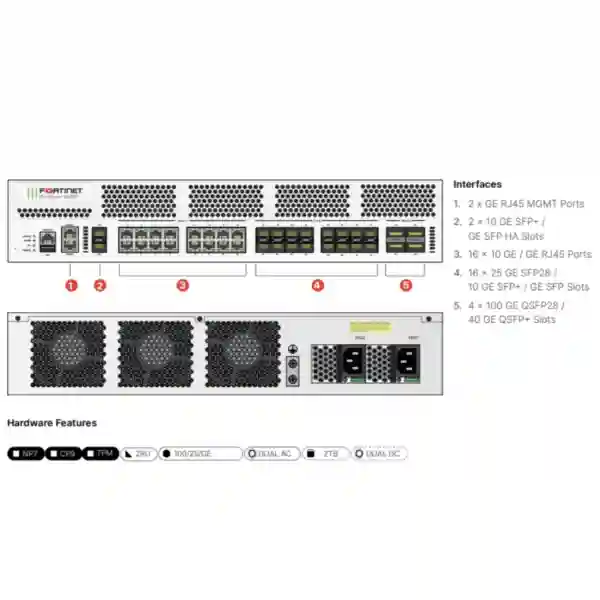
Fortinet positions the FortiGate 2600F as a high-end next-generation firewall for large enterprise and data-center use. Current Fortinet documentation lists the FG-2600F and FG-2601F, including DC variants. The principal difference called out in the hardware table is onboard storage: FG-2600F has no onboard storage while FG-2601F includes two 1 TB NVMe SSDs. Both are 2RU rack-mount systems and include redundant hot-swappable power supplies by default. This distinction matters when a project has local logging or storage requirements, so buyers should confirm the exact model and subscription bundle rather than treating every 2600F-series quotation as interchangeable.
Published Fortinet performance values include up to 198/196/120 Gbps IPv4 firewall throughput for 1518/512/64-byte UDP traffic, 31 Gbps IPS, 27 Gbps NGFW, 25 Gbps threat protection, 55 Gbps IPsec VPN and 20 Gbps SSL inspection. Fortinet notes that performance values are maximum figures and vary with configuration. For procurement, this is an important qualification: a production firewall should be sized against the security features that will actually be enabled, the expected traffic profile, encrypted traffic, VPN demand, policy complexity, growth and high-availability architecture.
Published IPS throughput for enterprise traffic mix.
Published NGFW throughput with firewall, IPS and application control.
Published threat-protection throughput under Fortinet test conditions.
Published IPsec VPN throughput using Fortinet’s stated test method.
Hardware, interfaces and capacity planning
The FortiGate 2600F platform provides sixteen hardware-accelerated 10 GE/GE RJ45 ports, four hardware-accelerated 25 GE SFP28/10 GE SFP+/GE SFP slots, two hardware-accelerated 100 GE QSFP28/40 GE QSFP+ slots, dedicated high-availability connectivity, two GE RJ45 management ports, USB 3.0 and an RJ45 console port. Two SFP+ SR 10 GE transceivers are listed as included. These interfaces allow architects to separate internet, WAN, server, core, DMZ, management and high-availability paths without relying on a single low-speed uplink design.
Capacity figures published by Fortinet include 24 million concurrent TCP sessions, with a higher figure requiring the applicable Hyperscale Firewall license, and one million new TCP sessions per second, likewise with a higher licensed figure available. The platform supports active-active, active-passive and clustering high-availability configurations. The practical architecture should still be built from business requirements: how many upstream carriers exist, whether the firewall connects directly to a core, whether 25/40/100 GbE optics are required, what routing protocols are in scope, and how maintenance will be performed without unnecessary service interruption.
Security, SD-WAN, VPN and segmentation use cases
A 2600F deployment can act as more than an internet perimeter. FortiOS supports firewall policy, application control, intrusion prevention, encrypted traffic inspection, VPN, routing, segmentation and SD-WAN functions in a converged platform. In a large campus, the appliance can help enforce policy between user, server, guest, voice, wireless and operational networks. At a data-center edge, it can protect north-south traffic and controlled network zones. For multi-site organizations, IPsec connectivity and SD-WAN can be considered alongside application performance and link resilience.
Subscription selection should be treated as part of the security design. FortiGuard services and support entitlements vary by bundle and contract. A quotation should therefore state the exact appliance, term, support level and security-service bundle. Organizations renewing an existing FortiGate should also confirm the serial-number entitlement and renewal period rather than assuming a generic license is transferable. FourTeck’s Tanzania security planning can be considered alongside integrated IT and network infrastructure planning, while regional requirements can reference FourTeck Fortinet UAE, FourTeck Uganda, FourTeck Kenya and FourTeck Africa for connected multi-country project discussions.
FortiGate 2600F Series Tanzania
For a Tanzania deployment, the FortiGate 2600F Series is most relevant when the firewall must sit in front of substantial internet, private WAN, data-center or campus traffic while continuing to apply security inspection. Enterprises should begin by documenting current and planned internet bandwidth, internal core speeds, traffic peaks, remote-access demand, site-to-site VPNs, public services, network zones and expected security subscriptions. This produces a more defensible specification than selecting a firewall only from the number of users. A business with high-speed server traffic, many VPN tunnels or heavy encrypted application use can require a different design from an organization with the same employee count but lighter traffic.
Tanzania projects should also consider rack space, cooling, clean power, UPS strategy, redundant power feeds and the physical path of fiber or copper connections. The 2600F is a 2RU appliance, and its high-capacity interfaces may require appropriate SFP+, SFP28 or QSFP-family optics and compatible upstream switching. Those transceiver and cable requirements should be listed explicitly in the bill of materials. High availability should be planned at the topology level, including duplicated links and switch dependencies, rather than simply purchasing two firewalls without a failover design.
For procurement teams, request a quotation that identifies FG-2600F or FG-2601F, AC or DC variant where applicable, subscription bundle, support term, optics, installation scope and any migration services. Existing firewall rules, objects, VPNs and routing should be reviewed before cutover. A staged migration plan should include configuration backup, validation, rollback, monitoring and post-change documentation. Organizations combining the firewall with switches, Wi-Fi, servers or CCTV can use FourTeck Tanzania’s broader infrastructure approach to coordinate dependencies instead of treating the security gateway as an isolated appliance.
FortiGate 2600F Series Dar es Salaam
Dar es Salaam organizations often concentrate headquarters, data-center, cloud-access and branch aggregation traffic at a major site. In that role, FortiGate 2600F can be evaluated as a high-capacity security edge where multiple internet circuits, MPLS or private WAN links, VPN connections and internal network zones meet. The first design task is to map those connections and identify which traffic requires inspection. Internet browsing, SaaS, public-facing applications, partner VPNs and branch tunnels may each have different policy and logging requirements. A clear traffic matrix helps determine interfaces, VLANs, routing, NAT and security profiles before deployment.
For a headquarters refresh, teams should review whether existing core switching can use 10, 25, 40 or 100 GbE connections supported by the appliance. They should also check whether upstream carrier handoffs require copper or fiber, what transceivers are needed and whether redundant paths terminate on separate switches. The firewall’s redundant power supplies are useful only when the surrounding power architecture also provides resilience. UPS capacity, rack ventilation and service access should therefore be included in the installation plan.
Migration planning is especially important for a busy Dar es Salaam site because an edge change can affect internet access, published services, VPNs, DNS dependencies and remote branches at once. The existing configuration should be audited for obsolete rules and undocumented objects before it is reproduced. Cutover should use a controlled test list covering critical applications, remote sites, authentication, monitoring and failover. Procurement teams can improve quote accuracy by providing current bandwidth, projected upgrades, VPN counts, desired inspection services, high-availability requirements and the preferred FortiGuard/support term.
FortiGate 2600F Series Mwanza
In Mwanza, a high-capacity FortiGate project may serve a regional enterprise hub, industrial operation, financial environment, healthcare network, hospitality group or organization linking several sites. The 2600F Series should be assessed when security inspection and connectivity requirements justify an enterprise-class platform rather than a smaller branch firewall. Design begins with the network role: internet edge, data-center perimeter, VPN concentrator, segmentation gateway, SD-WAN hub or a combination of these. Defining that role prevents unnecessary complexity and helps determine which performance figures matter most.
Where connectivity includes multiple providers, failover policy should reflect application needs. A secondary circuit can be reserved for critical traffic, used actively through SD-WAN rules, or configured for controlled failover. The correct approach depends on link characteristics and business priorities. For site-to-site connectivity, IPsec design should document peer addresses, encryption settings, routing, monitoring and change ownership. For remote users, identity, endpoint posture and access scope should be considered together rather than opening broad network access by default.
Mwanza procurement should also account for lifecycle items beyond the chassis: subscriptions, support, optics, patching, rack position, UPS, configuration, documentation and administrator handover. If the firewall will connect to server, CCTV, voice and wireless networks, segmentation requirements should be collected from the owners of those systems. This avoids late policy changes after installation. A useful quotation request includes diagrams or a concise description of current topology, expected growth, internet capacity, critical applications and whether an HA pair is required.
FortiGate 2600F Series Arusha
Arusha businesses evaluating the FortiGate 2600F Series may include hospitality groups, institutions, international organizations, large campuses and multi-site enterprises that need controlled access between users, servers, guest services and external networks. The appliance’s high interface capacity gives architects flexibility, but a successful design depends on logical segmentation. Staff, guest Wi-Fi, servers, management interfaces, cameras, building systems and public services should not automatically share the same trust level. Firewall zones and policies can be designed around operational need and least-privilege principles.
Encrypted traffic inspection can be an important sizing factor because modern application traffic is predominantly encrypted. Fortinet publishes 20 Gbps SSL inspection throughput under its stated test methodology, but actual results depend on configuration and traffic. Organizations should therefore identify applications that require inspection, privacy or compliance exceptions, certificate deployment needs and performance expectations. IPS, application control and malware protection likewise need policy decisions; enabling every feature everywhere without design can create operational issues.
For Arusha sites with remote branches or cloud applications, the firewall can be evaluated for secure SD-WAN and VPN functions as part of a broader WAN strategy. Teams should document provider links, latency-sensitive applications, failover objectives and branch standards. During procurement, specify the exact 2600F-series variant and license term and ask for a bill of materials that includes required optics and accessories. Installation scope should distinguish physical mounting, base configuration, migration, testing, training and ongoing support so responsibilities remain clear.
FortiGate 2600F Series Dodoma
Dodoma organizations planning secure government, institutional, education, enterprise or multi-building networks can evaluate FortiGate 2600F where high throughput, many sessions, VPN scale or fast uplinks are required. The platform’s published capacity is substantial, but sizing should be linked to the intended security architecture. A perimeter-only design has different traffic patterns from a deployment that also segments internal data-center zones. Similarly, a VPN hub serving many remote locations can place different demands on the appliance than a campus gateway focused mainly on internet inspection.
A requirements workshop should identify critical services, acceptable downtime, authentication sources, routing, public IP use, logging, monitoring and retention expectations. Where high availability is required, active-passive or another supported design can be assessed with the surrounding switches and carriers. Both devices need consistent cabling and configuration, and failover should be tested rather than assumed. Management access should be restricted to approved administrative networks and protected with appropriate authentication controls.
For procurement in Dodoma, a structured bill of materials reduces surprises. It should identify appliance variant, subscription and support term, high-availability quantity, optics, cables and implementation services. If the project replaces an older firewall, configuration cleanup is a valuable part of migration: unused objects, expired VPN peers and overly broad rules should be reviewed rather than copied indefinitely. Documentation after deployment should include interface mapping, addressing, routing, VPNs, policy ownership, backup procedure and support contacts.
FortiGate 2600F Series UAE
For UAE enterprises, the FortiGate 2600F Series can fit high-capacity campus, headquarters and data-center edges where organizations require fast interfaces and consolidated network security. A regional group may also use a UAE site as a connectivity hub for branches in Africa, making VPN scale, routing and consistent security policy important design considerations. Rather than duplicating configurations manually between countries, teams can establish standards for zones, naming, logging and change control while still adapting policies to each site’s applications and regulatory requirements.
Data-center and internet-edge projects should map 10/25/40/100 GbE connectivity carefully. The presence of high-speed ports does not by itself guarantee end-to-end performance; upstream switches, optics, cabling, carrier handoffs and server-side paths must be compatible. Encrypted inspection and threat services should be included in sizing. If an organization expects bandwidth upgrades during the firewall lifecycle, headroom can reduce the risk of an early replacement, but capacity should still be justified against realistic growth rather than purchased without a workload model.
A UAE quotation should clearly separate hardware, FortiGuard services, FortiCare/support, optics, professional services and renewal terms. Multi-country organizations can also define a repeatable deployment template covering HA, management access, VPN standards, logging and backup. This helps Tanzania and UAE sites remain operationally familiar to the same IT team while allowing local connectivity and application differences. The goal is a supportable architecture, not merely identical hardware in every country.
FortiGate 2600F Series Uganda
Uganda enterprises considering FortiGate 2600F should first determine whether the platform will operate as a national hub, large campus gateway, data-center firewall or VPN aggregation point. High-capacity firewalls are most valuable when their performance and interfaces match a defined workload. Inventory internet links, private WANs, branch tunnels, cloud connectivity, server networks and public services, then estimate traffic with security inspection enabled. This creates a practical basis for comparing the 2600F with other FortiGate sizes.
For organizations connecting Uganda and Tanzania operations, consistent IP addressing, routing, VPN standards and policy naming can simplify administration. Cross-border topology should still be designed around actual carrier paths and latency rather than assuming geographic proximity guarantees network performance. SD-WAN policies can be considered where multiple links exist, with health checks and application priorities defined from business needs. Logging and monitoring should provide enough visibility to troubleshoot link changes and security events.
Procurement should include subscription term, support level, optics and deployment services in addition to the appliance. For an HA pair, verify rack space, redundant switching and power paths. Before cutover, test business applications, VPN peers, public services and failover behavior. A documented rollback plan is particularly useful for a hub firewall because an error can affect many downstream sites. After deployment, retain configuration backups and schedule policy, firmware and subscription reviews as part of lifecycle management.
FortiGate 2600F Series Kampala
Kampala headquarters and data-center environments can generate a dense mix of user internet traffic, cloud applications, branch VPNs, public services and server communication. FortiGate 2600F can be assessed for these environments where a smaller appliance would provide insufficient inspected throughput or interface capacity. Network teams should model peak traffic and security features rather than relying on average internet utilization. Backup windows, software distribution, cloud synchronization and large data transfers can create short peaks that are operationally important.
Segmentation is another common reason to deploy a capable firewall at a central site. Server, user, guest, management and operational networks can be separated according to policy, but east-west inspection also consumes resources and changes traffic paths. The architecture should therefore define which zones genuinely require firewall traversal and avoid creating unnecessary bottlenecks. High-speed interfaces can connect the firewall to the core, while dedicated management paths help separate administrative access from production traffic.
A Kampala migration should include discovery of existing NAT, routes, VPNs and application dependencies. Legacy firewall rules often contain historical exceptions that are poorly documented. Reviewing them with application owners before migration can improve security and reduce clutter. Quote requests should state whether the organization needs FG-2600F or storage-equipped FG-2601F, HA, support term, security subscriptions and implementation. Optics and fiber patching should be matched to the existing switching environment.
FortiGate 2600F Series Arua
For Arua, the FortiGate 2600F Series is likely to be considered for a substantial regional hub or specialized high-capacity environment rather than a typical small branch. Buyers should validate that the site’s bandwidth, VPN concentration, segmentation or future growth warrants this class of appliance. If the local site is smaller, a central 2600F elsewhere can still act as the hub while an appropriately sized branch FortiGate connects securely over IPsec or SD-WAN. This hub-and-spoke distinction can prevent over-specifying remote locations.
Where connectivity resilience is important, document primary and secondary provider characteristics and what should happen during degradation, not only complete link failure. SD-WAN health checks and policy can steer critical applications according to defined conditions. The network team should also determine whether local services must remain reachable if the WAN is interrupted. DNS, authentication, voice and business applications may have different dependencies that influence branch design.
If a 2600F is deployed in Arua, physical infrastructure deserves the same attention as logical configuration. Confirm rack depth and space, ventilation, UPS capacity, redundant power and fiber availability. The appliance is 2RU and intended for enterprise rack deployment. Procurement documents should list optics and cables explicitly. For remote administration, restrict management exposure, use controlled administrator accounts and retain configuration backups. A clear support escalation path and current documentation can be as important as the initial installation.
FortiGate 2600F Series Mbarara
Mbarara organizations with large campuses, regional aggregation or data-center workloads can evaluate FortiGate 2600F against measured requirements. A useful sizing exercise separates raw firewall traffic from inspected traffic, VPN traffic and SSL inspection. Fortinet publishes different figures for each because security processing changes the workload. The target design should preserve headroom for normal peaks and planned bandwidth growth while avoiding a specification based only on the largest number on a datasheet.
For multi-building or multi-department environments, VLAN and zone design can improve control. Finance, servers, guest wireless, cameras, voice and administration may require different access policies. The firewall can enforce selected boundaries while core switching handles traffic that does not need security inspection. This balance should be documented in a logical network diagram. If the project includes new switches, ensure uplink speeds and transceiver types align with the 2600F interfaces selected for the design.
Procurement in Mbarara should specify licensing and support duration at purchase time because security services and lifecycle support affect the operational value of the firewall. For replacement projects, schedule configuration review and migration testing before the change window. Validate internet, VPN, DNS, authentication and key applications after cutover. If high availability is used, conduct an actual failover test and record expected behavior so future maintenance teams know how the environment should operate.
FortiGate 2600F Series Gulu
In Gulu, a FortiGate 2600F project should be driven by a clear enterprise workload such as a major aggregation point, large institutional network, data center or high-capacity security perimeter. If the requirement is primarily a modest branch internet gateway, another FortiGate model may be more proportionate. FourTeck can use bandwidth, users, sessions, security features, VPNs, interfaces and growth expectations as sizing inputs rather than assuming one model fits every site.
For sites that depend heavily on connectivity to centralized systems, WAN resilience and application behavior should be mapped before firewall configuration. Some applications tolerate brief path changes; others are sensitive to session interruption. VPN and SD-WAN policy can be designed around these realities. Monitoring should show link health and tunnel status so administrators can distinguish a provider issue from a firewall or application problem. Good observability reduces troubleshooting time in distributed networks.
The implementation scope should also cover documentation and handover. Interface labels, IP addressing, routing, security zones, VPN peers and administrator procedures should be recorded. Configuration backups need a defined storage location and update process. When security subscriptions are used, renewal dates should be tracked so protection does not lapse unexpectedly. These operational practices help a high-performance appliance remain manageable throughout its service life and make future expansion less dependent on individual memory.
FortiGate 2600F Series Kenya
Kenya enterprises with Nairobi or regional data-center and headquarters networks can consider FortiGate 2600F as part of a multi-country security standard. The model’s high-speed interfaces can support substantial core and WAN connectivity, while FortiOS provides firewall, VPN, SD-WAN and security functions. A regional standard should define design principles such as zone names, VPN parameters, logging, administrator roles and change control, while allowing each country to use appropriate providers, addresses and local application exceptions.
When connecting Kenya and Tanzania operations, organizations should decide whether traffic flows directly between sites, through a central hub or through cloud security services. Each topology affects latency, resilience and firewall load. Site-to-site IPsec capacity is only one factor; route design, failover, DNS and application dependencies also matter. For high availability, ensure both firewall nodes have independent connectivity to the surrounding switching infrastructure and suitable power resilience.
Kenya procurement teams should compare quotations on like-for-like terms. One quote may include only hardware while another includes FortiGuard services, support, optics and implementation. The exact model, subscription bundle and term should be visible. If local logging or storage is needed, confirm whether FG-2601F is appropriate. Migration services should state whether rule cleanup, VPN recreation, routing, testing and documentation are included. This makes commercial comparison more meaningful than comparing a single headline price.
FortiGate 2600F Series Kuwait
Kuwait organizations deploying high-capacity enterprise security can evaluate FortiGate 2600F for data-center, campus and internet-edge use cases. Hot climates make controlled data-room cooling and airflow especially important for rack equipment. Fortinet specifies an operating temperature range of 0 to 40 degrees Celsius for the platform, so the equipment room should be engineered and monitored accordingly rather than relying on general office conditions. Power and UPS design should support both the firewall and its surrounding network infrastructure.
From a network perspective, the appliance’s 25 and 100 GbE-capable interfaces can be useful when the firewall sits between high-speed core, server and carrier networks. The design should identify which links genuinely need those speeds and select compatible optics. Security inspection throughput, not only firewall throughput, should be compared with expected traffic. SSL inspection, IPS and threat protection can materially affect sizing, and policy should be based on risk and application requirements.
For regional organizations operating in Kuwait and East Africa, a shared FortiGate operating standard can simplify support. Templates can define naming, management access, VPN baselines, logging and backup procedures without forcing identical physical topology. Procurement should capture hardware, licenses, support and professional services separately. Renewal planning should begin before contract expiry, with serial numbers and entitlement details recorded so the organization knows exactly which services apply to each appliance.
FortiGate 2600F Series Ghana
Ghana enterprises considering FortiGate 2600F can use the platform at a substantial headquarters, data-center edge or regional aggregation point where high session counts and security inspection are required. The business case should connect technical capacity to specific needs: internet growth, VPN scale, encrypted traffic, server publishing, segmentation and high availability. This makes it easier for procurement and management teams to understand why a high-end firewall is being selected and what services must accompany it.
A well-planned deployment separates design decisions from product defaults. Administrators should define trusted and untrusted zones, management networks, logging destinations, identity integration, routing and failover. Policies should have clear owners and business justification. Where SSL inspection is deployed, certificate and application compatibility need testing. Where remote access is required, user authentication and access scope should be designed carefully. These tasks are implementation work, not automatic outcomes of purchasing the appliance.
Ghana procurement can also benefit from a lifecycle view. Include support term, FortiGuard subscriptions, renewal responsibility, configuration backups and firmware maintenance in the project plan. If the organization operates sites in Tanzania, Nigeria or other markets, document common standards so teams can troubleshoot consistently. The physical bill of materials should include the correct transceivers and cables for the chosen interfaces, avoiding delays caused by a firewall arriving without compatible connectivity to the existing core.
FortiGate 2600F Series Nigeria
Nigeria’s large enterprise, financial, telecom, energy and multi-site environments can create substantial firewall and VPN workloads. FortiGate 2600F may be appropriate where a major site needs high throughput and dense high-speed connectivity, but the sizing process should still begin with measured demand. Internet capacity, application traffic, branch tunnels, remote users, public services and security inspection should be modeled separately. Large user counts alone do not describe a firewall workload accurately.
For a data-center edge, teams should examine whether the firewall will inspect only north-south traffic or also enforce segmentation between internal zones. East-west inspection can significantly change capacity planning and network topology. High-speed 25/100 GbE interfaces provide options for core integration, but switching and optics must be compatible. HA architecture should remove single points of failure where practical, including power, switch uplinks and carrier connectivity rather than focusing only on the firewall pair.
Nigeria procurement teams should ask vendors to identify exact appliance model, subscription bundle, support term and implementation scope. Comparing quotes without these details can produce misleading price differences. Migration plans should inventory NAT, VPNs, routes, objects and security rules from the existing environment, with obsolete entries reviewed before transfer. After cutover, monitor resource use and security events to confirm the production traffic matches assumptions used during sizing and retain documentation for future changes.
FortiGate 2600F Series Seychelles
Seychelles organizations in hospitality, financial services, government and multi-property operations may require secure connectivity between sites and centralized services. A FortiGate 2600F is most relevant for a substantial central hub or data-center role where many connections converge. Smaller properties can use appropriately sized edge devices while the central platform aggregates VPNs and enforces shared security policy. This approach can provide consistency without placing an oversized appliance at every location.
Connectivity planning is particularly important for geographically distributed operations. Teams should document primary and backup links, critical cloud applications and what services must continue during a WAN disruption. SD-WAN policies can be evaluated for link steering and health monitoring, while IPsec provides secure site-to-site connectivity. Application testing should include failover conditions because a technically available secondary path may have different latency or bandwidth characteristics.
For procurement, account for logistics, optics, subscriptions and support alongside the chassis. The firewall requires suitable rack, cooling and power infrastructure. If high availability is required, confirm the complete duplicated path and test failover after installation. Centralized documentation is valuable for island or multi-property networks because remote troubleshooting often depends on accurate diagrams and interface records. A quotation request should therefore include implementation, documentation and handover expectations rather than treating these as assumed extras.
Related Tanzania network and security planning
A FortiGate 2600F deployment depends on the infrastructure around it. FourTeck Tanzania’s business technology overview explains the integrated approach across firewall, switching, Wi-Fi, servers and cabling. The Tanzania technology shop provides a starting point for related product procurement. For network-security projects, switching uplinks, fiber, rack design, UPS capacity, server connectivity and wireless segmentation should be considered together. This is especially important when high-speed firewall ports are introduced into an older LAN where the core or cabling could otherwise become the limiting factor.
The Tanzania site also describes firewall and VPN planning, network switching, Wi-Fi, servers and structured infrastructure as connected solution areas. A project can therefore combine firewall migration with core upgrades, VLAN redesign, secure wireless segmentation, server-zone protection or resilient WAN design. The exact scope should be based on an assessment rather than automatically replacing every surrounding component.
FortiGate 2600F quotation checklist
FortiGate 2600F Series FAQs
What is the FortiGate 2600F Series designed for?
It is a high-end FortiGate platform for large enterprise, campus, data-center, high-capacity internet edge, VPN, segmentation and secure networking use cases. Suitability depends on the actual inspected traffic and architecture.
What is the difference between FG-2600F and FG-2601F?
Fortinet’s current hardware table lists no onboard storage for FG-2600F and two 1 TB NVMe SSDs for FG-2601F. Confirm the exact model and current datasheet when ordering.
How fast is FortiGate 2600F?
Fortinet publishes up to 198 Gbps firewall throughput, 31 Gbps IPS, 27 Gbps NGFW, 25 Gbps threat protection, 55 Gbps IPsec VPN and 20 Gbps SSL inspection under its stated test conditions. Production results vary with configuration and traffic.
Does FortiGate 2600F support high availability?
Yes. Fortinet lists active-active, active-passive and clustering HA configurations. The surrounding switches, links and power should also be designed for resilience.
Which licenses should be included?
The answer depends on the required FortiGuard security services, support level and contract term. Request a quote that names the bundle and duration explicitly rather than assuming all security functions have identical entitlement.
Can FortiGate 2600F be used for SD-WAN and VPN?
Yes. FortiOS provides SD-WAN and VPN capabilities, and Fortinet publishes 55 Gbps IPsec VPN throughput for the platform under its test methodology. WAN policy should be designed around actual links and applications.
Decision recap and consultation
FortiGate 2600F Series is a substantial enterprise security platform, and the strongest purchase decision comes from matching its inspected throughput, high-speed interfaces, HA options and FortiGuard services to a documented workload. Before requesting a final quotation, capture bandwidth, VPNs, zones, optics, existing firewall details, subscription term and migration expectations. FourTeck can use those inputs to frame a bill of materials and deployment discussion without assuming stock, price or delivery commitments that have not been confirmed.



Reviews
There are no reviews yet.