
FortiGate 30G Series Tanzania
FortiGate 30G Series is a compact Fortinet next-generation firewall and secure SD-WAN family designed for distributed enterprise sites, small offices and branches that need security and networking in one FortiOS-driven appliance. For Tanzania organisations replacing a basic router, standardising branch security or building secure links between locations, the 30G family provides a practical platform for firewall policies, application visibility, IPsec VPN, SD-WAN and licensed FortiGuard security services. FourTeck Tanzania can help translate business requirements into a suitable appliance, subscription and deployment scope without assuming that raw firewall throughput alone determines sizing.
Published firewall throughput up to 4/4/3.9 Gbps for 1518/512/64-byte UDP traffic.
Published IPsec VPN throughput, useful when planning encrypted branch connectivity.
Published threat-protection throughput under Fortinet test conditions.
FortiGate 30G Series Overview
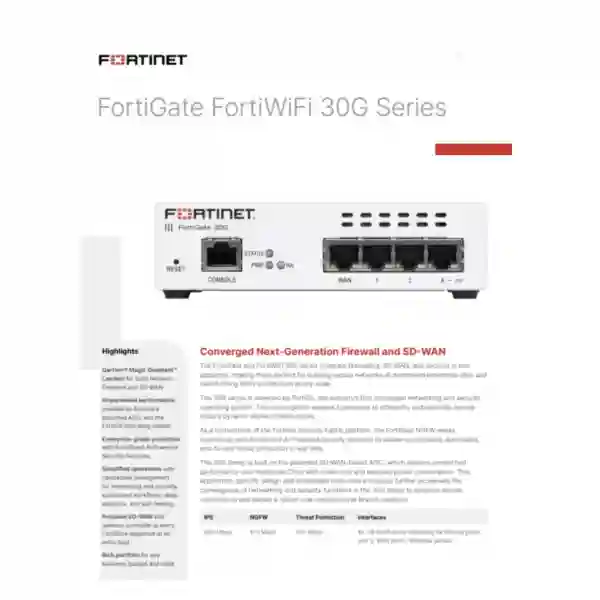
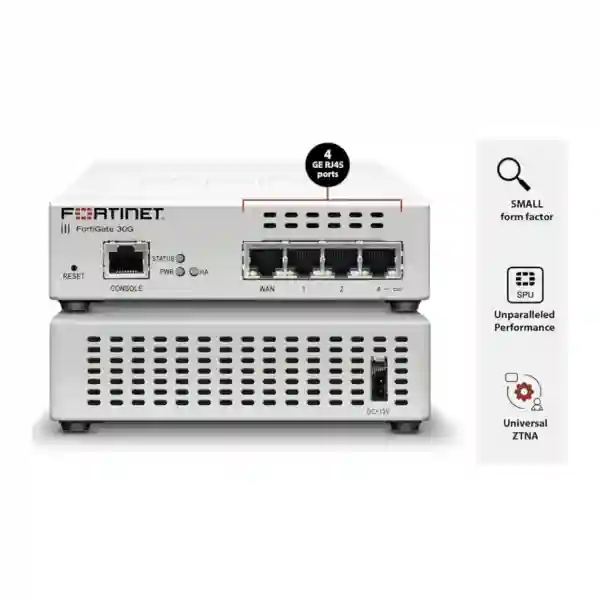
Fortinet positions the FortiGate and FortiWiFi 30G series as converged next-generation firewall and SD-WAN appliances. The platform uses FortiOS to combine network and security functions and can work with FortiGuard AI-powered security services and the wider Fortinet Security Fabric. Fortinet documentation identifies the FortiGate 30G with four front-panel Gigabit Ethernet data interfaces: WAN, ports 1 and 2, and an A interface used for FortiLink, plus console connectivity. The architecture uses Fortinet SOC4 with NP6XLite and CP9XLite acceleration. These details matter because the 30G is not simply an internet router with filtering added; it is designed as a purpose-built security gateway for sites that need controlled internet access, segmentation, encrypted connectivity and centrally managed policy.
Published Fortinet figures for the family include 800 Mbps IPS throughput, 570 Mbps NGFW throughput, 500 Mbps threat protection, 3.5 Gbps IPsec VPN throughput, up to 600,000 concurrent TCP sessions and 30,000 new TCP sessions per second. Performance figures are laboratory measurements and should not be treated as guaranteed production capacity. Real sizing must consider internet bandwidth, TLS inspection, enabled security profiles, application mix, VPN traffic, logging, user count and expected growth. A useful procurement conversation therefore begins with the workload, not with the highest number in a datasheet.
Important sizing point: describe your internet circuits, users, devices, VPN tunnels, security inspection requirements and growth target when requesting a quotation. This allows the 30G to be assessed against larger FortiGate options when necessary.
Security, SD-WAN and Branch Connectivity
The value of FortiGate 30G is the convergence of functions that would otherwise be managed separately. Firewall policies can control traffic between WAN and internal zones; segmentation can separate employee, guest, server, CCTV, voice and operational networks; IPsec VPN can connect branches; and SD-WAN policies can help organisations use more than one WAN path according to application and link conditions. Licensed FortiGuard services can extend protection with security capabilities such as intrusion prevention, web and DNS security and application controls according to the selected service bundle and FortiOS support.
For a small branch, this can simplify architecture. Instead of treating internet access, branch VPN, application control and threat inspection as unrelated projects, the organisation can define a single edge-security policy. For multi-site deployments, standard templates, naming, addressing and policy design become particularly important. Buyers should also plan subscriptions and support as lifecycle items rather than treating them as afterthoughts. The required bundle, term and renewal approach should be confirmed during procurement.

Deployment and Integration Planning
A clean deployment starts with an inventory of WAN services, IP addressing, VLANs, switches, access points, servers, printers, CCTV systems, voice devices and remote-access requirements. The FortiLink interface can be relevant where compatible FortiSwitch integration is planned. If the site uses dual internet links, SD-WAN design should define preferred paths, failover behaviour, health checks and application priorities rather than merely plugging in a second circuit. For site-to-site VPN, document subnets, routing, encryption requirements, peer details and resilience expectations.
FourTeck Tanzania’s technology services page explains why firewalls should be planned with switching, Wi-Fi, servers and other dependencies. Buyers can also use the Tanzania technology shop to frame related product requirements and the FourTeck Tanzania contact page to submit bandwidth, user, VPN and project details for quotation. For regional planning, related FourTeck resources include FourTeck Uganda, FourTeck Kenya, Fortinet UAE resources, FourTeck Ghana and FourTeck Nigeria.
FortiGate 30G Series Tanzania
Tanzania organisations evaluating the FortiGate 30G Series commonly need a compact security gateway for an office, retail branch, clinic, school, hospitality site, professional practice or operational location. The strongest buying case is not simply “we need a firewall”; it is a defined requirement to protect an internet edge while maintaining usable application performance and manageable policies. A Tanzania quotation should therefore identify ISP bandwidth, whether the site has one or two internet links, approximate users and devices, expected VPN traffic, security profiles, switch integration and any segmentation requirements. This information helps determine whether the 30G is appropriately sized or whether a higher model should be considered.
For organisations with several Tanzania sites, consistency is often as important as appliance performance. Standard VLAN conventions, branch addressing, VPN design, administrator access and configuration backup practices can reduce operational complexity. Retail environments may separate POS, staff and guest traffic; offices may isolate servers, employees, voice and visitor Wi-Fi; schools may distinguish administration, staff and student access. The 30G can form the security boundary for such designs, while the actual policy set should be based on business risk and application requirements.
Procurement should include the correct FortiGuard and FortiCare choices rather than comparing hardware-only prices. Buyers should request the exact appliance, service bundle and subscription term, and should document renewal dates. Where a project includes switching or Wi-Fi, it is useful to quote the whole edge environment together so that port requirements, VLANs and management expectations are aligned. Tanzania customers can send these details through FourTeck’s verified contact page to begin a model-selection and quotation discussion.
FortiGate 30G Series Dar es Salaam
Dar es Salaam businesses often operate internet-dependent offices, retail locations, logistics sites, professional services, hospitality environments and branch networks where downtime or unsafe access can disrupt daily operations. A FortiGate 30G Series deployment can be considered where a compact branch firewall is required to enforce internet policies, connect users to cloud services, build encrypted links to another site and separate traffic classes. Before ordering, define whether the firewall will serve one office or participate in a wider multi-branch design, because routing, VPN, logging and policy standards should be agreed early.
For dual-ISP sites, the design should identify whether the second circuit is intended for failover, load distribution or application-specific routing. SD-WAN can support more intelligent path selection, but effective results depend on correctly defined health checks and business priorities. Voice, video meetings, cloud ERP and general browsing do not always need identical treatment. A procurement request should state the bandwidth of each circuit and which applications are operationally important.
Dar es Salaam buyers should also account for downstream infrastructure. A firewall cannot compensate for an undersized switch, poor Wi-Fi coverage or unmanaged network loops. Where the project includes access points, IP phones, CCTV or servers, include those dependencies in the design discussion. The objective is a coherent network edge: suitable firewall capacity, clear segmentation, reliable switching and a documented support and renewal plan.
FortiGate 30G Series Mwanza
For Mwanza organisations, FortiGate 30G Series can suit branch environments that need controlled business internet access and secure connectivity without deploying a large rack-mounted firewall. The first decision is workload. Count users, PCs, phones, cameras and other IP devices, but also identify traffic behaviour: cloud applications, backups, video meetings, remote administration and inter-site transfers can affect practical sizing differently. Security inspection adds processing requirements, so raw ISP speed should not be the only sizing input.
Businesses linking Mwanza to a head office can use IPsec VPN as part of a branch architecture. Good VPN planning includes non-overlapping subnets, routing, authentication, monitoring and a recovery procedure. If a backup ISP is available, decide whether branch connectivity must fail over automatically and which applications should retain priority. For sites that cannot tolerate prolonged loss of connectivity, resilience planning should cover ISP diversity, power protection and configuration backup as well as the firewall itself.
When requesting a Mwanza quotation, specify the expected subscription term and required security services. The ongoing security value of a next-generation firewall depends on correctly licensed services, maintained firmware and operational policy review. A clear request should therefore combine appliance quantity, service bundle, support term, WAN information and deployment scope rather than asking only for the lowest hardware price.
FortiGate 30G Series Arusha
Arusha businesses in tourism, hospitality, professional services, education and general commerce may have mixed network populations: employees, guests, payment devices, cameras and cloud-connected systems. FortiGate 30G Series can provide an edge platform for separating these groups and applying different access policies. Segmentation should be designed deliberately. Guest access should not automatically share the same trust level as administration, servers or operational devices, and CCTV networks may also benefit from restricted communication paths.
Hospitality and customer-facing environments should pay particular attention to application demand and internet continuity. Guest usage can be unpredictable, while business systems require consistent access. SD-WAN and traffic policy can help when multiple WAN links exist, but bandwidth management must reflect the actual circuits and service expectations. Security inspection, VPN and logging requirements should be included when assessing whether the 30G provides sufficient headroom.
Arusha procurement teams can improve quotation accuracy by describing the physical and logical environment: number of users, switch topology, access points, WAN speeds, VLANs, remote users, site-to-site VPN peers and expected growth. If the site is expanding, size for a realistic future state rather than today’s minimum. Subscription renewals should also be recorded in the IT lifecycle plan so security services do not lapse unexpectedly.
FortiGate 30G Series Dodoma
Dodoma organisations considering FortiGate 30G Series may be upgrading from an ISP router, adding a dedicated security boundary or standardising branch firewalls across multiple sites. The migration should begin with a policy inventory. Identify existing port forwards, VPNs, public services, static routes, DNS dependencies, VLANs and allowed outbound applications before replacing the old gateway. This reduces the risk of discovering hidden dependencies after cutover.
For offices handling sensitive business systems, administrators should define least-necessary access between network segments rather than leaving all internal devices in one flat network. Staff endpoints, servers, printers, voice, cameras and guest devices can be grouped according to operational needs. The FortiGate becomes the enforcement point, while the switch and wireless design must carry the corresponding VLANs correctly. A documented addressing and naming scheme simplifies troubleshooting and future expansion.
A Dodoma quotation request should state whether configuration, migration planning, VPN setup or policy work is part of the required scope. Hardware and subscription procurement is only one component of a successful firewall project. Administrators also need configuration backups, controlled access, firmware planning and a process for reviewing logs and policy changes. These lifecycle considerations help turn the appliance into a maintainable security platform.
FortiGate 30G Series UAE
UAE buyers evaluating FortiGate 30G Series for a branch, small office, retail outlet or remote site should compare the appliance against actual inspection and VPN requirements. Fortinet’s published performance figures provide a useful baseline, but production throughput depends on enabled features and traffic conditions. Organisations with high-speed internet circuits, extensive TLS inspection or rapidly growing user populations should assess whether a larger FortiGate offers more appropriate capacity.
Multi-site UAE environments can use standardised FortiOS policies and IPsec connectivity to create a repeatable branch design. The network team should define common VLANs, addressing rules, SD-WAN behaviour, security profiles and logging before rolling out multiple appliances. Standardisation reduces configuration drift and makes troubleshooting more predictable. Where branches use different ISP types, templates may still require site-specific WAN settings and health checks.
Procurement should align appliance, FortiGuard services and FortiCare support with the planned lifecycle. Buyers comparing quotes should check whether subscription terms and service bundles are equivalent rather than comparing totals without context. FourTeck’s Fortinet-focused UAE resource can support regional research while Tanzania projects should continue through the Tanzania enquiry channel.
FortiGate 30G Series Uganda
Uganda organisations can consider FortiGate 30G Series for small offices and distributed branches that require firewalling, SD-WAN, IPsec VPN and licensed security services. A branch firewall should be selected from the traffic profile rather than a simple user-count rule. Internet speed, concurrent cloud use, inspection depth, VPN throughput and future growth all affect suitability. Fortinet publishes 500 Mbps threat-protection throughput for the 30G, which provides a useful reference point for security-enabled sizing.
For organisations connecting Uganda sites with Tanzania, Kenya or a central data environment, address planning is critical. Overlapping private subnets complicate VPN routing and should be avoided where possible. Branch rollouts benefit from a documented template covering VLANs, DHCP, DNS, VPN peers, administrator access, logging and backup procedures. Where multiple internet circuits are used, SD-WAN rules should reflect application priorities and measurable link health.
Uganda procurement should also distinguish appliance cost from the security-service lifecycle. Confirm the service bundle, support level and term, and record renewal dates. If a project includes several branches, align renewal periods where practical to simplify administration. The related FourTeck Uganda resource provides a regional reference for FortiGate 30G enquiries.
FortiGate 30G Series Kampala
Kampala offices and branches frequently combine cloud productivity, web applications, voice, video, Wi-Fi and remote access on the same internet edge. FortiGate 30G Series can centralise policy enforcement for a compact site, but network design should identify which applications are critical and which device groups require isolation. A retail location may prioritise POS and business applications; a professional office may prioritise cloud systems and VPN; a clinic may separate administrative and guest traffic.
Where an organisation uses a primary and backup ISP, define the expected failover behaviour before deployment. Some applications may tolerate a changed public IP while others may not. Site-to-site VPN tunnels may need redundant peers or dynamic behaviour depending on architecture. Testing should include actual link failure, not just confirmation that both WAN interfaces show as connected.
For quotation preparation, Kampala buyers should provide internet speeds, approximate users, VLAN requirements, number of VPN sites, remote-access needs, security services and the expected subscription term. This creates a clearer comparison between the 30G and alternatives and reduces the risk of buying a device based only on headline firewall throughput.
FortiGate 30G Series Arua
Arua branch environments can benefit from a compact security appliance when the requirement includes protected internet access, branch VPN and clearer control over applications. The FortiGate 30G Series is designed for distributed sites, but successful deployment depends on the surrounding connectivity. If WAN service quality varies, SD-WAN health checks can be designed to detect degradation and steer traffic according to policy when multiple links are available.
Branch resilience should include power and operational considerations. A firewall configuration should be backed up after approved changes, administrator access should be restricted, and recovery information should be available to the responsible IT team. For remote branches, central visibility and consistent configuration standards can reduce the need for ad-hoc troubleshooting. If local staff are not technical, cabling and port labels also become valuable operational controls.
Arua buyers requesting a FortiGate 30G quotation should identify whether the site is standalone or part of a larger network. A standalone office may have simpler requirements, while a branch linked to head office needs routing, VPN, policy and potentially failover coordination. Include the subscription term and security-service expectations so the quote represents the intended security posture, not just the appliance chassis.
FortiGate 30G Series Mbarara
Mbarara businesses looking for FortiGate 30G Series should start by defining what the firewall must protect and connect. The answer may include staff laptops, business applications, guest Wi-Fi, cameras, printers, servers and branch traffic. These groups should not automatically receive identical network access. A VLAN and policy design can reduce unnecessary lateral communication and make the network easier to understand.
The appliance’s IPsec VPN capability can support branch-to-head-office connectivity, while SD-WAN can help manage multiple WAN links. The design should document routing and failover rather than relying on defaults. For cloud-heavy offices, DNS security, web controls, intrusion prevention and application policies may be relevant depending on the licensed FortiGuard bundle. Enabling advanced inspection should be included in performance planning.
Mbarara procurement teams should compare complete lifecycle packages. Ask which FortiCare and FortiGuard services are included, how long the term runs, and what configuration or deployment scope is quoted. Where several appliances are being purchased, standardising the bundle and renewal cycle can simplify administration. A structured bill of requirements is more useful than an isolated request for “best price.”
FortiGate 30G Series Gulu
Gulu organisations may use FortiGate 30G Series as a security gateway for a compact branch that needs stronger controls than a consumer or ISP router provides. The platform can enforce firewall policy, support encrypted IPsec connectivity and integrate security services, but the deployment should be planned around the business network. Identify critical applications, user groups, guest access, cameras and any servers or operational devices before building policy.
If the branch connects to another office, document both ends of the VPN, including subnets and routing. Avoid duplicate addressing across sites where possible. If connectivity reliability is a concern and two ISPs are available, define which traffic should use each circuit and how failover will be tested. The firewall can participate in resilience, but ISP diversity, power protection and monitoring are equally important.
Gulu buyers should request a quote that identifies the appliance and the exact service term. Security subscriptions influence the capabilities available over the product lifecycle. Administrators should also plan firmware maintenance, configuration backups and controlled change procedures. These operational practices help ensure that the firewall remains understandable and supportable after the initial installation.
FortiGate 30G Series Kenya
Kenya businesses evaluating FortiGate 30G Series for branch security can use the same disciplined sizing process: document WAN bandwidth, users, devices, VPN demand, inspection features and growth. A compact branch with moderate internet requirements may fit the 30G profile, while higher-speed or inspection-heavy sites may require a larger platform. The goal is adequate headroom under the security configuration that will actually be used.
For East African multi-country networks, a standard branch blueprint can simplify operations. The blueprint can define VLANs, addressing, IPsec VPN, administrator controls, logging and SD-WAN rules while leaving room for local ISP differences. Consistent policy naming and documentation also make audits and troubleshooting easier. When branches share applications hosted in another country or cloud region, latency and WAN quality should be considered alongside firewall capacity.
Kenya procurement requests should include the intended FortiGuard bundle and support term. If the organisation is buying appliances for several countries, align technical standards while confirming each site’s electrical, connectivity and operational requirements separately. FourTeck Kenya can serve as a related regional resource for Kenya-specific enquiries.
FortiGate 30G Series Kuwait
Kuwait buyers considering FortiGate 30G Series for a small office or branch should evaluate the device against available internet speeds and enabled inspection. High-bandwidth access can make headline firewall throughput look comfortable, yet threat inspection, TLS processing, VPN and application mix influence practical capacity. A design review should therefore identify the security profiles that will be active during normal business use.
For branches connecting to regional headquarters, IPsec VPN can provide encrypted site-to-site communication. SD-WAN can add policy-based path control where multiple WAN links exist. A useful design specifies business-critical applications, health-check targets, failover thresholds and expected behaviour during a circuit outage. Testing these scenarios is part of deployment quality.
Kuwait procurement should compare equivalent subscription packages. FortiGate hardware without the intended security services is not the same solution as an appliance bundled with FortiGuard and FortiCare for a defined term. Request the exact bundle, duration and implementation scope so quotations can be compared on a like-for-like basis.
FortiGate 30G Series Ghana
Ghana organisations can consider FortiGate 30G Series when a branch requires compact next-generation firewalling, secure SD-WAN and IPsec connectivity. The best fit depends on the branch workload. Count devices but also document internet speed, cloud applications, video usage, VPN traffic and inspection requirements. This gives a more realistic picture than a user count alone.
For distributed companies, standardising branch firewall configuration can improve operational control. Common security zones, policy names, VPN conventions and backup procedures reduce variation across sites. If a branch uses multiple ISPs, SD-WAN policy can be designed around link health and application priority. Business continuity planning should also consider power, ISP failure and access to configuration backups.
Ghana procurement should specify the FortiGuard service bundle and FortiCare term required with the appliance. Buyers should also describe whether configuration, migration or VPN work is expected. This creates a complete project scope and helps avoid a situation where hardware arrives without the subscriptions or deployment tasks needed to meet the original security objective.
FortiGate 30G Series Nigeria
Nigeria businesses with distributed branches can use FortiGate 30G Series as part of a standardised edge-security architecture where site requirements fit the platform’s capacity. The appliance can combine firewalling, SD-WAN, IPsec VPN and licensed threat-protection functions, helping IT teams consolidate controls at smaller sites. Sizing should account for real inspection requirements and growth rather than relying solely on the 4 Gbps raw firewall figure.
Multi-WAN planning can be particularly useful for locations that need resilient internet. The firewall policy should define how applications respond to degraded or unavailable circuits. A second ISP only improves resilience if failover is correctly configured, monitored and tested. Critical services may also depend on DNS, public IP addressing or upstream provider behaviour, so end-to-end testing is important.
Nigeria procurement teams should document quantities, branch types, WAN speeds, VPN topology and subscription terms. For large rollouts, grouping branches into standard profiles can simplify ordering and configuration: for example, small branch, medium branch and high-demand branch. The 30G can then be assessed as one profile rather than being forced into every location regardless of workload.
FortiGate 30G Series Seychelles
Seychelles organisations evaluating FortiGate 30G Series may be protecting compact offices, hospitality sites or remote branches where secure internet access and manageable connectivity are important. A useful design separates business-critical systems from guest or unmanaged devices and applies policies according to trust and application need. The firewall can provide the enforcement point while switching and Wi-Fi carry the corresponding network segmentation.
Where a site depends heavily on cloud applications or remote systems, WAN reliability becomes a central design concern. If two internet paths are available, SD-WAN can help apply health-aware routing, but the organisation should define acceptable failover behaviour and test it. Site-to-site IPsec VPN can connect remote offices securely, provided routing and address plans are coordinated.
Seychelles buyers should include lifecycle details in the procurement request: FortiGuard services, FortiCare support, subscription term, configuration scope and renewal planning. For remote environments, clear documentation is particularly valuable. Port labels, network diagrams, configuration backups and administrator procedures can reduce recovery time when troubleshooting must be coordinated across locations.
Buying Checklist for FortiGate 30G Series
Network inputs
Provide WAN bandwidth, ISP count, user/device totals, VLANs, switch and Wi-Fi environment, public services and expected growth.
Security inputs
Define IPS, web/DNS security, application control, VPN, inspection and logging expectations so capacity and subscriptions can be assessed.
Commercial inputs
State appliance quantity, service bundle, support term, implementation scope, target timeline and any multi-site standardisation requirement.
FortiGate 30G Series FAQs
What is FortiGate 30G Series designed for?
Fortinet positions the FortiGate and FortiWiFi 30G series for distributed enterprise sites and branch environments that need converged next-generation firewall and SD-WAN functions in a compact platform.
What throughput does FortiGate 30G provide?
Fortinet publishes up to 4/4/3.9 Gbps firewall throughput, 3.5 Gbps IPsec VPN, 800 Mbps IPS, 570 Mbps NGFW and 500 Mbps threat protection for the 30G. These are laboratory figures; actual results vary with configuration and traffic.
Does FortiGate 30G support SD-WAN?
Yes. Secure SD-WAN is a core part of Fortinet’s positioning for the 30G family. Effective deployments still require correct WAN health checks, routing and application policies.
How should I request a FortiGate 30G quote in Tanzania?
Provide internet speed, ISP count, users and devices, VPN requirements, required security services, existing switching/Wi-Fi, quantity and desired subscription term. FourTeck Tanzania’s contact page accepts firewall quotation and model-selection enquiries.
Decision Recap
FortiGate 30G Series is best evaluated as a compact security and networking platform rather than by hardware price alone. Confirm that its security-enabled performance matches the intended WAN and workload, choose the correct FortiGuard/FortiCare term, document VPN and segmentation requirements, and plan how the device will be maintained. If the branch requirement exceeds the 30G profile, compare a larger FortiGate rather than reducing the planned security controls simply to fit the appliance.
For a quotation, include your country/city, quantity, internet bandwidth, number of users, number of sites, VPN requirement, dual-WAN requirement, current firewall, desired subscription term and any installation or migration scope.




Reviews
There are no reviews yet.