
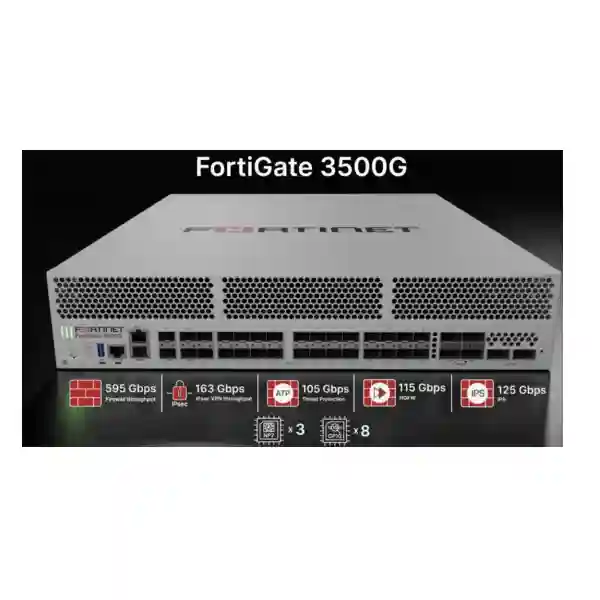
FortiGate 3500G Series Tanzania
FortiGate 3500G Series is designed for organizations that need data-center-class network security without forcing high-speed applications, encrypted traffic and east-west flows through a low-capacity security layer. Fortinet positions the 3500G as a high-end FortiGate for modern data centers and enterprise infrastructure, using NP7 and SP5 processors with FortiOS to combine accelerated networking and security. For Tanzanian banks, telecom environments, government networks, service providers, universities, large industrial groups and enterprises consolidating security at core or data-center boundaries, the platform offers a practical path to very high throughput, dense interfaces and unified policy control.
Published firewall throughput for the 3500G in Fortinet’s current product matrix.
Enterprise-mix IPS performance for high-volume inspected traffic.
Published threat-protection throughput for sizing demanding security workloads.
Two 400GE QSFP-DD interfaces plus 100GE and 25GE connectivity support dense high-speed designs.
FortiGate 3500G Series overview
The 3500G is aimed at security architectures where traffic volume, segmentation and inspection requirements have moved beyond conventional enterprise-edge appliances. Fortinet lists 595/590/420 Gbps firewall throughput for 1518/512/64-byte UDP traffic, 163 Gbps IPsec VPN throughput, 125 Gbps IPS throughput, 115 Gbps NGFW throughput and 105 Gbps threat-protection throughput. These figures are vendor-published performance measurements and should be interpreted using Fortinet’s test conditions; production sizing should consider enabled security profiles, traffic composition, encryption, session behavior, redundancy, growth and operational headroom.
Connectivity is equally important in this class. The platform provides two 400GE QSFP-DD ports, four 100GE QSFP28 ports, thirty 25GE SFP28 ports and two 10GE RJ45 interfaces. This mix supports aggregation, core interconnects, server and fabric-facing links, high-capacity WAN handoffs and segmented security zones without relying on a large number of external media conversions. The appliance uses a 2RU form factor and dual power supplies. Organizations requiring onboard storage can evaluate the FortiGate 3501G variant, for which Fortinet lists two 1.92TB SSDs.
What the FortiGate 3500G solves
High-capacity networks create a security engineering problem: the firewall must inspect enough traffic to remain useful while avoiding a bottleneck between application tiers, users, internet gateways, cloud connections and partner networks. The 3500G addresses that problem with purpose-built security processing and FortiOS policy enforcement. It can be considered for north-south perimeter security, internal segmentation, data-center edge enforcement, large campus cores, service-provider environments, high-speed VPN concentration and architectures that need consistent Fortinet controls across distributed infrastructure.
Fortinet also introduced the 3500G in the context of growing encrypted traffic and AI-driven workloads. Current Fortinet material describes native shadow-AI detection and FortiGuard AI-Powered Security Services, while FortiOS 8.0 expands visibility into newer AI-related traffic patterns. Exact features available to a deployment depend on FortiOS version, subscriptions and configuration, so procurement teams should define the required security services before requesting a quotation rather than selecting hardware from firewall throughput alone.
Key capabilities for enterprise security teams
Next-generation firewalling
Application-aware controls, security policies and integrated inspection help teams consolidate controls at high-throughput network boundaries.
Intrusion prevention
Fortinet publishes 125 Gbps enterprise-mix IPS throughput, giving architects a relevant metric for networks where prevention is enabled on substantial traffic volumes.
High-capacity VPN
Published IPsec VPN throughput of 163 Gbps supports evaluation for encrypted site connectivity, data-center interconnect use and large remote-network designs.
Security Fabric integration
FortiOS enables integration with the wider Fortinet ecosystem so firewall telemetry and controls can participate in a broader security architecture.
Technical specifications at a glance
| Item | FortiGate 3500G |
|---|---|
| Firewall throughput | 595 / 590 / 420 Gbps (1518 / 512 / 64 byte UDP) |
| IPsec VPN throughput | 163 Gbps |
| IPS throughput | 125 Gbps, enterprise mix |
| NGFW throughput | 115 Gbps, enterprise mix |
| Threat protection | 105 Gbps, enterprise mix |
| Interfaces | 2×400GE QSFP-DD, 4×100GE QSFP28, 30×25GE SFP28, 2×10GE RJ45 |
| Virtual domains | 10 default / 500 maximum |
| Form factor | 2RU |
| Power | Dual power supplies |
FortiGate 3500G Series Tanzania
Organizations evaluating FortiGate 3500G Series in Tanzania are usually solving a capacity and architecture problem rather than purchasing a simple branch firewall. A useful procurement process begins with the topology: internet edge, data-center perimeter, internal segmentation, core security, VPN concentration or a combination of these roles. Teams should document peak and sustained traffic, expected east-west flows, security services to be enabled, encrypted-traffic requirements, high-availability design, interface speeds and growth over the intended lifecycle. This prevents the common mistake of sizing from a single headline firewall number.
For Tanzanian enterprises, connectivity diversity can also influence design. A large organization may combine carrier links, private WAN circuits, cloud connectivity and multiple data-center or disaster-recovery paths. The 3500G’s mix of 400GE, 100GE and 25GE interfaces makes it relevant where the security layer must connect directly to high-speed switching or routing infrastructure. Transceiver selection, fiber type, rack space, power feeds and redundancy should be checked during quotation preparation because these details affect deployment readiness even when the firewall model itself is correct.
Security subscriptions are another planning item. FortiGuard services, support coverage and the required FortiOS feature set should be aligned with the organization’s threat model and operating process. Buyers should state whether they need IPS, application control, web security, malware protection, centralized management, analytics, remote-access capabilities or broader Security Fabric integration. FourTeck can use that requirement set to prepare a more precise commercial proposal without implying that every optional service is included with the appliance by default.
FortiGate 3500G Series Dar es Salaam
Dar es Salaam buyers considering the FortiGate 3500G are likely to include large headquarters, data centers, financial organizations, telecom-related environments, universities, logistics operations and enterprises with substantial internet or inter-site traffic. In these environments the key question is not simply whether the firewall can pass traffic, but whether the chosen architecture can inspect the required flows while preserving resilience and operational clarity. The 3500G’s published 115 Gbps NGFW and 105 Gbps threat-protection performance provide useful reference points for that discussion.
A Dar es Salaam deployment should map each high-speed interface to an intended role before procurement. Architects may need 100GbE or 400GbE uplinks toward switching fabrics while using 25GbE for security zones, service networks or aggregation. High availability should include redundant upstream and downstream paths, independent power where available and tested failover behavior. Where multiple carriers are involved, routing, SD-WAN or dynamic path-selection requirements should be captured early rather than treated as post-installation details.
For quotation accuracy, provide current firewall model, peak utilization, circuit capacities, VLAN or VRF segmentation, VPN requirements, expected session scale, desired FortiGuard services and management preferences. This information allows a supplier to distinguish between a straightforward hardware refresh and a broader security redesign. Organizations migrating from an older FortiGate should also identify configuration dependencies, interface mappings and policy objects that require validation rather than assuming a direct one-for-one replacement.
FortiGate 3500G Series Mwanza
In Mwanza, a FortiGate 3500G project may support a regional enterprise hub, industrial operation, large institutional network or centralized infrastructure serving multiple sites. The business case becomes stronger when a security gateway must handle substantial aggregated traffic or when an organization is consolidating multiple security functions into a resilient platform. Buyers should compare real inspected-throughput needs against Fortinet’s published IPS, NGFW and threat-protection figures and leave capacity for growth rather than sizing at today’s peak.
Network design in a distributed organization should also consider the relationship between Mwanza and other sites. IPsec VPN, SD-WAN policies and route design can determine whether traffic is inspected centrally or locally. Fortinet publishes 163 Gbps IPsec VPN throughput for the 3500G, but production results depend on traffic and configuration. The requirement document should therefore specify tunnel counts, bandwidth targets, encryption expectations and failover behavior instead of using a single benchmark as a guarantee.
Operational readiness matters as much as hardware capacity. Teams should plan monitoring, log retention, configuration backup, administrative access, change control and incident-response workflows. If centralized Fortinet management or analytics is part of the target design, include it in the bill-of-material discussion from the beginning. This creates a clearer deployment scope and helps avoid purchasing a high-capacity appliance without the management processes needed to operate it effectively.
FortiGate 3500G Series Arusha
Arusha organizations evaluating the 3500G may have a mixture of headquarters users, guest networks, cloud applications, branch connectivity and data-center services. A high-end firewall is most appropriate when those traffic domains converge at a security point with enough volume to justify the platform. The design should separate internet edge, internal segmentation, partner access, server networks and management traffic into clear zones so that the appliance’s capacity is matched by understandable policy architecture.
The 3500G supports a dense set of high-speed interfaces, which can reduce external aggregation complexity in suitable designs. That flexibility does not remove the need to validate optics, switch compatibility, cabling and link negotiation. Procurement teams should list required port speeds and quantities, including redundant links, and confirm compatible transceivers during solution design. Where the organization expects future 100GbE or 400GbE growth, documenting that roadmap can help determine whether ports should be reserved for expansion.
Security-service selection should follow risk and application requirements. An organization handling sensitive business systems may prioritize IPS, malware defense, application control and strong segmentation, while a large remote-access or inter-site environment may emphasize VPN and identity integration. A well-scoped request for quotation should state these priorities, desired support term and implementation responsibilities. This turns a model inquiry into a deployable security solution rather than an appliance-only purchase.
FortiGate 3500G Series Dodoma
For Dodoma institutions and large organizations, the FortiGate 3500G can be evaluated where centralized systems, inter-agency or branch connectivity, data-center applications and high-capacity internet access create demanding inspection requirements. Architecture should start with data classification and trust boundaries. Critical server segments, administrative networks, user access, partner connectivity and public services can then be mapped to firewall zones and policies with appropriate inspection levels.
Resilience is especially important for centralized services. A production design may require high-availability appliances, redundant switching, dual power paths and carefully tested routing convergence. These elements should be included in procurement planning because the firewall alone cannot deliver end-to-end availability. Teams should define acceptable outage windows, maintenance procedures and rollback methods before migration. Where existing FortiGate configurations are being transferred, policy cleanup and object normalization can reduce inherited complexity.
Capacity planning should use realistic traffic profiles. Fortinet’s published 595 Gbps firewall figure describes a specific test condition, while enterprise-mix security metrics are lower and often more useful for inspected production traffic. The 125 Gbps IPS, 115 Gbps NGFW and 105 Gbps threat-protection figures therefore deserve particular attention. Buyers should also account for SSL inspection, logging and optional services when building a design margin.
FortiGate 3500G Series UAE
UAE enterprises evaluating the FortiGate 3500G often operate high-bandwidth data centers, regional headquarters, cloud interconnects and multi-site environments where 100GbE-class networking is increasingly common. The platform’s two 400GE, four 100GE and thirty 25GE interfaces make it suitable for architectural discussions around dense data-center connectivity. A procurement team should map these interfaces to leaf-spine, core, edge and service-network requirements and validate optics before finalizing the bill of materials.
For regional environments spanning the Gulf, Africa and other markets, policy consistency and centralized operations can be as important as raw throughput. FortiOS and the wider Fortinet Security Fabric provide a common foundation for security controls across different FortiGate sizes. The 3500G can therefore serve as a high-capacity central component while smaller platforms protect branches, provided the design is validated for each site’s needs.
Commercial evaluation should distinguish hardware, support and FortiGuard subscriptions. Organizations should identify required term length, threat-prevention services, centralized management, logging, VPN, segmentation and implementation scope. For UAE-focused Fortinet requirements, buyers can also review FourTeck’s Fortinet UAE resource for related regional solution context.
FortiGate 3500G Series Uganda
Ugandan enterprises can evaluate the FortiGate 3500G when a central data center or major network hub aggregates traffic from many users, branches and services. The model is not intended as a routine small-office firewall; its value appears in high-throughput environments where inspection, segmentation and encrypted connectivity must scale together. Requirement gathering should document WAN bandwidth, internal east-west traffic, security zones, application criticality and projected growth.
For multi-site organizations, IPsec VPN and SD-WAN architecture can determine how traffic reaches central services and the internet. The 3500G’s high VPN capacity provides room for demanding designs, but tunnel topology, routing and security policy still require careful engineering. Organizations should decide whether branches break out locally or backhaul traffic, how cloud services are reached and how failover is handled when a carrier path is unavailable.
A complete quotation should include compatible optics, support and security subscriptions alongside the appliance. Where the project extends across Uganda, regional buyers may also consult FourTeck Uganda for related market context. Procurement teams should avoid assuming stock or delivery dates until these are explicitly confirmed in a current quotation.
FortiGate 3500G Series Kampala
Kampala data centers, large corporate networks and service environments may need a firewall that can sit between high-speed network domains without forcing major compromises in security inspection. The 3500G’s enterprise-mix figures help architects estimate whether it fits that role. A useful design exercise separates raw forwarding, IPS, NGFW and threat-protection requirements because each represents a different workload.
Kampala organizations with several branches should also evaluate how central security integrates with remote sites. Identity, DNS, endpoint controls, secure access and centralized logging can influence the overall Fortinet architecture. The firewall should be treated as part of an operational security system rather than an isolated box. Administrators need monitoring, backup, software lifecycle, incident handling and change-control procedures that match the criticality of the network.
Before purchase, document rack and power requirements, port speeds, transceiver types, HA design and migration responsibilities. The 2RU platform uses dual power supplies, supporting resilient facility designs when connected appropriately. If onboard storage is required, ask whether the 3501G variant is more suitable and confirm the exact configuration in the vendor quotation.
FortiGate 3500G Series Arua
For Arua, the 3500G is most relevant where an organization is building or operating a substantial regional hub rather than a typical branch. A central platform may aggregate traffic from remote offices, institutional networks, data services or cross-region connectivity. The first sizing question should therefore be aggregate inspected traffic over the next several years, not simply the speed of one internet connection.
Connectivity planning should identify which services require high-speed fiber interfaces and which can use lower-speed management connectivity. If the appliance is placed in a central facility, redundant upstream and downstream paths can help remove single points of failure. VPN and routing policies should be documented alongside firewall rules so that failover behavior remains predictable during carrier or equipment outages.
Organizations should also define who will operate the system after deployment. Administrative roles, authentication, configuration backups, log review, alerting and escalation should be established before cutover. A high-performance firewall delivers the most value when operational controls are mature enough to use its visibility and security functions consistently.
FortiGate 3500G Series Mbarara
Mbarara organizations considering a 3500G should begin by confirming that the expected workload justifies a high-end data-center appliance. Large educational, healthcare, industrial or distributed enterprise networks may aggregate enough users, applications and branch traffic to require this class, while smaller sites may be better served by a different FortiGate model. Model selection should follow measured traffic and security-service requirements.
If the 3500G is used as a central segmentation firewall, policy design should reflect business trust boundaries rather than only IP addressing. Server tiers, management systems, user groups, guest access and external services can be separated into zones with tailored inspection. This makes future audits and troubleshooting easier and helps security teams understand why traffic is permitted.
Procurement should include implementation details such as rack space, power, optics, cabling, HA links, software versions and support subscriptions. Where an existing firewall is being replaced, capture current routing, NAT, VPN, policy and object dependencies before migration. A staged cutover with documented rollback criteria reduces operational risk.
FortiGate 3500G Series Gulu
In Gulu, the 3500G can be assessed for large centralized networks that need strong segmentation and high-throughput connectivity to other sites or services. The platform’s capacity is particularly relevant where traffic from many downstream networks converges at a core security boundary. Architects should use monitoring data to establish current peaks and then model growth, security inspection and redundancy.
Remote-site connectivity may be an important part of the design. IPsec VPN can secure links between locations, while routing and SD-WAN capabilities can support path selection where multiple WAN services are available. The required architecture depends on carrier design and application priorities, so these features should be scoped from actual connectivity rather than assumed from product capability alone.
A production deployment also needs an operations plan. Logging, alerting, administrator access, backups, firmware maintenance and incident response should be assigned to responsible teams. If centralized Fortinet tools are required, include them in the solution design and licensing discussion. This avoids deploying an enterprise-class firewall without sufficient visibility or lifecycle management.
FortiGate 3500G Series Kenya
Kenyan enterprises with high-capacity data centers, financial platforms, service-provider infrastructure or large campus networks can evaluate the 3500G for security at core and edge boundaries. Dense 25/100/400GbE connectivity is particularly useful where firewall links must match modern switching fabrics. Port planning should account for high availability and future growth, not only the day-one topology.
The published enterprise-mix security metrics are important for sizing. IPS at 125 Gbps, NGFW at 115 Gbps and threat protection at 105 Gbps provide more context than the 595 Gbps firewall figure when multiple security functions are enabled. Actual deployment performance depends on traffic and configuration, so these values should be treated as vendor benchmarks rather than guaranteed production results.
Organizations procuring across East Africa can standardize FortiOS operational practices while selecting different appliance sizes for each location. For Kenya-specific sourcing context, see FourTeck Kenya. A quotation request should identify the exact model, required FortiGuard bundle or services, support term, optics, HA quantity and deployment scope.
FortiGate 3500G Series Kuwait
Kuwait organizations operating data centers or high-throughput enterprise cores may evaluate the FortiGate 3500G where security inspection must keep pace with large east-west and north-south flows. The high-density interface mix can simplify integration with modern switching environments, while FortiOS provides a consistent policy platform for segmentation, VPN and threat prevention.
Design teams should evaluate cooling, rack space, redundant power and optical connectivity together with logical architecture. The 2RU form factor and dual power supplies support data-center deployment, but facility resilience depends on how power feeds and upstream devices are arranged. HA topology, routing convergence and maintenance procedures should be validated before production cutover.
Licensing should be selected according to the services that will actually be operated. Threat prevention, support, management and analytics requirements can materially change the commercial package. For regional procurement context, FourTeck Kuwait provides a related FourTeck market resource. Current pricing and availability should always be confirmed through a quotation.
FortiGate 3500G Series Ghana
Ghanaian enterprises can consider the 3500G for major data centers, financial infrastructure, service-provider networks and large organizations that aggregate significant traffic at a central security point. Sizing should start with measured utilization and the intended security profile. A platform with large raw forwarding capacity may still be sized primarily around IPS, NGFW or threat-protection requirements.
Where an organization operates multiple sites, the central firewall can participate in a wider architecture that includes encrypted site connectivity and consistent policy controls. Teams should define whether internet traffic is centralized, whether cloud connectivity is direct, and how branch failover works. These decisions influence bandwidth and session requirements at the central appliance.
For procurement, identify required interfaces and optics, HA quantity, support term, subscriptions and professional-service scope. Ghana-focused buyers can also review FourTeck Ghana. This regional reference does not imply local stock or delivery commitments; those details require confirmation in the current commercial proposal.
FortiGate 3500G Series Nigeria
Nigeria’s large enterprise and service-provider environments can generate the scale that makes the FortiGate 3500G relevant. High-bandwidth internet, data-center fabrics, cloud connectivity and extensive branch networks create multiple inspection paths that must be considered together. A design should estimate both north-south traffic and east-west segmentation loads, particularly where the firewall protects application tiers inside a data center.
High availability should be planned as an end-to-end service. Two firewalls alone do not remove failures in switches, optics, power or carrier paths. Procurement and implementation teams should map redundant dependencies and test failover under controlled conditions. Logging and monitoring must also scale with the amount of inspected traffic so security events remain usable.
Nigeria-focused procurement teams can consult FourTeck Nigeria for related regional information. When requesting the 3500G, include expected throughput, security services, interfaces, HA, support and implementation needs. This makes it easier to prepare a complete solution rather than a hardware-only quote.
FortiGate 3500G Series Seychelles
For Seychelles, the 3500G is a specialized choice for organizations whose central infrastructure genuinely requires high-end data-center throughput. Large hospitality groups, service environments, public institutions or regional businesses should compare aggregate traffic and security needs with the platform’s capacity. Many smaller deployments will not need this class, so measurement and growth forecasting are important.
Where international connectivity is critical, architects should define carrier redundancy, VPN topology and application priorities. A central FortiGate can enforce consistent controls across internet, partner and private-network paths, but the surrounding routing design determines resilience. High-speed interfaces also require compatible optics and switching, which should be verified before purchase.
Operational planning should include remote administration, secure management access, backups, monitoring and support escalation. If local hands-on resources are limited, deployment documentation becomes especially valuable. The quotation should state installation responsibilities, support coverage and any optional subscriptions clearly rather than relying on assumptions about what is bundled.
Compatibility, integration and Security Fabric planning
The 3500G runs FortiOS and can participate in Fortinet’s broader Security Fabric. In practical design terms, buyers may need to consider FortiManager for centralized policy administration, FortiAnalyzer for analytics and logging, FortiSwitch or FortiAP integration, identity systems, endpoint security, SIEM/SOC workflows and cloud connectivity. Compatibility should be verified against the intended software versions and product documentation before deployment.
For mixed-vendor networks, document routing protocols, VLANs, link aggregation, authentication systems, monitoring protocols and logging destinations. The objective is to confirm interoperability at the design level rather than assume that high-speed Ethernet alone guarantees a smooth migration. Change windows should include validation of routing, NAT, VPN, security policies and application reachability.
FortiGuard subscriptions and support
FortiGate hardware and FortiGuard security services should be treated as related but distinct procurement elements. The required bundle depends on which security functions the organization intends to operate. Threat-prevention services, support entitlements and software access should be confirmed in the exact quotation. Renewal planning is also important for long-lived infrastructure because security services and support are operational dependencies, not one-time installation tasks.
Related Fortinet and FourTeck resources
Main Tanzania technology resource for related enterprise infrastructure and security enquiries.
Regional reference for organizations coordinating technology requirements across African markets.
Specialist firewall resource useful for broader firewall and security solution context.
Corporate technology resource for related networking, infrastructure and cybersecurity requirements.
FortiGate 3500G buying and sizing checklist
Before requesting a quote, record current and projected firewall throughput; expected IPS, NGFW and threat-protection load; internet and private-WAN speeds; east-west data-center traffic; IPsec VPN requirements; port speeds and quantities; HA requirement; transceiver and fiber requirements; segmentation design; required FortiGuard services; support term; centralized management and logging requirements; rack and power constraints; migration scope; implementation responsibility; and target deployment window. This information helps distinguish the correct appliance and subscription package from an incomplete hardware-only selection.
Frequently asked questions
What is the FortiGate 3500G designed for?
Fortinet positions the 3500G as a high-end next-generation firewall for data-center-scale and demanding enterprise environments, including high-density networks with substantial encrypted and east-west traffic.
What is the firewall throughput?
Fortinet publishes 595/590/420 Gbps firewall throughput for 1518/512/64-byte UDP traffic. Production sizing should also consider the lower enterprise-mix security metrics relevant to enabled inspection.
What high-speed ports are available?
Fortinet’s current matrix lists two 400GE QSFP-DD, four 100GE QSFP28, thirty 25GE SFP28 and two 10GE RJ45 interfaces.
What is the difference between 3500G and 3501G?
The product matrix identifies the 3501G as the storage-equipped option with two 1.92TB SSDs. Confirm the exact ordering configuration before purchase.
Does the appliance include every FortiGuard service?
Do not assume so. Security services and support depend on the purchased bundle and entitlement. Specify required services and term in the quotation request.
Can the 3500G be used for IPsec VPN?
Yes. Fortinet publishes 163 Gbps IPsec VPN throughput under its stated test methodology. Real deployments depend on configuration and traffic characteristics.
Decision recap
FortiGate 3500G Series is a high-end option for organizations that need very high firewall capacity, substantial inspected throughput and dense 25/100/400GbE connectivity. Its strongest fit is a data-center, large campus or enterprise-core environment where security must scale with modern network speeds. Selection should be based on measured inspected traffic, HA, interfaces, subscriptions, integration and operational requirements rather than headline throughput alone.
Consult FourTeck Tanzania
Share your topology, bandwidth, security services, interface requirements, HA design and support term to prepare a focused FortiGate 3500G quotation. Availability, pricing, delivery, subscription options and implementation scope should be confirmed in the current proposal.


Reviews
There are no reviews yet.