
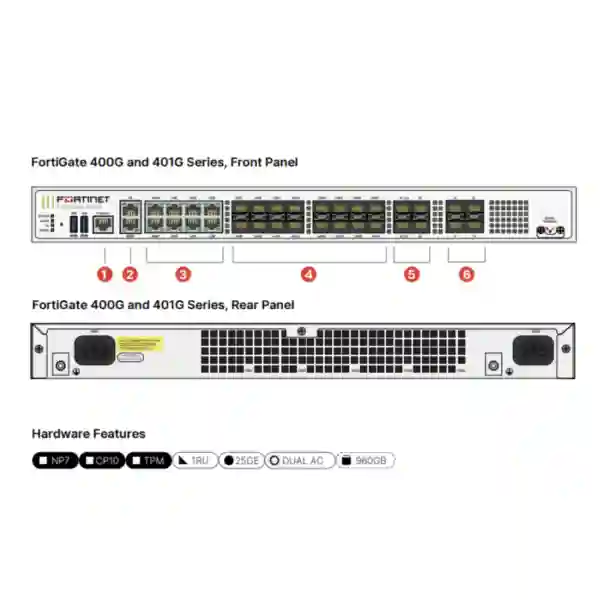
FortiGate 400G Series Tanzania
FortiGate 400G Series brings Fortinet’s current G-series architecture to mid-range enterprise security projects that need substantial firewall capacity, encrypted connectivity, segmentation and advanced threat inspection without separating networking and security into multiple operational silos. Fortinet positions the 400G for modern enterprise edges and publishes 164 Gbps firewall throughput, 55 Gbps IPsec VPN throughput, 13 Gbps threat protection and 28 million concurrent sessions. For Tanzania organizations, the practical value is not simply a headline throughput number: the platform can become the policy and connectivity point for internet access, branch VPN, secure SD-WAN, internal segmentation, application control and Security Fabric integration.
What the FortiGate 400G Series is designed to solve
Enterprise security teams increasingly inspect traffic that is encrypted, distributed between cloud and on-premises applications, and moving between many internal network segments. A firewall refresh therefore has to account for more than internet bandwidth. Inspection services, VPN tunnels, application control, branch traffic, east-west flows, high availability, logging and future growth all influence the correct design. FortiGate 400G is intended for organizations that need a substantial step above branch-class appliances while retaining FortiOS operations and Fortinet Security Fabric integration.
Fortinet documents dedicated security acceleration in the 400G/401G architecture, including NP7 and CP10 processing. The front-panel design supports a mixture of copper and fiber connectivity, allowing engineers to connect WAN, LAN, aggregation and high-speed network zones without forcing every deployment into one interface type. Exact optics, transceivers, subscriptions, storage variant and support terms should be confirmed against the final bill of materials before purchase.
For procurement teams, sizing should start with the real inspected workload. Record primary and secondary ISP speeds, expected growth, peak concurrent users, server zones, VPN requirements, public applications, segmentation boundaries, SSL inspection expectations, FortiGuard services, logging destination and high-availability requirement. That information produces a more meaningful quotation than selecting a firewall only from raw stateful throughput.
FortiGate 400G Series features and business value
Next-generation firewall
Use policy enforcement, application visibility, intrusion prevention and malware-focused security services as part of a unified FortiOS policy framework. Security performance depends on the services enabled and traffic profile, so project sizing should use the relevant inspected-throughput figures rather than the largest firewall number.
Secure SD-WAN and multi-WAN
FortiOS can combine security and WAN path control, useful for organizations with two or more internet circuits, branch connectivity and cloud application dependencies. Policy, health checks and failover behavior should be designed around actual carrier links and business applications.
High-speed enterprise connectivity
The 400G family provides high-speed interface options for enterprise edge and aggregation designs. This can reduce avoidable bottlenecks when connecting core switching, server networks, WAN services and segmented security zones, provided the correct optics and cabling are selected.
VPN and hybrid access
IPsec VPN capacity supports site-to-site connectivity and secure network extension between offices, data centers and cloud-connected environments. Authentication, routing, encryption settings and resilience should be documented as part of deployment rather than added after the firewall goes live.
FortiGate 400G technical planning snapshot
| Area | Published / documented point | Buying implication |
|---|---|---|
| Firewall throughput | Up to 164 Gbps | Do not use this figure alone for inspected-traffic sizing. |
| IPsec VPN | Up to 55 Gbps | Relevant for branch, data-center and hybrid interconnect planning. |
| Threat protection | Up to 13 Gbps | Use security-service workload when assessing practical headroom. |
| Concurrent sessions | Up to 28 million | Useful for dense enterprise traffic and large connection counts. |
| Architecture | FortiOS with dedicated Fortinet security processing | Supports consistent Fortinet operations across security and networking. |

Integration, licensing and deployment considerations
A FortiGate 400G project should define the FortiGuard security services and FortiCare support level required for the intended operating model. Hardware and subscriptions should be quoted together when the project requires active security services. Renewal dates, support ownership and configuration backup responsibilities should be documented so the firewall remains manageable after initial installation.
Integration planning should cover routing, VLANs, switching, wireless networks, server zones, identity sources, DNS, DHCP, VPN, logging and monitoring. Organizations using multiple FortiGate appliances may also evaluate centralized management and analytics. FortiManager can support centralized policy and configuration operations, while FortiAnalyzer can support logging, reporting and investigation workflows. These products are separate considerations and should be sized to the environment rather than assumed to be included with the appliance.
High availability is another design decision. Where firewall downtime would materially affect operations, procurement should consider an HA pair, redundant power design, resilient switching paths and diverse ISP circuits. The second firewall does not remove the need to test failover. Interfaces, routing, session behavior, upstream dependencies and maintenance procedures should all be verified during commissioning.
Related Fourteck Tanzania infrastructure
A firewall performs best when the surrounding network is designed coherently. Review the Fourteck Tanzania technology portfolio for integrated project context, use the Fourteck Tanzania shop when browsing available technology categories, and discuss the firewall requirement through the Fourteck Tanzania contact page. The Tanzania portfolio also covers firewall and VPN design, network switching and LAN infrastructure, Wi-Fi access, servers and storage, structured cabling, racks and UPS planning, and integrated IT lifecycle services. These areas matter because a 400G-class firewall can expose bottlenecks in old switching, undersized uplinks, weak power protection or poorly segmented networks.
For multi-country projects, Fourteck’s regional network can support consistent procurement discussions. Buyers can reference FortiGate firewall solutions in Kenya, Fortinet firewall planning in Uganda, Fortinet solutions in the UAE, Fourteck Kuwait, and Fourteck Africa when a security standard spans several markets.
FortiGate 400G Series Tanzania
Tanzania organizations evaluating FortiGate 400G are usually dealing with an enterprise edge rather than a small-office firewall requirement. A headquarters may have multiple ISP circuits, large numbers of cloud sessions, server VLANs, guest networks, IP telephony, surveillance traffic, remote users and branch VPNs crossing the same security boundary. The useful procurement question is therefore how much inspected traffic the network will generate when the required security services are active. Fourteck can structure a Tanzania quotation around internet bandwidth, expected growth, VPN load, internal segmentation, FortiGuard services, high availability and interface requirements instead of treating the appliance as a standalone box.
For a Tanzanian enterprise with branches, FortiGate 400G can form part of a repeatable FortiOS design where routing, SD-WAN rules, IPsec connectivity and security policy follow documented standards. This is valuable when branch links differ in speed or carrier type. The head-office firewall can terminate site-to-site connectivity while applying access controls between users, applications and server zones. Where remote access is required, identity, authentication and endpoint policy should be considered alongside VPN configuration. If public services are hosted behind the firewall, published applications need carefully restricted rules, logging and protection profiles.
Power, rack and cooling conditions also matter in Tanzania deployments. Enterprise security equipment should be installed in an organized rack with suitable ventilation and UPS planning, and dual power inputs should be connected according to the resilience design. Fiber and copper uplinks should match the switching environment and available transceivers. Before ordering, provide the current firewall model, ISP speeds, expected bandwidth growth, core switch uplinks, number of security zones, VPN tunnels, Fortinet management products already in use and preferred subscription term. That information helps turn a FortiGate 400G Tanzania price request into a complete and technically useful bill of materials.
FortiGate 400G Series Dar es Salaam
Dar es Salaam buyers may be securing headquarters, financial operations, logistics facilities, hospitality environments, healthcare sites, education campuses or multi-floor commercial offices. These environments often combine internet access with cloud applications, site-to-site connections and internal systems that cannot all share one unrestricted network. A FortiGate 400G design can place clear policy boundaries between corporate users, servers, guest access, CCTV, voice, building systems and administrative networks while still allowing approved services to communicate. The appliance class is most appropriate when traffic and inspection requirements justify substantial enterprise capacity.
For offices using two internet providers, secure SD-WAN planning can make the firewall part of the connectivity strategy as well as the security strategy. Link health checks, preferred application paths and failover behavior should be tested against real business services rather than configured only as a generic primary-and-backup rule. Microsoft 365, ERP, voice, video meetings and VPN traffic can have different priorities. A Dar es Salaam headquarters may also need resilient links to branches in Arusha, Mwanza or Dodoma, making routing design and tunnel monitoring important parts of the project.
A strong quotation request should include rack location, existing core switches, WAN handoff types, required fiber speeds, public IP services, server subnets, user count, concurrent VPN expectations and whether high availability is mandatory. Organizations migrating from an older FortiGate should also export and review the existing policy set instead of blindly reproducing years of accumulated rules. Obsolete objects, unused policies and broad access rules can be cleaned up during migration. Fourteck Tanzania’s verified contact page lists Dar es Salaam contact information and can be used to begin a FortiGate 400G discussion focused on sizing, subscriptions, migration and deployment scope.
FortiGate 400G Series Mwanza
Mwanza organizations considering FortiGate 400G may include larger commercial operations, distribution businesses, institutions and regional hubs that need dependable security between a main site, remote users and other branches. The firewall should be sized from application behavior and enabled inspection, not merely the number of employees. A smaller user population can still create demanding traffic when the site hosts servers, transfers large files, terminates many VPN tunnels, operates surveillance systems or provides connectivity to downstream locations. Conversely, a large office with modest traffic may not need the same security capacity.
Network segmentation is particularly useful when one site supports several operational functions. Finance systems, administrative users, guest wireless, CCTV, voice, servers and contractor devices can be placed into separate VLANs and firewall zones. The policy design then permits only the traffic required for each workflow. This reduces unnecessary lateral access and makes logs easier to interpret. If the site connects to a central data center or Dar es Salaam headquarters, IPsec tunnels can carry approved inter-site traffic while SD-WAN logic can choose between available WAN paths.
Procurement should also consider the surrounding infrastructure. High-speed FortiGate interfaces provide little benefit if core switching or cabling becomes the bottleneck. Confirm whether the network uses copper, SFP+, SFP28 or higher-speed uplinks and include appropriate optics in the bill of materials. Document UPS runtime expectations, rack space and environmental conditions. For a Mwanza quotation, share existing topology, ISP speeds, expected three-year growth, security services, VPN count, switch uplinks and management requirements. This creates a defensible sizing process and helps distinguish whether FortiGate 400G is the right tier or whether another FortiGate model should be evaluated.
FortiGate 400G Series Arusha
Arusha businesses and institutions may need to secure combinations of corporate offices, hospitality operations, education environments, travel-related businesses and regional branches. A FortiGate 400G deployment can consolidate perimeter firewalling, VPN, application visibility, segmentation and SD-WAN into the FortiOS operating model, but the final configuration should reflect the site’s actual risk and traffic profile. Guest networks, for example, should not inherit access to business systems merely because both use the same internet connection. Likewise, server and management networks should have tighter policy than general employee browsing.
Where an Arusha site relies heavily on cloud applications or communications with other offices, WAN resilience deserves careful attention. Two circuits are most useful when they have appropriately diverse failure characteristics and when the firewall has clear rules for link health and application steering. A backup link that shares the same upstream dependency may not deliver the expected resilience. During commissioning, engineers should test link loss, tunnel recovery, DNS behavior and critical application access. The goal is predictable business continuity rather than simply showing two WAN interfaces as active.
For migration projects, inventory existing NAT rules, VPNs, address objects, authentication methods, certificates and logging destinations before the change window. Confirm whether FortiManager or FortiAnalyzer will be used and how configuration backups will be retained. A FortiGate 400G Arusha request should state whether the project is a new installation, capacity upgrade, end-of-life replacement or standardization exercise. Include desired FortiCare and FortiGuard term, HA requirement, optics, rack and power details. Fourteck’s Tanzania contact information includes Arusha, allowing the procurement conversation to begin with concrete design inputs rather than a generic firewall price request.
FortiGate 400G Series Dodoma
Dodoma projects can involve administrative offices, institutions, education, healthcare, professional services and organizations connecting multiple sites. In these environments, a FortiGate 400G can act as a central enforcement point for internet security and inter-site connectivity when the workload justifies its enterprise performance class. The design should define which networks are trusted, which applications need inbound exposure, how remote users authenticate, what traffic must be logged and how branch connectivity behaves during an ISP interruption.
Segmentation can be organized around operational roles rather than physical switch locations. User departments, servers, guest Wi-Fi, cameras, voice systems and management interfaces can each receive policy appropriate to their function. This makes firewall rules easier to audit and reduces the chance that a compromised low-trust device can freely reach sensitive systems. FortiGate’s place in the Security Fabric can also be considered when the wider environment uses Fortinet switching, wireless, management or endpoint technologies. Integration choices should be validated against the exact products and software versions in the project.
Dodoma procurement teams should request a quotation that separates appliance hardware, FortiGuard security subscriptions, FortiCare support, optics and implementation services where required. If high availability is planned, include both appliances and the network dependencies needed to avoid creating a single point of failure elsewhere. Firmware compatibility should be checked before migration, particularly for newly introduced hardware. Provide current topology, internet circuits, user and device counts, VPN requirements, public services and preferred maintenance window. Fourteck Tanzania’s verified contact page includes Dodoma contact details and provides a direct route for a project-specific FortiGate 400G enquiry.
FortiGate 400G Series UAE
UAE organizations considering FortiGate 400G commonly operate high-bandwidth offices, regional headquarters, data-center-connected environments or distributed branches where security inspection must keep pace with substantial traffic. The platform’s published firewall, VPN and threat-protection figures make it relevant for mid-range enterprise edge projects, but final sizing should still be based on enabled services and expected peak load. A business using deep inspection, application control, IPS and extensive VPN may need more headroom than one using the appliance mainly for stateful firewalling and routing.
Multi-site UAE environments can use FortiOS secure SD-WAN and IPsec connectivity to standardize branch access to shared applications. When the same organization also operates in Tanzania, Kenya or Uganda, a common security architecture can simplify policy naming, address plans, VPN templates and operational procedures. Standardization should not mean copying identical rules to every location; each site still needs local subnets, carrier details and business-specific access. Central management can be considered when the firewall estate grows large enough to make device-by-device changes inefficient.
Before purchasing, UAE teams should confirm the exact hardware variant, FortiGuard bundle, FortiCare term, optics, rack power design and firmware support. Migration planning should include a rollback procedure and validation checklist for routing, NAT, VPN, public services and logging. Fourteck’s Fortinet-focused UAE web presence can support regional product discussions, while Tanzania requirements can remain coordinated through the Tanzania site. This approach is useful for procurement teams responsible for consistent cybersecurity standards across several offices but needing separate quotations and implementation plans for each country.
FortiGate 400G Series Uganda
Uganda enterprises evaluating FortiGate 400G may be planning a headquarters firewall refresh, central VPN hub, high-capacity internet edge or security platform for a multi-branch network. The key sizing inputs are inspected internet traffic, branch tunnel volume, concurrent sessions, public applications, internal segmentation and expected growth. Fortinet’s published 13 Gbps threat-protection figure is particularly relevant when comparing the platform for workloads that enable multiple security controls, while the larger raw firewall figure describes a different test profile.
A Uganda deployment can use policy zones to separate corporate users, servers, guest wireless, CCTV, voice and management traffic. Branches can connect over IPsec and use SD-WAN policies appropriate to their available carriers. For organizations with locations across Kampala, Mbarara, Gulu and Arua, standard templates can improve operational consistency while preserving site-specific addressing and link behavior. Central logging and configuration management can also reduce the burden on teams responsible for several firewalls.
Procurement should avoid assuming that the appliance price represents the complete project. FortiGuard services, FortiCare support, optics, HA hardware, rack power, implementation and migration may all affect the final bill. Document the existing FortiGate or competing firewall, ISP speeds, VPN tunnels, security zones, public IP services and renewal expectations before requesting a quote. Fourteck Uganda publishes Fortinet firewall content for local buyers, and multi-country customers can coordinate the Uganda requirement with a Tanzania FortiGate 400G project while maintaining separate site designs and validated bills of materials.
FortiGate 400G Series Kampala
Kampala is a likely location for enterprise headquarters and larger network edges where FortiGate 400G may be evaluated against existing mid-range firewalls. A proper assessment should capture peak bandwidth rather than contracted bandwidth alone, because cloud backups, video meetings, software updates and large data transfers can create bursts that coincide with normal business traffic. Security inspection adds processing requirements, and SSL inspection policies can change practical capacity depending on the traffic mix and configuration.
For a headquarters, high availability may be as important as throughput. Two firewalls can protect against appliance failure, but resilience also depends on upstream switches, ISP handoffs, power, routing and physical paths. A Kampala design should identify each dependency and decide whether it needs redundancy. Failover testing should be part of acceptance. If branches rely on the headquarters for applications or internet breakout, maintenance procedures must account for the wider impact of an outage.
A migration can also be used to improve security policy quality. Instead of importing every legacy rule unchanged, classify rules by owner and business purpose, remove obsolete objects, narrow broad services and document exceptions. Confirm VPN peers, certificates and authentication integrations well before the cutover. For procurement, request the exact FortiGate 400G or storage variant required, security bundle term, support level and optics. This produces a clearer comparison between proposals and helps prevent missing components from appearing later as unplanned costs.
FortiGate 400G Series Arua
Arua organizations with regional operations, institutional networks or branch aggregation requirements may consider FortiGate 400G when a site carries more traffic and security responsibility than a conventional branch firewall. The first step is to establish whether the site is a local edge, a hub for other locations, or both. A hub requires capacity not only for local users but also for tunneled traffic, shared services and potentially centralized internet access. This changes VPN, session and inspection requirements.
Where WAN options differ in performance or reliability, SD-WAN policy can prioritize critical business applications while retaining an alternate path. The design should be based on measurable link health and application needs. Voice, transactional systems and remote desktop may need different handling from software downloads or general browsing. If the site connects to Kampala or another central office, routing should avoid accidental asymmetry and the tunnel design should define how traffic behaves during partial failures.
A FortiGate 400G Arua quotation should include interface requirements and optics because the correct physical connectivity cannot be assumed from the firewall model alone. Also define FortiGuard services, support term, logging, backup and remote-management expectations. If the local site has limited rack or power infrastructure, confirm those constraints before equipment is shipped. A documented deployment package with interface map, VLANs, IP plan, VPN peers and acceptance tests is more valuable than an appliance-only purchase because it gives future support teams a clear operational baseline.
FortiGate 400G Series Mbarara
Mbarara businesses may need a firewall for a growing regional office, institution, healthcare environment, distribution operation or branch hub. FortiGate 400G should be considered when the required inspected throughput, session scale, VPN load and interface density place the project in an enterprise class. Buying a firewall that is far larger than the workload is not automatically better; the objective is enough capacity for security services and realistic growth without creating unnecessary cost or operational complexity.
For sites with several internal systems, segmentation can reduce risk and make troubleshooting clearer. User networks, server VLANs, guest access, CCTV, VoIP and device-management traffic can be separated and joined only through explicit policy. Logs then show which zone initiated traffic and which service was allowed. If an application requires broad access, that exception can be documented rather than becoming the default for the whole network.
When connecting Mbarara to other Ugandan locations, IPsec design should account for addressing, route preference, failover and monitoring. Avoid overlapping subnets across branches because they complicate tunnel routing and future expansion. Procurement inputs should include branch count, ISP speeds, user and device estimates, server workloads, FortiGuard services and the required support term. For existing Fortinet environments, include current FortiOS versions and management tools so compatibility can be checked before the migration plan is finalized.
FortiGate 400G Series Gulu
Gulu deployments can benefit from the same disciplined enterprise firewall sizing used in larger capitals. Location does not change the need to measure bandwidth, inspection services, VPN use, segmentation and growth. If a Gulu site acts as a regional hub, its firewall may carry traffic for satellite offices or remote users in addition to local employees. That role should be reflected in the capacity plan and resilience design.
Dual-WAN connectivity can improve continuity when independent circuits are available, but failover should be tested from the user’s perspective. A link may remain technically up while upstream internet quality is poor, so health checks should target meaningful destinations and use thresholds appropriate to the application. SD-WAN rules can then steer traffic based on policy rather than simple interface status. Critical VPN tunnels should also be monitored so a carrier change does not leave branches disconnected.
The internal LAN should be reviewed during a firewall upgrade. If the FortiGate connects to old access switches through a constrained uplink, users may not see the benefit of a high-performance security appliance. Confirm core switching, VLAN trunks, fiber types and rack layout. Include UPS and grounding considerations in site preparation. For a Gulu quotation, specify whether the requirement includes installation, migration, policy cleanup, VPN setup, HA, FortiGuard licensing or only hardware supply. Clear scope makes technical and commercial proposals easier to compare.
FortiGate 400G Series Kenya
Kenya organizations can evaluate FortiGate 400G for enterprise headquarters, campus edges, high-capacity branch aggregation and hybrid environments where security services must operate across substantial traffic. A Nairobi headquarters with cloud workloads, regional VPNs and segmented internal networks may require a different configuration from a manufacturing site or hospitality group even when both choose the same appliance. The FortiOS policy model allows the platform to be adapted, but sizing and licensing must still be matched to the intended use.
For cross-border businesses with Tanzania operations, a consistent Fortinet architecture can simplify support. Naming standards, VPN templates, logging conventions and security baselines can be shared while each country retains its own addressing, carrier and business requirements. Central management can help when the firewall estate is large, but change control and local validation remain important. A policy that works at one site may disrupt another if applications or routing differ.
Fourteck Kenya publishes a FortiGate firewall guide and Fortinet product category content that can support local product exploration. A FortiGate 400G Kenya quotation should still confirm the exact appliance variant, subscription package, FortiCare term, optics, HA requirement and implementation scope. Buyers should provide current firewall model, internet bandwidth, growth plans, VPN tunnels, internal zones and public services. That same information can be reused when comparing a Tanzania deployment, making regional procurement more consistent without turning the projects into identical copies.
FortiGate 400G Series Kuwait
Kuwait enterprises looking at FortiGate 400G may need a mid-range NGFW for a headquarters, data-center-connected office, high-bandwidth branch hub or secure SD-WAN environment. The platform’s published throughput gives substantial capacity, but security design should begin with enabled services, encrypted traffic and growth. If the business plans to increase internet capacity or move more applications to cloud services during the firewall lifecycle, that future load should be included in the sizing exercise.
High availability and redundant WAN are common considerations for critical sites. The firewall pair, core switching, ISP paths and power design should be assessed as one resilience chain. If any single upstream switch or carrier handoff remains a single point of failure, adding a second firewall alone cannot provide full continuity. Maintenance and firmware upgrades should also have a documented process, including backups, compatibility checks and rollback planning.
Kuwait buyers should ask for a bill of materials that identifies appliance hardware, subscriptions, support, optics and services separately. This makes renewals and future changes easier to understand. If the organization also operates in Tanzania, use the same technical discovery template for both sites: bandwidth, users, zones, VPN, applications, inspection, logging, HA and management. Fourteck Kuwait and Fourteck Tanzania can then be referenced for their respective regional requirements while maintaining a consistent enterprise security standard.
FortiGate 400G Series Ghana
Ghana enterprises may consider FortiGate 400G when a central site needs higher inspected throughput, many sessions, substantial VPN capacity or faster network interfaces than smaller branch appliances provide. Financial services, education, healthcare, logistics, professional services and distributed businesses can all have different traffic profiles, so the product tier should be justified by measurements and growth plans rather than industry name alone.
A central firewall can enforce segmentation between departments and technology zones while supporting site-to-site connectivity. For multi-branch organizations, document subnet allocation early to avoid overlapping networks that complicate VPN routing. Decide which applications should use local internet breakout and which should traverse a central security point. Secure SD-WAN can support path selection, but policy should reflect the actual application and carrier environment.
Procurement should include licensing and lifecycle planning from the start. FortiGuard services and FortiCare terms affect the operational capability and support model, while optics and high-availability hardware affect the physical design. Logging and reporting requirements may introduce FortiAnalyzer or other infrastructure. A Ghana buyer with operations in Tanzania can standardize the discovery and documentation process across both countries. This creates comparable bills of materials and makes later support easier without making unsupported assumptions about local stock, delivery or service coverage.
FortiGate 400G Series Nigeria
Nigeria’s large enterprise networks can generate significant traffic from cloud applications, branch connectivity, customer-facing systems and remote users. FortiGate 400G can be evaluated for mid-range enterprise edges where security inspection and connectivity need to scale together. The published 28 million concurrent-session capacity and high firewall and VPN throughput are useful reference points, but the design should focus on the traffic mix that will actually pass through security services.
For distributed organizations, the firewall can participate in an SD-WAN architecture connecting headquarters and branches over multiple carrier links. The operational benefit comes from clear policy and monitoring, not simply enabling SD-WAN. Define which applications are critical, acceptable latency and loss thresholds, preferred links and failover conditions. IPsec tunnels, dynamic routing and security rules should be documented so support teams understand how traffic is expected to move during normal and degraded conditions.
A Nigeria procurement package should state interface speeds, required transceivers, FortiGuard subscription, FortiCare term, HA design and management approach. For a migration, include the current policy count, VPN peers, NAT rules, certificates and authentication integrations. Multi-country organizations can use the same governance framework for Nigeria and Tanzania while adapting topology to each site. Fourteck’s regional network provides a path for separate market discussions without implying that availability, pricing or delivery conditions are identical between countries.
FortiGate 400G Series Seychelles
Seychelles organizations considering FortiGate 400G may include hospitality groups, institutions, larger corporate environments and multi-site operations where internet resilience and secure connectivity are business-critical. Because island connectivity and site topology can differ substantially between projects, firewall sizing should begin with the available circuits, application dependencies, VPN architecture and security services. A high-capacity appliance is useful only when the surrounding network and links can take advantage of it.
Hospitality or mixed-use environments can benefit from strict separation between guest access, staff systems, payment-related networks, CCTV, building systems and administration. Firewall zones and VLANs provide the policy boundaries, while the switching and wireless design must carry those segments consistently. If several properties or offices connect to a central location, IPsec and SD-WAN planning should account for link quality, addressing and failover. Centralized logging can help operations teams review activity across sites.
For procurement, document whether the firewall will be installed as a standalone appliance or HA pair, which FortiGuard services are required, how long support should run and what optics connect the device to the core network. Include rack, UPS and environmental preparation in the project plan. If the same organization has Tanzania or East African operations, a standardized Fortinet policy framework can reduce administrative variation while each location keeps a design suited to its connectivity and workload. Quotations should remain site-specific and should never assume identical stock or delivery conditions.
FortiGate 400G buying and sizing checklist
✓ Peak inspected traffic
✓ Number of users and devices
✓ Concurrent session profile
✓ Site-to-site and remote VPN needs
✓ Public applications and NAT
✓ Required FortiGuard services
✓ FortiCare support term
✓ High-availability requirement
✓ Required optics/transceivers
✓ FortiManager/FortiAnalyzer integration
✓ Rack, UPS and power design
✓ Migration and rollback window
FortiGate 400G Series FAQs
What is FortiGate 400G designed for?
Fortinet positions FortiGate 400G as a modern mid-range enterprise edge next-generation firewall. It is relevant to organizations that need high firewall capacity, threat inspection, VPN, segmentation and secure networking in a FortiOS platform.
What throughput does FortiGate 400G provide?
Fortinet publishes up to 164 Gbps firewall throughput, 55 Gbps IPsec VPN throughput and 13 Gbps threat protection for the 400G. These metrics use different test conditions, so buyers should size around the security services and traffic profile they intend to run.
Does FortiGate 400G support high availability?
FortiGate platforms support HA designs, but a complete resilient solution also needs suitable switching, WAN, power and cabling architecture. Confirm the exact design, firmware and bill of materials for the project.
How should I choose FortiGuard and FortiCare for 400G?
Choose services according to the security controls, support expectations and subscription term required by the organization. The exact bundle and order code should be confirmed during quotation rather than inferred from the appliance name.
Can FortiGate 400G be used for SD-WAN?
Yes. FortiOS integrates secure SD-WAN capabilities. A practical design should define WAN links, health checks, application priorities, routing, failover and security policy together.
What information should I send for a Tanzania quotation?
Provide internet speeds, user/device counts, current firewall, VPN requirements, security zones, expected growth, required subscriptions, high-availability preference, interface/optic needs and whether migration or configuration services are required.
Decision recap
FortiGate 400G Series is a strong candidate for organizations that need a current Fortinet enterprise-edge platform with substantial firewall and VPN capacity, 13 Gbps published threat-protection performance, large session scale and flexible high-speed connectivity. The correct purchase depends on the workload, enabled security services, interfaces, subscriptions, HA design and growth plan. A useful comparison therefore looks at the complete architecture rather than only the appliance price.
Consultation panel
Send Fourteck Tanzania your current topology, ISP bandwidth, branch count, VPN requirements, existing firewall model, security-service expectations and preferred support term. The enquiry can then focus on whether FortiGate 400G is appropriately sized, which license bundle and optics are needed, and what migration or deployment tasks should be included in the quotation.


Reviews
There are no reviews yet.